
Specs are compiled from manufacturer listings and verified buyer reviews and can change over time — please confirm the key details on the product page before buying.
You want to stop a swarm without climbing a ladder or getting within stinging range. That is why reach, knockdown speed, and a formula that keeps working after the first blast matter most. The picks below cover ground nests, high eaves, and everything between.
I’m Rikta — the founder and writer behind Lawn Gear Lab. This guide is built by comparing the manufacturers’ published specifications and the patterns across verified customer reviews, so you get each pick’s real strengths and trade-offs instead of marketing spin.
From foaming jets that trap wasps to plant-based formulas safe around pets, here are the bee sprays that earn a spot in your shed this season.
Our Picks at a Glance


How To Choose The Best Bee Sprays
Match the formula to the nest’s location and your comfort with chemicals. A foaming aerosol works well on wasps under eaves, while a dust is best for yellow jackets burrowed in the ground. Also weigh reach, residue, and how the product affects pets and plants.
Match the formula to the nest location
Foaming sprays expand on contact, so they blanket an entire nest and trap insects as they exit — ideal for crevices, soffits, and voids where you cannot see the full colony. Dusts, by contrast, are puffed into ground holes and cracks, coating the tunnel walls so returning insects carry the poison deeper inside. If your problem is a hole in the yard, a dust reaches where a liquid stream cannot.
Read the spray distance before you buy
Distance is your safety buffer. A jet that reaches 20 to 27 feet lets you treat a high eave nest while keeping both feet on the ground, well outside the wasps’ attack radius. Shorter-range sprays force you closer, which raises your risk of getting stung. Check the stated reach and confirm the stream stays accurate at that range, since wind can push a fine mist off target.
Consider what happens after you spray
Some formulas are water-based and non-staining, so they will not mar siding or asphalt shingles, while solvent-based options are safe around electrical equipment but may leave an oily film. If you have pets or kids, look for plant-based active ingredients. If you are treating near outlets or utility boxes, a non-conductive spray rated for high voltage is the safer call.
Quick Comparison
| Model | Best For | Form | Spray Reach | Volume | Amazon |
|---|---|---|---|---|---|
| Bonide 363 (2 Pack)★ Best Overall | Ground bees & yellow jackets | Dust | — | 10 oz each | Amazon |
| Black Flag Foaming (2 Pack)Best Value | Eaves & crevice nests | Foam Aerosol | 20 ft | 14 oz each | Amazon |
| Bengal FoamingLongest Reach | High nests & non-staining jobs | Foam Aerosol | 25 ft | 18 oz | Amazon |
| Bonide 363 (Single) | Budget ground-nest treatment | Dust | — | 10 oz | Amazon |
| Bengal Non-Conductive | Nests near electrical equipment | Aerosol | 20 ft | 15 oz | Amazon |
| Spectracide Foaming (3 Pack) | Multiple nests in one season | Foam Aerosol | 27 ft | 14 oz each | Amazon |
| STEM Botanical | Homes with pets & kids | Aerosol | 5–15 ft | 10 oz | Amazon |
| Spectracide WASP&HRNT (2 Pack) | Wasps & hornets on structures | Foam Aerosol | — | 20 oz each | Amazon |
| CRC Wasp & Hornet Killer Plus | Utility & industrial sites | Aerosol | 20 ft | 14 oz | Amazon |
In‑Depth Reviews
1. Bonide 363 Spider and Ground Bee Killer, 2 Pack of 10 oz
Our pick — over 4.5★ from 900+ verified ratings; the strongest balance of quality and price.
The puffer-style dust that wins the war against underground yellow jacket colonies
When yellow jackets burrow into the ground, a liquid spray just wets the surface — this 10 oz dust gets puffed straight down the tunnel opening, coating the walls so every returning insect picks up the poison. The active ingredient is Permethrin at.25%, a dust that kills and repels spiders and ground bees on contact. Buyers report putting down part of a bottle and finding the nest empty within a day, which is why it holds the crowd favorite spot at 4.6 stars from 900+ ratings.
The snorkel tube applicator lets you reach into a 1-inch gap between your stoop and siding, or deep into a hole in the yard, without getting your hands near the action. It is labeled for both indoor and outdoor use, so cracks in a basement wall get the same treatment as a nest by the porch. The dust stays where you put it instead of running off like a liquid.
One reviewer wrote: “Put this product down, only part of the bottle, and within a day they were gone.” The trade-off is that it is dusty — one owner wanted a spray-type liquid instead and found the powder messier than an aerosol. For ground nests and wall voids, this is the difference between a temporary fix and a colony that does not come back.
Why owners swear by it
- Effectiveness earns the most praise by far — 148 owners single it out
- Snorkel tube reaches deep crevices and ground holes safely
- Each 1.5 lb pack carries two 10 oz cans for extended coverage
Who should pass
- Dust formula is messier than a clean liquid spray
- Not built for high-eave nests you cannot reach by hand
Reach for this if: your problem is ground bees, yellow jackets, or nests tucked into tight wall gaps that a spray simply cannot penetrate.
Look elsewhere if: you need to hit a nest 20 feet up under a roofline — that is a job for a long-range aerosol, not a puffer dust.
2. Black Flag Foaming Wasp and Hornet Killer, 2 Pack
The foaming twin pack that blankets an eave nest while you stay 20 feet clear
Foam expands on contact and keeps killing wasps as they crawl out of the nest, making it effective on the undersides of eaves and in crevices where a liquid stream would drip away. The jet reaches up to 20 feet, so you can stand a safe distance from the nest at sunset when insects are least active. Each 14 oz can is labeled for wasps, hornets, mud daubers, and yellow jackets.
The real appeal is the twin pack at an entry-level price, which matters because foam sprays get consumed fast on a big nest. Owners mention that the way it foams up keeps catching wasps as they emerge, especially in the tucked-away spots. It is a 4.6-star product built around one simple idea — the foam sticks, so the killing keeps happening after you walk away.
The honest caveat is that this foam is messy, and owners advise keeping it away from decorative doorways and house entrances where the residue is hard to clean — save it for the yard and the roofline. One owner also warns the can goes quickly, so it is smart to keep a spare on hand in case a second, hidden nest turns up nearby.
What wins people over: the foaming action is the thing everyone raves about — it traps and kills insects that a plain spray misses, and the 20-foot reach keeps you out of harm’s way.
Best for: first-time buyers who want an affordable, effective foam for eave and crevice nests without overthinking the choice.
Note: the foam leaves a visible residue, so it is not the pick for spraying right beside your front door.
3. Bengal Foaming Wasp and Hornet Killer, 18 oz
The 25-foot foam jet that endangers wasps, not you, from a very safe distance
At 25 feet, this Bengal spray outranges the Black Flag above by a full 5 feet, and it holds 18 fluid ounces versus the Black Flag’s 14 — a 29% bigger can for the job. The water-based foam is non-staining on most siding and asphalt shingles, so you can treat nests on the house without worrying about ugly marks. The foam’s delayed action lets it thicken and encapsulate the nest, killing wasps, hornets, and yellow jackets on contact.
Customers note the foam kills wasps within a minute, and one homeowner who spent four years battling nests in his soffits said this was the first product that actually worked. It is also safe on ornamental plants and shrubs because of the water-based formula, though you should never aim it near electrical sockets. The 4.5-star rating across 200+ owners reflects a product that rewards patience — the foam needs a moment to expand and do its work.
There is a legitimate grip about aiming: from a safe distance, the stream is hard to line up precisely, and one owner used most of a can on a single application. The spray performance draws mixed feedback, with some cans atomizing poorly. If you have a tall, awkward nest, budget for the fact that you may burn through the can faster than you expect.
The standout spec: the 25-foot reach combined with a non-staining water-based foam makes it the most versatile long-range option for treating nests on the house itself.
Choose this for: high soffit nests where you want maximum distance and zero staining on your siding.
Think twice if: you need surgical precision — the stream can be tough to aim at long range, and the can empties fast on a big nest.
4. Bonide 363 Spider And Ground Bee Killer, 10 oz

The single-can dust that clears ground nests on a budget, no sprayer required
This is the same effective dust as the top pick but in a single 10 oz can, which makes it the budget-friendly entry point if you only have one nest to handle. The puffer applicator is refreshingly simple — you open the cap, aim, and rapidly squeeze the sides of the container to puff the dust into cracks, ground holes, and wall voids. No mixing, no sprayer, no mess to clean up afterward.
Reviewers point out it eliminates ground bees within two days, and one who battled nests for two summers found the puff-and-cover method finally ended the problem. It kills a wide list of species — ants, spiders, roaches, crickets, mites, wasps, bees, hornets, and more — and is EPA-listed. It works indoors in dark corners and behind baseboards as easily as it works outside on porches and patios.
The one trade-off versus the twin pack is simple: you get one can instead of two, and the dust is inherently a little messy compared to a spray. Buyers also note it is not tested much on spiders despite the name. But for the price, it treats ground nests effectively without needing any extra equipment.
The smart-buyer read: effectiveness is what owners praise most, with 175 singling it out, and the puffer top gets credit for being easy to use.
Grab this if: you have a single ground nest and want the cheapest reliable dust without committing to a two-pack.
skip it if: you have multiple nests across a large yard — the twin pack above gives you double the coverage for barely more.
5. Bengal Non-Conductive Wasp and Hornet Killer, 15 oz

The solvent-based spray rated for electrical gear, so you can treat nests near outlets safely
Most bee sprays are a bad idea anywhere near electricity — this one is non-conductive up to 38,800 volts, which makes it the right tool for nests built around outdoor outlets, utility boxes, or eaves with wiring. The solvent-based formula kills on contact, paralyzing wasps, bees, hornets, and yellow jackets instantly so they drop before they can sting. It reaches 20 feet with a wide shotgun blast, giving you a bigger margin for error when you are nervous about aiming.
Owners have used it to clear Japanese spotted lantern flies from a maple tree trunk and to wipe out a large mass of yellow jackets near a garbage can in a single hit. The 4.6-star score reflects genuine enthusiasm from a smaller but very satisfied owner base.
The catch is that a solvent-based spray is not the gentlest option on surfaces, and the wide blast means the can gets consumed quickly on a large nest. It is also not water-based, so you should not rely on it near plants the way you can with the foaming version.
The defining spec: the 38,800-volt non-conductive rating is what sets this apart from every other spray on this list, plus a 20-foot range that keeps you clear of the swarm.
Reach for this if: your nest is anywhere near electrical sockets, utility lines, or outdoor wiring where a standard spray would be a hazard.
Pass it up if: you are treating siding or plants — the solvent formula is not the non-staining, plant-safe option the foaming Bengal is.
6. Spectracide Foaming Wasp & Hornet Killer, 3 Pack
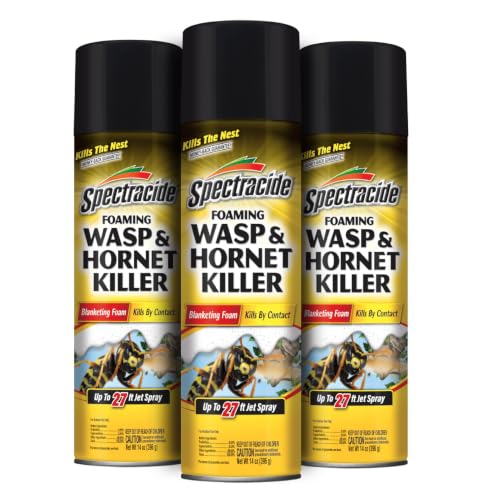
The 27-foot foamer that wins at range — three cans for a season of nests
This Spectracide stretches further than every other spray here, jetting foam up to 27 feet so you can treat the highest eave or roofline nest while staying planted on the ground. The blanketing foam formula kills wasps, hornets, yellowjackets, and mud daubers by contact, expanding to cover the whole nest. It is water-based, so it leaves no oily residue and will not stain the surfaces you spray.
The 3-pack is the real story for value — three 14 oz cans give you enough coverage for multiple nests across a season, which is rare in this category. Shoppers say the foam completely covers a nest and kills right away, with the spray distance earning consistent praise. Ground yellow jackets went down after two applications, and a roof hive was handled easily without anyone getting stung. The 4.6-star rating across nearly 500 owners speaks to dependable, repeatable performance.
The honest trade-off is that this foam is thirsty — the spray releases a heavy burst per trigger pull, and one owner found a single can covered only two to three small nests before emptying. Foam messiness gets mixed reactions too. If you treat nests regularly, the 3-pack softens the sting of that fast consumption.
Why it earns its spot: quality and spray distance are the top praise points after effectiveness, and the three-can pack means you will not run dry mid-season.
Best for: homeowners with multiple nests or a recurring wasp problem who want the longest reach and a season’s worth of cans in one order.
Keep in mind: the foam pours out fast, so ration your bursts or you will go through cans quicker than you expect.
7. STEM Kills Wasps, Hornets and Yellow Jackets, 10 oz

The botanical spray that drops hornets yet stays gentle enough for homes with pets
If you have ever hesitated to nuke a nest near where your dog sniffs around, this STEM spray is the answer — its active ingredient is plant-based, drawn from botanical extracts, and labeled safe around people and pets when used as directed. It kills wasps, hornets, and yellow jackets quickly, with owners reporting dying insects within seconds on contact. The fresh scent and lack of added dye or harsh chemical odor make it far more bearable than typical sprays.
It even beat a major brand in a real-world test — owners found Raid did nothing to a bald-faced hornets nest, while this product started killing them instantly. It works at dusk, sprays a long stream, and is entomologist-tested. At 10 fluid ounces, it is the smallest can here, which is the trade-off for the gentler formula.
The recurring gripe is texture — the spray leaves a greasy, oily residue that can stain composite decking and needs wiping off surfaces like camera lenses. The scent, while mild, has triggered mild allergies in some, so a mask is a smart precaution. If you need something safe around a toddler or pets, this is the pick, but be ready for the oily film.
The thing owners love: effectiveness is the top praise at 83 mentions, with pet-friendliness and spray range close behind — the confidence is worth the smaller can.
Reach for this if: you have pets, kids, or a sensitivity to chemical odors and still need a fast knockdown on wasps and hornets.
Be warned: the oily residue stains and lingers, so avoid spraying near decking, siding, or anything you care about keeping clean.
8. Spectracide WASP&HRNT KILL, 2 Pack of 20 oz
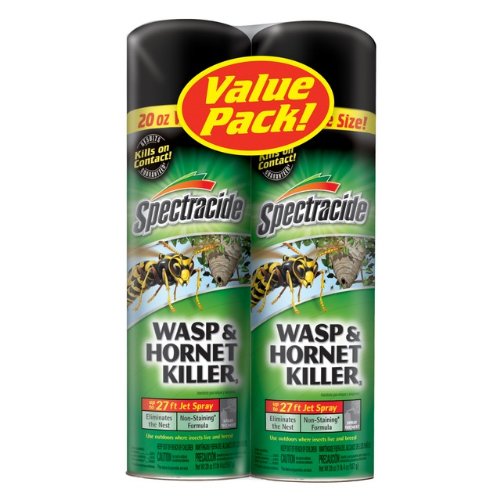
Two hefty 20-ounce foam cans that obliterate wasps hiding inside structures
This twin pack brings the biggest individual cans on the list at 20 ounces each, for 40 fluid ounces total — enough foam to attack a serious infestation without rationing. The foaming formula is built for wasps, hornets, and yellow jackets, and it also handles tent caterpillars, scorpions, and ants as a bonus. The foam expands into dark interiors, which is exactly what you need when wasps have claimed a birdhouse, a wall void, or an attic gap.
Owners have used it to clear wasps out of a birdhouse interior with immediate effect, and the quality earns consistent praise. The label advice matters here: wait at least 24 hours before removing a treated nest, and spray at sunset with the wind at your back to avoid drift. That timing is what makes the foam so effective — the colony is home and gets fully engulfed.
The honest caution is that effectiveness gets mixed feedback, particularly on yellow jackets, which some owners found this spray less effective against than plain wasps and hornets. It is unscented, which is nice, but if your specific enemy is the yellow jacket, you may want a dust for ground nests instead. For structural wasp problems, though, the sheer volume of foam is hard to argue with.
The standout quality: the twin 20-ounce cans deliver far more foam per order than any single can here, ideal for a property with nests in multiple locations.
Pick this for: wasps and hornets nested inside structures like birdhouses, wall voids, and eaves where expanding foam does the heavy lifting.
Look elsewhere if: yellow jackets in the ground are your problem — buyers report this is less decisive on them than on wasps.
9. CRC Wasp and Hornet Killer Plus, 14 oz

The utility-grade spray with a 47,600-volt dielectric rating for the toughest job sites
When wasps build nests around power utilities, telecom equipment, or industrial plants, you need a spray that will not short-circuit anything — this CRC formula carries a high dielectric strength of 47,600 volts. It kills on contact and reaches over 20 feet with a dense, accurate spray, so a worker on the ground can drench a nest high on a tower or bridge without climbing. The extension tube doubles as a locking mechanism under the trigger to prevent accidental sprays.
You can use it on wasps, hornets, black widow spiders, fire ants, and scorpions, and it is plastic-safe, so it will not damage connectors or insulating materials. The ergonomic trigger keeps control even with gloved hands, which is why workers keep coming back to it. One owner has bought nothing else since it cleared a below-ground yellow jacket nest years ago, calling it the best wasp and hornet killer out there.
The reality check is that this is a premium-priced can, and opinions on value split — some say it is well worth it, others call it an expensive waste. Spray distance is also inconsistent for some, with reports of it reaching only about 8 to 10 feet despite the 20-foot claim. One owner had the nozzle pop off mid-spray and needed both hands to hold the can. For homeowners, it is overkill; for anyone working around electrical gear, it is the right insurance.
The defining spec: the 47,600-volt dielectric strength and plastic-safe formula make it the only real choice for nests near electrical infrastructure.
Best for: outdoor workers, electricians, and anyone treating nests around power lines, telecom gear, or industrial sites.
Skip it for: routine home use — the price is steep for a backyard nest, and the range can disappoint if you get a finicky can.
Understanding the Specs
Spray Distance
Measured in feet, this is your safety buffer between you and the nest. A 20-foot reach lets you stand well outside the wasps’ attack radius, while a 27-foot jet like the Spectracide handles the highest eaves from the ground. Shorter-range sprays force you closer, which raises your sting risk, so match the reach to how high or far your nest actually is.
Foam vs. Dust vs. Liquid
Foam expands on contact to blanket a nest and trap insects as they exit — perfect for eaves, crevices, and voids. Dust gets puffed into ground holes and wall cracks, coating tunnels so returning insects carry it deep inside. Liquid sprays offer a straight knockdown but can drip off vertical surfaces and leave a mess on siding or decking.
FAQ
What is the difference between a foaming spray and a non-foaming spray?
Can I use a bee spray near electrical outlets or wiring?
How do I treat a ground nest of yellow jackets?
How long should I wait before removing a treated nest?
Is there a bee spray that is safe around pets and children?
Why is spray distance so important for wasp nests?
Will a bee spray stain my siding or decking?
What is the best time of day to spray a wasp nest?
Can I use a wasp spray indoors?
How many nests can one can of foam spray handle?
Final Thoughts: The Verdict
If you want one dependable pick, the bee sprays winner is the Bonide 363 2-Pack because its dust reaches ground nests and wall voids that liquids cannot touch, and owners mention clear nests within a day. If you want maximum distance for high eaves, grab the Spectracide Foaming 3-Pack with its 27-foot jet. And for homes with pets, the STEM Botanical Spray is the one to reach for. With the Bonide holding the highest score of the top contenders at 4.6 stars, it is the safest first buy for most yards.
How We Picked
We do not accept paid placement. Every pick is matched to a real buyer and a real use-case; we do not hands-on test units.
Sources & Methodology
Specifications: manufacturer listings and product documentation. Review insights: verified customer reviews, as of August 2026. Pricing: not shown on this page (it changes often); check the current price via the retailer link.
As an Amazon Associate, Lawn Gear Lab earns from qualifying purchases. This does not affect which products we feature.