
Homegrown bean and alfalfa sprouts cost a fraction of store-bought clamshells, but the difference between a crisp, nutty harvest and a slimy, spoiled batch often comes down to the gear you use. A poorly designed kit traps moisture, blocks airflow, or lets seeds fall through the mesh, turning a five-day grow into a frustrating loss. The right bean sprouting kit solves all of that with precision drainage, food-grade materials, and a design that keeps your counter dry and your sprouts thriving.
I’m Rikta — the co-founder and writer behind Lawn Gear Lab. I’ve spent hundreds of hours cross-referencing manufacturer spec sheets, studying the differences between 304 and 316 stainless steel mesh, borosilicate versus soda-lime glass, and the drainage architecture of every common sprouting jar and tray system to build this guide from real data and verified owner reports.
After reviewing seven of the most popular kits on the market for construction quality, ease of rinsing, seed retention, and overall yield consistency, this guide will help you decide which bean sprouting kit belongs on your countertop.
How To Choose The Best Bean Sprouting Kit
Every sprouting kit promises fresh greens, but the real differentiators are drainage performance, mesh density, jar material, and whether the accessories actually support consistent rinsing. Here are the three specs that matter most.
Screen Material and Mesh Density
The screen is the workhorse of any kit. 316 stainless steel is the premium choice because it resists pitting from constant moisture exposure better than 304 or standard ABS plastic screens. Mesh density also matters: holes that are too large let tiny seeds like alfalfa and broccoli escape, while holes that are too fine prevent adequate drainage and encourage mold. Look for dense 316 mesh with a secure rim seal.
Glass Quality and Jar Geometry
Borosilicate glass handles thermal shock better than soda-lime glass, which matters if you’re rinsing with cool tap water after soaking. A jar with faceted sides prevents rolling and provides a stable growth angle. Standing pegs on the lid keep the jar elevated so water drains fully rather than pooling at the bottom — a simple feature that dramatically reduces the risk of spoilage.
Accessories That Reduce Daily Friction
A good kit includes a stand that holds the jar at a downward angle for continuous drainage and a drip tray that prevents countertop puddles. Blackout sleeves are essential for grain and legume sprouts that need darkness to grow long and sweet. If you plan to grow multiple varieties at once, a stackable tray system can be more efficient than managing multiple jars.
Quick Comparison
On smaller screens, swipe sideways to see the full table.
| Model | Category | Best For | Key Spec | Amazon |
|---|---|---|---|---|
| SOLIGT Stackable | Tray System | High-volume continuous harvest | 304 stainless steel, 2-tier | Amazon |
| ALCEDIA Premium | Single Jar | Decorative countertop sprouting | Borosilicate glass, 316 screen | Amazon |
| Malastar 2-Jar | Multi-Jar Set | Growing two varieties at once | 316 stainless mesh, 32 oz jars | Amazon |
| Boombamo 2-Jar | Multi-Jar Set | Durable 304 steel construction | 304 stainless steel, 32 oz jars | Amazon |
| Elementi 2-Jar | Multi-Jar Set | Stylish twin-jar starter kit | Soda-lime glass, sage green lids | Amazon |
| Haswe Complete | Multi-Jar Set | Budget-minded all-in-one starter | ABS plastic lids, stainless mesh | Amazon |
| Masontops Bean Screen | Lid & Seed Pack | Entry-level jar conversion | BPA-free plastic, standing pegs | Amazon |
In‑Depth Reviews
1. SOLIGT Stackable Stainless Steel Seed Sprouting Kit

The SOLIGT kit breaks away from the jar-based format entirely, using a stackable 2-tier tray system made entirely from 304 stainless steel. Each tray sits 8 inches in diameter with a fine mesh base, allowing you to grow two separate crops simultaneously and stagger harvests for a continuous supply. The included solid base tray holds water while the top cover retains warmth and moisture, creating a microclimate that accelerates germination for seeds like broccoli, alfalfa, and mung beans.
Owner reports consistently highlight how much easier rinsing is compared to the traditional jar-and-screen setup — you simply run water through the mesh trays and the seeds stay put without escaping through the holes. The all-metal build is exceptionally durable, with the trays fitting snugly into each other with no rattling or wobble. The stackable architecture also saves significant counter space, making it ideal for anyone who wants to scale up without dedicating a cabinet full of jars.
The main trade-off is cleaning: tiny root fragments and broken stems can get lodged in the fine mesh, and reviewers note that pulling them out requires firm rubbing or a dedicated brush. The tray method also means sprouts grow slightly more tangled than in jars, so harvesting is a bit less neat. However, for volume and ease of daily rinsing, no other kit in this list matches the SOLIGT’s throughput.
What works
- Two-tier design allows continuous harvesting of different seeds
- Full 304 stainless steel construction resists rust and holds up to daily rinsing
- Fine mesh retains even tiny seeds like alfalfa without leakage
- Easy to rinse directly under the tap without disassembling
What doesn’t
- Cleaning screens of root debris requires significant scrubbing effort
- Harvesting sprouts can be messier than pulling from a jar
- Stainless steel base may slide on smooth countertops without padding
2. ALCEDIA Premium Sprouting Jar Kit
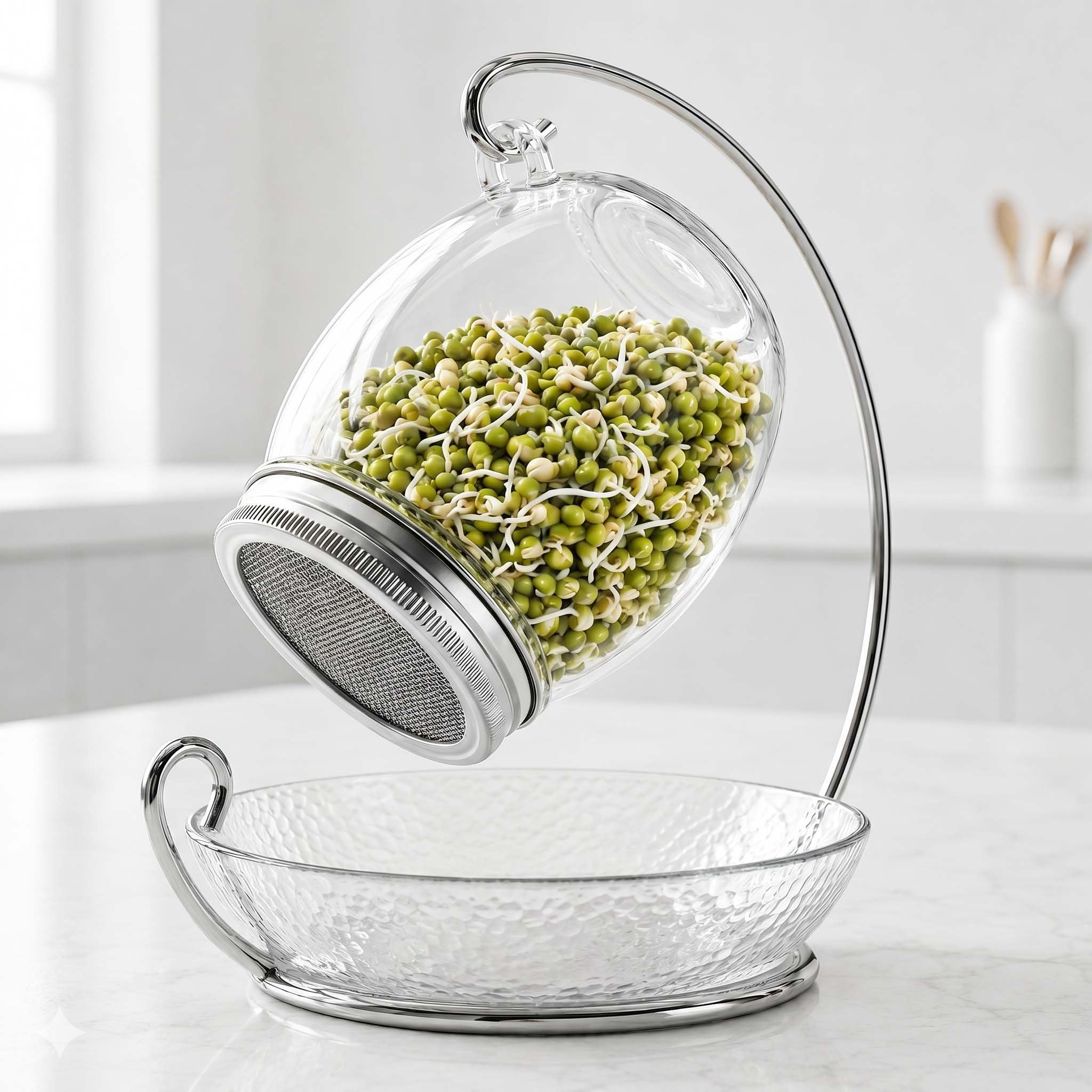
The ALCEDIA kit stands out for its choice of glass: a 30-ounce borosilicate jar that handles hot and cold water without risk of thermal cracking, a genuine advantage over the soda-lime jars found in most other kits. The 316 stainless steel mesh screen is the finest in this lineup, designed to keep even the smallest broccoli seeds from escaping while still allowing fast drainage. The rounded wide-mouthed shape is distinctly more decorative than a standard mason jar, with a flat-bottomed profile that looks intentional on a dining table or windowsill.
Users consistently describe the assembly as intuitive and the included stand and drip tray as well-proportioned for the jar size. The hanging design of the lid keeps the jar angled for continuous airflow, and the mesh is securely crimped into the rim so it won’t pop loose during rinsing. Sprout yields are consistent and fast, with alfalfa reaching harvestable size in as little as three days according to several reports.
Most of the criticism centers on capacity: the 30-ounce jar produces a smaller harvest than a standard quart-sized mason jar setup, which may be a limitation if you’re feeding more than one or two people. A few owners note that the rounded bottom can make it slightly harder to scrape out the last sprouts compared to a straight-walled jar, but the material quality and attractive design make this a strong contender for anyone who values aesthetics alongside function.
What works
- Borosilicate glass resists thermal shock from hot or cold rinses
- 316 stainless steel mesh retains the tiniest seeds securely
- Decorative jar design looks at home on a table or shelf
- Stand and tray provide stable angled drainage without pooling
What doesn’t
- 30-ounce capacity yields less volume than standard quart jars
- Rounded jar bottom makes full sprout removal slightly awkward
- Stand does not lock the jar in place, so it can shift if bumped
3. Malastar Complete Sprouting Jar Kit

The Malastar kit is the most complete multi-jar option in the mid-range, delivering two 32-ounce wide-mouth jars, two lids with 316 stainless steel mesh, two blackout sleeves, a stainless steel stand, and a drip tray. The inclusion of 316 steel at this price point is notable — most competitors use 304 for the mesh and reserve 316 for premium models — and it directly reduces the risk of corrosion after months of daily rinsing. The stand is sturdy enough to hold both jars securely at the ideal drainage angle, and the drip tray’s moderate depth prevents overflow during heavy rinsing cycles.
Owners praise the blackout sleeves for their effectiveness at blocking light for legume and grain sprouts, with several reporting longer, sweeter mung bean stalks compared to uncovered jars. The kit also includes a printed instruction guide that covers soaking times and rinsing frequency for different seed types, which is especially helpful for beginners. The 32-ounce jars provide a generous harvest window, typically filling the jar after five days with standard seed quantities.
The main drawback is the sleeve design: the elastic openings are tight and can be frustrating to install and remove, especially when wet. Some users report needing to wash the drip tray by hand to avoid warping, despite it being labeled as dishwasher-safe. Additionally, the ABS plastic rim on the lid, while food-safe, can feel less premium than all-metal alternatives.
What works
- Top-grade 316 stainless steel mesh for lasting rust resistance
- Two complete jars allow simultaneous growing of different seeds
- Blackout sleeves block light effectively for longer, sweeter sprouts
- Sturdy stand and drip tray keep counter clean and organized
What doesn’t
- Blackout sleeves require effort to put on and take off
- Drip tray may warp if washed in the dishwasher’s lower rack
- Plastic lid rim does not match the premium feel of the rest of the kit
4. Boombamo Premium Sprouting Jar Kit
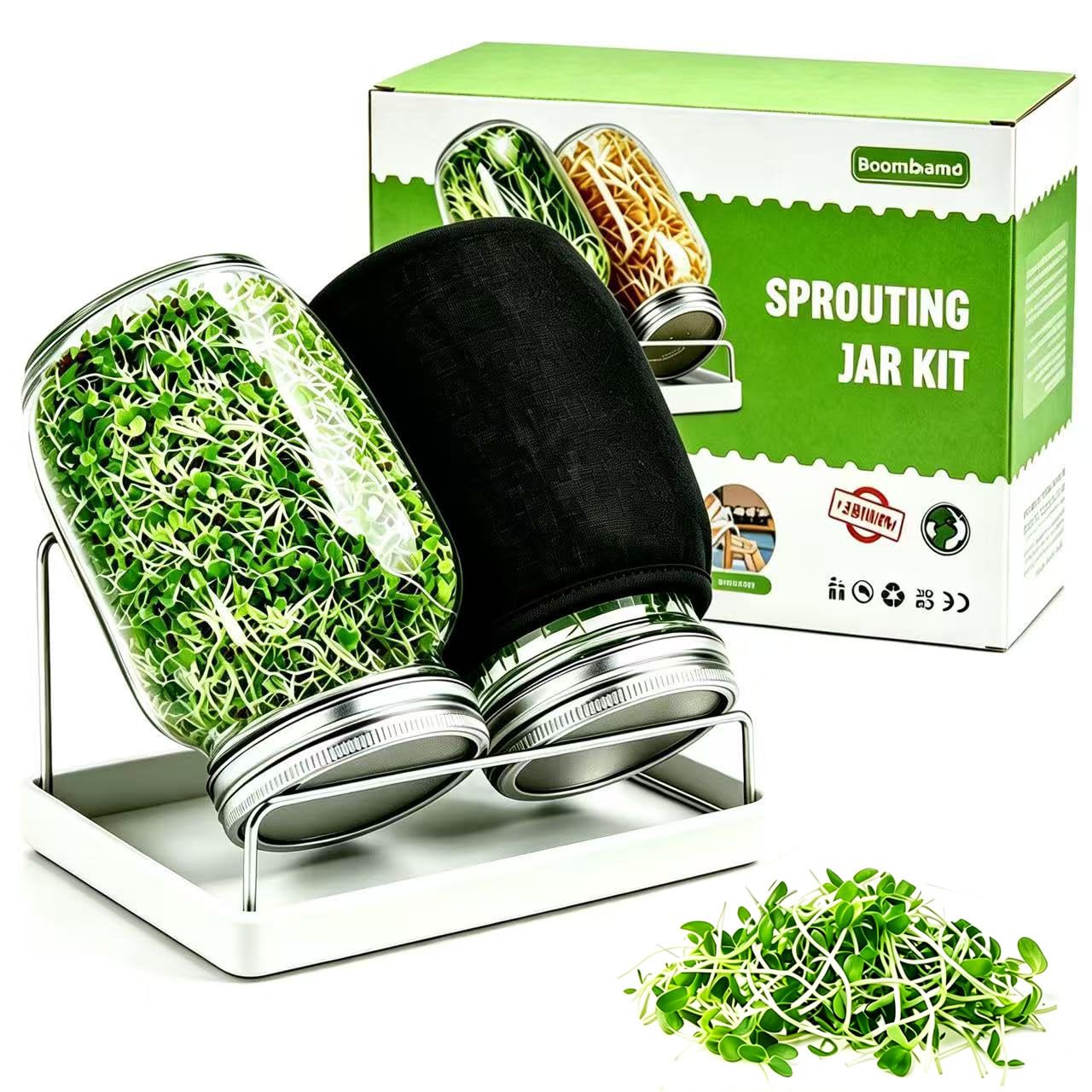
The Boombamo kit is a direct competitor to the Malastar, offering a similar two-jar package but with 304 stainless steel instead of 316, and a different accessory philosophy focused on long-term usability. The kit includes two 32-ounce mason jars, two screen sprout lids, two blackout sleeves, a metal stand, and a drip tray. The standout feature is the blackout sleeves themselves — they are fully washable and have a thicker fabric than most, designed to survive repeated washing cycles without losing their shape or light-blocking ability.
The metal stand holds each jar at a pronounced angle that encourages thorough drainage, and the drip tray has taller sides than many competitors to catch splashes during rinsing. Owners particularly appreciate the four-step growing process printed clearly in the manual, which simplifies the learning curve for first-time sprouters. The 304 steel mesh is durable and resists rust well, though it is marginally more prone to staining over time than 316.
Most complaints center on the lack of detailed customer reviews at the time of writing, which makes it harder to validate long-term performance. A few users also note that the screen mesh, while well-constructed, can allow very small seeds like amaranth or chia to slip through slightly easier than the denser 316 mesh found in the Malastar kit. The overall package is solid, but it sits in an awkward spot between the superior 316 options and the budget-level kits.
What works
- Washable blackout sleeves maintain shape after repeated cleaning
- Tall-sided drip tray prevents counter mess from splashes
- Sturdy metal stand provides a secure, angled drainage position
- Clear four-step instructions are beginner-friendly
What doesn’t
- 304 steel mesh may stain slightly over time compared to 316
- Very fine seeds can occasionally escape through the screen
- Limited verified owner feedback available for long-term durability
5. Elementi Sprouting Jar Kit
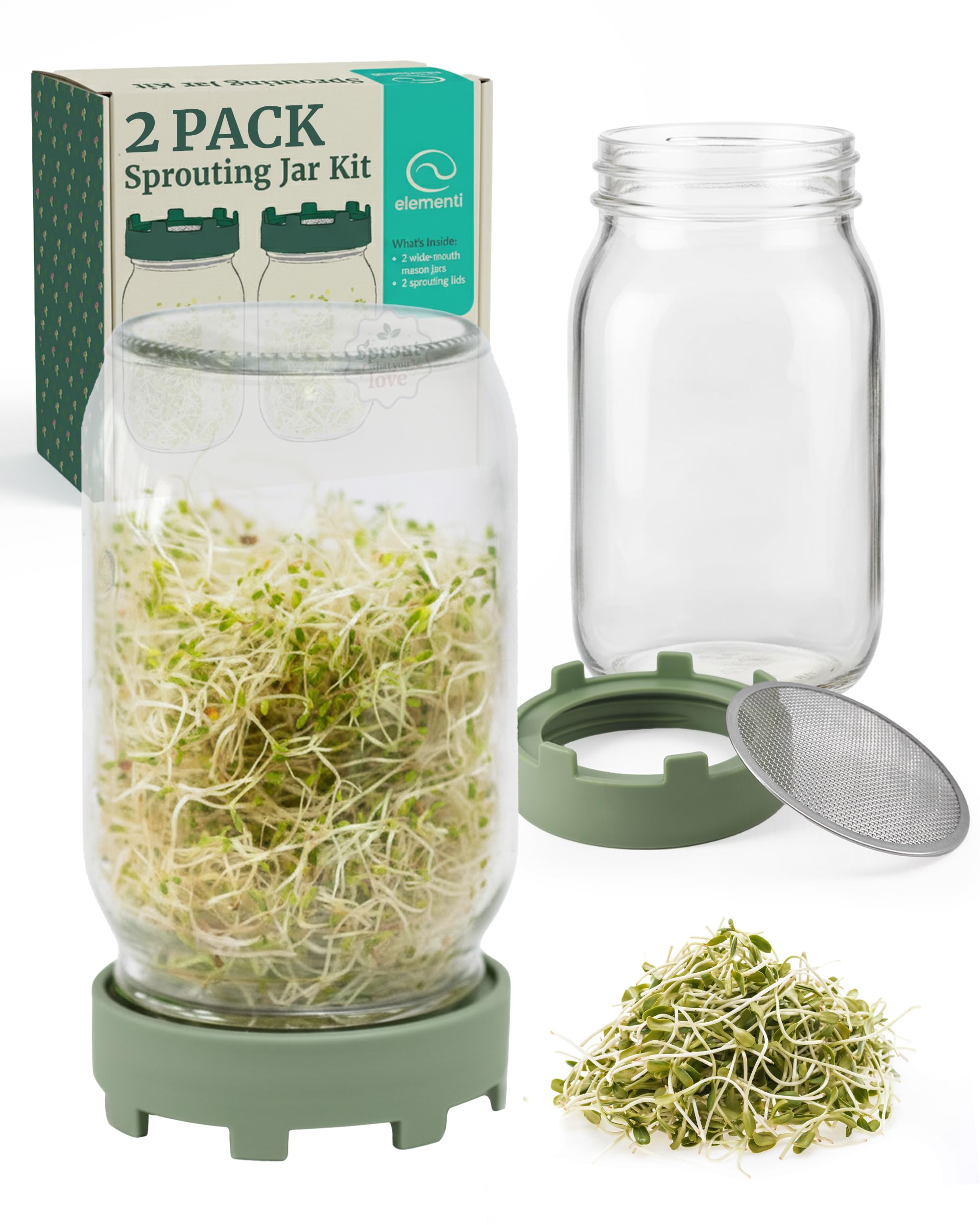
The Elementi kit arrives with two full jars and a very specific design choice: the plastic sprouting lids are cast in a sage green color, giving the whole set a modern, kitchen-friendly look that stands apart from the standard clear or black rims found elsewhere. Inside, each lid holds a separate 316 stainless steel mesh disk that is removable for cleaning, which helps avoid trapped moisture between the mesh and the rim. The jars themselves are standard soda-lime glass quart-sized containers, so they feel familiar and are widely available if you need replacements.
Users report that the fine mesh does an excellent job of retaining seeds during rinsing, and the two-jar format makes it easy to grow different varieties side by side for comparison. The inclusion of 316 mesh at this price point is unexpected and elevates the value considerably, since corrosion resistance is a key longevity factor in any sprouting kit. The jar shape is classic round with a wide mouth, making it simple to scoop out full batches of sprouts.
The most significant downside is the drainage behavior: several owners note that the fine mesh can hold water against the seeds due to surface tension, requiring a firm tap or shake to fully break the water seal. This can lead to a higher risk of spoilage if the user does not ensure complete draining after each rinse. The green plastic rim also has a tighter thread than standard mason jar lids, making it more difficult to screw onto the jar initially.
What works
- Removable 316 stainless steel mesh disk simplifies deep cleaning
- Distinctive sage green color fits well in modern kitchens
- Fine mesh retains even small seeds like broccoli and alfalfa
- Two-jar format offers flexibility for multi-seed growing
What doesn’t
- Water tension on the fine mesh can prevent full drainage
- Green rim threads are tighter and harder to secure on the jar
- Soda-lime glass is less resistant to thermal shock than borosilicate
6. Haswe Complete Sprouting Jar Kit

The Haswe kit is the most affordable entry-level bundle that still includes a stand, drip tray, and blackout sleeves. It uses ABS plastic lids with stainless steel mesh screens rather than all-metal construction, which keeps the cost down while still providing functional drainage and airflow. The two jars are standard wide-mouth quart mason jars that are included in the package, so you don’t need to supply your own, and the kit accommodates everything from alfalfa to broccoli to mung beans with equal ease.
Owner feedback is generally positive, with many calling it a terrific value for getting started without a big upfront investment. The blackout sleeves do a reasonable job of blocking light, and the wire screens allow decent airflow through the top of the jar. The included instruction manual covers the basic soak-rinse-drain cycle clearly. For someone who is not yet certain they want to commit to daily sprouting, this kit provides a low-risk on-ramp with all the essential accessories.
Where the Haswe kit falls short is material quality and long-term durability. The plastic lids can crack if over-tightened, and the stainless steel mesh is not specified as either 304 or 316, raising questions about rust resistance over months of daily use. Several users mention that the blackout sleeves are thin and may let light through around the seam. The stand is functional but less stable than the metal stands found in more expensive kits, and the drip tray is shallow enough to overflow if the jar is not tilted precisely.
What works
- Low entry price includes jars, lids, sleeves, stand, and tray
- Wire screens provide decent airflow and drainage for most seeds
- Blackout sleeves help with legume and grain sprouting
- Clear instructions make it simple for absolute beginners
What doesn’t
- Plastic lids can crack if threaded too tightly
- Mesh quality and rust resistance are not specified
- Blackout sleeves are thin and may not block all light
- Shallow drip tray can overflow without careful draining
7. Masontops Bean Screen Sprouts Growing Kit

The Masontops kit takes a different approach: instead of full jars and stands, it focuses on providing two Bean Screen lids and two packets of organic sprouting seeds, designed to transform any standard wide-mouth mason jar you already own into a functioning sprouting system. The lids are made from BPA-free plastic and feature standing pegs that keep the jar elevated above the counter to promote full drainage. The faceted sides of the lids also prevent the jar from rolling, providing a stable environment for the sprouts to grow.
Users appreciate the simplicity of the system — soak the seeds overnight in your own jar, swap the regular lid for the Bean Screen, rinse and drain twice a day, and harvest after a few days. The included seed packets from Mumm’s are organic and GMO-free, with a Sandwich Booster mix (clover and alfalfa) and a Crunchy Bean mix (lentil and chickpea), giving beginners a ready-to-go experience without needing to source seeds separately. The plastic screens are dishwasher-safe and hold up well to repeated use.
The main limitations are that you must supply your own mason jar, and the plastic construction, while durable, lacks the premium feel of a stainless steel mesh lid. Some users report that very small seeds like alfalfa can get stuck in the drain holes, and the cone-shaped spout on the lid is less useful than expected for directing airflow. The sample seed packets are small and will only produce a few batches before needing to be replenished.
What works
- Lids fit any standard wide-mouth mason jar you already own
- Standing pegs ensure full drainage to prevent spoilage
- Includes two organic, GMO-free seed starter packets
- Dishwasher-safe and made from BPA-free food-safe plastic
What doesn’t
- You must supply your own mason jar — not a full kit
- Small seeds can get lodged in the screen drain holes
- Seed sample packs are trial-sized and run out quickly
- Plastic lid feels less premium than metal mesh alternatives
Hardware & Specs Guide
Screen Material: 304 vs. 316 Stainless Steel
316 stainless steel contains molybdenum, which makes it significantly more resistant to pitting and corrosion from chlorides found in tap water. For a sprouting kit that sees moisture 24 hours a day, 316 is the clear long-term winner. 304 steel is still rust-resistant but may develop small pits or surface staining after a few months of continuous use. If you plan to sprout daily for years, prioritize 316 mesh.
Glass Type: Borosilicate vs. Soda-Lime
Borosilicate glass (like the ALCEDIA kit uses) can withstand rapid temperature changes — pouring cool rinse water into a jar that just held warm soak water won’t cause cracking. Soda-lime glass is cheaper and more common, but it has lower thermal shock resistance. If you live in a region with very cold tap water, or if you sometimes use warm water for rinsing, borosilicate is a genuine safety advantage.
FAQ
How often should I rinse seeds in a mason jar sprouting kit?
Why do some sprouting kits include blackout sleeves?
Final Thoughts: The Verdict
For most gardeners, the bean sprouting kit winner is the SOLIGT Stackable because its 2-tier stainless steel system allows continuous, high-volume harvests with effortless rinsing and unmatched durability. If you prefer a decorative jar that performs as well as it looks, grab the ALCEDIA Premium with its 316 mesh and borosilicate glass. And for the best two-jar starter package that balances material quality and accessory completeness, the Malastar Complete Kit delivers serious value with its dual 316 stainless steel screens, blackout sleeves, and sturdy stand.