
Specs are compiled from manufacturer listings and verified buyer reviews and can change over time — please confirm the key details on the product page before buying.
Your hands ache after a day of clipping, and the real question is which battery pruner will handle your thickest branches without jamming and without draining its battery halfway through the job. That is the difference between a tool that ends up back in the shed and one you reach for every weekend.
I’m Rikta — the founder behind Lawn Gear Lab. This guide is based on manufacturers’ published specifications and verified customer review patterns, so you get each pick’s real strengths and trade-offs instead of marketing spin.
After comparing the cutting diameters, blade materials, battery capacities, and real owner experiences across seven models, the right pick for your yard depends on one thing: how often you need to cut branches thicker than a soda can. Finding the best battery pruners means matching that single demand to the right motor and battery combo.
Quick Picks
- Upgraded Electric Pruning Shears, 2.56″ Cutting Diameter — Best Overall
- SEESII Electric Pruning Shears, 1.8″ Cut — Premium Pick
- DEWALT 20V MAX Cordless Pruner (DCPR320D1) — Ecosystem Choice
- Electric Pruning Shears, 2.6″ Opening (MuatCtarom) — Value Champion
- Scotts PR17215S 7.2-Volt Cordless Rechargeable Power Pruner — Budget Champion
- BLACK+DECKER 20V MAX Cordless Pruner (BCPR320C1) — Speed Editor
- Electric Pruning Shears, 1.6″ with LCD (PAOWAFOL) — Smart Starter Kit
How To Choose The Best Battery Pruners
Choosing a battery pruner is about matching the tool’s cutting capacity and battery runtime to what you actually prune. A person trimming rose bushes needs something very different from someone cutting 2-inch tree limbs around their property. Here are the three specs that matter most.
Cutting Capacity: Match The Branch Thickness
The cutting diameter, measured in inches, is the maximum branch thickness the pruner can cut through in one clean motion. A pruner with a 1.6-inch opening is great for most shrubs, small branches, and rose bushes, but you will need a model with a 2.5-inch or larger opening to tackle thicker tree limbs without having to go around the branch. The wrong capacity means you will either be forcing the tool or leaving the thickest limbs for manual sawing.
Battery System: Dual Batteries vs. Integrated
Most modern battery pruners come with two rechargeable batteries, so you can swap one in while the other charges. Look at the milliampere-hour (mAh) rating: a higher number, like 4.0Ah or 2000mAh per battery, means longer runtime between charges. Some premium models use a proprietary battery, while others share a battery platform with other power tools from the same brand, which can be a big advantage if you already own tools in that ecosystem.
Motor and Blade Build: Brushless vs. Brushed
A brushless motor is more efficient, runs cooler, and typically lasts longer than a brushed motor, making it the standard for any serious pruning. The blade material also matters: SK7 steel is harder and holds an edge longer than SK5 steel, while high-carbon steel blades are common and easy to sharpen. All three will give you clean bypass cuts, but the longevity difference shows after a season or two of heavy use.
Quick Comparison
| Model | Best For | Cutting Diameter | Battery Specs | Motor Type | Amazon |
|---|---|---|---|---|---|
| Upgraded Electric Pruning Shears, 2.56″ | Heavy-duty limb cutting | 2.56 Inches | 2×2.0Ah | Brushless | Amazon |
| SEESII Electric Pruning Shears | All-day professional use | 1.8 Inches | 2×4.0Ah | Brushless | Amazon |
| DEWALT 20V MAX Cordless Pruner | DeWalt ecosystem owners | 1.5 Inches | 20V MAX (battery sold separately) | Brushless | Amazon |
| Electric Pruning Shears, 2.6″ Opening | Larger opening on a budget | 2 Inches | 2×2.0Ah | Brushless | Amazon |
| Scotts PR17215S 7.2V Pruner | class-leading long-term value | — | Built-in 2Ah | Brushed | Amazon |
| BLACK+DECKER BCPR320C1 | Light trimming & speed | 1 Inches | 20V MAX (included) | Brushed | Amazon |
| PAOWAFOL Electric Pruning Shears | Entry-level with extras | 1.6 Inches | 2×2000mAh | Brushless | Amazon |
In‑Depth Reviews
1. Upgraded Electric Pruning Shears, 2.56″ Cutting Diameter
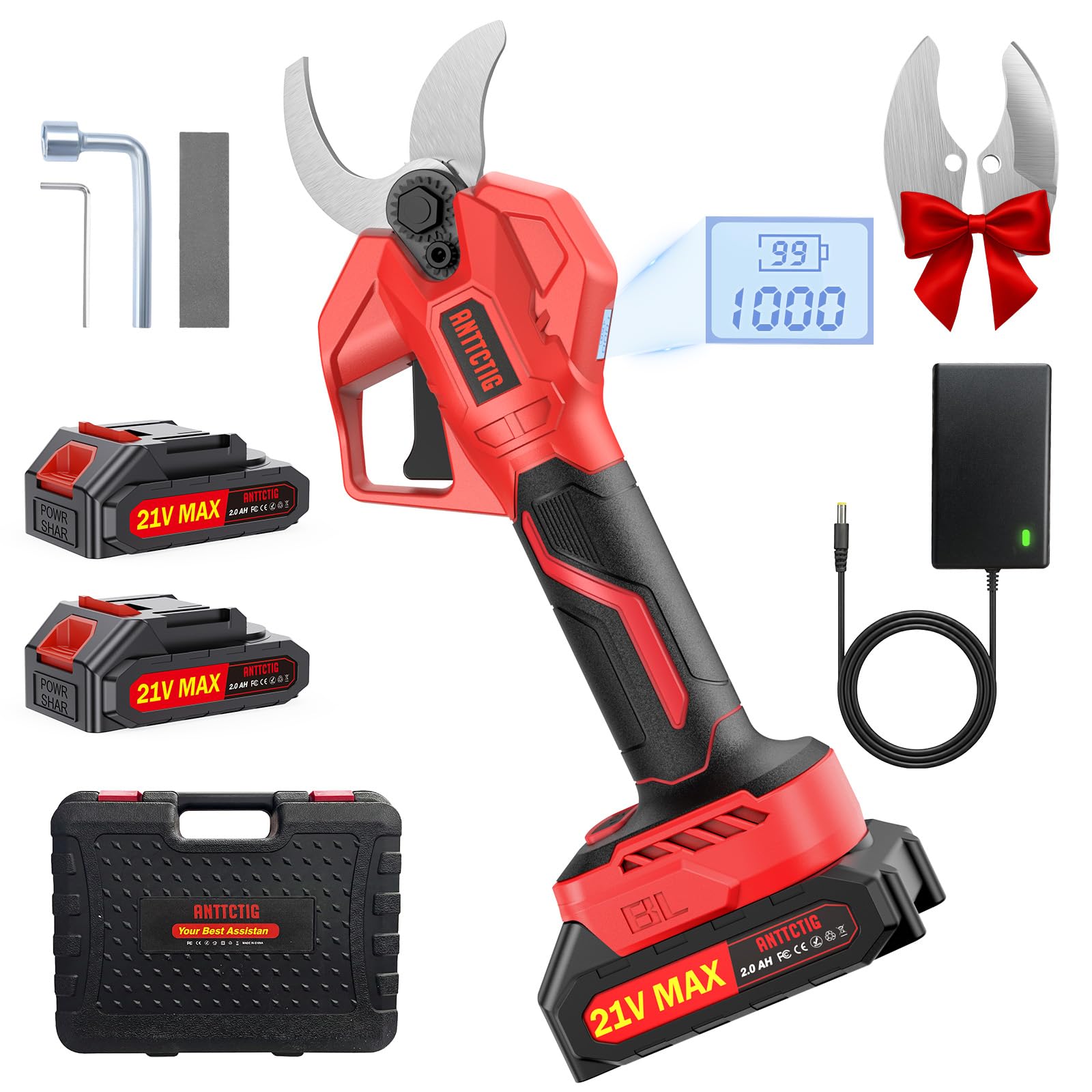
The brute that chomps branches thicker than your wrist without slowing down.
If you regularly fight with 2-inch tree limbs, this is the pruner you want in your hands. Its 2.56-inch cutting diameter is 60% larger than the 1.6-inch capacity of the entry-level PAOWAFOL model, so you can slice through a limb that would stall most other electric pruners. The upgrade to an SK7 steel blade (harder than the common SK5) helps that edge stay sharp over a long season — buyers report the same blade lasting over 2 years. At 2.33 pounds, it is heavier than the 1.6-pound PAOWAFOL, but the extra weight comes from a more powerful brushless motor (which runs cooler and needs less battery power to cut) and a larger cutting head.
The kit comes with two 2.0Ah batteries that give up to 5 hours of runtime, a smart LED display for battery level and cut count, and a silicone-wrapped handle that reduces vibration. The trade-off is it is the heaviest pruner here (except for the DeWalt), and the case clips feel flimsy, according to owners. But for weekend pruning of thick tree limbs, this is the one that gets the job done.
What makes it the best
- 2.56-inch max cutting capacity — the widest in this lineup
- SK7 blade is harder and sharper than SK5 steel blades
- Dual 2.0Ah batteries deliver up to 5 hours of run time
- Silicon-wrapped handle reduces hand fatigue and vibration
The honest limit
- At 2.33 pounds, it is heavier than most pruners in this list
- Case clips are functional but feel cheap, per owner feedback
Your best bet for: Anyone who prunes thick branches over 1.5 inches regularly and wants a tool that will not quit halfway through.
Think twice if: You only clip light shrubs and want the lightest option for arthritic hands — the weight here may feel tiring on very long sessions.
2. SEESII Electric Pruning Shears, 1.8″ Cut
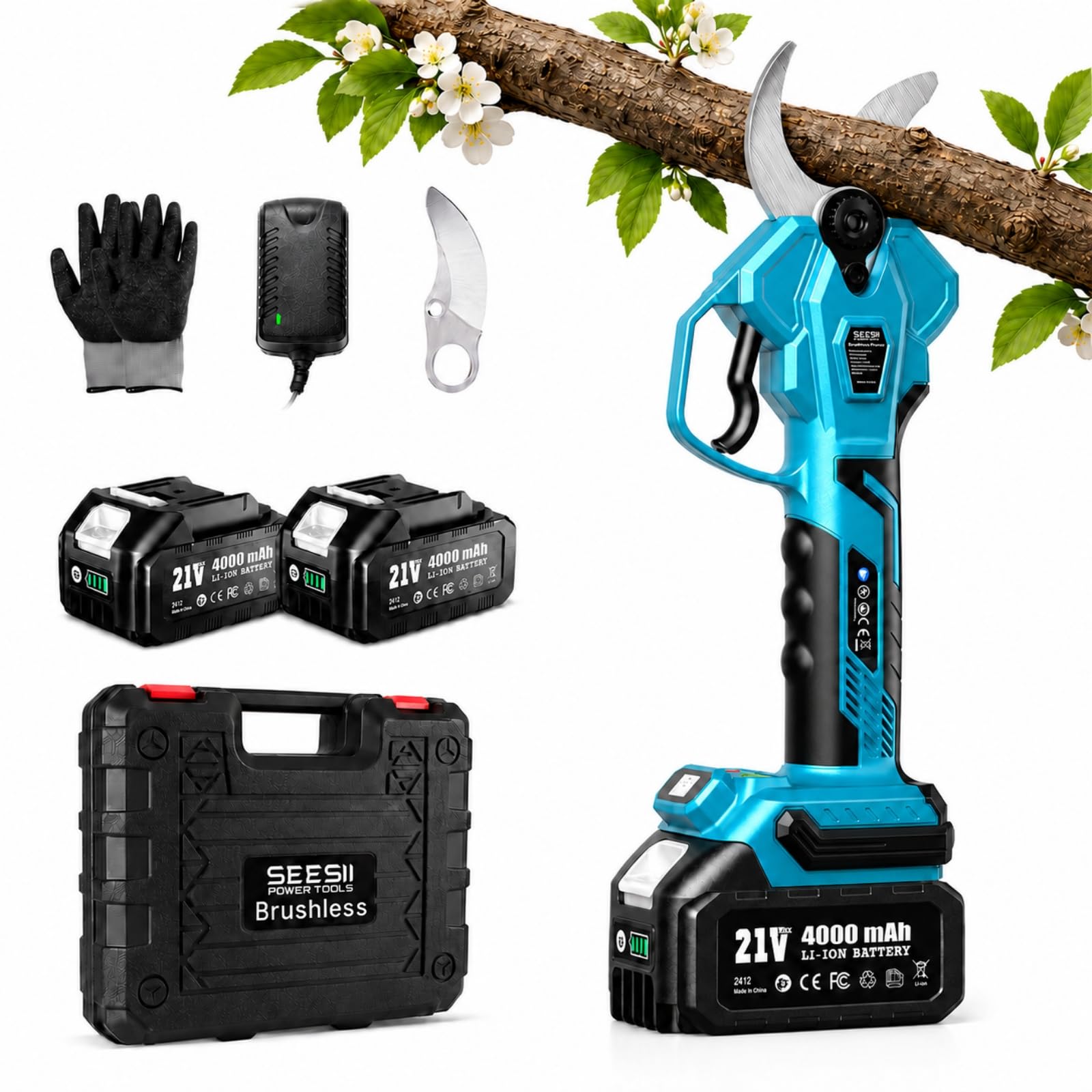
The endurance machine that keeps cutting long after your arms give out.
The battery story sets this pruner apart: dual 4.0Ah batteries — double the capacity of the 2.0Ah packs on the Anttctig or PAOWAFOL — so you get a full day of heavy trimming without switching to a charger. The brushless motor and SK5 blade combination cuts through 1.8-inch branches. Owners mention it handles 1-inch-plus limbs easily. One reviewer wrote the battery lasts over 3 hours per charge. Unlike the 2.56-inch Anttctig, the SEESII’s capacity tops out at 1.8 inches, and some customers note the marketing inflates that number — it handles 1.5-inch branches in one clean pull but may need multiple cuts for the thickest material.
At 3.44 pounds with a 4.0Ah battery, it is noticeably heavier than the 2.33-pound Anttctig, but the handle spreads the weight well. The LCD screen shows battery and cut count, four adjustable cutting modes let you fine-tune power, and the safety lock prevents accidental starts. The 4.0Ah batteries work with Makita tools, so this fits smoothly into that ecosystem.
Why it stands out
- Two 4.0Ah batteries provide all-day cutting power, far more than most competitors
- Brushless motor runs cooler and delivers consistent torque for thick branches
- Batteries are compatible with Makita tools
- Four adjustable cutting modes for different branch thicknesses
What holds it back
- Weighs 3.44 lbs, heavier than the Anttctig (2.33 lbs) and PAOWAFOL (1.6 lbs)
- Some users note actual max cut is closer to 1.5 inches despite 1.8-inch claim
Perfect for: Users who need pruners for all-day yard work or professional landscaping and value battery endurance over raw cutting diameter.
Not ideal if: Your main need is cutting branches thicker than 1.5 inches regularly — the Anttctig with 2.56-inch capacity will serve you better.
3. DEWALT 20V MAX Cordless Pruner (DCPR320D1)

The familiar name for anyone who already owns yellow tools and a growing stack of batteries.
If your toolbox already uses DEWALT 20V MAX gear, this pruner slots right into your battery system — just grab a standard 20V battery and start cutting. At 5.3 pounds with a battery installed, it is the heaviest pruner here by far, which is 3.7 pounds more than the 1.6-pound PAOWAFOL. That weight makes it feel durable but tiring overhead. Reviewers point out it easily handles 1-inch branches in a single cut and the battery lasts all day.
The built-in LED work light helps pruners see in low-light areas under dense shrubs, a feature no other pruner offers here. Non-stick coated blades resist sap buildup, and the kit includes a blade change tool. There is no belt hook or lanyard hole, so you have to set it down between cuts, and the weight will fatigue you after long use. If you are not already in DEWALT tools, the SEESII or Anttctig offer more cutting capacity for less money.
What works for Dewalt owners
- Shares batteries with the entire DEWALT 20V MAX family of tools
- Built-in LED work light illuminates dark work areas under shrubs
- Non-stick coated blades resist sap and debris
- Quick blade change tool is included
Where it falls short
- At 5.3 pounds, it is the heaviest pruner in this comparison
- 1.5-inch cutting capacity is smaller than the Anttctig (2.56 inches) and SEESII (1.8 inches)
- No belt hook or lanyard hole for carrying between cuts
Stick with it if: You are already invested in the DEWALT 20V MAX platform and want a smooth addition to your tool collection.
Look elsewhere if: You want the lightest tool or the widest cutting diameter — the Anttctig or SEESII are better values for those needs.
4. Electric Pruning Shears, 2.6″ Opening (MuatCtarom)
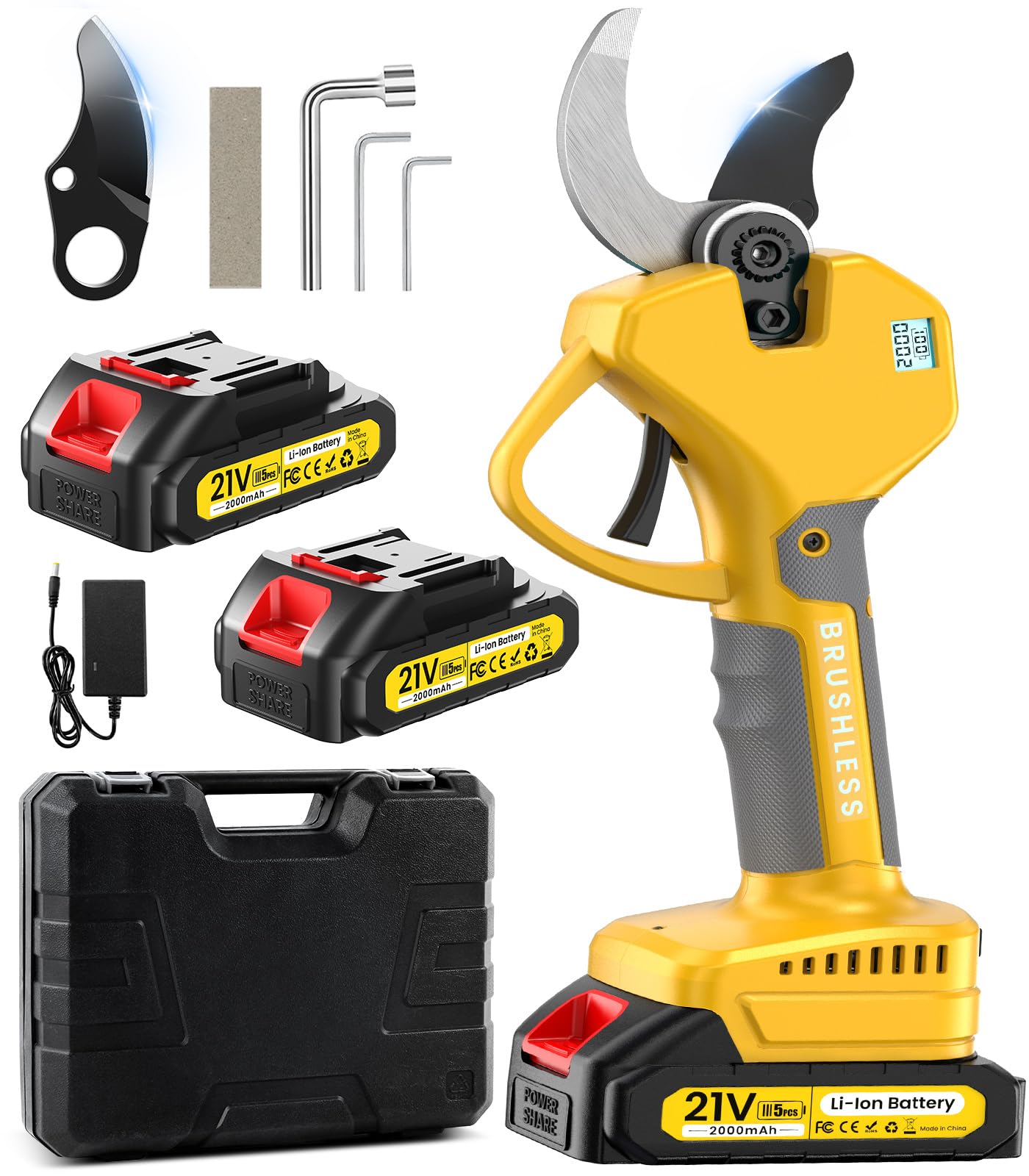
A massive 2.6-inch opening and an 800W brushless motor at a price that undercuts most mid-range picks.
The 800W brushless motor is the highest wattage in this entire list, and the 2.6-inch opening is the widest alongside the Anttctig. However, the actual cutting diameter is 2 inches, so the blade opening is wide, but it recommends multiple cuts for the thickest branches. The included SK7 blade (harder than SK5) is sharp, and the kit comes with two 2000mAh batteries that deliver over 2,400 cuts per charge. One reviewer noted it cuts 1 to 1.5-inch branches instantly and reduced a week of pruning to a single day.
The LCD display shows battery level and cut count. Safety features include an auto-pause after 1 minute of no use, a blade that opens immediately when you release the trigger, and a physical main switch rather than an electronic one. At 1.23 kilograms (about 2.7 pounds), it sits between the Anttctig and the SEESII in weight. Some owners say it sometimes takes a few trigger pulls to start.
Why it is a smart buy
- 800W brushless motor is the most powerful in this comparison
- 2.6-inch blade opening gives you a large working angle
- Includes SK7 blade, spare blade, and a whetstone for long-term maintenance
- Safety auto-pause and physical switch design
The compromises
- Actual cutting diameter is 2 inches, not the 2.6-inch opening
- A few users report intermittent trigger response at startup
Go for it if: You want the biggest motor power and a wide blade opening for a mid-range price and do not mind a little extra weight.
Pass if: You need a guaranteed 2.5-inch+ clean cut in one go — the Anttctig is the safer bet for that.
5. Scotts PR17215S 7.2-Volt Cordless Rechargeable Power Pruner

The iron horse that surprised everyone with five years of work-truck abuse.
Do not let the low 7.2-volt battery fool you. This Scotts pruner has a reputation for durability that outruns almost everything here. One buyer wrote it “stood up to 5 years of heavy use, banging around in my work truck in the summers, before it finally gave up.” That ruggedness, paired with a 1.8-pound body, makes it a fantastic budget pick. It uses a brushed motor (not brushless), so it lacks the efficiency of the Anttctig or MuatCtarom, but for rose bushes, small branches, and general garden work, it handles anything that fits in its jaws.
The dual-pull safety trigger needs two fingers to squeeze, preventing accidental starts. The cushioned grip helps with fatigue, and owners with arthritis or carpal tunnel say it makes a huge difference over manual clippers. The built-in 2Ah battery means you cannot swap packs — you have to wait for it to recharge — but it lasts through most small-to-medium jobs. The lack of a stated cutting diameter is the biggest gap, but owners consistently say it cuts whatever fits in the opening.
What makes it a cult favorite
- Proven 5-year lifespan in heavy-use conditions according to real owners
- At 1.8 pounds, it is among the lightest battery pruners you can buy
- Dual-pull safety trigger prevents accidental activation
- Extremely comfortable for people with arthritis or hand weakness
Its age shows in the specs
- Built-in battery means no hot-swap; you must wait for a recharge
- Brushed motor is less efficient and less powerful than brushless designs
- Replacement blades are reportedly hard to find
Reach for this if: You need a tough, lightweight pruner for general garden trimming and value proven longevity over raw power.
Look elsewhere if: You need to cut thick, 2-inch branches regularly — this pruner simply does not have the motor power for that.
6. BLACK+DECKER 20V MAX Cordless Pruner (BCPR320C1)
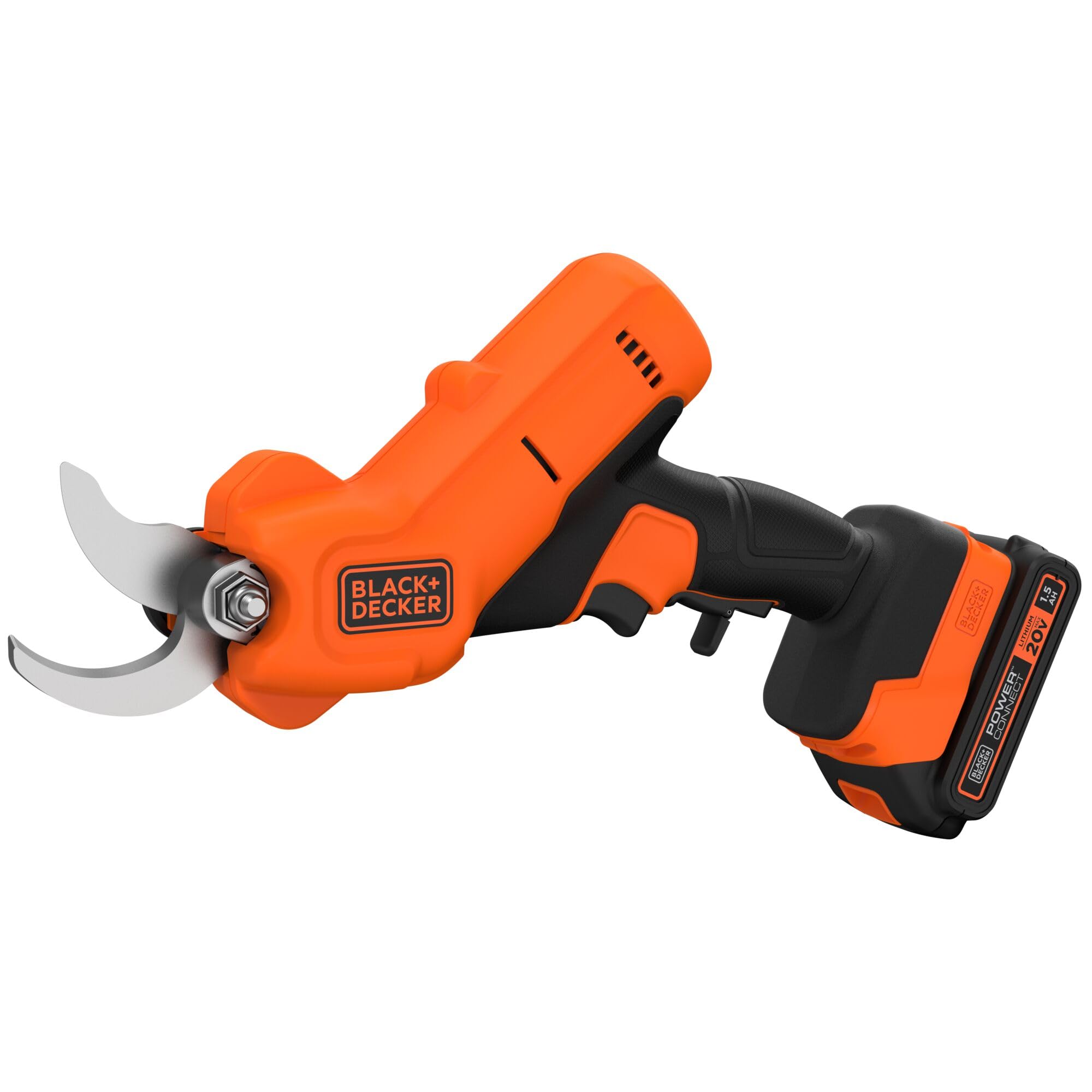
The speed demon that makes a manual pruner feel like a hand-crank.
If speed matters most, this is the pruner to beat. BLACK+DECKER claims up to 900 cuts per charge and a cut rate of one cut per second, which explains why one owner pruned an entire neglected memorial garden for 4 hours without the battery dying. The 1-inch cutting capacity is the smallest here — far smaller than the 1.6-inch PAOWAFOL and nowhere near the 2.56-inch Anttctig. So this is strictly for small branches, rose canes, and light pruning. Within that scope, it is incredibly fast and easy. Tool-free blade changes are easy, and it uses standard 20V MAX batteries from other BLACK+DECKER tools you may own.
At 4.6 pounds, it is 3 pounds heavier than the 1.6-pound PAOWAFOL, making quick touch-ups less comfortable. The brand’s claim of 10x less effort versus manual pruners — owners confirm you press a button and a branch is gone in under a second. The blade is extremely sharp and powerful, so you need to be careful where your other hand is.
Why speed demons choose it
- Up to 900 cuts per charge with one cut per second speed
- Uses standard BLACK+DECKER 20V MAX batteries
- Tool-free blade change for quick swaps
- Reduces effort: requires 10x less force than a manual pruner
The practical limit
- 1-inch cutting capacity is the smallest in this list by a wide margin
- At 4.6 pounds, it is heavy and bulky compared to the Scotts (1.8 lbs)
Pick it for: Rapid, high-volume trimming of small branches where speed is the priority and you stay within the 1-inch limit.
Avoid it if: You need to cut branches over 1 inch thick or want a lightweight tool for casual-use sessions.
7. Electric Pruning Shears, 1.6″ with LCD (PAOWAFOL)
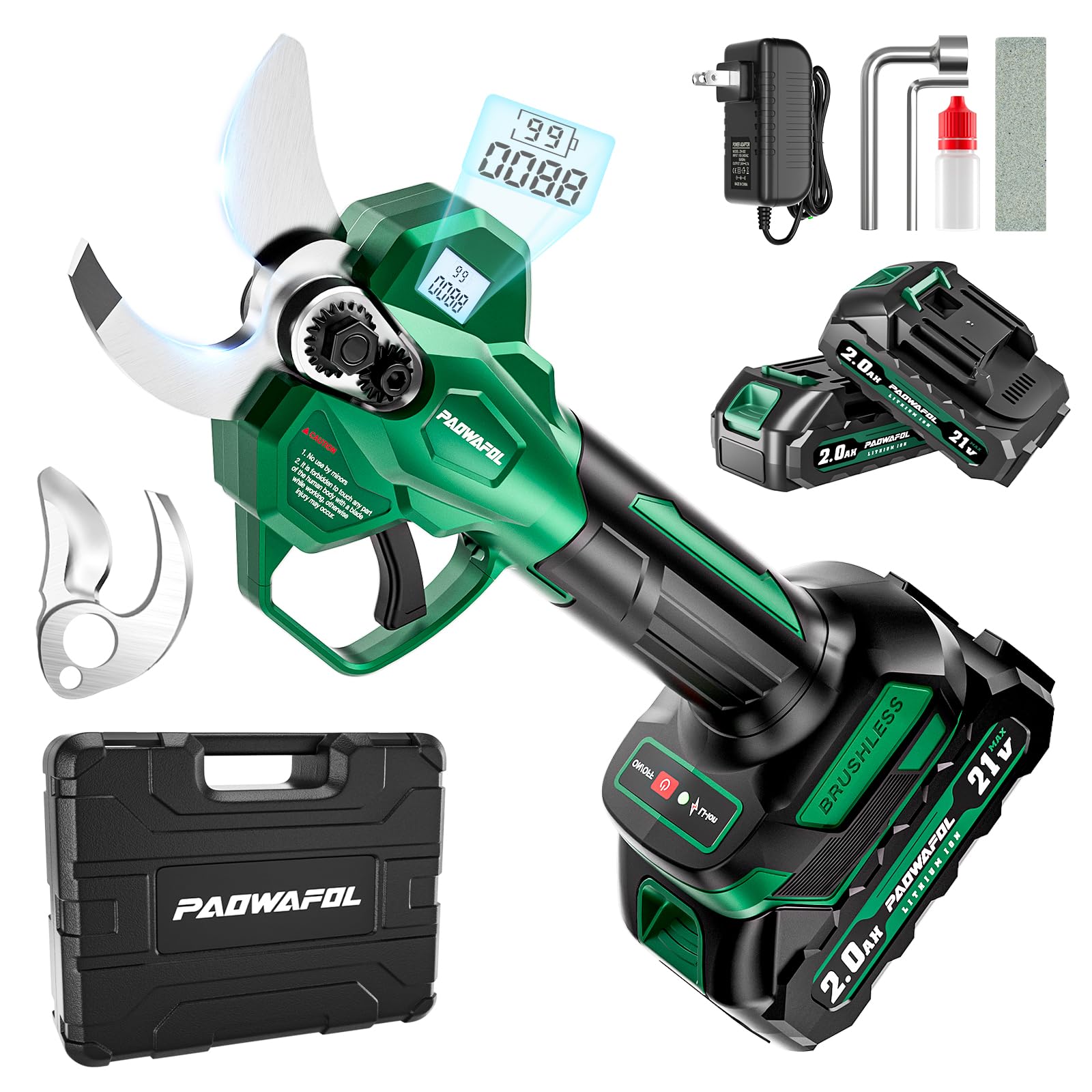
The most complete entry-level kit with extras that beat its price point.
This is the pruner to start with if you are new to battery pruning and want everything in one box. The kit includes the pruner, two 2000mAh batteries, a fast charger, two spare SK5 blades, a tool kit, a glove, and an oil pot — more accessories than any other pruner here, and it makes the 1.6-inch cutting capacity feel like a bargain. At 1.6 pounds, it is the lightest in this comparison (tied with itself), making it easy to handle over long sessions. One buyer with arthritis noted, “Easily cuts through a 2 inch branch,” which is impressive given the 1.6-inch max opening — it shows the brushless motor has real torque.
The LCD display shows battery level and cut count, and two cutting modes adjust between 1.4 inches and 1.6 inches for different branch sizes. The main limit is that 1.6-inch max opening cannot tackle thick tree limbs in one cut like the 2.56-inch Anttctig can. For roses, shrubs, grapevines, and fruit trees up to broom-handle-thickness, it is fast, sharp, and comfortable. Owners say the instruction manual is sparse.
Best-value package
- Comes with 2 extra SK5 blades, glove, tool kit, oil pot — more than any other kit here
- Weighs only 1.6 pounds, making it the lightest in this comparison
- Brushless motor provides consistent power despite low weight
- Two batteries with 2000mAh each deliver over 3000 cuts per charge
The obvious trade-off
- 1.6-inch max cutting diameter is tight compared to the Anttctig’s 2.56 inches
- Owners note the instruction manual is minimal and lacks detail
Start here if: You want the most complete beginner-friendly kit at a low entry point, with plenty of spare parts included.
Move up from here if: You regularly encounter branches over 1.5 inches thick — the Anttctig or MuatCtarom will handle those without a second pass.
Understanding the Specs
Cutting Diameter: Why It Matters
The cutting diameter, measured in inches, is the maximum thickness of a branch the pruner can cut through in one clean motion. A model with a 1.6-inch capacity handles most yard pruning — roses, shrubs, and small tree branches up to about the thickness of a broom handle. A 2.56-inch model, like the Anttctig, can cut through thick tree limbs that would stall a smaller unit. If you regularly trim trees or cut firewood-sized branches, go bigger. If you mostly prune bushes and flowers, a 1.6- to 1.8-inch capacity is plenty and keeps the tool lighter.
Battery Capacity: 2.0Ah vs 4.0Ah
Battery capacity is measured in amp-hours (Ah), and a higher number means the tool runs longer before needing a recharge. A standard 2.0Ah battery (found on the PAOWAFOL, Anttctig, and MuatCtarom) is good for a few hours of moderate pruning. The SEESII’s 4.0Ah batteries give you all-day power without swapping to a charger. If you have a large property or do professional landscaping, the extra battery capacity is worth the weight. For casual weekend use, 2.0Ah is sufficient.
Brushless vs Brushed Motors
Brushless motors have fewer moving parts and run cooler, meaning they are more efficient, deliver more consistent torque, and typically last longer than brushed motors. Almost every pruner in this list now uses a brushless motor, except for the Scotts and BLACK+DECKER models. If you plan to prune frequently or for long periods, a brushless motor is worth the small price premium. For occasional use, a brushed motor is fine and keeps the cost down.
Blade Material: SK7 vs SK5 vs High Carbon Steel
Blade steel determines how long the edge stays sharp. SK7 is a harder, more premium steel that holds its edge longer than SK5, which is already a good mid-range option. High-carbon steel is the standard and is easy to sharpen at home. The Anttctig and MuatCtarom use SK7 blades, giving them a durability edge. SK5 blades, like those on the SEESII and PAOWAFOL, still provide clean cuts but may need sharpening more often after heavy use on gritty or thick wood.
FAQ
Will a battery pruner work for branches thicker than its listed cutting diameter?
How long does a battery pruner battery actually last?
Can I use a battery pruner if I have arthritis in my hands?
What is the difference between SK5 and SK7 blade steel?
Are brushless pruners worth the extra money?
Can I sharpen the blades on a battery pruner myself?
What does the “bypass” blade type mean on battery pruners?
Why do some battery pruners have an LCD screen?
Can I use a battery pruner to trim wet branches after rain?
Will a battery pruner replace my manual loppers or pruning saw?
Final Thoughts: The Verdict
For most people, the best battery pruners winner is the Upgraded Electric Pruning Shears with 2.56-inch capacity because it handles the thickest branches of any model here while still being light enough at 2.33 pounds for comfortable use. If you value all-day endurance and battery compatibility with Makita tools, grab the SEESII Electric Pruning Shears. And for a proven, affordable workhorse that will last for years of light to medium pruning, the standout is the Scotts PR17215S Power Pruner.
How We Picked
We do not accept paid placement. Every pick is matched to a real buyer and a real use-case; we do not hands-on test units.
Sources & Methodology
Specifications: manufacturer listings and product documentation. Review insights: verified customer reviews, as of July 2026. Pricing: not shown on this page (it changes often); check the current price via the retailer link.
As an Amazon Associate, Lawn Gear Lab earns from qualifying purchases. This does not affect which products we feature.