
Specs are compiled from manufacturer listings and verified buyer reviews and can change over time — please confirm the key details on the product page before buying.
If you have spent a morning yanking a pull-cord on a gas tiller only to have it flood or stall, you already know the main reason to switch to battery power. Battery operated rototillers trade the noise, fumes, and maintenance of gas for instant-start convenience, lighter weight, and quiet operation that lets you work without disturbing the neighbors.
I’m Rikta — the founder and writer behind Lawn Gear Lab. This guide is built by comparing the manufacturers’ published specifications and the patterns across verified customer reviews, so you get each pick’s real strengths and trade-offs instead of marketing spin.
You need a rototiller that matches your garden size without leaving you stranded mid-row. The choice between a 20V (20-volt) lightweight model and a 40V (40-volt) dual-battery machine decides how much ground you can cover in one session. This round-up of the best battery operated rototillers compares tilling width, depth, runtime, and power so you pick the right tool without overpaying.
Our Picks at a Glance
How To Choose The Best Battery Operated Rototillers
The right battery tiller depends on one thing: what kind of soil you are working with and how big the area is. For a small raised bed of loose, previously-worked soil, a 20V machine with a 9-inch width is plenty. For breaking new ground, dense clay, or a 200-square-foot vegetable patch, a 40V model with a wider tilling path and higher amp-hour (Ah) batteries makes the job faster and spares you a re-charge wait.
Voltage and Motor Type
Voltage is the clearest signal of torque. A 40V tiller has roughly twice the electrical potential of a 20V machine, which translates to more twisting force at the tines. A brushless motor (found on most premium models) improves that further by delivering 30% more runtime and less heat buildup compared to a brushed motor—so the tool keeps pulling through roots without bogging down.
Tilling Width and Depth
Wider tilling width means fewer passes. A 14-inch model covers roughly 55% more ground per pass than a 9-inch one. Depth matters just as much: 8 inches is enough for most vegetable root vegetables, but shallow 5-inch depth units work better for light weeding and aeration. Adjustable wheels let you dial in depth without guessing, which is especially useful if you switch between shallow weeding and deep soil turning in the same session.
Battery Capacity (Ah) and Runtime
Battery capacity is measured in amp-hours (Ah). A 5.0Ah battery holds 25% more energy than a 4.0Ah battery. Two batteries double your total working time. Reviewers consistently report that a 4.0Ah battery on a 40V motor gives about 20 to 35 minutes of continuous tilling, so a 2-pack with 5.0Ah batteries can easily handle a 300-square-foot garden in one session.
Quick Comparison
| Model | Best For | Voltage | Tilling Width | Battery Included | Amazon |
|---|---|---|---|---|---|
| TaskStar 40V★ Best Overall | Best Overall | 40V | 12″ | 2×5.0Ah | Amazon |
| EnduTools 20VCompact Powerhouse | Tight Spaces | 20V | 9″ | 2×4.0Ah | Amazon |
| MZK 40VWide Pass Champion | Wide Passes | 40V | 14″ | 2×4.0Ah | Amazon |
| Mellif 40V | DeWalt Battery Users | 40V | 14.2″ | Tool Only | Amazon |
| MAXLANDER 40V | Brushless Power | 40V | 12″ | 2×4.0Ah | Amazon |
| Seesii 40V | Ease of Use | 40V | 12″ | 2×5.0Ah | Amazon |
| Sun Joe 24V | Brand Reliability | 24V | 14″ | 2×2.0Ah | Amazon |
| Greenworks 80V | Premium Power | 80V | 10″ | 1×2.0Ah | Amazon |
| Ryobi 18V | ONE+ Ecosystem | 18V | Variable | Tool Only | Amazon |
In‑Depth Reviews
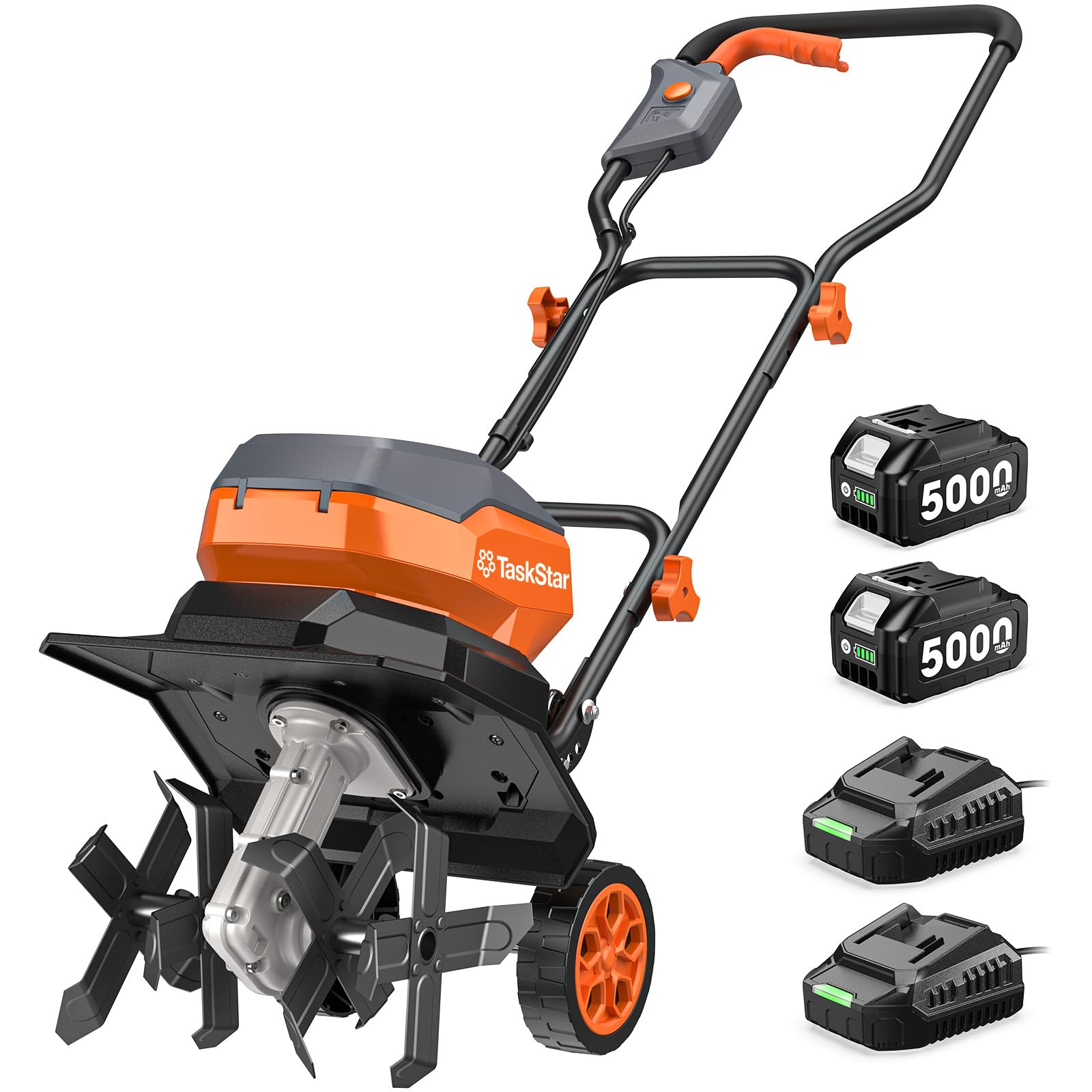
1. TaskStar 40V Cordless Tiller (12 Inch)
Our pick — over 4.5★ from 400+ verified ratings; the strongest balance of quality and price.
A lightweight tiller that surprised even a veteran two-stroke user with its raw power.
You get a 12-inch tilling width and an 8-inch working depth from a machine that delivers 40V of torque without the weight of a gas engine. Buyers report it “tills the soil to the max” on both raised beds and uneven backyard ground. The 2-pack of 5.0Ah (amp-hour) batteries is a key advantage—the extra capacity means you can work longer than the 4.0Ah packs that come with many competitors.
The dual-battery system here stacks up well against the EnduTools 20V model. The TaskStar runs on 40V versus the EnduTools’ 20V, giving it more grunt for unbroken ground, while the EnduTools spins faster at 360 RPM. Both machines include two batteries, but the TaskStar’s 5.0Ah capacity means 25% more stored energy than the EnduTools’ 4.0Ah packs, so you stay in the dirt longer.
Reviewers consistently highlight how easy it is to assemble—one said “simple 5 minute setup and your off.” The four-position depth wheel gives you control whether you are lightly weeding or sinking the tines the full 8 inches for deep soil turning. It is a rare cordless tiller that converts skeptics.
What stands out
- Two 5.0Ah batteries provide extended runtime versus typical 4.0Ah packs.
- Four adjustable depth settings from shallow weeding to 8-inch digging.
- Dual-switch safety lock prevents accidental starts during transport.
Know before you buy
- A few buyers mention it jumps on very hard, dry clay and needs an extra pass.
- The 12-inch width is nimble but slower on large open plots than a 14-inch model.
Reach for this: If you have small to medium gardens, raised beds, or flower beds and want a powerful, lightweight machine with enough battery life to finish the job in one go.
Look elsewhere if: You need to cover a very large area in one pass—consider a wider 14-inch model like the MZK below.
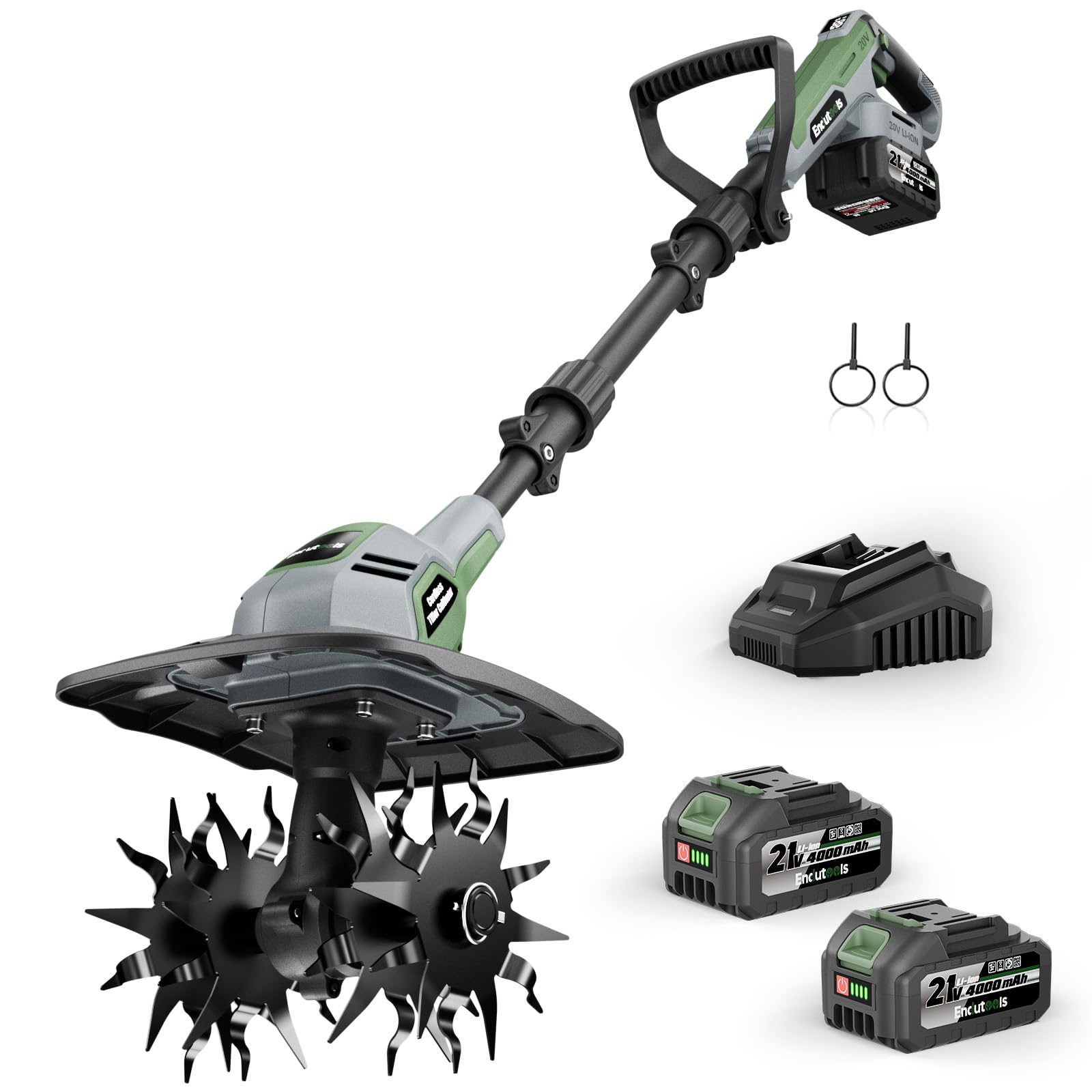
2. EnduTools Cordless Garden Tiller Cultivator 20V
The smallest tiller on this list that still chews through compacted clay without hesitation.
Do not let the 20V label fool you—this unit spins its steel tines at 360 RPM, which is twice the speed of the MZK 40V tiller’s 180 RPM. That fast rotation helps it slice through tough soil rather than churn through it. Reviewers specifically note that the “adjustable, stainless steel tines are strong and sharp; penetrates compacted clay soil.”
The 9-inch tilling width is the narrowest here, but that is the trade-off for a machine that weighs roughly half as much as a 40V model. The handle adjusts to different heights so you do not have to hunch over.
At a 7-inch depth, it handles most weeding and light aeration jobs easily. For the price of a mid-range model, you get a compact tool that stores in a shed corner and is easy for seniors or anyone with limited mobility to control, as one reviewer noted: “appropriate for seniors.”
Why it wins
- 360 RPM rotation speed cuts through compacted soil faster than slower 180 RPM models.
- 60-minute runtime from dual 4.0Ah batteries is the best on this list.
- LED battery indicator lets you plan your work without surprise shutdowns.
Trade-offs
- 9-inch width means more passes on larger garden plots.
- 20V has less torque than 40V models if you hit deep-rooted weeds in dense clay.
Ideal for: Small gardens, tight beds, and anyone who values lightweight handling and long battery life over maximum tilling width.
Not ideal for: Breaking new ground in a large vegetable patch—step up to a 40V for that.
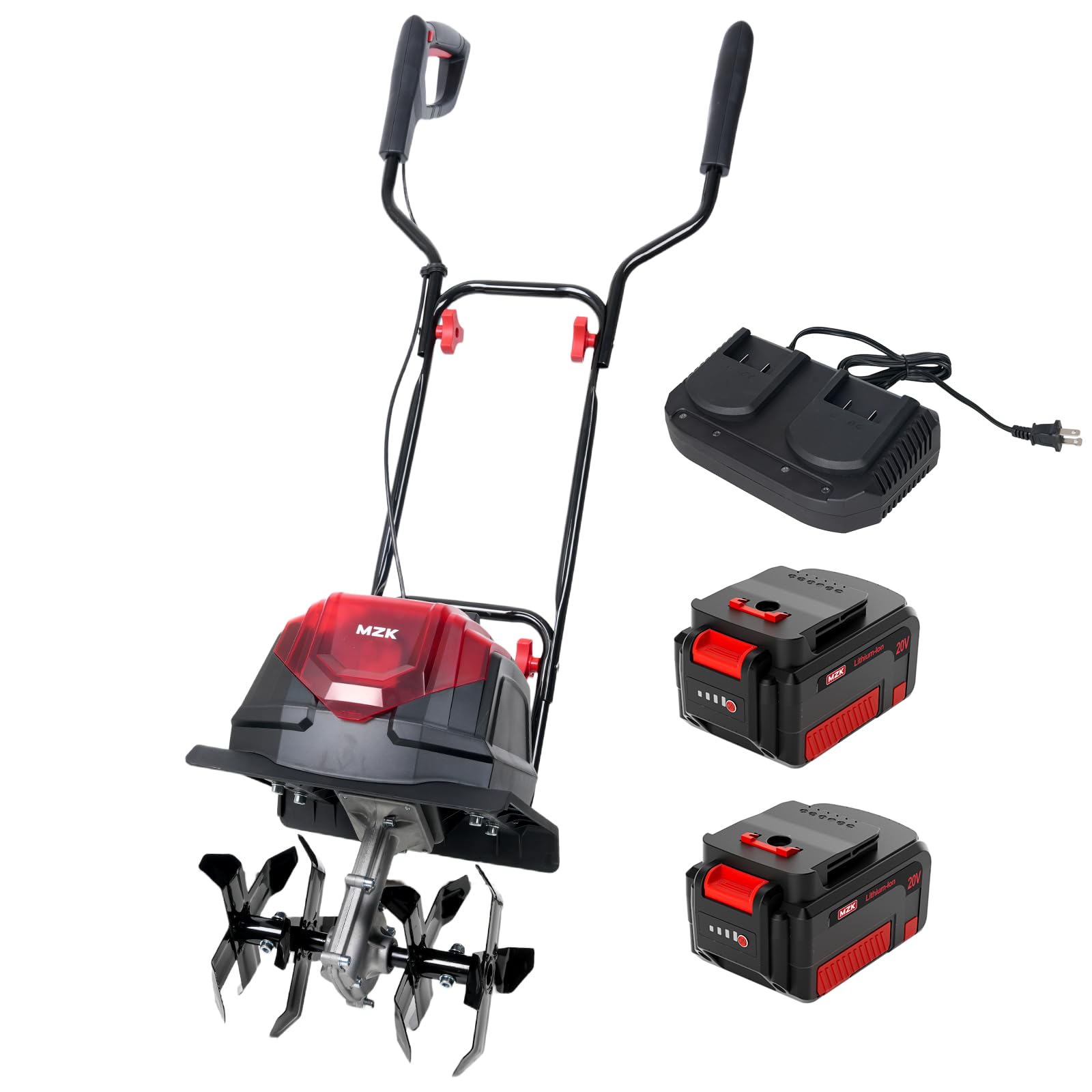
3. MZK 40V 12-inch Cordless Garden Tiller
The widest tilling path in the mid-range that covers ground fast without getting heavy.
This MZK tiller opens up a 14-inch tilling path—56% wider than the 9-inch EnduTools model—which means you can finish a 4-foot-wide raised bed in fewer passes. With a depth of 8.6 inches, it matches the deepest tillers here. Owners mention it “tills 3 raised beds in 15 min” and that the double-handle design gives you control even when the tines bite hard.
The dual 4.0Ah batteries provide up to 35 minutes of runtime at 180 RPM. That is enough for routine maintenance in small to medium beds. The adjustable wheels help you set depth precisely, and the foldable handle stores flat. One reviewer who is 5’3″ called it “perfect depth into soil, light weight, EASY, & powerful.”
While the 180 RPM rotation is slower than the EnduTools, the wider tines and 40V torque compensate by covering more soil per revolution. It is a trade-off of speed versus coverage—choose this if your priority is fewer passes.
Strong points
- 14-inch tilling width is the widest in the mid-range, reducing total pass count.
- 8.6-inch depth handles root vegetables and deep soil turning.
- Lightweight enough for a petite user to maneuver easily.
Weak points
- 180 RPM is slower than the EnduTools’ 360 RPM, so it takes longer to churn through each inch.
- Runs only 35 minutes per battery set versus the EnduTools’ 60 minutes.
Pick this for: Medium gardens where you want the widest possible tilling path in a lightweight, easy-to-store package.
skip it if: You need long runtime for a large area—the EnduTools or TaskStar last longer per charge.
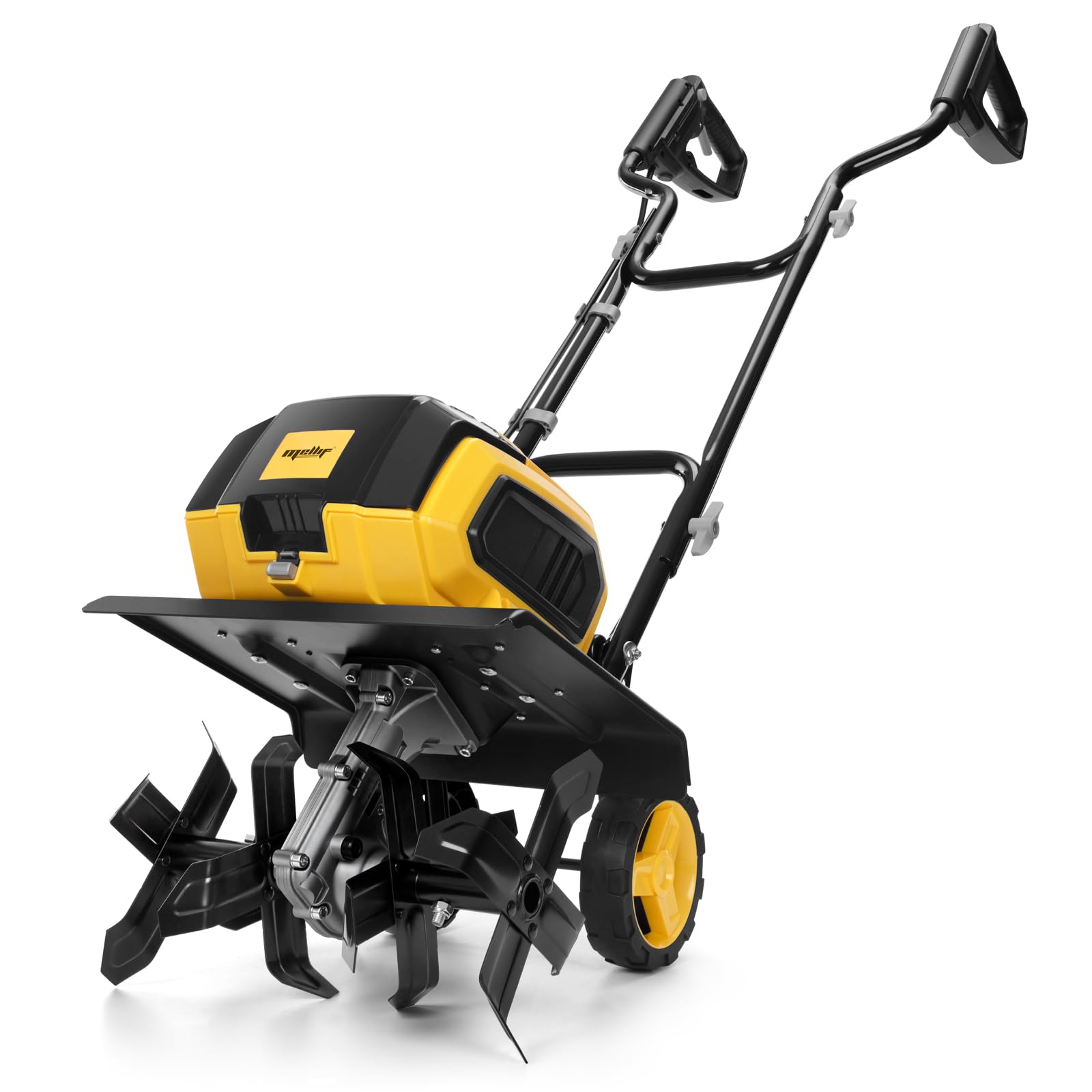
4. Mellif 40V Cordless Brushless Tiller Cultivator
A brushless motor machine that runs on the DeWalt batteries you already own.
If you are already invested in the DeWalt 20V Max platform, this is the only tiller on the list that taps into that battery ecosystem. It uses two DeWalt 20V batteries wired in series to produce 40V of power. That means no extra charger, no new battery packs—just slide in what you have. The manufacturer recommends at least 4.0Ah batteries for best performance, and customers note that “6 Ah or higher” gives longer stretches between swaps.
The brushless motor improves runtime by 30% compared to a brushed equivalent, and the 14.2-inch tilling width with 8.7-inch depth is the roomiest spec on paper. A wide steel base plate 14.5 by 11.4 inches helps reduce soil splash, and the foldable design stores in a small garage corner.
One buyer had the tines stop spinning on the first use, and another mentioned that pine needles wrap around the auger and need cutting off—so quality control is a slight gamble at this price point, but the 5-year warranty covers you if something goes wrong.
Reasons to buy
- Compatible with DeWalt 20V batteries so you can share packs with your drill or saw.
- Brushless motor delivers 30% more runtime and less heat buildup than brushed models.
- 5-year warranty is longer than most competitors.
Watch out for
- Tool only—no batteries or charger included in the box.
- Mixed early reviews on durability; some units failed on first use.
Best for: Homeowners who already own several DeWalt 20V tools and want to avoid buying a separate battery system.
Not for: First-time tool buyers who do not have a stock of high-capacity 20V batteries ready to use.
5. MAXLANDER 40V Cordless Tiller Cultivator
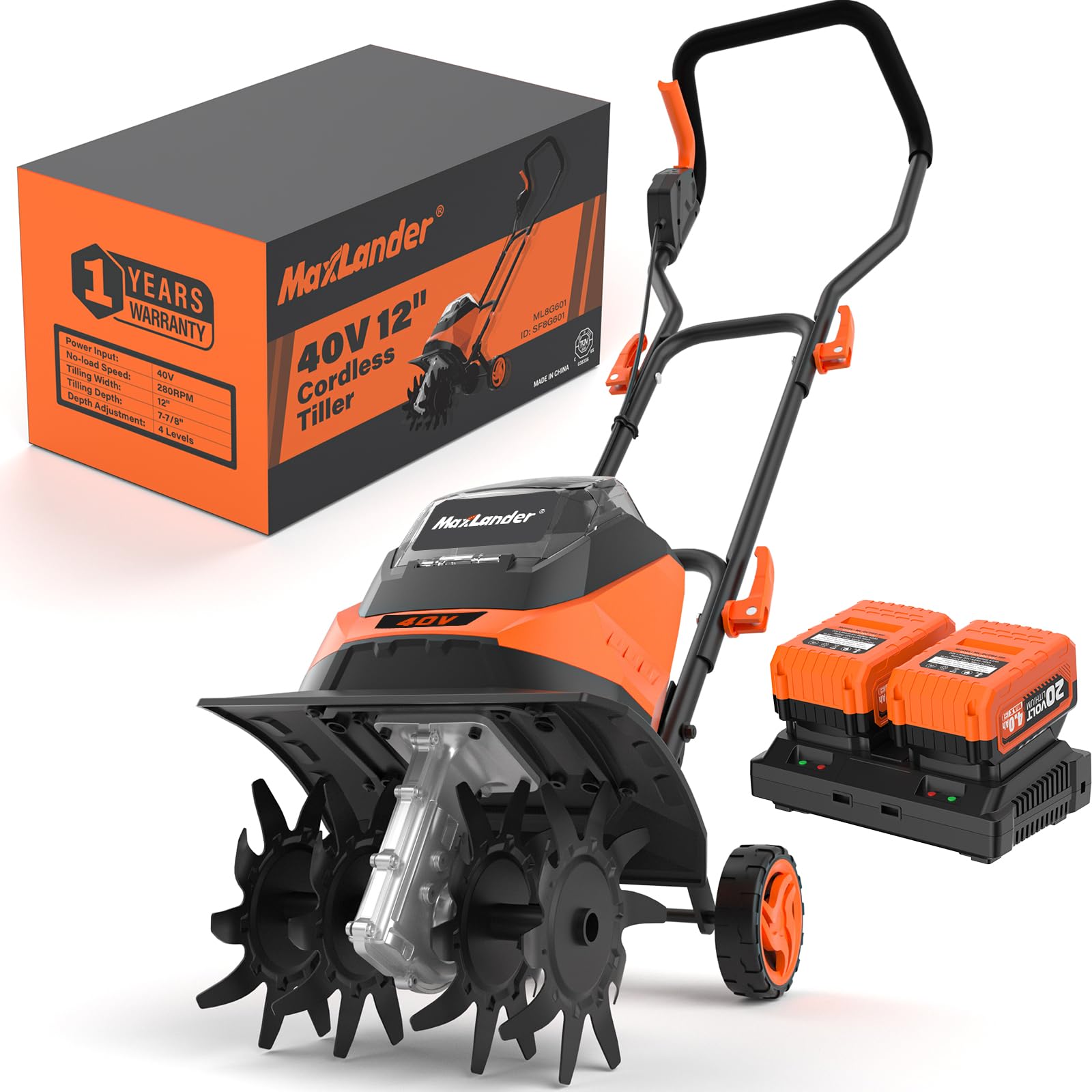
A brushless motor in the mid-range price bracket that breaks up clay with surprising authority.
The MAXLANDER packs a brushless motor (a motor that runs without brushes, so it lasts longer and needs less maintenance) that spins four steel tines at 280 RPM (revolutions per minute) over a 12-inch width and up to 8 inches deep. That 280 RPM sits between the EnduTools’ 360 RPM and the MZK’s 180 RPM—a balance that balances cutting speed with controlled tilling. Reviewers point out it “worked on clay soil with a lot of rocks and roots” without bending the tines, which speaks to the build quality of the alloy steel parts.
It comes with two 4.0Ah batteries and a fast charger. The folding handle makes it convenient for storage, and the double safety button prevents accidental starts. One buyer appreciated the “convenient cordless design that offers freedom of movement” and said the lightweight build was great for extended sessions.
At a mid-range price, you are getting a brushless motor—a feature often reserved for pricier units—which means less maintenance and longer motor life. It is a direct competitor to the TaskStar, but with 4.0Ah batteries instead of 5.0Ah, so runtime is slightly shorter per charge.
Why it works
- Brushless motor provides strong torque and longer life than a brushed motor.
- 4 steel tines handle rocky, root-filled soil without bending.
- Folding handle for easy transport and compact storage.
Considerations
- 12-inch width is solid but not the widest—the MZK covers 14 inches per pass.
- Some users wish the batteries lasted longer on heavy clay.
Reach for this: If you want a brushless motor without paying premium-tier prices, especially for mixed soil conditions with rocks and roots.
Look elsewhere: If maximum battery capacity matters most—the TaskStar includes 5.0Ah packs for a longer run.
6. Seesii 40V Cordless Tiller for Gardening

A thoughtfully engineered tiller that puts comfort and clean-up on equal footing with power.
The Seesii runs on a 40V system with two 5.0Ah batteries—the same generous capacity as the TaskStar top pick—and drives a 320W (watt) motor through four steel tines. The 12-inch tilling width and 8-inch depth are standard for this class, but the real story is in the details: a 3-position adjustable handle and 4-position wheel depth control let you fine-tune the ergonomics and tilling depth without bending down.
Shoppers say that one battery runs for 20+ minutes of continuous work, and the dual chargers mean both batteries top up at the same time. The removable steel tines rinse clean in seconds, which is a major convenience if you regularly work in damp or clay soils that cake onto blades. One reviewer called it “lightweight and easy to use” and said it “does the trick” for a small garden.
The 19-pound weight is among the lightest for a 40V unit, making it easier to lift into a raised bed or carry across the yard. It also comes with a 3-year warranty, which is better than the 2-year coverage on many competitors.
Highlights
- Two 5.0Ah batteries with dual chargers minimize downtime between jobs.
- Removable tines rinse clean in seconds—no caked-on mud.
- Adjustable handle and wheel depth for a custom fit.
Downsides
- 320W motor is adequate but not the most powerful on this list compared to some 40V brushless models.
- Runs slower in damp clay, according to a reviewer.
Best suit: Home gardeners who prioritize comfort adjustments, easy cleaning, and a long warranty period.
Not the best fit: If you need the highest possible torque for breaking entirely new ground with heavy clay.
7. Sun Joe 24V-X2-TLR14 Cordless Garden Tiller Cultivator
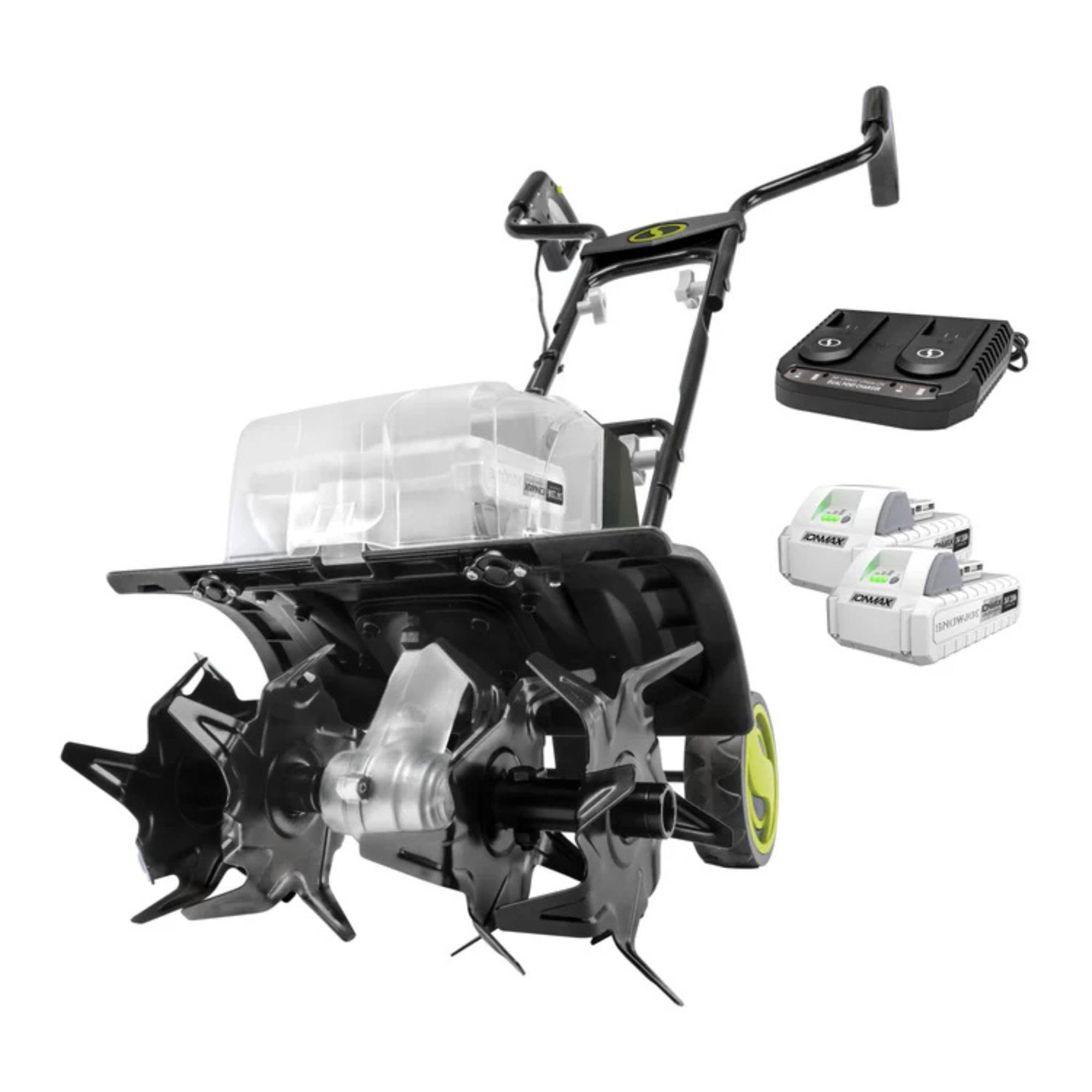
A well-known brand with a wide 14-inch path that keeps the price reasonable.
Sun Joe is a name many homeowners recognize from their string trimmers and blowers, and this tiller fits the same mold: straightforward, reliable, and easy to use. It runs on two 24V 2.0Ah lithium-ion batteries wired together to produce a 24V system (the “24V-X2” in the name) and cuts a 14-inch wide path at 7 inches depth. Four 7-inch steel blades do the digging.
At 25.9 pounds, it is heavier than the 19-pound Seesii but still manageable. The 3-position height adjustment and ergonomic auxiliary handle help reduce back strain. Buyers report it is “lightweight and for a petite woman, can control it” and that it “easily destroys roots” despite being battery powered.
The catch is the 2.0Ah batteries. Compared to the 5.0Ah or even 4.0Ah packs on other models, the Sun Joe’s batteries have less total capacity, so you get shorter runtime per charge. For a medium garden, you may need to recharge mid-job. It is a trade-off of price versus endurance.
What you gain
- 14-inch tilling width covers ground faster than 10- or 12-inch models.
- Brand support and wide availability of replacement parts.
- Easy assembly with just four bolts for the handles.
What you give up
- 2.0Ah batteries provide less runtime than the 4.0Ah or 5.0Ah packs on most competitors.
- No variable speed control, which some users wish for when switching between weeding and deep tilling.
Best for: Homeowners who already use Sun Joe 24V tools and want a tiller with a wide cutting path from a trusted brand.
Skip it for: Long sessions on large gardens—the 2.0Ah batteries run out faster than the competition’s packs.
8. Greenworks Pro 80V 10 inch Cultivator

The highest voltage in the lineup for maximum torque, but with a modest 10-inch tilling width.
The Greenworks Pro runs on an 80V system—double the voltage of most tillers here—which delivers serious torque to its brushless motor. That extra torque translates to slower but more forceful tine rotation that pulls through tough soil without bogging down. One reviewer who switched from a Honda mini gas tiller said the Greenworks “runs much slower but seems to have greater torque” and does the same job with less wear on the operator.
The tilling width adjusts from 8.25 to 10 inches, and depth goes up to 5 inches—shallower than the 8-inch models above, but the design is meant for lighter cultivation and weeding rather than deep soil turning. The included 2.0Ah battery provides up to 40 minutes of runtime, and the 30-minute rapid charger gets you back to work quickly.
A 4-year tool warranty and 2-year battery warranty protect your investment. However, a durability complaint from one buyer who said the unit lasted only a month is worth noting; the mix of metal and plastic construction drew criticism. The 80V platform does lock you into Greenworks batteries if you expand your tool set later.
Pros
- 80V brushless motor delivers class-leading torque for heavy soil.
- 4-year tool and 2-year battery warranty is the longest coverage here.
- Adjustable tilling width from 8.25 to 10 inches for flexibility.
Cons
- 5-inch depth is shallow compared to 8-inch models—not ideal for deep soil turning.
- Some durability concerns reported on the plastic components.
Ideal for: Gardeners who want a powerful motor for weeding and aeration and already own Greenworks 80V tools.
Not ideal for: Deep tilling or preparing brand-new garden beds that require 8+ inches of penetration.
9. Ryobi RY18CVA-0 Motor Hoe 18V ONE+

A versatile cultivator that turns from four tines to two for narrow-row work.
The Ryobi 18V ONE+ cultivator is unique on this list because the tines are tool-free adjustable: you can switch from four tines for full-width tilling down to two tines for narrow cultivating between rows or in smaller patches. That makes it the most versatile pick if your garden layout changes throughout the season. Three speed settings let you match the pace to the job, from slow deep turning to faster weeding.
It is a “tool only” product, meaning no battery or charger in the box. Ryobi claims over an hour of runtime with a 4.0Ah ONE+ battery, which is competitive with the 60-minute EnduTools model. The adjustable auxiliary handle makes extended use more comfortable, and the 18V voltage is enough for maintaining already-worked soil but not for breaking new ground in heavy clay.
Reviewers using it on hard, dry clay report that it “creates good tilth and pulls weed roots” and is ideal for clearing ivy. It is best viewed as an addition to an existing Ryobi ONE+ collection rather than a standalone purchase.
Why choose it
- Tool-free tine adjustment from 4 to 2 tines for narrow passages.
- Three speed settings for different soil conditions.
- More than one hour of runtime with a 4.0Ah ONE+ battery.
Limitations
- 18V motor has less torque than 40V models for breaking hard clay.
- Tool only—requires a separate Ryobi battery purchase if you do not already own one.
Best for: Existing Ryobi ONE+ users who want a nimble cultivator for maintenance, weeding, and precision row work.
Not for: Heavy-duty tilling of new ground or gardeners without a Ryobi battery system.
Understanding the Specs
Voltage and Torque
Voltage is the number that tells you the electrical pressure driving the motor. A 40V tiller can deliver roughly twice the torque of a 20V model, which matters most when you hit compacted clay or roots. Higher voltage also means the motor is less likely to stall when the tines bite deep, so you get a consistent churning action rather than a stuttering one.
Battery Capacity (Ah)
Amp-hours (Ah) measure how much energy the battery stores. A 5.0Ah battery holds 25% more charge than a 4.0Ah one. In real terms, that difference can mean 5 to 10 extra minutes of tilling time per battery. Two batteries double your total runtime. For a medium vegetable garden (roughly 200-300 square feet), two 4.0Ah batteries at 40V are usually enough to finish the job without a recharge break.
FAQ
Can a battery operated rototiller break up new or hard clay soil?
How long do the batteries last on a single charge?
What is the difference between a brushed and a brushless motor?
How wide and deep does a battery tiller need to be for a vegetable garden?
Can I use my existing power tool batteries with a cordless tiller?
Are battery operated rototillers heavy to use?
Can I use a battery tiller for weeding between established plants?
Do I need to assemble a battery powered tiller from the start?
How do I maintain a cordless tiller after use?
Which is better for a large garden—a 40V or an 80V tiller?
Final Thoughts: The Verdict
If you want one dependable pick, the best battery operated rototillers winner is the TaskStar 40V because it pairs a powerful 40V motor with two 5.0Ah batteries for long runtime, a 12-inch tilling width, and an adjustable depth wheel that handles everything from shallow weeding to 8-inch digging. If you want a lightweight machine that fits tight spaces and runs for a full hour, grab the EnduTools 20V. And for the widest tilling path in the mid-range with a foldable design, the MZK 40V covers ground fast with its 14-inch tines.
How We Picked
We do not accept paid placement. Every pick is matched to a real buyer and a real use-case; we do not hands-on test units.
Sources & Methodology
Specifications: manufacturer listings and product documentation. Review insights: verified customer reviews, as of July 2026. Pricing: not shown on this page (it changes often); check the current price via the retailer link.
As an Amazon Associate, Lawn Gear Lab earns from qualifying purchases. This does not affect which products we feature.