
Specs are compiled from manufacturer listings and verified buyer reviews and can change over time — please confirm the key details on the product page before buying.
You want a balanced fertilizer for tomatoes, but the big question is whether to go with a slow-release organic that feeds the soil for weeks or a water-soluble powder that turns your plants dark green in days. Each solves the same problem—giving your tomatoes the even NPK numbers they need—in completely different ways that matter at different points in your growing season. This guide walks through exactly which style fits your tomatoes and your schedule.
I’m Rikta — the founder and writer behind Lawn Gear Lab. This guide is built by comparing the manufacturers’ published specifications and the patterns across verified customer reviews, so you get each pick’s real strengths and trade-offs instead of marketing spin.
These three picks share one thing: a balanced NPK ratio where all three numbers are the same, which is exactly what your tomatoes need to avoid focusing too much on leaves at the expense of fruit. This comparison of the best balanced fertilizer for tomatoes covers a slow-release organic granule, a fast-acting water-soluble powder, and a premium option with added kelp, so you can match the style to how you garden.
Quick Picks
- Jack’s Classic 20-20-20 All Purpose Water-Soluble Fertilizer — Best Overall
- Down To Earth All Natural Fertilizers Organic Vegetable — Best Organic
- GS Plant Foods All Purpose Water Soluble 20-20-20 Fertilizer — Premium Pick
How To Choose The Best Balanced Fertilizer For Tomatoes
A balanced fertilizer has an NPK ratio (the three numbers on the bag for Nitrogen, Phosphorus, and Potassium) that is the same or very close. For your tomatoes, this balanced ratio helps the plant grow healthy leaves, strong roots, and plenty of fruit all at once. Your main choice is between a slow-release organic type and a water-soluble synthetic one, and it depends on how often you want to feed and how quickly you need results.
Slow-Release Organic vs Water-Soluble Synthetic
The biggest fork in the road is how the fertilizer delivers its nutrients. An organic slow-release product like a 4-4-4 granule feeds the soil microbes first, and they break down the nutrients over weeks. This is a low-maintenance approach: you mix it into the soil at planting and let nature do the rest. A water-soluble powder like a 20-20-20 dissolves instantly and the plant absorbs it within days. You have to mix and apply it every week or two, but you get rapid results and can adjust the dosage as you go.
Why an Equal NPK Ratio Matters for Tomatoes
Tomatoes need all three macronutrients in roughly equal measure to avoid common problems. Too much nitrogen relative to phosphorus and potassium pushes the plant to grow huge leafy vines with fewer blooms and smaller fruit. Too little nitrogen leaves the plant yellow and stunted. A balanced ratio—whether it is a mild 4-4-4 or a concentrated 20-20-20—avoids that imbalance so you get sturdy stems, dark green foliage, and good fruit set without any single nutrient dominating.
Reading the Application Rate on the Label
Water-soluble powders list a mixing ratio like “1 tablespoon per gallon of water” while organic granules list pounds per square foot. The concentrated 20-20-20 powders require careful measuring because the high nitrogen content can burn leaves if you overdo it. The 4-4-4 organic granules are much gentler and have almost zero risk of burning your plants. Your choice depends on whether you prefer precision and speed or forgiving simplicity.
Quick Comparison
| Model | Best For | NPK Ratio | Item Form | Item Weight | Amazon |
|---|---|---|---|---|---|
| Jack’s Classic 20-20-20 | Rapid visible greening after transplant | 20-20-20 | Powder | 1.5 Pounds | Amazon |
| Down To Earth 4-4-4 | low-maintenance organic feeding | 4-4-4 | Granules | 5 Pounds | Amazon |
| GS Plant Foods 20-20-20 | Premium formula with kelp for trace minerals | 20-20-20 | Dry | 3 Pounds | Amazon |
In‑Depth Reviews
1. Jack’s Classic 20-20-20 All Purpose Water-Soluble Fertilizer

The fast-acting powder that gave one gardener a “complete garden turnaround in 1 week.”
Reach for this pick right after you transplant your tomatoes into the garden. Its balanced 20-20-20 NPK ratio (20% Nitrogen, 20% available Phosphate, and 20% Soluble Potash) gives your plants a concentrated dose for fast green-up and leaf expansion. Unlike the Down To Earth 4-4-4 organic granules below, which weigh 5 pounds and feed slowly for weeks, this water-soluble powder weighs just 1.5 pounds and mixes instantly with water for a liquid feed your plant absorbs within hours. Buyers report it dissolves completely “no shaking needed” and works on peppers, flowers, and hydroponic setups too.
The included measuring spoon takes the guesswork out of mixing: reviewers report using 1 tablespoon per gallon of water as a full-strength dose. The added micronutrients (iron, manganese, zinc, copper, boron, molybdenum) cover the trace elements that plain NPK formulas miss. One experienced gardener mentioned the 1.5 pound tub “lasts most of the growing season” when used weekly. The catch is that the high 20% nitrogen content means you must measure carefully to avoid burning the leaves—stick to the spoon and do not guess.
Fast & Effective
- Gives “complete garden turnaround in 1 week” per buyers reports
- Dissolves completely with “no shaking needed” for quick mixing
- Works as foliar feed or root feed for flexible application
Handle with Care
- High nitrogen concentration requires careful measuring to avoid leaf burn
- Only 1.5 pounds—runs through faster than the 5 lb organic granules
- Not organic; synthetic formulation
Reach for this if: You want fast visible results after transplant and enjoy the flexibility of adjusting your feeding strength week by week.
Look elsewhere if: You prefer a mix-once-and-forget slow-release organic that you can work into the soil before planting without measuring every week.
2. Down To Earth All Natural Fertilizers Organic Vegetable Garden 4-4-4
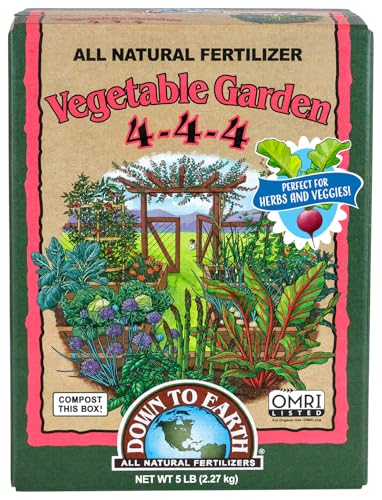
The slow-release organic that one buyer’s kale and collards “really start standing up” after.
This 5-pound box of granules takes the opposite approach from the Jack’s Classic 20-20-20 above. Instead of dissolving instantly for a quick hit, the 4-4-4 ratio is mild and the all-natural ingredients break down gradually as soil microbes do their work. You mix these granules into the soil at planting or top-dress around established plants, and the nutrients release over weeks. Owners mention their Kale and Collard Greens “really start standing up and have sprouted some more over the week it’s been in the plant” after feeding with this.
The mild 4-4-4 ratio means you have almost zero risk of burning your plants, even if you apply a generous amount. The manufacturer specifically lists it for “tomatoes” and “herbs” along with greens and raised beds. One reviewer called it a “good top dressing after transplant” giving the plants a gentle extra kick at a critical moment. At 5 pounds versus the Jack’s Classic 1.5-pound powder, so one box covers a lot of garden bed. The trade-off: you will not see the same overnight green-up you get from the water-soluble 20-20-20 option above, because the nutrients take time to break down.
Gentle low-maintenance
- Non-toxic and safe for beneficial insects, pollinators, and pets
- Slow-release formula reduces risk of nutrient leaching and fertilizing too often
- Generous 5-pound box means one purchase covers an entire season for several beds
Patience Required
- Slower onset—don’t expect visual results within days like a synthetic powder
- Bulkier than powder; you need to work granules into the soil
Perfect for: The organic gardener who wants to work the fertilizer into the soil at the start of the season and not think about feeding again for weeks.
Not ideal for: Anyone who needs a quick rescue for yellowing or stalled tomato plants and wants a visible response in days rather than weeks.
3. GS Plant Foods All Purpose Water Soluble 20-20-20 Fertilizer
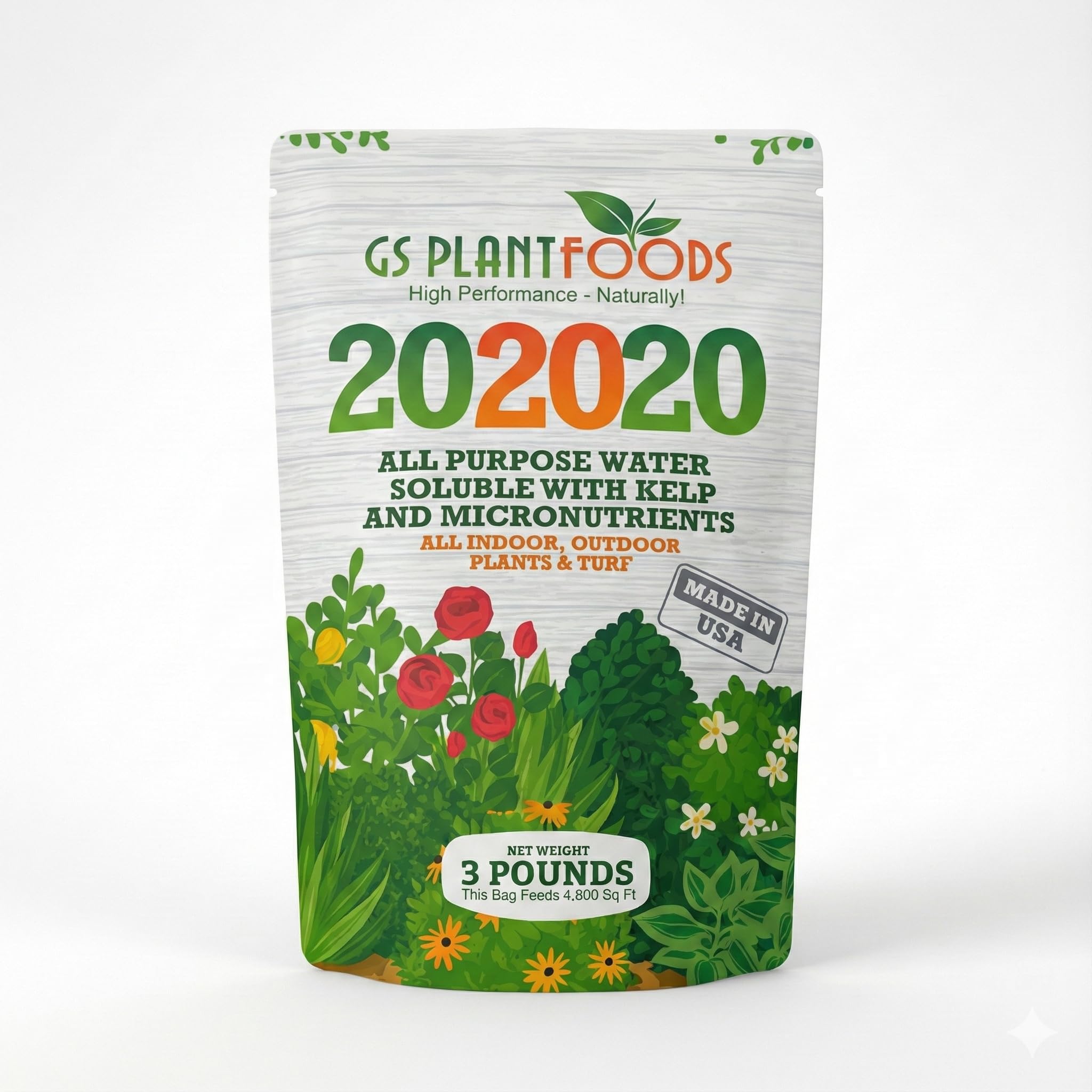
The water-soluble option with added kelp that turned a dying Orchid tree around in a week.
Like the Jack’s Classic 20-20-20 above, this is a concentrated water-soluble powder with the same 20-20-20 balanced NPK ratio. What makes it different is the addition of kelp (Ascophyllum nodosum) as part of the nutrient blend. Kelp provides natural growth stimulants and trace elements that standard synthetic formulas often skip. One reviewer noted trying it on unhealthy Purple Orchid trees and seeing “within a week, treated tree developed dark green, larger leaves vs. yellow/brown on untreated.” That kind of rapid response is exactly what you want when your tomato plants stall after a cold snap or poor soil.
The 3-pound bag feeds up to 4,800 square feet of turf when used as directed, compared to the Jack’s Classic 1.5-pound tub above. The full micronutrient profile includes iron, manganese, copper, zinc, boron, and molybdenum. Customers note it “will not burn your plants if you use it according to the instructions” and keep the powder dry between uses. One experienced grower also observed it has a “slight organic odor” from the kelp content, which is noticeable when mixing but fades quickly. The only real caveat is that the kelp content does not make it organic—it is a blend of natural and industrially produced fertilizer, so purists should stick with the Down To Earth 4-4-4 organic granules above.
Kelp-Enhanced Formula
- Added kelp provides trace minerals and natural growth stimulants standard 20-20-20 formulas lack
- Reviewers point out dramatic greening effect within a week on stressed plants
- 3-pound bag covers a large area—up to 4,800 sq ft of turf
Not Fully Organic
- Blend of kelp and standard synthetic fertilizer—not an organic product
- Slight organic odor when mixed due to kelp content
Best suited for: Gardeners who want the rapid green-up of a water-soluble 20-20-20 but also want the extra micronutrient boost from kelp for healthier, more resilient plants.
skip it if: You require a 100% organic fertilizer—go with the Down To Earth 4-4-4 granules instead.
Understanding the Specs
What NPK Ratios Actually Mean
The three numbers on a fertilizer bag—like 4-4-4 or 20-20-20—represent the percentage by weight of Nitrogen (N), available Phosphate (P), and Soluble Potash (K). A balanced ratio means all three numbers are equal, so your tomato plants get roughly the same proportion of each macronutrient. A 20-20-20 is much more concentrated than a 4-4-4, so you use far less powder per gallon of water. Think of it like stock concentrate versus a mild broth: both are balanced, but one requires careful dilution.
Slow-Release vs Water-Soluble Delivery
Slow-release organic granules (like the 4-4-4) rely on soil microbes to break down the nutrients over weeks. You mix them into the soil once and they release gradually as the soil warms and microbes become active. Water-soluble powders (like the 20-20-20) dissolve instantly in water and the plant can absorb them within hours. This gives you the speed to correct a deficiency fast, but you have to reapply every one to two weeks because the nutrients do not linger in the soil.
FAQ
Can I use a 20-20-20 water-soluble fertilizer on tomato seedlings or is it too strong?
Will a balanced 4-4-4 organic fertilizer feed my tomatoes all season or do I need to reapply?
What is the difference between applying a balanced fertilizer as a foliar spray versus a root drench for tomatoes?
Can I mix two different balanced fertilizers together for better results on tomatoes?
Why would I choose a 4-4-4 organic fertilizer over a 20-20-20 water-soluble option if the NPK ratios are both balanced?
Does the kelp extract in GS Plant Foods make it organic or just a synthetic fertilizer with a natural additive?
How often should I apply a water-soluble 20-20-20 fertilizer to my tomato plants during the growing season?
Can I use a balanced 4-4-4 organic fertilizer in a container or raised bed with potting mix or does it need real soil microbes?
What should I do if my tomato leaves start turning yellow after I apply a 20-20-20 water-soluble fertilizer?
Is a 20-20-20 balanced fertilizer safe to use alongside other supplements like Epsom salt or calcium for tomatoes?
Final Thoughts: The Verdict
For most people, the best balanced fertilizer for tomatoes winner is the Jack’s Classic 20-20-20 because it gives you the fastest visible results, dissolves completely, and comes with a measuring spoon so you avoid burns. If you want a low-maintenance organic approach, grab the Down To Earth 4-4-4 which is safer for beneficial insects and feeds gently for weeks. And for the extra trace mineral boost from kelp, go with the GS Plant Foods 20-20-20 which one buyer described as turning an unhealthy tree around within a week.
How We Picked
We do not accept paid placement. Every pick is matched to a real buyer and a real use-case; we do not hands-on test units.
Sources & Methodology
Specifications: manufacturer listings and product documentation. Review insights: verified customer reviews, as of July 2026. Pricing: not shown on this page (it changes often); check the current price via the retailer link.
As an Amazon Associate, Lawn Gear Lab earns from qualifying purchases. This does not affect which products we feature.