
Bahia grass is a low-maintenance, drought-tolerant warm-season turf that thrives on sandy, infertile soil — but its very resilience makes it easy to starve or burn with the wrong NPK ratio. Unlike hybrid Bermuda or St. Augustine, Bahia has a deep taproot and a coarser blade that demands measured, slow-release nitrogen rather than quick-fix liquid dumps that leach through sand before roots can drink.
I’m Rikta — the co-founder and writer behind Lawn Gear Lab. I spend my days cross-referencing NPK ratios, analyzing slow-release polymer coatings, and stacking verified owner feedback against university turf trials to separate the blends that actually feed a Bahia root system from those that just green the top for a week.
After comparing seven formulations — from budget granular blends to premium professional-grade feeds — this guide breaks down exactly which bahia grass fertilizer delivers sustained deep greening without the burn, leaching, or surge growth that wastes your time and money.
How To Choose The Best Bahia Grass Fertilizer
Bahia grass is not a heavy feeder, but it is a nitrogen-hungry grass that grows on soils where most other turf struggles. Choosing the right fertilizer means balancing nitrogen delivery speed, phosphorus content, and supplemental micronutrients that sandy soils typically lack.
Slow-Release vs. Quick-Release Nitrogen
Bahia’s root system extends deep into the soil profile, but sandy soils have little cation exchange capacity to hold nutrients. Quick-release nitrogen sources like urea can leach below the root zone within days. A fertilizer with at least 50 percent slow-release nitrogen — from polymer-coated urea or sulfur-coated urea — feeds the turf steadily over 8 to 12 weeks without the flush-and-fade cycle.
Low Phosphorus (The Middle Number)
Most Bahia growing regions — Florida, the Gulf Coast, the Southeast — have sandy soils naturally high in phosphorus and are subject to strict local fertilizer bans on phosphorus. A fertilizer labeled “0” in the middle number (e.g., 24-0-6 or 28-0-0) avoids overloading the soil and complies with seasonal restrictions. Even where phosphorus is allowed, Bahia rarely benefits from anything above 5 percent P2O5.
Iron and Micronutrients for Color
Bahia is naturally a lighter green than St. Augustine or Zoysia. Iron supplementation — ideally 2 percent or more — deepens the green without pushing excessive top growth that requires extra mowing. Humic acid additives further improve nutrient uptake in sandy profiles, making every pound of nitrogen count.
Quick Comparison
On smaller screens, swipe sideways to see the full table.
| Model | Category | Best For | Key Spec | Amazon |
|---|---|---|---|---|
| The Andersons Deep Green 24-0-11 | Premium Granular | Deep color + summer stress prevention | 24-0-11 with 2% iron | Amazon |
| Yard Mastery Flagship 24-0-6 | Premium Granular | Large lawns needing full-season feeding | 24% slow-release N, 15K sq ft | Amazon |
| The Andersons Green Shocker 7-1-2 | Fast-Acting Granular | Quick green-up in 3 days | 7-1-2 with Humic DG | Amazon |
| GreenView Fairway Formula 27-0-5 | Mid-Range Granular | Steady 12-week feeding for medium lawns | 63% slow-release N, 10K sq ft | Amazon |
| Petramax Liquid 28-0-0 | Liquid Concentrate | Quick correction of nitrogen deficiency | 28-0-0, 70% quick-release N | Amazon |
| Great Big Roses Liquid Booster | Liquid Soil Activator | Root conditioning and trace minerals | 70 minerals + humic acid | Amazon |
| Hi-Yield Grower’s Special 12-6-6 | Entry-Level Granular | Ornamental beds near Bahia turf | 12-6-6 slow-release granules | Amazon |
In‑Depth Reviews
1. The Andersons Deep Green 24-0-11 Professional-Grade Lawn Fertilizer

The Andersons Deep Green delivers a 24-0-11 NPK profile that aligns perfectly with Bahia’s needs: high nitrogen, zero phosphorus, and a healthy potassium boost for heat and drought stress. The 2 percent iron content is not a token additive — it’s enough to visibly darken the foliage without pushing the surge of top growth that forces you to mow twice a week. The nitrogen blend combines quick-release for an initial green flush with slow-release polymer-coated prills that feed for up to 8 weeks.
On sandy Bahia lawns, this formulation reduces the risk of nitrogen leaching because the slow-release component stays put through heavy summer thunderstorms. Owner reports frequently note that brown spots disappear within three weeks and that the color matches — or beats — what neighbors get from professional lawn services. The 40-pound bag covers 10,000 square feet, making the cost per application competitive with mid-range granular options despite the premium label.
The manganese inclusion supports chlorophyll production in alkaline sandy soils where iron alone can lock up. Apply it in late spring after Bahia greens up fully, then again in late summer for sustained color through fall. Overlapping passes during application will leave dark green stripes that last two months, so use a calibrated spreader and cover each row carefully.
What works
- Zero phosphorus avoids local fertilizer bans and suits sandy soil profiles
- 2 percent iron plus manganese delivers deep color without excessive growth
What doesn’t
- Overlapping spreader passes creates very visible dark stripes that persist for weeks
- Premium price point may be hard to justify for very small Bahia lawns under 3,000 sq ft
2. Yard Mastery Flagship 24-0-6 Granular Lawn Fertilizer

Yard Mastery Flagship is built for large Bahia lawns where covering 15,000 square feet with a single bag matters as much as the formulation itself. The 24-0-6 ratio keeps phosphorus at zero while providing 24 percent slow-release nitrogen supplemented by Bio-Nite technology — a microbial activator that helps unlock existing soil nutrients. At 45 pounds, this is a heavy bag, but the coverage per pound is among the best in this comparison.
Bermuda and Bahia owners both report that this fertilizer thickens the turf enough to choke out existing weed pressure after one full season of quarterly applications. The 3 percent iron content contributes to the dark green color that neighbors notice, though the 6 percent potassium is modest compared to the Andersons Deep Green’s 11 percent — a minor trade-off if your lawn does not face extreme summer heat stress.
The slow-release coating uses a dual-polymer technology that releases based on soil temperature rather than moisture, which means a single application in late spring continues feeding through the hottest weeks of July. Some users note that the growth response is vigorous enough to require twice-weekly mowing during peak season, so adjust your nitrogen schedule accordingly if you prefer a slower growth rate.
What works
- Single 45-pound bag covers 15,000 sq ft — excellent value per square foot
- Bio-Nite microbial additive improves nutrient availability in sandy soils
What doesn’t
- Vigorous growth stimulation may require more frequent mowing than expected
- Potassium at 6% is lower than premium alternatives for heat-stress scenarios
3. The Andersons Green Shocker 7-1-2 Fertilizer with Humic DG
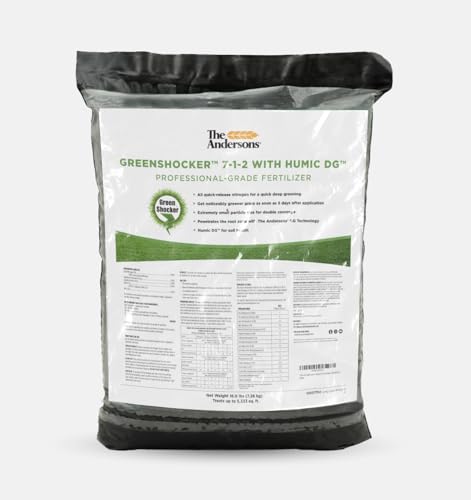
The Andersons Green Shocker takes a different approach from the high-N, slow-release options. Its 7-1-2 NPK is entirely fast-release nitrogen, designed for spoon-feeding — small, frequent applications that give you precise control over color without the long-term commitment of a polymer-coated product. The Humic DG granules are extremely fine, dispersing evenly through a broadcast spreader and dissolving quickly into the soil profile.
For Bahia lawns that have turned pale from a nitrogen deficiency or an early-season cold shock, this product produces visible darkening in as little as three to four days. It is not a standalone feeding program — think of it as a spot-treatment booster or a mid-season color refresher between your main granular feedings. The 16-pound bag covers roughly 5,000 to 8,000 square feet at maintenance rates, so it pairs well with a larger slow-release program.
The Humic DG component chelates micronutrients and improves the soil’s cation exchange capacity, which is particularly valuable on sandy Bahia soils where nutrients normally wash through. Some users have found it effective on potted ornamentals and vegetable beds as well, making it a flexible addition to your garden shed if you manage mixed plantings adjacent to Bahia turf.
What works
- Visible greening within 72 hours — unmatched speed for a granular product
- Humic DG improves nutrient retention in leachy sandy soils
What doesn’t
- All fast-release nitrogen requires reapplication every 3-4 weeks for sustained feeding
- Not for sale in California due to local fertilizer regulations
4. GreenView Fairway Formula Lawn Fertilizer 27-0-5

GreenView Fairway Formula hits a sweet spot between price and performance for medium-sized Bahia lawns. The 27-0-5 ratio delivers the highest nitrogen concentration in this comparison, with 63 percent of that nitrogen in slow-release form — enough to sustain feeding for a full 12 weeks. The 33-pound bag covers 10,000 square feet, and the cost per application lands well below premium options while still using a quality polymer-coated prill.
Bahia owners in the Southeast report that this fertilizer greens up their lawn within a few days of application, with the color holding through the summer heat without the dramatic fade common with quick-release products. The zero-phosphorus formulation complies with summer fertilizer bans in Florida and other sensitive watershed areas. The granules flow cleanly through rotary spreaders without bridging or clogging, which is a real advantage for users who have struggled with sticky, moisture-prone blends.
One limitation is the relatively modest potassium at 5 percent. For Bahia lawns that face heavy foot traffic or extended dry periods, a higher-K supplement in late summer may still be needed. But for the standard two-application schedule — spring and late summer — this bag covers an entire acre of Bahia with one purchase, making it the most cost-effective option for budget-conscious homeowners.
What works
- 63% slow-release nitrogen provides 12 weeks of consistent feeding per application
- Zero phosphorus allows use during local summer fertilizer restrictions
What doesn’t
- Potassium at 5% may be insufficient for high-traffic or drought-stressed areas
- 33-lb bag is heavy to handle and requires a large spreader hopper
5. Petramax Liquid Nitrogen Fertilizer 28-0-0

Petramax Liquid 28-0-0 is the highest-nitrogen product in this review and the only pure liquid formulation. It blends 70 percent quick-release urea for immediate green-up with 30 percent slow-release nitrogen for residual feeding between applications. For Bahia lawns that have gone pale from a missed feeding cycle, this product corrects the deficiency within a week and can be applied through any hose-end sprayer or backpack sprayer.
The 32-ounce bottle treats up to 12,800 square feet at maintenance rates, making it surprisingly cost-effective for a liquid product. The key advantage of a liquid over granules is uniform coverage on Bahia lawns that may have uneven thatch layers — the nitrogen solution penetrates down to the root zone rather than sitting on top of the canopy. It also works well on Bahia pastures where granular spreader access is limited by uneven terrain.
The main trade-off is longevity. Even with the slow-release fraction, liquid nitrogen does not match the 8-to-12-week feeding window of a good polymer-coated granular. Expect to reapply every 4 to 6 weeks to maintain color. The formula also lacks iron and potassium, so it functions best as a booster within a broader program rather than a standalone seasonal feed.
What works
- Liquid application penetrates thatch and reaches Bahia’s deep root zone directly
- Treats up to 12,800 sq ft per bottle at maintenance dilution — excellent value
What doesn’t
- No iron or potassium means color and stress-resistance improvements are limited
- Requires reapplication every 4-6 weeks — higher labor than slow-release granulars
6. Great Big Roses and Flowers Liquid Fertilizer Booster
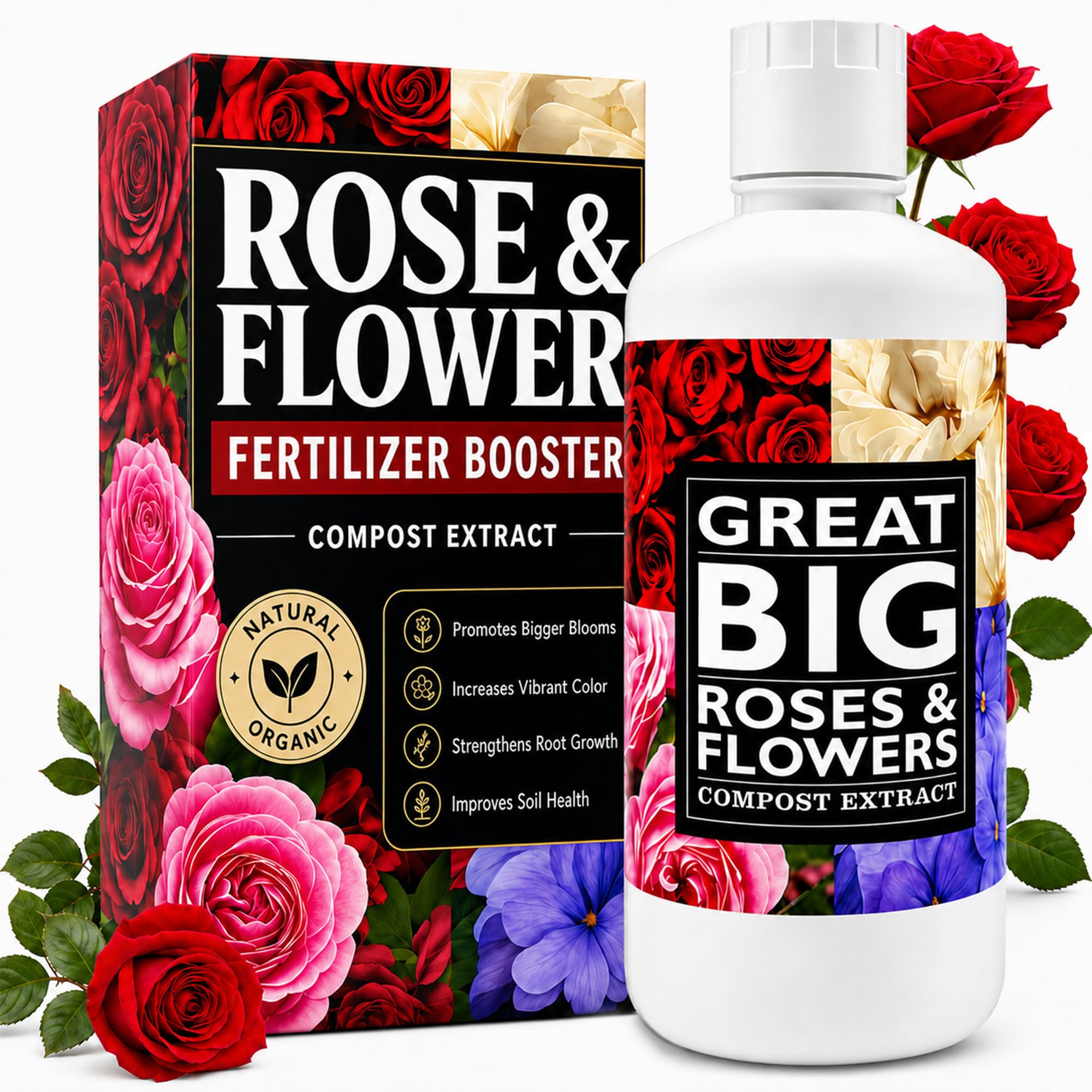
This product is not a traditional N-P-K fertilizer — it is a soil activator and mineral supplement designed to amplify the performance of the granular feed you already apply. Great Big Roses delivers humic acids, seaweed extract, and over 70 chelated trace minerals that unlock nutrients locked in sandy soils and convert them into forms Bahia roots can absorb. On tired Bahia lawns that have been fed only synthetic urea for years, this booster can restore microbial activity and improve root mass.
Apply it as a soil drench 48 hours after your main granular application. The 32-ounce bottle makes 8 gallons of working solution, covering a full growing season for most residential lawns. Bahia owners report that their grass develops a deeper, more uniform green after one season of using this alongside a standard 24-0-6 granular — the minerals help correct deficiencies that straight nitrogen cannot fix.
The liquid is thick and requires thorough shaking before mixing. Some users find the bottle opening too wide, making it easy to over-pour when measuring into a watering can. For large Bahia lawns, a hose-end sprayer makes application faster, though the product is not specifically designed for sprayer use at full concentration.
What works
- 70 chelated minerals correct micronutrient deficiencies common in sandy Bahia soils
- Humic and seaweed content improves root mass and soil microbial health
What doesn’t
- Not a standalone nitrogen source — must be paired with a granular fertilizer program
- Bottle design makes measuring and pouring messy; spillage wastes expensive concentrate
7. Hi-Yield Grower’s Special Fertilizer 12-6-6
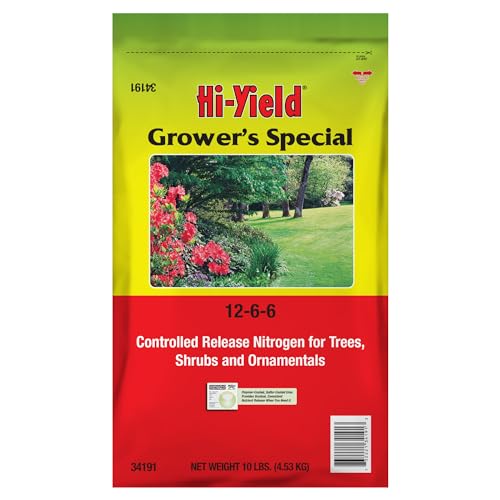
Hi-Yield Grower’s Special is a general-purpose granular fertilizer with a 12-6-6 NPK formulation. It provides slow-release nitrogen to reduce the risk of burn, but the phosphorus content at 6 percent is higher than ideal for Bahia lawns — especially those in areas with phosphorus restrictions. For Bahia that is part of a mixed ornamental landscape with shrubs, trees, and flower beds, this one-bag solution covers everything without needing separate products for different plant types.
The 10-pound bag is compact and easy to store, but the coverage area is limited compared to the larger bags in this comparison. At the label rate for trees and shrubs, a single bag treats only a modest area — for a full Bahia lawn of 5,000 square feet or more, you would need multiple bags, which negates the low entry price. Where this product shines is spot-feeding Bahia that borders garden beds or container plants, because the 12-6-6 ratio serves both the turf and the ornamentals in the same pass.
User reviews note visible growth improvement in shrubs and magnolias, but the effect on Bahia grass itself is less dramatic than with a high-nitrogen, zero-phosphorus product. This is a serviceable entry-level option for a very small Bahia yard or for treating the perimeter where the lawn meets garden beds, but it is not the most efficient tool for a full Bahia turf feeding program.
What works
- One bag feeds both Bahia border areas and adjacent ornamental shrubs and trees
- Slow-release nitrogen reduces the risk of burn on sensitive plants
What doesn’t
- High phosphorus (6%) may violate local bans and offers no benefit to Bahia turf
- Small 10-lb bag is uneconomical for full-lawn coverage on any lawn over 2,000 sq ft
Hardware & Specs Guide
NPK Ratio — The Three Numbers
For Bahia grass, the first number (nitrogen) is the most critical. Look for 12 to 28 percent nitrogen. The middle number (phosphorus) should ideally be 0 or very low — Bahia rarely benefits from extra P on sandy soils. The third number (potassium) between 5 and 11 percent supports drought and heat stress tolerance. A ratio like 24-0-6 or 27-0-5 is nearly ideal for pure Bahia turf.
Slow-Release vs. Quick-Release Nitrogen
Polymer-coated or sulfur-coated urea particles release nitrogen over weeks rather than days. Products with 50 percent or more slow-release N — such as the GreenView Fairway Formula at 63 percent or Yard Mastery Flagship at 24 percent slow N — reduce leaching losses in sandy Bahia soils and keep the turf fed evenly. All quick-release products like The Andersons Green Shocker work best as short-term boosters between granular applications.
Iron and Humic Additives
Iron (chelated or sulfate form) deepens the green color of Bahia grass without forcing excessive leaf growth. Products with 2 percent or more iron, such as The Andersons Deep Green at 2 percent or Yard Mastery Flagship at 3 percent, produce a visible color difference within days. Humic acid additives — like those in The Andersons Green Shocker’s Humic DG — improve the soil’s ability to hold nutrients on sandy profiles where cation exchange capacity is low.
Coverage Area and Bag Size
Coverage rates are typically listed for maintenance feeding (about 1 pound of nitrogen per 1,000 square feet per application). A 33-pound bag of GreenView covers 10,000 sq ft, while a 45-pound Yard Mastery bag covers 15,000 sq ft. Smaller bags like the 10-pound Hi-Yield are better suited for spot-feeding or garden beds. For a full Bahia lawn, choose a bag that covers your square footage in one application to avoid having to buy multiple bags.
FAQ
Can I use a fertilizer with phosphorus on Bahia grass?
How often should I fertilize Bahia grass in a year?
Is liquid or granular fertilizer better for Bahia grass?
Why does my Bahia grass stay pale even after fertilizing?
Final Thoughts: The Verdict
For most gardeners, the bahia grass fertilizer winner is the The Andersons Deep Green 24-0-11 because it delivers the zero-phosphorus, high-iron profile that Bahia needs for deep color and heat stress protection on sandy soils. If you want the best per-square-foot value on a large lawn, grab the GreenView Fairway Formula 27-0-5. And for a quick color rescue between your main granular feedings, nothing beats the speed of the The Andersons Green Shocker 7-1-2 with Humic DG.