
Specs are compiled from manufacturer listings and verified buyer reviews and can change over time — please confirm the key details on the product page before buying.
Stopping weeds, keeping the soil damp, and feeding your vegetables without adding chemicals is the real job of a good garden mulch. But with blocks of compressed coconut husk, bags of aspen bark, and bales of organic straw on the shelf, the right pick depends on which trade-off you are willing to make. The best bagged mulch for a vegetable garden either expands massively from a small block to cover a big area, or locks moisture in so you water far less often — and the data behind each pick makes that choice clear.
I’m Rikta — the founder and writer behind Lawn Gear Lab. This guide is built by comparing the manufacturers’ published specifications and the patterns across verified customer reviews, so you get each pick’s real strengths and trade-offs instead of marketing spin.
After sorting through organic options from coconut coir blocks to aspen bark and wheat straw, five natural mulches stand out as the top contenders for your vegetable garden. This deep dive into the best bagged mulch for vegetable garden choices covers the actual volume you get, how well each one holds water, and what real buyers discovered after spreading it.
Quick Picks
- Back to the Roots 100% Organic Mulch, 58 Quart (2 Cubic ft), Expanding Coconut Husk Block — Best Overall
- Plantonix Organic Coco Chips for Plants (10lbs) – Coconut Husk Chips — Top Performer
- Brut Organic Aspen Mulch 10 QT – Natural Moisture Retainer & Root Protector — Best Value
- HealthiStraw GardenStraw, 3 cu ft (20 lbs) All-Natural Mulch — Compact Pick
- Blue Mountain Hay Organic Garden Straw (5 lb) – Natural Mulch — Best for Pots
How To Choose The Best Bagged Mulch For Vegetable Garden
The first question is what you want the mulch to do for your vegetables. Some mulches are great at holding water, some at blocking weeds, and some at adding organic matter back into the soil as they break down. The material you pick — bark, coir (coconut husk), or straw — decides which of those jobs it does best.
Material: Bark vs Coir vs Straw
Bark mulches like aspen are fine-textured and break down into something close to compost, which feeds the soil over time. Coconut coir (husk chips or a compressed block) is excellent at holding water — it absorbs up to 10 times its own weight — and improves soil aeration as it decomposes. Straw is lightweight and great for covering large areas quickly, but the big risk is that it may carry seeds that sprout in your beds, turning your weed-suppression layer into a weed-growing layer.
Expanded Volume vs Packaged Volume
Pay close attention to whether the mulch is compressed or loose. A 10-pound block of coconut coir expands to over 2 cubic feet (about 15 gallons) when you add water — far more volume than the bag suggests. A bag of loose bark or straw, on the other hand, is what you see. If you need to cover a large garden area, the compressed blocks give you more mulch per package, but you must have a container big enough to hydrate and fluff them.
Water Retention and Your Climate
If you garden in a hot, dry area or want to cut down on how often you water, look for a mulch with strong water-holding capacity. Buyers of aspen bark report that it reduces watering by half. Coconut coir can hold up to 10 times its weight in water. Straw is also good at retaining moisture and keeping the soil cool, but it can dry out faster on the surface if spread too thin.
Organic Certification and Purity
For a vegetable garden, you want a mulch that is free from dyes, chemical treatments, and synthetic additives. Look for an OMRI (Organic Materials Review Institute) listing on the label, which confirms the product meets organic standards. Also check buyer reviews for mentions of unwanted seeds or contaminants — especially with straw mulches, as some buyers report an explosion of grass shoots after spreading the straw.
Quick Comparison
On smaller screens, swipe sideways to see the full table.
| Model | Best For | Volume | Item Weight | Unit Count | Amazon |
|---|---|---|---|---|---|
| Brut Organic Aspen Mulch 10 QT | Odor-free bark for pots & herbs | 10 Quarts | 10 Pounds | 192.0 Ounce | Amazon |
| Plantonix Coco Chips 10lbs | Water-absorbing coir for raised beds | 15 Gallons | 10 Pounds | 160.0 Ounce | Amazon |
| Back to the Roots Coco Mulch Block | Big expansion for large garden areas | 2 Cubic Feet | 10 Pounds | — | Amazon |
| Blue Mountain Hay Organic Straw | Clean, soft straw for potted plants | — | 5 Pounds | — | Amazon |
| HealthiStraw GardenStraw 3 cu ft | Large-volume straw for big gardens | 3 cubic feet | 20 Pounds | — | Amazon |
In‑Depth Reviews
1. Back to the Roots 100% Organic Mulch, 58 Quart (2 Cubic ft), Expanding Coconut Husk Block
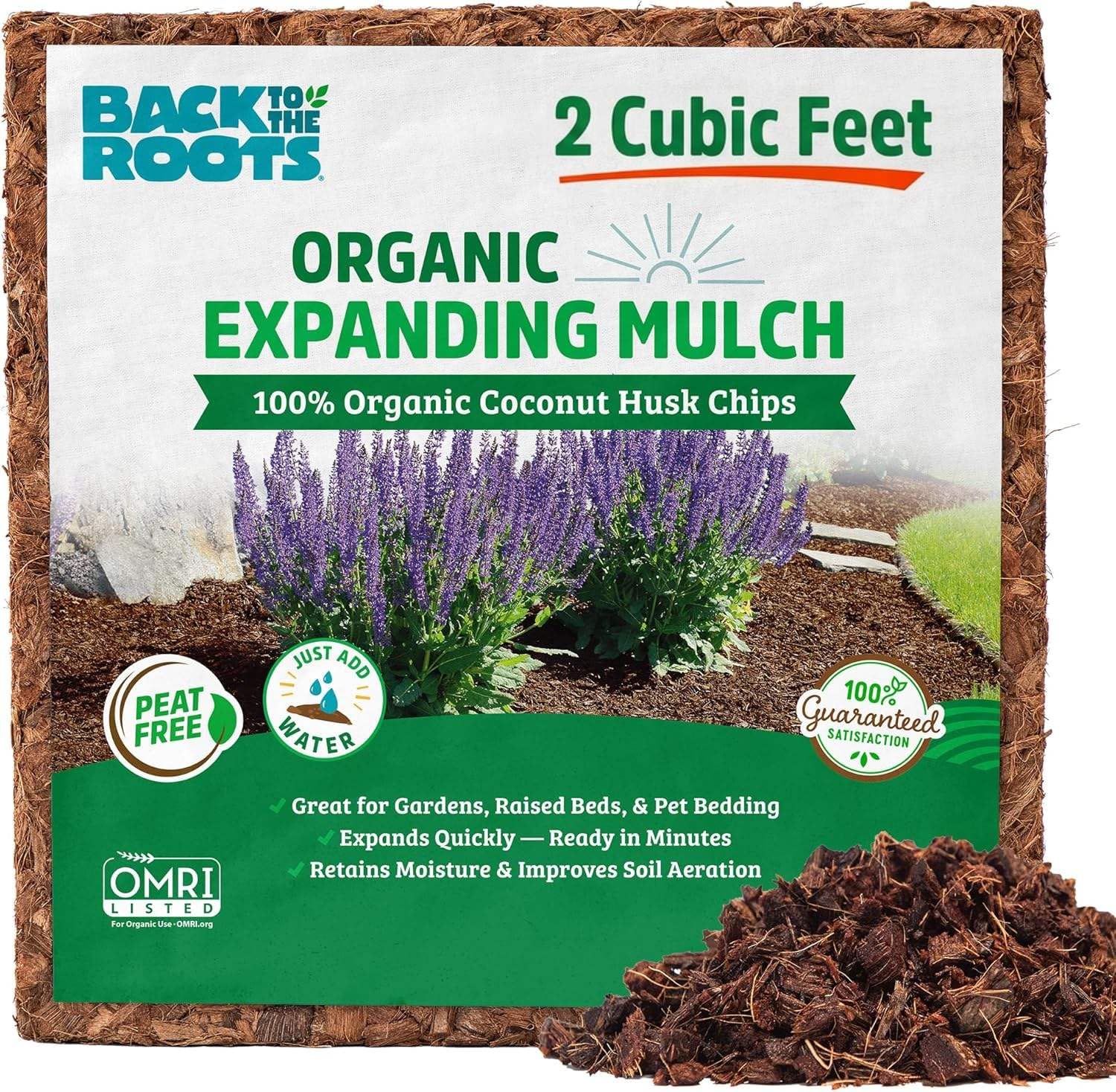
A 10-pound compressed block that turns into a wheelbarrow-load of garden-ready mulch.
You get one dense 10-pound block of compressed coconut husk that expands to over 2 cubic feet when you add water — enough volume that one reviewer noted it filled a wheelbarrow three-quarters full and even a kiddie pool. Unlike loose bark bags that show you what you get, this block hides its real volume until you hydrate it, so you cover far more garden bed than the package size suggests. It is OMRI-listed (Organic Materials Review Institute — certified for organic production), meaning it meets organic standards, and the material breaks down over time to add organic matter back into your vegetable garden soil.
In full sun, owners mention this mulch retains moisture noticeably longer than other organic options, which is the main reason you layer it on in the first place. The chips are fine enough for small spaces and pots, and a few buyers pair it with cocoa bean hulls for a more aromatic top layer. The trade-off is that you need a strong person or a wheelbarrow to carry the soaked mass — one reviewer specifically mentioned you have to be strong enough to carry the bucket after expansion.
Unlike the Blue Mountain Hay straw below, which carries a risk of sprouting grass, this coconut block gives you a clean seed-free mulch that suppresses weeds without introducing new ones. The expansion also means this pick gives you 2.0x the volume-per-pound vs the 5-pound Blue Mountain straw — you are getting a lot more coverage for roughly the same effort.
Why it wins
- Compressed block expands to over 2 cubic feet, covering a large area from a small package
- Excellent moisture retention in full sun, according to buyer reports
- OMRI-listed organic certification with no dye or chemicals
- Breaks down into soil-improving organic matter over time
The physical work
- Heavy and bulky once hydrated; you need a strong person or wheelbarrow to handle it
- Must be soaked in a large container before spreading — not a straight-out-of-the-bag mulch
Your best bet if: you want maximum coverage from a lightweight block and are willing to spend a few minutes hydrating it before spreading across raised beds or a large garden.
The one caution: the soaked block is heavy, so plan your setup — a wheelbarrow or large bucket is nearly essential.
2. Plantonix Organic Coco Chips for Plants (10lbs) – Coconut Husk Chips

Coco chips that hold 10x their own weight in water, keeping your vegetable roots hydrated.
These coconut husk chips are a natural soil amendment that doubles as a moisture-holding mulch for vegetable gardens. The 10-pound brick expands to 15 gallons when you add water, and each chip can absorb up to 10 times its own weight in water, which directly reduces how often you need to irrigate your beds. The chips also have a high cation exchange capacity (CEC — the soil’s ability to hold onto nutrients like fertilizer), which means the mulch helps keep fertilizer in the root zone where your vegetables can use it rather than letting it wash away.
Customers note that once wet, the chips work great in raised beds and large planters, and the natural color looks good on top of the soil without any smell. The brick expands nicely and creates a lot less dust than smaller coir, making it easier to handle indoors or in a garage. But the obvious head-to-head difference against the Brut aspen bark is unit count: the Plantonix has 160.0 ounces, which is 20% less than Brut’s 192.0 ounces, so you get slightly less material by weight for a similar price tier.
What stands out
- Absorbs up to 10x its weight in water — one of the highest moisture retentions among organic mulches
- Improves soil aeration and drainage as it breaks down, preventing compaction
- Neutral pH prevents nutrient lock-up in the soil
What to know
- Brick needs to be soaked and broken up before use; not a pour-and-spread product
- Fewer ounces per package than the Brut aspen bark (160.0 vs 192.0 ounces)
Reach for this if: you want a mulch that doubles as a soil conditioner and helps keep nutrients available for heavy-feeding vegetables like tomatoes and peppers.
Look elsewhere if: you prefer a ready-to-spread bark that does not require soaking or breaking up before application.
3. Brut Organic Aspen Mulch 10 QT – Natural Moisture Retainer & Root Protector
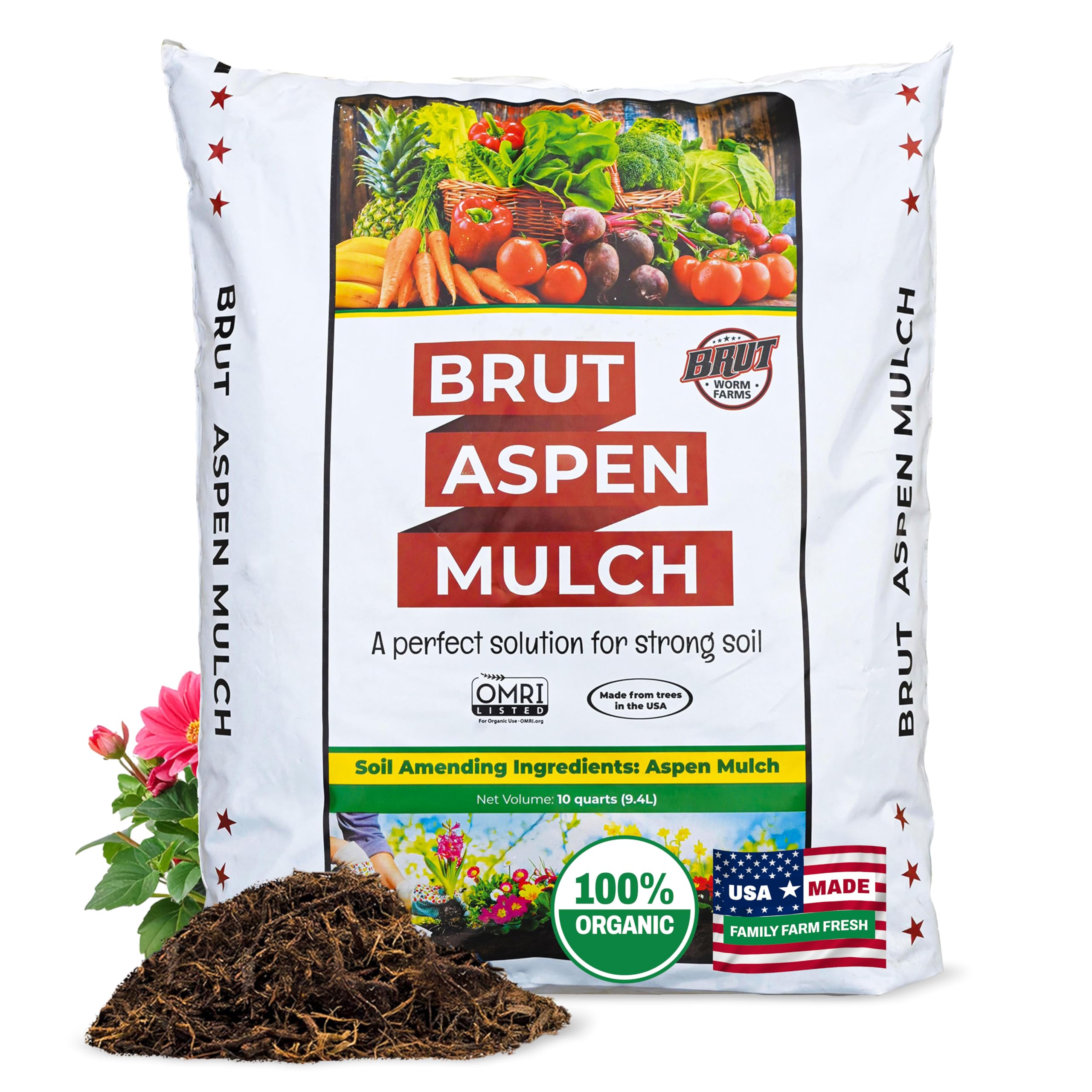
Fine aspen bark that one buyer says reduced their watering by half.
This is a loose, ready-to-spread aspen bark mulch with a fine texture that is closer to compost than coarse wood chips. It is OMRI-listed for organic gardening and comes with 192.0 ounces in the bag — which is 20% more material by weight than the Plantonix coconut chips above. The fine texture makes it ideal for container herbs and tomatoes, and one buyer specifically noted the “excellent moisture retention” and that it “reduces watering by half.” Another reviewer praised it as top quality, saying their newly planted tree was a happy camper.
The bark contains 30% natural carbon to foster beneficial soil microbes, according to the manufacturer, which helps improve soil structure over time. It is also odor-free and lightweight, so you can carry the bag straight to your garden beds and pour it out without any prep work. The clear trade-off is volume — multiple buyers mention that the 10-quart bag covers less area than you might expect, and one reviewer gave it 3 stars specifically because they felt the bag did not contain the stated 10 quarts. For large garden beds, you would need several bags.
Why it works
- Fine near-compost texture is perfect for container vegetables and herbs
- Odor-free and lightweight — ready to spread straight from the bag
- Reviewers point out it reduces watering frequency by half
- Contains 30% natural carbon to support soil microbes
The catch
- 10-quart volume covers less area than expected per bag
- Some buyers question whether the bag truly holds 10 quarts of mulch
Perfect for: container gardening and small raised beds where you want a fine-textured ready-to-use organic mulch that lowers your watering load.
Not ideal if: you need to cover a large in-ground vegetable garden on a budget, as the per-area cost adds up fast.
4. HealthiStraw GardenStraw, 3 cu ft (20 lbs) All-Natural Mulch
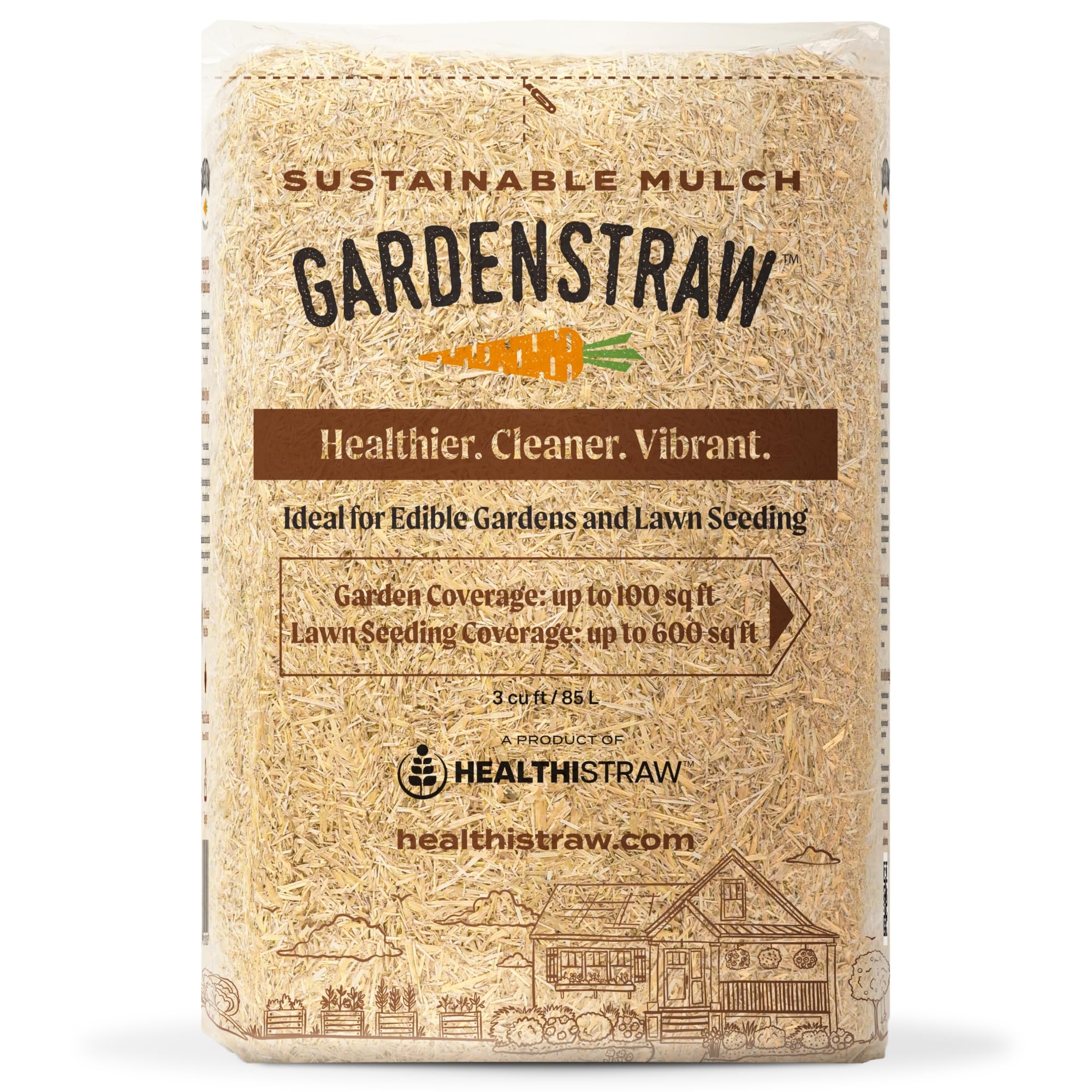
A 20-pound straw bale that the manufacturer claims reduces watering by up to 50%.
This is a substantial 3-cubic-foot compressed bale of all-natural wheat straw designed to retain soil moisture and limit evaporation. The manufacturer claims it reduces watering needs by up to 50%, and the fibers are specially cut so they interlock when watered — meaning the straw stays in place even in wind and rain without requiring chemical binders. For a large vegetable garden, the maker says this bale covers up to 100 square feet at a 2-to-3-inch layer, or up to 600 square feet if you are spreading it thinly for lawn seeding.
Buyers with two 4-by-8-foot raised beds report that one bale covered both perfectly, and another reviewer noted the straw lasts a long time and works well with everything from flowers to peppers to sweet potatoes. The bale is bulky but not heavy, which makes it easy to carry around the garden. However, a significant caveat emerged: a few buyers discovered excessive seeds sprouting in their beds and lawn after spreading this straw, making it hard to distinguish from grass. One 3-star review specifically called it “so many seeds.” This is the same seed-sprouting risk that also showed up in the Blue Mountain Hay straw, but the HealthiStraw gives you a much bigger bale for a similar premium price.
The big coverage
- Compressed 3 cu ft bale covers up to 100 sq ft at a 2-3 inch depth, according to the manufacturer
- Interlocking fibers stay in place without chemical binders
- Non-GMO wheat straw breaks down quickly to add carbon and organic matter
The seed risk
- Multiple shoppers say excessive seeds sprouting in garden beds and lawn
- Coverage claims may be optimistic; some buyers found it covered less than stated at the recommended depth
Get this for: a large garden area where you want a single bale of clean straw that stays put and reduces watering, and you are willing to accept some seed sprouting risk.
skip it if: you cannot afford any stray grass shoots in your raised beds — the seed content is a real gamble.
5. Blue Mountain Hay Organic Garden Straw (5 lb) – Natural Mulch
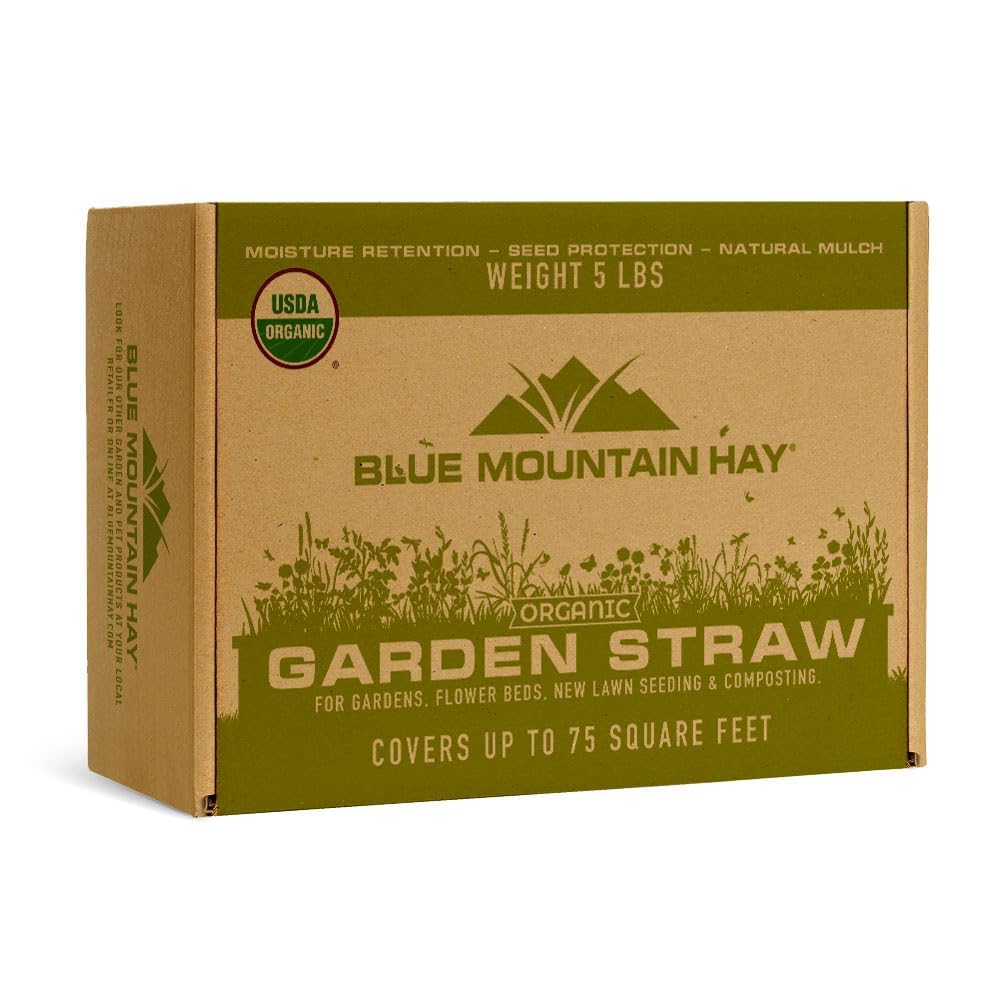
A tidy 5-pound box of clean organic straw for pots and small garden jobs.
This is a small 5-pound box of organic straw that is minimally processed and naturally dried, giving you clean fibers with no dirt or bugs. One reviewer used it as a cover for potted plants, onion tubs, garlic, and potato layering, and said the single 5-pound box was more than enough for all those applications. It is a 5-pound box, which at 5 pounds is noticeably lighter than the 10-pound blocks and bricks of the other mulches in this guide.
However, this product has a serious reported issue: one buyer mentioned the straw caused massive grass shoots to sprout in all their raised beds, including strawberries and vegetables, and described the shoots as looking like winter wheat. The company did not respond to their complaint. Another reviewer gave 4 stars but said the 300-square-foot coverage claim is unrealistic — they only achieved about 100 square feet at a 1-inch depth. For large gardens, this box is expensive per square foot, and you would need several boxes to match the coverage of one HealthiStraw bale.
Why it fits small gardens
- Clean, soft, low-dust straw — easy to spread by hand around potted plants and small beds
- One 5lb box was enough for multiple containers and a small garlic bed, per one buyer
- Organic and minimally processed with no chemical treatments
Real-world problems
- Some buyers report massive grass and wheat shoots sprouting in raised beds
- Coverage claim of 300 sq ft is unrealistic; one reviewer got 100 sq ft at 1 inch
- Expensive per square foot compared to the larger HealthiStraw bale or coconut blocks
Best for: small-scale gardeners who need a clean, tidy straw for potted vegetables, onion beds, or garlic layering and do not want a huge bale sitting around.
Not for: anyone with a large vegetable garden or raised beds where stray grass shoots would be a nightmare — the seed risk is real and well-documented.
Understanding the Specs
Expanded Volume vs Packaged Weight
Compressed coconut blocks (like the Back to the Roots or Plantonix) are light to carry at 10 pounds, but they expand to 2 cubic feet or 15 gallons once you add water. Loose bark or straw shows its full volume in the bag. The key question is whether you have a container big enough to hydrate a block — if not, a loose-fill bag might be simpler even if it covers less ground.
Moisture Retention Capacity
Some mulches absorb a lot of water and release it slowly to your plant roots. Coconut coir can hold up to 10 times its own weight in water. Aspen bark owners mention it reduces watering by half. Straw also retains moisture but can dry out faster on the surface. If your garden is in full sun or you want to water less often, the material’s water-holding ability is the single most important spec.
OMRI-listed Certification
OMRI (Organic Materials Review Institute) listing means the product has been reviewed and approved for use in organic production. For a vegetable garden, this certification gives you confidence that the mulch contains no synthetic dyes, pesticides, or chemical treatments. Not all natural mulches carry this label, so check for it if organic purity is a priority.
Seed Contamination Risk
With straw mulches, the biggest hidden spec is the seed count. Unlike coconut coir or bark, straw comes from grain plants, and some batches retain viable seeds that sprout in your moist garden beds. This is not stated on the bag — you only learn about it from buyer reviews. If you cannot risk stray grass or wheat shoots in your carefully planted beds, a seed-free material like coconut husk or aspen bark is safer.
FAQ
Can I use regular wood chips as mulch for my vegetable garden?
How thick should I spread mulch in my vegetable garden?
Will coconut coir mulch lower the pH of my vegetable soil?
How long does bagged mulch last before it breaks down?
Is straw mulch safe for tomato plants?
How much mulch do I need for a 4×8 foot raised bed?
Can I mix coconut coir with garden soil?
Does dyed mulch harm vegetable plants?
How do I hydrate a compressed coconut husk block?
What is OMRI-listing and why does it matter for vegetable gardens?
Final Thoughts: The Verdict
For most vegetable gardeners, the best bagged mulch for vegetable garden is the Back to the Roots Organic Coconut Husk Block because it expands from a compact 10-pound block to over 2 cubic feet of organic, OMRI-listed mulch that retains moisture in full sun and suppresses weeds without introducing seeds. If you want a ready-to-spread bark that reduces watering by half for your containers and herbs, grab the Brut Organic Aspen Mulch. And for covering a large in-ground garden with straw that stays in place without chemical binders, the HealthiStraw GardenStraw bale gives you the biggest coverage per package, as long as you are willing to accept a small risk of stray seed sprouts.
How We Picked
We do not accept paid placement, and we did not hands-on test every unit. Instead, we match each pick to a real buyer and use-case by comparing the manufacturers’ published specifications against the patterns in verified customer reviews — so you get each pick’s real strengths and trade-offs instead of marketing copy.
Sources & Methodology
Specifications: manufacturer listings and product documentation. Review insights: verified customer reviews, as of July 2026. Pricing: not shown on this page (it changes often); check the current price via the retailer link.
As an Amazon Associate, Lawn Gear Lab earns from qualifying purchases. This does not affect which products we feature.