
Specs are compiled from manufacturer listings and verified buyer reviews and can change over time — please confirm the key details on the product page before buying.
You want to finish the yard and have the clippings disappear in one pass — no raking, no blowing, no piles. But a bag that clogs or fills halfway forces you to stop every few minutes. The right bagged lawn mower keeps you moving from start to finish.
I’m Rikta — the founder and writer behind Lawn Gear Lab. This guide is built by comparing the manufacturers’ published specifications and the patterns across verified customer reviews, so you get each pick’s real strengths and trade-offs instead of marketing spin.
For most people, the best bagged lawn mower is the push mower that packs a bigger bag than anything near its price. Read on to see why.
Quick Picks
- SENIX 21″ Gas Lawn Mower 144cc — Best Overall
- PowerSmart EasyGlide 21-Inch Gas Lawn Mower — Top Value
- SENIX 21″ Self-Propelled Gas Lawn Mower — Self-Propelled Pick
- PowerSmart 21″ Self-Propelled Gas Lawn Mower — Slope Master
- GasXcel 21″ Self Propelled Lawn Mower Gas, 170CC — Most Versatile
- SENIX 22 Inch 3-in-1 Gas Lawn Mower, 201cc — Heavy Duty
- EGO Power+ Electric Lawn Mower LM2200SP — Premium Cordless
- 21″ Steel Deck Gas Lawn Mower — Budget Pick
- AMERISUN 21-Inch Gas Push Lawn Mower — Budget Alternate
How To Choose The Best Bagged Lawn Mower
Bagged lawn mowers are defined by their ability to collect clippings, but not every catcher works the same way. A few key specs will tell you whether a mower actually fills its bag or just blows grass around the deck.
Engine Displacement and Power
The engine size (in cubic centimeters, or cc) dictates how well the mower cuts through thick, wet, or tall grass before it reaches the bag. A 144cc engine handles a typical suburban yard, while a 170cc or 201cc engine powers through heavier growth without bogging down. More displacement also keeps the blade spinning fast enough to push clippings fully into the catcher, reducing clogs at the chute.
Bag Capacity and Catcher Design
Bag size is measured in bushels. A 1.4-bushel catcher is standard on most mid-range mowers and works well for a quarter-acre lot. A 1.7-bushel bag means fewer stops to empty, which matters if your yard has a lot of grass or thick growth. The material and frame of the catcher also matter — a rigid frame holds its shape even when full, while a flimsy bag can sag and block the chute opening.
Push vs Self-Propelled
A push mower is lighter and simpler, but a full bag of clippings adds weight you have to push. Self-propelled models, especially with rear-wheel drive, keep the mower moving forward on slopes and over uneven ground without you fighting the load. For yards with hills or for anyone who wants less effort, self-propelled is worth the extra cost.
Deck Width and Material
Deck width (21 or 22 inches) sets how wide a path you cut with each pass — a 22-inch deck covers more ground per lap. Steel decks are standard for gas mowers; they handle bumps and resist cracking better than plastic, and a heavier steel deck also keeps the mower planted on uneven turf for a more consistent cut height.
Quick Comparison
| Model | Best For | Engine | Deck Width | Bag Size | Amazon |
|---|---|---|---|---|---|
| SENIX 21″ Push (Prod 5) | Overall Value & Performance | 144cc | 21″ | 1.7 bushel | Amazon |
| PowerSmart EasyGlide Push | Lightweight & Easy Assembly | 144cc | 21″ | — | Amazon |
| PowerSmart 21″ Self-Propelled | Slopes & Medium Yards | 170cc | 21″ | 1.4 bushel | Amazon |
| GasXcel 21″ Self-Propelled | 4-in-1 Versatility & 7 Heights | 170cc | 21″ | — | Amazon |
| SENIX 21″ Self-Propelled (FWD) | Flat Yards & Easy Guidance | 170cc | 21″ | 1.7 bushel | Amazon |
| SENIX 22″ Self-Propelled | Large Yards & Heavy Cutting | 201cc | 22″ | — | Amazon |
| EGO Power+ LM2200SP | Premium Cordless Power | Electric (56V) | 22″ | — | Amazon |
| 21″ Steel Deck Push (Amerisun) | Budget Pick for Basics | 144cc | 21″ | 1.4 bushel | Amazon |
| AMERISUN 21″ Push (Black) | Alternate Budget Pick | 144cc | 21″ | 1.4 bushel | Amazon |
In‑Depth Reviews
1. SENIX 21″ Gas Lawn Mower 144cc
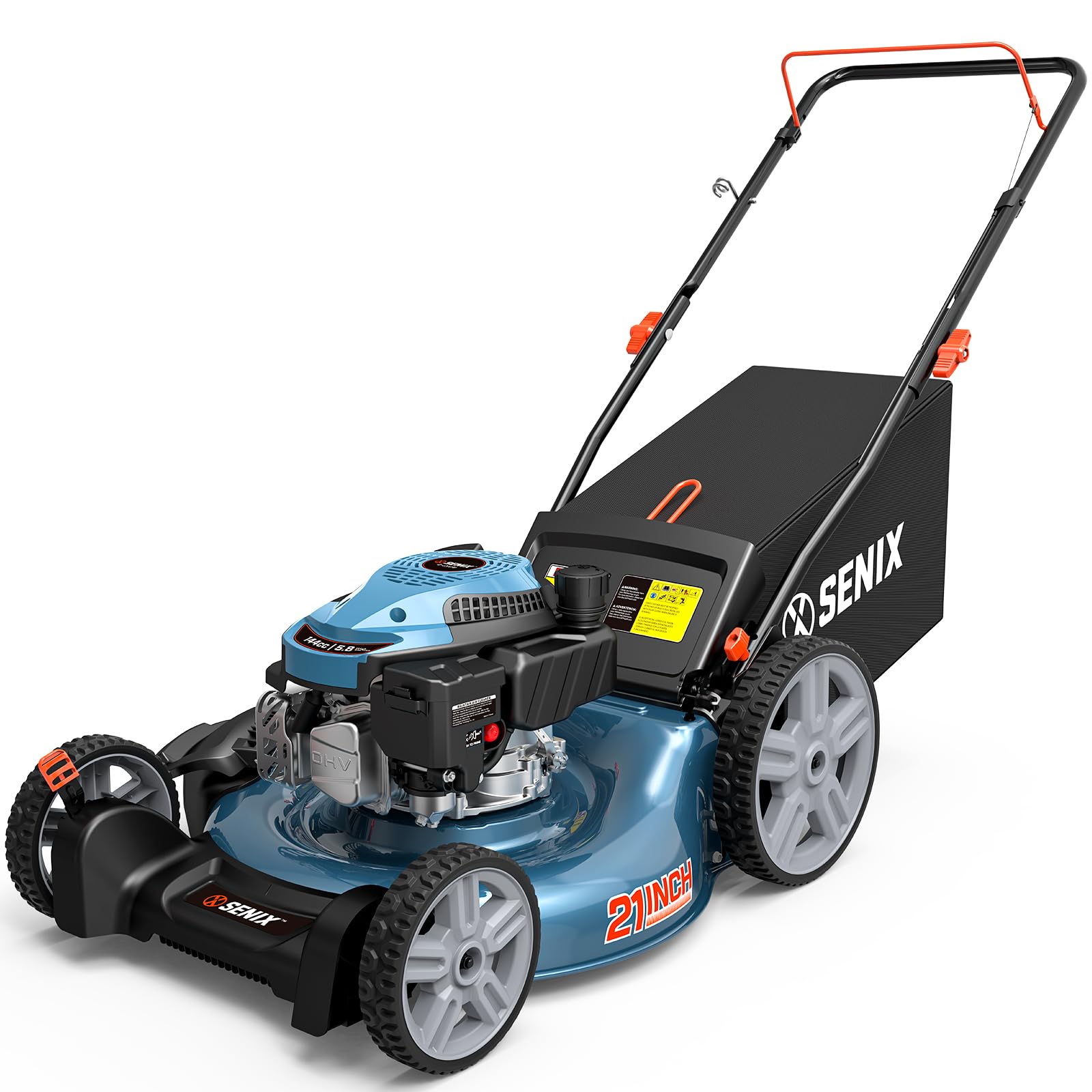
The push mower that packs a 1.7-bushel bag — the largest catcher in its price bracket — and a 144cc engine that starts on the first pull.
You stop fewer times to dump clippings with this mower because its 1.7-bushel bag holds about 2.1 cubic feet, while many competitors use 1.4-bushel catchers. The 144cc 4-cycle OHV engine delivers 3.4 HP and 5.8 ft-lb of torque, so it powers through thick grass without bogging, and the pre-filled oil means you start mowing in minutes. The 8-inch front and 11-inch rear wheels roll smoothly over uneven ground, and the dual-lever height adjustment gives you six cutting positions from 1.25 inches to 3.75 inches.
Buyers report the mower “starts in one pull every time” and that it is “lightweight and pushes easy,” which matters when the bag fills up and adds weight. The 21-inch cutting width covers a 1/3-acre yard efficiently, and the 3-in-1 system (bag, mulch, side discharge) gives you options for every season. The DC04-06 high-strength steel deck resists dents and keeps the cut consistent on bumpy ground. Owners mention that the vortex tunnel design reduces grass buildup under the deck, which keeps the chute clear and the bag filling properly. The 2-year limited warranty adds a layer of protection that many budget mowers lack.
Biggest catch: A few early customers note the deck adjustment can slip or the engine may smoke on first use — a quality-check concern that makes it worth inspecting the unit immediately and testing it before the return window closes.
Who it fits: Homeowners with a 1/3-acre lot who want a push mower that bags efficiently, starts reliably, and costs less than a self-propelled model.
Who should look elsewhere: Anyone with a hilly yard who needs rear-wheel drive — this is a manual-push mower, so you will be doing the work on inclines.
2. PowerSmart EasyGlide 21-Inch Gas Lawn Mower
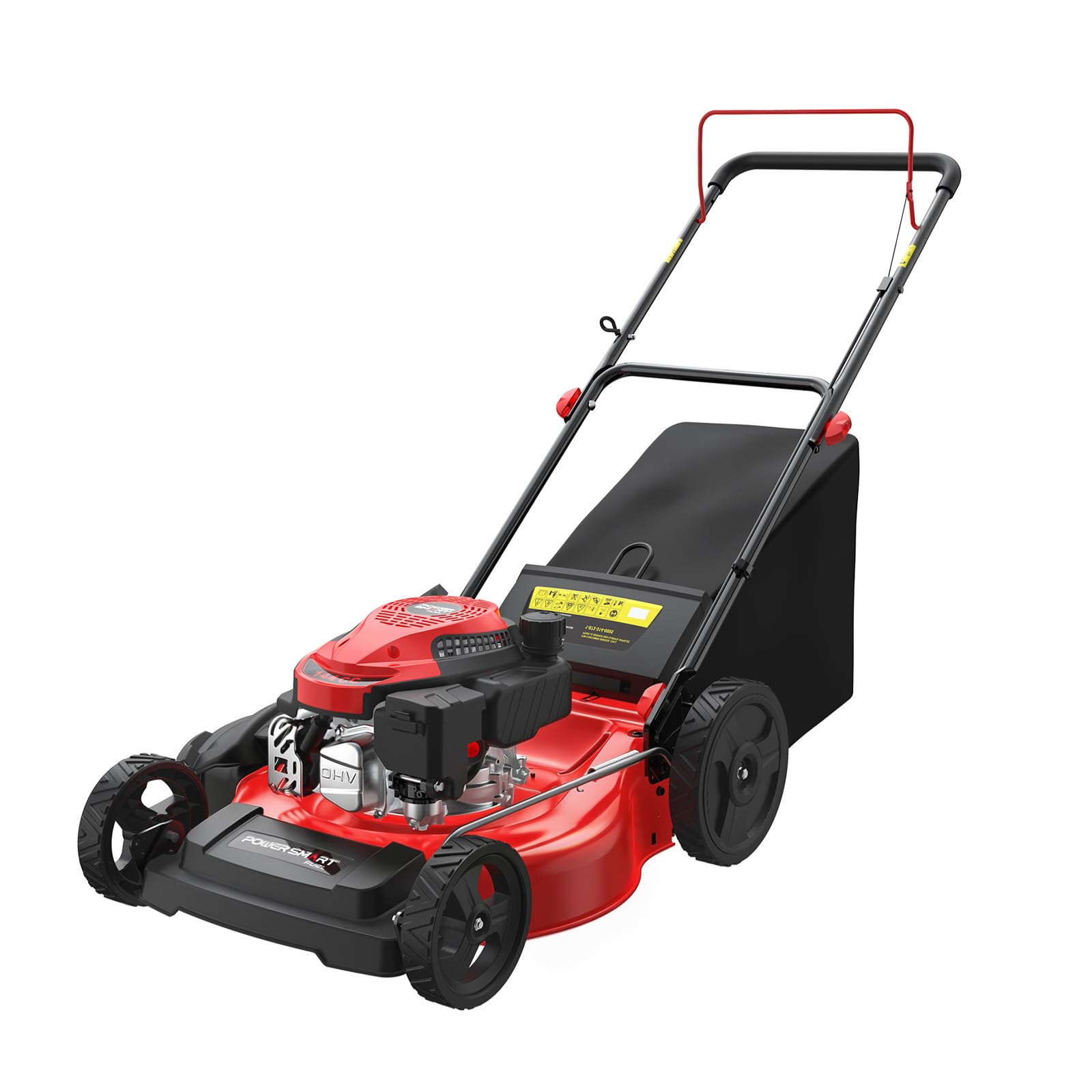
At 61.6 pounds compared to the Amerisun budget pick at 68.3 pounds, you feel the difference when pushing a full bag across the yard.
The weight savings come from the PowerSmart’s design, and they matter more than you might think: a light push mower is easier to maneuver and less tiring, especially when the grass catcher is full. The 144cc 4-stroke OHV engine with auto choke starts reliably, and the 10-inch rear and 7-inch front double ball-bearing wheels glide over bumps without fighting you. The 21-inch steel deck delivers a clean, even cut, and the single-lever height adjustment lets you switch among six cutting positions from 1.5 inches to 3.9 inches in one motion.
Reviewers point out this mower is “lightweight, easy assembly (<20 min), powerful motor handles thick grass, clean even cut, great value.” One reviewer noted that the small fuel tank requires a refill for larger yards, so it is best suited for small to medium lots. The 3-in-1 system (bag, mulch, side discharge) lets you switch modes without tools, and the bagging mode collects clippings cleanly — a direct result of the blade design and deck shape that pushes grass up and into the chute rather than dropping it under the deck.
The trade-off: A few units arrived with a damaged handle foam grip, and the tank runs dry quickly on bigger lawns — check the handle before assembly and budget for a mid-mow refill if your yard is over a quarter acre.
Reach for this if: You want a lightweight, easy-to-assemble push mower that handles thick grass and leaves a clean cut without breaking your budget.
Look elsewhere if: You have a large yard — the small fuel tank means extra trips for gas, and the rear bag capacity is not listed, so emptying may be more frequent.
3. SENIX 21″ Self-Propelled Gas Lawn Mower (FWD), 170cc
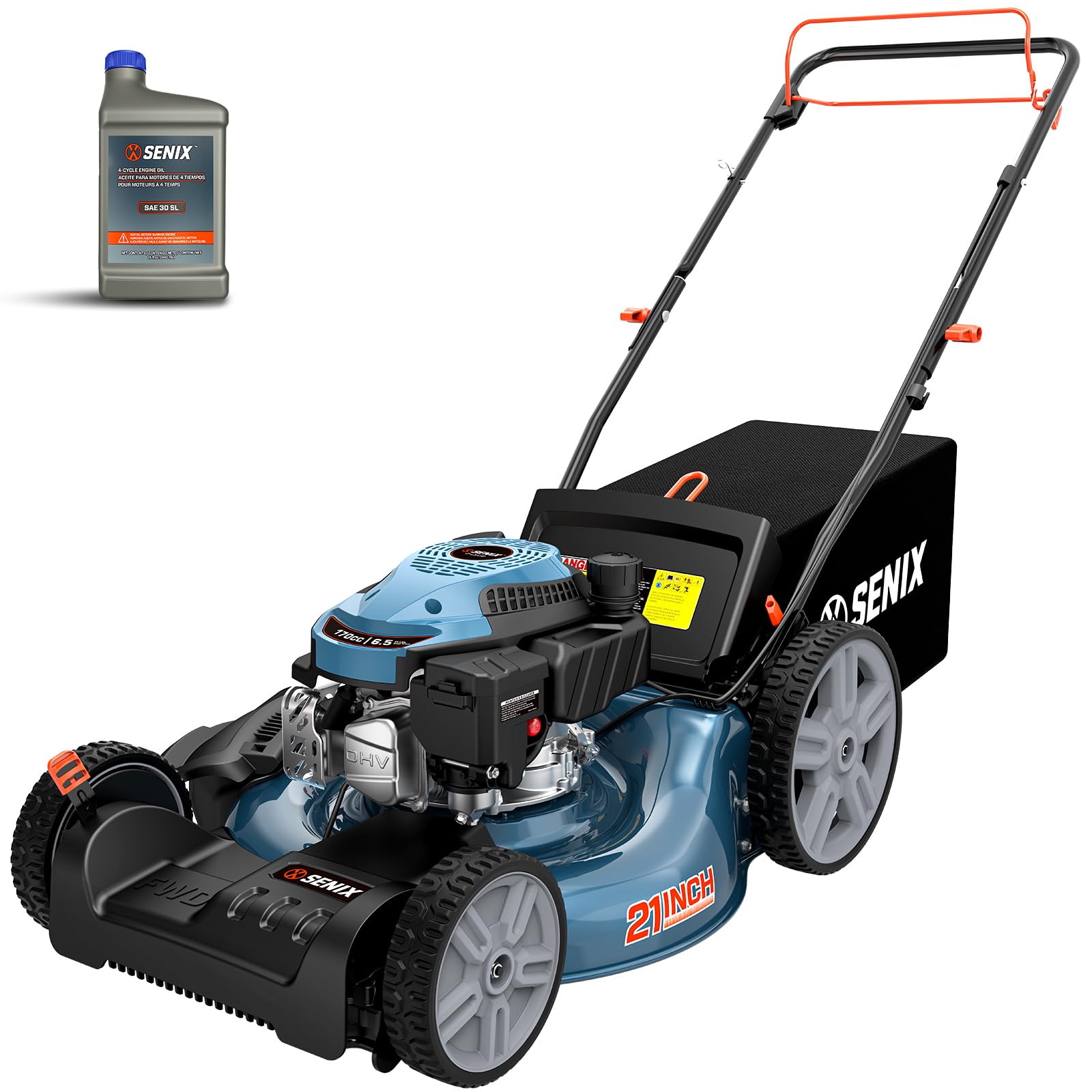
Front-wheel drive that pulls itself — and a 1.7-bushel bag — across flat yards with no effort.
Self-propelled mowers reduce fatigue, and this SENIX uses front-wheel drive (FWD) to pull the mower forward so you just steer. The 170cc 4-cycle OHV engine puts out 3.8 HP and 6.5 ft-lb of torque, giving it more grunt than the 144cc models when bagging wet or tall grass. The 1.7-bushel bagger is the same large capacity as the top overall pick, meaning fewer stops to empty. The 21-inch high-strength steel deck uses a vortex tunnel design that reduces clippings building up under the deck, keeping the chute clear for steady bag filling.
Shoppers say “easy assembly, starts on first pull” and that the self-propelled drive “makes mowing quick and enjoyable,” particularly for older users or anyone who wants less physical effort. The 11-inch rear wheels handle rough terrain well, and the 6-position height adjustment (1.25 to 3.75 inches) is controlled by a dual lever. The 2-year warranty covers defects, adding confidence. The FWD system is best for relatively flat yards — unlike rear-wheel drive, it can lose traction on steep inclines if the front wheels lift.
Watch out for: A few buyers report that the engine is hard to restart when hot and that hitting rocks can damage the driveshaft, potentially requiring replacement every couple of years — avoid rocky areas and let the engine cool before restarting.
Who it fits: Homeowners with flat or gently sloping yards who want the ease of self-propulsion and the stopping power of a 1.7-bushel bag.
Who should skip: Anyone with steep hills — front-wheel drive can lose grip on inclines, and rear-wheel drive would serve you better.
4. PowerSmart 21″ Self-Propelled Gas Lawn Mower, 170cc
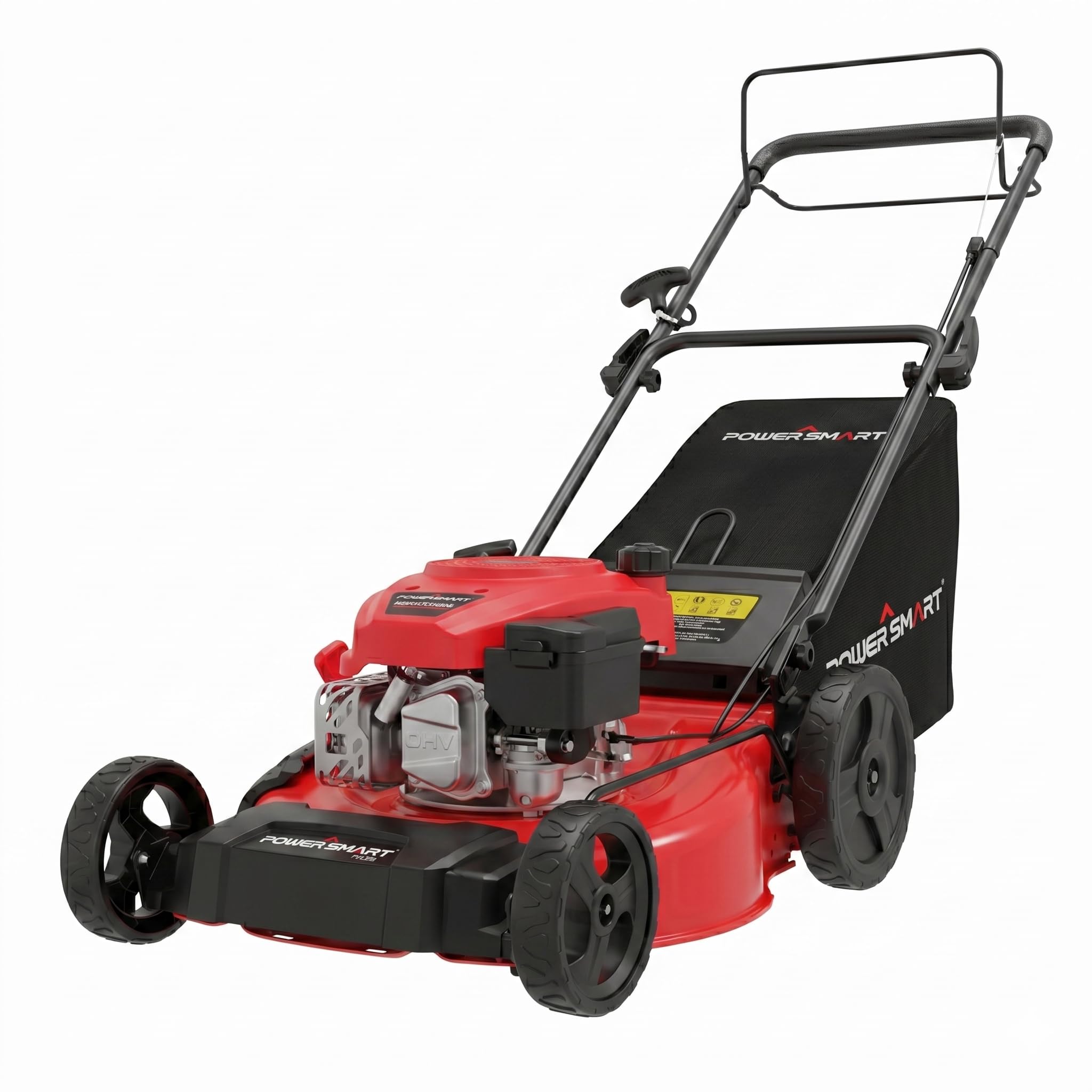
Rear-wheel drive (RWD) and a 170cc engine that claw up slopes while the 1.4-bushel bag fills behind you.
Slopes are where rear-wheel drive earns its keep, and the PowerSmart 21″ self-propelled mower uses it to push clippings uphill into a 1.4-bushel bag without you fighting the weight. The 170cc OHV engine starts smoothly and provides consistent power for medium to large yards. The 21-inch steel deck reduces mowing time compared to smaller decks, and the single-lever height adjustment changes the cut from 1.5 to 3.9 inches across all four wheels at once — a convenience that saves crouching and adjusting each corner individually.
Owners mention the mower “cranked up after assembly on the 2nd pull” and that it is “lightweight and very easy” to maneuver, even on uneven terrain. One buyer mentioned that the first unit arrived with a damaged wheel, but customer service sent a replacement immediately — a positive sign for warranty support. The 10-inch rear wheels provide the traction needed for slopes, and the 3-in-1 system (bag, mulch, side discharge) lets you switch modes depending on grass conditions. Unlike the FWD SENIX above, this mower keeps its drive wheels planted on inclines where front wheels might spin.
The reliability question: A few customers note the metal clip that holds the starter wire to the handlebar came off after about six mows — check this connection on delivery and consider reinforcing it to avoid a no-start situation mid-season.
Who it fits: Anyone with a sloped or uneven yard who needs rear-wheel drive traction plus a self-propelled system that does not require pushing a heavy bag uphill.
Who should skip: Those who want a huge bag — the 1.4-bushel catcher is standard capacity, so you will empty it more often than with a 1.7-bushel model.
5. GasXcel 21″ Self Propelled Lawn Mower Gas, 170CC
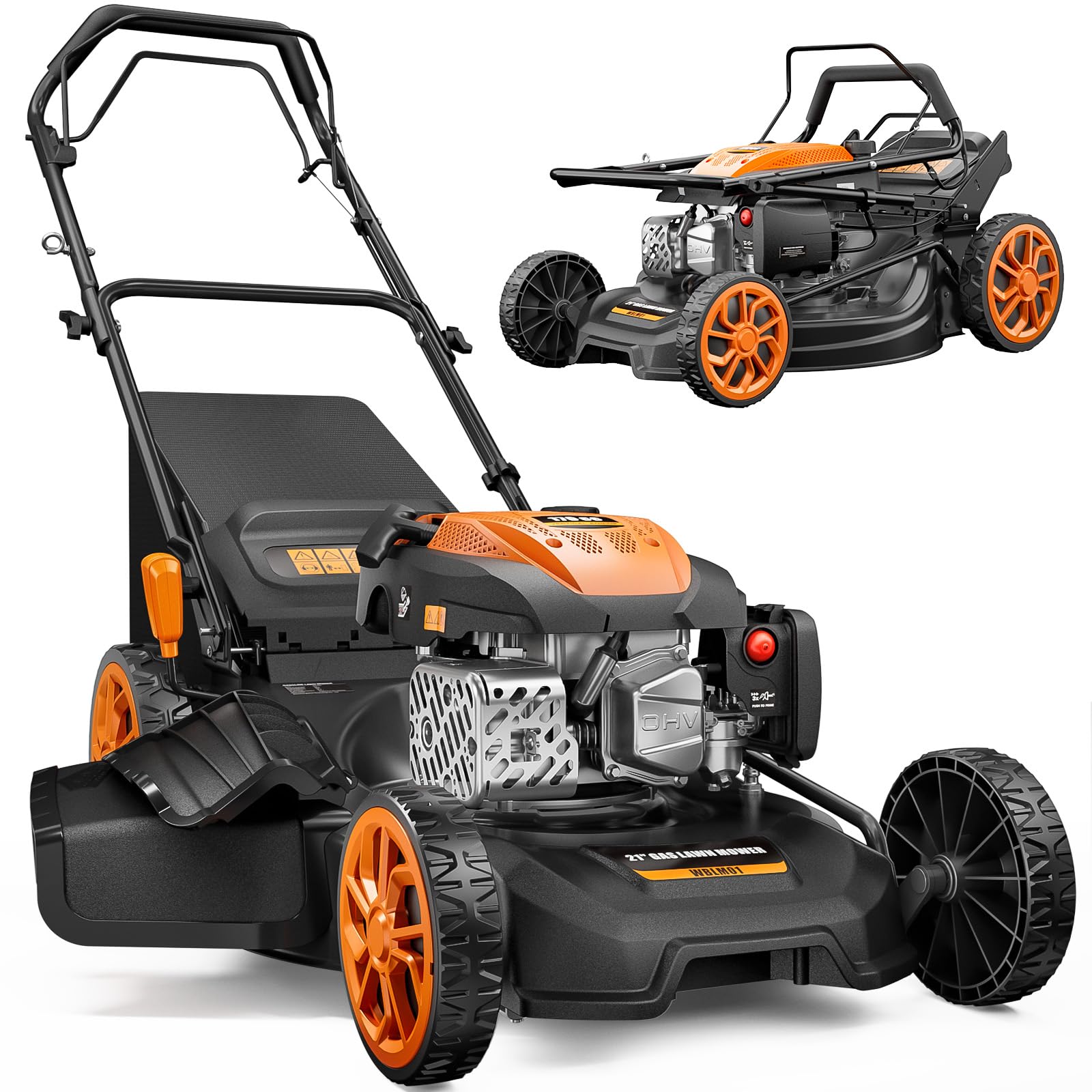
A 4-in-1 cutting system with seven height positions — more modes and more precision than any other pick here.
Most mowers offer three modes; the GasXcel adds a fourth — rear discharge — for times when you do not want to bag or mulch but just need to cut and clear the deck fast. The 170cc 4-cycle OHV engine runs up to 1.5 hours on a full tank, so you can cover a medium yard without refueling. The self-propelled drive has variable speed control, so you can match the pace to the grass density. The 7-position height adjustment ranges from 1 inch to 3 inches, giving you a finer tuning range than the standard 6-position systems. The 8-inch front and 10-inch rear wheels keep the mower stable on turns and uneven ground.
Reviewers point out the variable speed self-propel “works smoothly” and that the “wheels don’t drag when pulled back,” a common frustration with self-propelled mowers that lock in reverse. The single-handle 7-height adjustment is frequently called a standout feature — it changes all four wheels at once and offers a narrower 1-inch minimum cut for Bermuda grass or a 3-inch maximum for tall fescue. The 4-in-1 system includes a rear bagger, and shoppers say that the bag fills evenly without clogging. The mower ships pre-assembled — just attach the handle with twist-lock knobs in about 10 minutes.
Risk factor: One owner reported the engine locked up on the very first use — a concerning failure rate that makes it essential to test the mower immediately and verify the return policy before the window expires.
Who it fits: Lawn enthusiasts who want maximum flexibility — four discharge options and seven height settings let you dial in exactly the cut and cleanup method for each season.
Who should hesitate: Buyers who prioritize reliability above features — the early failure reports, even if rare, are a higher risk than more established brands.
6. SENIX 22 Inch 3-in-1 Gas Lawn Mower, 201cc
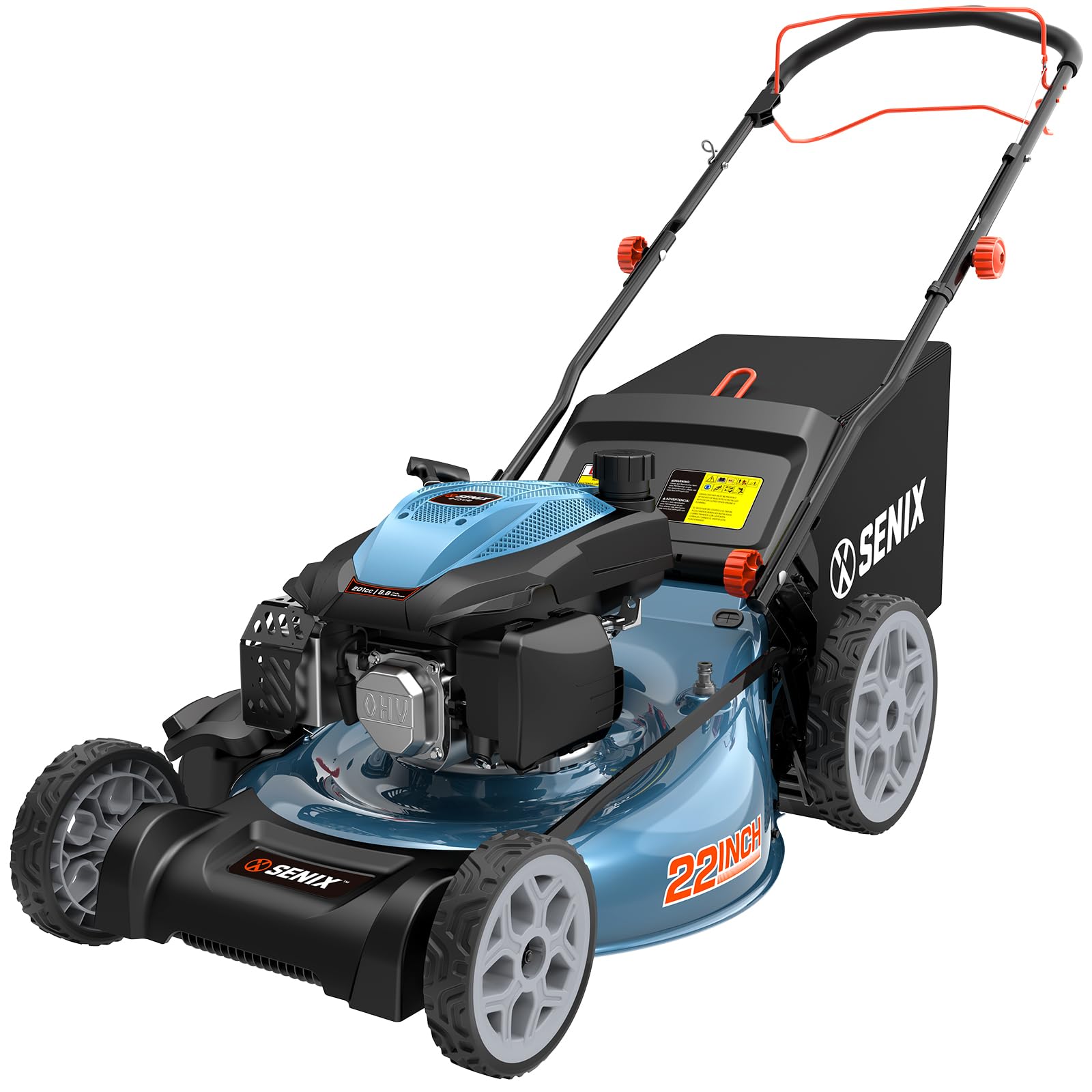
The widest deck here at 22 inches paired with the most powerful engine at 201cc — cuts a 22-inch path and powers through thicker growth than any 21-inch model.
When your yard approaches half an acre, every inch of deck width saves you laps. The SENIX 22-inch deck is an inch wider than the standard 21-inch cuts, and the 201cc OHV engine delivers 4.7 HP and 8.8 ft-lb of torque — the highest power figures in this lineup. The single-speed rear-wheel self-propelled drive reaches up to 2.9 MPH, so you maintain a steady pace without overworking the engine. The heavy-duty steel deck uses a vortex tunnel airflow design that pushes clippings into the chute instead of letting them settle under the deck, improving bag fill consistency. The central 6-position height adjustment ranges from 1.25 inches to 4 inches, giving you a taller maximum cut than most competitors for warm-season grasses.
Buyers report it “starts on first pull, quiet, lightweight” for its size and that the mower “cuts through overgrown weeds and small trees easily.” The foldable handle supports compact storage, saving garage space. The manganese steel alloy blades with 45–50 HRC hardness stay sharper longer than standard steel blades. The 2-year warranty covers defects. The 22-inch deck is recommended for lawns up to 11/20 acre (roughly 2,200 square meters). At 72 pounds, this is one of the heavier mowers here, but the self-propelled drive offsets the weight.
Know before you buy: A few owners mention that the wheels can fall off after several uses and that the manual lacks basic information like gas and oil capacity — check and tighten all wheel hardware during assembly and note that the grass catcher accessory may need to be sourced separately.
Who it fits: Owners of large, relatively flat yards (up to half an acre) who want a powerful, wider-deck mower that bags efficiently without the cost of a commercial-grade machine.
Who should skip: Anyone with a small yard or tight storage — the 22-inch deck and 72-pound weight are overkill for a quarter acre and harder to maneuver in tight spaces.
7. EGO Power+ Electric Lawn Mower LM2200SP

The battery-powered exception that delivers 11.1 ft-lbs of cutting torque — more than most gas mowers on this list.
If you want to leave gas behind but refuse to sacrifice cutting power, the EGO LM2200SP delivers up to 11.1 ft-lbs of torque and blade speeds up to 3,350 RPM — figures that exceed many gas-powered mowers in this list. The 22-inch cast aluminum deck carries a lifetime warranty, so you are not replacing a rusted deck in five years. The Select Cut multi-blade system uses interchangeable lower blades: the high-performance blade for everyday mowing and the high-lift bagging blade for maximum grass collection. The Touch Drive self-propel engages with the palm of your hand, and a scroll dial lets you adjust speed on the fly. With a recommended 56V 10.0Ah battery (sold separately), you get up to 70 minutes of runtime, which covers most suburban lots.
Customers note the cut quality is “better than my 190cc gas mower” and that the mower is “nearly silent self-drive, no rear wheel hang-up.” The 8-position height adjustment ranges from 1 inch to 4 inches — the most height settings in this guide. The aluminum deck is lighter than steel but the mower still weighs 83.8 pounds (with a battery), which is noticeable but manageable with the self-propel system. The bagging performance is excellent, especially with the high-lift blade installed. One caveat: the battery and charger are not included, so factor in that cost.
The catch: This is the most expensive mower here by a significant margin, and some users report that older batteries can cause the mower to cut power mid-lawn — if you already own EGO batteries, check their age; if starting fresh, budget for the battery and charger separately.
Who it fits: Tech-savvy homeowners who want gas-equivalent bagging power without the fumes, noise, or maintenance, especially if you already own EGO 56V tools.
Who should pass: Anyone on a strict budget or who does not want to manage battery charging — the upfront cost plus separate battery purchase makes this a premium investment.
8. 21″ Steel Deck Gas Lawn Mower, 3-in-1 Push Mower, 144cc (Amerisun)
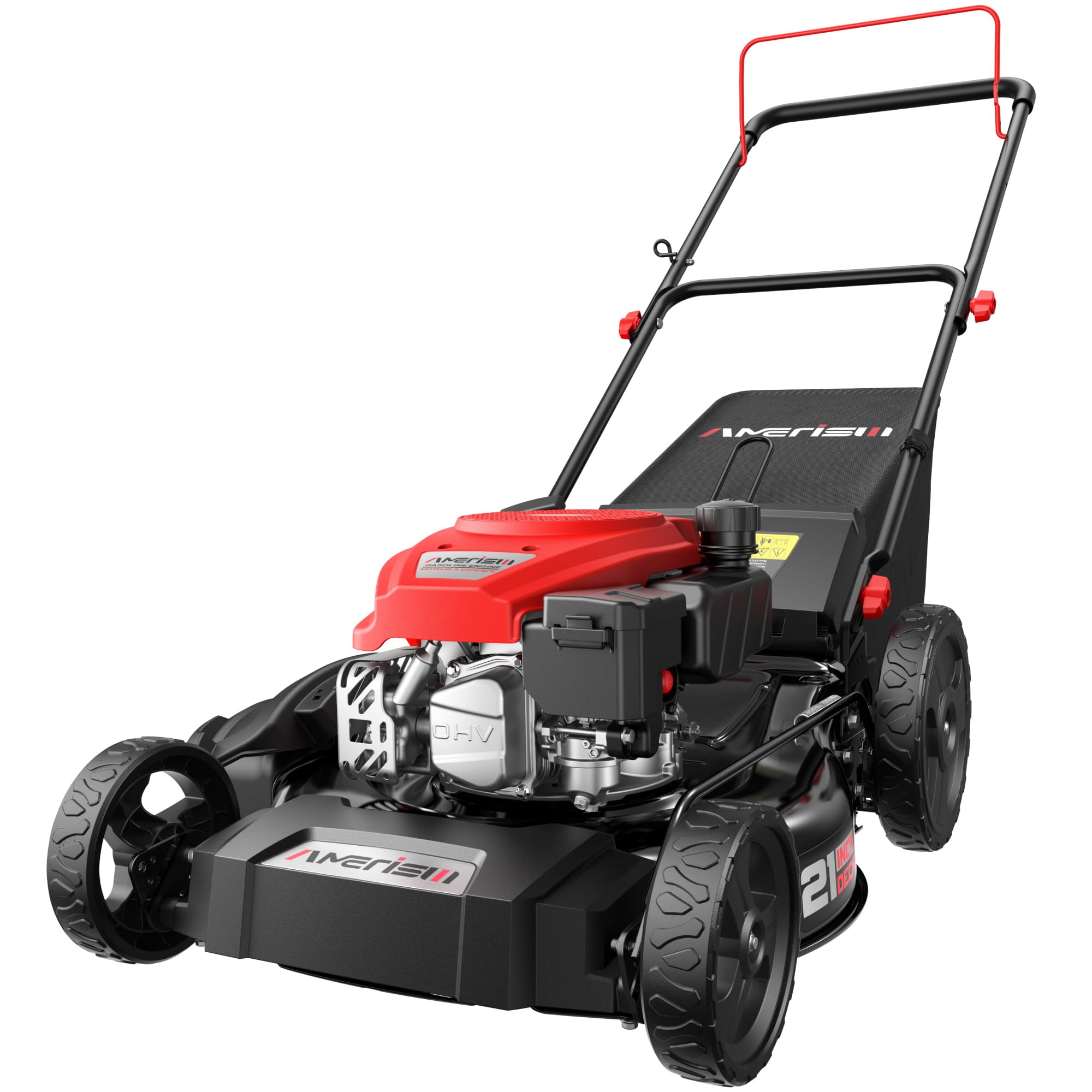
The cheapest bagged mower in this guide that still cuts 21 inches wide with a 144cc engine — but buyer reports warn of a bent axle on arrival.
You pay less for this Amerisun mower, but you still get a 144cc 4-stroke OHV engine with auto choke, a 21-inch reinforced steel deck, and a 1.4-bushel grass catcher that collects clippings as you push. The 7-inch front and 10-inch rear wheels with 1.5-inch wide treads and double ball bearings roll smoothly over uneven ground. The single-lever height adjustment gives you six cutting heights from 1.5 inches to 3.9 inches, and the 3-in-1 system (bag, mulch, side discharge) covers your seasonal needs. At 68.3 pounds versus the PowerSmart EasyGlide at 61.6 pounds, you notice the difference when pushing a full bag on a hot day.
Reviewers point out the mower is “great” for the price and that it “starts right up” after adding oil and gas. The self-propelled version (some reviews mention) works well for quick yard work. However, multiple buyers reported a serious quality issue: “Bent front axle on arrival; Amazon refused return, manufacturer only sent parts, requiring paid repair.” This pattern across two separate Amerisun listings raises a red flag about shipping damage and post-purchase support. Positive reviews still outnumber negative ones, but the risk of receiving a damaged unit is higher here than with the PowerSmart equivalent.
The risk: The bent front axle reports and Amazon’s refusal to accept returns on this item mean that if you receive a damaged unit, you may be stuck with a repair bill — inspect the axle and wheels immediately on delivery and file any claim within 24 hours.
Who it fits: Budget-conscious buyers who are comfortable checking a mower for shipping damage and dealing with potential warranty claims to save money upfront.
Who should avoid: Anyone who cannot afford the hassle of a potential return fight — the PowerSmart EasyGlide costs slightly more but has a much cleaner track record for arrival condition.
9. AMERISUN 21-Inch Gas Push Lawn Mower, 144cc (Black)
The same basic engine and deck as the red Amerisun, in a black finish and manual-push only.
Between the two Amerisun models, this black version uses the same 144cc 4-stroke OHV engine, the same 21-inch steel deck, the same 1.4-bushel grass catcher, and the same 6-position height adjustment (1.5 to 3.9 inches). The key difference is that this is a manual push mower — no self-propelled option. The 10-inch rear and 7-inch front wheels are identical. The 3-in-1 bagging, mulching, and side discharge system works the same way. At the same dimensions (32.9 x 16.5 x 22.6 inches), it occupies the same storage footprint.
Shoppers say the same mixed experience: good value and easy starting for those who receive a solid unit, but also the same bent front axle concern on arrival. One owner stated: “Bent front axle on arrival; Amazon refused return, manufacturer only sending parts, requiring paid repair. Do not buy.” The manual-only operation means you push the weight of the mower plus a full bag of clippings, which gets tiring on a medium yard or any slope. Positive reviews note it “starts right up” and is “as advertised” for the money. The handle pad has been reported to start ripping after a few uses, but that is a minor fix with athletic tape.
Bottom line on this one: If you are choosing between the two Amerisun models, there is essentially no difference in hardware — pick whichever color you prefer, but know that both carry the same shipping-damage risk and both are manual push only.
Who it fits: Buyers who want the absolute lowest entry price for a bagged gas mower and are willing to accept a higher risk of arrival defects.
Who should skip: Anyone with a medium to large yard or hills — manual push plus a 68.3-pound mower plus a full bag of wet clippings is a workout you did not sign up for.
Understanding the Specs
Engine Displacement (cc)
The engine’s cubic centimeters (cc) rating tells you how much power the motor can produce. A 144cc engine handles a typical suburban yard with thin to moderate grass. Jump to 170cc or 201cc when you have thick St. Augustine, wet grass, or a larger lot — the extra displacement keeps the blade speed up even when the mower is working hard, which also improves how well the bag fills because clippings are thrown all the way into the catcher instead of falling back onto the lawn.
Bag Capacity (bushels)
A bushel is a volume measurement — roughly 1.25 cubic feet. A 1.4-bushel bag holds about 1.75 cubic feet of clippings, while a 1.7-bushel bag holds about 2.1 cubic feet. That 0.3-bushel difference may sound small, but it translates to roughly one less stop per 1,000 square feet of lawn. Bigger bags are heavier when full, so self-propelled mowers pair best with larger catchers to prevent you from fighting the added weight.
Self-Propelled Drive Type
Front-wheel drive (FWD) pulls the mower forward and is easiest on flat ground. Rear-wheel drive (RWD) pushes from behind, giving better traction on slopes because the weight of the engine and your pushing force sits over the drive wheels. Single-speed self-propel moves at one pace; variable-speed lets you slow down for thick patches or speed up on open stretches. If your yard has any incline, RWD is the safer choice for reliable bagging on hills.
Cutting Height Range & Positions
The number of height positions (6 or 7) determines how finely you can dial in the cut. A wider range — from 1 inch to 4 inches — lets you scalp low for Bermuda grass in summer and raise high for fescue in fall. Single-lever adjustment that changes all four wheels at once is a major time saver over adjusting each corner individually. The minimum height matters for early spring scalping; the maximum matters for letting grass stay tall during dry spells.
FAQ
How often do I need to empty the grass catcher on a bagged lawn mower?
Can I use a bagged mower without the bag attached?
What is the difference between a 1.4-bushel and a 1.7-bushel grass catcher?
Is a self-propelled mower worth the extra money for bagging?
Can I use a gas bagged mower on thick or wet grass?
How many cutting height positions do I really need?
Why does my bagged mower leave grass clippings on the lawn even with the bag on?
Will a 21-inch bagged mower fit in a standard car trunk?
What maintenance does a bagged gas mower need to keep the bag working well?
Can I convert a mulching mower to a bagging mower?
Final Thoughts: The Verdict
Across the board, the best bagged lawn mower winner is the SENIX 21″ Push Gas Lawn Mower because it combines the largest 1.7-bushel catcher in its price range with a reliable 144cc engine, easy starting, and a 2-year warranty — all in a 54.2-pound package. If you want self-propelled convenience for a sloped yard, grab the PowerSmart 21″ Self-Propelled with its 170cc rear-wheel drive and 1.4-bushel bag. And for those who want gas-level bagging power without the fumes, the EGO Power+ LM2200SP offers 11.1 ft-lbs of torque, a lifetime aluminum deck, and quiet operation — but budget for the battery separately.
How We Picked
We do not accept paid placement. Every pick is matched to a real buyer and a real use-case; we do not hands-on test units.
Sources & Methodology
Specifications: manufacturer listings and product documentation. Review insights: verified customer reviews, as of July 2026. Pricing: not shown on this page (it changes often); check the current price via the retailer link.
As an Amazon Associate, Lawn Gear Lab earns from qualifying purchases. This does not affect which products we feature.