
That kitchen scrap bucket on the counter fills up fast, but dragging it to the curb for the city to haul away feels wasteful when you could turn it into black-gold soil amendment for your flower beds and veggie patch. A dedicated unit frees you from the stink, the fruit flies, and the back pain of manually turning an open pile with a pitchfork — and it keeps the raccoons and neighborhood dogs from making a mess of your yard after dark.
I’m Rikta — the co-founder and writer behind Lawn Gear Lab. I’ve spent hours digging through spec sheets, cross-referencing capacity claims against real-world user results, and studying the aerodynamics of tumbling chambers to understand exactly which engineering choices accelerate the breakdown of kitchen scraps and yard clippings into usable compost.
This guide cuts through the noise to deliver an honest, detail‑packed look at the best options on the market. Here is your definitive resource for finding the best backyard composter that fits your space, your volume of waste, and how much effort you actually want to put into the process.
How To Choose The Best Backyard Composter
Picking the right composter isn’t as simple as grabbing the biggest barrel you see. The ideal unit depends on how much organic waste your household generates, how much space you have near the garden, and whether you’re willing to wait months for finished compost or prefer a faster, more hands‑on tumbling approach. Every design trade‑off — from chamber count to frame material — directly affects how often you need to turn the pile, how quickly the material breaks down, and whether pests become a problem.
Capacity vs. Household Size
A 35‑gallon drum works well for a couple that cooks at home most nights and does light yard cleanup. A family of four with a large vegetable garden and regular grass clippings will want at least 43 gallons — preferably a dual‑chamber 53‑gallon unit so one side can cure while the other gets filled. If you go too small, the pile won’t heat up enough to break down effectively, and you’ll constantly be waiting for space to add more scraps.
Dual Chamber vs. Single Batch
Single‑chamber tumblers force you to stop adding fresh material while the current load finishes. Dual‑chamber composters let you fill one side for a month, then switch to the other while the first batch completes its cycle. That continuous flow is the single biggest quality‑of‑life upgrade in this category — you never have to pause your waste stream, and you get a steady supply of finished compost every four to eight weeks.
Frame Construction & Sealing
The frame is what keeps the barrel off the ground and allows smooth rotation. Look for a powder‑coated or galvanized steel frame that won’t rust after a rainy season. Barrel panels should lock together tightly with minimal gaps; a UV‑resistant polypropylene body holds up better to direct sunlight than cheaper recycled plastics. Check that the access doors slide or latch securely — loose doors invite rodents and fruit flies.
Aeration & Internal Mixing
Compost needs oxygen. Tumblers with deep fins or ridges on the interior walls lift and tumble the material as you crank, breaking up anaerobic clumps. Adjustable air vents on the drum panels let you control airflow and moisture retention based on your climate. If you live in a wet area, vents that can close during heavy rain prevent the pile from getting waterlogged and smelly.
Quick Comparison
On smaller screens, swipe sideways to see the full table.
| Model | Category | Best For | Key Spec | Amazon |
|---|---|---|---|---|
| RSI Maze 65 Gal Tumbler | Premium Tumbler | High-volume continuous composting | 65-gallon capacity with geared crank | Amazon |
| Maygrove 53 Gal Dual Chamber | Mid-Premium Tumbler | Ergonomic gear-assist for heavy loads | 53 gal dual chamber with brake locks | Amazon |
| THEGROW’ING 43 Gal Dual Chamber | Mid-Range Tumbler | Fast assembly & built-in thermometer | 43 gal dual chamber with embedded nuts | Amazon |
| VIVOSUN 43 Gal Dual Chamber | Mid-Range Tumbler | Reliable value with included garden gloves | 43 gal dual chamber with aeration vents | Amazon |
| Hourleey 43 Gal Dual Chamber | Mid-Range Tumbler | Entry-level dual chamber with sturdy frame | 43 gal dual chamber with sliding doors | Amazon |
| EJWOX 35 Gal Tumbler | Budget Tumbler | Compact footprint with compost tea spout | 35 gal single chamber with drain plug | Amazon |
| Food Cycler Eco 5 | Electric Countertop | Odorless indoor food waste processing | 5L electric grind with carbon filter | Amazon |
In‑Depth Reviews
1. RSI MCT-MC Maze Compost Tumbler

The RSI Maze delivers 65 gallons across a single massive drum — the largest capacity in this roundup — supported by a heavy‑duty steel frame that doesn’t wobble even when fully loaded with wet kitchen waste and grass clippings. The geared handle provides a mechanical advantage that makes turning the dense drum manageable from a seated position, and the sliding doors on the drum give you wide access for loading and harvesting finished compost. The included detachable cart with a 12-gallon bin underneath simplifies transporting the final product to raised beds or flower borders.
Assembly leans toward the involved side — expect roughly two hours of work, and several owners report needing to drill out slightly misaligned handle holes. The instructions are clear and include actual‑size screw images, but the sheer number of fasteners (nylock nuts, alternate bolts) can be tedious. Once assembled, the UV‑resistant high‑impact plastic holds up well under full sun, and the adjustable air vents let you dial in oxygen flow depending on the moisture of your current batch.
After two years of New England weather, owners note the frame resists rust and the barrel doesn’t crack or warp. The single‑chamber design means you must stop adding fresh material while a batch cures, so this unit suits gardeners who can commit to batch cycles rather than continuous processing. The wheelbarrow‑style cart is functional but not as rugged as the main drum — it’s fine for light movement across a level yard.
What works
- Massive 65-gallon volume handles high waste output
- Geared crank makes turning easy even when full
- Adjustable air vents for moisture control
What doesn’t
- Assembly is time-consuming with some hole alignment issues
- Single-chamber forces batch pauses
- Wheelbarrow cart feels less durable than main frame
2. Maygrove 53 Gallon Dual Chamber Compost Tumbler
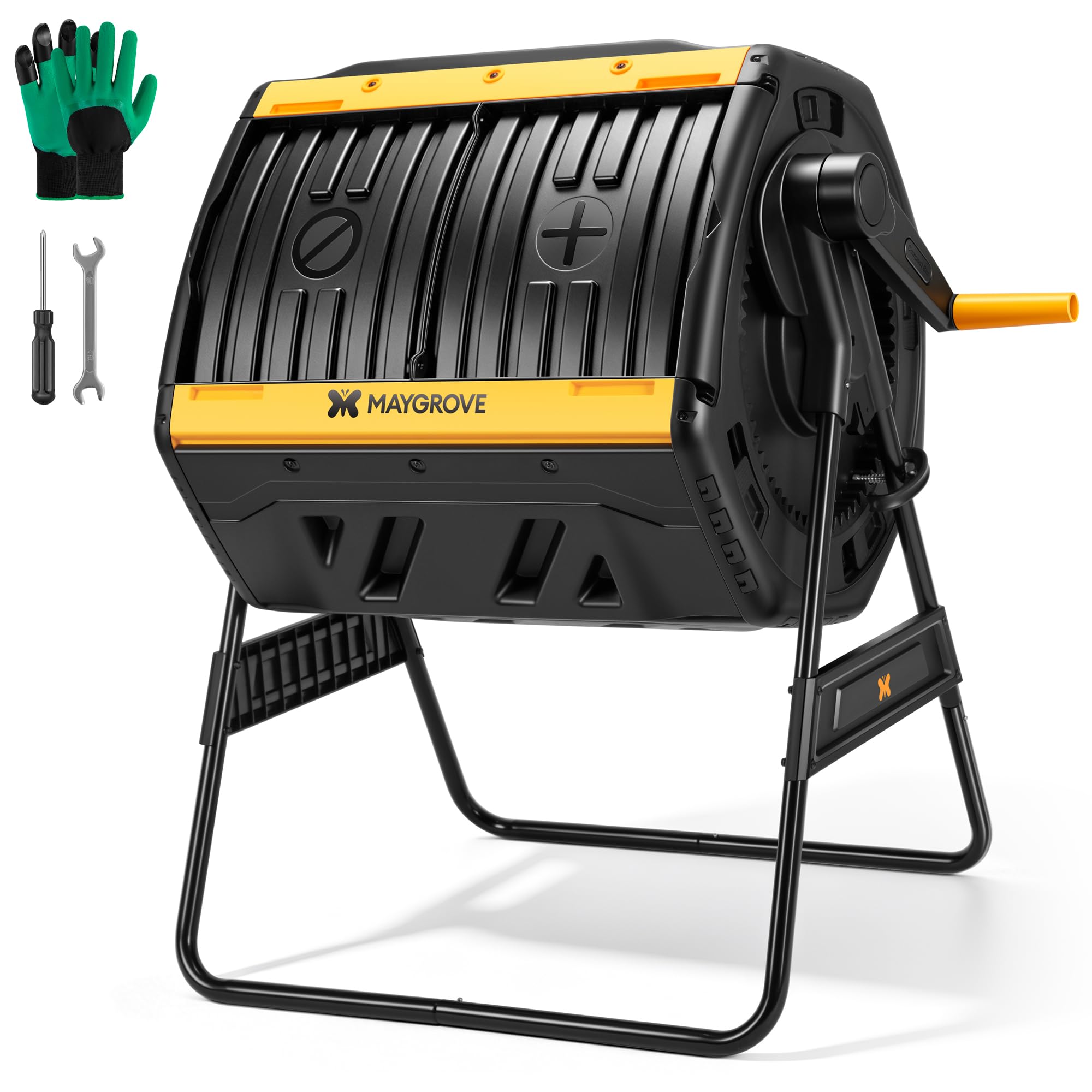
The Maygrove strikes a strong balance between capacity and daily usability with its 53-gallon dual‑chamber design and a gear‑assist handle that maintains smooth rotation even when one side is packed full of wet coffee grounds and vegetable peels. The snap‑together construction with minimal screws promises faster assembly than many competitors, though actual reports put setup closer to 90 minutes once you sort through the hardware. Extra‑large sliding doors on each chamber make loading trimmings and unloading finished compost uncomplicated, and the dual‑direction brake locks keep the drum stationary while you fill or empty a side.
The steel frame is reinforced at the leg supports to prevent the barrel from sagging under full load, a common failure point on cheaper tumblers. UV‑resistant PP plastic resists cracking and fading, and the adjustable air vents let you close them during rainy weeks to keep the pile from getting waterlogged. The two chambers allow continuous composting — add to one side for a month, then switch to the other while the first batch finishes breaking down in four to six weeks.
The main caveat is assembly: several owners rate the instruction manual as the weakest link, describing steps that are ambiguous, especially regarding proper bolt placement on the handle side. A few users found that the door slides work well but lack a physical stop to keep them from sliding off the track. Once assembled, the unit feels sturdy and stable, and the ergonomic handle reduces the effort needed to spin a full load compared to basic tumblers that rely on arm strength alone.
What works
- Gear-assist handle makes turning a full chamber easy
- Dual-chamber setup for continuous production
- Reinforced steel frame resists sagging
What doesn’t
- Assembly instructions are poorly organized
- Door slides lack end stops to prevent derailment
- Some hardware confusion between different bolt sizes
3. THEGROW’ING 43 Gallon Dual Chamber Compost Bin
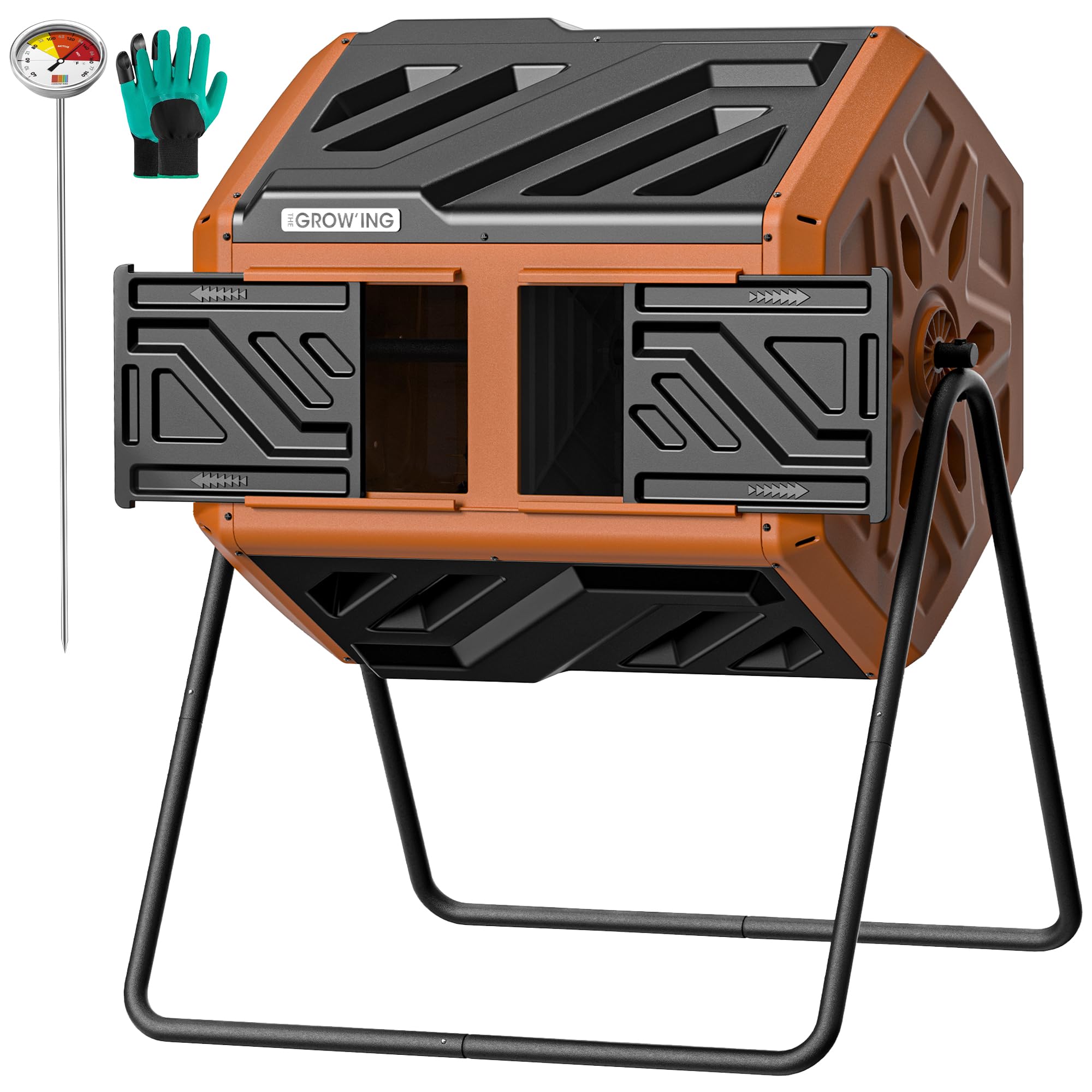
The GROW’ING composter sets itself apart from the crowded 43-gallon field with its embedded‑nut design, which eliminates the headache of aligning loose nuts deep inside the barrel during assembly. Many buyers report finishing setup in about 45 minutes working solo, a significant improvement over the 90‑minute builds common in this class. A built‑in temperature gauge on the front panel lets you monitor the internal heat of the pile without opening the lid — you can see at a glance whether the microbial activity is in the ideal 130‑150°F range for fast decomposition.
The hexagonal barrel shape houses two separate compartments, each holding roughly 20‑plus gallons. The sliding doors are large enough to add bulky yard waste, and the dual‑chamber layout supports continuous processing: fill one side for three weeks, then switch to the other while the first batch finishes. The frame is a hollow aluminum alloy — lighter than steel but some users report a slight wobble when the unit is fully loaded. The included gardening gloves and two small fabric grow bags add convenience without inflating the cost significantly.
Some early assembly hiccups appear: plastic flashing can partially block screw holes, requiring a quick pass with an awl, and the divider panel on a few units arrived with a missing nut that needed careful threading to install. The stand’s hollow construction, while rust‑proof, doesn’t feel as bombproof as a solid steel frame found on premium models. For the price point, the thermometer and fast‑setup hardware make this the strongest value proposition among the 43‑gallon dual‑chamber options here.
What works
- Embedded nut design cuts assembly time significantly
- Built-in thermometer gives real-time pile temperature
- Dual compartments allow continuous waste stream
What doesn’t
- Hollow aluminum stand can feel wobbly when full
- Some screw holes blocked by plastic flashing
- Divider panel assembly can be fiddly
4. VIVOSUN Outdoor Tumbling Composter 43 Gallon

VIVOSUN’s 43‑gallon octagonal tumbler has earned a strong reputation through sheer volume of sales — it sits near the top of the best‑seller list in the composting bins category, backed by nearly 10,000 ratings. The twin chambers allow the same continuous‑composting workflow as other dual‑bin designs, and the eight panels include deep internal fins that lift and aerate the material with every rotation. The galvanized steel frame supports the 21.7‑pound barrel without bowing, and the legs are wide enough to keep the unit stable on uneven ground.
Assembly is the main sticking point. Many owners report the center divider panel is difficult to align — some describe it as not fitting properly into the tracks, requiring forcing or partial disassembly to seat correctly. The sliding door mechanisms work smoothly once installed, but the process of snapping all eight panels together and getting the divider seated can test your patience. A typical build runs 60 to 90 minutes with two people. The included gardening gloves with ABS plastic claws are a thoughtful addition for handling rough materials.
Once assembled, the barrel rotates smoothly on its axle, and the aeration holes along each panel provide good airflow. The plastic feels thick and UV‑resistant, and several two‑year check‑ins report no cracking or warping. The main trade‑off is assembly difficulty — if you enjoy tinkering, this is a fine unit; if you want something out of the box and spinning in 20 minutes, look at the GROW’ING or the Maygrove.
What works
- Proven long-term durability with thousands of positive reviews
- Deep internal fins for effective aeration
- Includes useful gardening gloves and digging claws
What doesn’t
- Center divider is notoriously difficult to install
- Assembly generally requires two people
- Some units arrive with cracked plastic parts
5. Hourleey 43 Gallon Dual Chamber Compost Bin

Hourleey offers a budget‑conscious entry into dual‑chamber composting without skimping on the core features that matter — the 43‑gallon capacity, 360‑degree tumbling axis, and a corrosion‑resistant metal frame wrapped in a thick orange plastic body. The deep fins on each panel help break up clumps during rotation, and the sliding doors on both chambers are wide enough to accept kitchen scraps and small yard trimmings. The cylindrical shape is simpler than octagonal designs, which reduces the number of panel joints that can leak or separate over time.
The assembly process is where most owners hit friction. Instructions are printed on a single sheet with small diagrams, and the interlocking panels can require some force with a putty knife to seat correctly. Several builders recommend using an electric screwdriver and attaching the doors as the very last step. Once together, the bin spins freely and has kept critters out during long‑term testing. A few users note that the openings, while functional, feel slightly smaller than they’d like for loading large handfuls of garden waste.
Over a year of use, the plastic hasn’t faded or become brittle under direct sun, and the metal frame shows no rust. The dual chambers allow the continuous‑composting cycle, and the weight of the empty unit (21.7 pounds) makes it manageable to relocate if you rearrange your garden layout. The main downside is that the rotation mechanism feels less smooth than pricier gear‑assist models — you’re relying on arm strength to spin the barrel rather than a mechanical advantage.
What works
- Dual chambers for continuous composting on a budget
- Corrosion-resistant frame holds up to weather
- Simple cylindrical shape reduces potential leak points
What doesn’t
- Assembly instructions are sparse and hard to follow
- Sliding doors are on the small side
- No gear assist — requires full arm effort to turn
6. EJWOX 35 Gallon Tumbling Composter Bin
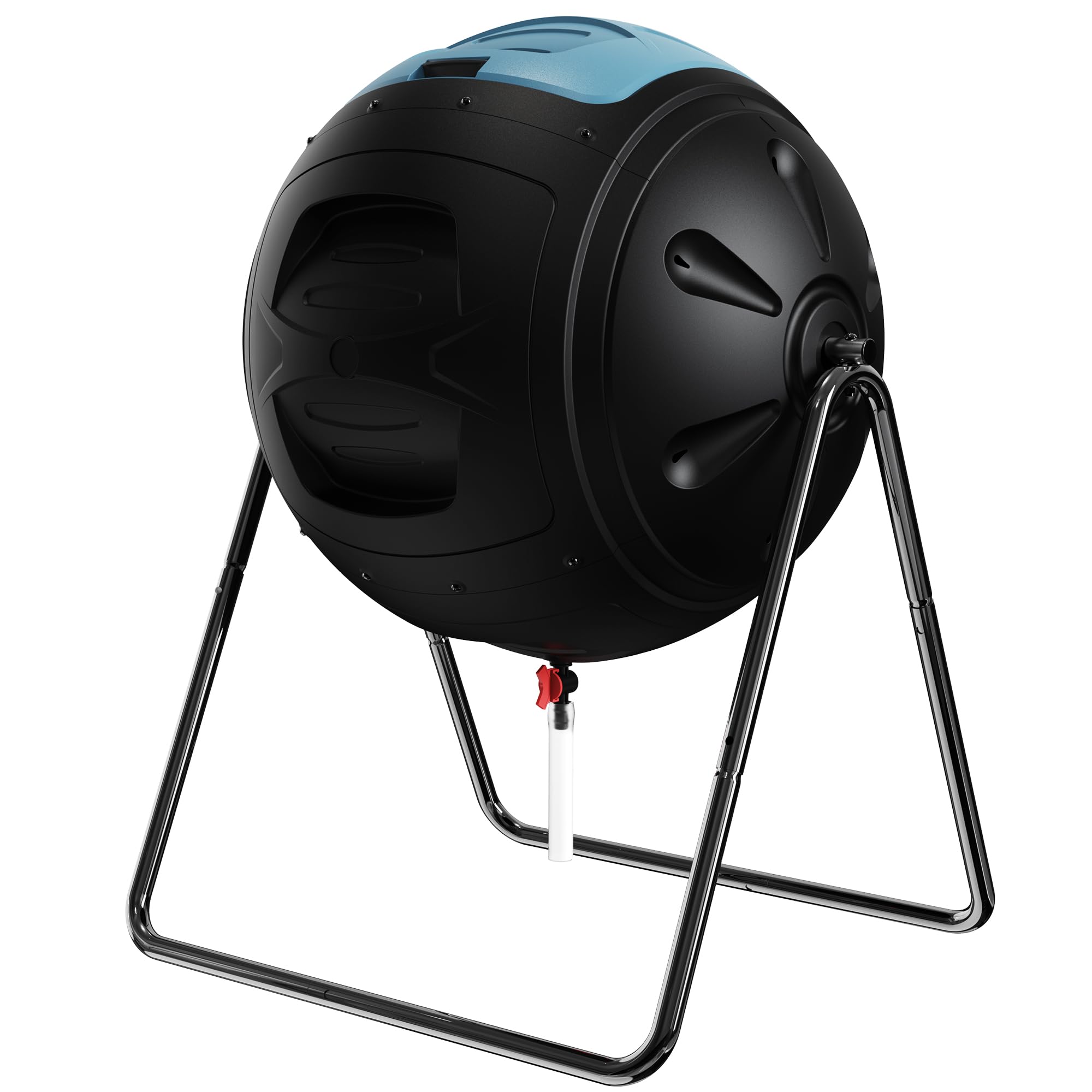
The EJWOX 35‑gallon tumbler is built for smaller yards and lighter waste streams — a single chamber with a manageable 15.8‑pound empty weight that makes it easy to move around a patio or tight backyard. The blue barrel includes a drain plug at the bottom for collecting compost tea, a liquid fertilizer that drips out during the decomposition process. The powder‑coated alloy steel frame supports the drum well, and the UV‑protected plastic resists fading after months in direct sunlight.
Assembly clocks in around 15 to 20 minutes for most users, though the printed instruction sheet is minimal and occasionally confusing. The single‑chamber layout means you’re running batch cycles — fill it up, let it cook, then harvest before starting again. That works fine for a couple who generates moderate kitchen waste and grass clippings, but it won’t keep up with a large family’s output. The turning axis works smoothly, and the drum’s round shape tumbles contents effectively, breaking up clumps with each rotation.
The biggest complaint revolves around rain ingress — the vent holes on the drum are numerous and uncovered, allowing water to enter during storms and soak the pile. Several owners had to fashion a makeshift cover or relocate the unit under an eave. The door latch mechanism, made of plastic, can warp under high heat and heavy loads, causing the door to pop open during rotation. The compost tea spout is handy in theory but tends to leak from the seams over time if you don’t seal them with food‑grade silicone during assembly.
What works
- Very fast assembly — under 20 minutes
- Drain plug enables compost tea collection
- Lightweight and easy to reposition
What doesn’t
- Open vents let rain in, soaking the pile
- Plastic door latch warps and may fail
- Seams can leak compost tea if not sealed
7. Food Cycler Eco 5 Electric Food Recycler
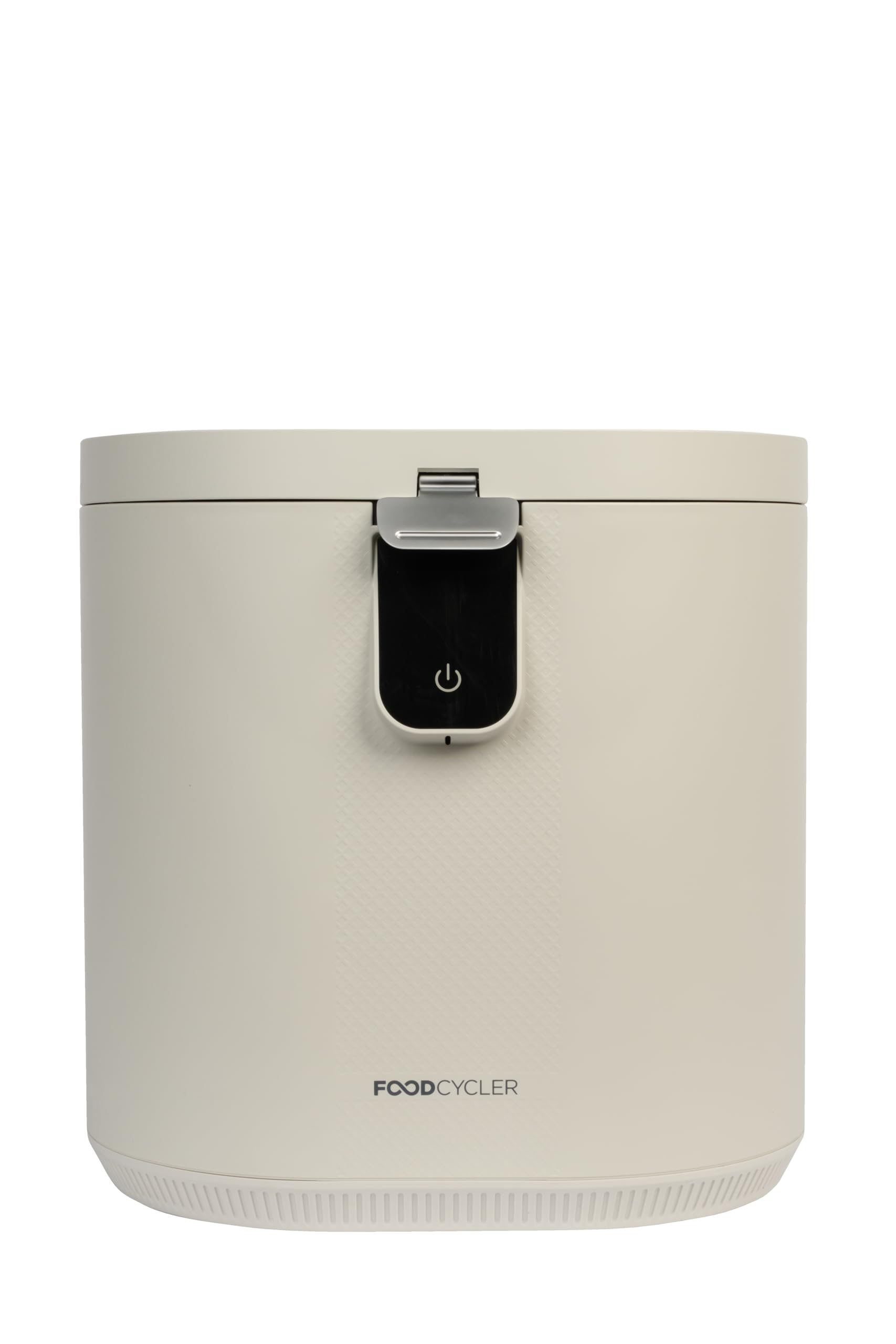
The Food Cycler Eco 5 represents a completely different approach to composting — an electric countertop unit that grinds and dehydrates food waste into a dry, odorless, nutrient‑dense byproduct in about eight hours. The 5‑liter bucket handles the output of a busy kitchen, processing everything from fruit pits and eggshells to cooked leftovers and small bones. The Vortech grinding system is quiet and nearly vibration‑free, and the refillable carbon filter absorbs any odors so you can run it overnight in the kitchen without disturbing sleep or filling the room with cooking smells.
This isn’t a substitute for a large outdoor tumbler — the output is a dry, coarse material you mix into garden soil or add to an outdoor pile to boost microbial activity. The 8‑hour cycle uses electricity comparable to a clothes dryer, so it’s an operating‑cost consideration if you run it daily. The bucket is removable and easy to carry to the prep area, and the one‑touch button operation is straightforward. The 3‑year warranty and Vitamix brand backing provide confidence in long‑term reliability.
The main trade‑off is volume. You can’t process grass clippings, leaves, or woody yard waste — this is strictly kitchen food scraps. If you already maintain an outdoor pile for yard waste, the Eco 5 is an excellent supplement that eliminates the mess and smell of collecting kitchen scraps in an indoor bin. If you’re looking for a single solution to handle all your organic waste, you’ll need a traditional outdoor tumbler as the primary unit and this as a convenience booster.
What works
- Quiet and odorless operation — runs overnight in kitchen
- Processes bones, pits, and cooked leftovers
- 3-year warranty and strong brand support
What doesn’t
- Does not handle yard waste or large volumes
- 8-hour cycle consumes noticeable electricity
- Wet or overloaded batches can produce damp output
Hardware & Specs Guide
Dual-Chamber Logic
A two‑chamber tumbler divides the drum with a fixed internal wall, creating two independent composting zones. You fill one side for three to four weeks, then switch to the other side. By the time the second side is full, the first batch has had time to break down into usable compost. This continuous cycle eliminates the downtime inherent in single‑batch systems. Look for a divider that locks securely into the barrel tracks — if it shifts during rotation, material can cross‑contaminate between chambers and ruin the batch timing.
Frame Material & Finish
The weight of a full 43‑gallon drum can exceed 150 pounds, so the frame needs to support that load without twisting. Powder‑coated steel offers the best rigidity and corrosion resistance for outdoor placement. Galvanized steel is a close second. Hollow aluminum frames save weight but may flex under heavy loads, especially on uneven ground. The cross‑brace design between the legs is critical — frames that lack a bottom crossbar rely entirely on the ground plate to prevent splaying, which can lead to instability over time.
Aeration & Moisture Control
Composting microbes need oxygen to break down organic matter aerobically. Deep internal fins or ridges lift the material as the drum turns, pulling air into the pile. Adjustable vents allow you to close off airflow during wet weather to prevent waterlogging or open them during dry spells to encourage evaporation. Fixed vents can’t adapt to changing conditions — if you live in a rainy climate, prioritize removable vent covers or adjustable sliders on the drum panels.
Access Door Design
Sliding doors are the most common design on tumblers, but their quality varies. A good door uses a recessed track that the panel slides into, with a physical stop or locking tab at the end of the travel to prevent the door from sliding off entirely. Hinged doors with latches are less likely to fall off but can warp in high heat. The door opening width directly affects how easily you can add bulky items like corn stalks or melon rinds — measure the opening before buying if you process large garden waste.
FAQ
How full should I fill each chamber of a dual‑bin composter?
Can I put weeds and diseased plants in a backyard composter?
Final Thoughts: The Verdict
For most gardeners, the best backyard composter winner is the Maygrove 53 Gallon Dual Chamber because its gear‑assist handle and reinforced steel frame deliver smooth, continuous composting without the back strain that plagues budget tumblers. If you want maximum raw capacity and don’t mind a longer assembly session, the RSI Maze 65 Gallon Tumbler is the volume king. And for zero‑mess kitchen scrap processing, the Food Cycler Eco 5 is the perfect complement to an outdoor setup.