
Clearing a half-acre yard of wet oak leaves with a handheld blower is a two-hour arm-numbing ordeal. A backpack leaf blower shifts that weight to your hips and shoulders, letting a high-displacement engine or high-torque motor move debris in thick streams instead of scattered puffs. The right unit triples your clearing speed while halving fatigue.
I’m Rikta — the founder and writer behind Lawn Gear Lab. I’ve spent years analyzing power equipment markets, comparing CFM and MPH curves across engine displacements, and cross-referencing thousands of owner hours to identify which backpack blowers deliver on their specs and which fall apart in the field.
This guide focuses on nine contenders spanning gas and battery platforms, from budget-friendly homeowner machines to estate-grade professional units. After weighing air volume, engine reliability, harness ergonomics, and real-world owner satisfaction, here is the definitive analysis of the best backpack leaf blower for every property size and budget tier.
How To Choose The Best Backpack Leaf Blower
The right backpack leaf blower balances raw clearing power with the physical reality of wearing a machine for extended periods. Three specs — CFM, engine platform, and harness quality — separate a joy from a chore.
Air Volume (CFM) vs. Air Speed (MPH)
A blower with 800 CFM at 150 MPH will move a pile of wet leaves far faster than a unit rated for 400 CFM at 200 MPH. CFM (cubic feet per minute) measures how much air the machine pushes; MPH measures how fast that air moves. For clearing broad lawns, driveways, and deep leaf beds, prioritize CFM. MPH matters more for blasting packed debris out of cracks or flower beds. Most high-performing backpack leaf blowers sit at 650 CFM or above.
Engine Displacement vs. Battery Platform
Gas backpack blowers span from 31cc homeowner engines to 79.9cc commercial monsters. Larger displacement delivers more torque and sustained high CFM, but adds weight — expect 18 to 33 pounds. Battery units have closed that gap; premium 56V and 40V models now deliver 800 CFM with far less noise and zero fuel mixing, though runtime on turbo mode may drop to 15-20 minutes per battery. Choose gas for estates over two acres or extended commercial loops. Choose battery for residential sub-acre lots where quiet operation and instant start matter more than raw endurance.
Harness and Vibration Management
A blower can have 1,000 CFM on paper, but if the shoulder straps dig into your collarbone or the engine vibration numbs your hands after 15 minutes, it’s a failure. Look for padded, contoured shoulder straps, a sternum strap, and a waist belt that transfers weight to the hips. Anti-vibration engine mounts and rubber-grip handles reduce fatigue dramatically. Tube-mounted throttles place controls at your fingertips; harness-mounted throttles can be awkward if you switch hands frequently.
Quick Comparison
On smaller screens, swipe sideways to see the full table.
| Model | Category | Best For | Key Spec | Amazon |
|---|---|---|---|---|
| PRORUN PBB2884 | Gas Pro | Large estates / commercial | 1020 CFM, 240 MPH, 75.6cc | Amazon |
| VEVOR 79cc | Gas Beast | High CFM on a budget | 930 CFM, 184 MPH, 79cc | Amazon |
| Husqvarna 560BTS | Gas Premium | Professional durability | 631 CFM, 232 MPH, 65.6cc | Amazon |
| Echo PB-9010T | Gas Beast | Maximum air volume | 1110 CFM, 220 MPH, 79.9cc | Amazon |
| Echo PB-580T | Gas Mid | Reliable mid-range gas | 510 CFM, 58.2cc | Amazon |
| Husqvarna 350iB | Battery Handheld | Quiet battery power | 800 CFM, 200 MPH, 40V | Amazon |
| EGO Power+ LB8803-2 | Battery Handheld | Premium battery performance | 880 CFM, 200 MPH, 56V | Amazon |
| HTK 63cc | Gas Budget | Entry-level gas backpack | 665 CFM, 205 MPH, 63cc | Amazon |
| LawnMaster NPTBL31AB | Gas Entry | Easy electric start | 470 CFM, 175 MPH, 31cc | Amazon |
In‑Depth Reviews
1. PRORUN 75.6cc 1020 CFM 240 MPH Gas-Powered 2-Cycle Backpack Leaf Blower, PBB2884

The PRORUN PBB2884 sits at a rare intersection: commercial-grade CFM without the commercial price tag. Its 75.6cc 2-cycle engine pushes 1020 CFM at 240 MPH — figures that rival machines costing twice as much. Multiple owners reported starting it in two pulls and clearing properties up to 5 acres in a single session. The ergonomic backpack frame distributes the 32.8-pound dry weight well, using padded straps and a sturdy frame that transfers load to the hips rather than the shoulders.
Real-world feedback highlights the unit’s ability to move wet leaves, acorns, and pine straw in huge swaths. The tube connections require a firm twist to lock, and the starter switch feels somewhat thin and tight according to some owners, but no failures have been widely reported. The 3-year residential warranty adds confidence for homeowners pushing the machine hard.
For anyone managing two-plus acres of heavy debris, this blower offers the best CFM-per-dollar ratio on the market. The weight is noticeable when lifting it onto a truck bed, but once strapped on, the balance is forgiving enough for operators in their 60s with previous back issues to run full tanks without pain.
What works
- Hurricane-force airflow clears deep leaf piles in passes
- Starts reliably with 2 pulls even after storage
- Harness distributes weight effectively for long sessions
What doesn’t
- Heavy at 32.8 pounds; lifting onto shoulders requires some strength
- Tube lock mechanism can be finicky until broken in
- Starter switch feels less robust than premium brands
2. VEVOR 79cc Backpack Gas Leaf Blower, 930 CFM 184 MPH
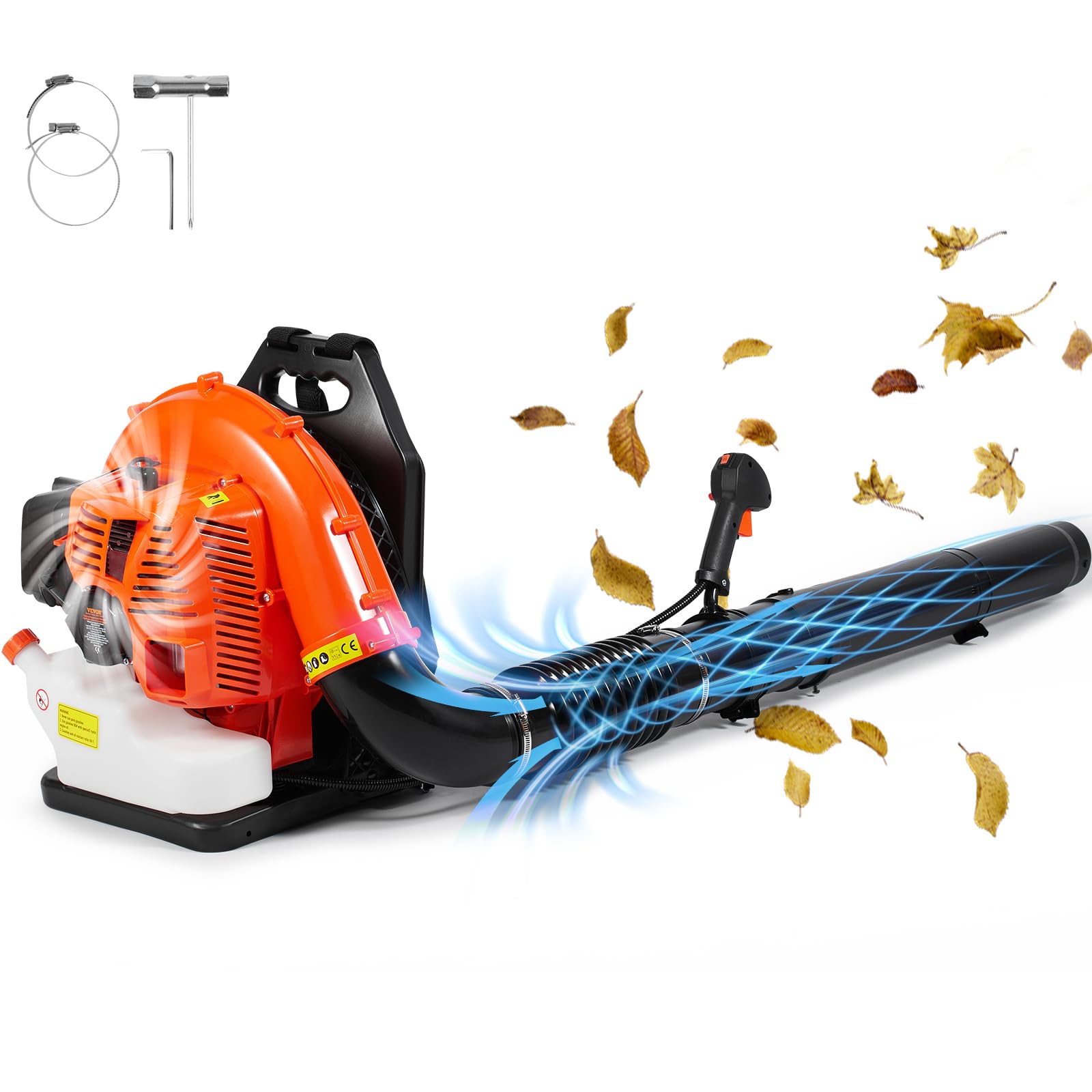
VEVOR’s 79cc entry takes a no-nonsense approach: a large-displacement 2-stroke engine, 930 CFM output, and a massive 3-liter fuel tank that delivers roughly 95 minutes of continuous runtime. That tank capacity alone sets it apart — most blowers require refueling after 40-60 minutes of heavy work. Owners consistently praise the quick start (often 2 pulls) and the ability to clear a 200-foot driveway of snow in 20 minutes.
The drawbacks center on assembly and ergonomics. The primer bulb is awkwardly placed, and the included tubing and hardware feel less premium than the engine itself. At 29.8 pounds, it is heavy, and the shoulder straps, while padded, lack the sophisticated load distribution of pricier competitors. The noise level is typical for a 79cc 2-stroke — hearing protection is not optional.
Budget-conscious buyers with large properties who prioritize raw runtime over refined comfort will find this blower compelling. The included earmuffs and tool kit are a thoughtful addition, though the muffler is basic. For the price, the engine performance is hard to beat.
What works
- 3-liter tank enables nearly 1.5 hours of continuous use
- 930 CFM moves wet leaves and snow effectively
- Starts easily with manual pull in cold conditions
What doesn’t
- Primer bulb placement makes cold-starts slightly awkward
- Tubing and harness feel economy-grade relative to engine
- Heavy at nearly 30 pounds without fuel
3. Husqvarna 966631102 560BTS 65.6cc 631-CFM 232-MPH Professional Gas Backpack Leaf Blower
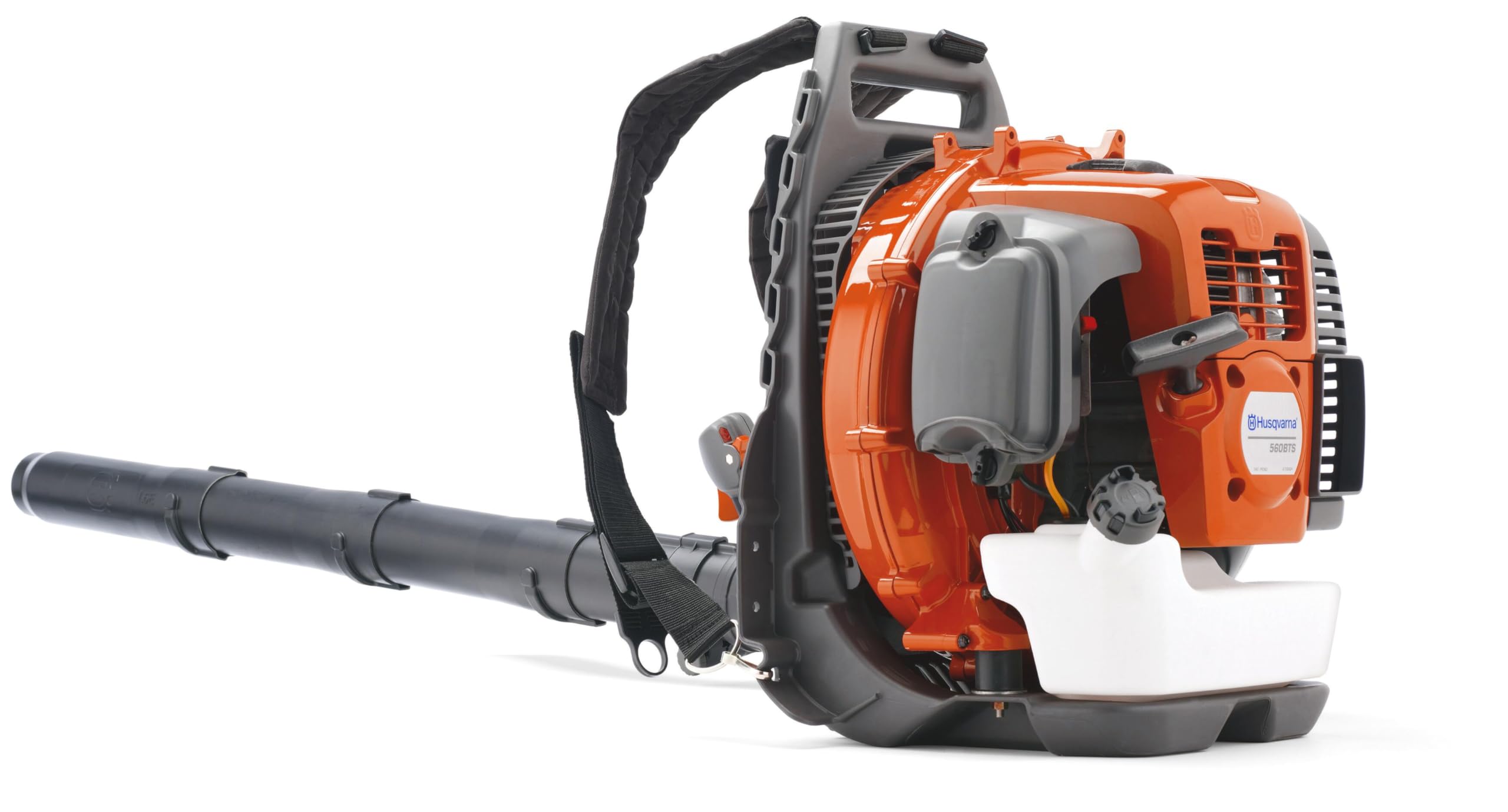
The Husqvarna 560BTS has been a commercial standard for years, and for good reason. Its 65.6cc X-Torq engine delivers 631 CFM and 30 Newtons of blow force — enough to move sticks, small rocks, and wet leaves that would stall lesser units. The 2-stage air filtration system keeps fine debris out of the engine, extending service life significantly. Owners report starting it on the second pull every time, even after long storage periods.
The ergonomic harness is a standout: ventilated back pad, padded shoulder straps, and even weight distribution reduce fatigue during multi-hour jobs. The tube-mounted throttle puts control at the wand, which reduces wrist strain compared to harness-mounted triggers. The trade-offs are weight (23.15 pounds) and noise — this is a loud machine that demands quality ear protection. Some users note the absence of a waist belt, which would further stabilize the load.
For pros or homeowners with 5+ acres who need a machine that survives daily abuse, the 560BTS justifies its premium positioning through build quality and parts availability. Husqvarna dealers stock common service parts, keeping downtime minimal. It is not the highest CFM on paper, but the real-world blow force feels stronger than the spec sheet suggests.
What works
- 30N blow force moves heavy debris that stalls lower-CFM blowers
- 2-stage air filter extends engine life in dusty conditions
- Tube-mounted throttle reduces arm fatigue
What doesn’t
- No waist strap for additional weight transfer
- Loud operation requires quality hearing protection
- Fuel consumption is high — roughly 1 quart per 40 minutes
4. Echo 220 MPH 1110 CFM 79.9 cc Gas 2-Stroke X Series Backpack Blower PB-9010T

The Echo PB-9010T is the undisputed air volume king among mainstream backpack blowers. Its 79.9cc 2-stroke engine produces 1110 CFM at 220 MPH — figures that outpace Husqvarna, Stihl, and Redmax top-tier models. Owners describe it as a hurricane strapped to your back, capable of moving wet leaf piles that previously required raking. At half throttle, many users report the blower outpaces their walking speed, allowing one-pass clearing of large areas.
The drawbacks are the same as any max-output machine: weight, noise, and fuel consumption. At just over 24 pounds dry, it is heavier than mid-range blowers, and the deep exhaust note is unmistakably powerful. Fuel economy is poor at full throttle; expect to refuel frequently during extended commercial use. The tube-mounted throttle and cruise control work well, though some owners prefer the older toggle-style off switch over the cruise control shutoff method.
If your property involves deep hardwood leaf cover, pine straw, or commercial landscaping contracts, the PB-9010T reduces clearing time by half compared to 600 CFM blowers. It is overkill for suburban quarter-acre lots, but for those who need maximum air volume, it delivers without compromise.
What works
- 1110 CFM is the highest mainstream output available
- Starts easily and idles smoothly out of the box
- Comfortable harness for a machine this powerful
What doesn’t
- High fuel consumption at full throttle
- Loud deep exhaust requires ear protection
- Heavier than mid-range blowers by several pounds
5. Echo PB-580T 58.2 CC Back Pack Blower with Tube Mounted Throttle

The Echo PB-580T occupies a sweet spot for the serious homeowner or light commercial user who wants Echo reliability without the weight and cost of the PB-9010T. Its 58.2cc engine produces 510 CFM — modest on paper, but owners consistently report it feels significantly more powerful than that number suggests. One 73-year-old user reported replacing a broken handheld and covering more ground in two hours than the previous two days with the old unit.
The tube-mounted throttle is a major comfort upgrade, reducing wrist and arm strain compared to grip-mounted triggers found on older blowers. The motor sits on the backpack frame rather than at the blower head, which shifts the center of gravity to your back and away from your arms. Owners praise the low vibration levels and the air circulation system that prevents the back pad from soaking in sweat during summer use.
Assembly is straightforward, though the included instructions are sparse. Echo pre-measured oil packs simplify fuel mixing. The PB-580T is lighter than the 560BTS and noticeably quieter than the flagship PB-9010T, making it a better fit for noise-sensitive neighborhoods without sacrificing the brand’s reputation for 40-year service life.
What works
- Lighter and quieter than Echo’s top-tier blowers
- Tube-mounted throttle reduces wrist fatigue
- Motor-on-back design balances weight away from arms
What doesn’t
- 510 CFM is lower than many competitors at this price
- Instructions are minimal and vague
- Can struggle with deeply packed wet leaves compared to 900+ CFM units
6. Husqvarna Leaf Blaster 350iB Battery Powered Cordless Leaf Blower, 40V 7.5Ah

The Husqvarna 350iB is technically a handheld blower, not a backpack — but its performance level (800 CFM and 200 MPH from a brushless 40V motor) puts it in the conversation for anyone considering a gas backpack replacement. With the 7.5Ah battery, it delivers runtime sufficient for most residential lots, and the power boost mode adds 20% more output for tough patches. Owners who switched from gas backpack units report the 350iB delivers 80-90% of the power with zero fuel mixing and dramatically less noise.
The 10-pound weight is a fraction of any gas backpack, reducing fatigue to near-zero. The cruise control locks in your desired speed, and the intuitive keypad start eliminates pull-start struggles. The included battery is compatible with the entire Husqvarna 40V line. The downsides are battery life — turbo mode drains the 7.5Ah pack in 15-20 minutes — and the price point, which is premium for a handheld.
For homeowners with sub-acre properties who want hushed operation and instant start, the 350iB makes a compelling case. It won’t match the endurance of a gas backpack for all-day commercial use, but for weekly yard maintenance, it’s more pleasant in every way.
What works
- Very quiet operation compared to any gas unit
- 10-pound weight eliminates back fatigue
- Power boost mode delivers burst of 800 CFM when needed
What doesn’t
- Turbo mode drains battery in ~20 minutes
- Premium price for a handheld tool
- Not suitable for multi-acre all-day clearing
7. EGO Power+ Leaf Blower, Cordless Electric 880 CFM, Includes (2) 56V 4.0Ah Batteries and Charger – LB8803-2

EGO’s LB8803-2 is the most powerful battery handheld blower most people will ever own. Variable-speed trigger adjusts from 270 to 700 CFM, and turbo mode unleashes 880 CFM at 200 MPH — enough to nearly push the user backward, according to multiple owners. The carbon fiber body keeps weight manageable, and the included shoulder strap turns it into a quasi-backpack experience. The onboard digital display shows battery charge, speed, and cruise lock status in real-time.
The kit ships with two 56V 4.0Ah batteries and a charger, providing up to 90 minutes total runtime at lower speeds. On turbo, expect 15-20 minutes per battery. Owners with half-acre lots report completing the job on two batteries with moderate speed management. The high-efficiency brushless motor delivers low vibration and extended motor life. The 5-year tool and 3-year battery warranty add confidence.
For anyone who values instant start, zero emissions, and the ability to use the same batteries across an entire OPE ecosystem, the EGO LB8803-2 is the benchmark. It won’t run all day like a gas backpack, but for residential clearing, it rivals gas performance with far less hassle.
What works
- 880 CFM from a battery unit rivals gas backpack blowers
- Digital display provides real-time feedback
- Carbon fiber body is lightweight and durable
What doesn’t
- Turbo mode battery life is short at ~15-20 minutes
- Expensive kit, though value is strong with 2 batteries
- Weight may be noticeable for smaller users despite strap
8. HTK Backpack Blower, 63CC Gas Powered, 665 CFM 205 MPH
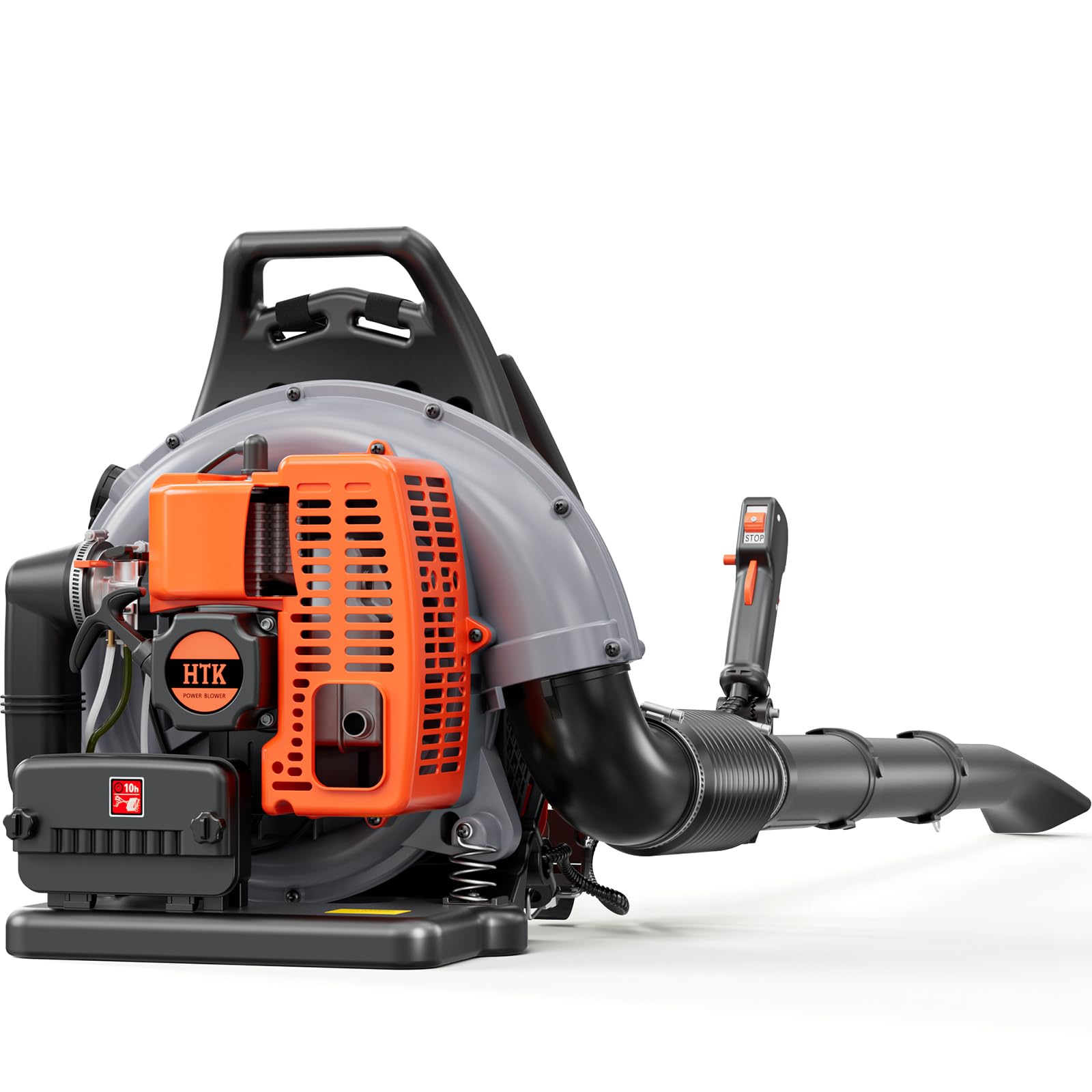
HTK’s 63cc backpack blower delivers 665 CFM and 205 MPH — respectable numbers for the entry-level price tier. The 2-stroke engine includes an air purge system that simplifies cold starts, and the cruise control prevents trigger fatigue during long sessions. The 1.7-liter fuel tank provides extended runtime for medium to large properties. Owners consistently praise the power output and the comfortable padded harness, noting that vibration is well-controlled for a budget machine.
The build quality reveals its price point in a few areas. The plastic tubes are thin, the back pad and straps are adequate rather than excellent, and the trigger feels a bit flimsy. The 2-stroke engine requires a 25:1 break-in ratio before switching to 40:1, and it is loud — hearing protection is mandatory. Some users reported the need for premium ethanol-free fuel to avoid starting issues after storage.
For a homeowner with 1-2 acres who needs backpack capacity without spending premium dollars, the HTK offers strong value. It won’t survive daily commercial abuse, but for weekend clearing of leaves and light debris, it punches above its weight class.
What works
- Strong 665 CFM output for the price
- Air purge system simplifies cold starts
- Comfortable harness for the weight class
What doesn’t
- Thin plastic tubes feel less durable
- Loud unmuffled 2-stroke exhaust
- Trigger and foam padding feel economy-grade
9. LawnMaster NPTBL31AB No-Pull Backpack Leaf Blower, 31cc Electric Start

The LawnMaster NPTBL31AB targets a specific pain point: pull-start fatigue. Its electric push-button start, powered by a rechargeable 7.2V battery, eliminates the cord-pulling that deters many older users or those with shoulder issues. The automatic choke and anti-vibration engine mount further reduce friction. With 470 CFM and 175 MPH, it is not a high-output machine, but owners with arthritis or shoulder injuries report it enables them to maintain their properties independently.
The 31cc engine is best suited for smaller properties — 1 acre or less — where moderate leaf cover is the norm. The backpack design is lightweight at 18.5 pounds, and the padded ventilated harness keeps the user comfortable. The downsides are significant: the electric start battery provides only 5 starts per charge, and there is no backup pull cord, so a dead battery leaves you waiting for a recharge. Several owners reported engine issues after 20-30 hours of use, and customer support responsiveness has drawn complaints.
For seniors or users with physical limitations who need gas power without the pull-start struggle, the LawnMaster is a thoughtful solution. Buyers should be prepared for potentially shorter engine life compared to premium brands and should have a backup plan for when the starting battery inevitably needs charging mid-job.
What works
- Electric push-button start eliminates pull-cord strain
- Lightweight at 18.5 pounds; easy for smaller operators
- Automatic choke simplifies operation
What doesn’t
- Only 5 electric starts per battery charge, no pull-cord backup
- Modest 470 CFM output limits heavy-duty use
- Mixed reliability reports after 20+ hours of use
Hardware & Specs Guide
CFM and MPH — The Right Balance
A backpack leaf blower’s effectiveness is tied to its CFM, not MPH. High CFM moves large volumes of air, pushing broad piles of leaves in fewer passes. MPH matters for blasting debris out of cracks or dense beds. For general property maintenance, target 600 CFM or higher. For commercial or estate work, 900+ CFM reduces job time by more than half. MPH above 200 is useful but secondary — a high-CFM machine with moderate MPH will outperform a low-CFM unit with extreme MPH in most leaf-clearing scenarios.
Engine Displacement vs. Weight
Gas backpack engines range from 31cc (entry-level) to 79.9cc (commercial max). Larger displacement delivers more torque and sustained CFM under load, but adds weight — expect a direct relationship: each additional 10cc adds roughly 3-5 pounds to the total unit weight. A 31cc blower weighs around 18 pounds, while a 79.9cc machine hits 24-33 pounds. Battery units avoid that trade-off, with premium 56V handhelds like the EGO LB8803-2 delivering 880 CFM at under 10 pounds, but at the cost of limited runtime on maximum power.
FAQ
How many CFM do I need in a backpack leaf blower?
What fuel mix does a 2-stroke backpack leaf blower use?
Is a battery backpack blower as powerful as a gas one?
How do I maintain a backpack leaf blower for long life?
Final Thoughts: The Verdict
For most homeowners and light commercial users, the best backpack leaf blower winner is the PRORUN PBB2884 because it delivers 1020 CFM — commercial-grade air volume — at a price that makes sense for serious property owners who refuse to pay the flagship premium. If you want featherlight battery convenience with zero maintenance, grab the EGO LB8803-2. And for maximum air volume when nothing else will do, nothing beats the Echo PB-9010T.