
Specs are compiled from manufacturer listings and verified buyer reviews and can change over time — please confirm the key details on the product page before buying.
Your azaleas and camellias want one thing: soil that is reliably acidic. If the pH drifts neutral or alkaline, those plants stop blooming, leaves turn yellow (a condition called chlorosis), and no amount of water or sun fixes it. The right fertilizer does two jobs at once — it drops the soil pH into the 5.0–6.0 range your acid-lovers crave and delivers the nitrogen, phosphorus, and potassium they need to set flower buds. The trick is picking a formula that delivers those nutrients without burning tender roots, and that lasts long enough that you are not re-applying every weekend.
I’m Rikta — the founder and writer behind Lawn Gear Lab. This guide is built by comparing the manufacturers’ published specifications and the patterns across verified customer reviews, so you get each pick’s real strengths and trade-offs instead of marketing spin.
Whether you are coaxing blooms from a stubborn camellia or feeding a row of rhododendrons that have not flowered in two years, the right choice starts with knowing which formula matches your soil condition and your effort level — that is exactly what this review of the best azalea camellia fertilizer options will walk you through.
Quick Picks
- Espoma Organic Holly-Tone 4-3-4 — Best Overall
- Miracle-Gro Water Soluble Azalea, Camellia, Rhododendron Plant Food — Top Performer
- GARDENWISE 8-4-8 Acidic Fertilizer — Best Value
- Nelson NutriStar 9-13-11 Acid Loving Plant Food — Bloom Specialist
- True Organic Azalea, Camellia & Rhododendron Food 5-4-3 — Organic pH Corrector
- Dr. Earth Acid Lovers Azalea, Camellia, Rhododendron & Maple Fertilizer — Organic Entry-Level
How To Choose The Best Azalea Camellia Fertilizer
The wrong fertilizer is worse than no fertilizer. A general-purpose lawn feed, for example, is high in nitrogen but rarely contains the sulfur or iron your acid-loving plants need, so you end up with lots of leafy growth and no flowers. Here is what to watch for when you read the label.
N-P-K Ratio and What It Actually Does
Every bag shows three numbers, like 9-13-11. The first is nitrogen (for green leaves), the second is phosphorus (for root development and blooms), and the third is potassium (for overall plant health). Acid-loving plants do well with a phosphorus number that is roughly equal to or higher than the nitrogen number — that keeps the plant focused on setting flower buds rather than just pushing out leaves. A ratio like 4-3-4 or 8-4-8 is a good starting point for azaleas and camellias.
Sulfur Content — The pH Adjuster
Sulfur is the ingredient that gradually lowers soil pH. If your soil is neutral (pH 7) or alkaline (above 7), your azalea cannot absorb iron no matter how much iron is in the bag — the pH locks it out. A fertilizer with 5% sulfur, like the True Organic or Espoma options, helps open up those nutrients over several weeks. If you already have naturally acidic soil (pH 5.5–6.0), you need less sulfur and can lean on a balanced organic feed instead.
Granules vs. Water-Soluble — Which Fit Your Routine?
Granules are the low-maintenance method: you sprinkle them around the drip line of the plant once in early spring and again in fall, and rain or watering carries them down to the roots slowly. Water-soluble powders, like the Miracle-Gro option, are mixed with water and applied every 7-14 days — they work faster but demand a regular schedule. If you have more than a few shrubs, granules save you time and reduce the chance of over-fertilizing.
Quick Comparison
| Model | Best For | N-P-K Ratio | Weight | Form | Amazon |
|---|---|---|---|---|---|
| Espoma Organic Holly-Tone | Large gardens & long-season feeding | 4-3-4 | 36 lb | Granules | Amazon |
| Miracle-Gro Water Soluble | Fast results & indoor/outdoor feeding | — | 5 lb | Powder | Amazon |
| GARDENWISE 8-4-8 | Slow-release with beneficial microbes | 8-4-8 | 2.1 lb | Granules | Amazon |
| Nelson NutriStar 9-13-11 | Heavy bloom production | 9-13-11 | 2 lb | Granules | Amazon |
| True Organic 5-4-3 | Organic with sulfur for pH drop | 5-4-3 | 12 lb | Granules | Amazon |
| Dr. Earth Acid Lovers | Pet-safe & entry-level organic | — | 1 lb | Granules | Amazon |
In‑Depth Reviews
1. Espoma Organic Holly-Tone 4-3-4
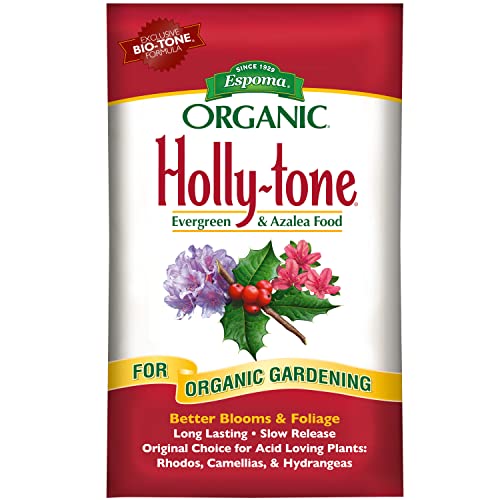
The 36-pound bag that feeds an entire yard through spring and fall with one application.
The 36-pound weight is the largest single bag in this lineup — buyers report using it for their spring and fall feedings across azaleas, hydrangeas, rhododendrons, and even magnolias in the Bay Area. The 4-3-4 ratio is balanced enough that it does not push excessive leafy growth, and the 5% sulfur works slowly to keep the soil acidic over the whole growing season.
Buyers consistently mention that Holly-Tone produces more blooms than they expected. One reviewer called it “on the miracle level,” noting that their azaleas and hydrangeas had never flowered so heavily. Unlike the Miracle-Gro option which requires mixing every 7-14 days, these granules are simply sprinkled around the drip line twice a year (spring and fall) and watered in — less effort, same or better results.
The catch is the bag size. At 36 pounds, it is overkill if you are only feeding one or two potted camellias on a patio — you will have leftover granules to store. For that situation, the smaller Dr. Earth or GARDENWISE options make more sense. But if you have a yard full of acid-lovers, no other pick delivers this much value per pound without requiring a second product to manage pH.
What owners love
- 36-pound bag provides enough for two full feedings across a large garden
- Organic ingredients with Bio-tone slow-release formula reduce application frequency
- Contains 5% sulfur to gradually lower soil pH for iron uptake
One limitation to note
- Large bag is too much for a single small potted plant or a tiny urban garden
Best for the whole yard: If you own multiple acid-loving shrubs, trees, or berry plants and want to feed just twice a year, this is the most efficient and proven option.
Not for patio pots: For a single container-grown camellia, the 1-pound Dr. Earth bag is a more practical size.
2. Miracle-Gro Water Soluble Azalea, Camellia, Rhododendron Plant Food

The water-soluble powder that shows visible greening within a week of the first feeding.
This is the fast-acting option for anyone who sees leaves turning yellow and wants a quick fix. Unlike the slow-release granules of the Espoma pick that work over months, this powder dissolves in water and feeds the plant the same day. The mixing ratio changes depending on where you apply it — 1:144 for indoor plants and 1:18 for outdoor shrubs — which is note if you split the bag between houseplants and garden beds.
Owners mention that it helped their rhododendrons recover and look “stunning” the same summer, and that the resealable bag keeps the powder dry between uses. It is also one of the few options here that lists specific instructions for indoor acid-loving plants like orchids, giving it a wider use range than the granular-only picks.
The trade-off is the schedule. You need to apply every 7-14 days during the growing season, unlike the GARDENWISE 8-4-8 which asks for only three feedings per year. If you have twenty shrubs, that is a lot of hose-end mixing. But for potted plants or a small bed you walk past daily, the routine is easy to keep.
Where it shines
- Results visible within a week of first application, according to buyers
- Versatile for indoor and outdoor acid-loving plants including orchids
- 80-ounce unit count gives more product per bag than the 32-ounce GARDENWISE option
Keep in mind
- Requires re-application every 7-14 days; not a slow-release formula
Reach for this if: You want immediate greening and have a watering can or hose-end sprayer ready for weekly feeding sessions.
Look elsewhere if: You prefer a twice-yearly, no-mix granular routine — the Espoma or GARDENWISE picks suit that habit better.
3. GARDENWISE 8-4-8 Acidic Fertilizer
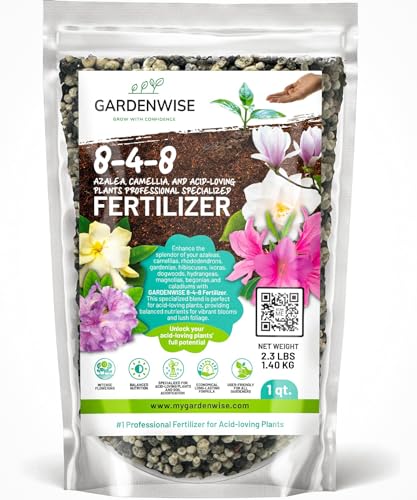
Three feeds per year, slow-release granules, and live microbial boosters for the soil.
This is the most economical application schedule of any pick here. The manufacturer specifies just three feedings per year — early spring, mid-summer, and fall — which makes it almost as hands-off as the Espoma but at a lower starting size. The 8-4-8 ratio provides higher nitrogen than the Espoma 4-3-4, which is useful if your azaleas are struggling with weak growth in addition to poor blooms.
Customers note that their rhododendrons doubled in size after using this, and that it revived shrubs that had stopped blooming. One reviewer noted that their Magnolia tree in a pot grew visibly better after application. The added bio-solid component (heat-treated and prilled to remove toxins) introduces live bacterial microbes into the soil, something none of the other granule options in this list do.
The down side is the bag size. At 32 ounces (2.1 lb), it is small — a 5.0x gap in weight compared to the 80-ounce Miracle-Gro bag. If you are feeding a large hedge of established azaleas, you may need to buy multiple bags per season, while a single bag of Espoma would cover the same area at a lower per-pound cost.
What stands out
- Only three applications needed per year — less effort than weekly mixes
- Contains live bacterial microbes from a bio-solid process that enrich soil health
- Includes iron and magnesium to prevent yellowing leaves
A practical concern
- Small 32-ounce bag means large gardens will need multiple purchases per season
Best for small-to-medium beds: If you have a handful of azaleas or a single row of camellias and want a low-maintenance granular, this is the most cost-effective per-season choice.
Not ideal for large-scale: A full hedge of rhododendrons will exhaust this bag quickly — the Espoma 36-pounder is the better value there.
4. Nelson NutriStar 9-13-11 Acid Loving Plant Food

The highest phosphorus number in the group, built to push out heavy blooms.
If your azaleas are all green leaves and no flowers, this is the ratio that can tip the balance. The 13 in the middle — phosphorus — is the highest of any pick here, and that drives root development and flower bud formation. The 9-13-11 also includes three different sources of iron (totaling 3.2%) to keep leaves deep green and prevent the chlorosis that plagues acid-lovers in high-pH soil.
Buyers in Houston reported that their azaleas looked great after using this, and one buyer mentioned that it saved plants from a cold snap and had them blooming in the same season. The four acidifying sources nudge the soil pH down faster than a single sulfur source, so you may see results earlier than with the True Organic option.
The bag is 2 pounds, putting it in the smaller end of the lineup — similar in size to the Dr. Earth and GARDENWISE. It is formulated for use from early spring through every other month during the growing season, which is slightly less convenient than the twice-yearly Espoma routine.
What it does best
- Highest phosphorus (13%) among all picks for bloom production
- Contains three iron sources (3.2%) for deep green foliage
- Four acidifying sources lower pH faster than single-source formulas
Points to consider
- Requires re-application every other month during growing season
- 2-pound bag is small for large gardens
Grab this if: Your acid-loving plants are healthy and green but refuse to flower — the high phosphorus directly targets that problem.
skip it if: You want a twice-yearly slow-release granule that also handles soil acidification; the Espoma covers both jobs with fewer applications.
5. True Organic Azalea, Camellia & Rhododendron Food 5-4-3
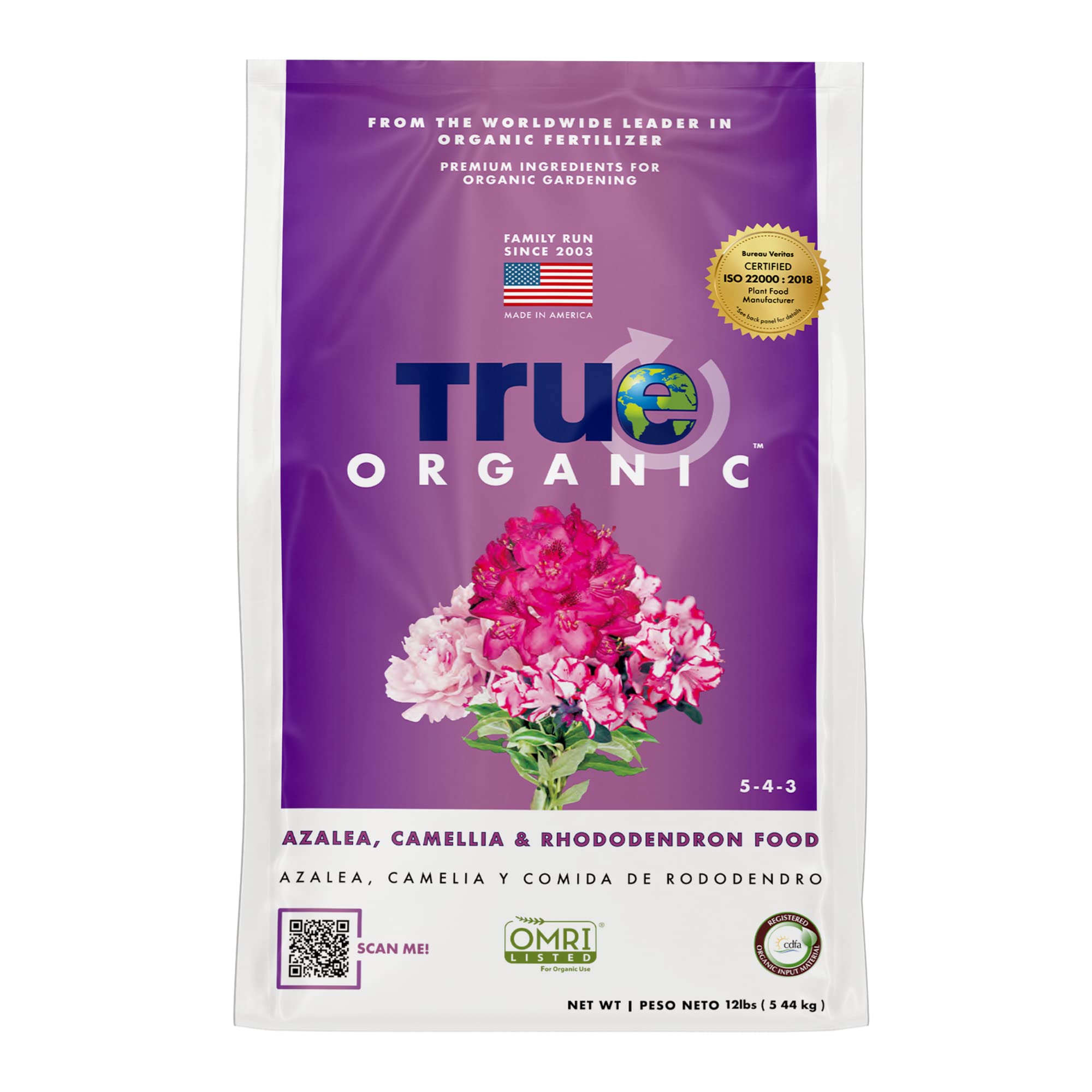
Organic granules that drop soil pH naturally while feeding shrubs twice a year.
The 5% sulfur in this formula is what separates it from the Dr. Earth option. Sulfur is the natural acidifier that open up iron in the soil, and at 5%, this product actively lowers pH over time rather than just maintaining an already-acidic environment. That makes it a stronger choice if you are planting azaleas in soil that tested near neutral (pH 7) or if you noticed yellow leaves last season despite regular feeding.
Reviewers point out that it revived neglected raspberry patches and turned struggling zinnias into four-foot-tall bloomers in two weeks. The 12-pound bag covers up to 261 square feet per the manufacturer, which is the second-largest coverage behind the Espoma — good for a medium-sized hedge or a row of camellias along a driveway. The ingredients include seabird guano and shrimp and crab shell meal, which add trace minerals that synthetic formulas skip.
The trade-off is the lower nitrogen and phosphorus (5-4-3 ratio) compared to the Nelson 9-13-11 or the Miracle-Gro. If your plants are already vigorous but not blooming, this ratio leans toward soil health and pH correction rather than a direct flower boost.
Why it works
- 5% sulfur actively lowers soil pH for iron absorption
- 12-pound bag covers up to 261 sq. ft. with twice-yearly application
- Contains seabird guano and shell meal for trace minerals
One thing to know
- Lower N-P-K ratio (5-4-3) means slower visible growth compared to water-soluble options
Pick this for pH issues: If your soil is neutral or alkaline and you want to lower it organically without using aluminum sulfate, the 5% sulfur here does the job naturally.
Not the bloom-maximizer: For plants that are healthy but flower shy, the higher-phosphorus Nelson formula is a more direct solution.
6. Dr. Earth Acid Lovers Azalea, Camellia, Rhododendron & Maple Fertilizer

The pet-safe, non-GMO granule that revived sad camellias with just a toss and water.
This is the only pick with Non-GMO Project Verified status, and it is marketed as safe around people and pets because it contains no synthetic chemicals or toxic ingredients. One buyer summed up the application simply: “Revived sad camellias; used Dr. Earth without digging or tea, just tossed and watered. Greened up quickly, new leaves, and nearby agapanthus flowered a month early.” That is the story across the reviews — people who had given up on a shrub seeing it bounce back with minimal effort.
At 1 pound, this is the smallest bag in the lineup — a 5.0x gap versus the Miracle-Gro 5-pound bag. It is purely a granular organic feed with no added sulfur, so it works best if your soil is already somewhat acidic (pH 6 or below) and you just want a maintenance boost. For raising pH from neutral, the True Organic or Espoma options with sulfur are a better fit.
Reviewers also report great results on gardenias — one owner reported it got their gardenia “blooming the best it ever has.” The handcrafted formulation includes humic acids and trace elements that feed the soil microbiome rather than just the plant, which is the kind of long-term soil-building that synthetic fertilizers skip.
What reviewers highlight
- Non-GMO Project Verified and OMRI-listed for organic gardening
- Safe around pets and people — no synthetic chemicals or toxic ingredients
- Revived camellias and gardenias with just a surface application, per buyer reports
The size trade-off
- 1-pound bag is the smallest here — a 5.0x weight gap compared to the 5-pound Miracle-Gro
Best for beginners or small gardens: If you have one or two potted azaleas or camellias and want a safe, organic no-fuss granule, this is the entry point.
Not for large beds: You will need multiple bags for a hedge, and without sulfur it may not fix a high-pH soil problem.
Understanding the Specs
N-P-K Ratio
The three numbers on every bag stand for Nitrogen (leaf growth), Phosphorus (roots and blooms), and Potassium (overall health). For azaleas and camellias, a phosphorus number that is equal to or greater than the nitrogen number (like 8-4-8 or 9-13-11) encourages flower buds over leafy growth. A ratio like 4-3-4 is a balanced maintenance feed, while 5-4-3 leans toward soil building and pH correction rather than a direct bloom push.
Sulfur Content & Soil pH
Sulfur is the ingredient that gradually lowers soil pH. Azaleas and camellias need a pH between 5.0 and 6.0 to absorb iron; without it, leaves turn yellow even if the fertilizer contains iron. A bag with 5% sulfur (like the True Organic or Espoma picks) actively moves pH down, while sulfur-free organic blends (like Dr. Earth) maintain existing acidity but do not correct neutral or alkaline soil.
Granules vs. Water-Soluble Powder
Granules are sprinkled around the base of the plant and release nutrients slowly over weeks or months — ideal for twice-yearly spring and fall feedings. Water-soluble powders are mixed with water and applied every 7-14 days; they work faster but demand a consistent schedule. Choose granules if you have many shrubs and limited time; choose water-soluble if you want to see greening within a week and do not mind a weekly routine.
Organic vs. Synthetic Formulations
Organic fertilizers (Dr. Earth, True Organic, Espoma) feed the soil microbiome with ingredients like seabird guano, feather meal, and composted materials. They release nutrients more slowly and are less likely to burn roots. Synthetic fertilizers (Miracle-Gro) use chemically processed salts that are immediately available to the plant — faster results but no long-term soil building and a higher risk of over-fertilization if you mis-measure.
FAQ
When should I fertilize my azaleas and camellias?
Can I use a general all-purpose fertilizer on azaleas?
How do I know if my soil is acidic enough for camellias?
How often should I apply a slow-release granular fertilizer?
What is the difference between 4-3-4 and 9-13-11 ratios?
Is organic fertilizer better than synthetic for azaleas?
Can I use azalea fertilizer on blueberries and hydrangeas too?
How do I apply granular fertilizer without burning the roots?
What does “chlorosis” mean and how do I fix it?
Will azalea fertilizer work in containers and pots?
Final Thoughts: The Verdict
If you want one dependable pick, the best azalea camellia fertilizer winner is the Espoma Organic Holly-Tone because its 36-pound bag, slow-release 4-3-4 formula with 5% sulfur covers the most ground for the least effort over a full growing season. If you want fast greening and do not mind a weekly feeding schedule, grab the Miracle-Gro Water Soluble. And for a small organic entry at the lowest commitment, the Dr. Earth Acid Lovers is the pet-safe, no-sulfur starter for a potted camellia or a single azalea bed.
How We Picked
We do not accept paid placement. Every pick is matched to a real buyer and a real use-case; we do not hands-on test units.
Sources & Methodology
Specifications: manufacturer listings and product documentation. Review insights: verified customer reviews, as of July 2026. Pricing: not shown on this page (it changes often); check the current price via the retailer link.
As an Amazon Associate, Lawn Gear Lab earns from qualifying purchases. This does not affect which products we feature.