
Specs are compiled from manufacturer listings and verified buyer reviews and can change over time — please confirm the key details on the product page before buying.
Autumn is when you get the upper hand on lawn weeds—cooler temperatures slow the grass but not the dandelions, clover, and creeping Charlie that want to take over before winter. A targeted fall weedkiller stops those invaders now so your lawn comes back clean in spring instead of looking like a patchy mess.
I’m Rikta — the founder and writer behind Lawn Gear Lab. This guide is built by comparing the manufacturers’ published specifications and the patterns across verified customer reviews, so you get each pick’s real strengths and trade-offs instead of marketing spin.
You will find a range of products from ready-to-use sprayers to concentrated liquids and granular feed-and-weed combos, each chosen for how well they handle the unique conditions of cool-season use. This is your straight-to-the-point breakdown of the autumn lawn weedkiller options actually worth your time this fall.
Quick Picks
- SpeedZone EW Lawn Weed Killer — Top Performer
- Scotts Turf Builder WinterGuard Fall Weed & Feed — Best Value Combo
- Ortho WeedClear Lawn Weed Killer with Comfort Wand — Easy Spot Treatment
- Fertilome (10519) Weed-Out Lawn Weed Killer (1 Gal) — Heavy-Duty Broadleaf
- Atticus Sertay Herbicide (1.25 oz) — Southern Specialist
How To Choose The Best Autumn Lawn Weedkiller
Not all weedkillers work the same when the mercury drops. Fall applications need a product that is effective in cooler temperatures and targets the specific broadleaf weeds that thrive as summer fades. Here is what matters most.
Formulation: Liquid, Granular, or Ready-to-Use
Liquid concentrates give you the most control over mixing strength and coverage, making them ideal for larger lawns. Granular feed-and-weed products combine fertilizer with herbicide, feeding your lawn while killing weeds in a single pass. Ready-to-use sprayers—like a battery-powered comfort wand—offer the fastest path to spot-treating a few weeds without mixing or measuring anything.
Active Ingredients and Weed Spectrum
The combination of active ingredients determines which weeds the product kills. Common broadleaf weed killers rely on 2,4-D, dicamba, and mecoprop-p to tackle dandelion, clover, chickweed, and ground ivy. If you have grassy weeds like crabgrass or nutsedge, you need a product with a different active ingredient, such as sulfosulfuron. Always check the label against the weeds you actually see in your lawn.
Coverage and Application Timing
Fall applications work best when weeds are young and actively growing, before the first hard frost. Check the coverage per bottle or bag—some concentrates treat up to 8,000 square feet per pint, while a granular bag might cover 4,000 square feet. Apply when temperatures are between 45°F and 90°F, and water the lawn before applying granular products so the granules stick to the weed leaves.
Quick Comparison
| Model | Best For | Formulation | Coverage | Weed Speed | Amazon |
|---|---|---|---|---|---|
| SpeedZone EW | Fast, cool-weather action | Liquid concentrate | Mix per 1,000 sq. ft. | Hours to days | Amazon |
| Scotts WinterGuard Fall Weed & Feed | Feed + weed in one step | Granule | 4,000 sq. ft. | ~3 weeks | Amazon |
| Ortho WeedClear Comfort Wand | Easy spot treatment | Ready-to-use liquid | 1.33 gal. (spot) | ~1 month | Amazon |
| Fertilome Weed-Out | Large-area broadleaf control | Liquid concentrate | Up to 8,000 sq. ft./pint | 1–6 weeks | Amazon |
| Atticus Sertay | Poa annua and sedge in southern lawns | Water-dispersible granule | 12,500 sq. ft./1.25 oz | 3–4 weeks | Amazon |
In‑Depth Reviews
1. SpeedZone EW Lawn Weed Killer

The fastest-acting cool-weather weedkiller that lawn pros rely on for fall cleanups.
If you want visible results before the weekend is over, SpeedZone EW is the pick. This liquid concentrate delivers visible effects within hours—buyers report that weeds curl and brown in just 2 days, which is a stark contrast to slower products that take weeks. The active ingredients (2,4-D, dicamba, carfentrazone-ethyl, and mecoprop-p) work together to control over 90 listed weeds including white clover, dandelion, ground ivy, and spurge.
The cool-weather performance is the standout here. SpeedZone is formulated to stay effective when fall temperatures drop, which is exactly when many other weedkillers lose their punch. It is also rainfast in as little as 3 hours, so you don’t have to worry about a surprise shower washing it away. Unlike the Ortho WeedClear’s ready-to-use approach, this is a concentrate—you mix it yourself, typically 1.5 fluid ounces per 0.5 to 1 gallon of water for cool-season grasses. The bottle itself holds 20 fluid ounces, while the Ortho WeedClear contains 170.24 fluid ounces of ready-to-use liquid, though the SpeedZone’s concentrated formula goes much further per application.
On the downside, it is a targeted herbicide that can damage surrounding grass if you overspray—one reviewer noted that a slight spray on the weed leaves is enough to kill clover and spurge without harming the lawn. It also weighs 8 ounces, while the Fertilome Weed-Out is listed at 3.7 kilograms, but the trade-off is that you need a separate sprayer.
What Makes It Fast
- Visible results within hours, weeds brown in 2 days
- Effective in cool fall temperatures
- Rainfast in 3 hours
- Reseed in as little as 7 days
What to Watch For
- Must be mixed with water—not ready-to-use
- Overspray can damage surrounding grass
- Not a feed-and-weed product (no fertilizer)
Best for fast action: Reach for SpeedZone when you need to knock down an active weed problem in cool weather and you are comfortable mixing your own spray.
Skip if you want a low-maintenance approach: If you prefer a ready-to-use wand or a granular product that feeds as it kills, look at the Ortho or Scotts picks instead.
2. Scotts Turf Builder WinterGuard Fall Weed & Feed

One bag that feeds your lawn and kills weeds together in a single fall application.
This is the all-in-one solution for anyone who wants to fertilize and control weeds without separate trips around the yard. The 11.28-pound bag covers 4,000 square feet and kills over 50 listed weeds including clover, dandelion, plantain, and purslane. Buyers who applied it to 3,000 square feet of wet lawn reported that weeds browned and died by week 3, while the grass became thicker, greener, and healthier. That dual action—weed killer plus fall fertilizer—gives your lawn a boost heading into winter dormancy.
Application is straightforward: spread the granules on a wet lawn when temperatures are between 60°F and 90°F, and expect rain within a few days for best absorption. It works on a wide range of grass types including Bahiagrass, Bermudagrass, Bluegrass, Centipedegrass, Fescue, Ryegrass, and Zoysiagrass. The weed kill is slower than SpeedZone’s hours-to-days timeline, but you get the fertilizer benefit that no liquid-only product provides. Unlike the Ortho WeedClear’s spot-treatment approach, this is a full-lawn broadcast product, so it covers every inch in one pass.
The catch is timing. The granular herbicide is most effective when applied early in fall while weeds are still actively growing. If you wait too late and cold weather stops weed growth, effectiveness drops. A reviewer specifically noted that the product is less effective if the grass and weeds stop growing due to cold temperatures.
Why It’s a Time-Saver
- Feeds lawn and kills weeds in one application
- Kills over 50 listed weed types
- Visible results in about 3 weeks
- Works with many common grass types
Timing Matters
- Must be applied to a wet lawn for best results
- Less effective if applied too late in cold weather
- Slower than liquid concentrates like SpeedZone
Reach for this if you want efficiency: The Scotts WinterGuard is ideal for homeowners who want to fertilize and control weeds in a single fall afternoon without mixing or spraying.
Look elsewhere if you need targeted spot treatment: If you only have a few weeds scattered around, a granular broadcast product will apply herbicide to the whole lawn whether it needs it or not.
3. Ortho WeedClear Lawn Weed Killer with Comfort Wand

The grab-and-go sprayer that makes spot-treating weeds as easy as pointing and pressing.
For the person who hates mixing chemicals and cleaning sprayers, the Ortho WeedClear with its battery-powered Comfort Wand is the simplest path to a weed-free lawn. The 1.33-gallon container of ready-to-use liquid attaches to a wand that delivers a consistent spray pattern with minimal overspray. You just point at the weed, press a button, and the product does the rest. It kills crabgrass, dandelion, clover, chickweed, and creeping Charlie down to the root, often in a single application—though owners mention that tough weeds like thistle take about a month to fully die.
One major advantage over the other picks is the sheer volume: this container holds 170.24 fluid ounces, while the SpeedZone bottle holds 20 fluid ounces. Granted, the SpeedZone is a concentrate that gets diluted, but for someone treating a few dozen weeds across a half-acre, the Ortho is ready to spray immediately. It works on Bermudagrass, Fescues, Kentucky Bluegrass, Ryegrass, and Zoysiagrass, and you should use it when temperatures are between 45°F and 90°F—perfect for early fall.
The trade-off is speed and depth. While SpeedZone shows results in hours, Ortho is a slower worker—some hard-to-kill invasives need 2 or more sprays. A reviewer mentioned that while it kills many weed types selectively, it acts slowly and does not discolor the lawn. Another buyer reported that two recent cartons with the spray wand failed completely, with the weeds not even yellowing after application, which suggests some quality control variability on the wand itself.
Why Grab This
- No mixing, no measuring, no cleanup
- Battery-powered wand for targeted application
- Large 1.33-gallon container for many spots
- Kills down to the root in one application for common weeds
What to Know
- Slow acting on tough weeds like thistle
- Some reports of faulty wand performance
- Lower value per ounce compared to concentrates
Your pick if convenience is king: The Ortho WeedClear Comfort Wand is perfect for homeowners who want to spot-treat a handful of weeds without any prep work or cleanup.
skip it if you are treating a large area or need fast results: For a full-lawn treatment or hours-to-days action, the SpeedZone or Fertilome concentrates are better bets.
4. Fertilome (10519) Weed-Out Lawn Weed Killer (1 Gal)

The gallon-sized concentrate that takes on over 200 broadleaf weeds across your entire lawn.
When you have a serious broadleaf weed problem across a large yard, Fertilome Weed-Out gives you the most pure coverage for your money among the liquid concentrates here. Each 1-gallon bottle treats large areas—1 pint of the concentrate can treat up to 8,000 square feet of lawn. Its active ingredients, dicamba, mecoprop-p, and trimec, target over 200 broadleaf weeds including dandelion, clover, and chickweed. That is over 200 listed weeds versus SpeedZone’s 90+ listed weeds, though both share overlapping core ingredients.
Patience is the main requirement here. Customers note visible results after 1 to 2 weeks, but the full effect takes about 6 weeks, with approximately 80% weed kill at that point. One reviewer emphasized that you must be patient and use proper mixing ratios. That is significantly slower than SpeedZone’s 2-day timeline, but it is also a more comprehensive kill on a broader weed list. The product is labeled for use on Bahia, Bermuda, Zoysia, Kentucky Bluegrass, and Fescue. Apply in spring for early weeds and in fall for late-germinating ones.
You get more for your money here: one gallon of concentrate (weighing 3.7 kilograms) treats far more area than a single 20-ounce bottle of SpeedZone, and it kills a wider range of weed types. The trade-off is that it misses crabgrass and thistle unless you add a second product like Quinclorac, according to one buyer. Another reviewer said it killed clover well but left dandelions untouched in their yard.
What Makes It a Powerhouse
- Controls over 200 broadleaf weeds
- 1 pint treats up to 8,000 square feet
- Same active ingredients used by professionals
- Effective for both spring and fall application
The Trade-Offs
- Slow acting—full effect at 6 weeks
- Requires a separate sprayer and mixing
- Does not kill crabgrass or thistle
- Heavy gallon container (3.7 kg)
Grab this for broadleaf coverage at scale: Fertilome Weed-Out is the go-to for large-lawn owners who want the broadest weed spectrum in a single bottle and are okay waiting 6 weeks for the full effect.
Pass on it if you want fast results or are spot-treating: SpeedZone works in days, not weeks, and the Ortho wand is easier for just a few weeds.
5. Atticus Sertay Herbicide (1.25 oz)
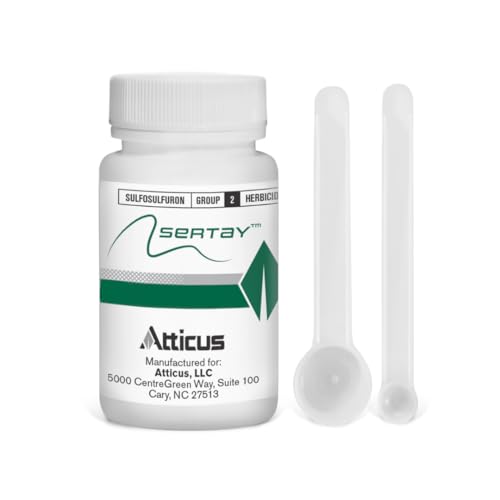
The targeted solution for warm-season grass owners fighting Poa annua and sedge this fall.
If you maintain a southern lawn and your autumn weed problem is more than just broadleaf invaders, Atticus Sertay fills a gap that none of the other picks cover. Its active ingredient, sulfosulfuron at 75%, is formulated for warm-season turf like Bermudagrass, St. Augustinegrass, and zoysiagrass. This is the product to reach for when you are battling Poa annua (annual bluegrass), nutsedge, kyllinga, or cool-season grass species invading your warm-season lawn. A single 1.25-ounce bottle covers 12,500 square feet—more coverage per unit than any other product here.
The application timing is flexible—spring, summer, or fall on young, actively growing weeds—but its fall role is crucial: use it ahead of overseeding with perennial ryegrass for a clean start. Reviewers point out that Sertay delivers visible results in 3 to 4 weeks for Poa annua. It also works on grassy weeds, broadleaf weeds, and sedges, making it the most versatile in terms of weed type diversity among these five picks. Unlike the other products that focus purely on broadleaf weeds, Sertay also suppresses invading cool-season grass species like tall fescue and perennial ryegrass.
The specialization does come at a cost—this is not a product for a cool-season fescue lawn in the Pacific Northwest. It is also a water-dispersible granule rather than a liquid, so you need to mix it in a sprayer, and it is not available for sale in Alaska, the District of Columbia, or Vermont. There are no customer reviews available in the data to judge real-world performance, so rely on the spec sheet and label for expectations.
Why It Stands Apart
- Targets Poa annua, nutsedge, and kyllinga
- Extensive coverage—12,500 sq. ft. per bottle
- Safe for warm-season grasses like St. Augustine and Bermuda
- Suppresses invading cool-season grasses
Know Before You Buy
- Not for cool-season grass lawns
- Requires mixing (water-dispersible granule)
- Not available in AK, DC, or VT
- No verified customer reviews available
Choose this for southern weed challenges: Atticus Sertay is the right weapon if you manage a warm-season lawn and need to control Poa annua, sedge, or cool-season grass invasions this fall.
Skip it for standard broadleaf weeds: If your fall problem is dandelions and clover in a cool-season lawn, the Fertilome or SpeedZone are better matches.
Understanding the Specs
Liquid Concentrate vs. Ready-to-Use vs. Granular
Liquid concentrates (like SpeedZone and Fertilome) give you the most flexibility and the best value per square foot, but you need to mix them in a sprayer and follow dilution rates carefully. Ready-to-use products (like the Ortho WeedClear with its Comfort Wand) skip all the mixing and cleanup—just point and spray—but you pay for that convenience with a higher cost per ounce and lower total coverage. Granular products (like the Scotts WinterGuard) combine feeding and weeding in one broadcast application, which saves a trip but requires a wet lawn and proper timing to activate the herbicide.
Active Ingredients: What They Kill and What They Miss
The most common broadleaf weedkillers use a three-way mix of 2,4-D, dicamba, and mecoprop-p—this tackles dandelion, clover, chickweed, and ground ivy effectively. Products like Fertilome add trimec for a broader weed spectrum at over 200 types. For grassy weeds like crabgrass or nutsedge, you need a different active ingredient entirely, such as sulfosulfuron (found in Atticus Sertay). No single product kills everything, so match the active ingredient to the actual weeds in your lawn for the best results.
FAQ
Can I use an autumn weedkiller on a wet lawn?
How cold is too cold for a fall weedkiller application?
Will an autumn weedkiller kill my grass too?
How long after applying can I reseed my lawn?
What is the difference between a feed-and-weed and a straight weedkiller?
Can I use a southern lawn weedkiller on my cool-season fescue lawn?
How much area does a 1-gallon bottle of liquid concentrate cover?
Will these products kill crabgrass in the fall?
Do I need a surfactant with these weedkillers?
Can I apply a fall weedkiller if rain is forecast?
Final Thoughts: The Verdict
For most people, the autumn lawn weedkiller to buy is the SpeedZone EW because it shows results within hours (not weeks) and keeps working in cool fall temperatures that slow other products. If you prefer a single pass that fertilizes and kills weeds together, choose the Scotts WinterGuard Fall Weed & Feed. And for southern warm-season lawns fighting Poa annua (annual bluegrass), nutsedge, or invading cool-season grasses this fall, the Atticus Sertay offers the most targeted control.
How We Picked
We do not accept paid placement. Every pick is matched to a real buyer and a real use-case; we do not hands-on test units.
Sources & Methodology
Specifications: manufacturer listings and product documentation. Review insights: verified customer reviews, as of July 2026. Pricing: not shown on this page (it changes often); check the current price via the retailer link.
As an Amazon Associate, Lawn Gear Lab earns from qualifying purchases. This does not affect which products we feature.