
Specs are compiled from manufacturer listings and verified buyer reviews and can change over time — please confirm the key details on the product page before buying.
Forgetting to water the garden is one thing; overwatering and drowning your plants is another thing entirely. And dragging a hose around every evening gets old fast. An automated watering system does the job for you — it turns a faucet into a programmable sprinkler that runs on a schedule, so your lawn and planters get the right amount of water at the right time.
I’m Rikta — the founder and writer behind Lawn Gear Lab. This guide is built by comparing the manufacturers’ published specifications and the patterns across verified customer reviews, so you get each pick’s real strengths and trade-offs instead of marketing spin.
You need a simple timer for a couple of hose bibs or a full smart setup you can control from your phone while on vacation. This breakdown of the best automated watering system options helps you match the right features to your yard’s needs.
Quick Picks
- RAINPOINT WiFi Water Timer — Best Overall
- Orbit 62067 1-Outlet Programmable Digital Hose Watering — Two-Timer Value
- VIVOSUN Automatic Drip Irrigation Kit — Grower’s Choice
- Rvwsx Sprinkler Timer 2 Zone — Clear Display Value
- RAINPOINT Sprinkler Timer with Brass Inlet & Outlet — Sturdy Single-Zone
- MOES 2 Outlet Sprinkler Timer — Dual-Zone Heavy
- Beday Solar Drip Irrigation System — Solar Off-Grid
How To Choose The Best Automated Watering System
The features that separate a good timer from a frustrating one come down to your yard’s layout and how much control you want. Here are the key specs to focus on.
Zone Count and Independent Scheduling
A single-zone timer waters everything on one schedule. If you have a lawn that needs longer watering and a flower bed that needs a short, frequent soak, a two-zone timer lets you run completely different programs for each area from one device. Some budget models offer only one timed run per day, which is fine for a single hose but limits flexibility.
Material Quality: Brass vs. Plastic
The inlet and outlet threads take the most wear. Plastic connections are common on entry-level timers and can crack or strip over time. A brass inlet and outlet, like those rated to withstand up to 116 psi (pounds per square inch, a measure of water pressure), is far more durable and leak-resistant, especially in direct sunlight or freezing temperatures.
Rain Delay and Manual Override
A rain delay function pauses your programmed schedule for a set period — often 24, 48, or 72 hours — so you do not water right after a storm. A manual mode lets you run the hose on demand without canceling your stored program. These two features together save water and keep your schedule intact.
Power Source and Connectivity
Most hose timers run on two AA alkaline batteries. A solar-powered system with a USB backup charging option can operate year-round without battery swaps. Wi-Fi enabled timers let you adjust schedules from a phone app, but they rely on a stable 2.4 GHz connection and a gateway hub for remote access. If you travel often, a smart timer with voice control and weather-based adjustments (like Seasonal Adjust, which modifies duration by a percentage each month) adds convenience.
Quick Comparison
| Model | Best For | Zones/Settings | Inlet/Outlet | Smart Home | Amazon |
|---|---|---|---|---|---|
| RAINPOINT WiFi Water Timer | Full remote control & multi-schedule | 2 zones (up to 27 settings) | Brass | Yes | Amazon |
| Orbit 62067 1-Outlet Timer (2-Pack) | Simple, reliable, two-timer value | 1 zone (3 settings) | Plastic | No | Amazon |
| VIVOSUN Automatic Drip Irrigation Kit | Indoor growers & small potted gardens | 16 emitters (app-controlled) | Anti-siphon valve | Yes | Amazon |
| Rvwsx Sprinkler Timer 2 Zone | Budget dual-zone setup with clear display | 2 zones | Plastic with metal filter | No | Amazon |
| RAINPOINT Brass Inlet Sprinkler Timer | Single-zone durability with brass threads | 1 zone | Brass | No | Amazon |
| MOES 2 Outlet Sprinkler Timer | Two-zone scheduling with brass durability | 2 zones (4 settings) | Brass | No | Amazon |
| Beday Solar Drip Irrigation System | Off-grid, solar-powered, indoor/outdoor | 15 drippers (programmable) | Plastic | No | Amazon |
In‑Depth Reviews
1. RAINPOINT WiFi Water Timer
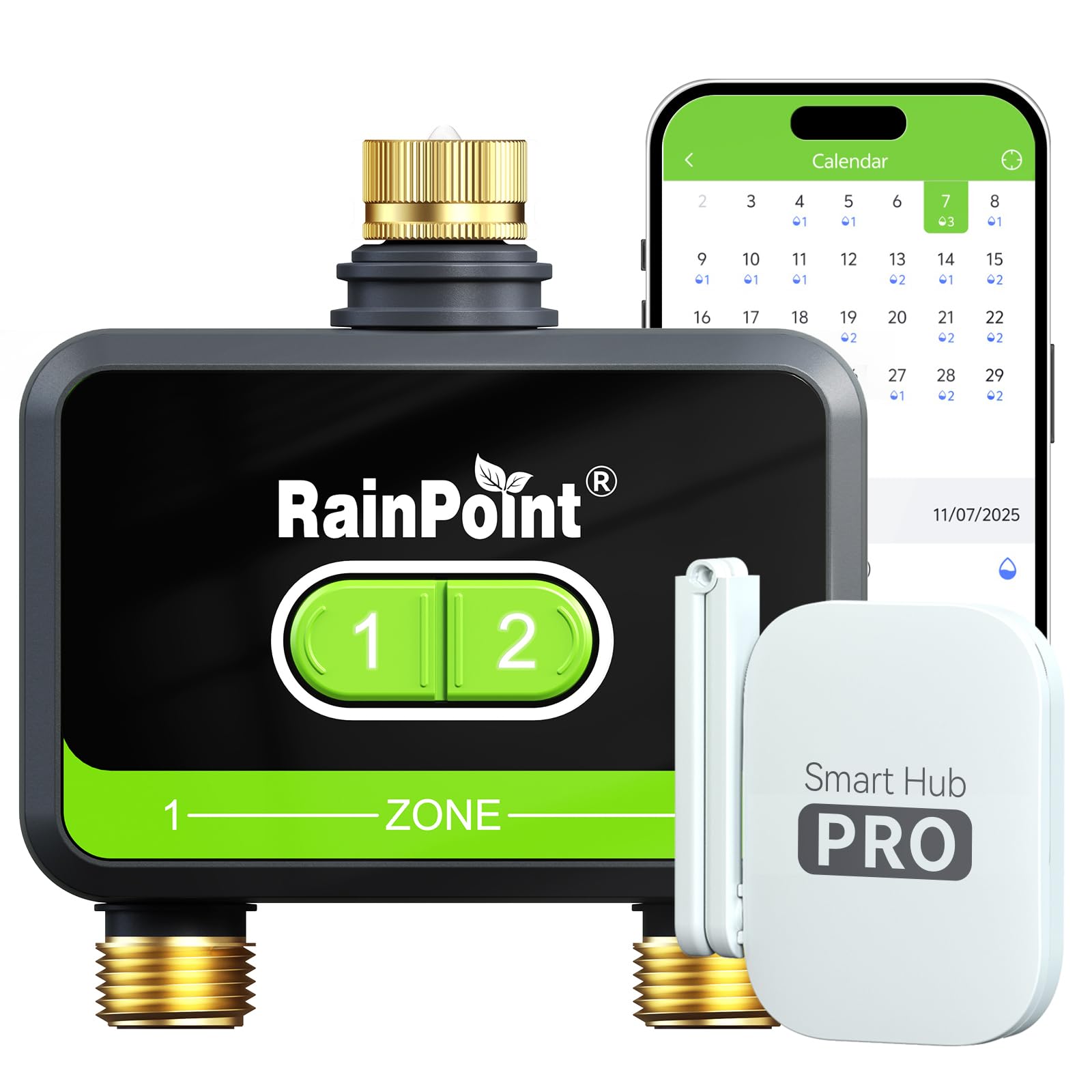
The smartest pick for controlling two zones remotely from anywhere.
The RAINPOINT WiFi Water Timer gives you two independently programmable zones, so you can water the lawn and the flower bed on completely different plans. Each zone holds up to 6 customizable schedules. The solid brass inlet and outlet ports handle typical household water pressure without leaking. The WiFi connection through the RainPoint Home app lets you adjust schedules, turn the water on or off, and check the status from your phone. Buyers report that the gateway and timer were relatively easy to install and that they appreciate being able to interrupt watering remotely after a storm.
You get three watering modes — Normal Irrigation, Misting Irrigation, and Cycle & Soak. Five frequency options include EveryDay, Odd Dates, Even Dates, Weekly, or Every 2-30 Days. The Seasonal Adjust feature changes the watering duration each month by a percentage you set, from 10% to 200%, so you do not have to manually tweak the schedule as the seasons shift. It works with Alexa and Google Assistant for voice control, and the gateway can pair with multiple RainPoint devices to expand the system later.
One reviewer noted that after a few weeks the scheduled watering stopped working reliably, and their replacement unit was still under evaluation. The weather-based scheduling also misread local conditions at times. Most owners say the remote control feature alone is worth it. Unlike the simpler RAINPOINT programmable timer with no smart features, this one keeps you connected even when you are states away.
Remote advantage: The combination of brass durability, two independent zones, and app-based control makes this the most flexible system here for anyone who wants to manage watering from their phone.
Reliability caveat: A small number of users report schedule failures after a few weeks, so if you need 100% guaranteed uptime with no chance of missed watering, a simpler mechanical timer might be safer.
Reach for this if: you travel frequently, have two distinct watering zones, and want full remote control with weather-based adjustments.
Look elsewhere if: you prefer a dead-simple, no-app setup and do not want to rely on WiFi connectivity to water your plants.
2. Orbit 62067 1-Outlet Programmable Digital Hose Watering Timer, 2-Pack
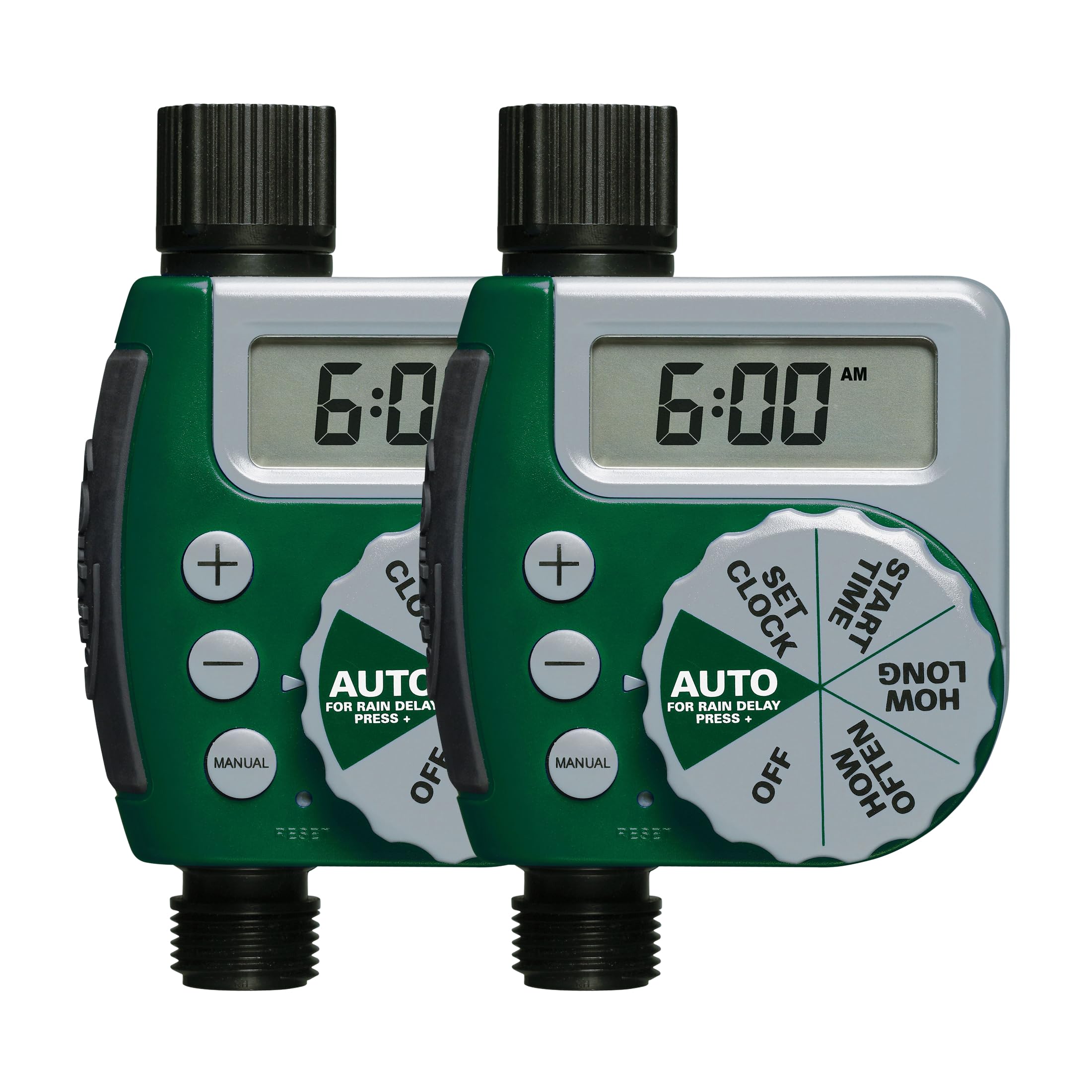
A classic, no-fuss two-pack that just works year after year.
The Orbit 62067 two-pack gives you the straightforward option for covering two separate faucets with individual timers. Each timer is a single-outlet unit with a large, easy-to-read LCD screen and three settings that let you program one timed run per day. It retains the program even when you change the batteries, so you do not have to reprogram it every season. The rain delay pauses the schedule for 24, 48, or 72 hours, which prevents overwatering after a wet day.
Buyers who have used this brand for years say each timer lasts 2-4 years even in harsh Arizona heat, and they appreciate that the programming steps are simple and the battery life is solid. The timer has a water-resistant plastic body, though the hose connections are plastic as well, which some owners note feels less durable than brass. Since it runs one timed run per day, you cannot set a morning and evening cycle on the same unit — you would need a timer per schedule.
Compared to the RAINPOINT WiFi timer above, the Orbit gives up app control and dual-zone independence. It wins on simplicity and the fact that you get two timers in one box. If you just need to water a couple of garden hoses on a basic schedule and do not want to mess with a phone app, this two-pack is the most practical way to cover two spigots without buying two separate units.
Why users stick with it
- Batteries last well and programs survive battery swaps
- Rain delay works in three intervals
- Two timers in one package covers two faucets
The limitations
- Only one timed watering event per day
- Plastic hose connections instead of brass
Who it is for: homeowners who want a simple, reliable timer for two separate hoses without an app or extra features.
Who should pass: anyone who needs two different watering times per day on the same zone or prefers metal fittings for extra durability.
3. VIVOSUN Automatic Drip Irrigation Kit

A powerful, app-smart drip kit built for serious indoor plant setups.
This kit is a different kind of system — instead of screwing onto a faucet, it uses a 15W pump that delivers up to 1000 L/H (liters per hour) at a quiet 30–40 dB (decibels, a measure of sound level, about as loud as a quiet library). The upgraded 4 mm drippers increase water flow by 30% compared to standard 3 mm lines, and the kit includes 16 drip emitters so you can water up to 16 pots simultaneously. You connect it to a reservoir (like a bucket or tote) and control it through the Vivosun A10 GrowHub and app, setting custom schedules, Cycle Mode for automatic intervals, or Recipe Mode for precise daily timing and amounts.
Owners mention that the system works well when the tubing is kept to even lengths and the pump is run at around 50% speed. The anti-siphon connector prevents backflow and flooding, and the built-in filter cotton blocks dirt and debris to keep the drippers from clogging. For indoor growers using soil, coco coir, perlite, or rockwool, this delivers water directly to the root zone with less waste than overhead watering.
One significant complaint is that the injection-molded splitters can be defective: one owner found that after a month only two of eight nozzles worked, and flow rates varied drastically between lines. This system is best suited for users who are willing to monitor and possibly replace a few components. Unlike the Rvwsx dual-zone timer that attaches directly to a hose bib, the VIVOSUN kit requires a water reservoir and space for the pump, so it works best on a tabletop or shelf near an outlet.
Precision watering: The app-based scheduling and fast 4 mm drippers give you tight control over how much water each plant gets, which is ideal for indoor gardens with varied species.
Part reliability risk: Some splitters arrive clogged or fail within weeks, so you may need to source better-quality fittings to ensure even flow to all emitters.
Best for: indoor plant collectors and small-space growers who want app-timed root-zone watering and are comfortable troubleshooting the drip line parts.
Skip if: you just need a simple hose-end timer for outdoor garden beds and do not want to set up a reservoir and pump.
4. Rvwsx Sprinkler Timer 2 Zone

A budget-friendly two-zone timer with the biggest, most readable screen.
The Rvwsx Sprinkler Timer’s 3.5-inch large screen separates it from most in its price range — it clearly shows which zone is active and the next watering time in big, easy-to-read fonts. You get two independent zones, each programmable with a watering duration from 1 minute up to 3 hours 59 minutes and a frequency from 1-12 hours or 1-7 days. That means you can run a short, frequent schedule for delicate flowers and a longer, less frequent one for the lawn, all from one unit.
The build is IP66 rated (a protection rating meaning it is fully sealed against dust and powerful water jets), and the battery cover uses a rubber gasket to keep moisture out. A built-in metal filter removes impurities from the water, and the standard 3/4-inch threading fits most household faucets. Customers note the setup is easy and the dual-zone scheduling works perfectly, with one owner saying it reliably waters their Florida lawn and kept their plants thriving. The rain delay pauses watering for the current cycle, and manual mode lets you water without affecting the preset program.
Compared to the Orbit 2-pack, this timer offers twice the zones per unit — you get two independent schedules from one device instead of one schedule per device. It does not have brass fittings like the RAINPOINT or MOES models, so the plastic threads may not last as long in extreme sun or frequent connection changes, but for the price, the clear display and dual-zone flexibility make it a strong value. Some buyers mention a slight learning curve with the menu, but once set, it runs reliably.
Standout strengths
- Very large 3.5-inch screen is easy to read from a distance
- Two independent zones for different watering needs
- IP66 waterproof rating with rubber gasket seal
Trade-offs
- Plastic housing and threads, not as durable as brass
- Menu navigation has a slight learning curve
Ideal for: gardeners who want dual-zone control on a budget and prioritize a clear, large display for easy programming.
Not ideal for: anyone who needs all-metal fittings for high-pressure or year-round outdoor exposure.
5. RAINPOINT Sprinkler Timer with Brass Inlet & Outlet

A single-zone timer built with brass threads that outlast plastic alternatives.
The RAINPOINT Sprinkler Timer’s brass inlet and outlet are the headline here — pure metal threads that resist corrosion and cracking far better than the plastic fittings found on many timers at this level. It is rated to handle up to 116 psi, and the built-in metal filter gaskets stop sediment and larger particles from getting into your irrigation system. The body shell uses heavy-duty weatherproof construction and UV-resistant materials, so it holds up in direct sun.
Programming is straightforward with a dial that uses plain English labels — “How Long,” “How Often,” “Time,” “Start” — which reviewers point out is the clearest control interface they have used. You set the watering duration from 1 minute to 3 hours 59 minutes and the frequency from every 1-12 hours or 1-7 days. The rain delay can pause the schedule for 24, 48, or 72 hours, and manual mode lets you water immediately for up to 8 hours without interrupting your stored program. The large LCD screen shows the watering time, frequency, and power status clearly.
Compared to the Rvwsx timer above, this RAINPOINT model trades a second zone for significantly better material quality — brass instead of plastic at the connection points. One downside: some users report that batteries drain after only 3-4 watering cycles with alkaline cells, though rechargeable batteries seem to work better. If you only need to water one zone but want a timer that will survive seasons of outdoor use, the brass construction makes this a solid long-term investment.
Durable build: The brass inlet and outlet, plus UV-resistant housing, make this the most weather-resistant single-zone timer here.
Battery consideration: Some owners find alkaline batteries drain fast; rechargeables may last longer but show inaccurate charge levels on the display.
Reach for this if: you need a single-zone timer that can withstand full sun, high pressure, and years of seasonal use without cracking.
Look elsewhere if: you need two independent zones or want a timer that runs well on standard alkaline batteries without frequent changes.
6. MOES 2 Outlet Sprinkler Timer

A brass-tough dual-zone timer with silicone-sealed electronics for wet conditions.
The MOES 2 Outlet Sprinkler Timer offers two independently programmable outlets with 4 settings each, so you can run different watering frequencies, durations, and start times for different areas of the yard. The reinforced brass inlet provides superior leak resistance and corrosion protection compared to plastic inlets. What sets this model apart is the silicone potting technology — the internal electronic components are fully encapsulated in silicone, creating a sealed barrier against moisture, dust, and shock. That means the timer can handle being outdoors in rain or sprinkler overspray without the electronics shorting out.
Shoppers say that the scheduling options are flexible and the brass connections feel solid. The rain delay automatically pauses watering based on weather conditions, and manual mode lets you water on demand without disrupting the preset programs. The large LCD screen and control panel are intuitive enough that most owners find setup straightforward. One buyer mentioned they appreciate being able to set different schedules for different parts of the yard, and the rain delay helps avoid watering after a storm.
The catch: a few owners have reported durability issues. One owner reported the plastic part inside the connector broke after six weeks, and the every-12-hour setting never worked correctly. They also noted that MOES customer service did not respond to their requests. Compared to the Rvwsx two-zone timer, the MOES has more settings (4 vs. 2) and better weather sealing, but the brand’s support reputation is weaker. If you are willing to take a chance on a well-protected timer with brass threads, the silicone sealing is a real advantage in wet climates.
Protection-first design
- Silicone potting fully seals electronics from moisture
- Brass inlet and outlet for leak resistance
- Two zones with 4 settings each for flexible scheduling
Known issues
- Reports of connector failure within weeks
- Customer support described as unresponsive
- Some scheduled intervals (like every 12 hours) do not function
Who it is for: gardeners who need a sealed, dual-zone timer with brass fittings and a rain delay, and are okay with a slightly higher risk of early failure.
Who should skip: anyone who needs reliable customer support or absolutely cannot afford a timer that might fail mid-season.
7. Beday Solar Drip Irrigation System

A solar-powered drip kit that waters up to 15 pots without a hose connection.
The Beday Solar Drip Irrigation System is for situations where you do not have a faucet nearby — a balcony, a patio, or a greenhouse far from the house. It runs on a solar panel with USB charging as a backup for cloudy or winter days, so it keeps working year-round without battery swaps. The kit comes with 50 feet of tubing, 15 T-joints, 15 watering spikes, a filter, an anti-siphon component, and a soil moisture sensor. You set up the tubing to reach each pot, and the programmable controller lets you set watering frequency and duration through a smart LED display that shows battery levels and real-time status.
Buyers report the system is easy to set up and works well for deck planters and balcony boxes. One owner said it has been running strong for two years with no leaks. The targeted drip irrigation delivers water directly to the soil of each plant, which minimizes waste compared to a sprinkler. The anti-siphon component prevents backflow, protecting the water source from contamination.
The main limitation is that the maximum watering interval is only 7 days — so plants that need water every two weeks during winter cannot be accommodated on the controller alone. Some buyers also note that the tubing size appears non-standard, making it difficult to find compatible extensions or replacement fittings from other brands. Compared to the VIVOSUN kit, this one is solar-powered and does not need an AC outlet, but it lacks the app-based scheduling and high-flow drippers. For a small off-grid setup, it is the easiest option here.
Off-grid convenience: Solar charging plus USB backup means no batteries to replace and no outlet required, making it ideal for remote garden spots.
Interval limit: The 7-day maximum interval will not suit plants that need very infrequent winter watering, and the proprietary tubing size limits expandability.
Best for: balcony, patio, or greenhouse gardeners who want a self-contained drip system without running a hose or extension cord.
Skip if: you need to water plants that require intervals longer than 7 days or want the flexibility to use standard tubing connectors.
Understanding the Specs
Watering Zones
The number of independently programmable outlets on one timer. A single-zone timer waters everything on one schedule. A two-zone timer lets you run different frequencies and durations for separate areas from one device — useful if you have a lawn that needs 30 minutes every three days and a flower bed that needs 5 minutes every day.
Rain Delay & Manual Mode
A rain delay pauses your programmed schedule for a set period (usually 24, 48, or 72 hours) after a storm so you do not overwater. Manual mode lets you run the hose immediately for a specific time without canceling your stored program. These two features prevent waste and keep your schedule intact.
Brass vs. Plastic Inlet/Outlet
Brass fittings resist corrosion, cracking, and wear from temperature changes and repeated connection changes. Plastic fittings are lighter and cheaper but can crack under high pressure (over 100 psi) or become brittle after a few seasons in direct sun. Look for brass if the timer will stay outdoors year-round.
IP Rating (Waterproofing)
The Ingress Protection rating tells you how sealed the device is against dust and water. IP66 means it is protected against powerful water jets and dust ingress, suitable for outdoor hose use. IP67 adds protection against temporary immersion in water, which is useful for systems that might sit in rain puddles.
FAQ
Can an automated watering system work without a faucet?
How long do the batteries last in a typical hose timer?
Does a rain delay feature automatically sense rain?
Will a timer work with low water pressure from a well or rain barrel?
What is the difference between a 1-zone and a 2-zone timer?
Can I use a smart timer if I do not have home Wi-Fi?
How do I winterize an outdoor hose timer?
What size thread do most hose timers use?
Can I water more than 16 plants with a single drip irrigation kit?
What is silicone potting technology and why does it matter?
Final Thoughts: The Verdict
For most people, the best automated watering system winner is the RAINPOINT WiFi Water Timer because it combines two independent watering zones, durable brass fittings, and full app-based remote control with weather-based adjustments and voice assistant support. If you want a simple, reliable two-pack that covers two faucets without any app fuss, grab the Orbit 62067 1-Outlet Timer 2-Pack. And for off-grid drip irrigation on a balcony or patio without a faucet, the standout is the Beday Solar Drip Irrigation System.
How We Picked
We do not accept paid placement. Every pick is matched to a real buyer and a real use-case; we do not hands-on test units.
Sources & Methodology
Specifications: manufacturer listings and product documentation. Review insights: verified customer reviews, as of July 2026. Pricing: not shown on this page (it changes often); check the current price via the retailer link.
As an Amazon Associate, Lawn Gear Lab earns from qualifying purchases. This does not affect which products we feature.