
An indoor plant without enough light is a plant that slowly surrenders — leggy stems, pale leaves, and stunted growth are the unmistakable signs of a window that just doesn’t deliver. Artificial light for plants bridges that gap, letting you grow herbs on a north-facing counter, overwinter a fig tree in a dark garage, or start vegetable seedlings weeks before the last frost. But the fixture you choose — its spectrum wattage, and distribution — determines whether your plants merely survive or actually thrive.
I’m Rikta — the co-founder and writer behind Lawn Gear Lab. I’ve spent hundreds of hours digging through horticultural lighting research, comparing PPFD maps, analyzing diode layouts and timer logic, and cross-referencing thousands of verified owner reports to separate the fixtures that deliver real photosynthesis from the ones that are just fancy desk lamps.
Whether you are outfitting a single shelf or a full grow tent, this guide walks you through the core specs to look for — and reviews the seven top contenders currently worth your attention. My goal is to help you confidently choose the right artificial light for plants so your indoor garden finally gets the light energy it craves.
How To Choose The Best Artificial Light For Plants
Picking the right grow light is about matching the fixture’s spectral output, intensity, coverage area, and control features to your specific plants and space. Here are the decisions that matter most.
Spectrum — Full, White, or Blurple
Full-spectrum white LED lights (380-800 nm) are now the standard recommendation for nearly every indoor gardener. They provide the red and blue wavelengths that drive photosynthesis plus green and far-red light that improves leaf penetration and plant morphology. Blurple lights (narrow-band red + blue) are more efficient for dedicated grow tents but are visually harsh and make it impossible to spot pests or nutrient deficiencies. For living-room shelves and office desks, full-spectrum white is the clear pick.
PPFD — The Real Intensity Metric
Wattage is a measure of electricity consumption, not light output. Photosynthetic Photon Flux Density (PPFD) — measured in µmol/m²/s — tells you how many usable photons actually reach your plant leaves at a given distance. A light with a PPFD of 150–300 µmol/m²/s at 12 inches is adequate for low-light houseplants like pothos or ZZ. Succulents, tomatoes, and cannabis require 400–700 µmol/m²/s. Always check the manufacturer’s PPFD map for your intended hanging height.
Timer and Control — Automation vs. Manual
A built-in timer (4/8/12-hour cycles) is the baseline for convenience — it maintains a consistent photoperiod without daily intervention. More advanced controllers offer dimming, sunrise/sunset simulation, and app-based scheduling. Dimming is particularly valuable because it lets you dial intensity up or down for different growth stages (seedlings need less light than flowering plants) without moving the fixture.
Form Factor — Clip, Stand, Panel, or Bar
Clip-on lights are ideal for a single pot or small shelf — they are flexible but limited in reach. Freestanding pole lamps cover a wider area and adjust in height, making them the best choice for a desk or corner with several pots. Panel lights (square or rectangular) provide uniform coverage for a flat canopy and are the standard for seedling trays or small tents. Bar-style lights are designed for inter-canopy or supplemental coverage inside larger tents, delivering photons to lower branches that overhead panels miss.
Heat Output and Safety
LEDs run cooler than HID or fluorescent fixtures, but some designs still get hot enough to burn leaves if placed too close. Look for aluminum heat sinks, ceramic bodies, or built-in fans. A gooseneck clip fixture with a metal shade, for example, stays cool to the touch on the stem but has bulbs that can reach leaf-scorching temperature within a few inches. Always follow the manufacturer’s minimum distance recommendation, typically 6–12 inches for entry-level fixtures and 12–18 inches for higher-power panels.
Quick Comparison
On smaller screens, swipe sideways to see the full table.
| Model | Category | Best For | Key Spec | Amazon |
|---|---|---|---|---|
| SANSI 4-Head 600W | Clip-on | Multi-shelf coverage | 4000 lm / 40W | Amazon |
| VIPARSPECTRA XS1500 Pro | Panel | Tent veg & flower | 150W / 120° lens | Amazon |
| VIVOSUN LumaLight 200W | Panel | Smart automated tents | 200W / IP65 | Amazon |
| AC Infinity IONBEAM S16 | Bar | Inter-canopy fill light | 3000 lm / Samsung EVO | Amazon |
| GLOWRIUM 36W Stand | Stand | Desk/corner plants | 63 in. max height | Amazon |
| HMVPL 20W Standing | Stand | Accent-looking tall lamp | 75 in. / CRI 98+ | Amazon |
| SANSI 2-Head 300W | Clip-on | Single-pot or small shelf | 2000 lm / 20W | Amazon |
In‑Depth Reviews
1. SANSI 4-Head 600W Clip-on Grow Light

The SANSI 4-head clip light delivers the most versatile balance of brightness, coverage, and build quality in the entry-to-mid tier. Each of its four goosenecks holds a replaceable 10W PAR20 bulb that outputs full-spectrum white light (380-800 nm) from ceramic aluminum housings—no cheap plastic that degrades under heat. At 4000 total lumens, this fixture can cover a multi-shelf plant stand or a 2×2 foot desktop with enough intensity for low-to-medium light plants like pothos, snake plants, and small succulents.
The built-in auto timer (4/8/12-hour cycles) is the most reliable mechanical-style timer in this price bracket; it resets only after a full power loss, so daily use is genuinely set-and-forget. Owners consistently report that the goosenecks hold their angle better than comparable clip lights, though the clips themselves are rated for a light weight and cannot swivel freely. The bulbs run warm enough to burn leaves if placed closer than four inches, so maintain a 6- to 8-inch distance for safe coverage.
SANSI’s whole-life free bulb replacement policy is a standout warranty—if a bulb fails, they ship a new one without requiring you to replace the entire fixture. With a 3.1-pound weight, the clamp holds securely on shelves up to two inches thick, though users with extremely thick standing desks may need an alternative mounting solution. For the gardener with a modest collection on wire shelves or a tiered plant stand, this is the most bang-for-buck full-spectrum system available.
What works
- Four independently adjustable heads provide flexible light placement across a wide area
- Whole-life free bulb replacement eliminates the need to junk the fixture when a bulb dies
- 4000-lumen output gives real photosynthetic punch for low-to-medium light plants
- Mechanical timer holds its cycle reliably after initial programming
What doesn’t
- Clips cannot swivel freely, limiting some positioning options on thick shelves
- Bulbs run hot; leaves within 4 inches risk burns despite cool-to-touch gooseneck stems
- Timer resets if power is lost, requiring reprogramming after a blackout
2. VIPARSPECTRA XS1500 Pro 150W Panel

The XS1500 Pro is a serious panel for gardeners who need high-PPFD output for seed starting, leafy greens, or flowering plants in a 2×2 to 3×3 foot tent. VIPARSPECTRA uses an optical lens design — 120° beam angle per diode — that concentrates light downward with minimal spill, achieving exceptionally uniform PPFD across the canopy. Independent measurements show over 700 µmol/m²/s at 50% power and 13 inches, which is enough to drive robust vegetative growth and solid flower development.
The full-spectrum array combines white 3000K, 5000K, red 660nm, and far-red 730nm LEDs, covering the full photo-morphogenic range. The daisy-chain dimming feature allows up to 20 units to be linked and controlled from a single dimmer — a practical setup for multi-tent propagation or vertical farming. Heat management is handled by a high-quality aluminum heatsink; most users report the panel stays cool enough that a fan is unnecessary at normal hanging heights, though the 2.55 kg weight requires strong ratchet hangers.
Owners of temperamental plants — hot peppers, echeveria succulents, and tomatoes — consistently report tight internodes and vigorous growth. The only real complaint is the lack of a physical on/off toggle; the fixture powers on immediately when plugged in, so you must either rely on an external timer or use the built-in dimmer knob as a daily off switch. For the indoor grower who wants real photosynthetic intensity in a dedicated tent or cabinet, the XS1500 Pro delivers lab-grade results at a consumer-friendly price.
What works
- Optical lenses produce high and uniform PPFD for serious plant growth
- Daisy-chain dimming lets you scale up to 20 lights with single-control convenience
- Full spectrum (3000K + 5000K + 660nm + 730nm) supports every growth stage
- Aluminum heatsink keeps thermal output low even during 12-hour cycles
What doesn’t
- No mechanical on/off switch; lights fire up instantly when power is applied
- 6-pound weight requires sturdy hanging hardware; ceiling hooks may need reinforcement
- Intensity at 100% can scorch young seedlings if hung below 18 inches
3. VIVOSUN LumaLight 200W Panel
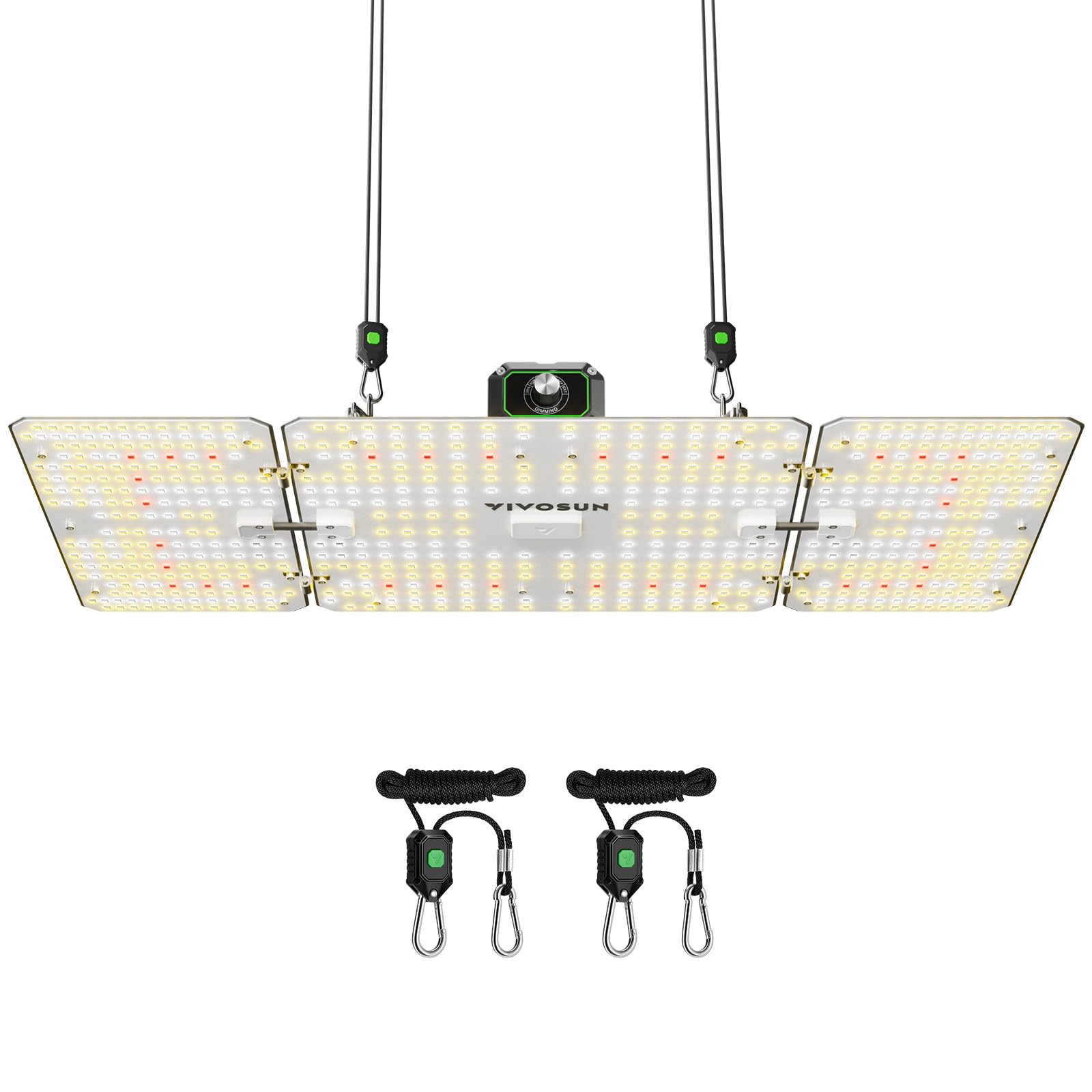
VIVOSUN’s LumaLight 200W is built for growers who want app-based automation and don’t want to worry about humidity. With an IP65 waterproof and dustproof rating, this panel can handle high-moisture environments like greenhouses, propagation domes, or hydro setups where splashing is a given. The spectrum includes white (3000K, 5000K), red (660nm), and far-red (730nm) diodes — a well-balanced mix that drives tight vegetative growth and accelerates flowering in short-day plants.
The 4-level dimming knob (0/25/50/100%) gives you staged intensity control, but the real power unlocks when you pair the fixture with the VIVOSUN GrowHub controller (sold separately). With that hub, you can set sunrise/sunset ramps, daily photoperiods, and intensity curves from your phone — a rare feature in the sub- panel category. The 23.5 x 11.8-inch form factor covers a 2×4-foot veg or a 3×3-foot flowering tent with balanced edge-to-edge PPFD.
The fixture runs noticeably warmer than some competitors; owners report a 8-10°F temperature rise inside a 4×4 tent during peak operation. The IP65 seal contributes to that heat retention, so tent ventilation is essential. At 9 pounds, the unit includes VIVOSUN’s patented rope hangers for secure mounting. For the grower building a fully integrated system — especially one that manages multiple tents via a single app — the LumaLight is a smart, durable centerpiece that won’t flinch at humidity.
What works
- IP65 waterproofing allows safe use in high-humidity environments without corrosion risk
- Smart controller compatibility enables app-based sunrise/sunset and full photoperiod automation
- 4-level dimming gives easy staged intensity without needing an external controller
- 2-year unlimited warranty provides long-term peace of mind
What doesn’t
- Runs warmer than comparative panels; tent ventilation must be robust
- GrowHub is sold separately, pushing total smart-system cost higher
- Heavy 9-pound weight may sag on standard wire shelves without reinforcement
4. AC Infinity IONBEAM S16 Bar Light

The IONBEAM S16 is a supplemental bar light, not a primary grow fixture — and that distinction is exactly what makes it so effective for serious growers. Each 16-inch bar uses Samsung LM301H EVO diodes rated at 3.14 µmol/J PPE, among the most efficient LEDs available for horticultural use. These bars are designed to be mounted vertically or horizontally inside a grow tent to illuminate lower canopy and side branching that overhead panels can’t reach.
AC Infinity includes magnetic mounting bars that attach securely to tent poles or tent fabric, making installation tool-free and repositionable. The included digital controller offers ten intensity levels and a daily schedule with programmable on/off times. For users who own an AC Infinity Controller 69 Pro+, the IONBEAM integrates fully into that ecosystem, enabling sunrise/sunset simulation and temperature-triggered dimming. The slim profile (about 1 inch wide and 0.6 inches thick) eats almost no tent real estate.
Owners praise the build quality — heavy-gauge aluminum housings, clean wiring, and strong magnets that stay put. The main limitation is the relatively short connecting cables between bars; daisy-chaining multiple units over a long distance may require purchasing extension cords separately, which are not included. This bar excels for the precision grower who wants to maximize yield by flooding those deep, shaded buds with usable photons that would otherwise become larf.
What works
- Samsung LM301H EVO diodes deliver industry-leading PPE of 3.14 µmol/J
- Magnetic mounting allows instant repositioning without tools or brackets
- Digital controller with 10 levels and schedule programming is genuinely set-and-forget
- Ultra-slim profile fits tight canopy gaps without blocking airflow
What doesn’t
- Short interconnecting cables may require separate extension purchases for large tents
- Serves as a supplemental light only; inadequate as a standalone primary source
- Premium price per lumen when compared to full-panel alternatives
5. GLOWRIUM 36W 2-Head Stand Light
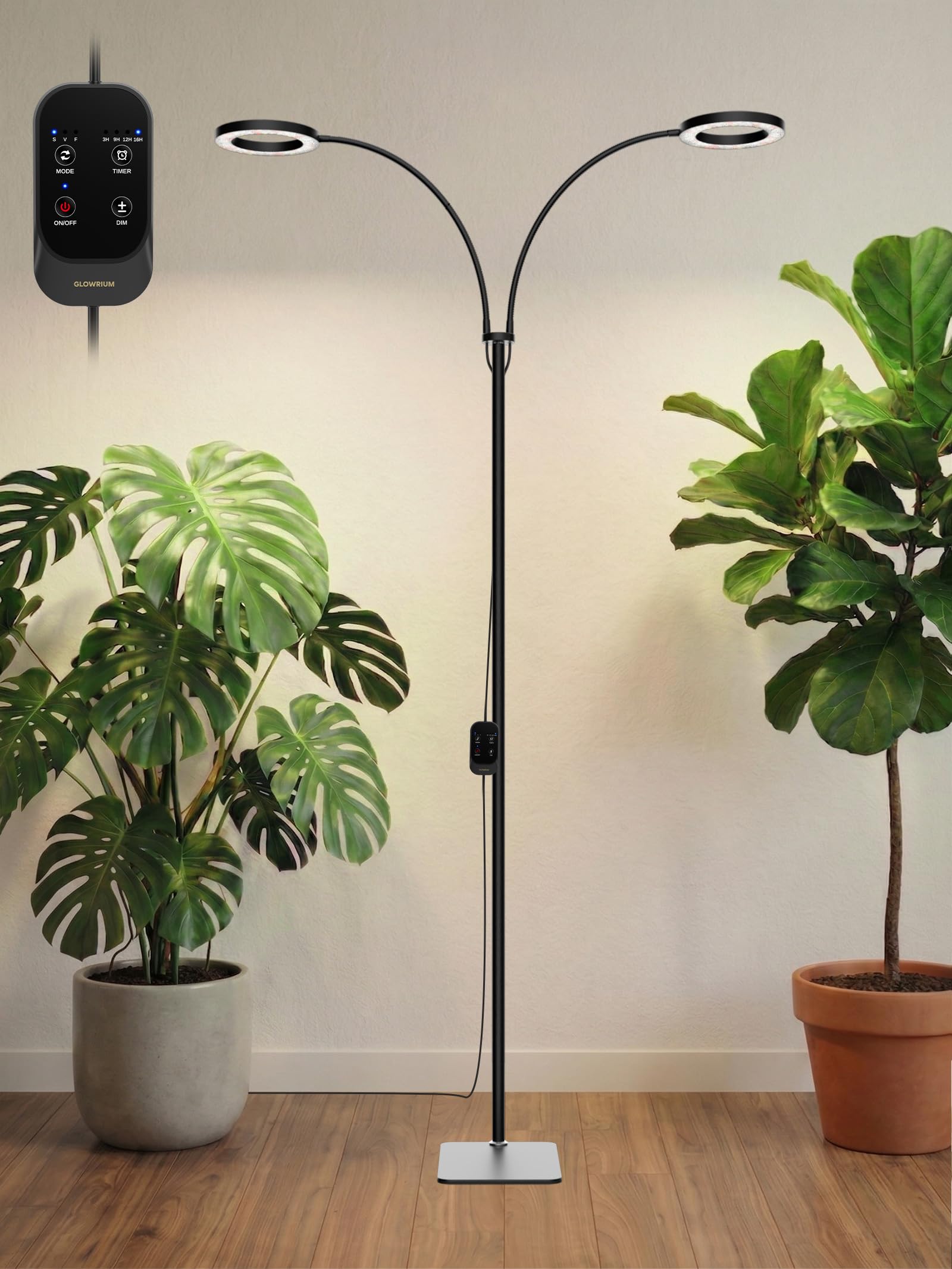
The GLOWRIUM stand light solves the height problem that clip-on fixtures cannot touch. Its three-section pole adjusts from 32 to 63 inches, and each 360-degree rotating lamp head can be angled independently, making it easy to illuminate a cluster of pots on a desk, floor, or side table without bulky shelving. The 36W total draw is modest, but the full-spectrum coverage (380-780 nm) with three mode presets — warm white for germination, mixed for flowering, and full spectrum for general growth — offers useful flexibility.
What sets this model apart in the freestanding category is the combination of 6 dimming levels and a built-in timer (3/9/12-hour cycles). The slim remote control lets you switch modes and brightness from across the room, and the lamp head stays cool enough for safe placement within 6 inches of foliage. The 13-foot power cord means you don’t need an outlet right next to your plant display. Assembly is tool-free and takes under three minutes.
Owners consistently note that their plants show new growth and richer color within a week of use, and the natural white light looks like a designer floor lamp — no purple glow. The aluminum lamp head dissipates heat effectively, and the heavy non-slip base prevents tipping even when the pole is fully extended. The main trade-off is coverage area: with only two heads, you get a concentrated zone rather than a wide wash. For a focal-point plant arrangement of three to five medium pots, this is an elegant, effective solution.
What works
- Height-adjustable pole (32-63 in.) and rotating heads cover plants at multiple levels
- Three spectral modes plus 6 dimming levels give precise control for different growth needs
- Included remote makes mode and brightness changes effortless from across a room
- Natural white light blends into home decor without an industrial grow-light look
What doesn’t
- Two heads limit coverage to a small cluster; insufficient for a wide shelf or large tent
- Timer programming manual is unclear; several users needed trial-and-error to set cycles
- Light output is adequate for low-light houseplants but not for high-light succulents or flowering
6. HMVPL 20W COB Standing Lamp
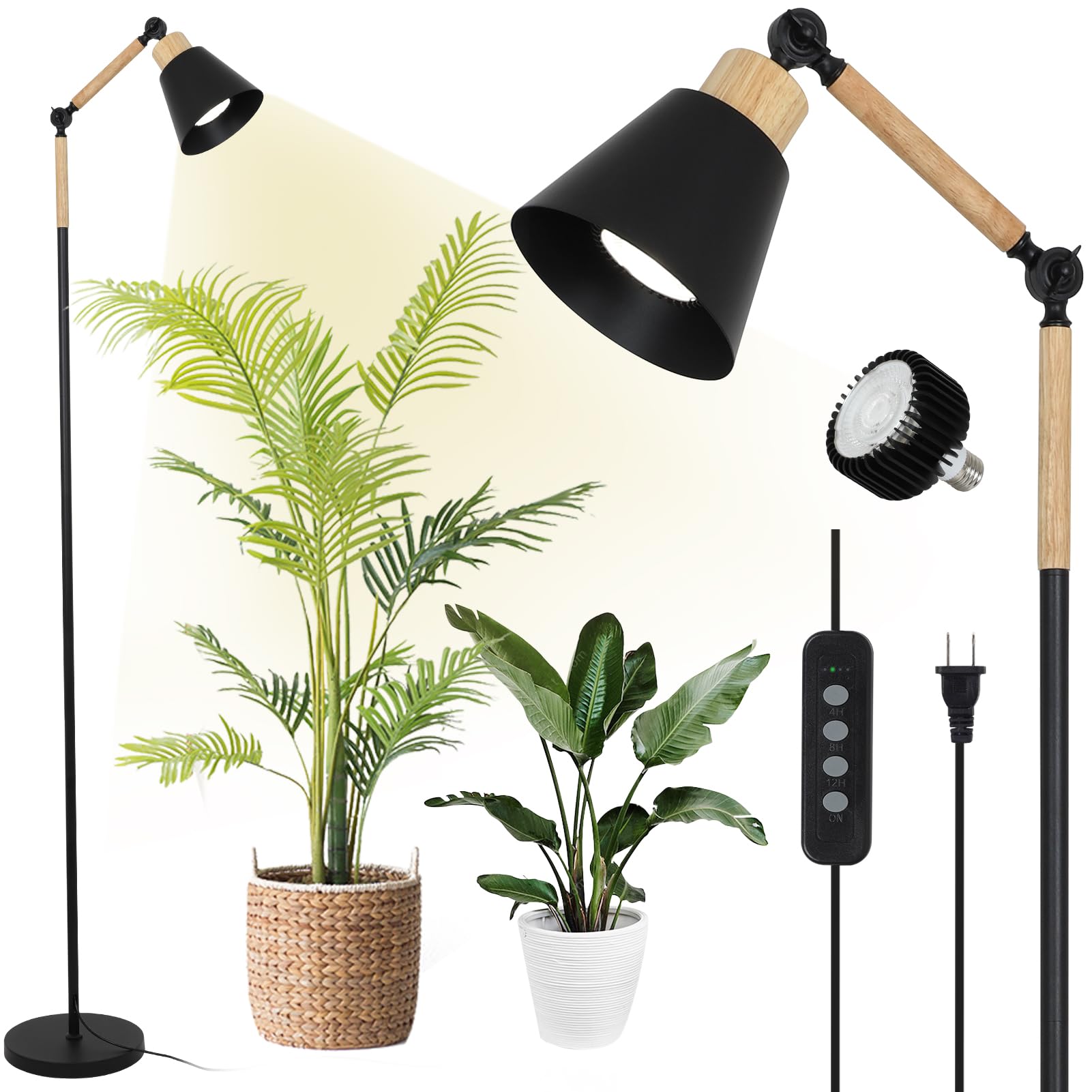
The HMVPL standing lamp uses a COB (Chip-on-Board) LED array inside an aerospace aluminum housing to deliver a 20W, 4000K full-spectrum output that closely mimics winter sunlight. The standout spec here is the CRI rating of 98+ — color rendering that rivals professional photography lights — which means your plants look vivid and natural while the lamp doubles as an attractive floor lamp in a living room or office. The PAR output (30% PAR, PPFD measured at 1716 µmol/m²/s at the source) is respectable for a single-bulb fixture.
Height adjustment spans six levels up to 75 inches, and the head tilts via two knobs for precise angle targeting. The aluminum shade prevents direct eye glare, a thoughtful detail that most bare-bulb stands miss. The timer offers 4/8/12-hour cycles on a 24-hour recurring schedule — standard, but effective. The heavy base keeps the lamp stable on hardwood and tile floors, though some users report a slight lean on thick carpet.
The main limitation is intensity at distance: a light meter reading shows adequate output only within a 12-inch radius. For a single large plant or a compact grouping of small pots, this is the best-looking photosynthetic lamp on the list. For a 3-foot-wide plant stand, you will need two units.
What works
- CRI 98+ makes this the most color-accurate plant lamp; plants look stunningly true-to-life
- Aerospace aluminum heat sink keeps the bulb cool and the housing durable
- 75-inch max height and tilting head accommodate everything from floor plants to tall potted trees
- Shade design prevents direct eye glare, unlike exposed-bulb stands
What doesn’t
- Effective PPFD drops off sharply beyond 12 inches; only suitable for focused area coverage
- Base leans slightly on plush carpet; best placed on a hard, level surface
- Timer resets after power loss, requiring daily re-set if you unplug the lamp
7. SANSI 2-Head 300W Clip-on Light

The two-head version of SANSI’s clip-on system distills everything that makes the 4-head model excellent into a more compact and affordable package. Each head uses the same full-spectrum PAR20 bulb (10W, 380-800 nm) and ceramic aluminum housing, and the fixture shares the same whole-life free bulb replacement warranty. At 2000 lumens total, this is the right intensity for a single medium pot (monstera, fiddle-leaf fig, or a cluster of succulents) or a narrow shelf of small plants.
The auto timer (4/8/12-hour cycles) works identically to the larger version — reliable once set, but resets after a power interruption. The clamp is sturdy enough for shelves up to about 1.5 inches thick, and the goosenecks hold their position without drooping. The bulbs run warm enough to scorch leaves within three inches, so maintain at least six inches of clearance. Owners praise the bright daylight color (4000K) and the fact that the light looks natural, not purple or harsh.
For the new indoor gardener or someone with a single cherished plant that needs a winter boost, this is the most cost-effective way to get real full-spectrum lighting with a warranty that backs the bulbs for life. The trade-off is obvious: two heads cannot cover a wide area, so if your collection grows, you will likely upgrade to the four-head version or a stand model. But as a starter light or a targeted solution for one pot, the 2-head SANSI delivers honest value without fluff.
What works
- Same full-spectrum bulb and lifetime replacement warranty as the larger SANSI model
- Compact design fits tight shelves and single-pot setups without clutter
- 2000 lumen output is sufficient for low-to-medium light houseplants
- Goosenecks hold their angle reliably; clips are substantial for the fixture weight
What doesn’t
- Two heads limit coverage to a very small area; not suitable for multi-shelf stands
- Bulbs run hot; leaf burn risk requires mindful minimum distance of 6 inches
- Timer resets on power loss; fine for stable outlets but annoying if moved frequently
Hardware & Specs Guide
PPFD — Measuring What Plants Actually See
Photosynthetic Photon Flux Density (PPFD) is measured in µmol/m²/s and represents the number of photons in the 400-700 nm range landing on a square meter each second. This is the single most important metric for comparing grow lights. A reading of 150-300 µmol/m²/s supports low-light foliage plants; 400-600 µmol/m²/s drives vegetative growth for herbs and greens; above 600 µmol/m²/s is needed for succulents, tomatoes, and flowering. Always check the manufacturer’s PPFD map at your intended hang height — reported wattage tells you nothing about useful light delivery.
Spectrum Distribution and the Role of Far-Red
Full-spectrum fixtures combine white LEDs (3000K to 5000K) with discrete red (660nm) and far-red (730nm) diodes. The 660nm red drives photosystem II and is critical for flowering and fruiting. Far-red light (730nm) triggers the Emerson enhancement effect — it improves photosynthetic efficiency in lower leaf layers and accelerates flowering in short-day plants via the phytochrome system. Fixtures that include far-red diodes (like the VIVOSUN and VIPARSPECTRA panels) generally produce tighter internodal spacing and faster bloom transitions than those relying on white LEDs alone.
Dimmer Controls vs. Mechanical Timers
A mechanical timer (typically 4/8/12-hour settings) provides a fixed photoperiod on a 24-hour cycle. It is simple, cheap, and effective for low-intensity setups but offers no flexibility for growth-stage-specific intensity changes. A dimming controller adds analog or stepped adjustable power (25/50/75/100%), allowing you to lower intensity for seedlings or cuttings and crank it up during flower. Advanced digital controllers (AC Infinity, VIVOSUN GrowHub) add sunrise/sunset ramps and smartphone scheduling — overkill for a single houseplant but transformative for serious tent cultivation.
Heat Dissipation and Lamp Life
LED grow lights generate far less radiant heat than HID or fluorescent equivalents, but the diodes and drivers still produce waste heat that must be managed. Aluminum heatsinks provide passive dissipation; the best designs use finned or extruded aluminum bodies (VIPARSPECTRA, GLOWRIUM) that keep junction temperatures below the threshold that degrades diode life. Fixtures with sealed lenses or IP65 ratings (VIVOSUN) trap more internal heat, so they depend on ambient airflow. Expect a Q90 lifespan of 30,000-50,000 hours from quality Samsung or Epistar diodes — essentially a decade of daily 12-hour use before output drops to 90% of original.
FAQ
What PPFD level do common houseplants need from an artificial light for plants?
Is there any reason to choose a purple blurple light over a full-spectrum white light?
How far should I hang a panel light above seedlings vs. flowering plants?
Final Thoughts: The Verdict
For most gardeners looking for a versatile, high-value artificial light for plants, the winner is the SANSI 4-Head 600W because it delivers four independently aimable full-spectrum heads, a reliable built-in timer, and a lifetime bulb warranty at a price that undercuts any equivalent system. If you want real PPFD-driven growth for a tent or propagation station, grab the VIPARSPECTRA XS1500 Pro — its optical lens design and daisy-chain dimming make it the powerhouse of this list. And for an elegant floor lamp that doubles as an accent light, nothing beats the HMVPL COB standing lamp with its stunning CRI 98+ color rendering that makes both your plants and your room look fantastic.