
An arborist hand saw is not a machete, not a cheap folding camp saw, and not a chainsaw substitute for the timid. It is a precision pull-cutting tool engineered to slice through live wood with surgical aggression—far faster than any bow saw and with zero exhaust fumes. The difference between a good cut and a great cut comes down to Japanese steel, tooth geometry, and whether the blade is impulse-hardened or taper-ground.
I’m Rikta — the co-founder and writer behind Lawn Gear Lab. I spend hundreds of hours comparing blade metallurgy, tooth-per-inch counts, handle ergonomics, and scabbard retention systems by cross-referencing technical datasheets and arborist forum feedback to separate the tools that earn their keep from the ones that bind mid-cut.
After combing through owner reviews and spec sheets across the category, these seven models represent the most capable options for anyone serious about tree work. Here is your practical guide to the best arborist hand saw for clean, fast cuts on live limbs up to seven inches thick.
How To Choose The Best Arborist Hand Saw
An arborist hand saw is defined by its blade geometry, steel quality, and handle ergonomics—not by price or brand name. Knowing what to prioritize will save you from a frustrating tool that binds, dulls fast, or chatters on green wood.
Blade Profile: Curved vs Straight
Curved blades concentrate cutting force on a smaller contact area, making them ideal for reaching around obstructions and cutting branches at awkward angles away from your body. Straight blades excel for flush cuts close to the trunk or for cuts where you need a flat kerf line. Most arborists own both, but if you only buy one, curved offers more versatility in tree canopies.
Tooth Geometry and TPI
Teeth per inch (TPI) determines cut speed and finish quality. Lower TPI (5-6) with larger gullets clears sawdust faster on green wood and prevents binding in sappy limbs. Higher TPI (7-9) gives a finer finish on hardwoods. Impulse-hardened teeth resist dulling against dirt and bark far longer than standard stamped teeth. Triple-ground or “Mirai-Me” edge profiles cut on three or four angles simultaneously, reducing friction and user fatigue.
Handle Comfort and Blade Locking
A full-tang blade anchored through the handle length is non-negotiable for heavy pruning. Rubber or arbor-composite grips absorb vibration better than hard plastic, especially when you’re cutting overhead for extended periods. Folding saws need a positive lock that won’t collapse mid-stroke, while fixed-blade saws rely on scabbard retention—look for push-button or roller-release systems rather than friction-only sheaths.
Quick Comparison
On smaller screens, swipe sideways to see the full table.
| Model | Category | Best For | Key Spec | Amazon |
|---|---|---|---|---|
| Fiskars Professional Pruning Saw SW-330 | Premium Fixed | Two-handed leverage on heavy limbs | 33 cm curved blade, coarse teeth | Amazon |
| Silky Gomboy Curve 240mm Outback | Premium Folding | Portable high-speed cutting on the go | 9.5″ blade, 6.8 TPI impulse-hardened | Amazon |
| Silky SUGOI Curved 360mm XL | Pro Fixed | Large limb cutting with long reach | 14.2″ blade, progressive 4.7-5.5 TPI | Amazon |
| Oregon Curved 13″ Premium Japanese | Mid-Range Curved | Affordable Japanese steel with tri-edge teeth | 13″ curved, 3 cutting angles | Amazon |
| Oregon Straight 12″ Premium Japanese | Mid-Range Straight | Precision flush cuts close to body | 12″ straight, 6.5 TPI chrome-plated | Amazon |
| Fiskars Telescopic Pole Pruner 8ft | Pole Saw Combo | High-reach pruning without a ladder | 12″ double-grind, extends to 8 feet | Amazon |
| Hooyman Extendable Tree Saw 10ft | Budget Pole Saw | Lightweight reach-to 10 feet for hunting/light trimming | 7″ SK5 steel blade, extends to 10 ft | Amazon |
In‑Depth Reviews
1. Fiskars Professional Pruning Saw SW-330

The Fiskars SW-330 is a fixed-blade, pull-cut saw with a 33-centimeter curved high-steel blade and coarse triple-ground teeth. Unlike folding saws that compromise handle length, this tool uses a full two-handed grip with a non-slip surface that distributes force evenly across both arms—critical when you are cutting overhead for extended periods. The blade geometry is designed specifically for fresh, green wood, and the hollow-ground tooth profile prevents binding by ejecting sawdust aggressively on the pull stroke.
Arborists praise this saw for its ability to slice through 5-6 cm diameter limbs in roughly 20 seconds with minimal arm fatigue. The versatile handle shape accommodates right- and left-handed users, and the included transport case keeps the exposed blade safe between cuts. The blade is replaceable, extending the service life of the saw beyond the first dull edge—a feature that justifies the premium positioning over single-use stamped blades.
Where the SW-330 really shines is in sustained pruning sessions. The pulling cut mechanism keeps the kerf clean and the blade tracking straight rather than wandering, which is a common complaint with push-cut arborist saws on live wood. It is noticeably heavier in hand than a folding saw, but that mass translates to momentum that does the work for you.
What works
- Two-handed grip multiplies cutting force without straining your wrist
- Coarse triple-ground teeth chew through green limbs rapidly with no binding
- Replaceable blade extends the tool’s life significantly
What doesn’t
- Fixed blade design is less portable than folding alternatives
- Premium pricing sits above many mid-range folding saws
2. Silky Professional Gomboy Curve 240mm Outback Edition

The Silky Gomboy Curve 240mm is a folding handsaw that has achieved near-legendary status among arborists, landscapers, and serious outdoor enthusiasts. Its 9.5-inch blade is made from high-quality steel with a black nickel/tin plating that resists rust, tree resin, and sap buildup far better than standard chrome plating. The impulse-hardened teeth are taper-ground to improve cutting speed and are rated to last up to three times longer than non-hardened alternatives.
What sets the Gomboy apart is Silky’s “Mirai-Me” cutting technology—four distinct cutting angles on each tooth that allow it to rip-cut, cross-cut, and slant-cut simultaneously. On dry hardwood, this saw produces a surface so smooth it barely needs sanding. On green softwood, the aggressive 6.8 TPI tooth pattern clears chips efficiently enough that you can cut through a 4-inch limb in under ten seconds. The arbor composite handle provides excellent grip even when wet or cold, and the blade lock is robust enough that the saw can live in a truck bed without rattling loose.
At just over ten ounces, the Gomboy disappears into a backpack or rides comfortably on a belt. It is equally at home in the tree canopy, on a campsite trail, or processing small game. The included custom carrying case protects the blade in transit, though some users note the case is snug with the blade folded.
What works
- Mirai-Me tooth geometry cuts aggressively across all wood grains without changing technique
- Impulse-hardened teeth stay sharp significantly longer than standard steel
- Ultra-light and compact enough for daily carry in a backpack or on a belt
What doesn’t
- Blade length is shorter than some fixed-saw alternatives for large limbs
- Premium price puts it at the top of the folding saw segment
3. Silky Professional SUGOI Curved Hand Saw 360mm XL

The Silky SUGOI is the big brother of the Gomboy—a fixed-blade, true pro-grade saw designed for arborists who regularly face limbs 5 to 7 inches in diameter. Its 14.2-inch curved blade uses progressive tooth pitch (ranging from 4.7 to 5.5 TPI) that shifts to coarser, faster-cutting teeth near the tip where you need the most aggression. The 2.0 mm blade thickness provides rigidity that prevents the blade from bending or wandering during deep cuts into tensioned wood.
The electroless nickel plating on the SUGOI blade does more than resist rust—it actively repels tree resin and sap, meaning the blade wipes clean with a rag rather than requiring solvent. This is a significant convenience when you are making dozens of cuts in a single session. The rubber handle is oversized and textured, giving a secure grip even with thick leather gloves, and the high-visibility yellow plastic sheath includes a safety roller and a Tech-Lock belt clip that prevents accidental dislodging.
Arborists who have used the SUGOI for ten or more years report that the blade maintains its surgical sharpness through thousands of cuts with proper maintenance. The pull-cut design requires less effort than a push saw, and the progressive tooth pattern means you start the cut with finer teeth and finish with the coarse ones, reducing the initial resistance that can cause a saw to skate across the bark.
What works
- Progressive XL teeth combine fast starting with aggressive finish cuts on large limbs
- Electroless nickel plating sheds sap and resists rust far better than chrome
- Safety roller and Tech-Lock sheath provide secure one-handed blade access
What doesn’t
- Fixed-blade design requires the included sheath for safe transport
- Highest price point in this list limits accessibility for casual users
4. Oregon Curved 13″ Premium Japanese Hand Saw (600136)

The Oregon 600136 brings Japanese high-carbon steel and tri-edge offset tooth geometry to a mid-range price point that competes fiercely with more expensive imports. The 13-inch curved blade is chrome-plated for rust prevention, and the impulse-hardened teeth maintain their edge through heavy pruning sessions on branches up to 3 inches in diameter. The curved profile increases cutting power on the pull stroke, especially when reaching around foliage or cutting at uncomfortable angles.
What makes this saw stand out in its price bracket is the full-length tang that runs through the entire handle, providing solid structural integrity that prevents the blade from wobbling or detaching during aggressive cuts. The push-button release mechanism on the scabbard allows one-handed deployment and safe re-sheathing without looking at the blade. The handle itself is lightweight plastic with a molded grip pattern that offers reasonable traction, though it does not dampen vibration as effectively as rubber or arbor-composite handles.
Several experienced arborists in owner reviews note that this saw cuts remarkably well for the cost, with one lifelong professional stating it is hard to beat for the price. The plastic scabbard latch has been reported as unreliable by a minority of users, but the overall blade performance and durability make this a compelling choice for anyone who wants Japanese steel without spending Silky-level money.
What works
- Tri-edge offset teeth reduce friction binding on live, sappy wood
- Full-tang handle construction provides robust, rattle-free blade connection
- Chrome plating and impulse hardening extend blade sharpness noticeably
What doesn’t
- Plastic scabbard latch is prone to failure under repetitive use
- Hollow handle transmits more vibration than solid composite grips
5. Oregon Straight 12″ Premium Japanese Hand Saw (600138)

The Oregon 600138 is the straight-blade counterpart to the curved model above, built from the same premium Japanese high-carbon steel and featuring the same tri-edge offset tooth geometry. The straight profile makes it an excellent choice for flush cuts against the trunk or collar cuts where a curved blade would leave a concave kerf. At 6.5 TPI, it strikes a practical balance between fast cutting in green wood and a clean finish on hardwoods.
Like its curved sibling, this saw has a full-length tang and a lightweight plastic handle with a molded grip. The chrome plating resists rust effectively, and the impulse-hardened teeth are designed to stay sharp significantly longer than non-hardened alternatives. The included scabbard uses the same push-button release mechanism, which works reliably for most users but has received similar complaints about the latch quality over time.
Where this saw differentiates itself is in close-quarters cutting. Arborists who work on ladders or in tight canopies often prefer a straight blade because it allows them to position the saw flat against the trunk without the curved belly interfering. The taper-ground blade reduces friction through the cut, and the tri-edge teeth produce three cutting angles per tooth that clear chips efficiently. For the price, it offers a solid introduction to Japanese pull-cut technology without the investment of a premium folding saw.
What works
- Straight blade profile enables precise flush cuts and collar cuts against the trunk
- Taper-ground tri-edge teeth reduce friction and clear sawdust effectively
- Japanese high-carbon steel with chrome plating offers good rust resistance
What doesn’t
- Plastic scabbard latch is less durable than roller-style retention systems
- Hollow handle lacks the vibration damping of rubberized grips
6. Fiskars Telescopic Pole Pruner 8ft (394620-1001)
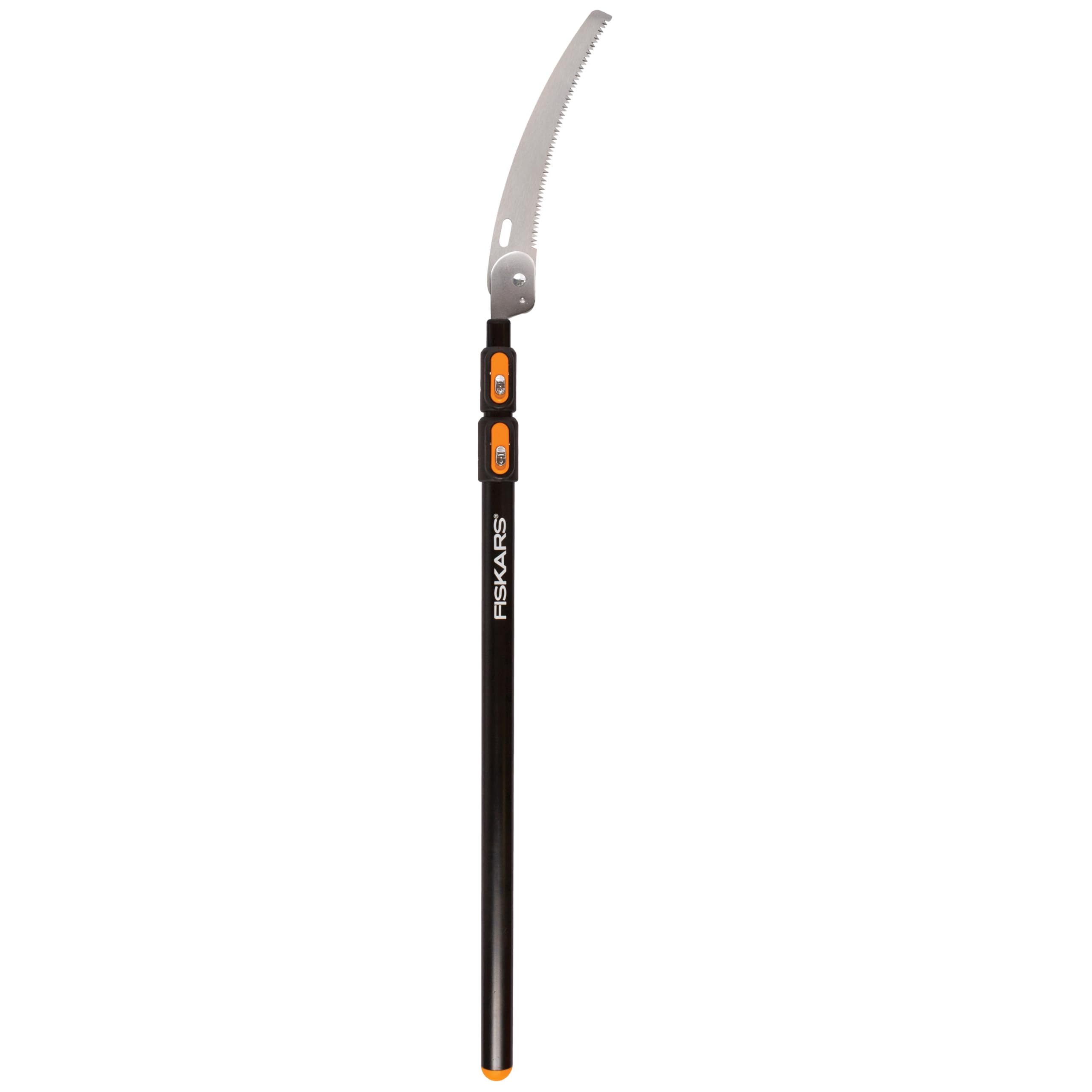
The Fiskars Telescopic Pole Pruner is a 2-in-1 system that combines a 12-inch double-grind saw blade with an extendable steel pole that reaches from 3 feet collapsed to 8 feet extended. This is not a pure arborist hand saw in the traditional sense, but it fills a critical niche: high-reach pruning without climbing a ladder. The triple-ground power tooth blade is designed to cut aggressively on the pull stroke, and the steel pole provides enough rigidity to cut branches up to 4 inches thick without excessive flexing.
At 3.7 pounds, the Fiskars pole saw is noticeably heavier than a dedicated hand saw, but the weight is distributed along the pole, which helps with cutting momentum. The telescoping sections lock positively, and the saw head pivots to maintain optimal cutting angle. The included pruner head on the same pole adds the ability to snip smaller branches before committing to the saw, reducing the number of tool swaps needed during a pruning session.
Owner reviews consistently highlight this unit as a light-duty workhorse for moderate pruning tasks around the home. It is not a substitute for a professional pole saw on large-scale jobs—the blade is relatively short at 12 inches, and the double-grind teeth lack the aggressive chip clearance of Japanese impulse-hardened designs. But for reaching over fences, clearing cactus, or trimming branches from a second-story window, it provides an excellent reach-to-cost ratio with the backing of Fiskars’ lifetime warranty.
What works
- Collapses to 3 feet for easy storage and extends to 8 feet for high-reach cuts
- Triple-ground blade cuts aggressively on the pull stroke through green wood
- Lifetime warranty provides long-term value for occasional users
What doesn’t
- Double-grind teeth clear chips less efficiently than impulse-hardened Japanese teeth
- Weight of the pole assembly makes sustained overhead cutting tiring
7. Hooyman Extendable Tree Saw 10ft (655227)
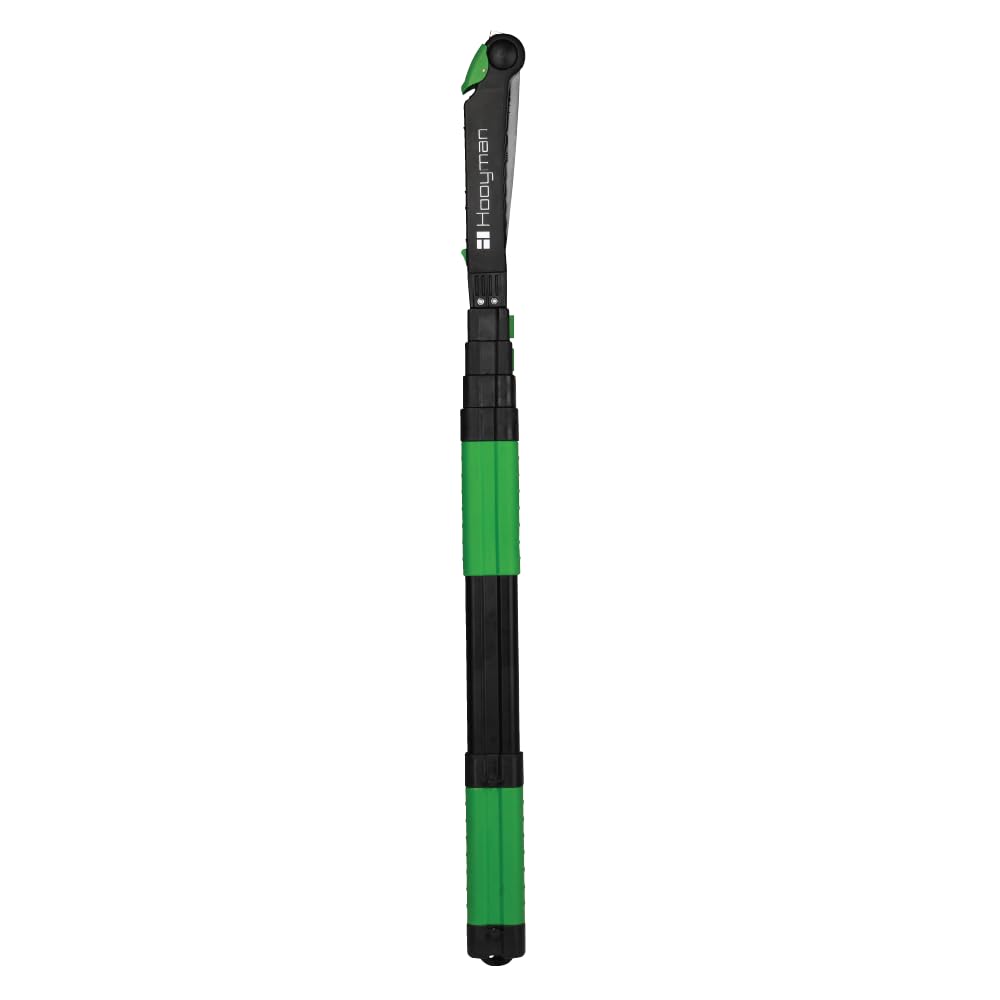
The Hooyman Extendable Tree Saw is designed for the outdoor enthusiast who needs a portable, lightweight pole saw that collapses to just 28 inches and extends to 10 feet. It uses a 7-inch SK5 high-carbon steel blade with impulse-hardened 4-edge “MegaBite XP” teeth that cut aggressively on green and dry wood. The I-beam aluminum pole provides structural stiffness without adding excessive weight, and the cork handle offers a secure grip even in wet conditions.
What makes this saw unique is its inline folding mechanism: the saw head detaches from the pole and can be used as a standalone hand saw. This dual-mode capability is particularly useful for hunters and campers who need to clear trail obstructions or cut branches from a tree stand. The positive-locking extension system allows the pole to be extended one section at a time, and the locking mechanism holds securely during the cut.
The trade-off for the compact design is that the 7-inch blade cuts more slowly on limbs over 3 inches in diameter compared to longer-bladed options. The plastic knobs used to secure the saw head to the pole have been reported to break on the first use by a minority of buyers, though Hooyman’s customer service is noted as responsive for warranty replacements. For the price, this saw delivers remarkable portability and reach, but it is best suited for light trimming rather than sustained professional pruning.
What works
- Collapses to just 28 inches and extends to 10 feet for impressive portability
- Detachable saw head works as a standalone hand saw for ground-level cuts
- Cork handle provides excellent wet-grip comfort during use
What doesn’t
- 7-inch blade cuts slowly on branches larger than 3 inches in diameter
- Plastic knobs securing the saw head to the pole can break under heavy use
Hardware & Specs Guide
Blade Steel and Plating
Premium arborist hand saws use Japanese high-carbon steel (SK5 or equivalent) that can be hardened to Rockwell 60+ for edge retention. Chrome plating adds corrosion resistance but can chip on contact with dirt, while electroless nickel plating bonds at the molecular level, making it more resistant to tree resin and impact damage. Budget options often use standard carbon steel without rust-proofing, which requires immediate drying and oiling after use in wet conditions.
Impulse Hardening and Tooth Grinding
Impulse hardening uses induction heating to fuse additional carbon into the tooth tips, creating a wear-resistant edge that lasts 2-3 times longer than non-hardened teeth. Triple-ground teeth feature three distinct cutting facets on each tooth, while Mirai-Me technology from Silky uses four facets that allow the saw to rip and crosscut simultaneously. In practice, impulse-hardened teeth are the single most important feature for longevity in a professional arborist saw.
FAQ
Why do arborist hand saws cut on the pull stroke instead of the push stroke?
How many teeth per inch should I choose for green live wood?
Are folding arborist saws as durable as fixed-blade saws?
Final Thoughts: The Verdict
For most gardeners and arborists, the best arborist hand saw winner is the Fiskars Professional Pruning Saw SW-330 because its two-handed grip, 33 cm curved blade, and aggressive triple-ground pull-cut teeth provide the best balance of cutting speed, user comfort, and long-term durability. If you want a portable saw that disappears into a pack, grab the Silky Gomboy Curve 240mm. And for large limbs up to 7 inches without a chainsaw, nothing beats the Silky SUGOI Curved 360mm XL.