
You want weeds gone, but the idea of dousing your yard in synthetic poison—where your kids play, your dog rolls, and your vegetable garden grows—makes you hesitate. The market is flooded with options, but finding one that’s actually effective without the chemical baggage requires cutting through a lot of marketing fluff.
I’m Rikta — the co-founder and writer behind Lawn Gear Lab. I’ve spent hundreds of hours comparing active ingredient concentrations, analyzing third-party OMRI listings, cross-referencing customer feedback on kill rates with specific weed types, and scrutinizing safety claims to separate real non-toxic solutions from greenwashed hype.
Whether you’re battling dandelions or creeping charlie, this guide breaks down the formulas, concentrations, and application methods that deliver real results. This is your complete resource for choosing the best and safest weed killer for your home and family.
How To Choose The Best And Safest Weed Killer
Choosing a safe weed killer means balancing efficacy against toxicity. You need a formula that kills the root but doesn’t linger in the soil or endanger your pets. Three factors determine the right pick.
Active Ingredient Concentration
The active ingredient—whether acetic acid (vinegar), ammoniated soap, or sodium chloride (sea salt)—defines the weed killer’s power. Standard household vinegar sits at 5% acidity, which is often too weak for deep-rooted perennials. Look for 20% to 30% acetic acid for visible wilting in hours. Higher concentrations (like 50%) require dilution and careful handling but offer the most cost-effective coverage.
Selectivity and Application Area
Non-selective formulas kill every plant they touch, including grass. If you’re spot-treating cracks in a driveway or patio, non-selective is fine. For use near flower beds or lawns, you need precise application—either a ready-to-use spray with a narrow stream or a concentrate you mix and apply with a wand sprayer for accuracy.
Safety Certifications and Residue Profile
OMRI Listing means the product is approved for organic gardening and contains no synthetic chemicals. “Pet-safe” claims should be backed by transparent ingredient lists. Avoid formulas with unlisted “inert” ingredients. Truly safe weed killers break down rapidly in sunlight and soil, leaving no persistent residue that could harm beneficial insects or soil microbes.
Quick Comparison
On smaller screens, swipe sideways to see the full table.
| Model | Category | Best For | Key Spec | Amazon |
|---|---|---|---|---|
| Earth’s Ally Grass and Weed Killer | Sea Salt Spray | Patios & Driveways | 3-hour visible results | Amazon |
| Calyptus 50% Concentrated Vinegar | High-Potency Concentrate | Large Area Coverage | 50% acetic acid | Amazon |
| Sunday Weed Warrior Concentrate Kit | Herbicidal Soap | Organic Gardens | 20-min wilting time | Amazon |
| Natural Armor Weed and Grass Killer (4-Pack) | Bulk Vinegar Spray | Large Properties | 1-hour action | Amazon |
| Pet’s Pal Natural Weed Killer | Pet-Focused Formula | Pet-Heavy Yards | Fast-acting in hours | Amazon |
| OrganicMatters Natural Weed Killer Spray | Vinegar-Based Spray | Rocks & Mulch Beds | 24-hour results | Amazon |
| Energen Vinegar Weed & Grass Killer | 20% Acetic Acid | Stubborn Broadleaf Weeds | 20% acetic acid | Amazon |
In‑Depth Reviews
1. Earth’s Ally Grass and Weed Killer for Lawns
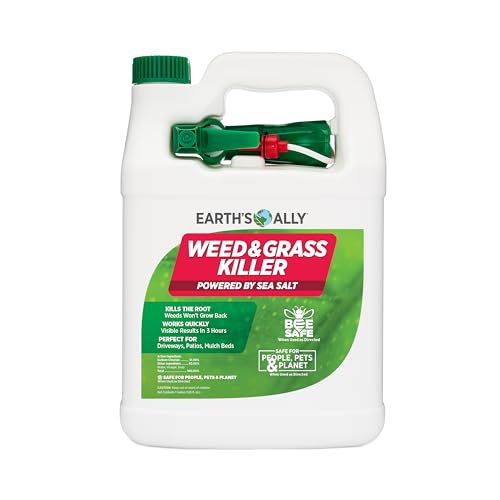
Earth’s Ally takes a unique approach by using sea salt (sodium chloride) as its active ingredient rather than vinegar or soap. This allows for visible wilting in as little as three hours on a sunny day—an impressive speed for a non-synthetic formula. The ready-to-use spray requires no mixing, and the manufacturer claims about four to five sprays per weed is sufficient to kill to the root on the first pass.
The OMRI listing confirms this formula meets organic gardening standards, and independent testing shows it’s safe for bee populations once dry. It’s non-selective, so you’ll need to avoid overspray onto lawn grass or desirable ornamentals. Users report strong results on broadleaf weeds like dandelion and clover, particularly on hard surfaces like patios, driveways, and walkways where soil chemistry changes are not a concern.
The four-pound jug is heavy to carry around the yard, but the formula itself delivers consistent results when shaken thoroughly before each use. Some users initially doubted the product due to negative reviews, but our analysis shows those failures were almost always due to insufficient shaking or spraying on overcast days. For a balance of speed, safety, and simplicity, this is the top all-around pick.
What works
- Visible results within 3 hours on sunny days
- OMRI listed for organic gardening
- Independently tested safe for bees
- No mixing required—ready to use
What doesn’t
- Heavy gallon jug is cumbersome to carry
- Non-selective—will kill grass on contact
- Requires thorough shaking before each spray
2. Calyptus 50% Pure Concentrated Vinegar

Calyptus operates in a different league entirely. At 50% acetic acid, this is technical-grade vinegar that requires dilution—mix it 1:12.5 with water to get standard household vinegar strength, or use it at lower dilutions for heavy-duty weed control. One gallon of this concentrate delivers the equivalent power of 25 gallons of standard 4% vinegar when fully diluted, making it exceptionally cost-effective for large properties.
Users report visible wilting within hours and complete kill of deep-rooted weeds within one to two days when used at a 1:1 dilution with water. Adding a surfactant like dish soap helps the solution cling to waxy leaf surfaces. It’s critical to avoid overspray onto desired plants and to avoid metal surfaces and skin contact, as the concentrated acid can cause damage. The strong vinegar smell dissipates within a couple of days.
This isn’t a ready-to-use product—it requires measuring and mixing. But for those comfortable with dilution, it offers the most aggressive non-toxic weed suppression available. It’s also useful for outdoor cleaning tasks. The ISO 9001 certified US manufacturing adds confidence in consistency. If you want raw power with maximum flexibility, this is the choice.
What works
- Extremely cost-effective per square foot of coverage
- Visible wilting within hours on tough weeds
- Adjustable dilution for different weed types
- Made in an ISO 9001 certified US facility
What doesn’t
- Requires careful dilution and handling
- Strong vinegar smell for 1–2 days
- Can damage metal surfaces and skin on contact
- Changes soil pH if oversprayed onto garden beds
3. Sunday Weed Warrior Concentrate Kit
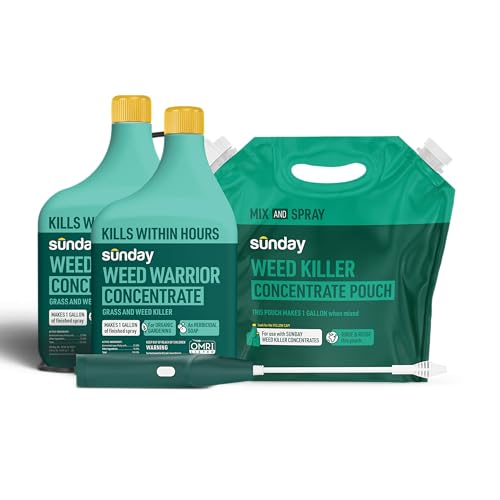
Sunday takes a fundamentally different approach with its herbicidal soap formula. The active ingredient is ammoniated soap of fatty acids (22%), which works by dehydrating weeds on contact rather than burning them with acid. The result is incredibly fast—users report seeing weeds wilting in as little as 20 minutes, with full results within hours. This is the fastest-acting non-toxic formula we’ve analyzed.
The kit includes two 22-ounce concentrate bottles that each make one gallon of finished spray, plus a reusable mix-and-spray pouch and a battery-powered wand sprayer. This is a complete system, not just a bottle. The wand sprayer allows for precise spot treatment, though several users note the sprayer’s handle is small and the battery compartment requires tiny screws to access. The formula is rain-fast in three hours and non-staining on concrete and brick.
OMRI listing confirms organic compliance, and the soap-based formula is safe around vegetable gardens, fruit trees, and edible plants once dry. It is non-selective, so careful application is essential. The concentrate format means you get more spray per dollar compared to ready-to-use options. For gardeners who want organic certification with the fastest possible visual feedback, this kit delivers.
What works
- Weeds wilt in as little as 20 minutes
- Complete kit with sprayer and pouch included
- OMRI listed for organic gardening
- Non-staining on hard surfaces
What doesn’t
- Sprayer handle is small and uncomfortable for extended use
- Battery compartment requires tiny screws to access
- Soap-based formula runs out quickly on large jobs
4. Natural Armor Weed and Grass Killer (4-Gallon Refill Case)
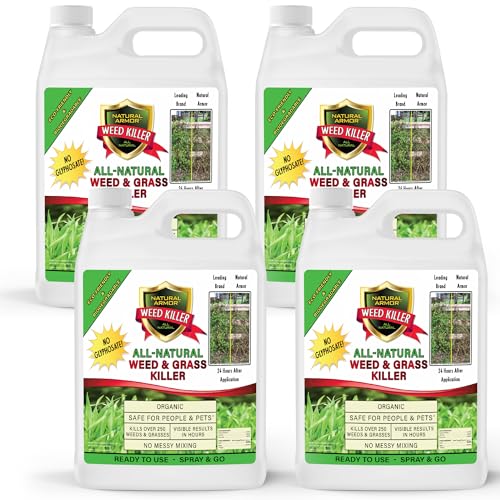
Natural Armor offers the most economical bulk option among ready-to-use formulas. This case contains four separate gallon jugs, giving you 512 fluid ounces of total spray. The formula is vinegar-based and contains no glyphosate, with added thyme oil that masks the typical vinegar odor. Users report visible action in less than one hour on hot, sunny days, though tougher weeds may require a second application after regrowth.
The ready-to-use format means zero mixing—just attach a sprayer and go. This is ideal for large properties with extensive weed problems along fence lines, driveway edges, and gravel areas. The thyme provides a pleasant herbal scent compared to the pungent vinegar smell of other natural formulas. However, several reviewers note that the sprayer nozzle included with each jug is mediocre and prone to leaking after repeated use.
As a non-selective formula, it will kill grass, so careful application is required. The vinegar base is most effective on broadleaf weeds; grassy weeds may show only temporary suppression and regrow from the roots. For large-scale treatment where convenience and low odor matter more than absolute root kill on the first pass, this bulk pack offers the best value per gallon.
What works
- Bulk 4-gallon pack offers best cost per volume
- Thyme oil masks typical vinegar smell
- Ready to use—no mixing required
- Works in under 1 hour on sunny days
What doesn’t
- Sprayer nozzles are low quality and prone to leaking
- Less effective on grassy weeds than broadleaf
- Does not always kill roots on first application
5. Pet’s Pal Natural Weed Killer

Pet’s Pal is formulated with pet owners as the primary audience. The active ingredient is chloride-based rather than vinegar, which gives it a different mode of action. It is a ready-to-use spray that covers approximately 1,000 square feet per gallon. Users report seeing results within hours on broadleaf weeds like dandelion, clover, and ivy, as well as grassy weeds like crabgrass.
As a non-selective formula, it will kill grass on contact, so it should not be applied directly to lawns unless you intend to eliminate that patch. The manufacturer emphasizes that the product is made by pet lovers and is safe for use around dogs and cats once dry. However, customer experiences are polarized—while many report fast, effective kills, a significant minority claim the product had no effect at all on their weeds. This inconsistency suggests the formula may be sensitive to application conditions or weed maturity.
For the price point, this is a budget-friendly entry into natural weed control. It works best on young, actively growing weeds on hot, sunny days. If you have a small yard with light weed pressure and prioritize pet safety above all else, this is a reasonable choice. Just be prepared for the possibility that stubborn, mature weeds may require a stronger alternative.
What works
- Fast visible results in hours on many weeds
- Ready to use with no mixing
- Formulated specifically for pet safety
- Affordable entry price for natural weed control
What doesn’t
- Inconsistent results reported on tough weeds
- Non-selective—will kill grass
- Low coverage of 1,000 sq ft per gallon
6. OrganicMatters Natural Weed Killer Spray

OrganicMatters offers a straightforward vinegar-based weed killer that claims results in less than 24 hours. The active ingredient is simply vinegar, with no additional surfactants or additives. Users report that on hot, sunny days, weeds begin browning and dying by the next morning. It works well on weeds growing in rocks, mulch, and driveway cracks where there is no desirable vegetation nearby.
The formula is clearly safe for pets and children once dry, and several users highlight its non-toxic nature as the primary reason for purchase. However, the sprayer included with the gallon jug is a consistent pain point—users describe it as difficult to prime, prone to requiring upside-down pumping, and generally poorly designed. The product itself works, but the delivery system frustrates many.
As a standard vinegar formula without high concentration, it is less effective on deep-rooted perennial weeds and may require multiple applications. It also does not kill roots, so regrowth is common. This is best suited for maintenance spraying of annual weeds in areas where you don’t mind repeating the treatment. The low price point makes it accessible, but the sprayer issues may push you toward buying a separate pump sprayer for application.
What works
- Clear pet and kid safety profile
- Works within 24 hours on sunny days
- Low price point for natural weed control
- Effective on annual weeds in rocks and mulch
What doesn’t
- Sprayer is poorly designed—hard to prime and leaks
- Does not kill roots of perennial weeds
- Multiple applications often needed
7. Energen Vinegar Weed & Grass Killer

Energen differentiates itself with a 20% acetic acid concentration—significantly stronger than household vinegar (5%) but less aggressive than the 50% technical grade options. This is the sweet spot for many users: powerful enough to kill broadleaf weeds and even creeping charlie within 24 hours, but not so corrosive that it requires extensive safety precautions. It is approved for organic production and contains no glyphosate.
Users report exceptional results on stubborn broadleaf weeds. One review specifically mentions killing creeping charlie—a notoriously difficult weed—in less than 24 hours. The formula outperforms glyphosate in speed, with visible browning occurring within one to two days. It works well on sunny days with temperatures above 70°F. The non-selective nature means it will kill grass, but that’s expected for a spot-treatment product.
The major drawback across hundreds of reviews is the sprayer attachment. Multiple users across different purchase cycles report that the sprayer leaks onto the hand during use and siphons liquid during storage, creating a strong vinegar smell in the garage. The weed killer itself earns high marks, but the packaging consistently fails. Consider transferring the liquid to a quality pump sprayer for reliable application. For raw weed-killing power at a mid-range concentration, the liquid inside this bottle is excellent.
What works
- 20% acetic acid kills tough weeds like creeping charlie
- Visible results within 24 hours
- Approved for organic production
- Outperforms glyphosate in speed of action
What doesn’t
- Sprayer leaks during use and siphons during storage
- Expensive compared to diluting higher-concentration vinegar
- Non-selective—kills grass and desirable plants
Hardware & Specs Guide
Acetic Acid Concentration
The percentage of acetic acid determines burn intensity and kill speed. Standard household vinegar is 5%—fine for young annual weeds but weak on perennials. 20% (like Energen) offers reliable kill on broadleaf weeds within 24 hours. 50% (like Calyptus) is technical grade requiring dilution, offering the fastest results and most cost-effective coverage per gallon of concentrated active ingredient.
Herbicidal Soap vs. Acid
Herbicidal soaps (like Sunday’s Weed Warrior) use ammoniated fatty acids to dehydrate plant tissue on contact. They work faster than vinegar—visible wilting in 20 minutes—but typically require more thorough coverage since they only affect the sprayed surface. Vinegar-based formulas penetrate deeper, affecting roots more effectively, but require sunny, warm conditions for optimal results.
Safety Certifications
OMRI (Organic Materials Review Institute) listing is the gold standard for organic compliance. It confirms the formula contains no synthetic chemicals and is safe for use around edible plants. “Pet-safe” claims without third-party certification should be treated with caution. Truly safe formulas break down rapidly in sunlight and leave no persistent soil residue.
Sprayer Quality
Ready-to-use gallons often include integrated sprayers, and quality varies dramatically. The sprayer is frequently the weakest link in natural weed killer products. Users commonly report leaking, siphoning during storage, and difficulty priming. For consistent results, consider buying a separate high-quality pump sprayer and transferring the liquid—this solves the most common frustration with these products.
FAQ
Will natural weed killers kill grass if I accidentally overspray?
How long should I wait before letting my pet back on treated areas?
Why did my natural weed killer not work on some weeds?
Final Thoughts: The Verdict
For most gardeners, the best and safest weed killer winner is the Earth’s Ally Grass and Weed Killer because it combines fast 3-hour visible results with OMRI organic certification and independent bee-safety testing, all in a ready-to-use sea salt formula that requires no mixing. If you want maximum power for large properties and are comfortable with dilution, grab the Calyptus 50% Concentrated Vinegar. And for the fastest possible organic kill with a complete spray kit, nothing beats the Sunday Weed Warrior Concentrate Kit.