
Specs are compiled from manufacturer listings and verified buyer reviews and can change over time — please confirm the key details on the product page before buying.
You push a mower up a slope and the drive system gives out, leaving you to wrestle the machine through the rest of the yard. That is the exact problem a reliable self-propelled lawn mower solves — it pulls itself forward so you guide it instead of shoving it. The trick is finding one that actually delivers on that promise without costing a fortune.
I’m Rikta — the founder and writer behind Lawn Gear Lab. This guide is built by comparing the manufacturers’ published specifications and the patterns across verified customer reviews, so you get each pick’s real strengths and trade-offs instead of marketing spin.
Every model here has a verified self-propelled drive system and a gas engine, so you only see options that genuinely take the strain out of mowing a slope or a bigger lot. This is the best affordable self-propelled lawn mower list for anyone who wants real pulling power without the premium price tag.
Quick Picks
- SENIX 201cc 22″ 3-in-1 Gas Lawn Mower — Top Performer
- BILT HARD 21″ 201cc 4-Cycle OHV Self Propelled Gas Lawn Mower — Most Height Options
- PowerSmart 22″ 170cc 4-Cycle OHV Self Propelled Gas Lawn Mower — Lightweight Runner
- YARDMAX 22″ 201cc Select PACE 6 Speed CVT High Wheel FWD 3-in-1 Gas Lawn Mower — CVT Speed Control
How To Choose The Best Affordable Self-Propelled Lawn Mower
Self-propelled mowers all move forward on their own, but the way they handle your specific yard changes everything. Here are the three specs that separate a good buy from a frustrating one.
Drive System: Rear-Wheel Drive vs Front-Wheel Drive
The drive wheels decide where the mower has grip. Rear-wheel drive (RWD) pushes from the back, which gives the back wheels traction as you push downhill — that makes it the clear winner on slopes and uneven ground. Front-wheel drive (FWD) pulls from the front; it is lighter and turns more tightly on flat lawns but loses grip on wet grass or inclines. If your yard has any hill at all, pick RWD.
Engine Size and Starting System
Engine displacement is measured in cubic centimeters (cc). A 170cc engine handles a typical quarter-acre lawn with average grass, while 201cc engines deliver the extra torque (twisting force) needed for thick, tall, or damp grass without bogging down. Look for an automatic choke — a feature that sets the fuel-air mix for you — because it means the engine starts on the first or second pull with no priming or choking required.
Cutting Height Range and Number of Positions
A wider range of cutting heights lets you adapt to different grass types and seasons. Warm-season grasses (like Bermuda) are often cut shorter, around 1 to 1.5 inches, while cool-season grasses (like fescue) do better at 3 to 4 inches. More height positions — 6 or 8 versus 3 or 4 — give you finer control so you can dial in exactly the length you want. A single-lever adjustment that moves all four wheels at once is much faster than adjusting each wheel individually.
Quick Comparison
On smaller screens, swipe sideways to see the full table.
| Model | Best For | Engine Size | Cutting Width | Weight | Amazon |
|---|---|---|---|---|---|
| SENIX 201cc 22″ | Variable speed on slopes | 201cc | 22 Inches | 66 Pounds | Amazon |
| BILT HARD 21″ 201cc | Most height options | 201cc | 21 Inches | — | Amazon |
| PowerSmart 22″ 170cc | Lightweight flat-yard mower | 170cc | 22 Inches | 68 Pounds | Amazon |
| YARDMAX 22″ 201cc | CVT speed control | 201cc | 22 Inches | 84.9 Pounds | Amazon |
In‑Depth Reviews
1. SENIX 201cc 22″ 3-in-1 Gas Lawn Mower
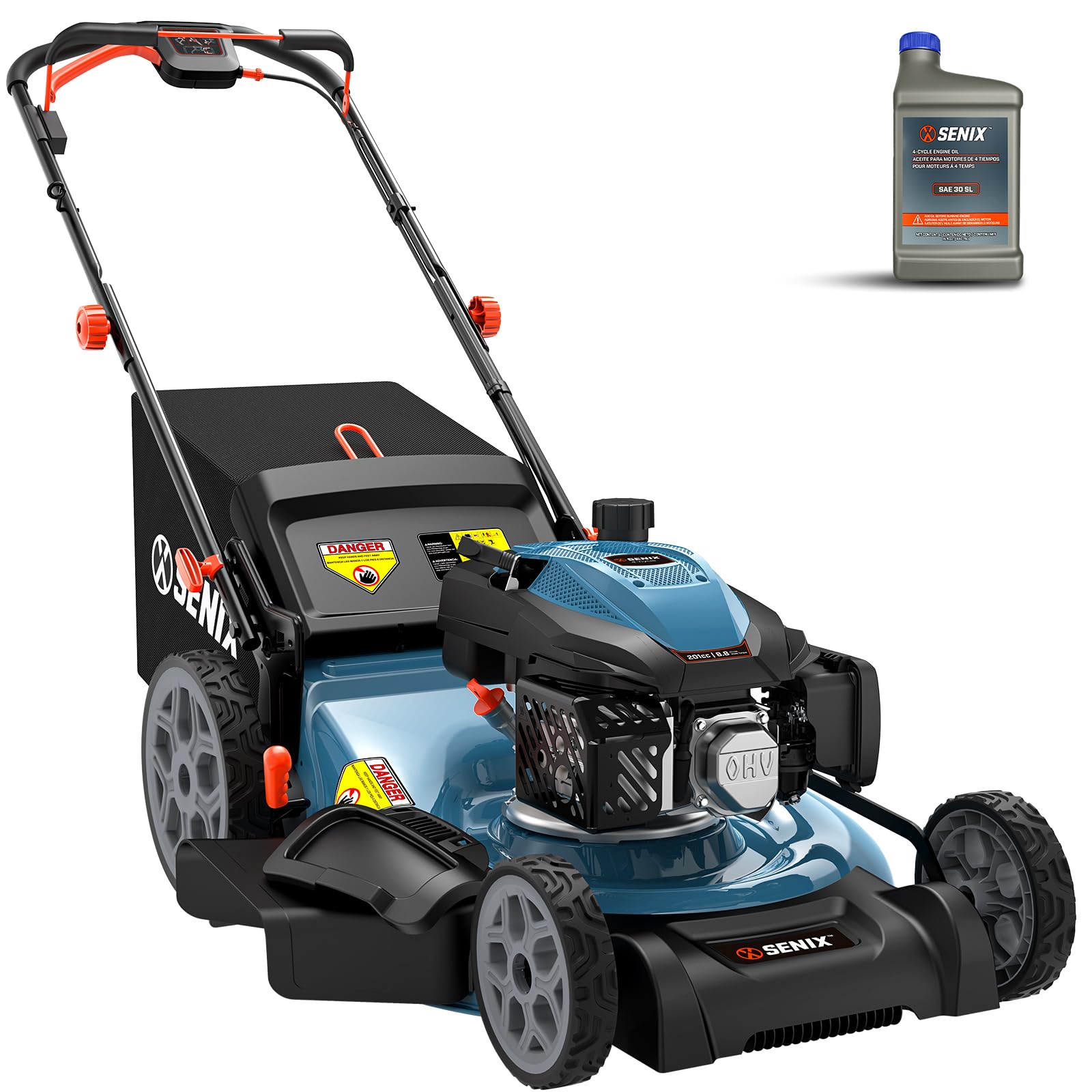
The SENIX pairs a 201cc engine with variable-speed rear-wheel drive, so it keeps itself pulling on hills while you adjust the pace with a twist of the handle.
At 66 pounds, the SENIX is lighter than the YARDMAX at 84.9 pounds, so you feel the difference when you angle it or push across a ditch. The variable-speed rear-wheel drive (RWD) lets you dial the forward motion up or down by twisting the handle, which matters when you step from thick grass onto a bare patch or crest a hill. Reviewers report the mower cranks on the first pull thanks to the automatic choke, and they praise the single-lever height adjustment that changes all four wheels at once.
The cutting height range runs from 1.25 inches up to 4 inches versus the PowerSmart’s 3-inch max, so you can leave cool-season grass longer in summer. The 201cc engine slices through thick grass without bogging. Buyers mention the 3-in-1 system (mulch, bag, side discharge) works well, and the bag fills completely before needing emptying. One owner noted the self-propel belt came off during a mow and took about 30 minutes to re-spool, which is the single consistent service hiccup. The deck folds upright to save storage space, and users confirm it stores without leaking fuel or oil.
Unlike the heavier YARDMAX, the SENIX weighs 66 pounds versus 84.9 pounds, which makes it easier to lift into a shed or over a bump. If your yard has any slope and you want a mower that keeps pace with you while storing nearly vertically, this is the strongest overall pick in this price tier.
Handles the hill, stores small: The variable-speed RWD and 4-inch max height make this the most versatile single choice for yards with varied terrain and mixed grass types. The foam grip split on one unit, and the belt can slip under heavy use, but the engine power and fold-flat storage are tough to beat at this level.
Your best bet if: you have a sloped yard and want a rear-drive mower that you can vary the speed of as you walk, plus fold upright when done.
Reconsider if: you need a mower that never needs a belt adjustment — some owners had to re-spool the self-propel belt at least once.
2. BILT HARD 21″ 201cc 4-Cycle OHV Self Propelled Gas Lawn Mower
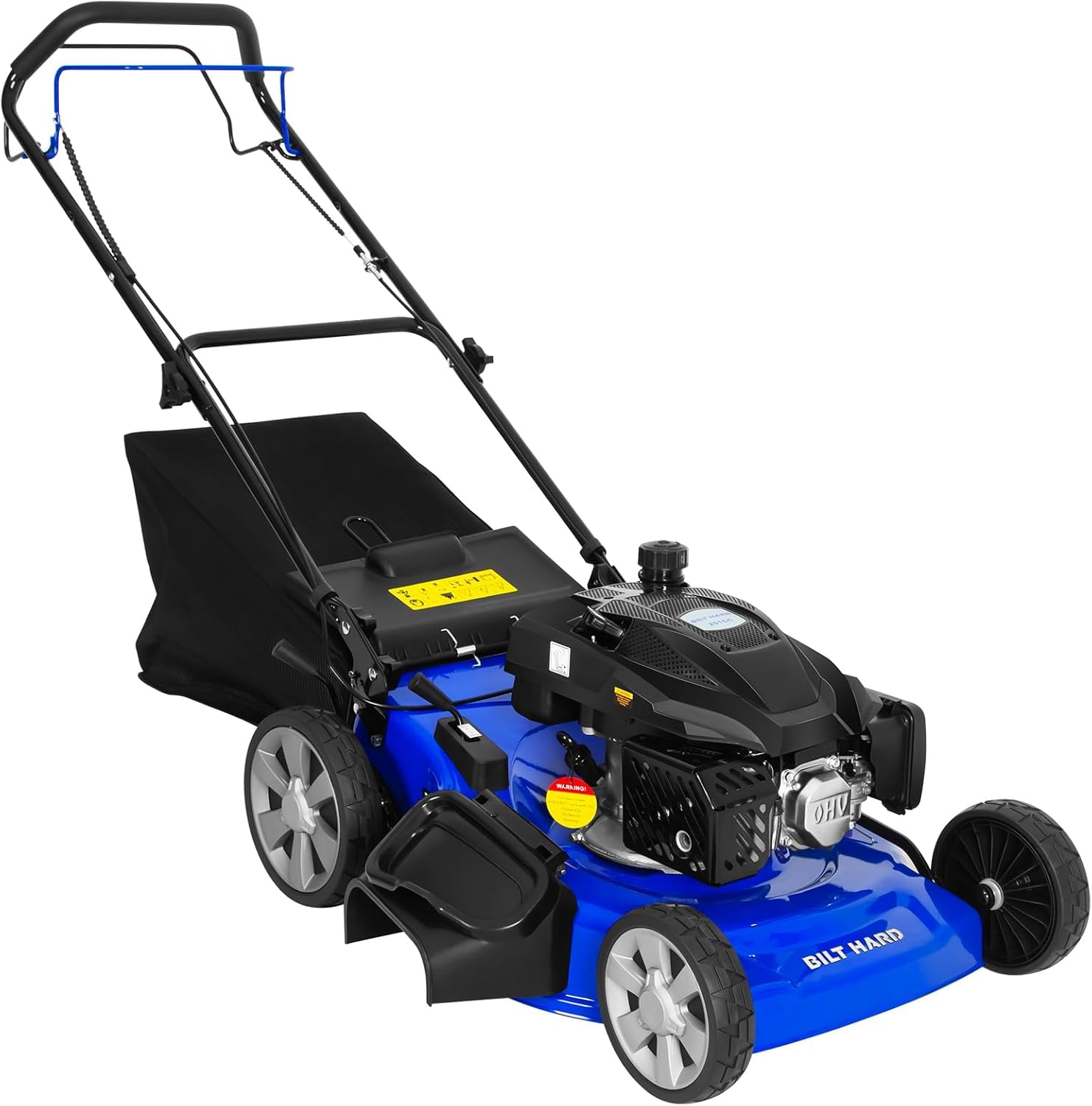
With 8 height positions from 1.2 to 3.75 inches, the BILT HARD lets you dial in more cutting lengths than any other pick here, with 8 positions versus the PowerSmart’s 6.
The 201cc engine delivers 9.0 ft·lb of torque (twisting force), which is enough to mash through overgrown patches without the blade slowing. Buyers report it starts on the first pull, and the no-choke, no-primer design means you simply pull the cord and go. That extra granularity is helpful if you switch between a close Bermuda cut in summer and a slightly taller fescue cut in spring.
The rear-wheel drive system is single-speed — you get one forward pace, not a variable range like the SENIX. That is fine for flatter lawns but less forgiving on steep inclines where you want to go slower. Owners mention the assembly is straightforward and oil is included in the box. A few owners flagged a bent drive shaft causing vibration from first use, and one reported the dipstick housing cracked after fewer than eight hours of use.
The foam-wrapped angled handle reduces hand fatigue during longer mows, and the 21-inch steel deck is slightly narrower than the 22-inch Senix and PowerSmart. If you routinely mow at different heights across your property and want the most granular blade adjustment for the money, this engine is a solid match.
Why it stands out
- 8 cutting positions — the widest selection in this lineup
- 201cc OHV engine starts first pull with no choke or primer needed
- Includes oil and straightforward assembly
Watch out for
- Single-speed self-propel — no way to slow the pace on hills
- A few buyers reported a bent drive shaft or vibration
- Long-term reliability still unproven past a few months
Reach for this if: you want the most height choices (8 positions) and a powerful 201cc engine without paying premium money.
Look elsewhere if: you need variable-speed self-propel for a steep yard or you prefer a wider 22-inch cut — this one is 21 inches.
3. PowerSmart 22″ 170cc 4-Cycle OHV Self Propelled Gas Lawn Mower
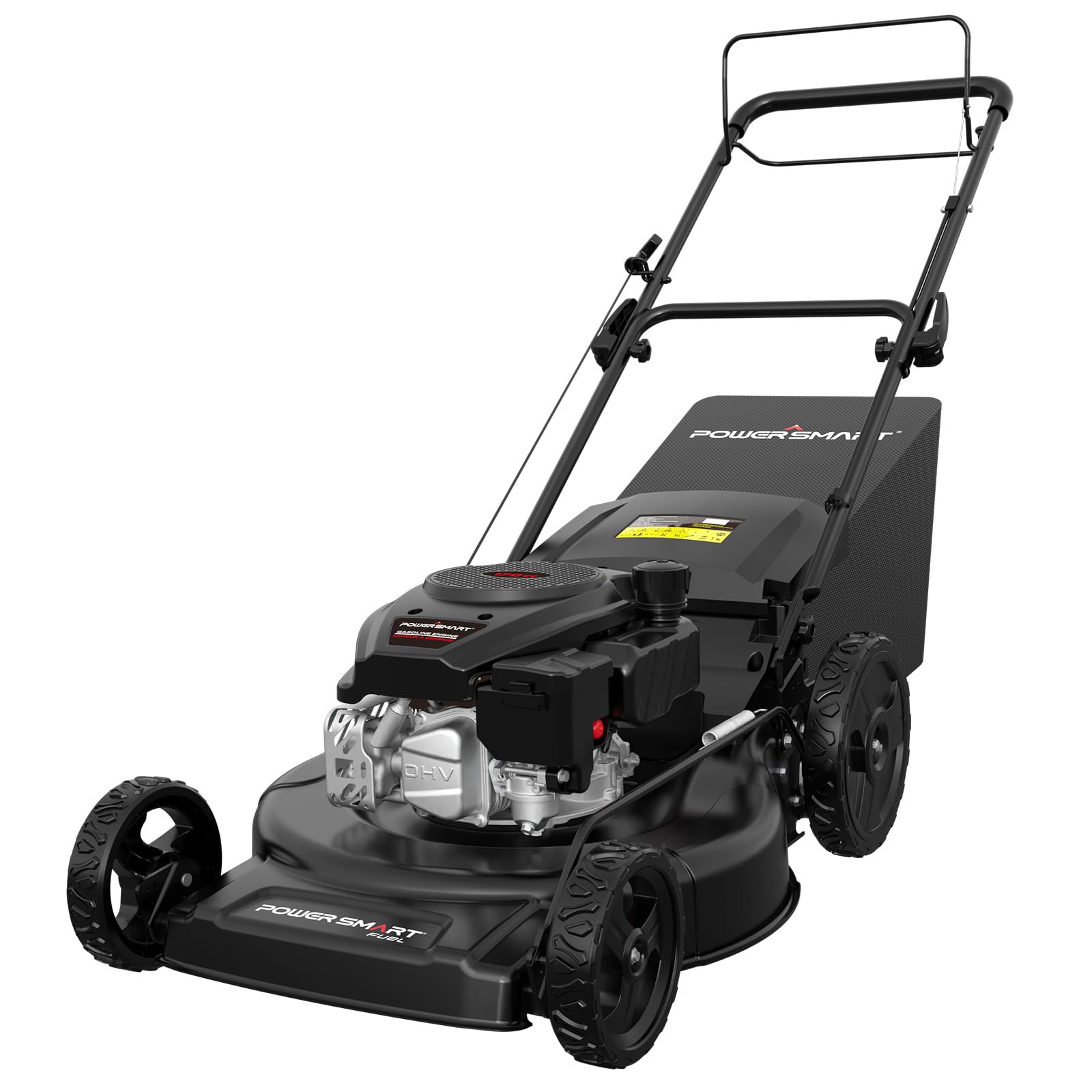
At 68 pounds with a 170cc engine, the PowerSmart is one of the lightest mowers here, but its 3-inch max cutting height is the lowest of the group, versus the SENIX’s 4-inch top end.
That engine is fine for a quarter-acre of average-thickness grass, but it will struggle sooner than the 201cc units in tall, damp, or overgrown patches. Buyers consistently report the mower starts on the first pull even after sitting, and one owner noted after a couple mows the product works as hoped — easy assembly and reliable starting each time.
The rear-wheel drive provides solid traction on mild slopes, though the single-speed self-propel is less adaptable than the variable-speed SENIX. The 22-inch all-steel deck is the same width as the SENIX and YARDMAX, so you cover ground at the same pace per pass. The cutting height adjusts from 1.5 inches to 3 inches across 6 positions. If you prefer cutting grass at 3.5 or 4 inches during the hotter months, this mower simply cannot reach that length.
The 60L grass bag is generous — one reviewer noted it empties quickly and saves time. A reviewer noted the rear rubber skirt can detach and get chewed by the blade, which is a design flaw to watch for. Customers note this mower is not self-propelled in all configurations, but the verified unit on this page is the self-propelled version. For smaller flat lawns where you do not need a 4-inch cut or a 201cc engine, the PowerSmart keeps the price low and the weight manageable.
Light and reliable starter: The 170cc engine and 68-pound weight make it easy to pull the cord and maneuver, but the 3-inch max cutting height and single-speed drive limit it to flatter, cooler-season yards where you keep the grass shorter.
Fine for you if: your lawn is flat, you keep the grass at 3 inches or shorter, and you want the lowest weight among these gas self-propelled mowers.
Not for you if: you cut cool-season grass at 4 inches in summer or you need variable speed on a slope — the 170cc engine and single-speed drive lack the headroom.
4. YARDMAX 22″ 201cc Select PACE 6 Speed CVT High Wheel FWD 3-in-1 Gas Lawn Mower
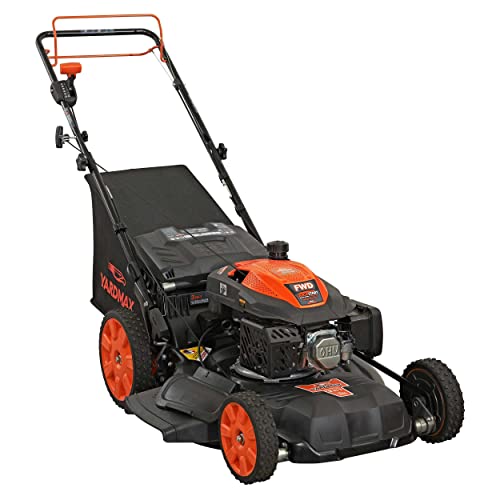
The YARDMAX offers a CVT (continuously variable transmission that shifts smoothly through speeds with no gears) with a 6-speed lever, but its front-wheel drive and 84.9-pound weight make it a poor match for anything beyond flat, dry lawns.
Its standout feature is the CVT with a 6-speed shift lever, so you can match the forward pace to your walking speed more precisely than with a single-speed mower. The thick rubber tires with an aggressive spiked tread pattern give it traction on packed dirt and dry grass. One buyer summed it up: heavy (84 lbs, ~90 with grass) — that is the trade-off you accept for the sturdy drivetrain.
A critical catch: the YARDMAX uses front-wheel drive (FWD). On a dry, flat lawn, FWD pulls fine, but on wet grass or an incline it loses grip because the front wheels carry less weight than the rear. One owner reported the speed lever slips during use and the grass bag is awkward to attach — complaints that come up in several reviews. The 201cc engine starts on the second pull, and the automatic choke means no priming. The single-lever deck adjuster changes the cutting height quickly across all four wheels.
The 22-inch stamped steel deck handles the same cutting width as the SENIX and PowerSmart, and the deck cleanout port lets you spray water underneath while the blade is spinning (with the spark plug disconnected) to prevent grass buildup. If you have a flat, dry lawn and you want the precision of a CVT without paying for premium variable-speed electronics, the YARDMAX brings that transmission control. But for a sloped or wet yard, the lighter rear-drive SENIX or even the BILT HARD will outperform the YARDMAX on traction alone.
What you gain
- CVT with 6 speeds — more control over your walking pace
- 201cc engine with automatic choke for easy starting
- Deck cleanout port for quick underside washing
Where it falls short
- Front-wheel drive loses traction on wet grass and inclines
- Heaviest pick at 84.9 pounds; one buyer called it “like wrestling”
- Speed lever slips according to several owner reports
Best for a flat, dry yard: The CVT speed selection is genuinely useful on level ground where you want to match your walking pace exactly, and the 201cc engine has the muscle for thick grass.
skip it if: your lawn has any slope or stays damp — front-wheel drive will lose grip, and the 84.9-pound weight makes it a fight on hills.
Understanding the Specs
Engine Displacement (cc)
The engine size, measured in cubic centimeters (cc), tells you how much air and fuel the cylinders can hold. A 170cc engine works fine for a lawn of about a quarter acre with average grass. A 201cc engine delivers more torque (twisting power) to cut through tall, thick, or damp grass without the blade slowing down. A bigger engine also adds weight — expect around 66 to 85 pounds depending on the design.
Self-Propelled Drive: RWD vs FWD
The drive wheels determine where the mower gets its grip. Rear-wheel drive (RWD) pushes from the back, keeping the heaviest part of the mower over the drive wheels so they maintain traction on slopes. Front-wheel drive (FWD) pulls from the front; it turns more sharply on flat ground but the front wheels lose grip on wet grass or hills because they carry less weight. Variable-speed self-propel lets you adjust forward speed by twisting the handle — single-speed gives you one fixed pace.
Cutting Height Range and Positions
The minimum and maximum cutting heights determine what grass lengths the mower can handle. A range from 1.25 to 4 inches covers short warm-season Bermuda cuts and longer cool-season fescue cuts. The number of height positions (6 or 8) tells you how many intermediate settings you get between the lowest and highest. A single-lever adjustment that moves all four wheels at once is far faster than adjusting each wheel individually.
3-in-1 Mowing Modes
Three modes let you decide what happens to the clippings. Mulching chops the grass into fine particles and drops them back onto the lawn as fertilizer. Side discharge blows clippings out to the side so you can rake them later. Bagging collects clippings in an attached grass bag (often 60L or larger). Some mowers switch between modes with a single plug or lever, while others require you to remove and attach different parts.
FAQ
Is rear-wheel drive always better than front-wheel drive on a self-propelled lawn mower?
What size engine do I need for an average lawn?
What does variable speed self-propel mean?
How many cutting height positions do I really need?
Can I use a self-propelled mower on very steep slopes?
What does a CVT transmission do on a lawn mower?
Do self-propelled mowers work on wet grass?
How much does a self-propelled gas mower weigh?
Can I store a self-propelled mower upright to save space?
What does 3-in-1 mowing mode mean?
Final Thoughts: The Verdict
If you want one dependable pick, the best affordable self-propelled lawn mower winner is the SENIX 201cc 22″ because it combines variable-speed rear-wheel drive, a 4-inch max cutting height, and a relatively light 66-pound frame — the strongest all-rounder for slopes and mixed grass types. If you want the most cutting height options (8 positions) and a powerful 201cc engine at a lower price, grab the BILT HARD 21″ 201cc. And for a flat, dry lawn where you want the precise pace control of a CVT transmission, the YARDMAX 22″ 201cc brings that speed selection, though its front-wheel drive and 84.9-pound weight make it a poor fit for hills or damp ground.
How We Picked
We do not accept paid placement, and we did not hands-on test every unit. Instead, we match each pick to a real buyer and use-case by comparing the manufacturers’ published specifications against the patterns in verified customer reviews — so you get each pick’s real strengths and trade-offs instead of marketing copy.
Sources & Methodology
Specifications: manufacturer listings and product documentation. Review insights: verified customer reviews, as of July 2026. Pricing: not shown on this page (it changes often); check the current price via the retailer link.
As an Amazon Associate, Lawn Gear Lab earns from qualifying purchases. This does not affect which products we feature.