
Forgetting to aerate your lawn is the single easiest way to end up with a patchy, waterlogged yard where nutrients never reach the roots. But renting a gas-powered core aerator (a machine that pulls plugs of soil out of the ground) is expensive, heavy, and a pain to return — so you either skip it or break your back with a hand tool. The smarter middle ground is a pair of aerator shoes: you strap them over your regular footwear and simply walk across your yard, letting spikes punch holes into the soil with every step. The best ones stay locked onto your shoes, dig deep enough into compacted clay, and keep working season after season without bending their spikes.
I’m Rikta — the co-founder and writer behind Lawn Gear Lab. This guide is built by comparing the manufacturers’ published specifications and the patterns across verified customer reviews, so you get each pick’s real strengths and trade-offs instead of marketing spin.
Whether your yard suffers from rock-hard clay, soggy patches, or thin grass that won’t thicken, using a best aerator shoes pair lets you tackle compaction the easy way — walk the lawn once a season and watch the water, air, and fertilizer actually reach the roots.
How To Choose The Best Aerator Shoes
Before you strap any pair on, there are three things that decide whether the shoes actually help your lawn or just feel like a wasted walk. Spike count, sole stiffness, and strap security make the difference between a tool you use every spring and one you toss after one trip.
Spike count and spike length
More spikes per shoe means more holes per step, but the real question is whether those spikes go deep enough to break through compacted soil. Look for at least 13 spikes per shoe and a spike length around 2 inches (about 48 to 51 millimeters) — anything shorter risks only scratching the surface, especially on clay-heavy lawns where the crust is hard.
Sole material — plastic vs. metal
A plastic base keeps the shoes lighter and cheaper, but it can crack or flex in cold weather or on rocky ground. A metal sole (often a steel or aluminum alloy plate) transfers your body weight straight down into the spikes, so you get deeper holes with less effort. Some high-end models use a 5-millimeter metal base that also resists the mud buildup that clogs plastic soles.
Strap system and fit
The best strap design uses either a hook-and-loop (Velcro) wrap-around or a buckle-and-lever lock. A loose shoe wastes every step — the spikes barely dent the soil because your foot lifts inside the aerator before the spikes pull out. Look for adjustable strapping that wraps around the heel and instep, and check user reviews for whether the straps fit larger shoe sizes (US men’s 11 and up often struggle).
Quick Comparison
On smaller screens, swipe sideways to see the full table.
| Model | Category | Best For | Key Spec | Amazon |
|---|---|---|---|---|
| HFH Lawn Aerator Shoes | Premium | Secure locking fit + nylon sole | 26 steel spikes | 2.1 lbs | Amazon |
| LawnVigor 5mm Metal Sole | Premium | Non-clogging metal base | 2-3/16″ spikes | 2.68 lbs | Amazon |
| Leweio 3mm Metal Bottom | Premium | Metal sole for hard soils | 2″ heat-treated spikes | 2.55 lbs | Amazon |
| MOFEEZ Lawn Aerator | Mid-Range | Aluminum/plastic hybrid base | 2.66 lbs | 3 Velcro straps | Amazon |
| MILLUXXi Dual Strap | Value | Pre-assembled with dual straps | 13 x 48mm spikes | 2.12 lbs | Amazon |
| Socient Ankle Lace | Value | Ankle protection with lacing | 2.36 lbs | Lace + buckle system | Amazon |
| Wodesid Strap & Buckle | Value | 2-in-1 lawn + epoxy floor use | 26 x 2″ spikes | 2.16 lbs | Amazon |
In‑Depth Reviews
1. HFH Lawn Aerator Shoes
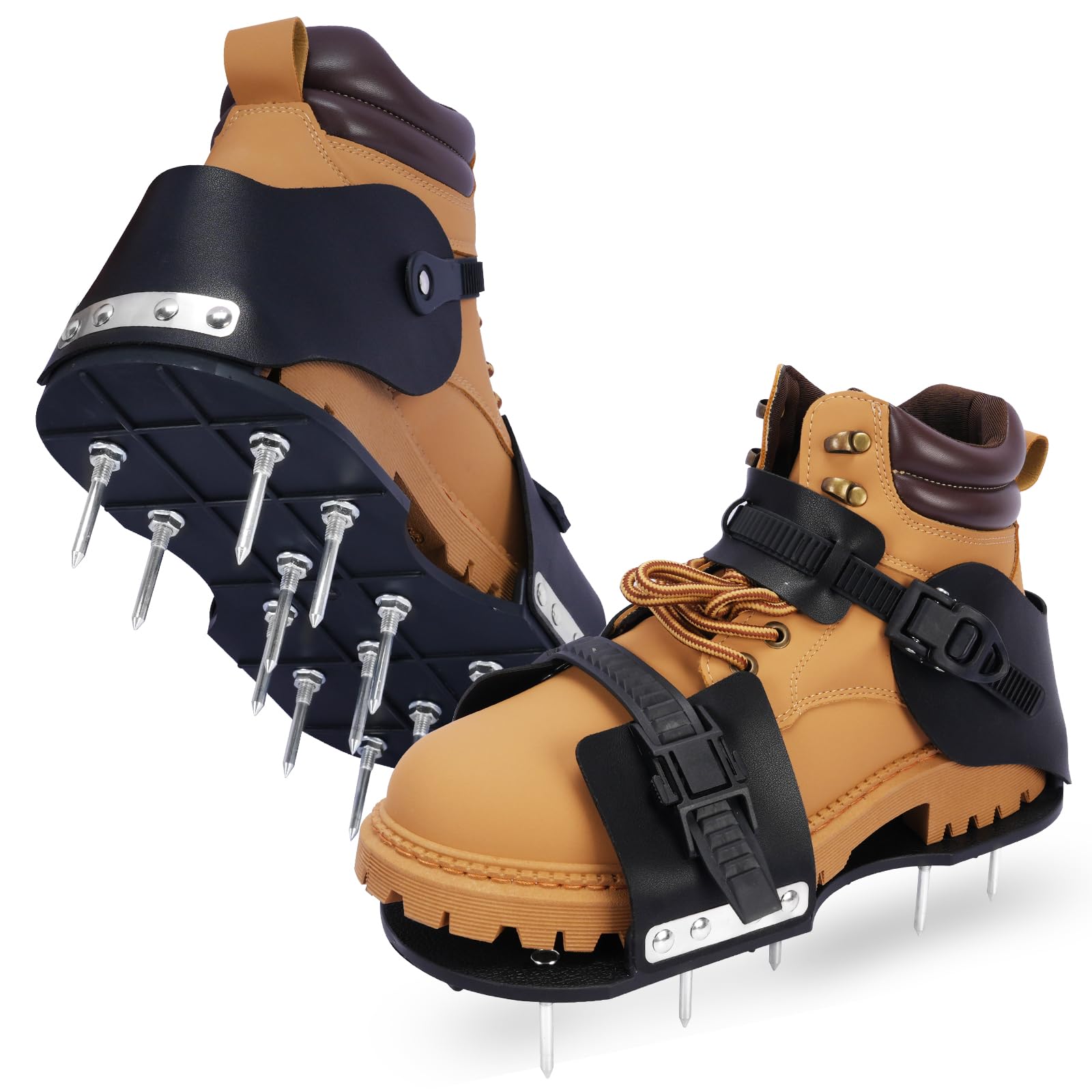
The 26 steel spikes (each roughly 2 inches long) and dual-lock closure make the HFH pair the top pick for anyone who has tried aerator shoes before and found the straps too loose to keep the spikes sinking deep.
The heavy-duty nylon sole flexes naturally without cracking, and the 26 steel spikes punch holes deep enough to reach grass roots on compacted soil. Buyers report that the shoes worked well on dying grass and allowed enough water to reach the roots to save it, and the included wrench makes tightening or replacing spikes simple. At 2.1 pounds, it is also about 25% lighter than the MOFEEZ model at 2.66 pounds, which means less leg strain on a full-yard walk.
The honest limit is size: owners mention the straps are really meant for US men’s sizes up to 10, and anyone with a size 12 shoe will struggle to keep the shoes from popping off. For most yards up to half an acre, though, this is the best-balanced pair of aerator shoes for security, weight, and build.
Why it’s great
- Dual buckle-and-lever closure keeps shoes locked to your feet
- Heavy-duty nylon sole won’t crack like plastic alternatives
- Works for both lawn aeration and epoxy floor projects
Good to know
- Straps too short for US men’s size 12 or larger
- Some buyers describe the build as a little flimsy under heavy use
2. LawnVigor 5mm Metal Sole Aerator Shoes

Compared to the top-pick HFH, the LawnVigor trades a 0.3-pound weight penalty for a 5-millimeter metal sole (about 0.2 inches thick) that eliminates the plastic-base mud-clogging issue — buyers confirm dirt does not clump to the spikes, so you aerate continuously instead of stopping every few steps to scrape the soles clean.
Its 2-3/16-inch heat-treated spikes (about 55 millimeters) are the longest in this lineup, and they penetrate packed soil with no bent pins even after repeated use, according to reviewers. The adjustable shoelace-and-buckle system fits US sizes 6 to 12, and the unit comes fully assembled so you just strap on and walk. At 2.68 pounds, though, it is the heaviest option here.
Choose the LawnVigor over the HFH if your yard has heavy clay that demands longer spikes and you are tired of cleaning mud-caked soles mid-job — the metal base saves those extra trips.
Where it shines
- 5mm metal sole prevents mud buildup so you keep walking
- Longest spikes in the comparison at 2-3/16 inches for deep penetration
- Pre-assembled out of the box — no setup needed
Worth noting
- Heaviest pair at 2.68 pounds, noticeable on long walks
- Runs slightly large; requires tight strap adjustment
3. Leweio 3mm Metal Bottom Aerator Shoes
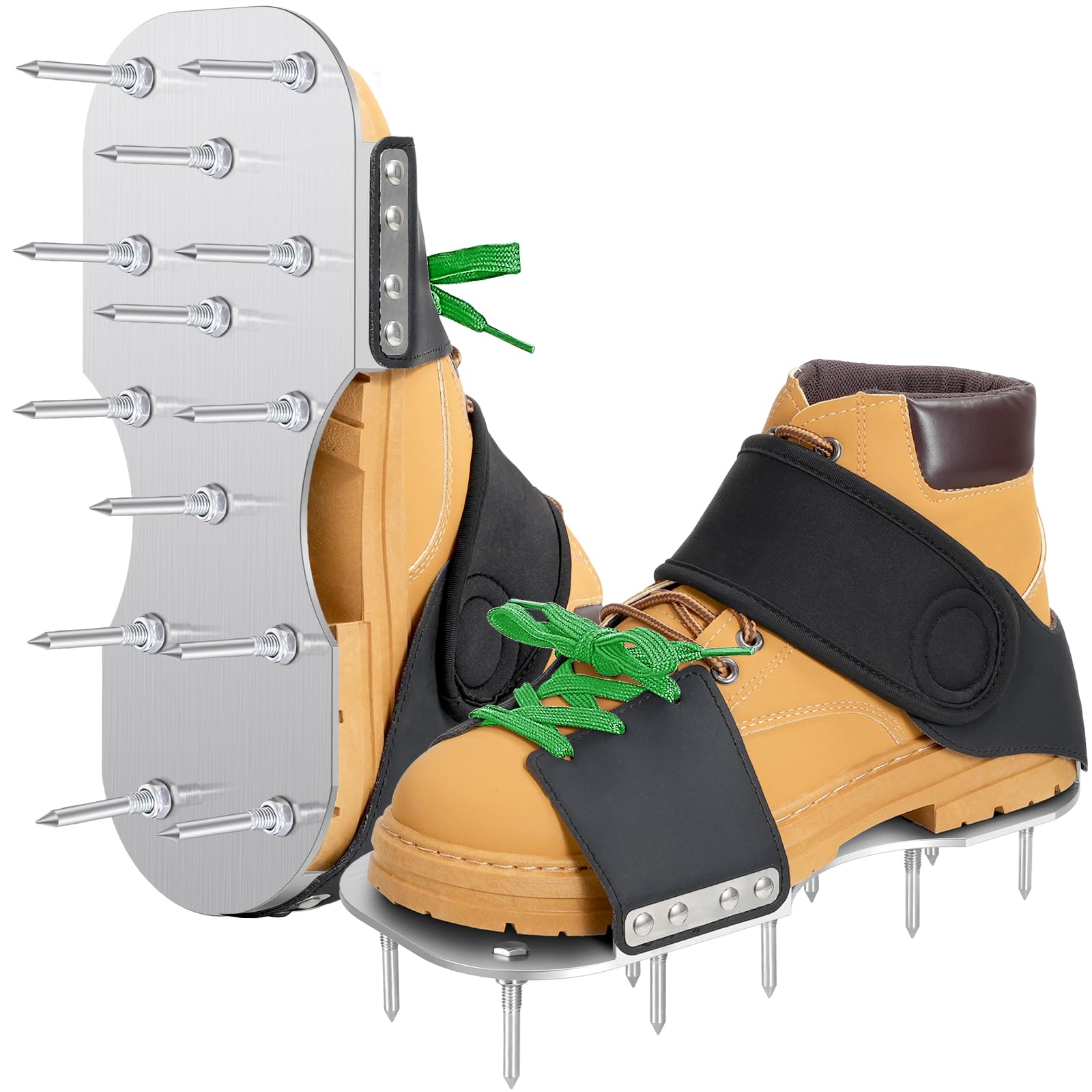
The Leweio is the pair you reach for when your lawn sits on hard red clay that bends cheap plastic spikes on the first pass. Its 2-inch heat-treated steel spikes are locked in with secure lock nuts (nuts that resist loosening from vibration) that prevent loosening during use, and the 3-millimeter metal sole transfers your body weight straight into the soil for deeper holes per step.
One reviewer used these for three garage epoxy floor projects and reported excellent footing, calling them “much better than cheap plastic shoes.” The elastic hook-and-loop straps (Velcro-like straps) adjust quickly over sneakers or work boots, and the shoes arrive fully assembled. However, customers note the ankle strap is barely long enough for large ankles, and the short spikes create shallow holes that may not be deep enough for severely compacted soil.
The standout spec is the 3-millimeter metal sole at a weight of 2.55 pounds — it gives you the durability of a metal base without the full weight of the LawnVigor’s 5-millimeter plate.
What stands out
- 3mm metal sole prevents bending and transfers weight effectively
- Heat-treated spikes with lock nuts stay tight during use
- Versatile for both lawn aeration and epoxy flooring
The trade-offs
- Ankle strap barely long enough for large shoe sizes
- Short spikes create shallow holes, not ideal for deep-core aeration
4. MOFEEZ Lawn Aerator Shoes

The single number that matters most in this category is sole durability, and the MOFEEZ scores a hybrid two-layer base — one of aluminum alloy and one of hard plastic — instead of the single plastic sheet most budget shoes use. The result is a sole that resists cracking on rocky ground while staying lighter than a full steel plate.
The catch you accept is weight: at 2.66 pounds, the MOFEEZ is the heaviest model in this guide (tied with the LawnVigor), and the three hook-and-loop (Velcro) straps, while secure, take more time to tighten than a buckle-and-lever system. Reviewers point out the medium size fits a men’s 8.5 well and that the shoes double as improvised crampons for snow traction, which speaks to the build quality.
At a mid-range price point, the MOFEEZ gives you a near-indestructible sole for the money — ideal if your lawn has scattered rocks or roots that would snap a cheap plastic base.
The upsides
- Aluminum-and-plastic hybrid sole resists cracking on rocky ground
- 3 adjustable Velcro straps keep shoes locked to your feet
- Shoppers say using them as snow traction crampons
Keep in mind
- Heavier than most at 2.66 pounds
- Velcro straps are a hassle to put on and remove quickly
5. MILLUXXi Dual Strap Aerator Shoes
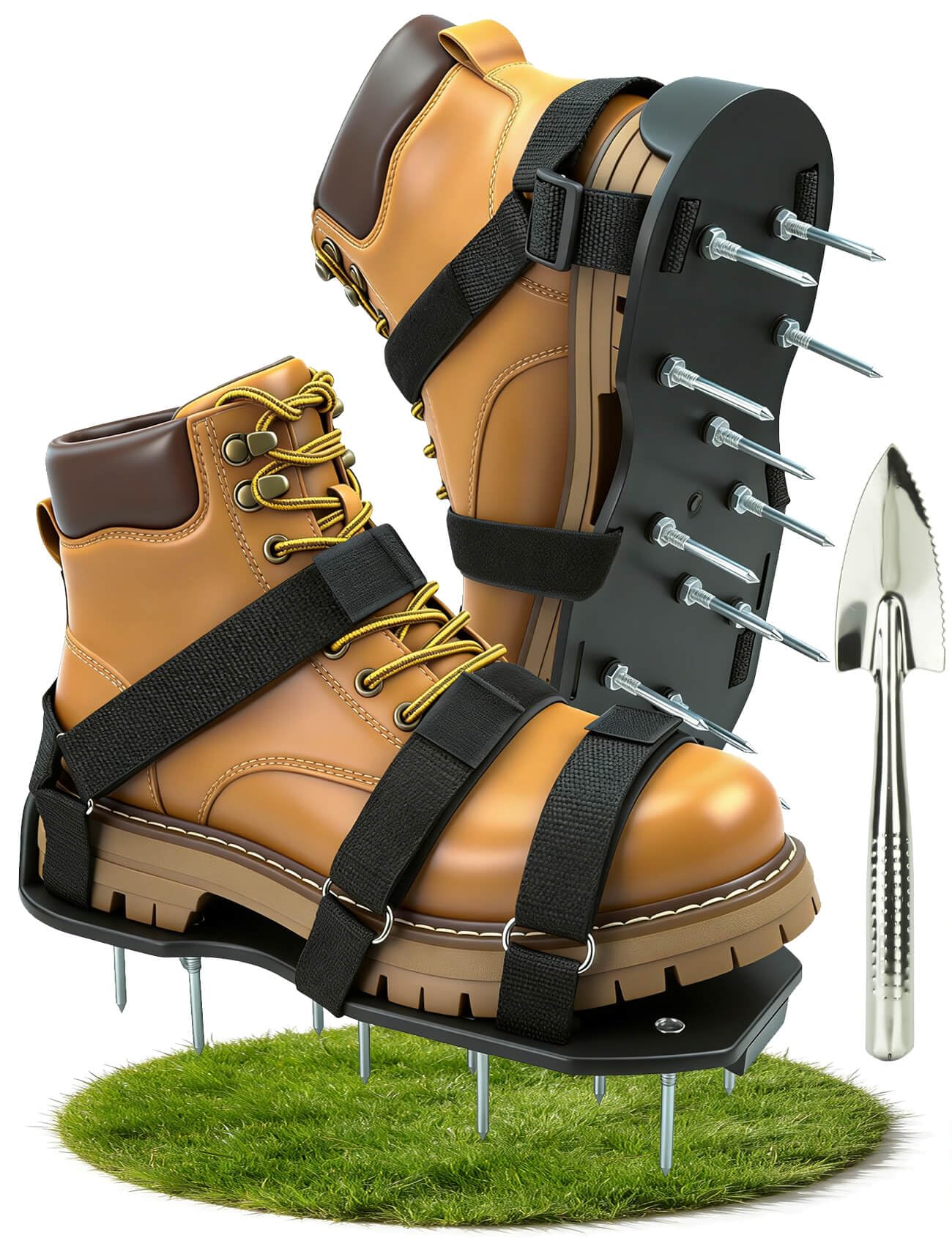
For the entry-level price, the MILLUXXi gives you a fully assembled pair of aerator shoes with reinforced dual straps on the instep — a design that buyers report stays secure and prevents the wobble that plagues cheaper single-strap models. You get 13 heavy-duty 48-millimeter (about 1.9-inch) metal spikes per sandal.
What you give up is a plastic-only sole that can collect mud quickly. One reviewer noted that the shoes collect dirt buildup fast, preventing spikes from sinking on damp lawns, and another recommended using them only on dry grass.
At 2.12 pounds, this is one of the lightest pairs, making it the right pick for the budget buyer who has a small, dry lawn and wants a no-fuss tool to punch shallow holes before overseeding.
Why we’d pick it
- Fully assembled with reinforced dual-strap design for a secure fit
- Lightweight at 2.12 pounds — easy to walk in for extended sessions
- Anti-slip pads prevent spike movement on wet grass
A few caveats
- Plastic sole clogs with mud on damp soil
- Best results on dry, moderately packed soil
6. Socient Ankle Lace Aerator Shoes
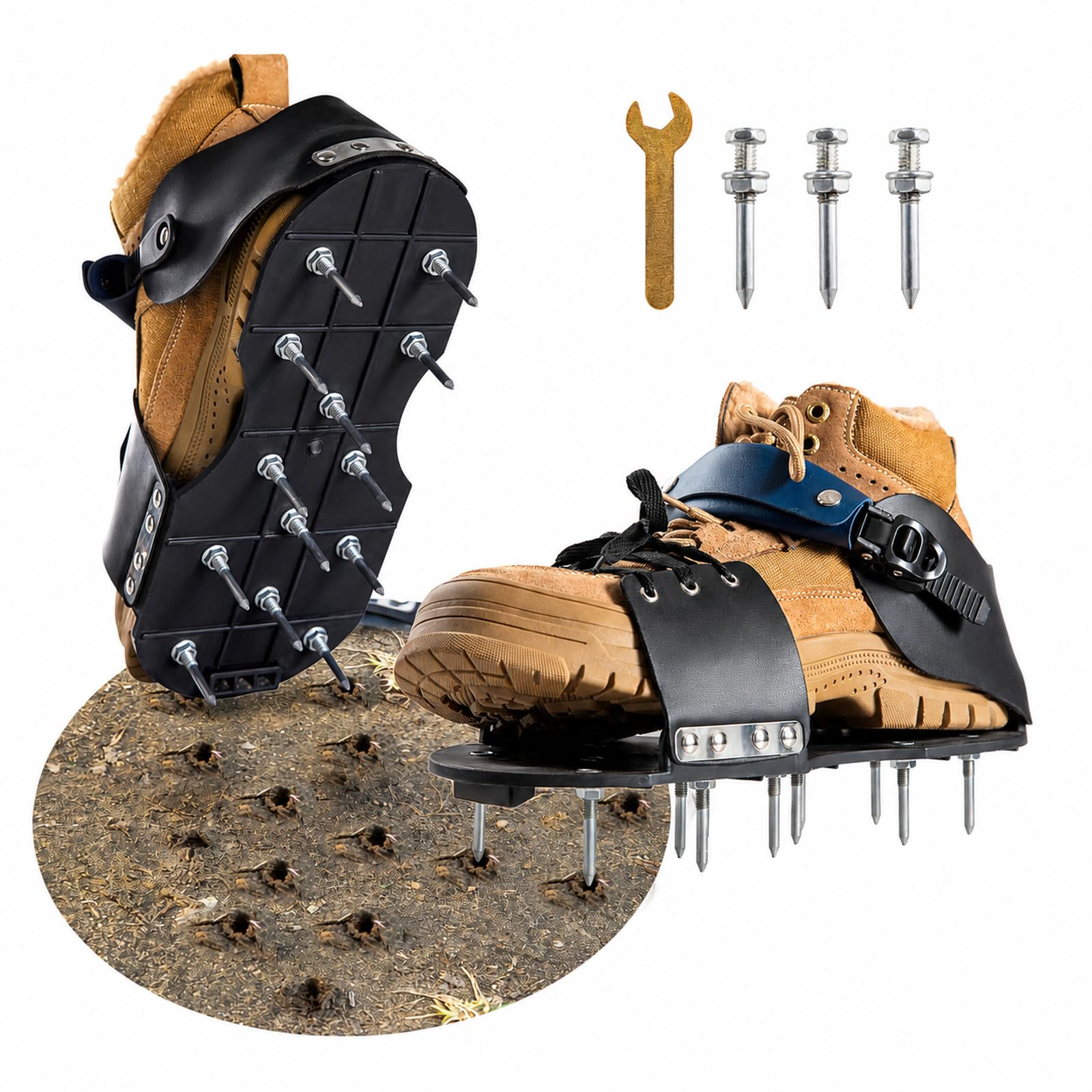
If you have ever twisted an ankle while clomping around in stiff aerator shoes, the Socient addresses that directly with an adjustable lacing system wrapped in soft leather around the ankle — a design that protects the ankle bone from the constant rubbing most spike shoes cause. This is the pair for homeowners who plan to spend an hour wearing them and want comfort over bare-bones simplicity.
The lacing and locking buckles adjust freely to fit men’s and women’s sizes 6 to 12, and anti-loosening nuts (nuts that resist loosening from vibration) mean you are not retightening spikes after every walk. Owners mention the shoes work great and save your back compared to hand-held aerators, though they caution that wet grass sticks to the bottom and gums up the spikes. At 2.36 pounds, it sits mid-pack weight-wise.
The one honest limit is the lacing system: it takes longer to put on than a hook-and-loop (Velcro) or buckle pair, so if speed matters more than ankle comfort, look elsewhere.
Strong points
- Soft leather ankle wrap prevents rubbing and protects ankle bones
- Adjustable lacing and locking buckles fit a wide range of shoe sizes
- Anti-loosening nuts keep spikes tight during use
Before you buy
- Lacing system is slower to put on than Velcro or buckle designs
- Wet grass clogs the sole and reduces spike penetration
7. Wodesid Strap & Buckle Aerator Shoes
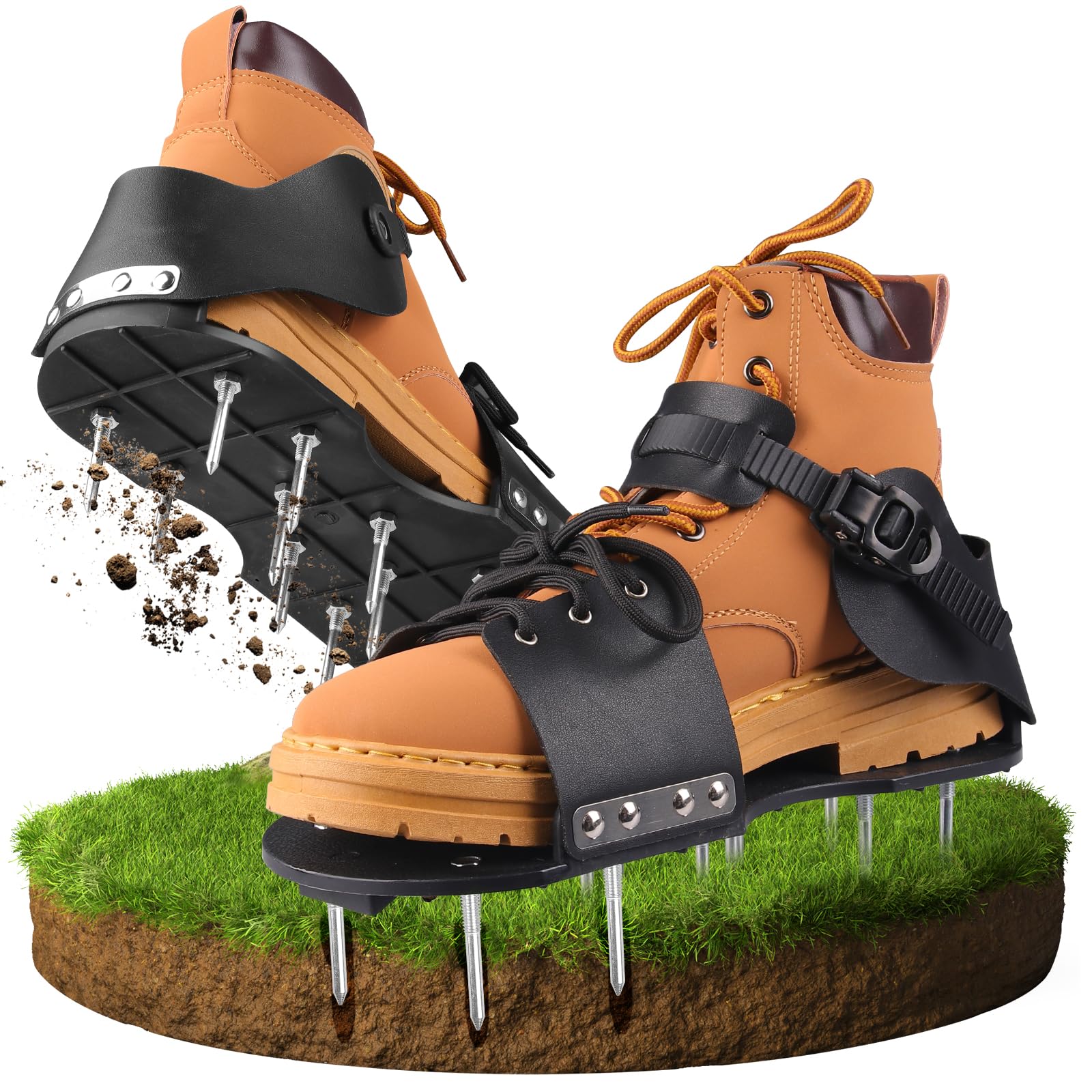
The Wodesid lands at a budget-friendly price while packing 26 stainless steel spikes per pair — more than double the spike count of the MILLUXXi model, which has 13 per shoe. That extra density means you punch more holes per step, covering ground faster on a small lawn.
For that money, you get a high-density slip-resistant rubber molded sole with corrosion-resistant zinc alloy spikes and a 2-in-1 design that works for both lawn aeration and walking on wet epoxy flooring during renovations. The downside is assembly: the spikes arrive loose and require using the included custom wrench to tighten them, which takes about 10 minutes. Customers note the shoes work well on soft ground after rain and are effective on hard red clay lawns, but walking feels awkward until you adjust your gait.
Compared to the rest of the field at this tier, the Wodesid gives you the highest spike density for your money — ideal if you have a small yard and want maximum holes per minute without spending for a metal-sole upgrade.
What we like
- 26 spikes per pair — the highest count in the budget tier
- Rubber molded sole offers good flexibility and crack resistance
- Works as epoxy floor shoes for DIY renovations
The downsides
- Requires assembly — spikes need to be tightened with the included wrench
- Awkward walking gait until you get used to the spike pattern
Understanding the Specs
Spike length and spike count
Spike length — measured in inches or millimeters (like 2 inches or 48 millimeters) — determines how deep your holes go. Compacted clay needs at least 1.9 inches (about 48 millimeters) to break through the hard crust. Spike count per shoe ranges from 13 to 26; more spikes mean more holes per step, but they also require more downward force to sink. For most lawns, 13 spikes per shoe at 2 inches is the minimum effective setup.
Sole material — plastic vs. metal vs. hybrid
The sole is the platform that transfers your body weight into the spikes. Plastic soles are light and cheap but can crack on cold or rocky ground, and they build up mud clogs in wet grass. Metal soles (steel or aluminum alloy) are heavier but resist clogging and bend less, so the spikes stay perpendicular. A hybrid base — aluminum alloy bonded to plastic — gives you the stiffness of metal at a lower weight.
Strap and closure system
The strap design is what keeps the aerator shoe attached to your regular footwear. Hook-and-loop (Velcro) straps are the most common and let you fine-tune the tightness, but they can wear out after a couple of seasons. Buckle-and-lever systems snap into place faster and hold tighter for larger shoe sizes. Lace-up designs offer the most customized ankle fit but take longer to put on and remove.
Weight and ease of use
Each shoe’s weight in pounds affects how quickly your legs fatigue. Most aerator shoes weigh between 2.1 and 2.7 pounds per pair. Pre-assembled models save you the 10-minute spike installation that some budget kits require. Also check whether the manufacturer recommends wetting the soil before use — pre-moistening softens hard ground so spikes penetrate more easily, but some soles clog faster in wet conditions.
FAQ
Can I use aerator shoes on wet grass?
How deep do the spikes need to be for compacted clay soil?
Do aerator shoes actually work, or are they a gimmick?
Will aerator shoes fit my US size 12 or 13 shoes?
Can I use aerator shoes for epoxy flooring projects?
Final Thoughts: The Verdict
If you want one dependable pick, the best aerator shoes winner is the HFH Lawn Aerator Shoes because of its secure buckle-and-lever locking system that keeps the spikes digging deep without slipping. If you want a non-clogging metal sole that handles sticky clay without constant cleaning, grab the LawnVigor 5mm Metal Sole. And for the budget buyer who needs a pre-assembled, lightweight pair for a small dry lawn, the standout is the MILLUXXi Dual Strap Aerator Shoes.