
Specs are compiled from manufacturer listings and verified buyer reviews and can change over time — please confirm the key details on the product page before buying.
Your azaleas and blueberries need soil that is naturally acidic, not neutral. Standard fertilizer can make them worse by raising the pH (a measure of how acidic or alkaline your soil is). A specialized acid loving plant food gives you extra iron, sulfur, and a lower pH so the plants can open up the nutrients already in the ground. Most gardeners get the biggest return from the Miracle-Gro Azalea, Camellia, Rhododendron Plant Food — it revives leaves fast, comes in a big 80 oz bag, and costs less than many smaller alternatives.
I’m Rikta — the founder and writer behind Lawn Gear Lab. This guide is built by comparing the manufacturers’ published specifications and the patterns across verified customer reviews, so you get each pick’s real strengths and trade-offs instead of marketing spin.
To match your plants and schedule, you just need the right acid loving plant food. This list covers every type.
Quick Picks
- Miracle-Gro Water Soluble Azalea — Best Overall
- Dr. Earth Acid Lovers Azalea — Organic Pioneer
- GARDENWISE 8-4-8 Acidic Fertilizer for Azaleas — Best Value
- Jack’s Classic 17-6-6 Acid Special Water-Soluble Fertilizer — Precision Feed
- Espoma Organic Holly-Tone 4-3-4 Evergreen & Azalea — Trusted Classic
- Nelson Acid Loving Plant Food NutriStar 9-13-11 (2 lb.) — Bloom Booster
- True Organic Azalea, Camellia & Rhododendron Food — Big-Bed Organic
How To Choose The Best Acid Loving Plant Food
You have two main roads to pick from: water-soluble powders that feed fast, or organic granules that release slowly. The choice depends on how much time you have and if you want a quick green-up or steady long-term soil health. Read on for the critical factors to weigh before you buy.
Water-Soluble vs. Granular: Speed vs. Steadiness
Water-soluble formulas like the 17-6-6 Jack’s Classic dissolve in water and get to the roots fast, making them ideal for a noticeable boost within a couple of weeks. Granular options, like the Espoma Holly-Tone, release nutrients over several months as soil microbes break them down, so you apply just once or twice per season. Pick water-soluble if you are container-growing or spot-treating a struggling plant. Pick slow-release granules for established shrubs and a “set it and water it” routine.
N-P-K Ratio: What Those Numbers Really Mean
The three numbers on the bag stand for nitrogen (leaf growth), phosphorous (root and flower development), and potassium (overall plant health and disease resistance). Acid-loving plants need less nitrogen and more iron and sulfur than your average vegetable garden. A balanced ratio like 8-4-8 or 9-13-11 works well. A high-first-number formula (like 17-6-6) pushes strong leaf growth but must be used at the recommended rate to avoid burning the roots. Always check the mix ratio on the label before you sprinkle.
Organic vs. Synthetic: Soil Health vs. Immediate Results
Organic products like the Dr. Earth Acid Lovers use seabird guano and other natural inputs to feed the soil itself, which creates a healthier growing environment over time. Synthetic powders like Miracle-Gro deliver nutrients in a form the plant can use right away, which is why you see results in a week. There is no wrong choice — it is about matching your gardening philosophy and your patience level.
Quick Comparison
| Model | Best For | N-P-K Ratio | Item Weight | Form | Amazon |
|---|---|---|---|---|---|
| Miracle-Gro Azalea, Camellia, Rhododendron Food | Fast green-up on a tight budget | 30-10-10 | 5 lb | Powder | Amazon |
| Dr. Earth Acid Lovers Fertilizer | Strictly organic, pet-safe feeding | 4-6-5 | 1 lb | Granules | Amazon |
| GARDENWISE 8-4-8 Acidic Fertilizer | Iron-rich, thrice-yearly feeding | 8-4-8 | 0.96 kg | Granules | Amazon |
| Jack’s Classic 17-6-6 Acid Special | Precise pH control for blueberries | 17-6-6 | 1 lb | Powder | Amazon |
| Espoma Organic Holly-Tone 4-3-4 | Slow-release, year-round maintenance | 4-3-4 | 4 lb | Granules | Amazon |
| Nelson NutriStar 9-13-11 Acid Food | Heavy blooming on flowering shrubs | 9-13-11 | 2 lb | Granules | Amazon |
| True Organic Azalea, Camellia & Rhododendron Food | Large-scale organic beds | 5-4-3 | 12 lb | Granules | Amazon |
In‑Depth Reviews
1. Miracle-Gro Water Soluble Azalea, Camellia, Rhododendron Plant Food, 5 lb.

The mass-market workhorse that revives struggling rhododendrons inside a week.
This is the acid loving plant food most gardeners reach for first, and for good reason. The 5 lb bag (80.0 oz) gives you far more feedings than the smaller specialty bags above, yet it costs less than many of them. Buyers report that it “truly helped our rhododendron to recover and look stunning this summer,” so you are not just buying volume — you are buying predictable, fast results.
You mix it with water at a 1:144 ratio for indoor plants or a stronger 1:18 ratio for outdoor beds, then apply every 7-14 days with a watering can or a hose-end feeder. The powder dissolves fully with no clumps, and it is safe on other plants as long as you follow the label. A handful of owners mention the resealable bag closure is weak, so plan to store it in a dry container.
Compared to the Dr. Earth organic option below, the Miracle-Gro bag weighs 5 lbs versus 1 lb — a large volume advantage. It feeds instantly rather than slowly, which makes it ideal for a plant that needs visible help by next weekend.
Fast & Familiar
- 80 oz covers many plantings with one purchase
- Dissolves completely for even feeding
- Works on azaleas, rhododendrons, gardenias, hydrangeas, blueberries, and orchids
Storage Downsides
- Bag reseal closure is hit-or-miss
- Requires mixing every feeding, not a slow-release option
Reach for it if: You want a proven, affordable powder that greens up a broad range of acid-loving plants after a week of use.
Look elsewhere if: You prefer an organic, no-mix, slow-release granule you apply only twice per season.
2. Dr. Earth Acid Lovers Azalea, Camellia, Rhododendron & Maple Fertilizer, 1 lb

The organic answer for reviving a two-year bloomless rhododendron.
Dr. Earth holds the unusual distinction of being Non-GMO Project Verified — the only fertilizer brand in the U.S. with that claim — and it is made from human and feed-grade ingredients with no synthetic chemicals or GMO-infested chicken manure. One buyer wrote, “I applied it to my rhododendron (which hadn’t bloomed for two years) and bam! It sprang to life and was covered with huge pink flowers in no time.” That is the kind of story that makes a gardener trust a bag.
The 1 lb bag is relatively small compared to the 5 lb Miracle-Gro option, but because it is a slow-release granule you toss around the drip line and water in, you use less per application. Another reviewer noted it revived sad camellias quickly and even pushed a nearby agapanthus to flower a month early. Pet owners will appreciate that it is people- and pet-safe when used as directed.
Unlike the water-soluble Miracle-Gro above, this granular formula works with the soil biology rather than delivering a fast synthetic punch — so patience pays off. Many gardeners reported seeing new growth within a couple of weeks and full blooms by the next season.
Clean Ingredients
- Non-GMO Project Verified, OMRI (Organic Materials Review Institute) listed for organic production
- No synthetic chemicals, safe around people and pets
- Revived plants that had not bloomed for years
Small Bag Size
- 1 lb bag is skimpy for large garden beds
- Slow release means results show over weeks, not days
Best for organic-minded gardeners: This is the cleanest option on the list for anyone who wants to feed the soil, not just the leaves.
skip it if: You have a large area to cover and need massive volume from one bag.
3. GARDENWISE 8-4-8 Acidic Fertilizer for Azaleas, Camellias, Hydrangeas, Blueberries, 1 Quart
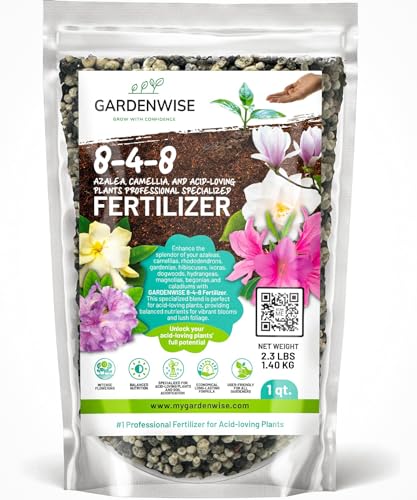
A slow-release granule so efficient it requires only three feedings per year.
GARDENWISE 8-4-8 stands out with its professional-grade slow-release formula that builds soil health as it feeds. One reviewer noted, “I bought this for my newly planted rhododendron and it has doubled in size,” which suggests the sustained nutrition from this 32 oz bag works. The NPK ratio of 8-4-8 is a balanced middle ground — not too hot on nitrogen, enough phosphorus for blooms, and plenty of potassium for root strength.
The maker packs it with magnesium, iron, and manganese to prevent chlorosis (yellowing leaves caused by iron deficiency) in acid-loving plants. You simply sprinkle the granules around the base, scratch them into the topsoil, and water. A single bag lasts a long time because the recommended schedule is only spring, summer, and fall. Another reviewer shared that their Magnolia (in a large pot) is “helping it grow” steadily, which is a solid endorsement for container plants too.
Compared to the Espoma Holly-Tone below, this GARDENWISE formula delivers richer iron content at 8-4-8 versus 4-3-4, making it a better pick if your soil is known to be alkaline and your plants show yellow leaves.
Low-Maintenance Feeding
- Only three applications per year needed
- Enriched with iron, magnesium, and manganese
- Works on magnolias, evergreens, berries, and hydrangeas
Limited Range
- Designed strictly for acid-loving plants — not for general garden use
- Over-application can harm plants if not measured carefully
Reach for it if: You want to set a low-maintenance feeding schedule and prioritize iron content for preventing yellow leaves.
Look elsewhere if: You need a fast-acting water-soluble boost for a container plant this weekend.
4. Jack’s Classic 17-6-6 Acid Special Water-Soluble Fertilizer with Micronutrients, 1.5 lbs

The blueberry grower’s secret weapon for precise pH control.
This 24 oz powder has a higher nitrogen count (17-6-6) than anything else on this list, but it earns its place because of the sulfur content that brings the soil pH down reliably. One buyer mentioned, “Jack’s fertilizer (17-6-6) boosted blueberry bush growth after 3 bi-weekly applications,” and they explicitly chose it over the Miracle-Gro Acid Mix (30-10-10) because the lower concentration meant less risk of over-fertilizing. That is a smart distinction for anyone nervous about burning roots.
You mix 1 teaspoon per gallon of water — the measuring spoon comes in the bag — and apply it as a root drench or a foliar spray (a spray on the leaves). The improve iron and sulfur are exactly what gardenias, blueberries, and citrus need to avoid that sad yellow look. Several reviewers reported fresh growth within two weeks on both berry plants and Colorado Spruce trees. Although the bag is smaller than the 80 oz Miracle-Gro bag, a little goes a long way because the powder concentrates into many gallons of liquid.
Unlike the granular Dr. Earth option, which feeds the soil, this water-soluble powder feeds the leaves and roots directly for a faster, more controlled response.
Targeted Nutrition
- High sulfur content for lowering soil pH
- Comes with a measuring spoon for accurate mixing
- Works as both root feed and foliar spray
Requires Diligence
- Must mix fresh each application
- High nitrogen means strict adherence to dosage to avoid burn
Best for blueberry and citrus owners: The sulfur-based acidification with lower nitrogen gives you pH control without pushing runaway leaf growth.
pass on it if: You prefer a no-mix, sprinkle-and-forget granule for a large ornamental bed.
5. Espoma Organic Holly-Tone 4-3-4 Evergreen & Azalea Plant Food, 4 lb. (Pack of 2)
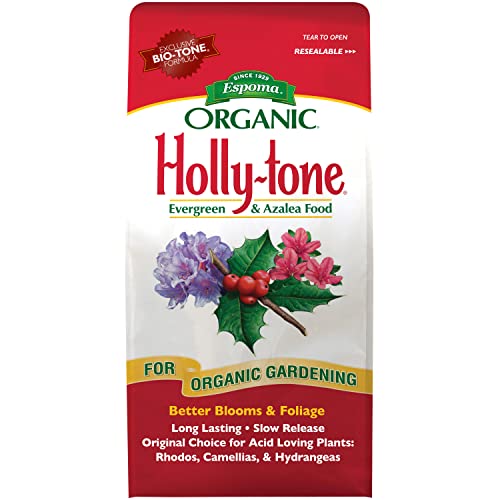
The original slow-release organic that has fed acid-lovers since 1929.
Holly-tone is not new. Espoma has been making this 4-3-4 granular formula for nearly a century, and it is still the reference point for organic slow-release feeding. You get two 4 lb bags — so 8 lbs total — and you apply them in spring and fall only. No mixing, no measuring. Just toss it around the drip line of your azaleas, hydrangeas, rhododendrons, blueberries, or evergreens and water it in.
The secret is the Bio-tone formula, a proprietary blend of beneficial microbes that break down the organics slowly over months. One reviewer whose tree expert recommended it said it “gives trees and shrubs the food they need for year round good health.” A few buyers noted the bag has a strong earthy odor that dissipates after watering, and hydrangea color change took longer than two weeks. Still, blueberries and azaleas showed improvement quickly.
Compared to the True Organic pick below, this one comes in a two-pack of 4 lb bags, making it easier to store and use in stages than one massive 12 lb sack.
Set-and-Forget
- Apply only in spring and fall for full-season feeding
- Organic and OMRI-listed with no sludge or toxins
- Two 4 lb bags are manageable for handling and storage
Slow Start
- Hydrangea color change and results take weeks, not days
- Strong smell for a day or two after application
Reach for it if: You want a hands-off, organic routine for established shrubs and trees.
Look elsewhere if: You are impatient and need to fix yellowing leaves before next weekend.
6. Nelson Acid Loving Plant Food NutriStar 9-13-11 (2 lb.)

The high-phosphorus granular that pushes azaleas into a heavy bloom cycle.
Nelson NutriStar 9-13-11 is built around blooming. The 13 in the middle is phosphorus (the nutrient that drives flower production), and the formula includes four separate acidifying sources and three sources of iron (3.2% total) to keep leaves dark green and healthy. Landscapers have been using Nelson for over 30 years, and the 2 lb bag is concentrated enough to go a long way on azaleas, gardenias, camellias, jasmine, and hydrangeas.
One reviewer from Houston said they “used this product on my Azaeleas… and they look great!” Another described how it revived cold-damaged plants within a week, with blooms that same season. The granules provide an immediate feeding boost plus a slower release from the cottonseed (20%), so you get both speed and endurance. Apply in early spring and then every other month through the growing season.
Where the Jack’s Classic above focuses on pH control via sulfur, this Nelson formula focuses on pushing bloom size and quantity. If you have a gardenia that refuses to flower, this is the granular to try.
Flower-Focused Formula
- High phosphorus (13) and three iron sources for heavy blooms
- Four acidifying sources to lower soil pH
- Cottonseed provides a slow, steady release
Smaller Bag
- 2 lb bag is best for targeted feeding, not large beds
- Requires re-application every other month
Best for flower-lovers: If your main goal is bigger, more abundant blooms on azaleas and gardenias, this formula is dialed in for that.
it’s not for you if: You are feeding a large blueberry patch and need a lower-cost, high-volume bag.
7. True Organic Azalea, Camellia & Rhododendron Food – Organic Fertilizer for Low-pH Plants – 12lb Bag
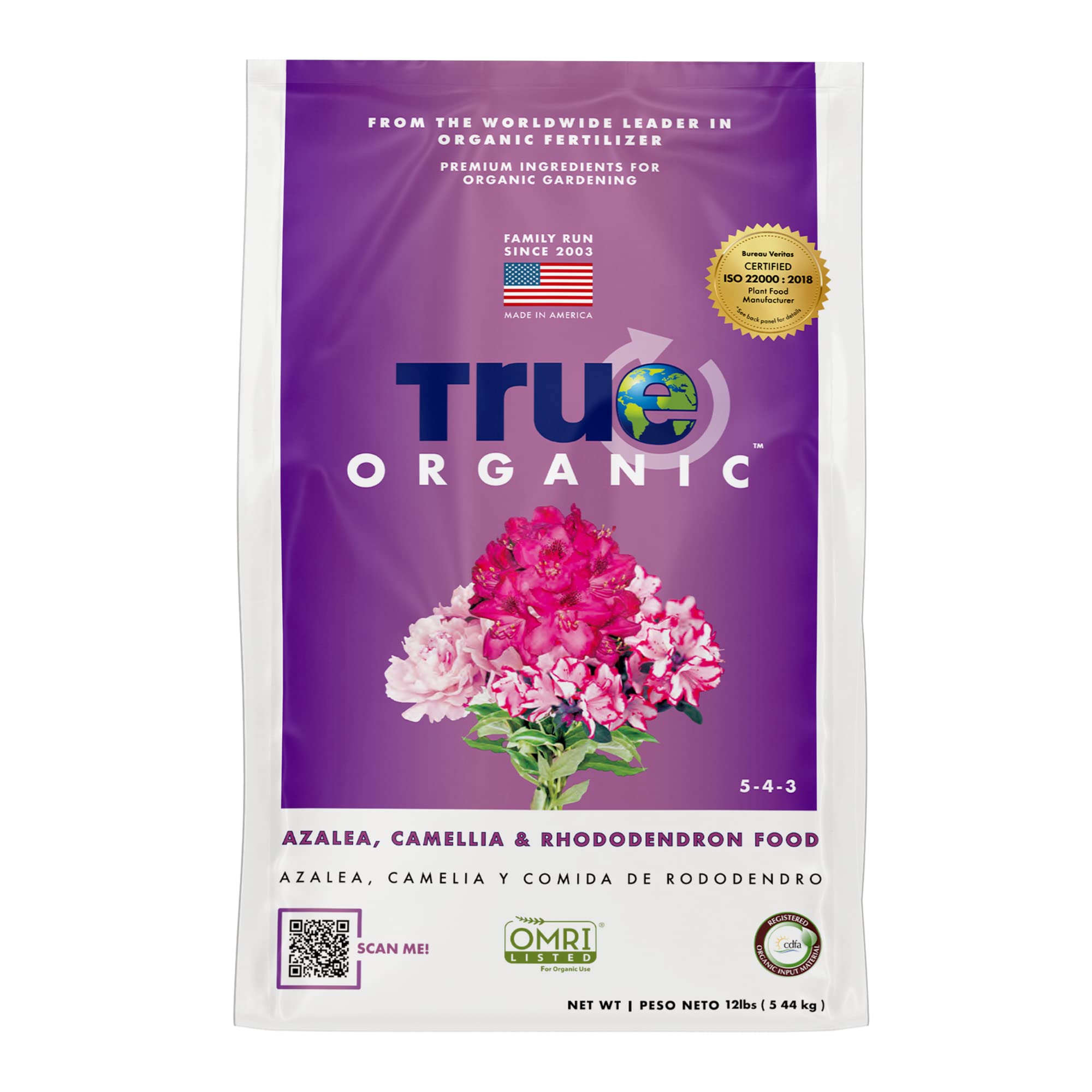
The 12 lb workhorse for organic gardeners with a lot of ground to cover.
With a 12 lb bag, this True Organic formula is the heavyweight on the list in terms of physical volume. The 5-4-3 NPK ratio is gentle and slow, designed for shrubs and trees that you feed twice a year — spring and fall. The 5% soil sulfur content actively lowers the pH of your soil as it feeds, which is critical if you live in an area with naturally alkaline water or soil.
The ingredient list reads like a soil-recipe from a specialty nursery: seabird guano, shrimp and crab shell meal, and other organic inputs. One owner reported that on neglected old raspberry plants, it revived them so they “produce beautiful berries.” Another said their struggling zinnias grew to 4 ft tall with huge blooms within two weeks. The 12 lb bag covers up to 261 sq. ft. according to the maker, so it is truly for larger beds or multiple shrub plantings.
Compared to the Espoma Holly-Tone, which comes in two 4 lb bags, this one bag of True Organic weighs 12 lb compared to the Espoma’s 8 lb total — better for one-shot coverage but requires more storage space.
Large Coverage
- 12 lb bag covers up to 261 sq. ft. per the maker
- Contains 5% sulfur to naturally lower soil pH
- Twice-yearly application schedule
Heavy Bag
- 12 lbs is cumbersome to carry and store for small spaces
- Slow-release formula requires patience for results
Reach for it if: You have a large organic bed or multiple shrubs and want a single-bag solution for the whole season.
Look elsewhere if: You only have a couple of potted plants and do not want to store a 12 lb bag.
Understanding the Specs
N-P-K Ratio
Those three numbers stand for nitrogen (leaf growth), phosphorus (root and flower development), and potassium (overall plant health and disease resistance). A high first number, like the 17 in Jack’s Classic, pushes green leaves fast. A high middle number, like the 13 in Nelson’s NutriStar, encourages heavy blooms. Acid-loving plants generally need less nitrogen than your lawn, so moderate ratios like 8-4-8 or 5-4-3 are common.
Water-Soluble vs. Granular
Water-soluble powders (like Miracle-Gro and Jack’s Classic) dissolve in water and feed the plant almost immediately through the roots or leaves. Granular formulas (like Espoma Holly-Tone and True Organic) rely on soil moisture and microbes to break down the nutrients slowly. If you have container plants or need fast correction of yellow leaves, a soluble powder is your best bet. For in-ground shrubs you want to maintain all season, slow-release granules save you time.
FAQ
Can I use acid loving plant food on all my garden plants?
How often should I apply acid loving plant food?
Will this fertilizer turn my hydrangeas blue?
Can I use it on potted plants and containers?
What is the difference between organic and synthetic acid fertilizers?
Why do acid-loving plants need iron and sulfur?
Is it safe around pets and children?
How do I know if my soil is too alkaline for acid-loving plants?
Can I mix acid plant food with water in a hose-end sprayer?
What happens if I use too much acid loving plant food?
Final Thoughts: The Verdict
For the majority of shoppers, the best acid loving plant food winner is the Miracle-Gro Azalea, Camellia, Rhododendron Plant Food because it combines fast results, an enormous 80 oz bag, and a price that undercuts the competition — making it the sensible choice for anyone who wants to see greener leaves and more blooms within a week. If you need precise pH control for blueberry bushes, grab the Jack’s Classic 17-6-6 Acid Special. And for strict organic gardening with pet-safe ingredients, the Dr. Earth Acid Lovers Fertilizer is the cleanest pick on the shelf.
How We Picked
We do not accept paid placement. Every pick is matched to a real buyer and a real use-case; we do not hands-on test units.
Sources & Methodology
Specifications: manufacturer listings and product documentation. Review insights: verified customer reviews, as of July 2026. Pricing: not shown on this page (it changes often); check the current price via the retailer link.
As an Amazon Associate, Lawn Gear Lab earns from qualifying purchases. This does not affect which products we feature.