
Specs are compiled from manufacturer listings and verified buyer reviews and can change over time — please confirm the key details on the product page before buying.
Your gardenia’s leaves turn yellow because the soil pH is wrong or it is missing key nutrients. An acid fertilizer — a plant food designed for acid-loving (acidic-soil-preferring) plants — fixes that pH balance so your gardenia can access the iron and magnesium it needs to stay green and bloom.
This guide uses the manufacturers’ published specifications and patterns from verified customer reviews to show you each pick’s real strengths and trade-offs.
The guide covers the top acid fertilizer for gardenias in liquid, granular, and water-soluble forms.
Our Picks at a Glance

How To Choose The Best Acid Fertilizer For Gardenias
Gardenias need a soil pH (a measure of acidity or alkalinity) between 5.0 and 6.0. A standard balanced fertilizer can lock up the iron and magnesium your gardenia needs, causing yellow leaves and weak blooms. Choosing the right acid fertilizer depends on a few key decisions.
Form: Liquid vs Granular vs Water-Soluble
Liquid fertilizers (like the HiThrive and TPS Nutrients options) act fast — you often see greener leaves within a week or two. They are ideal for potted gardenias and for fixing a nutrient deficiency quickly. Granular fertilizers (like SouthernGRO and Espoma) release nutrients slowly over weeks. They require less frequent application and work well for garden beds. Water-soluble powders (like Miracle-Gro) sit in the middle: you mix them with water for a quick drink, but you apply every 7-14 days.
NPK Ratio: What the Numbers Mean
The three numbers on a fertilizer bag (nitrogen-phosphorus-potassium, the three main nutrients plants need) tell you what the plant gets. For gardenias, you generally want a higher middle number (phosphorus) to encourage blooms. A ratio like 04-08-08 puts the emphasis on flowers and roots. A balanced 5-4-4 or 4-3-4 is fine for general health and leaf growth. Avoid anything very high in nitrogen unless your plant is severely yellow and needs a green-up first.
Organic vs Synthetic
Organic fertilizers (like Dr. Earth and Espoma) feed the soil microbes as well as the plant. They are slower but gentler — less risk of burning roots. They are also pet-safe if you have dogs that dig. Synthetic fertilizers (like Miracle-Gro) give faster, more predictable results but need careful measuring. If you want an OMRI-listed (Organic Materials Review Institute, a third-party certification for organic inputs) or Non-GMO Verified option for an edible garden, organic is the path.
Quick Comparison
| Model | Best For | Form | NPK Ratio | Unit Count | Amazon |
|---|---|---|---|---|---|
| Miracle-Gro Water Soluble Azalea, Camellia, Rhododendron Plant Food★ Best Overall | Fast-acting water-soluble feed | Powder | Not listed | 80.0 Ounce | Amazon |
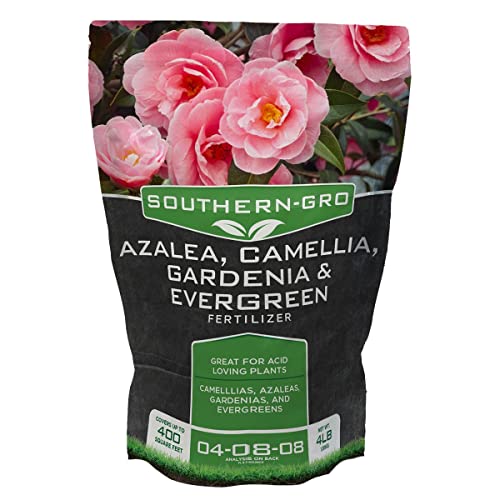
| SouthernGRO Azaleas, Camellia, Gardenia Fertilizer 04-08-08Best Value | Granular bloom booster for beds | Granules | 04-08-08 | 64.0 Ounce | Amazon |
| HiThrive 16oz Gardenia Fertilizer | Quick liquid fix for yellowing gardenias | Liquid | Not listed | 16.0 Fluid Ounces | Amazon |
| Dr. Earth Acid Lovers Azalea, Camellia, Rhododendron & Maple Fertilizer | Organic, Non-GMO project verified | Granules | Not listed | Not listed | Amazon |
| True Organic Berry Food | Organic feeding for acid-loving plants | Granules | 5-4-4 | 4 Pounds | Amazon |
| Espoma Organic Holly-Tone 4-3-4 | Trusted organic slow-release, 2-pack value | Granules | 4-3-4 | 128.0 Ounce | Amazon |
| TPS Nutrients Gardenia Fertilizer 32 oz | Liquid nutrition for gardenias in pots | Liquid | Not listed | 32.0 Fluid Ounces | Amazon |
In‑Depth Reviews
1. Miracle-Gro Water Soluble Azalea, Camellia, Rhododendron Plant Food, 5 lb.
Our pick — over 4.5★ from 600+ verified ratings; the strongest balance of quality and price.
A 5-pound (80.0-ounce) powder bag that works for gardenias, azaleas, and hydrangeas — you get the most feedings per dollar here.
Gardenias, azaleas, camellias, rhododendrons, hibiscus, hollies, hydrangeas, and orchids all get the right balanced nutrients from this one scoop. The water-soluble powder dissolves completely in water — mix at a 1:144 ratio (about 1/2 teaspoon per gallon) for indoor plants, or a 1:18 ratio for outdoor ones. Apply every 7-14 days with a watering can or a Miracle-Gro Garden Feeder. One reviewer wrote, “This truly helped our rhododendron to recover and look stunning this summer.”
The bag holds 80.0 ounces (5 pounds) — at 80.0 ounces (5 pounds) versus the HiThrive at 16.0 fluid ounces (1.2 pounds) and the SouthernGRO at 64.0 ounces (4 pounds). Buyers report the resealable Velcro bag seals well as long as no powder gets on the strip. The catch is you must mix and apply it every 7-14 days, unlike a slow-release granule you just sprinkle once. If you own a single small potted gardenia and want a ready-to-use liquid, the HiThrive is more convenient.
Why It Leads
- 5 lb bag (80 oz) feeds many plants — best value per use
- Dissolves completely, easy to measure
- Safe for a wide range of acid-loving plants
One Trade-Off
- Requires mixing and biweekly application
Reach for this if: you have multiple acid-loving plants (gardenias, azaleas, hydrangeas, blueberries) and want a single water-soluble feed that covers them all.
Look elsewhere if: you only have one small potted gardenia and prefer a ready-to-use liquid with no mixing.
2. SouthernGRO Azaleas, Camellia, Gardenia Fertilizer 04-08-08 – 4lb Bag
The 04-08-08 NPK ratio (nitrogen-phosphorus-potassium) puts phosphorus first — that means more blooms and stronger roots, not just leaves.
If your gardenias have plenty of green leaves but few flowers, this 4lb bag of granules delivers the higher middle number (phosphorus) that encourages root development and flower production. You simply sprinkle it around the root system of your azaleas, camellias, gardenias, and evergreens — no mixing, no measuring cups. Owners mention the “best display of flowers this year” for their plants. One reviewer noted it was “easy to apply.”
The 4 lb bag has the same weight as the True Organic option, but its 04-08-08 ratio targets blooms more aggressively than the balanced 5-4-4 or 4-3-4 ratios. The catch is it is not organic certified or OMRI-listed (a third-party organic seal). For organic gardeners, the Dr. Earth or Espoma picks are better. If you want added micronutrients beyond the basic NPK, look at the HiThrive liquid instead.
What Works
- 04-08-08 ratio targets blooms and roots specifically
- No mixing — sprinkle and water
- Affordable price for a 4lb bag
The Limit
- Not organic certified or OMRI-listed
Perfect for: gardenia owners who just want more flowers and do not need an organic label.
Not ideal for: organic gardeners or those who want a feed with added micronutrients beyond the basic NPK.
3. Dr. Earth Acid Lovers Azalea, Camellia, Rhododendron & Maple Fertilizer 4 lb

It is the only Non-GMO Project Verified fertilizer in the U.S., made for acid-loving plants with zero synthetic chemicals.
This granular fertilizer is handcrafted from human and feed-grade ingredients, according to the manufacturer — no synthetic chemicals, no GMO-infested chicken manure, and no toxic ingredients. It holds certifications from OMRI (Organic Materials Review Institute), OIM (Organic Input Material), CCOF (California Certified Organic Farmers), and the Non-GMO Project. The blend includes multi-minerals, proteins, carbohydrates, humic acids (naturally occurring compounds that improve soil structure and nutrient uptake), and trace elements that build healthy soil as well as feeding the plant.
One buyer applied it to a rhododendron that had not bloomed in two years and reported: “bam! It sprang to life and was covered with huge pink flowers in no time.” Another said it got their gardenia blooming “the best it ever has.” The catch — this organic granular works more slowly than liquid synthetics, so you should expect results over weeks, not days. If you need a fast emergency green-up for yellowing leaves, the HiThrive liquid is faster. For pet owners worried about digging dogs, the Dr. Earth formula is designed to be pet-safe.
The High Points
- Non-GMO Project Verified — the only one in the U.S.
- Pet-safe formula, no synthetic chemicals
- Enriched with humic acids and trace minerals
The Slow Side
- Slower visible results compared to synthetic liquids
Best suited for: organic gardeners and pet owners who want a Non-GMO Verified, soil-building feed for gardenias and other acid-loving shrubs.
Skip if: you need a fast, immediate green-up and are comfortable with synthetic fertilizers.
4. HiThrive 16oz Gardenia Fertilizer – Makes 96 Gallons
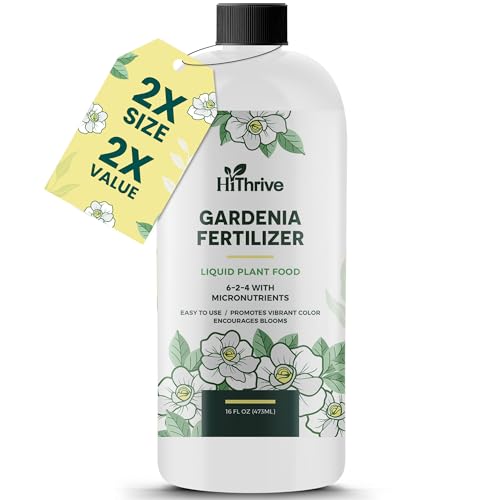
The 16oz liquid reverses yellow leaves in days — customers note green-up in 10 days — and makes 96 gallons of mixed feed from one bottle.
When your gardenia leaves turn yellow, you want a rescue, not a wait. This liquid fertilizer from HiThrive is packed with nitrogen (for leaves), phosphorus (for blooms), and potassium (for stress resilience), plus a full micronutrient suite including calcium, magnesium, iron, copper, manganese, and zinc. At the standard feed rate, mix 1 teaspoon (half a capful) per gallon of water and apply every watering. For a deficiency fix, use 2 teaspoons (one capful) per gallon. It also works on hydrangeas, azaleas, rhododendrons, camellias, and jasmine. One buyer mentioned: “They went from yellow to green in 10 days.”
The catch is its weight — at 1.2 pounds, this bottle is much lighter than the 5-pound Miracle-Gro bag. So you trade total volume for convenience and speed. If you want a large-volume, budget-friendly option for many plants and do not mind mixing powder, the Miracle-Gro offers more feedings per dollar. But if your gardenia looks sick right now, this liquid gives you visible results faster than any slow-release granule.
Why It Wins
- Fast green-up — yellow to green in 10 days per buyer reports
- Easy measuring: 1 teaspoon per gallon
- Includes full micronutrient blend (calcium, iron, zinc, etc.)
The Trade-Off
- Only 16 fl oz total — less bulk value than powders
Grab this if: your gardenia has yellow leaves right now and you want a quick liquid fix with visible results in 10 days.
Pass if: you want a large-volume, budget-friendly option for many plants and don’t mind mixing powder.
5. Espoma Organic Holly-Tone 4-3-4 Evergreen & Azalea Plant Food, 4 lb. Pack of 2
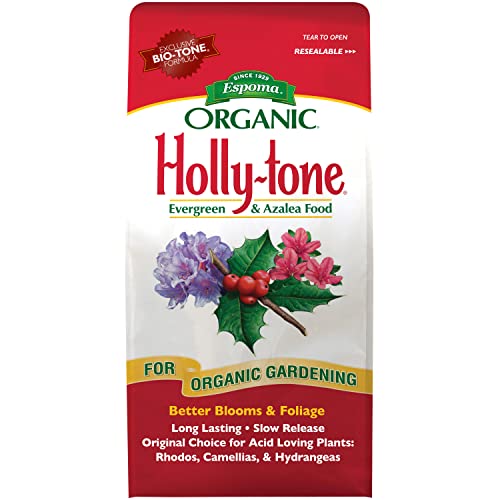
Two 4-pound bags (128 ounces total) of the original 1929 organic formula, with 5% sulfur to naturally lower soil pH.
Holly-tone has been a trusted name since 1929. This pack of two 4-pound bags gives you 128 ounces total — the largest unit count in this lineup. The 4-3-4 formula includes 5% sulfur to help lower soil pH naturally. It is enhanced with Espoma’s exclusive Bio-tone formula, a blend of beneficial microbes that help roots absorb nutrients more effectively. Apply in spring and fall: sprinkle it around the drip line (the edge of the plant’s leaf canopy) of the plant and water it in — no mixing required. One owner reported, “I have been using this on shrubs for years, it works really well.”
This is approved for organic gardening and registered as an Organic Input Material. The catch — one bag covers only a medium area, so you may need the full 2-pack for a garden with multiple large shrubs. Unlike the HiThrive liquid, it works slowly over weeks rather than days. If you only have one small gardenia, a 4lb single bag from Dr. Earth or the HiThrive liquid is better suited.
The Strengths
- 128 oz total — the largest volume in this guide
- Organic, OMRI-registered, and Bio-tone enhanced
- Slow, steady feed with only spring/fall application
The Weakness
- Slow-release — not for emergency yellow-leaf fixes
Choose this for: large gardens with many acid-loving shrubs that need a reliable, low-maintenance organic feed twice a year.
Avoid if: you only have one small gardenia and don’t need a 2-pack worth of fertilizer.
6. True Organic Berry Food – Organic Fertilizer for Acid-Loving Plants – 4lb Bag

A 5-4-4 organic blend made from seabird guano and shellfish meal — it feeds gardenias and doubles as a berry booster in one bag.
True Organic Berry Food is made from seabird guano (the accumulated droppings of seabirds, rich in nitrogen and phosphorus), shrimp and crab shell meal (a natural source of calcium and chitin), and other natural ingredients. The 5-4-4 ratio provides a balanced feed for acid-loving plants, with sulfur included to naturally lower soil pH and improve micronutrient availability. It works for both in-ground garden beds and container plants. Apply monthly during the growing season; one 4lb bag covers up to 58 square feet. One customer observed their zinnias “are pushing 4 feet tall, with the biggest blossoms ever.”
At 4 pounds, it has the same weight as the SouthernGRO bag but a higher nitrogen content (5 vs 04), making it better for general green growth rather than solely blooms. The catch is the smell: because it contains seabird guano and shellfish meal, it has an earthy, ripe odor — a natural byproduct, not a defect. It is also not specifically labeled for gardenias, though it works if you check the pH. If you are sensitive to strong natural odors, the Dr. Earth or Espoma granules have a milder scent.
The Upside
- Rich organic ingredients (seabird guano, crab shell meal)
- Sulfur helps lower soil pH naturally
- Covers 58 sq ft — good for garden beds
The Downside
- Strong natural smell from fish and shellfish ingredients
Great for: organic gardeners who want a multi-purpose acid fertilizer for gardenias, berries, and ornamental flowers in one bag.
Not for: anyone sensitive to natural earthy/fishy odors or who needs a gardenia-specific NPK ratio.
7. TPS Nutrients Gardenia Fertilizer – Liquid Plant Food for More Blooms, 32 oz

At 32 fluid ounces, this is the largest liquid bottle in this guide — 32 fluid ounces — with a 1:128 mixing ratio designed for gardenias.
TPS Nutrients formulated this liquid fertilizer explicitly for gardenias, camellias, and rhododendrons. The mixing ratio is 1:128 — that is 1 ounce of fertilizer per gallon of water — so one bottle goes a long way. It is designed to support green foliage, steady flower development, and stronger root growth in both garden beds and containers. One user highlighted, “My gardenia is now healthy again, and it has already bloomed twice with beautiful flowers.” Another noted that after pruning dead leaves and using this fertilizer, “I had blooms and quite a bit of new foliage in just a week.”
The 32 oz volume per bottle is twice the 16 oz HiThrive option, so you pay more upfront but get more feedings. The catch — some buyers reported leaking during shipping due to a loose seal, so check the seal when it arrives. The price sits at the premium end of this list. If you are on a tight budget or prefer a granular slow-release that requires less frequent application, the SouthernGRO or Espoma granules are better choices.
What Stands Out
- 32 fl oz — largest liquid volume in this guide
- 1:128 mixing ratio extends the bottle’s value
- Made in the USA for gardenias specifically
Watch Out
- Shipping leaks reported — check seal on arrival
- Premium price compared to smaller liquids
Pick this for: dedicated gardenia owners who want a large, ready-to-use liquid with a gentle mixing ratio that keeps feeding for weeks.
Skip if: you are on a tight budget or prefer a granular slow-release that requires less frequent application.
Understanding the Specs
NPK Ratio
The three numbers tell you the fertilizer’s nutrient balance. The first number is nitrogen (N), which drives leaf and stem growth. The second is phosphorus (P), which supports root development and flower production. The third is potassium (K), which helps overall plant health and stress tolerance. For gardenias, look for a higher middle number (like 04-08-08) if you want more blooms, or a balanced ratio (like 4-3-4 or 5-4-4) for general health.
Unit Count vs Item Weight
These two numbers are different. Unit count is the total volume of the product — for example, 80.0 Ounce for the Miracle-Gro powder means the bag holds 80 fluid ounces of powder by volume. Item weight is how heavy the package is, like 5 Pounds. A higher unit count usually means more feedings per bag, but a liquid (like 16 fl oz) will have a lower item weight than a powder (5 lb) while still making many gallons of mixed feed.
FAQ
How often should I fertilize gardenias with an acid fertilizer?
Can I use a regular all-purpose fertilizer on gardenias?
What NPK ratio is best for gardenia blooms?
Liquid vs granular acid fertilizer — which is better for gardenias?
How long does it take to see results from an acid fertilizer?
Will an acid fertilizer for gardenias also work on hydrangeas and azaleas?
Is organic or synthetic acid fertilizer better for gardenias?
How do I apply granular acid fertilizer to my gardenia?
Can acid fertilizer burn my gardenia if I use too much?
Does acid fertilizer lower soil pH permanently?
Final Thoughts: The Verdict
For the majority of shoppers, the best acid fertilizer for gardenias is the Miracle-Gro Water Soluble Azalea, Camellia, Rhododendron Plant Food because it combines a huge 5-pound bag, fast results, and compatibility with nearly every acid-loving plant you might own. If you want a fast liquid fix for a struggling gardenia with yellow leaves, go with the HiThrive 16oz Gardenia Fertilizer. And for organic gardeners who want a Non-GMO Verified, pet-safe feed that builds soil health, the Dr. Earth Acid Lovers Fertilizer is the clear choice.
How We Picked
We do not accept paid placement. Every pick is matched to a real buyer and a real use-case; we do not hands-on test units.
Sources & Methodology
Specifications: manufacturer listings and product documentation. Review insights: verified customer reviews, as of July 2026. Pricing: not shown on this page (it changes often); check the current price via the retailer link.
As an Amazon Associate, Lawn Gear Lab earns from qualifying purchases. This does not affect which products we feature.