
Orchids are epiphytes — they naturally cling to tree bark with their roots exposed to the air. Stuffing those roots into a solid, non-ventilated pot is a fast track to root rot, suffocation, and a drooping crown. A proper 4-inch orchid pot solves this by combining ample drainage, side ventilation slots, and a transparent body so you can actually see when the roots need water before they turn to mush. Choosing the wrong one means you are fighting the plant’s biology from day one.
I’m Rikta — the co-founder and writer behind Lawn Gear Lab. I’ve spent countless hours cross-referencing material science specs, slot geometry, and thousands of aggregated owner reports to bring clarity to this narrow but critical category.
This guide ranks the best construction types, ventilation designs, and material choices so you can confidently select the right 4 inch orchid pots for your specific growing conditions and root health goals.
How To Choose The Best 4 Inch Orchid Pots
A 4-inch orchid pot is a targeted tool for a specific growth phase — repotting a young Phalaenopsis, giving a miniature Dendrobium a new home, or transitioning a division into its own space. Choosing incorrectly can stall root development or trap moisture against the crown. Here are the key factors to evaluate.
Ventilation Geometry: Slots vs. Holes
Not all ventilation is created equal. Slotted side walls — vertical cuts running up the sides — provide continuous air exchange along the entire root zone. Individual round holes offer more localized airflow concentrated where the hole is punched. For orchids that are sensitive to stagnant air, slotted designs encourage roots to grow outward and anchor better. Pots with holes alone can still work, but the medium must be chunky enough that fine bark pieces don’t escape through 3mm openings.
Material Physics: Plastic vs. Terracotta vs. Ceramic
Clear polypropylene plastic lets light reach the roots (photosynthetic roots benefit from this) and makes moisture checks visual rather than tactile. Terracotta is naturally porous, wicking moisture away from the root zone, which helps prevent overwatering but means you must water more frequently. Glazed ceramic looks refined but is non-porous, so drainage relies entirely on the holes — make sure those holes are generous. Each material changes the drying cadence of your bark mix, so match it to your watering habits.
Bottom Drainage and Saucer Integration
A single center hole is insufficient. Look for multiple bottom drainage channels or a grid of small holes. The saucer should fit snugly but allow airflow between the saucer rim and the pot base — if the pot sits directly in collected water, capillary action can wick moisture back up into the root zone. A raised or ribbed bottom helps break that siphon.
Pot Height-to-Diameter Ratio
Standard 4-inch pots often measure 3.5 to 4 inches in height. Taller ratios suit orchids with deeper root systems like Dendrobiums, while shorter, wider profiles work better for compact, clumping growth. A pot that is too tall with a 4-inch diameter can leave the lower medium soggy while the top dries out. Look at the actual height dimension, not just the top diameter.
Quick Comparison
On smaller screens, swipe sideways to see the full table.
| Model | Category | Best For | Key Spec | Amazon |
|---|---|---|---|---|
| rePotme 4 inch Crystal Clear | Premium Plastic | Ultimate airflow for healthy roots | Slotted side walls with UV protection | Amazon |
| vensovo Terracotta 4 Inch | Natural Clay | Wicking moisture control | Baked at 1796°F, multiple side holes | Amazon |
| Blumiger Ceramic 4 Inch | Glazed Ceramic | Aesthetic display piece | 5.9 inch height, crack-resistant body | Amazon |
| T4U 4.3 Inch Clear Set | Mid-Range Plastic | Volume 6-pack with saucers | 360° drainage with 3mm side slots | Amazon |
| YOPIKUU 3-6 Inch Multi-Pack | Assorted Plastic | Multiple size grading | Upgraded slot shape, 8 pots total | Amazon |
| DUNPUTE 4 Inch Clear | Budget Plastic | High volume for propagation | 0.85 gallon capacity per pot, 20-pack | Amazon |
| WSMKSZ 4 Inch Clear 30-Pack | Budget Plastic | Starter seedling pots en masse | Flexible side walls for root removal | Amazon |
In‑Depth Reviews
1. rePotme 4 Inch Crystal Clear Slotted Pots

The rePotme pots use a continuous vertical slot design that runs from the upper third of the pot to the base, providing uninterrupted air exchange across the entire root profile. This geometry encourages roots to spread laterally and anchor themselves, rather than circling inside the pot. The UV-stabilized polypropylene resists yellowing and brittleness even when exposed to bright windowsill light for extended periods.
Each pot measures a true 4 inches across the top with a height of roughly 4 inches, making it suitable for mini-Phalaenopsis, Oncidium seedlings, or compact Dendrobiums. The included mini butterfly clip and care tag are thoughtful touches for gifting, but the real value lies in the heavy-gauge plastic — owners consistently report these lasting through multiple repotting cycles without cracking.
The design is optimized for use as an inner cachepot: slide it inside a decorative ceramic or metal cover pot while retaining full airflow. Because the slots extend to the brim, bottom-watering is efficient — the medium wicks moisture evenly without leaving a soggy base. This is the closest you can get to a basket mount in a standard nursery shape.
What works
- Vertical slotted walls promote unmatched lateral root growth.
- UV protection keeps the plastic clear and flexible for years.
- Fits flush inside standard 4-inch cover pots.
What doesn’t
- No integrated saucer — you must buy separately or use as cachepot.
- Premium price for a 6-pack compared to generic nursery pots.
2. vensovo 4 Inch Terracotta Orchid Pots
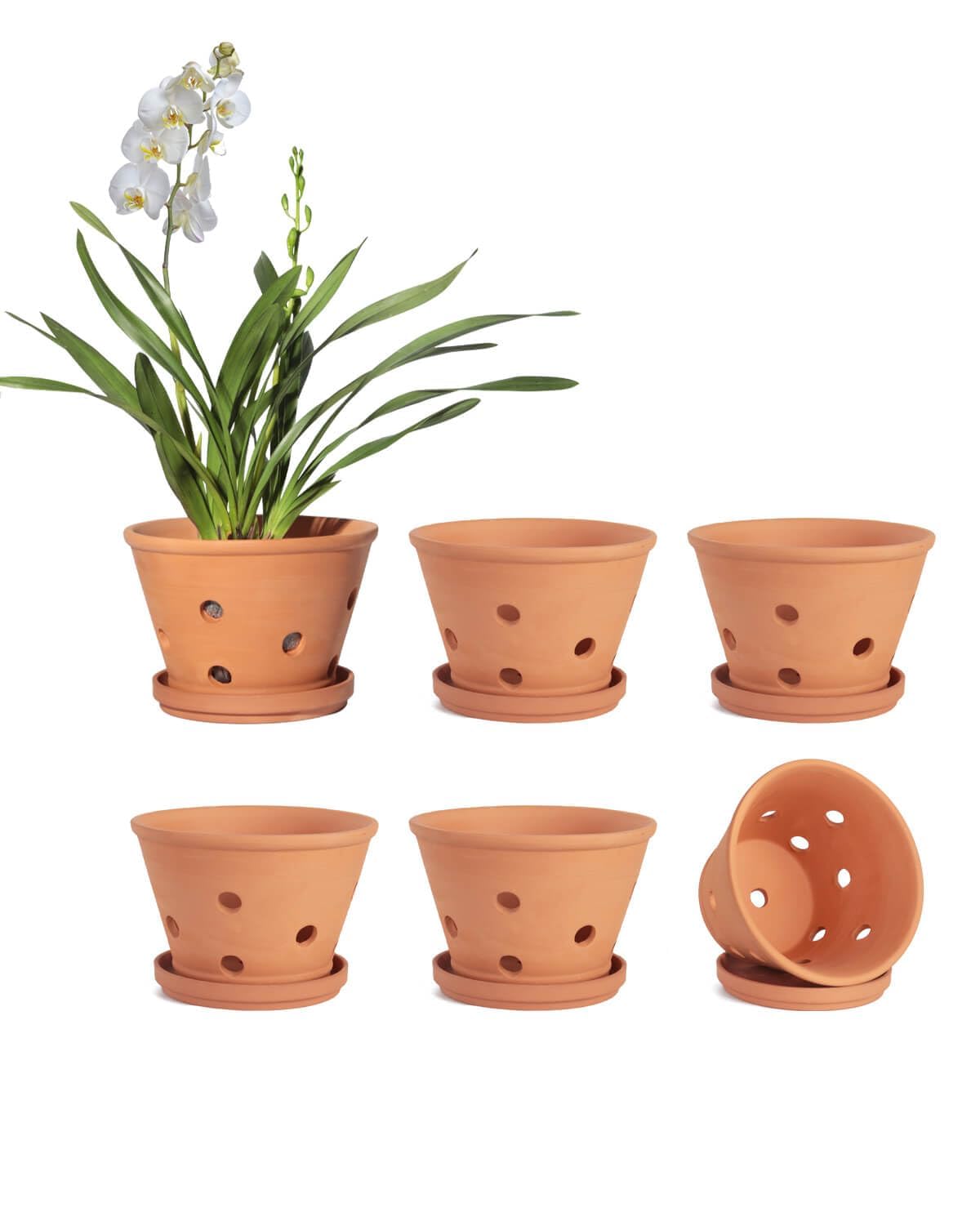
Terracotta fired at 1796°F creates a micro-porous structure that pulls moisture laterally from the medium and evaporates it through the clay walls. The vensovo pots combine this natural wicking property with four rows of drilled side holes, creating a hybrid aeration system. The result is a faster wet-dry cycle that suits growers who tend to overwater or who live in humid climates where bark stays damp too long.
Each pot has an outer diameter of 4 inches and a bottom diameter of 2.5 inches — a slight taper that prevents the pot from trapping roots in a straight cylinder. The included saucer has a raised center ridge that keeps the pot base from sitting in standing water, a detail many budget terracotta sets miss. Owners praise the packaging: each unit is wrapped individually with foam layers, and the 3-foot drop test certification gives confidence for shipping.
One caveat: the porous clay accelerates drying, so growers using sphagnum moss may need to water every 2-3 days in dry indoor air. For bark mixes, the cadence is more forgiving. A small number of owners reported that certain orchid varieties did not thrive in clay — this typically happens when the plant was previously adapted to constant moisture and struggles with the faster dry-back.
What works
- Natural moisture wicking prevents standing water near roots.
- Excellent packaging virtually eliminates shipping breakage.
- Raised saucer design prevents capillary reabsorption.
What doesn’t
- Frequent watering needed in dry conditions.
- Not suitable for orchids that prefer consistently moist medium.
3. Blumiger Ceramic 4 Inch Orchid Pot
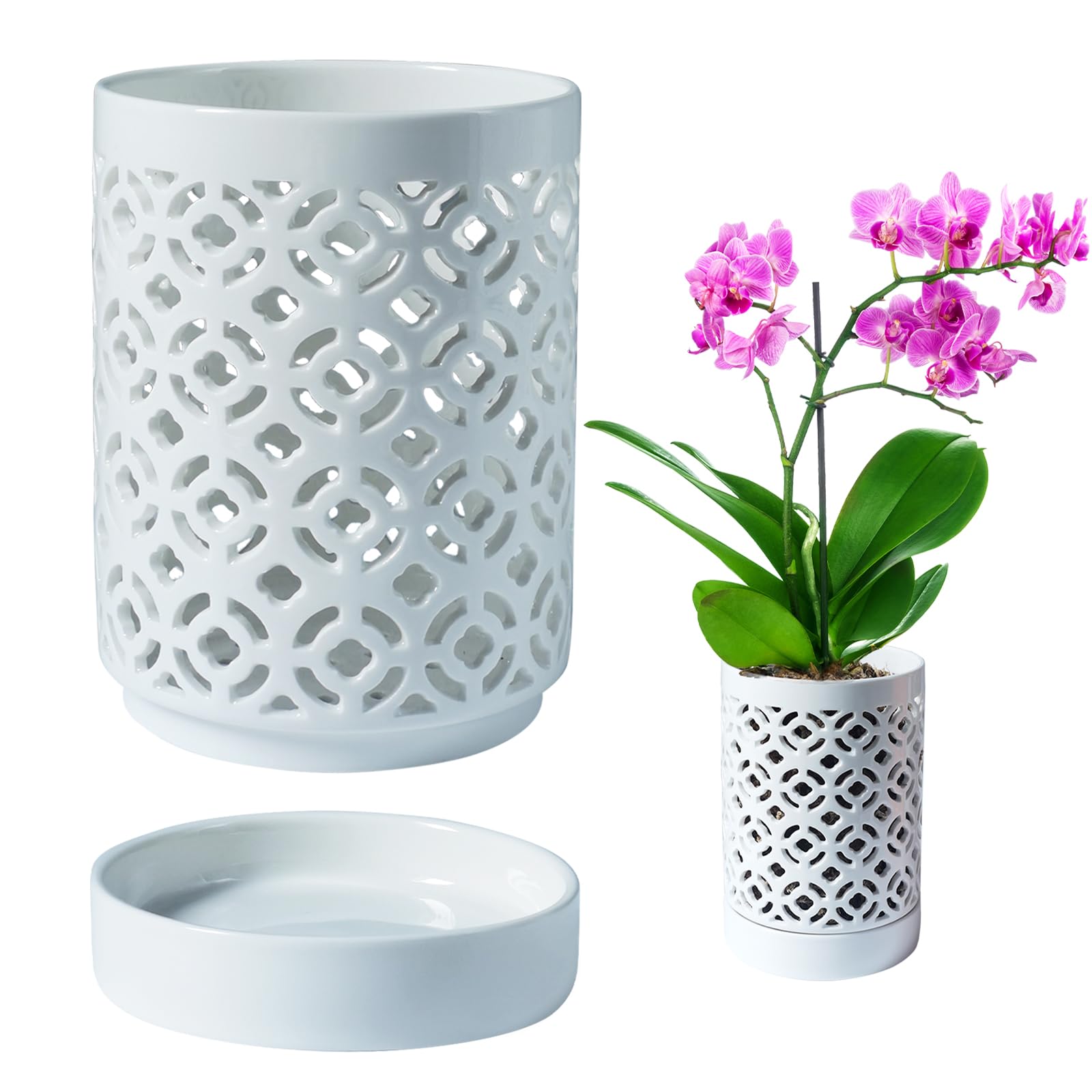
The Blumiger pot prioritizes aesthetics without sacrificing critical drainage. Its glazed ceramic body resists staining and doesn’t wick moisture, so all water movement happens through the bottom hole and the single side ventilation hole. The exterior comes in a clean white plum gloss that blends with modern interior decor.
With a 5.9-inch height and a 4-inch outer diameter, this pot is noticeably taller than standard 4-inch nursery pots. That extra vertical space suits Dendrobiums and other orchids that produce long, fleshy roots that prefer depth over spread. The inner diameter is 3.85 inches, meaning the pot accommodates a root ball up to that width — you’ll need to trim or select a smaller plant if the root mass is wider than that.
A detail worth noting: the saucer is glazed on top but unfinished on the bottom, which can scratch surfaces if slid without a felt pad. Also, some owners found the saucer fit snug — the pot may not sit perfectly level unless adjusted. But for a display piece that transitions from balcony to living room, the build quality justifies the premium price point.
What works
- Tall profile accommodates deep root systems.
- High-gloss glaze resists hard water staining.
- Packaging designed for 1-meter drop test survival.
What doesn’t
- Single side hole offers limited lateral aeration.
- Saucer fit can be uneven; may need shimming.
4. T4U 4.3 Inch Clear Orchid Pots 6-Pack
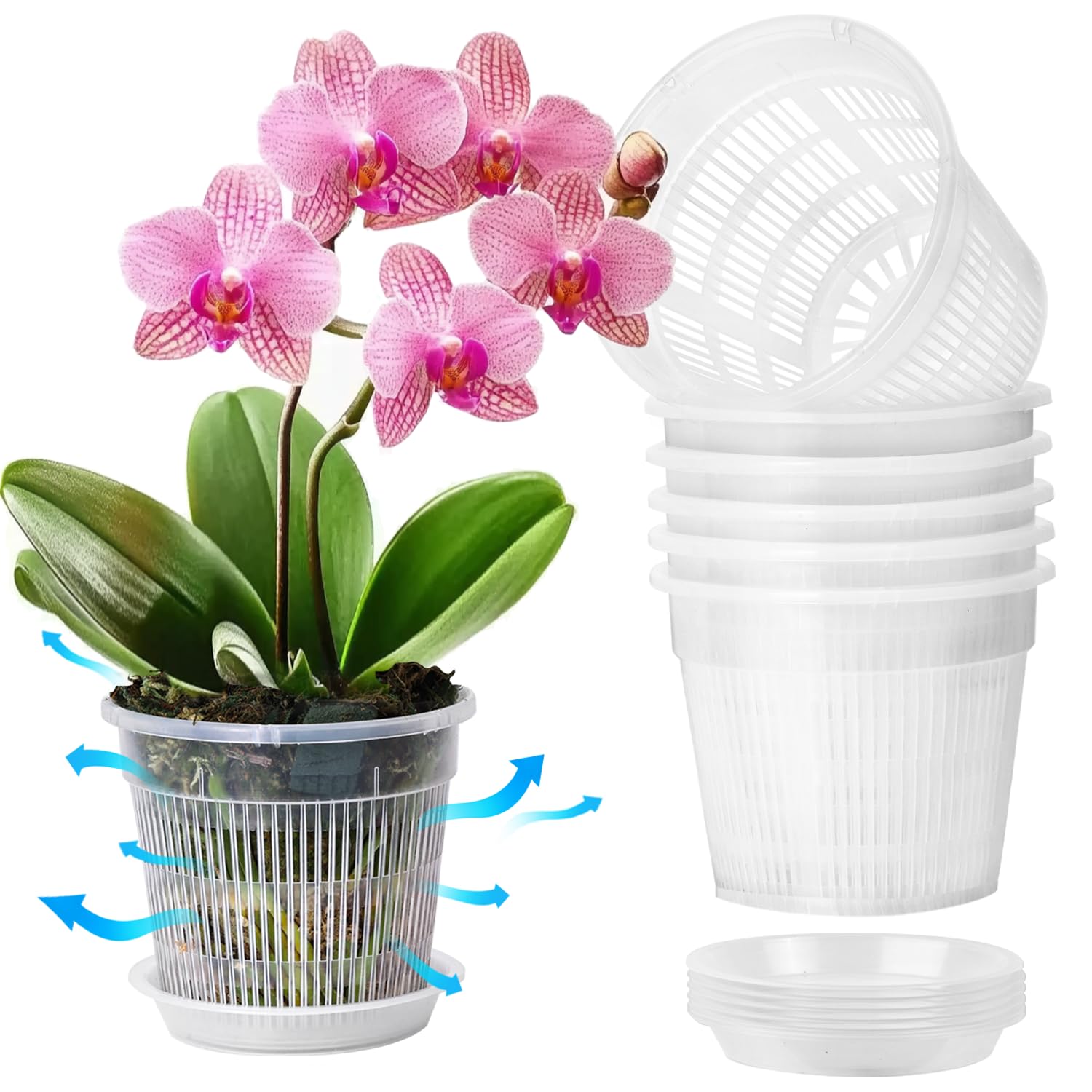
The T4U set offers a complete repotting bundle: six clear pots at 4.3 inches wide with matching saucers that click securely underneath. The side wall is drilled with an array of 3mm-wide drainage holes rather than vertical slots. This geometry works well for medium-grade orchid bark, but fine bark or coir can slip through those openings.
At 3.94 inches tall with a 0.8-liter volume, these pots are slightly wider than they are deep — a shape that favors compact, clumping varieties like Phalaenopsis. The transparent PP plastic allows you to assess root color, moisture level, and medium decomposition without disturbing the plant. Owners frequently mention the sturdiness of the plastic relative to dollar-store nursery pots; the side walls resist flexing even when the medium is fully saturated.
A common workaround for the 3mm holes is to line the bottom with a coffee filter or a layer of larger bark chunks before adding the main medium. The saucers themselves are shallow but effective — they catch runoff from heavy watering without overflowing easily. For growers managing multiple plants simultaneously, the complete set saves the hassle of matching saucers to pots.
What works
- Every pot includes a matching, secure saucer.
- Transparent walls enable immediate root inspection.
- Sturdy PP plastic resists cracking during handling.
What doesn’t
- 3mm side holes allow fine bark to escape.
- Shorter height limits use for deep-rooted orchids.
5. YOPIKUU 3-4-5-6 Inch Orchid Pots 8-Pack

The YOPIKUU set includes pots in four diameters — 3, 4, 5, and 6 inches — with two pots of each size and matching saucers. This diversity lets you grade your orchid collection as plants mature, avoiding the need to buy separate sets for each growth stage. The 4-inch pots in this set stand roughly 2.6 inches tall, making them shorter than dedicated 4-inch-only options.
The manufacturer redesigned the hole shape to reduce medium loss — instead of simple circles, the side holes are slightly elongated slots that retain larger bark pieces better. Owners who switched from generic nursery pots reported that their Dendrobium and Cattleya seedlings produced new root growth within weeks, crediting the improved air exchange. The clear plastic is heavy-duty enough to survive accidental drops without shattering.
On the downside, the saucers are thin and can warp slightly under high heat. And the 4-inch pot’s actual height is about 1.5 inches shorter than a standard 4-inch nursery pot, meaning the potting volume is reduced. If you need a true 4-inch depth for taller root systems, look at taller options. But for a starter kit that covers multiple plant sizes, the value per pot is hard to beat.
What works
- Four different pot sizes in one economical pack.
- Redesigned slots retain medium better than round holes.
- Lightweight but impact-resistant plastic.
What doesn’t
- 4-inch pot height is shorter than standard.
- Saucers are thin and may warp with heat.
6. DUNPUTE 4 Inch Clear Nursery Pots 20-Pack
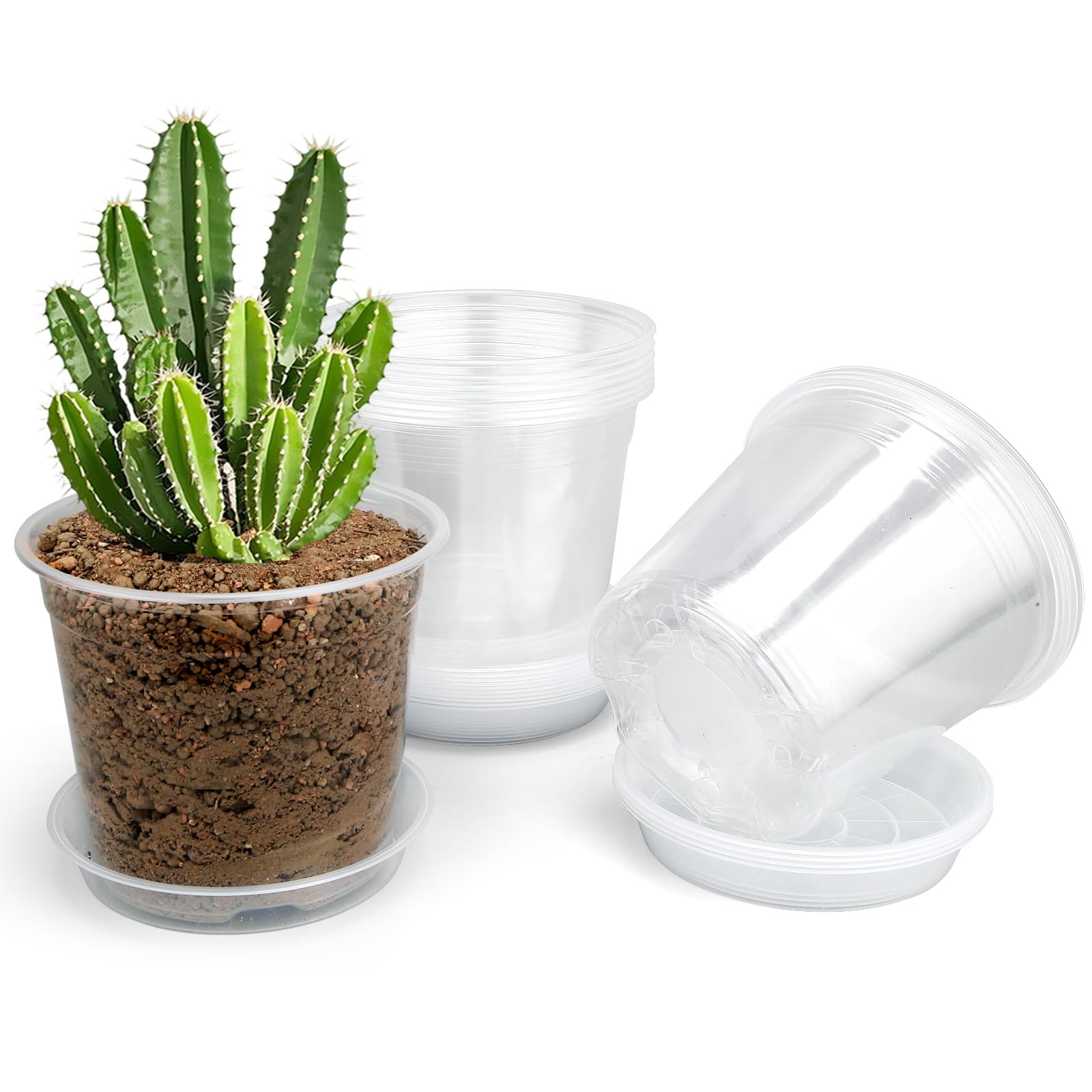
The DUNPUTE pots offer 20 units of 4-inch clear nursery pots with drainage trays — a high-volume solution for semi-hydro setups or large-scale propagation. The plastic is noticeably thicker than commodity nursery pots, with a flexibility that allows you to squeeze the sides to loosen a root-bound plant without tearing the pot. This material choice makes them ideal for converting to LECA or PON culture, where root visibility is critical.
Each pot measures 4 inches across and 3.4 inches tall, providing a 0.85-gallon capacity that suits medium-sized houseplants like peace lilies and snake plants as well as orchids. The bottom drainage holes are spaced widely enough to accommodate a wick for self-watering systems. Owners repeatedly highlight the value — at this price per pot, the cost to replace a broken unit is negligible, making them a low-risk choice for trial experiments with new potting mediums.
One limitation: the included trays are flat and perfectly smooth — water pools rather than wicking away from the pot base. If the pot sits flush against the tray, capillary action can pull water back into the medium. To counter this, many users elevate the pots on a thin layer of gravel or use them exclusively as cachepots with a separate drip tray underneath.
What works
- Thick, flexible plastic resists cracking during repotting.
- 20-pack provides high quantity for bulk propagation.
- Wick-friendly drainage pattern for self-watering systems.
What doesn’t
- Flat trays can trap water against the pot base.
- No side ventilation slots — only bottom drainage.
7. WSMKSZ 4 Inch Clear Nursery Pots 30-Pack
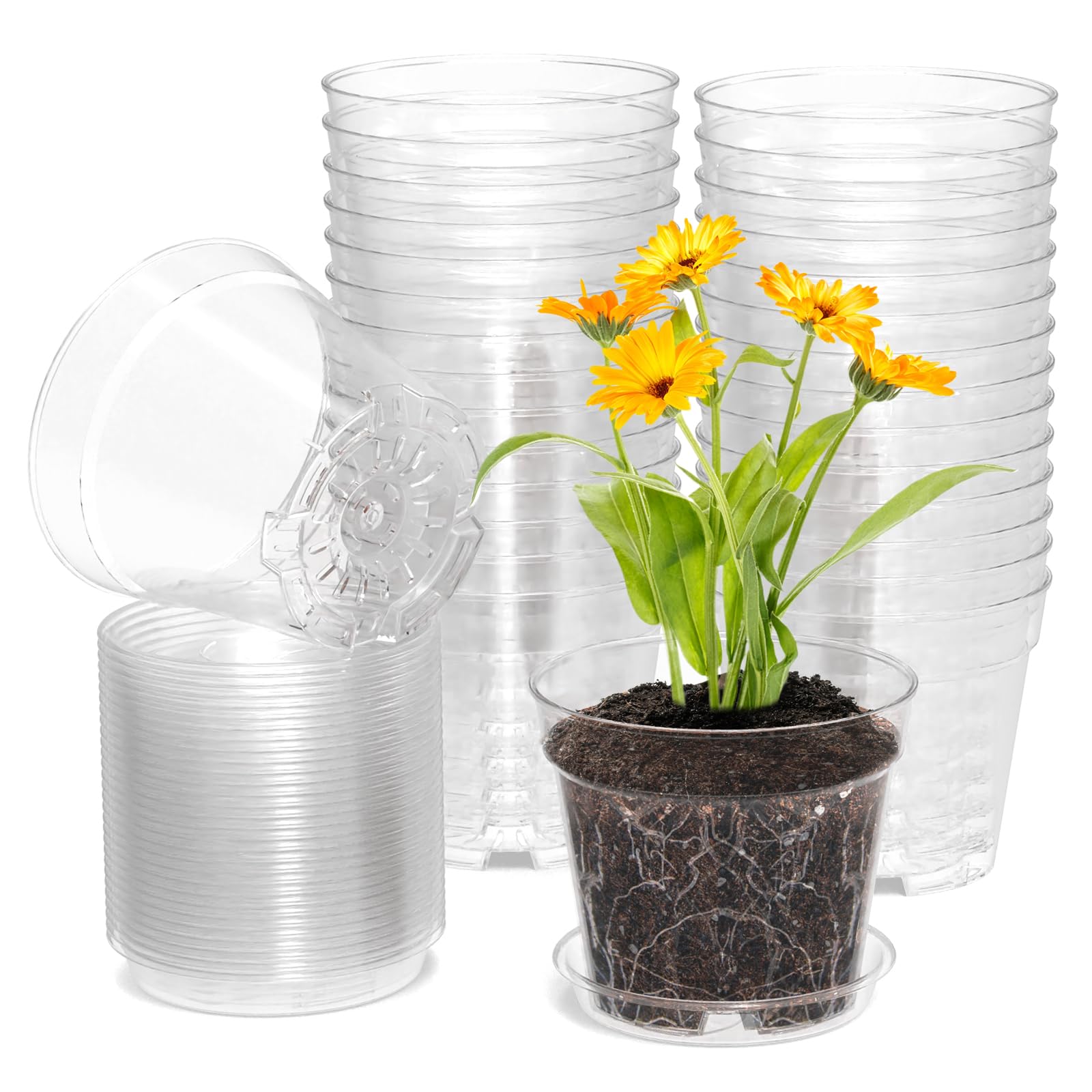
At 30 pots in a single purchase, the WSMKSZ set is the highest-count option for growers who need to move a large number of seedlings or divisions simultaneously. The pots are made from a softer, more flexible plastic than the DUNPUTE set — you can easily collapse the sides to extract a root ball without trauma. This flexibility is a double-edged sword: the pots lack the rigid structure that some growers prefer for top-heavy plants.
Each pot measures 4 inches in diameter but only 3.33 inches tall — notably shorter than the listed 4 inches in the specifications, a discrepancy that several owners flagged. For shallow-rooting plants like spider plant pups or succulent offsets, the reduced height is fine. For orchids developing a deep root system, you may find the root zone cramped. The bottom drainage holes are well-sized and paired with matching trays that fit securely without wobbling.
The value proposition here is raw quantity. If you are starting a collection, running a plant sale, or dividing a large number of keikis, the per-unit cost is the lowest in this comparison. The trade-off is the material softness and the undersized height. For growers who prioritize budget over dimensional precision, this pack delivers usable pots at an entry-level investment.
What works
- Highest pot count per dollar in this comparison.
- Soft walls enable root-safe transplant removal.
- Drainage trays fit securely without movement.
What doesn’t
- Actual height is 3.33 inches, not 4 inches as listed.
- Soft plastic lacks rigidity for top-heavy plants.
Hardware & Specs Guide
Slotted vs. Drilled Ventilation
Vertical slots that run from the upper portion to the base create continuous air channels along the entire root zone, promoting lateral root spread and preventing the stagnant microclimate that can lead to rot. Drilled round holes provide localized aeration at fixed points, which is sufficient for coarse bark mixes but may allow fine medium particles to escape. For orchids that benefit from maximum oxygen exchange — like those in semi-hydro culture — slotted designs are the clear winner. For traditional bark potting, well-placed drilled holes perform adequately if the medium is chunky enough.
Material Thickness and UV Resistance
Polypropylene pots vary wildly in gauge. Thin-walled options (under 1mm) flex easily for root extraction but can crack when stressed by temperature changes or heavy root pressure. Thicker pots (1.5mm+) resist deformation and last through multiple repotting cycles. UV stabilizers prevent the plastic from turning cloudy or brittle when placed on a sunny windowsill — a critical factor if you want to maintain root visibility over time. Terracotta and ceramic pots don’t have UV concerns but are subject to freeze-thaw cracking if left outdoors in cold climates.
FAQ
Should I choose clear plastic or terracotta for a Phalaenopsis?
How do I prevent bark from falling through the side holes?
Final Thoughts: The Verdict
For most gardeners, the 4 inch orchid pots winner is the rePotme Crystal Clear Slotted because its vertical slot design provides unmatched lateral aeration while the UV-stabilized polypropylene maintains clarity for root inspections over years of use. If you want natural moisture management that dries the pot faster and prevents overwatering, grab the vensovo Terracotta Set. And for a budget-friendly bulk option to propagate or divide a large collection, nothing beats the DUNPUTE 20-Pack Clear Nursery Pots.