
Twenty-five-gallon pots are the minimum viable root zone for most semi-dwarf fruit trees, large ornamental shrubs, and heavy-feeding perennials like blueberries or figs. A pot this size resists tipping, holds roughly 3 cubic feet of soil, and forces root structure to develop differently than a smaller container — either toward healthy air-pruning or circling strangulation, depending on the wall material. The choice between nonwoven fabric and coated mesh determines drainage speed, soil temperature, and how many seasons the pot survives before breaking down.
I’m Rikta — the co-founder and writer behind Lawn Gear Lab. I’ve spent dozens of hours comparing 25-gallon pot specifications, studying fabric weights from 200G to 500G, analyzing handle stitch patterns, and cross-referencing actual owner feedback on aeration performance, winter storage, and long-term structural integrity across multiple brands.
This guide breaks down the seven most serious contenders for the best 25 gallon pots for trees, ranking them by build quality, aeration technology, and real-world durability — not sticker price.
How To Choose The Best 25 Gallon Pots For Trees
Twenty-five-gallon tree pots sit at the inflection point where container gardening meets serious permanent-plant housing. Skimping on fabric thickness or handle quality in this size class leads to catastrophic wall failure mid-season — a split pot drops 250 pounds of wet soil and a tree onto the ground. Focus on three variables: material density, handle architecture, and aeration mechanism.
Fabric Weight & Wall Rigidity
Nonwoven fabric in 25-gallon pots ranges from 200G to 500G per square meter. At 200G the walls sag under soil weight after a single season, reducing usable volume and creating dead zones where roots get pinched. 300G is the minimum for multi-year use — the walls stay upright through freeze-thaw cycles and heavy rain. 500G fabric, found on premium options like AC Infinity, approaches the rigidity of plastic nursery pots while retaining breathability. Budget-oriented multi-packs often use 250-280G material that feels crisp out of the package but loses tension within six months of UV exposure.
Handle Stitching & Load Capacity
A filled 25-gallon pot weighs roughly 150 to 200 pounds when dry and over 250 pounds after watering. The handle attachment point is the most stressed structural joint in the entire assembly. Pots with handles that are simply cut from the same fabric layer (common in sub- packs) rip under partial loads. Look for double-stitched, reinforced nylon webbing handles that are sewn onto the body separately. The best designs use a full loop under the pot base or integration into the side seam. A detached handle mid-transport is a disaster for the tree’s root ball.
Air Pruning vs. Standard Fabric Aeration
Standard nonwoven fabric allows lateral air exchange, which drops soil temperature and prevents overwatering, but large-diameter roots can still deflect and circle inside the pot wall. True air-pruning requires a coated mesh structure — a rigid plastic grid with open holes that physically sever root tips when they reach the edge. This forces the plant to produce a dense, fibrous root ball rather than a spiraling knot. For trees that will stay in the pot for multiple growing seasons before transplant, the coated mesh design (exemplified by Rain Science) prevents the root-bound condition that eventually strangles the plant. Pure fabric pots work fine for annual vegetables and short-term tree holding, but for long-term tree culture, mesh air-pruning is superior.
Quick Comparison
On smaller screens, swipe sideways to see the full table.
| Model | Category | Best For | Key Spec | Amazon |
|---|---|---|---|---|
| AC Infinity Heavy Duty 25G | Premium Fabric | Long-term tree housing (3+ seasons) | 500G nonwoven fabric + metal training rings | Amazon |
| Rain Science Grow Bag | Coated Mesh | Aggressive air-pruning for permanent trees | Plastic-coated mesh — true root-severing holes | Amazon |
| Gardzen 10-Pack | 300G Nonwoven | Budget multi-pack for orchards | Double-stitched handles, 22.5″ diameter | Amazon |
| VIVOSUN 5-Pack | 300G Nonwoven | Patio vegetable + small fruit trees | 5-pack, 300G fabric, serger-stitched handles | Amazon |
| FEED GARDEN 8-Pack | 300G Nonwoven | Large vegetable production (tomatoes, potatoes) | 8-pack, 23.6″ wide base for stability | Amazon |
| JERIA 12-Pack | Value Multi-Pack | High-volume seasonal gardens | 12-pack with plant labels, 21.7″ diameter | Amazon |
| Songrey 10-Pack | Entry-Level Pack | Budget start-up garden | Tear-resistant fabric, 10-pack | Amazon |
In‑Depth Reviews
1. AC Infinity Heavy Duty Fabric Pots, 25 Gallon 5-Pack
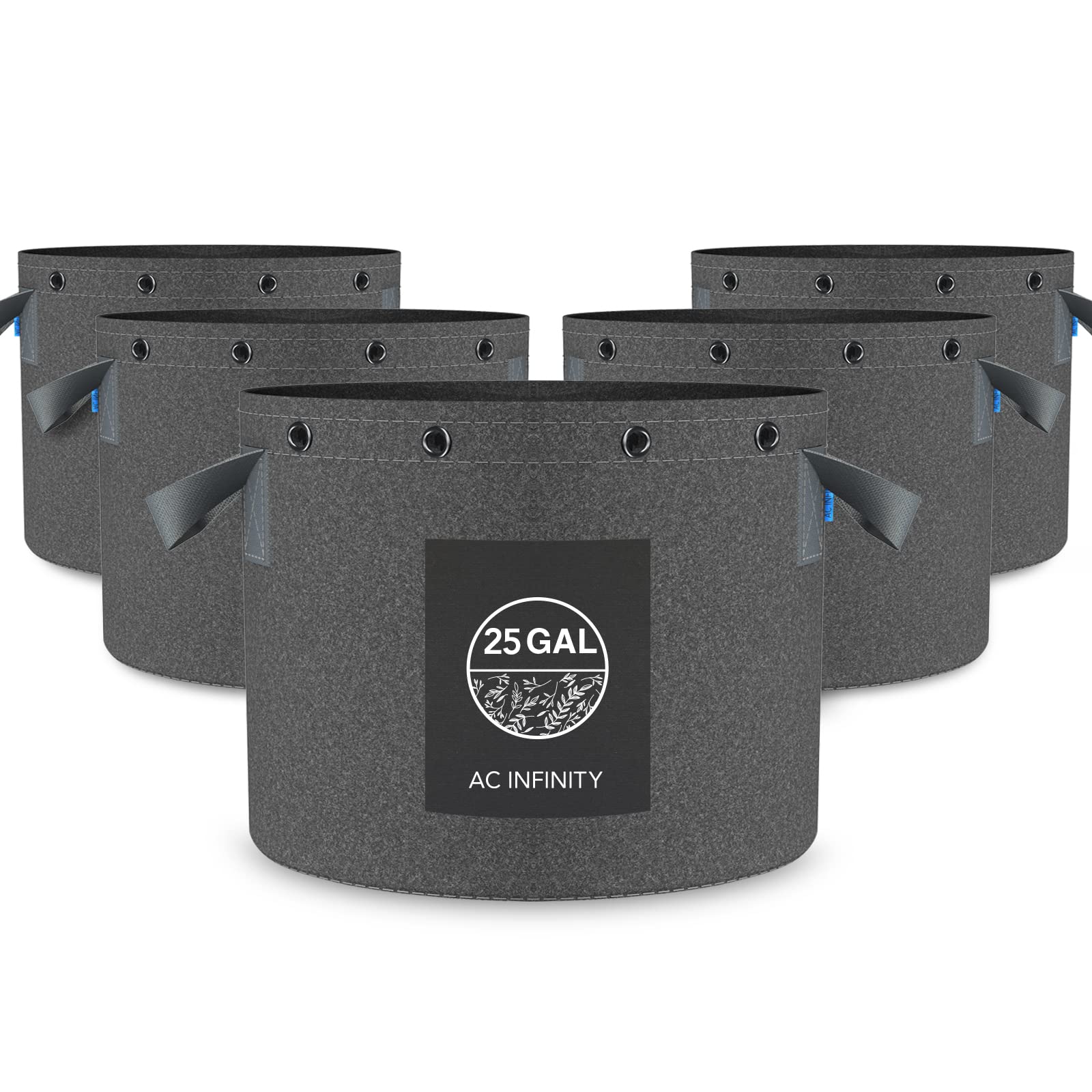
AC Infinity uses 500G nonwoven fabric — a full 200G heavier than the 300G standard found on most competitors — giving this pot wall rigidity close to a plastic nursery container without sacrificing breathability. At 22.68 inches in diameter and 15.98 inches tall, the capacity is true-to-size and allows ample lateral root spread for semi-dwarf apple, citrus, and fig trees. The 5-pack configuration suits orchard-scale planting without overwhelming the gardener with more containers than the season can fill.
The integrated metal grommet rings around the rim are a category-exclusive feature for low-stress training (LST). By passing twist ties through the rings rather than puncturing the fabric, growers can train branch structure without tearing the wall — a common failure point when users staple or poke holes into standard fabric pots. The reinforced stitching extends across the entire vertical seam, not just the handle attachment, preventing the blowout that kills 300G pots by mid-summer.
Owner feedback consistently highlights that these bags remain structurally upright into a third season even after repeated freeze-thaw cycles and heavy rain. The nylon handles are integrated into the side seam rather than surface-glued, allowing safe transport of a fully saturated 250-pound pot. The only recurring caution is that sharp plant support stakes can puncture the 500G fabric if driven with excessive force — use blunt-ended stakes or place them outside the pot rim.
What works
- 500G fabric provides unmatched wall rigidity for multi-season tree use
- Metal training rings enable fabric-safe LST without punctures
- Reinforced seam stitching prevents side-wall blowout under heavy soil loads
What doesn’t
- Sharp plant stakes can still puncture the dense fabric if driven hard
- Price per pot is higher than 300G multi-pack alternatives
2. Rain Science Grow Bag — 25 Gallon
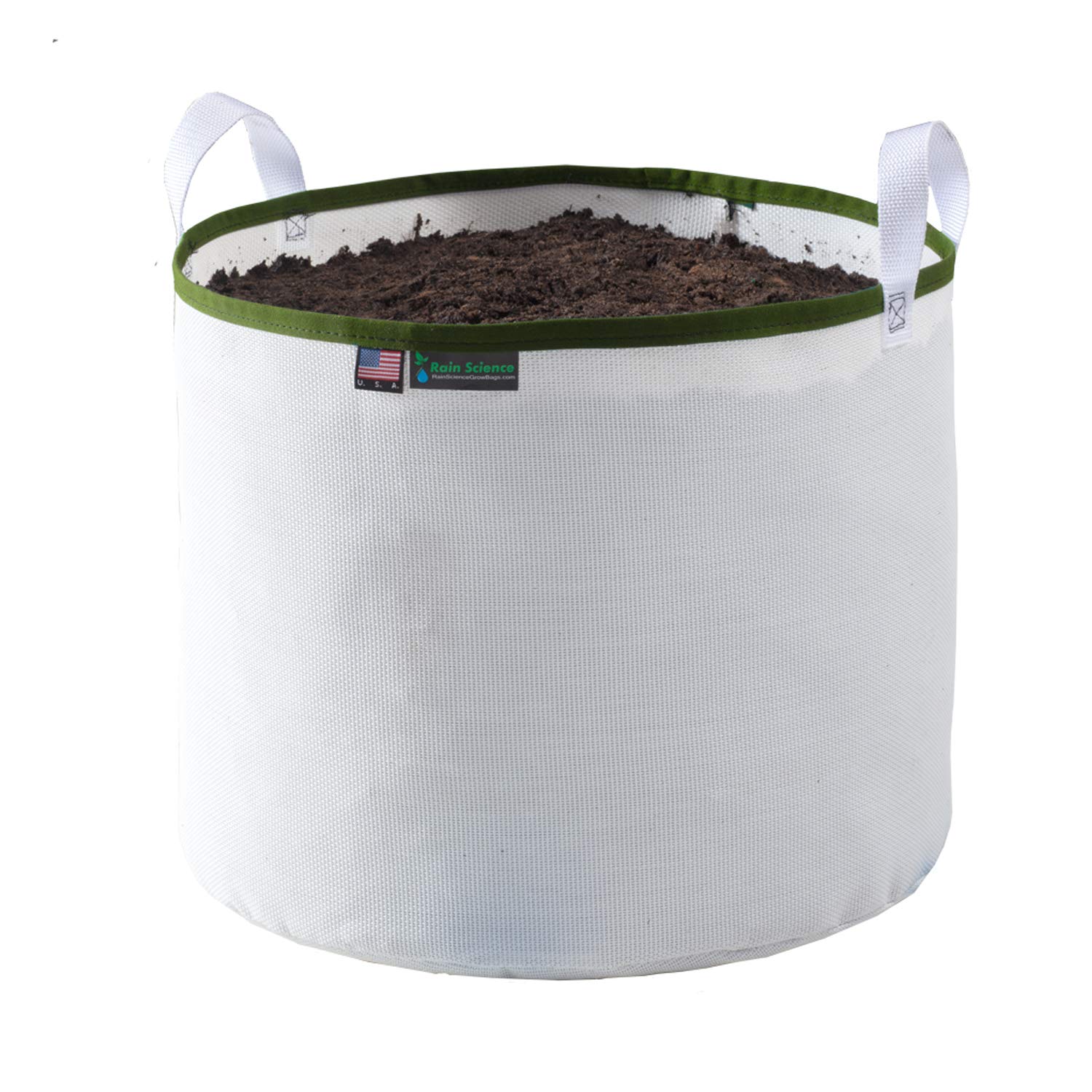
Rain Science uses a plastic-coated mesh that is structurally different from all other grow bags in this roundup. Rather than relying on nonwoven fabric’s passive porosity, this material contains thousands of small fixed openings that create true physical air-pruning — any root tip reaching the mesh wall is desiccated and severed by exposure to air, forcing the tree to develop a dense, fibrous root ball inside the pot rather than a circling knot. This matters more for 25-gallon tree culture than any other pot size because trees left in containers for multiple seasons are the most susceptible to root strangulation.
The white/OD green color option reflects solar radiation, keeping root-zone temperatures measurably lower than black fabric pots during peak summer heat. Root temperature management is frequently overlooked in tree container selection — a black pot sitting in full sun can exceed 110°F at the wall, cooking fine feeder roots. The Rain Science mesh stays cooler and dries faster than fabric because the coating prevents moisture wicking through the wall, meaning the pot structure itself doesn’t stay wet and heavy after rain.
The tapered design is a practical advantage for transplanting: the wider top and narrower base allow the entire root ball to slide out without tearing the root mass, reducing transplant shock significantly compared to straight-wall fabric pots that require cutting away the container. The lifetime warranty signals confidence in the coated mesh’s durability — owners report bags lasting over a decade with seasonal wash-and-store cycles. The tradeoff is that the mesh surface has less friction than fabric, so stacking two filled pots is less stable.
What works
- True air-pruning mesh severs circling roots at the wall
- White/OD green color keeps root zone significantly cooler in summer
- Lifetime warranty and tapered design for easy transplanting
What doesn’t
- Smooth mesh surface makes stacked pots less stable than fabric
- Single-pot purchase — must buy multiples individually for large orchards
3. Gardzen 10-Pack 25 Gallon Grow Bags

Gardzen’s 10-pack delivers a favorable cost-per-pot ratio without dropping to the thin, sag-prone material found in the cheapest market tiers. The 300G nonwoven fabric is the consensus baseline for multi-season reliability — it holds its shape through a full growing season without collapsing at the base, and the walls remain upright enough to avoid soil spillage during transport. At 22.5 inches in diameter and 15 inches tall, these bags offer a slightly wider footprint than some competitors, improving stability for top-heavy trees.
The handles use double-thick fabric folded and double-stitched into the pot body, which provides enough structural integrity to lift a saturated 25-gallon bag without tearing at the attachment point. Owners report successful relocation of bags containing dwarf citrus and large tomato plants across patios. The aeration is standard for 300G nonwoven: excess moisture drains through the entire wall surface rather than just the bottom, reducing the risk of overwatering and root rot in heavy clay soil mixes.
Multiple owners confirm that these bags remain functional through a second and even third season with proper off-season storage — washing with a garden hose and folding flat. The primary durability limitation is UV degradation: if left in direct sunlight year-round, the 300G fabric begins to stiffen and crack after 18-24 months. Storing indoors or under cover during winter extends the lifespan significantly. Gardzen promises the size is as advertised, and customer measurements confirm the 25-gallon rating is accurate.
What works
- Cost-effective 10-pack for large-scale planting projects
- Double-thick, double-stitched handles hold fully saturated pots
- Wide 22.5-inch diameter improves stability for heavy top-growth trees
What doesn’t
- 300G fabric degrades in under 2 years of constant direct UV exposure
- Hot summer sun requires daily watering due to fabric evaporation
4. VIVOSUN 5-Pack 25 Gallon Plant Grow Bags

VIVOSUN’s 300G nonwoven fabric strikes a balance between affordability and structure that makes these pots a frequent recommendation for gardeners expanding from 10-gallon to 25-gallon production. The fabric density is moderate enough to allow strong lateral aeration — roots exposed to high-oxygen walls develop the fibrous branching that drives nutrient uptake — but thick enough that the side walls do not collapse outward when the pot is filled with a heavy loam-based tree mix. The 5-pack quantity is ideal for a gardener adding a half-dozen fruit trees without committing to a 10- or 12-pack.
The defining design differentiator is the serger-stitched handle attachment. VIVOSUN specifically calls out that many competitors use handles cut from the same fabric layer as the pot, which tears away under load. Their handles are sewn onto the body using a serger stitch that reinforces the fabric at the stress point, and multiple owner reviews confirm that these handles can lift a bag containing 100 liters of wet soil without detaching. The handles themselves are wide enough to distribute the load across the palm, reducing strain on the hand during transport.
Owners note that the 25-gallon size works particularly well for raspberry, blueberry, and strawberry beds where horizontal root spread matters more than deep taproot penetration. The fabric prevents root circling in these shallow-rooted plants effectively, while the drainage prevents crown rot — a common failure in plastic pots. For trees specifically, the 300G fabric will need replacing after 2-3 seasons of continuous outdoor exposure, but for the per-pot cost, that represents acceptable longevity.
What works
- Serger-stitched handles outperform basic fabric-strip handles under load
- Good lateral aeration for fibrous root development in tree crops
- 5-pack offers manageable expansion scale for intermediate gardeners
What doesn’t
- 300G fabric begins to show UV wear after 18-24 months outdoors
- Wall flexibility high — may sag slightly under extremely heavy soil
5. FEED GARDEN 25 Gallon Grow Bags 8 Pack
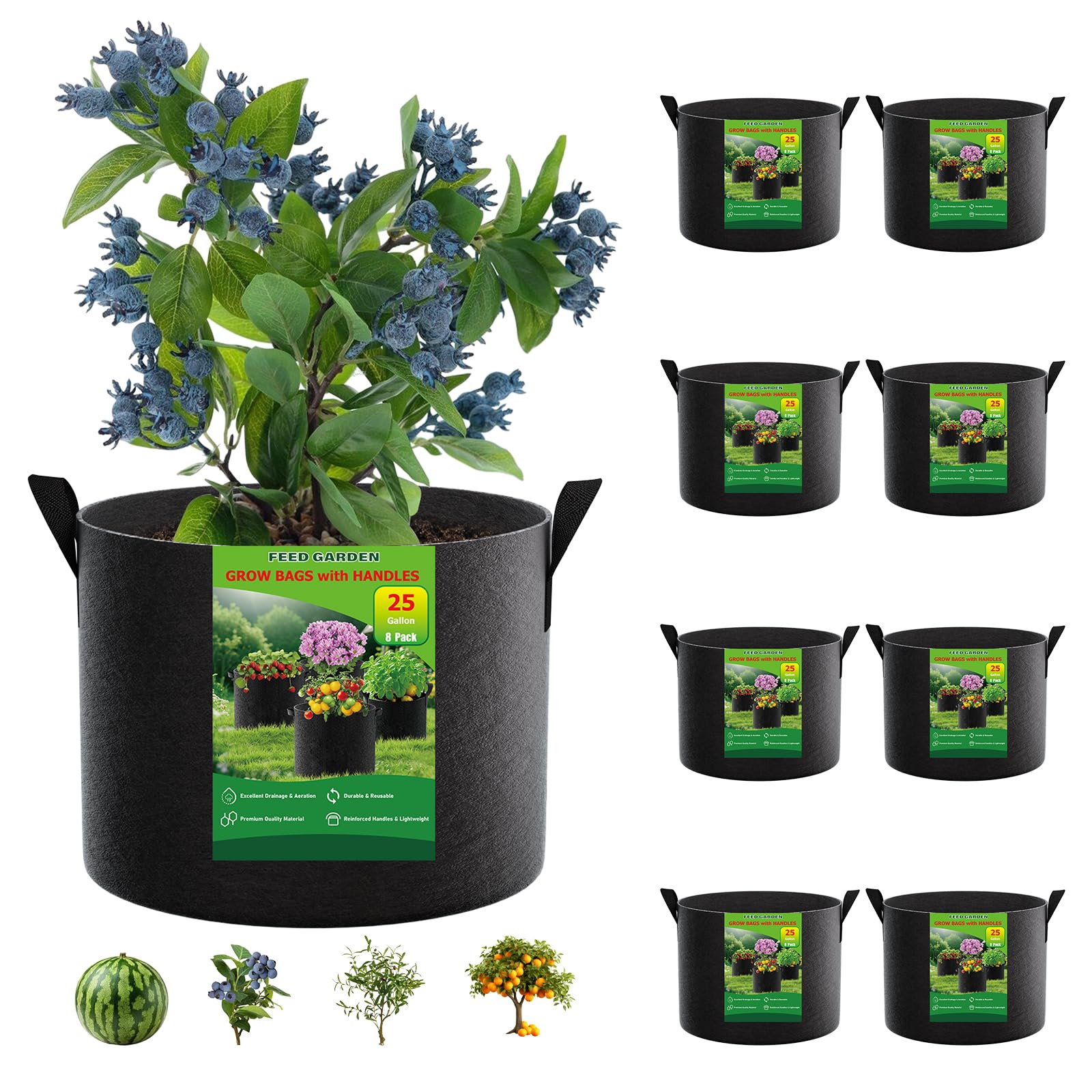
FEED GARDEN’s 8-pack provides the widest footprint in this comparison at 23.6 inches in diameter, making it the most stable option for top-heavy trees like dwarf mulberries or large citrus varieties that develop asymmetrical canopies. The 300G nonwoven fabric is double-stitched at the seams and reinforced at every joint, and the floor-standing mounting type is appropriate for ground-level placement where wind loads are a concern. At 13.7 inches tall, these bags are slightly shorter than the average 25-gallon container, favoring horizontal root spread over vertical taproot depth.
The handles are double-stitched with reinforced webbing that owners consistently describe as strong enough to drag partially filled bags across a lawn without the stitch line pulling. For full-weight transport (250+ pounds), dragging is the recommended technique — lifting a saturated bag by the handles alone risks back injury regardless of handle quality. The fabric feels thick out of the package and maintains its shape after filling, without the initial floppiness that some thinner 300G pots exhibit before the soil settles.
Owner reports specifically highlight that these bags work for large-scale vegetable production — tomatoes, potatoes, eggplants — but the 23.6-inch diameter also accommodates young fruit trees with spreading root systems. The faster drying rate inherent to fabric pots is noted as a con in hot climates; trees in 25-gallon fabric pots in 90°F+ weather may need watering every 24 hours. Folding flat for off-season storage is straightforward, and the material rinses clean with a hose.
What works
- Widest base diameter (23.6″) improves tip-over resistance for large trees
- Double-stitched seams hold shape under heavy soil loads
- 8-pack gives flexibility for mixed orchard and vegetable planting
What doesn’t
- Shorter profile (13.7″) limits vertical root depth for taproot-heavy species
- Fabric dries out fast — requires daily watering in peak summer heat
6. JERIA 12-Pack 25 Gallon Grow Bags
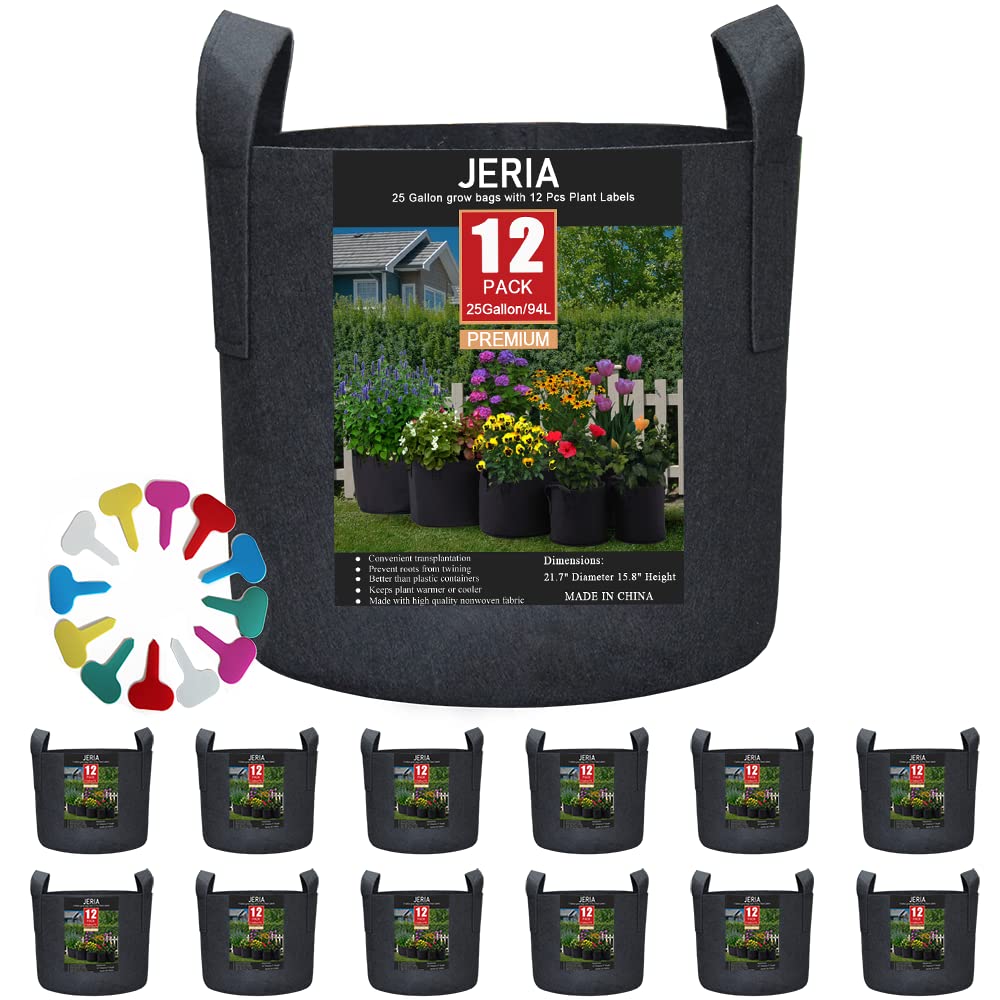
JERIA’s 12-pack is the highest-count offering in this roundup, catering to gardeners who need to transition a large batch of seedlings or young trees into 25-gallon containers at once without breaking the budget per unit. The 300G nonwoven fabric is comparable in density to the VIVOSUN and Gardzen options, but the included 12 plant labels add practical value for tracking different tree varieties or planting dates across a large plot. At 21.7 inches in diameter and 15.8 inches tall, the dimensions are standard for the category — neither especially wide nor exceptionally deep.
The 300G fabric provides adequate aeration for root pruning in annual applications, but owners who have used these bags for two seasons report that the fabric holds its structure well when stored properly between growing cycles. The handles are built into the side seams and are described as study enough to lift filled bags, though some users note that the handle material is the same nonwoven fabric rather than nylon webbing — a detail that reduces long-term tear resistance compared to the AC Infinity or Rain Science designs.
Multiple users emphasize that the drainage is the primary functional strength: the fabric allows water to pass through the entire surface area, preventing the waterlogged conditions that cause root rot in plastic pots. For trees that will be transplanted into the ground after one or two seasons, these bags provide sufficient root health without needing the premium 500G material. The per-pot cost at this pack size is among the lowest, but buyers should expect that the handles will not survive as many transport cycles as nylon-reinforced alternatives.
What works
- 12-pack plus plant labels provides the best per-pot value for bulk planting
- Standard 300G fabric with good drainage and fold-flat storage
- Proven two-season durability with proper off-season care
What doesn’t
- Handles are nonwoven fabric rather than nylon — lower tear resistance
- Not ideal for permanent tree housing beyond two growing seasons
7. Songrey 10-Pack 25 Gallon Grow Bags
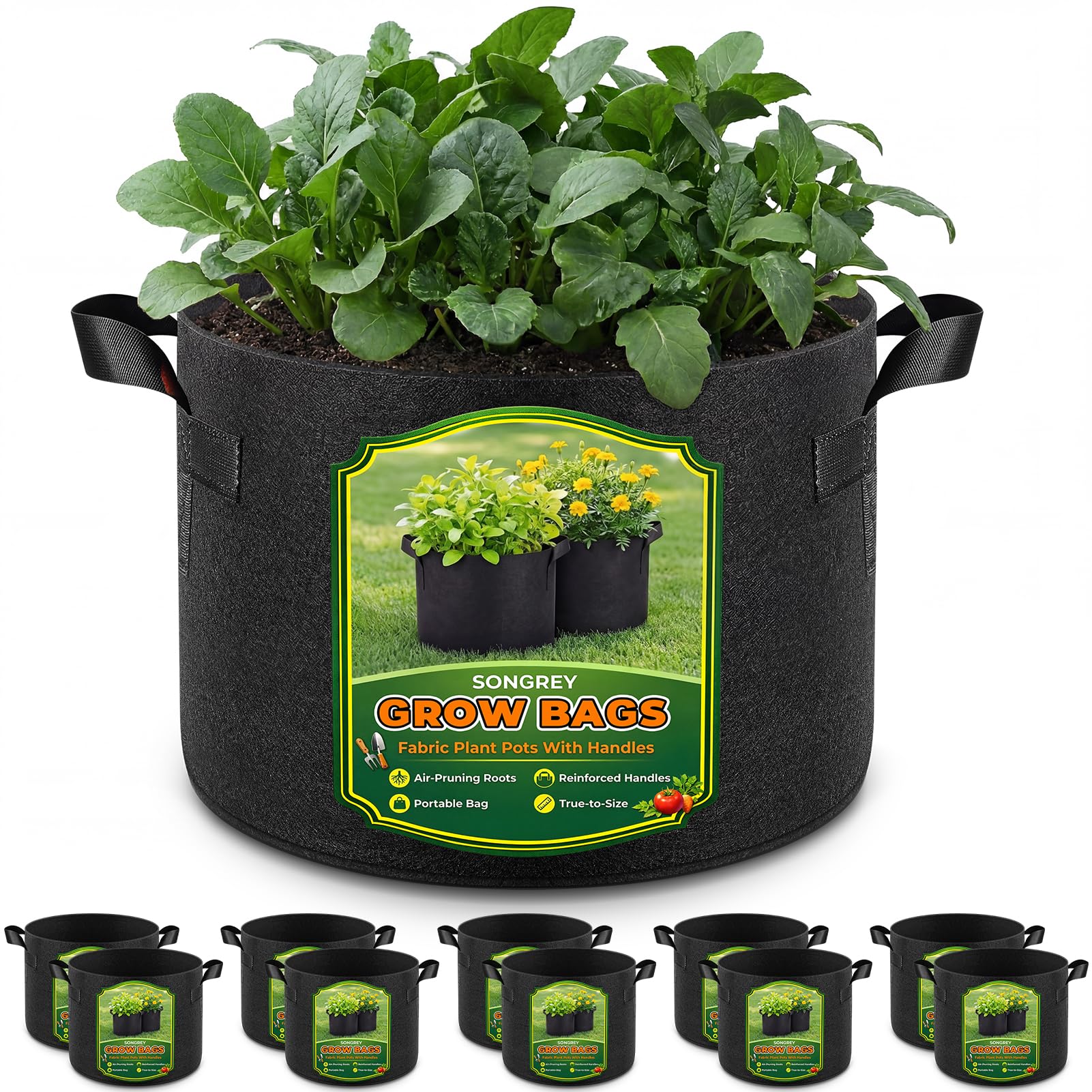
Songrey’s 10-pack targets the entry-level gardener who needs a large number of 25-gallon containers for a seasonal vegetable and small tree project without committing to premium fabric weights. The material is described as tear-resistant nonwoven fabric that is BPA-free and eco-friendly, and the 10-pack quantity at this price point allows the user to over-plant without worrying about per-pot losses from accidental punctures or UV damage. At 15.7 inches in diameter and 11.8 inches tall, these are the most compact pots in the roundup — the capacity is genuine 25 gallons, but the shape is relatively short and wide.
The handles are tightly stitched and some owners report successful lifting of fully loaded bags, though the weight capacity is lower than options with nylon-reinforced handles. For trees, this means the pots are best positioned permanently or moved when only partially filled. The fabric offers standard aeration — excess water drains through the walls, preventing overwatering — and the black color absorbs heat, which can be an advantage in cool climates but a drawback in hot-summer regions where root zone temperatures need to stay moderated.
Owner sentiment is generally positive, with the strongest reviews highlighting the value per pot and the ease of folding for storage. The tradeoff acknowledged consistently is that the walls feel flimsier than thicker 300G options when empty, though once filled with soil, the structure stabilizes. For gardeners who plan to use these pots for a single season before transplanting trees into the ground, this entry-level option gets the job done. For multi-season tree housing, the thin walls will deteriorate faster than any other pot in this lineup.
What works
- Lowest per-pot cost makes it ideal for single-season use
- Compact dimensions fit tight patio or raised-bed arrangements
- Washable and foldable for easy off-season storage
What doesn’t
- Walls feel noticeably thinner than 300G standard — shorter lifespan
- Handles lack nylon reinforcement — lower safe lifting capacity
- Black fabric absorbs heat, potentially raising root-zone temperature
Hardware & Specs Guide
Fabric Weight (G/M²)
The most important durability metric for 25-gallon tree pots. 300G per square meter is the baseline for multi-season use — it resists wall sag and UV degradation for 18-24 months of continuous outdoor exposure. 500G material, found on AC Infinity’s premium line, approaches the rigidity of plastic while retaining breathability and can last 3-5 seasons. Budget-grade 200-250G fabric works for single-season annuals but collapses under the weight of wet soil within months, reducing usable volume and risking structural failure during transport.
Handle Architecture
At 25 gallons, wet soil mass exceeds 200 pounds. Handles must be independently stitched onto the pot body using reinforced nylon webbing or serger stitching. The worst failure mode is a handle that is simply a strip cut from the same pot fabric — this design tears at the attachment point under partial load. The best designs use a full loop that wraps under the pot base or integrates into the vertical seam stitch. Double-stitched nylon handles (AC Infinity, Rain Science) allow safe dragging across surfaces without detachment.
FAQ
What diameter tree root ball fits a standard 25-gallon pot?
Do fabric 25-gallon pots need a plastic saucer underneath?
How often should I water a tree in a 25-gallon fabric pot during summer?
Final Thoughts: The Verdict
For most gardeners, the best 25 gallon pots for trees winner is the AC Infinity Heavy Duty 5-Pack because the 500G fabric outlasts every other nonwoven option by multiple growing seasons while the integrated training rings add functional value no competitor matches. If you want true air-pruning and cooler root-zone temperatures for a permanent tree that will stay containerized for years, grab the Rain Science Grow Bag. And for a high-volume orchard start at the lowest per-pot cost, nothing beats the Gardzen 10-Pack as a reliable 300G workhorse that balances price and multi-season durability.