
Specs are compiled from manufacturer listings and verified buyer reviews and can change over time — please confirm the key details on the product page before buying.
You apply a 0-0-7 fertilizer in early spring to stop crabgrass and Poa annua (a winter annual weed) before they sprout — the bag holds zero nitrogen and zero phosphorus, just a pre-emergent herbicide (a chemical that prevents weed seeds from rooting) that builds a barrier in your soil. The key is timing it right and covering the whole yard, and these two picks match different lawn sizes and budgets.
I’m Rikta — the founder and writer behind Lawn Gear Lab. This guide is built by comparing the manufacturers’ published specifications and the patterns across verified customer reviews, so you get each pick’s real strengths and trade-offs instead of marketing spin.
Both products deliver the same N-P-K (nitrogen-phosphorus-potassium) ratio of 0-0-7 and 0.37% Prodiamine (the active pre-emergent ingredient), but the bag weight, coverage area, and spreader fit differ. Here is how they stack up for your yard when you need a 0-0-7 fertilizer.
Quick Picks
- 0-0-7 Safeguard Pre-Emergent Lawn Fertilizer — Best Value
- 0-0-7 Granular Prodiamine Pre-Emergent — Large Yard Pick
How To Choose The Best 0-0-7 Fertilizer
You pick a 0-0-7 fertilizer by checking the active ingredient on the label, matching the bag weight to your lawn’s square footage, and applying it during the right window. Every bag here has Prodiamine at 0.37%, so your main choice is between a smaller bag for a typical suburban lot or a large bag for a bigger property.
Active Ingredient: Prodiamine vs Dithiopyr
Both products use Prodiamine at 0.37%. Prodiamine is a pre-emergent herbicide (a chemical barrier) that stops weed seeds from forming roots after they germinate — it does not kill weeds you already see. If you miss the early-spring window, a product with Dithiopyr (sold as Dimension) offers some early post-emergent (weed-killing) action, but Prodiamine is the standard for straight prevention before soil temperatures reach 55°F.
Bag Size and Coverage
The bag weight tells you how many square feet one bag treats. The 18-pound bag covers up to 4,500 square feet at the label rate. The 45-pound bag covers 15,000 square feet. Buy the bag that fits your yard — leftover product stored wrong can lose its strength by next season.
Spreader Compatibility
Some pre-emergent granules are larger or denser than ordinary fertilizer. Buyers report that big yellow granules can jam certain drop spreaders. Check reviews for spreader fit before you buy, and always calibrate your spreader on a hard surface first.
Quick Comparison
In‑Depth Reviews
1. 0-0-7 Safeguard Pre-Emergent Lawn Fertilizer (18 lbs)

This 18-pound bag covers up to 4,500 square feet — a single-purchase fit for a typical quarter-acre lot or smaller.
The Lawn Synergy bag weighs 18 pounds and covers up to 4,500 square feet, so you do not need two bags for a small suburban yard. The granules contain 0.37% Prodiamine (a pre-emergent herbicide that stops weed seeds from rooting), the same active ingredient as the larger 45-pound bag — same chemistry in a more manageable size. The label says it is safe for all lawn types, meaning you can spread it on fescue, Bermuda, or Zoysia without worrying about turf injury.
Owners mention one person had a backyard infested with Poa annua (annual bluegrass) last year and bought this to limit the outbreak. They claimed it cut the Poa to about 10% of what it was the prior season, though they admitted some operator error was possible. Another reviewer applied in April and wished they had put it down in late February to mid-March — a reminder that timing matters as much as the product. At 18 pounds, it is easier to haul and store than the 45-pound Yard Mastery bag.
Compared to the Yard Mastery 45-pound bag that covers 15,000 square feet and weighs 45 pounds, this 18-pound bag weighs 18 pounds and covers 4,500 square feet. Buy it if your yard does not need bulk and you want to avoid half a bag sitting in the garage all summer.
Simple and effective: A no-fuss pre-emergent for small to medium lawns that delivers the same Prodiamine chemistry as the giant bag, at a lower entry price and easier handling.
The trade-off: If your lawn measures more than 4,500 square feet, you will need two bags or the bigger option below — one bag alone will not cover a larger property at the label rate.
Who it fits: Homeowners with a 4,500 sq ft or smaller lawn who want a single-bag solution for crabgrass and Poa annua prevention at a mid-range cost.
Who should skip it: Anyone managing a half-acre or larger lawn — the 45-pound bag will save you a second purchase and per-square-foot cost.
2. 0-0-7 Granular Prodiamine Pre-Emergent Herbicide Fertilizer (45 lbs)
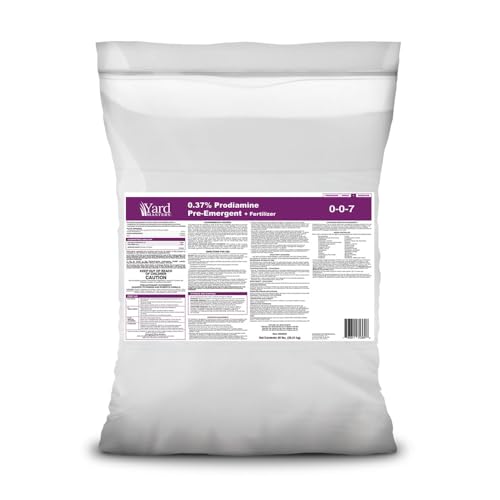
A 45-pound bag that covers 15,000 square feet — the efficient one-bag-per-season move for large properties.
Yard Mastery packs this 45-pound bag with the same 0.37% Prodiamine (the pre-emergent active ingredient) as the Safeguard 18-pound bag, but the coverage jumps to 15,000 square feet at the 3 lbs per 1,000 sq ft rate. That makes it the more economical per-square-foot choice if your lawn goes past the quarter-acre mark. The granules target crabgrass, Poa annua (annual bluegrass), bittercress, chickweed, and henbit — a broader weed list than some competitors — from a single spring application.
One reviewer notes they have used this product for seven years and call it effective crabgrass control, but they warn that the large yellow granules require a compatible spreader — standard drop spreaders sometimes jam if the opening is too narrow. Buyers also report that the dosage instructions are not printed on the bag; you have to contact the manufacturer or look them up online. That is a small nuisance, but the consensus among 241 ratings is that the product works when applied correctly. Another owner says to apply once yearly in early spring based on soil temperature and that it complies with local runoff rules when used at the recommended lower rate.
The 45-pound bag weighs 45 pounds versus the 18-pound Safeguard option, and covers 15,000 square feet versus 4,500 square feet — you get more chemistry per dollar but more to haul from the car to the garage. For anyone with a yard under 5,000 square feet, the 18-pound Safeguard bag leaves no half-used product to store. But if you manage an acre or close to it, this bag is the efficient move.
The bulk advantage: One bag covers a 15,000 sq ft lawn in a single pass, and the active ingredient list includes more weed types than the 18-pound alternative. Large-yard owners save per-season over buying multiple smaller bags.
The nuisances: The big granules need a compatible spreader — check yours before pouring — and you will need to look up the dosage chart online since it is not on the bag label.
Best for: Owners of large lawns (over 10,000 sq ft) who want one bag per season and are comfortable looking up dosage data or using a compatible rotary spreader.
Not for: Anyone with a yard under 5,000 sq ft — the 18-pound bag is lighter, cheaper, and leaves no giant half-bag to store for twelve months.
Understanding the Specs
N-P-K Ratio 0-0-7
A 0-0-7 fertilizer means the bag contains 0% nitrogen (which drives green growth), 0% phosphorus (for root development), and 7% potash (potassium, which supports overall plant health). In these pre-emergent products, the potassium is not the main show — the real work comes from the added herbicide. The 0-0-7 ratio tells you this is not a feed product; it is a weed prevention tool with a minor potassium side benefit. If your lawn needs greening, apply a separate nitrogen-rich fertilizer later in the season.
Prodiamine 0.37%
Prodiamine is a pre-emergent herbicide (a chemical barrier) that stops weed seeds from forming roots after they germinate. At 0.37% concentration, the product is labeled for use on established lawns to prevent crabgrass, Poa annua (annual bluegrass), and a list of broadleaf weeds. You must apply it before soil temperatures hit 55-60°F and water it in (by irrigation or rainfall within a few days). It does not kill existing weeds — if you already see green weeds in your lawn, you have missed the pre-emergent window and need a post-emergent (weed-killing) product instead.
Coverage Rate (lbs per 1,000 sq ft)
Coverage is listed both as total square feet per bag and as pounds per 1,000 square feet. The 18-pound bag covers 4,500 sq ft at about 4 lbs per 1,000 sq ft. The 45-pound bag covers 15,000 sq ft at 3 lbs per 1,000 sq ft. The difference in rate matters — too little product leaves gaps where weeds sneak through, and too much wastes money. Always measure your lawn (use Google Maps or a measuring wheel) and follow the label rate for your specific weed type; do not guess.
FAQ
What does 0-0-7 mean on a fertilizer bag?
Can I use 0-0-7 fertilizer on a lawn that has existing weeds?
Is 0-0-7 fertilizer safe for all grass types?
Which spreader should I use for 0-0-7 granules?
How long does 0-0-7 fertilizer last in the soil?
Will 0-0-7 fertilizer burn my lawn?
Can I seed my lawn after applying 0-0-7 pre-emergent?
Which 0-0-7 bag is better for a 10,000 sq ft lawn?
Does 0-0-7 fertilizer contain Prodiamine in every bag?
What is the difference between Pre-Emergent and Post-Emergent herbicides?
Final Thoughts: The Verdict
For most people, the 0-0-7 fertilizer winner is the 0-0-7 Safeguard Pre-Emergent (18 lbs) because it delivers the same 0.37% Prodiamine chemistry as the bigger bag but in a lighter, easier-to-handle size that matches a typical suburban lawn — no heavy hauling, no half-bag storage, and a straightforward single-purchase cost. If you manage a larger property over 10,000 square feet, grab the 0-0-7 Granular Prodiamine (45 lbs) for better per-square-foot value and coverage. And if you are seeding your lawn this spring, skip both — pre-emergents stop all seeds, so wait until your new grass is mature before using any Prodiamine-based product.
How We Picked
We do not accept paid placement. Every pick is matched to a real buyer and a real use-case; we do not hands-on test units.
Sources & Methodology
Specifications: manufacturer listings and product documentation. Review insights: verified customer reviews, as of July 2026. Pricing: not shown on this page (it changes often); check the current price via the retailer link.
As an Amazon Associate, Lawn Gear Lab earns from qualifying purchases. This does not affect which products we feature.