
Specs are compiled from manufacturer listings and verified buyer reviews and can change over time — please confirm the key details on the product page before buying.
Getting an orchid to rebloom is what separates a casual owner from a devoted grower, and the difference often depends on what you feed it. Too much fertilizer burns the delicate roots, and too little leaves you with nothing but sad green leaves and no flowers at all, so picking the right plant food for orchids is the single most important tool you can own.
I’m Rikta — the founder and writer behind Lawn Gear Lab. This guide is built by comparing the manufacturers’ published specifications and the patterns across verified customer reviews, so you get each pick’s real strengths and trade-offs instead of marketing spin.
The right formula delivers the exact balance of nitrogen (N, for leaf growth), phosphorus (P, for roots and blooms), and potassium (K, for overall health) that your specific orchid species needs, whether you grow Phalaenopsis, Dendrobium, or Cattleya varieties, and plant food for orchids comes in liquid concentrates, slow-release pellets, and ready-to-use mist forms to match every watering style.
Quick Picks
- Espoma Organic Orchid! 8-Ounce Concentrated (Pack of 2) — Best Overall
- Growth Technology GT Orchid Bloom Focus — Premium Pick
- Miracle-Gro Indoor Plant Food Mist for Orchids (3-Pack) — Easiest to Use
- Jack’s Classic 3-9-6 Orchid Bloom Booster — Blooms Specialist
- Orchid Fertilizer Pellets 13-11-11 Slow Release — Low Maintenance
- Orchid Plant Food – Bloom Booster Slow Release (SMEREKA) — Budget Champ
How To Choose The Best Plant Food For Orchids
Orchids are epiphytes, meaning they naturally grow attached to trees and absorb nutrients from rain and debris rather than from soil. Your fertilizer choice must mimic that delicate, low-concentration feeding pattern, or the roots will suffer. Here are the three most critical factors to consider.
N-P-K Ratio and the Bloom Stage
The three numbers on the label — nitrogen (N), phosphorus (P), and potassium (K) — control different parts of the plant. A higher middle number (phosphorus) encourages flower bud development and bloom size, which is why bloom-booster formulas like a 3-9-6 or 14-12-12 are popular. A balanced 13-11-11 mix supports overall health for both seedlings and mature plants. If your orchid is already in bloom, switch to a formula with less nitrogen so the energy goes to the flowers.
Slow-Release Granules vs. Liquid Concentrate
Slow-release pellets break down gradually over several months, reducing the risk of over-fertilizing and making them ideal for beginners or for people who travel. Liquid concentrates give you more precise control — you can adjust the dose based on the season or the plant’s current growth phase. The catch with liquid food is that you have to mix and apply it every two to four weeks, while granules let you “set and forget” for up to six months.
Urea-Free and Gentle Formulas
Orchid roots are extremely sensitive to harsh chemical salts. A urea-free formula uses nitrate-based nitrogen instead of urea-based nitrogen, which is easier for the roots to absorb without burning. Many premium liquid fertilizers advertise a “gentle” or “urea-free” label on the front. If you see that phrase on the bottle, it signals that the manufacturer says the food is designed for delicate epiphytic roots rather than for general garden soil.
Quick Comparison
| Model | Best For | N-P-K Ratio | Item Form | Unit Count | Amazon |
|---|---|---|---|---|---|
| Espoma Organic Orchid! 8-Ounce Concentrated (Pack of 2) | Organic Feeding | Not listed | Liquid | 16 Fluid Ounces | Amazon |
| Growth Technology GT Orchid Bloom Focus | Premium Bloom Support | 1:14 | Liquid | 8.45 Fluid Ounces | Amazon |
| Miracle-Gro Indoor Plant Food Mist for Orchids (3-Pack) | No-Mix Convenience | Not listed | Liquid Mist | 24 Fluid Ounces | Amazon |
| Jack’s Classic 3-9-6 Orchid Bloom Booster | Prolific Blooms | 3-9-6 | Liquid | 8 Fluid Ounces | Amazon |
| Orchid Fertilizer Pellets 13-11-11 Slow Release (Leaves and Soul) | Low-Maintenance Care | 13-11-11 | Granules | 5.2 Ounce | Amazon |
| Orchid Plant Food – Bloom Booster (SMEREKA) | Budget Bloom Booster | 14-12-12 | Granules | 5 Ounce | Amazon |
In‑Depth Reviews
1. Espoma Organic Orchid! 8-Ounce Concentrated (Pack of 2)

Organic liquid that turns stressed leaves into a 12-bloom spectacle.
This is the pick for anyone who wants an organic formula that is safe to use around kids and pets without compromising on bloom results. The bottle is an 8-ounce liquid concentrate, and you get two bottles per order, so you have a total of 16 fluid ounces of plant food ready to go. You simply add half a capful per quart of water and drench the soil every two to four weeks.
Buyers report that one orchid produced 12 blooms after regular use, calling it “super plant food.” One reviewer noted switching from a nursery bottle to this Amazon listing because the price was better. The liquid form dissolves instantly, which means you do not have to wait for granules to break down — the roots get the nutrients right away.
Unlike the Growth Technology GT product that holds only 8.45 fluid ounces in a single bottle, this Espoma pack gives you 89% more total liquid volume, according to the unit count data, so you get many more feedings for a similar investment.
What stands out: Two bottles of organic concentrate that work for all orchid types, with fast results visible in weeks. The catch is that you must mix it each time you water — it is not a set-and-forget granular formula.
Who should reach for this: The grower who wants natural ingredients and is ready to follow a routine feeding schedule every two to four weeks.
Go for it if: You value organic certification and want enough concentrate (16 fluid ounces total) to last through multiple bloom cycles without repurchasing.
Look elsewhere if: You prefer a “sprinkle once and forget” method — for that, a slow-release pellet is a better fit.
2. Growth Technology GT Orchid Bloom Focus
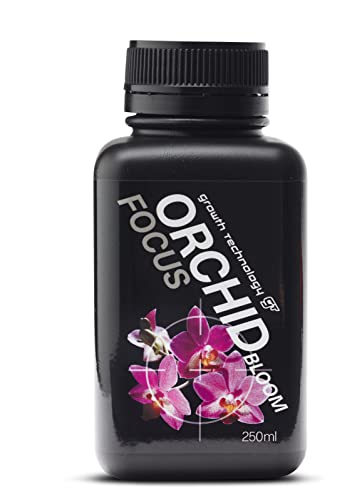
The 12-mineral formula that makes leaf size visibly larger.
This is a premium liquid concentrate designed specifically for the flowering stage of Phalaenopsis, Cattleya, Dendrobium, and Oncidium orchids. It supplies 12 essential minerals, including calcium, in a highly absorbable nitrate-based form that contains zero urea. That matters because urea-based nitrogen can burn sensitive orchid roots — this formula uses 100% nitrate-based nitrogen instead.
Owners mention that “the new growth and leaf size is significantly larger!!!,” and one reviewer called it the “secret sauce” for hydroponic plants. The 250 ml bottle (equal to 8.45 fluid ounces) is a concentrated liquid, and you dilute 3 to 5 ml per liter of water for potting mix or 5 to 7 ml for hydroponic setups. Some customers note the bottle can leak during shipping, so you may want to check the cap immediately on arrival. This formula is also effective as a foliar spray, so you can mist it onto the leaves.
At 8.45 fluid ounces, it is an 89% smaller total volume than the Espoma two-pack (16 fluid ounces), so the price per feeding is higher here. But the nutrient precision and urea-free formulation make it a specialist’s choice for coaxing blooms out of finicky orchid varieties.
Reasons to choose
- Urea-free formula prevents root burn on sensitive species
- Can be used as a foliar spray (sprayed directly on leaves) for quick nutrient uptake
- Reviewers point out significantly larger leaves and stronger growth
Things to know
- Only one 8.45 fl. oz. bottle per purchase
- Some users experience leaking from the original bottle cap
Right for you if: You grow multiple orchid species and want a gentle, calcium-rich fertilizer that you can also spray on the leaves.
Not ideal if: You need a large volume of food to feed many plants on a budget — the smaller bottle means more frequent repurchasing.
3. Miracle-Gro Indoor Plant Food Mist for Orchids (3-Pack)
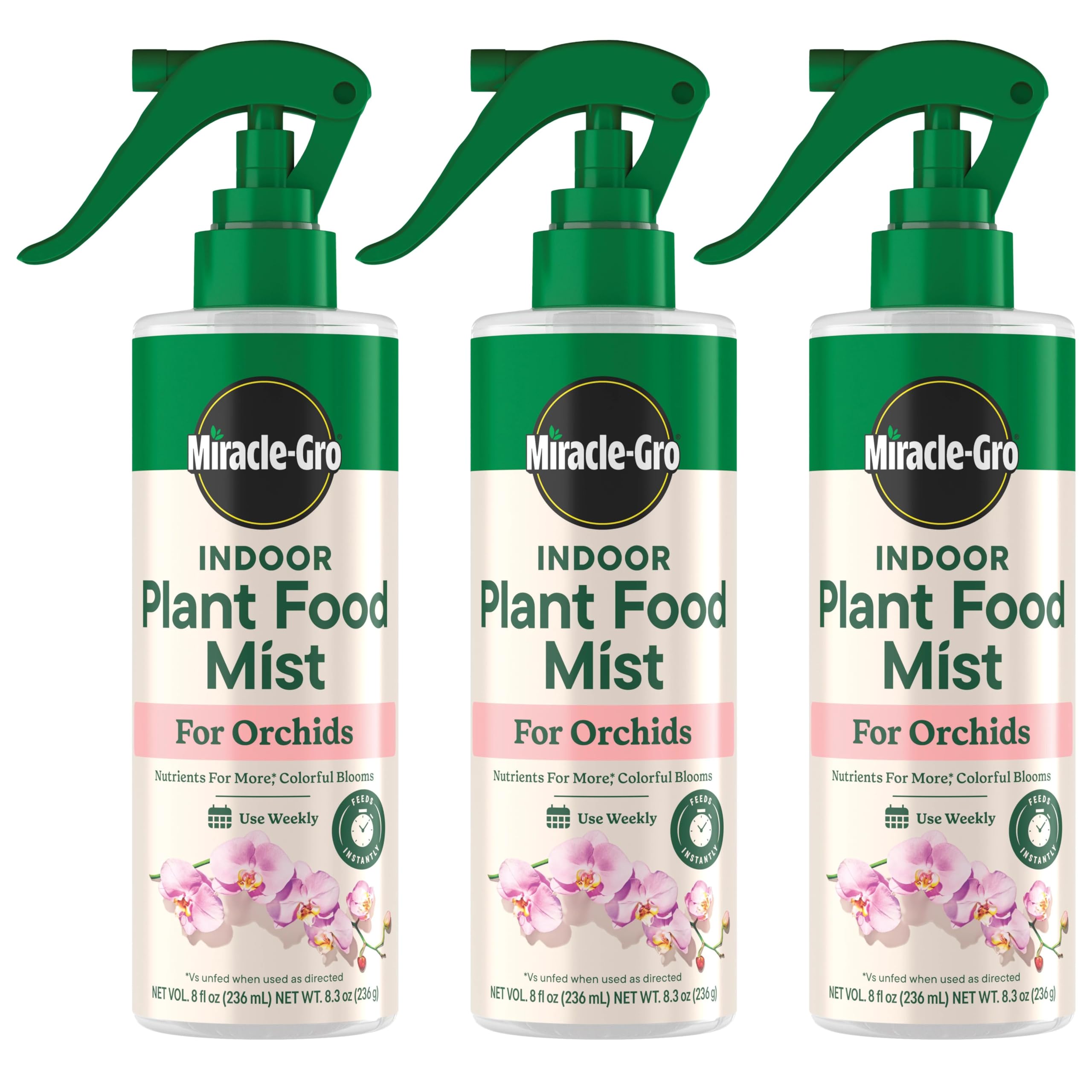
Spray-on feeding that mimics natural rain without measuring a thing.
If you dread mixing liquid concentrates and cleaning measuring spoons, this mist bottle is your answer. The product comes as a three-pack with each bottle holding 8 fluid ounces, giving you 24 fluid ounces total. You simply spray the leaves, roots, and top of the soil once per week, avoiding the flowers, and the plant absorbs the nutrients immediately without any mixing step.
Shoppers say that it works: one buyer mentioned it kept their first orchid alive and resulted in a new stem with 10 flowers. Another noted the orchid looked “very healthy” after repotting and using the mist. The sprayer delivers a fine mist that makes the weekly routine feel easy. One user did mention that flowers started to fall after two months of use, but they were unsure whether that was the food or the natural orchid lifecycle.
Compared to the Espoma liquid concentrate, this mist requires no mixing at all — you lose the ability to control the dose precisely, but you gain a truly zero-effort feeding routine that is tough to top for a busy owner.
The defining feature: Instant, no-measure feeding with a satisfying spray action that reaches the roots and leaves. The limitation is that you are locked into the manufacturer’s pre-mixed concentration — you cannot adjust the strength for different growth stages.
Best suited for: The owner who tends to forget watering schedules and wants a simple “spray once a week” habit that keeps the plant alive and blooming.
Reach for this if: Your main concern is convenience — no mixing, no measuring, no mess. This is the smart pick for anyone who finds the Espoma routine too involved.
skip it if: You want an organic formula or need the flexibility to adjust the nutrient ratio for specific orchid varieties.
4. Jack’s Classic 3-9-6 Orchid Bloom Booster

The 3-9-6 ratio that has kept phalaenopsis blooming for years.
This liquid concentrate features a 3-9-6 analysis, which is deliberately low in nitrogen and high in phosphorus and potassium to shift the plant’s energy from leaf growth into flower production. It is formulated for all orchid varieties and uses the bottle cap as a measuring tool, so you do not need any extra scoops or spoons. The mixing ratio is 3/4 teaspoon per gallon or 1/2 tablespoon per gallon.
Buyers rave about this product with one stating, “I’ve been using Jack’s on my phalaenopsis orchids for years, and they are almost constantly in bloom.” Another reviewer called it “the gold standard for orchids” and noted that their orchids bloom every year. The liquid form mixes better than granular powders, as one user pointed out, because it dissolves instantly without residue. It is more bloom-focused than the balanced Leaves and Soul 13-11-11 pellets because its phosphorus (the middle number 9) is three times higher than its nitrogen (the first number 3).
Unlike the SMEREKA slow-release pellets (14-12-12 ratio) that feed for six months in a single application, Jack’s Classic requires weekly or bi-weekly mixing and watering. You get more control over the feeding schedule but less convenience. The 3-9-6 ratio gives it the highest phosphorus concentration among all the picks, which is exactly what you want during the bud-setting stage.
Why it stands out
- High phosphorus ratio (3-9-6) specifically targets bloom production
- Bottle cap doubles as a measuring tool, no extra equipment needed
- Long-standing reputation with decades of positive grower feedback
Trade-offs
- Requires regular mixing and watering schedule (not slow-release)
- Only 8 fluid ounces per bottle — fewer total feedings than the multi-pack options
Choose this if: Your top priority is maximizing the number and frequency of orchid blooms using a proven, high-phosphorus liquid formula. This is the go-to for dedicated growers who want visible bud-setting results.
Pass on it if: You want an organic or slow-release solution — this is a conventional liquid that demands a consistent weekly routine.
5. Orchid Fertilizer Pellets 13-11-11 Slow Release (Leaves and Soul)
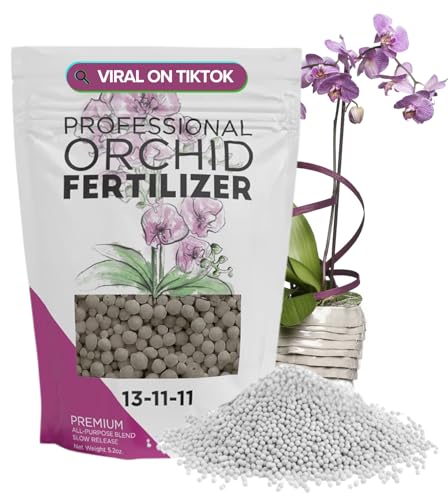
A single sprinkle that feeds up to 30 orchids for six months.
If you have a large collection of orchids or simply want to feed them without thinking about it every week, these slow-release pellets make the most sense. The formula provides a balanced 13-11-11 nutrient ratio and comes in a 5.2-ounce resealable bag. One application is designed to feed the plant for up to 180 days, so you apply the granules to the potting medium and then let the water do the work each time you water.
Buyers report that the product lasts a long time for 30 orchids, which is impressive value for the size. However, one owner reported the risk of over-fertilizing because the instructions are unclear for potted orchids of varying sizes, and no dosing spoon is included. The pellets are small, which makes even distribution a bit tricky in bark-heavy orchid mixes.
Compared to the SMEREKA pellets (5 ounce bag at a 14-12-12 ratio), this Leaves and Soul bag holds just 4% more by volume (5.2 ounces vs 5 ounces), so the difference in total quantity is negligible. The main distinction is the N-P-K ratio — this one is more balanced at 13-11-11, while SMEREKA pushes phosphorus slightly higher.
The key advantage: One application covers a huge number of plants for half a year. The downside is the lack of a dosing spoon and the learning curve to avoid over-fertilizing smaller pots.
Best for: Anyone with more than a dozen orchids who prefers a “sprinkle and water” method over mixing liquid feeds.
Reach for it if: You have a large orchid collection and want to feed them all with a single product that lasts months. This is the finest set-and-forget option for the busy orchid lover.
Pass on it if: You are a beginner who needs clear dosing instructions — the lack of a measuring spoon may lead to guesswork.
6. Orchid Plant Food – Bloom Booster Slow Release (SMEREKA)
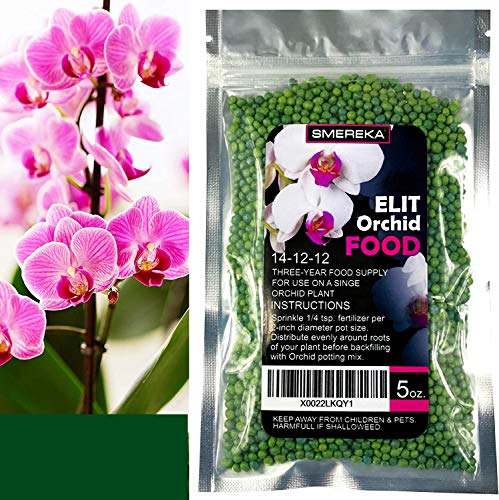
A budget-friendly granular that delivers blooms a year after the first application.
This is a 5-ounce bag of slow-release granules with a 14-12-12 N-P-K ratio designed to provide six months of consistent feeding in a single application. The higher phosphorus number (14-12-12 vs the 13-11-11 of the Leaves and Soul pellets) aims the formula more directly at bloom production. You simply sprinkle the granules onto the potting mix and let each watering release a small dose of nutrients.
Owners mention positive long-term results: one reviewer wrote, “All my orchids bloom after application last year; that a second purchase,” indicating that the product encouraged repeat use. Another buyer with half a century of orchid experience noted that it did not immediately kill the orchids, which is the first test any fertilizer must pass. The granules resemble Osmocote, a familiar general-purpose slow-release fertilizer, but this one, according to the brand, is formulated specifically for orchids.
The catch is that the 5-ounce bag is small — similar to the Leaves and Soul 5.2-ounce bag — so if you have a large collection, you may need to buy multiple bags. And like the other granular option, there is no dosing spoon included, so you will need to estimate or use a tiny measuring spoon from your kitchen.
What makes it worth it
- Very affordable entry point for orchid-specific slow-release feeding
- 14-12-12 ratio leans toward bloom production
- Customers note reblooming and repeat purchases
What to know before buying
- No dosing spoon included — measuring is left to you
- Small 5-ounce bag may require repurchasing for large collections
Grab it if: You are new to orchid care and want a cheap, simple slow-release option that works for all orchid types. This gives you the longest feeding duration (6 months) for the lowest outlay.
Not for you if: You need clear dosing instructions or prefer liquid feeding for more precise nutrient control.
Understanding the Specs
N-P-K Ratio
These three numbers stand for nitrogen (N), phosphorus (P), and potassium (K), in that order. They are the main nutrients any plant needs, but orchids have specific preferences. A ratio with a higher middle number (like 3-9-6 or 14-12-12) pushes the plant to put energy into flower buds rather than leaves. A balanced ratio like 13-11-11 works well during the growth phase when you want strong roots and leaves first, then switch to a bloom-booster ratio when you see a flower spike forming.
Slow-Release vs Liquid
Slow-release granules are coated pellets that break down gradually every time you water, releasing a tiny amount of nutrients over several months. They are perfect if you travel or if you tend to forget weekly feeding schedules. Liquid concentrates require you to mix a small amount of fertilizer with water each time you feed — typically every two to four weeks — but they give you full control over how much food the orchid gets. Liquid formulas also work well as foliar sprays (sprayed directly onto the leaves), meaning you can mist them directly onto the leaves for faster absorption.
FAQ
How often should I feed my orchid with plant food?
What is the best N-P-K ratio for orchid blooms?
Can I use regular houseplant fertilizer on orchids?
What does “urea-free” mean in orchid fertilizer?
Should I use slow-release pellets or liquid fertilizer?
How do I know if I am over-fertilizing my orchid?
Can I combine liquid fertilizer with foliar spraying?
How long does a bag of slow-release orchid fertilizer last?
Is foliar feeding as effective as root feeding for orchids?
Can I grow orchids without any fertilizer at all?
Final Thoughts: The Verdict
For most buyers, the plant food for orchids winner is the Espoma Organic Orchid! 8-Ounce Concentrated (Pack of 2) because it delivers organic, easy-to-mix liquid food with 16 fluid ounces total — enough volume to feed multiple orchids through many bloom cycles. If you want a premium urea-free formula that boost bloom size and leaf health, grab the Growth Technology GT Orchid Bloom Focus. And for a zero-effort, no-mix spray that keeps your orchid alive and blooming with a simple mist once a week, the Miracle-Gro Indoor Plant Food Mist for Orchids (3-Pack) is the easiest pick.
How We Picked
We do not accept paid placement. Every pick is matched to a real buyer and a real use-case; we do not hands-on test units.
Sources & Methodology
Specifications: manufacturer listings and product documentation. Review insights: verified customer reviews, as of July 2026. Pricing: not shown on this page (it changes often); check the current price via the retailer link.
As an Amazon Associate, Lawn Gear Lab earns from qualifying purchases. This does not affect which products we feature.