
Specs are compiled from manufacturer listings and verified buyer reviews and can change over time — please confirm the key details on the product page before buying.
Bamboo laughs at most weed killers. Its dense root system — called a rhizome — can push new shoots up fifty feet from the parent plant, which is why spraying the leaves and hoping for the best is a losing game. To actually stop bamboo, you need a herbicide with a specific combination: a high enough concentration of the active ingredient to penetrate those tough leaves, a systemic action that carries the poison all the way down to the underground runners, and enough staying power in the soil to prevent that next wave of regrowth. This guide lines up three proven solutions that tackle bamboo on its own terms, with real numbers on coverage, concentration, and kill speed so you can pick the one that matches the size of your infestation.
I’m Rikta — the founder and writer behind Lawn Gear Lab. This guide is built by comparing the manufacturers’ published specifications and the patterns across verified customer reviews, so you get each pick’s real strengths and trade-offs instead of marketing spin.
Whether you are facing a few rogue canes in a corner of the yard or a full-blown grove taking over your property line, these are the most effective options for a weed killer for bamboo that actually works on the root system, not just the leaves.
Quick Picks
- Plus Herbicide – 41% Glyphosate with Surfactant — Top Performer
- BioAdvanced Extended Control Brush Killer Spray — Best Overall
- Compare-N-Save 75324 Herbicide, 1-gallon, white — Best Value
How To Choose The Best Weed Killer For Bamboo
Bamboo is not a weed — it is a grass with a woody stem and a root system designed to survive. To pick a killer that actually finishes the job, you need to understand three things: how the herbicide gets into the plant, how much area you need to cover, and how long you are willing to wait for results.
Systemic vs. contact — the only distinction that matters for bamboo
A contact herbicide burns whatever leaf it touches, but the root system is unharmed, and the bamboo regrows within weeks. For bamboo, you need a systemic herbicide — one that the plant absorbs into its sap and transports to the roots and underground runners. Every pick below works systemically. The key difference is the active ingredient percentage: higher concentrations (like 41% glyphosate) penetrate mature bamboo leaves faster than lower dilutions.
Ready-to-use vs. concentrate — which fits your job size
A ready-to-use spray is simple — you point and spray — but the trade-off is coverage. The BioAdvanced bottle covers 500 square feet. If your bamboo patch is bigger, or you plan to treat multiple seasons, a concentrate like the Compare-N-Save or the Plus Herbicide lets you mix your own volume. The Compare-N-Save, for example, makes up to 85 gallons of ready-to-use spray from that single gallon jug, covering over 25,000 square feet.
Kill speed and rainfastness
Most bamboo killers show visible effects in a few days to a few weeks. Systemic action is not instant — the plant needs time to transport the chemical to the roots. The Compare-N-Save is rainproof in 2 hours, meaning a surprise shower will not wash it off before it gets absorbed. If you live in a rainy area, that number matters more than the price tag.
Quick Comparison
| Model | Best For | Active Ingredient | Coverage | Liquid Volume | Amazon |
|---|---|---|---|---|---|
| BioAdvanced Brush Killer | Small patches, ready-to-go | Triclopyr blend | 500 sq. ft. | 1 gal (128 fl. oz.) | Amazon |
| Compare-N-Save 75324 | Large areas, budget concentrate | 41% glyphosate | 25,000 sq. ft. | 1 gal (128 fl. oz.) | Amazon |
| Plus Herbicide Credit 41 | Mature groves, bulk concentrate | 41% glyphosate + surfactant | 50–1,000 sq. ft. per mix | 2.5 gal (320 fl. oz.) | Amazon |
In‑Depth Reviews
1. Plus Herbicide – 41% Glyphosate with Surfactant – 2.5 Gallon Credit 41 Extra

The heavy hitter for serious bamboo groves that need a one-two punch of chemical and surfactant.
This is the volume king of the group — 2.5 gallons of concentrate, which is 320 fluid ounces, compared to just 128 ounces for the BioAdvanced. You mix it at a rate of 2 ounces per gallon of water for general use, so that jug goes a very long way. The built-in surfactant (a soap-like additive that helps the herbicide stick to waxy bamboo leaves and penetrate the cuticle) is already pre-mixed, saving you the step of buying a separate spreader sticker. Buyers report it “works just as good as Roundup at a much cheaper price,” which tracks with the raw spec: 41% glyphosate is a professional-grade concentration.
One honest caveat from the reviews: the cap seal can be problematic. Several buyers mentioned a silicone sealant inside the cap that makes opening difficult and requires filtering out chunks before use. If you are tackling a very large area — say a whole hillside of running bamboo — the 2.5 gallon jug, at 320 fl. oz., compared to the Compare-N-Save’s 128 fl. oz., but you trade a little convenience in the packaging. The coverage per mix batch is listed at 50 to 1,000 square feet, but because you control the dilution, you can stretch it thinner for light growth or hit it harder for thick stands.
For anyone with a serious bamboo problem — not a few stray canes but a spreading grove — this is the most economical route to a high-concentration systemic kill. The glyphosate plus surfactant combo means it penetrates where lower percentages bounce off.
Best for big jobs: The 41% glyphosate plus built-in surfactant is the highest active-ingredient concentration in this lineup, and the 320 fl. oz. volume covers mature bamboo better per dollar than the smaller jugs.
The trade-off: The 2.5-gallon jug has a known cap-seal issue; a few owners mention silicone chunks in the liquid that need filtering out before you mix.
Reach for this if: you have a large established bamboo grove and you want the strongest per-ounce glyphosate concentration with a surfactant already included.
Look elsewhere if: you only have a small patch — the Compare-N-Save gallon is cheaper for light work, and the seal headache is not worth it for a single treatment.
2. BioAdvanced Extended Control Brush Killer Spray – Bamboo Killer Spray – Ready-to-Use – 1 gal Bottle
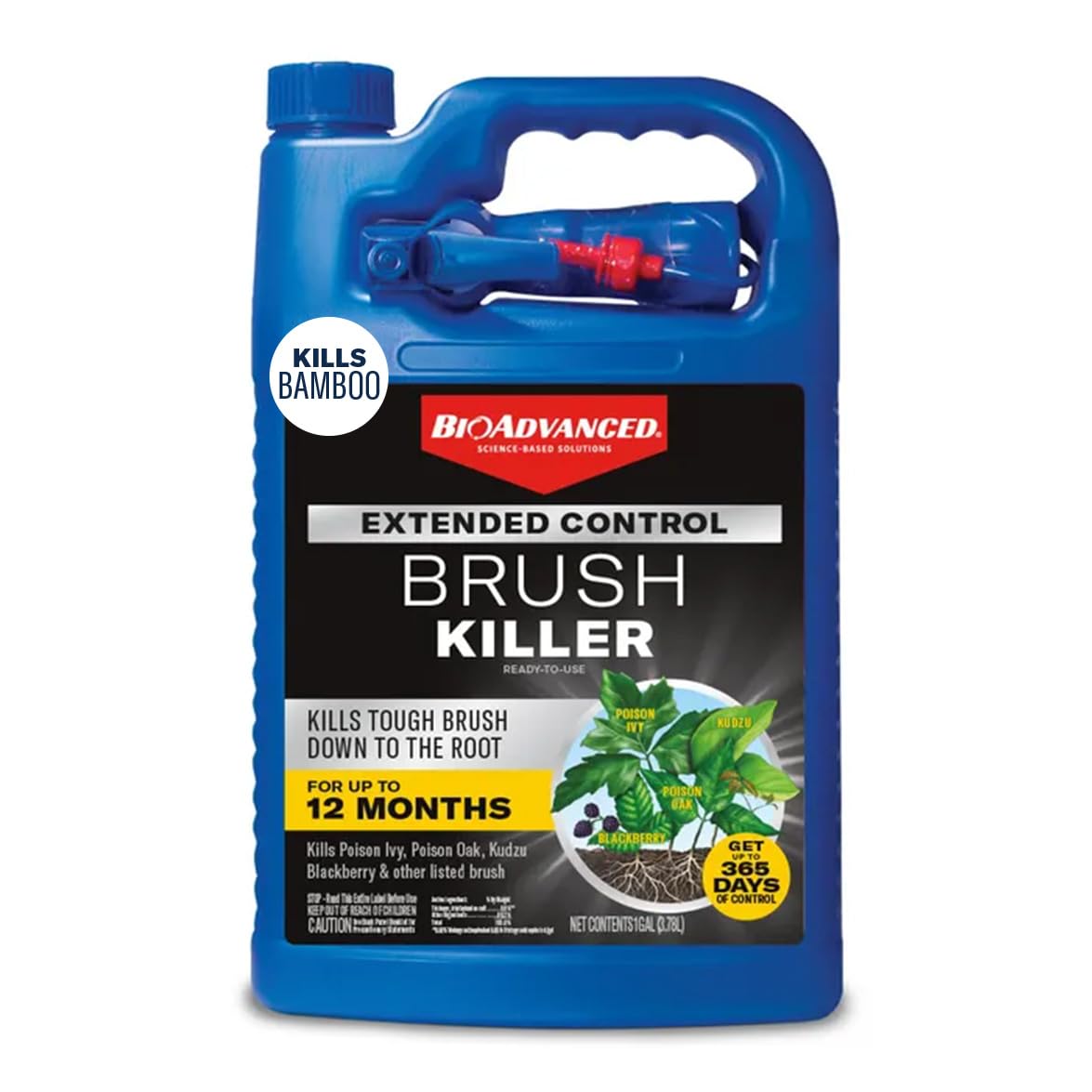
The grab-and-go spray that keeps bamboo down for a full year after one application.
This is the only ready-to-use product in the roundup, meaning you do not need a separate sprayer or mixing bucket — just point the nozzle and spray until the leaves are wet but not dripping. The standout number here is “up to 365 days of control,” which is a 12-month residual effect in the soil that the other two concentrates do not claim. One reviewer confirmed this in practice: “Killed bush regrowth in under a week; no regrowth for 2+ months,” which matches the manufacturer’s claim of visible results in 1 to 28 days. It covers 500 square feet per bottle, so it is best for defined patches and fence lines, not sprawling groves.
The special penetrating formula uses triclopyr, a different active ingredient from the glyphosate in the other two picks. Triclopyr is specifically better at killing woody brush and broadleaf plants like poison ivy, kudzu, and English ivy — bamboo is listed on the label. The trade-off is coverage: the Compare-N-Save covers 25,000 sq. ft. per dollar because it is a concentrate, while the BioAdvanced is a fixed 500 sq. ft. per gallon. At 8.5 pounds, it is lighter than the Compare-N-Save jug (8.5 pounds vs. 9.65 pounds), which is noticeable if you are carrying it around the yard.
Not every buyer had success: one reviewer tried three applications on bamboo and saw only “initial shriveling” before the plants survived. This suggests that for very old, thick bamboo stands, the ready-to-use formulation may lack the penetration power that a 41% concentrate provides. But for the average homeowner with a small bamboo patch near the fence, the convenience and the 365-day residual make this the simplest effective solution.
Why it wins
- Ready-to-use sprayer — no mixing, no extra equipment.
- Up to 365 days of residual control from one application.
- Customers note visible results in under a week on bush regrowth.
The limiting factor
- Only covers 500 sq. ft. per bottle — a fraction of the concentrated options.
- Mixed reviews on mature bamboo: one reviewer noted no kill after three attempts.
Best for small infestations: If your bamboo is a contained patch of 500 sq. ft. or less and you want to spray and forget it for the next year, this is the clearest win.
skip it if: your bamboo covers a large area or has very thick, established canes — you will need the higher concentration and bulk of the concentrates.
3. Compare-N-Save 75324 Herbicide, 1-gallon, white
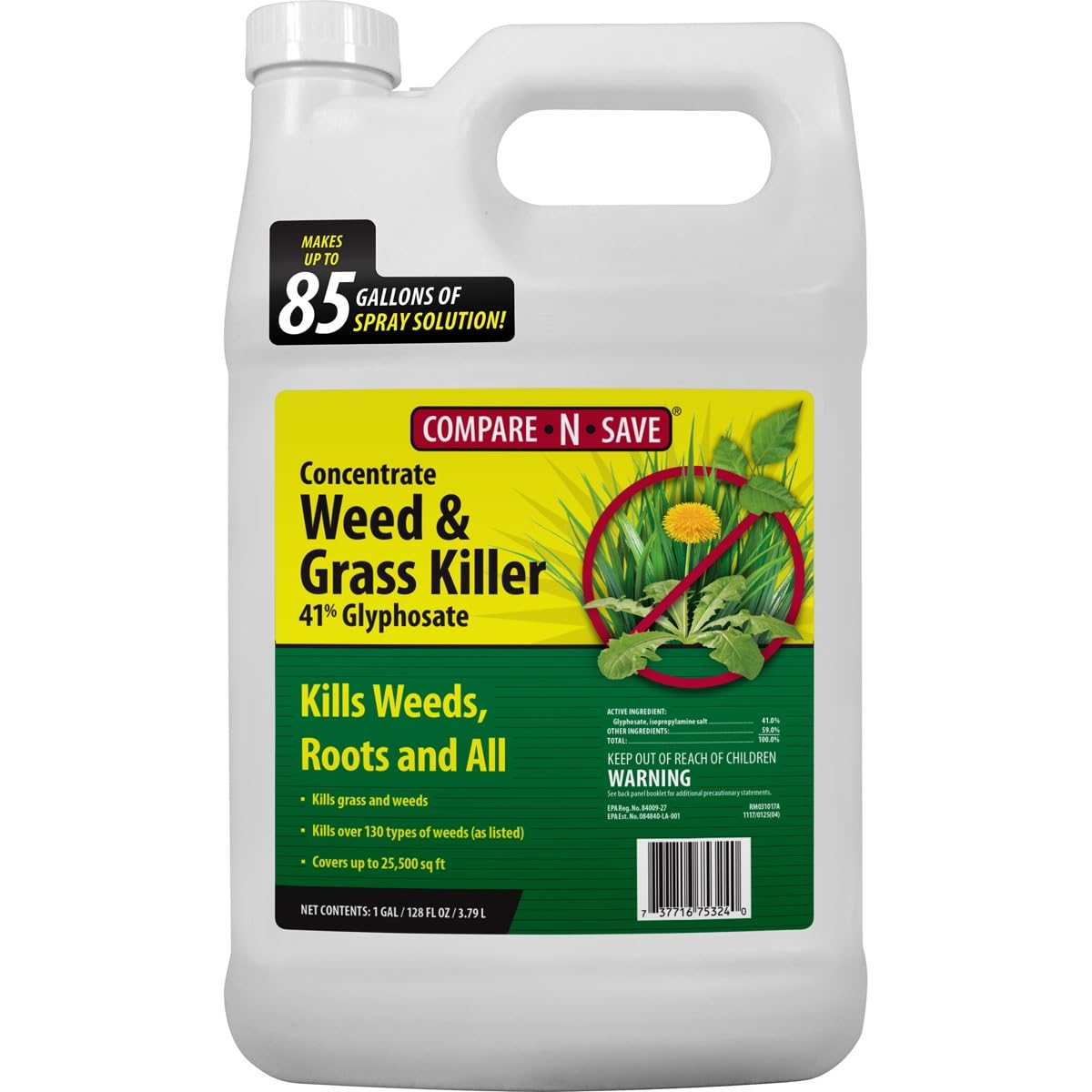
The budget-friendly concentrate that covers 25,000 square feet and makes 85 gallons of spray.
If your bamboo has already spread across a quarter-acre, this is the most cost-effective way to fight it. The Compare-N-Save jug holds 1 gallon of 41% glyphosate concentrate, but when diluted it makes up to 85 gallons of ready-to-use spray — at 25,000 sq. ft. compared to the BioAdvanced ready-to-use bottle’s 500 sq. ft. One buyer put it simply: “Kills weeds effectively but takes weeks, not days.” That patience is the trade-off for the lower price per gallon: glyphosate works systemically, so you will see browning in 2 to 4 days, but full root kill takes several weeks.
It is rainproof in 2 hours, which is a practical edge if you are spraying in a climate where afternoon storms roll in fast. The active ingredient is the same 41% glyphosate as the Plus Herbicide, but without the built-in surfactant — so you may want to add a few drops of dish soap per gallon if you are spraying bamboo with very waxy leaves. The liquid volume is 128 fl. oz. (1 gallon), the same as the BioAdvanced, but because it is concentrate you get vastly more coverage: 25,000 square feet versus 500 square feet for the BioAdvanced. In weight, it is 9.65 pounds, compared to the BioAdvanced jug’s 8.5 pounds.
Some buyers have noted the packaging is not always secure — one review mentioned a loose cap that required careful opening. And because it is a straight glyphosate concentrate without a specialized brush-killer additive, it may require a slightly higher mix ratio (the maker suggests following the label for woody plants) than the triclopyr-based BioAdvanced. But for the raw price-to-coverage ratio, nothing here beats it.
The coverage king: At 25,000 square feet from one gallon of concentrate, versus the BioAdvanced ready-to-use’s 500 sq. ft., making it the obvious choice for large patches.
Patience required: As buyers repeatedly note, it kills effectively but takes weeks, not days — and without a built-in surfactant, bamboo’s waxy leaves may need a help with adhesion.
Reach for this if: you have a large bamboo area (a quarter-acre or more) and you are willing to wait a few weeks for full root kill in exchange for the lowest cost per square foot.
Look elsewhere if: you want a quick 1-to-7-day knockdown and do not want to buy a separate surfactant — the BioAdvanced or the Plus Herbicide with built-in surfactant may be a better fit.
Understanding the Specs
Glyphosate concentration (the percentage that matters)
The number on the bottle — 41% — tells you how much pure herbicide is in the mix. 41% glyphosate is the standard professional grade; lower concentrations (like 18% or 20% found in many ready-to-use sprays) are less effective on bamboo’s thick leaves. A higher percentage means the plant absorbs more active ingredient per drop, which is critical for killing underground rhizomes. The Compare-N-Save and the Plus Herbicide both carry 41% glyphosate. The BioAdvanced uses a different active (triclopyr) formulated for brush and woody plants, which works differently but targets the same root system.
Coverage in square feet (matching product to patch size)
Coverage tells you how much area a full bottle will treat at the manufacturer’s recommended rate. The BioAdvanced covers 500 square feet — roughly a 20×25-foot patch. The Compare-N-Save, mixed as concentrate, covers 25,000 square feet — that is half an acre. If you have a single clump near the fence, the smaller coverage is fine. If bamboo is running along a property line, the concentrate’s coverage saves you from buying multiple bottles.
FAQ
Does regular Roundup kill bamboo or do I need a special product?
Will spraying the leaves kill the roots or does bamboo need a stump treatment?
How long does it take for the bamboo to actually die after spraying?
Can I use these products near my vegetable garden or fruit trees?
What is the difference between triclopyr and glyphosate for bamboo?
Is it safe for pets after the spray dries?
How much area does each product actually cover in real-world use?
Will these products kill the roots or will bamboo grow back next year?
Do I need a separate surfactant when using Compare-N-Save on bamboo?
What is the best time of year to spray bamboo killer for maximum effectiveness?
Final Thoughts: The Verdict
For most people with a contained bamboo problem, the best weed killer for bamboo is the BioAdvanced Extended Control Brush Killer because its ready-to-use convenience and 365-day residual control mean you spray once and do not think about bamboo for a year. If you are fighting a large grove and want the strongest per-dollar glyphosate concentration, the Plus Herbicide Credit 41 Extra with built-in surfactant is the top performer. And for maximum coverage on a budget, the Compare-N-Save 75324 covers 25,000 square feet from one gallon of concentrate — ideal if you are reclaiming a hillside or a property line.
How We Picked
We do not accept paid placement. Every pick is matched to a real buyer and a real use-case; we do not hands-on test units.
Sources & Methodology
Specifications: manufacturer listings and product documentation. Review insights: verified customer reviews, as of July 2026. Pricing: not shown on this page (it changes often); check the current price via the retailer link.
As an Amazon Associate, Lawn Gear Lab earns from qualifying purchases. This does not affect which products we feature.