
Specs are compiled from manufacturer listings and verified buyer reviews and can change over time — please confirm the key details on the product page before buying.
Aphids can turn a thriving garden into a sticky, curled-leaf mess in what feels like a single night. The real trick is not just finding something that kills the ones you can see — it is using a formula that handles the eggs, the next generation, and does not burn your plants in the process. This guide cuts straight to the six sprays that actually solve the problem, from contact killers to systemic protectors.
I’m Rikta — the founder and writer behind Lawn Gear Lab. This guide is built by comparing the manufacturers’ published specifications and the patterns across verified customer reviews, so you get each pick’s real strengths and trade-offs instead of marketing spin.
Whether you are dealing with a sudden infestation on your roses or a stubborn outbreak on your indoor herbs, picking the right aphid killer hinges on one thing: matching the active ingredient to where and what you are growing.
Quick Picks
- Grower’s Ally Crop Defender 3 — Best Overall
- Ortho Rose and Flower Insect Killer — Top Performer
- Botanical Tradesman Neem Oil Concentrate — Best Value
- Bonide All Seasons Horticultural & Dormant Spray Oil — Versatile Pick
- Monterey Take Down Garden Spray RTU — Fast Action
- Monterey Neem Oil RTU — Budget Champion
How To Choose The Best Aphid Killer
Not every spray works the same way, and picking the wrong one can waste time or damage your plants. Here are the three real factors that decide whether a product will solve your aphid problem or just knock it back for a few days.
Formulation Type: Ready-to-Use vs Concentrate
Ready-to-use (RTU) sprays come already mixed in a bottle — you shake, aim, and spray. They are perfect for small gardens or quick spot treatments because there is no measuring or mixing. Concentrates require you to dilute the oil or chemical with water, which makes them more economical if you have a large yard or multiple plants to treat. A concentrate like pure neem oil gives you more control over the strength, but it takes an extra step every time you spray.
Active Ingredient: Contact vs Systemic
A contact killer works by directly hitting the aphid’s body — usually by smothering it or breaking down its outer shell. Botanical oils (neem, canola, mineral) and pyrethrins are contact killers. Systemic insecticides are absorbed into the plant itself, so when an aphid bites into a treated leaf, it ingests the poison and dies. Systemic action lasts longer (some products claim up to four weeks of protection), but contact killers are often safer for beneficial insects that visit the plant after the spray dries.
Bee Safety and Edible Plant Timing
If you grow vegetables, herbs, or flowering ornamentals that attract pollinators, check whether the product is labeled bee-safe and how close to harvest you can apply it. Some oils (like neem) are safe to use right up until the day you pick your produce, while stronger chemical insecticides may require a waiting period. Also avoid spraying when bees are actively foraging — early morning or late evening is the safest window.
Quick Comparison
| Model | Best For | Active Ingredient | Volume | Form Type | Amazon |
|---|---|---|---|---|---|
| Grower’s Ally Crop Defender 3 | Organic indoor & outdoor gardens | Botanical oils blend | 24 oz | Ready-to-use | Amazon |
| Bonide All Seasons Spray Oil | Dormant & growing season coverage | Mineral oil | 32 oz | Ready-to-spray (hose-end) | Amazon |
| Ortho Rose and Flower Insect Killer | Systemic rose & flower protection | Systemic dual-action | 24 oz | Ready-to-use | Amazon |
| Botanical Tradesman Neem Oil Concentrate | Pure neem oil for homemade sprays | 100% cold-pressed neem oil | 3.4 oz (makes 320 oz) | Concentrate | Amazon |
| Monterey Neem Oil RTU | Ready-to-use organic multipurpose | Neem oil | 32 oz | Ready-to-use | Amazon |
| Monterey Take Down Garden Spray | Fast contact kill with natural pyrethrins | Pyrethrins + canola oil | 32 oz | Ready-to-use | Amazon |
In‑Depth Reviews
1. Grower’s Ally Crop Defender 3
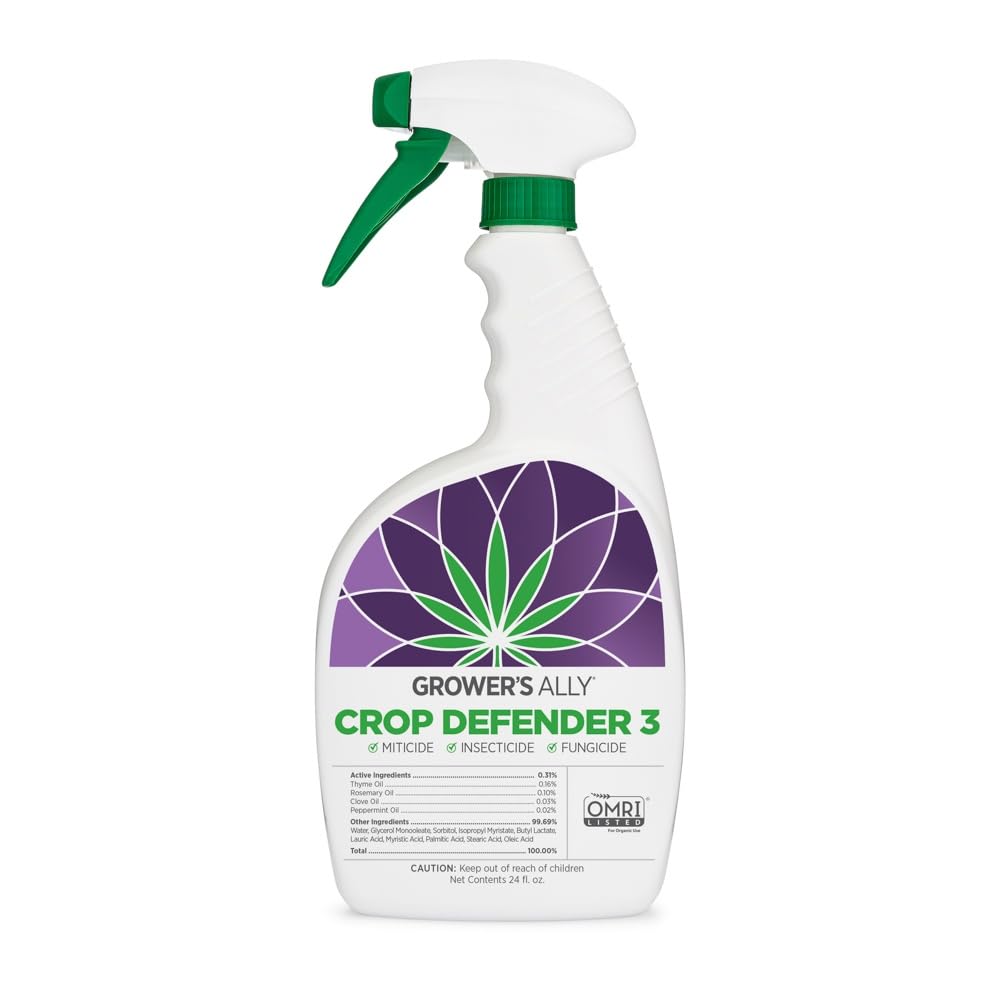
The triple-action spray that smothers aphids and mites without scorching a single leaf.
Buyers report it is the “best spray for aphids and mites” — and the reviews back that up across indoor, outdoor, greenhouse, and hydroponic setups. The triple-action formula blends botanical oils with a built-in surfactant (a wetting agent that helps the spray spread evenly across the leaf surface) so it kills aphids, spider mites, russet mites, thrips, and their eggs on contact. Unlike many organic sprays, it is FIFRA 25(b) exempt and OMRI Listed for organic gardening, meaning it tests clean for synthetic pesticides and heavy metals.
At 1.7 pounds, it is noticeably lighter than the Monterey Neem Oil RTU (2 pounds) — so it is easier to hold and aim for extended sessions on large plants. One reviewer confirmed it “does not burn the leaves — even on seedlings,” which is the biggest worry with oil-based sprays. You can safely apply it through all growth stages, including the flowering cycle, and harvest the same day.
Why it earns the top spot
- Triple-action miticide, insecticide, and fungicide in one bottle
- OMRI Listed and bee-safe when dry
- No burning on seedlings or mature leaves
One thing to know
- Smaller 24 oz bottle may need frequent repurchase for large gardens
Grab this if: You want one spray that covers aphids, mites, and powdery mildew without hurting your organic gardening certification.
Consider the concentrate version if: You need to treat more than a dozen medium-sized plants regularly.
2. Ortho Rose and Flower Insect Killer

Systemic protection that keeps roses bloom-ready for weeks with just an occasional spray.
Where the Grower’s Ally works on contact, this Ortho formula uses a dual-action approach: it kills listed insects on contact and then gets absorbed by the plant for systemic action (the plant itself becomes toxic to pests that bite into it). It claims protection for up to four weeks per application, which explains why one reviewer noted that “a few sprays per year keep roses healthy, enabling weekly cuttings.”
Buyers confirm it handles Japanese beetles — one noted “I bought this because I had Japanese Beetles on my roses. It sure did the trick!” — as well as general aphids and small spider mites. The trade-off, as one reviewer pointed out, is that the systemic effect is “weak systemic” and may need multiple sprays for heavy infestations on a single plant. For occasional drenching on a single infested begonia, it worked temporarily, but longstanding mealybug problems required repeated treatments.
What stands out
- Systemic action protects up to 4 weeks per spray
- Kills over 100 listed insect types
- Safe for blooms and won’t harm plants
The catch
- Some reviews note the systemic effect is not strong enough for large mealybug or heavy aphid colonies
Best for: Rose and flower enthusiasts who want a long-lasting shield with minimal spray frequency.
Look elsewhere if: You are dealing with a dense, established infestation that requires contact-killing force.
3. Botanical Tradesman Neem Oil Concentrate

A tiny bottle of 100% cold-pressed neem that stretches into gallons of aphid-killing spray.
This bottle holds just 3.4 fluid ounces of pure, undiluted neem oil — but it makes 320 fluid ounces of ready-to-use spray when mixed with water and a little mild soap. That is the kind of value that matters if you have a full vegetable patch or a collection of indoor plants that need regular treatments. It is 100% cold-pressed from the Indian neem nut with no added water, vegetable oils, or fillers.
Owners mention it “worked! Got rid of the thrips and scale that were killing my plant” in just two treatments. The catch is that the concentrate is “very thick” (multiple reviewers warn it is “very thick and not easily mixed with water”). One helpful tip from reviewers: putting the closed bottle in hot water before measuring makes it much easier to pour and blend. You will need your own spray bottle and a mild liquid soap as an emulsifier (a helper ingredient that lets the oil mix evenly into water).
Why this concentrate wins
- Makes 320 oz of spray from one small bottle — exceptional value per treatment
- 100% pure cold-pressed with no synthetic additives or diluents
- Organic and safe for use on edible plants up to harvest day
The mixing challenge
- Thick consistency requires patience and warm water to blend smoothly
- Must buy your own spray bottle if you do not already have one
Reach for this if: You want the purest neem oil concentrate and you do not mind mixing a batch before each spray session.
skip it if: You prefer the grab-and-go convenience of a ready-to-use bottle.
4. Bonide All Seasons Horticultural & Dormant Spray Oil

A mineral-oil spray that works from late winter dormancy right through the growing season.
Most insect killers wait until you see the bugs. Bonide’s All Seasons Spray Oil covers you year-round, including the dormant stage (when plants are bare and overwintering eggs are sitting on the bark), the green tip stage, and the delayed dormant stage — not just during active growth. It uses mineral oil as the active ingredient, which smothers pests like aphids, scale, mites, mealybugs, and adelgids rather than poisoning them with a chemical toxin.
Buyers confirm it “took care of the black bean aphids on my Spanish Broom” and handled black cherry aphids “overnight.” On a 25-foot Spanish Broom, it required thorough soaking and a well-hydrated plant for maximum absorption. One experienced reviewer noted that while the product itself is excellent, the included hose-end sprayer is hard to calibrate and messy — they recommended using a pump sprayer instead for better control and less waste. Compared to the Grower’s Ally (1.7 pounds), this bottle weighs 2 pounds and is 4 x 3 x 2 inches in package dimensions, making it compact but slightly heavier.
The year-round advantage
- Works in all four seasonal stages, including dormant and delayed dormant
- Mineral oil leaves no toxic residues and is approved for organic gardening
- Controls both insects (aphids, mites, scale) and fungal diseases
Setup note
- Hose-end sprayer attachment is imprecise and wasteful — plan to use your own pump sprayer for best results
Ideal for: Gardeners who want a single oil-based product they can use from pre-spring dormancy through harvest on fruits, veggies, and ornamentals.
Watch out for: The hose-end sprayer that comes with it — skip it and use a dedicated sprayer for precise coverage.
5. Monterey Take Down Garden Spray RTU
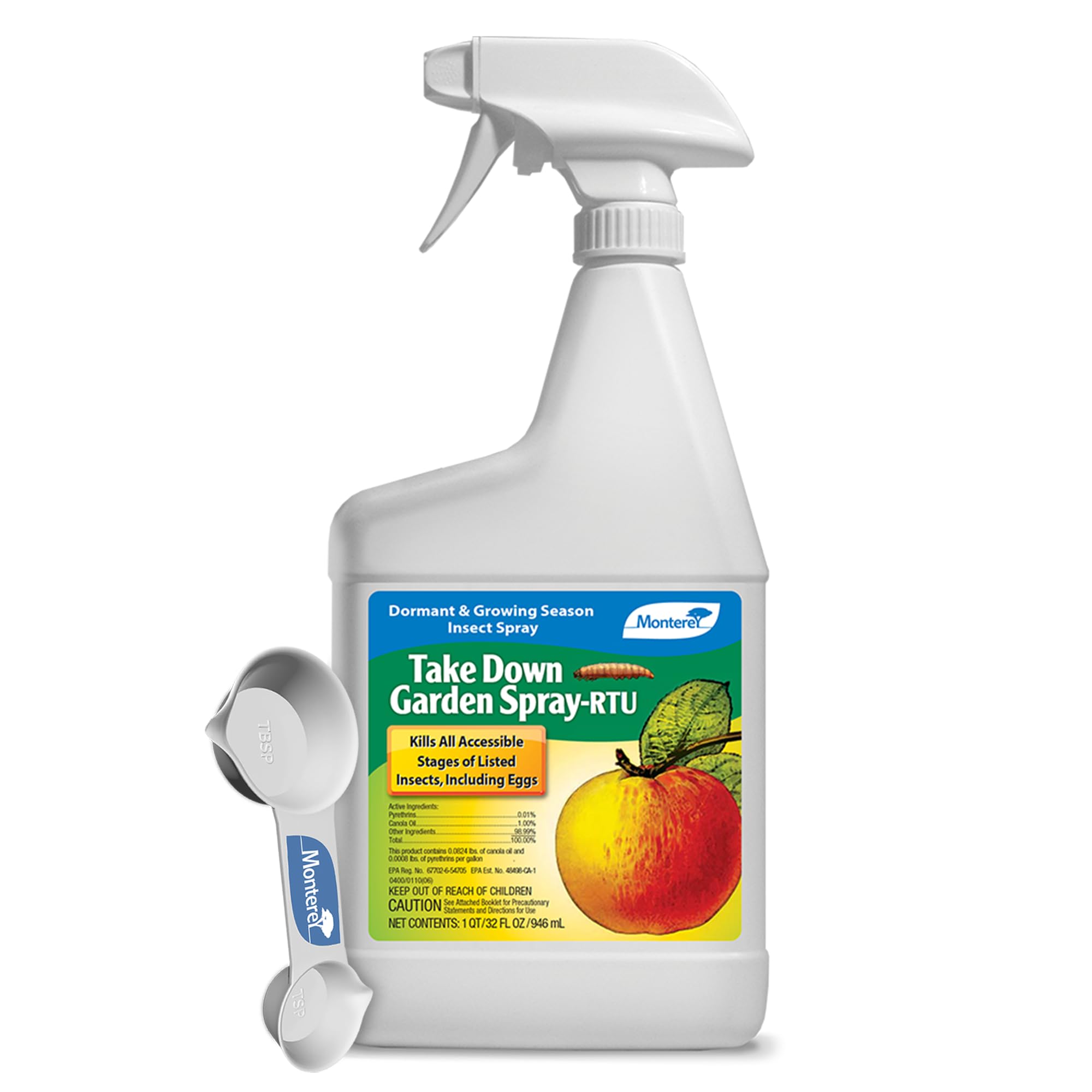
A natural pyrethrin spray that kills aphids on contact and degrades fast, so beneficial bugs stay safe.
Unlike the oil-based sprays that smother pests, this Monterey formula uses 0.01% pyrethrins (natural compounds extracted from chrysanthemum flowers) combined with 1.00% canola oil. Pyrethrins attack the insect’s nervous system on contact, providing a very fast knockdown — customers note it killed spider mites within two weeks when sprayed every three days, and it got rid of sundew aphids “within a day” after Neem oil had failed. The formula is non-persistent, meaning it breaks down quickly in sunlight and does not linger to harm bees and other beneficials that visit after it dries.
The ready-to-use bottle holds 32 fluid ounces and comes bundled with a measuring spoon. One important tip from reviewers: spray at night, because sunlight degrades the pyrethrin, and avoid skin contact to prevent an allergic reaction. Compared to the neem-based products above, this has a low odor — one reviewer specifically noted “low odor vs Neem” — so you won’t get the “dirty diaper” smell that some neem oils produce.
The speed advantage
- Kills all stages of listed insects including eggs on contact
- Non-persistent: protects beneficial insects when you spray correctly (at night)
- Low odor compared to neem-based sprays
Important to know
- Pyrethrin degrades quickly in sunlight — must spray in evening or early morning for full effect
- Some users report skin sensitivity; wear gloves
Turn to this when: You need a fast-acting contact killer that does not stink up your yard and won’t linger in the environment.
Be aware that: Because it breaks down in light, you may need to respray every few days during an active outbreak.
6. Monterey Neem Oil RTU
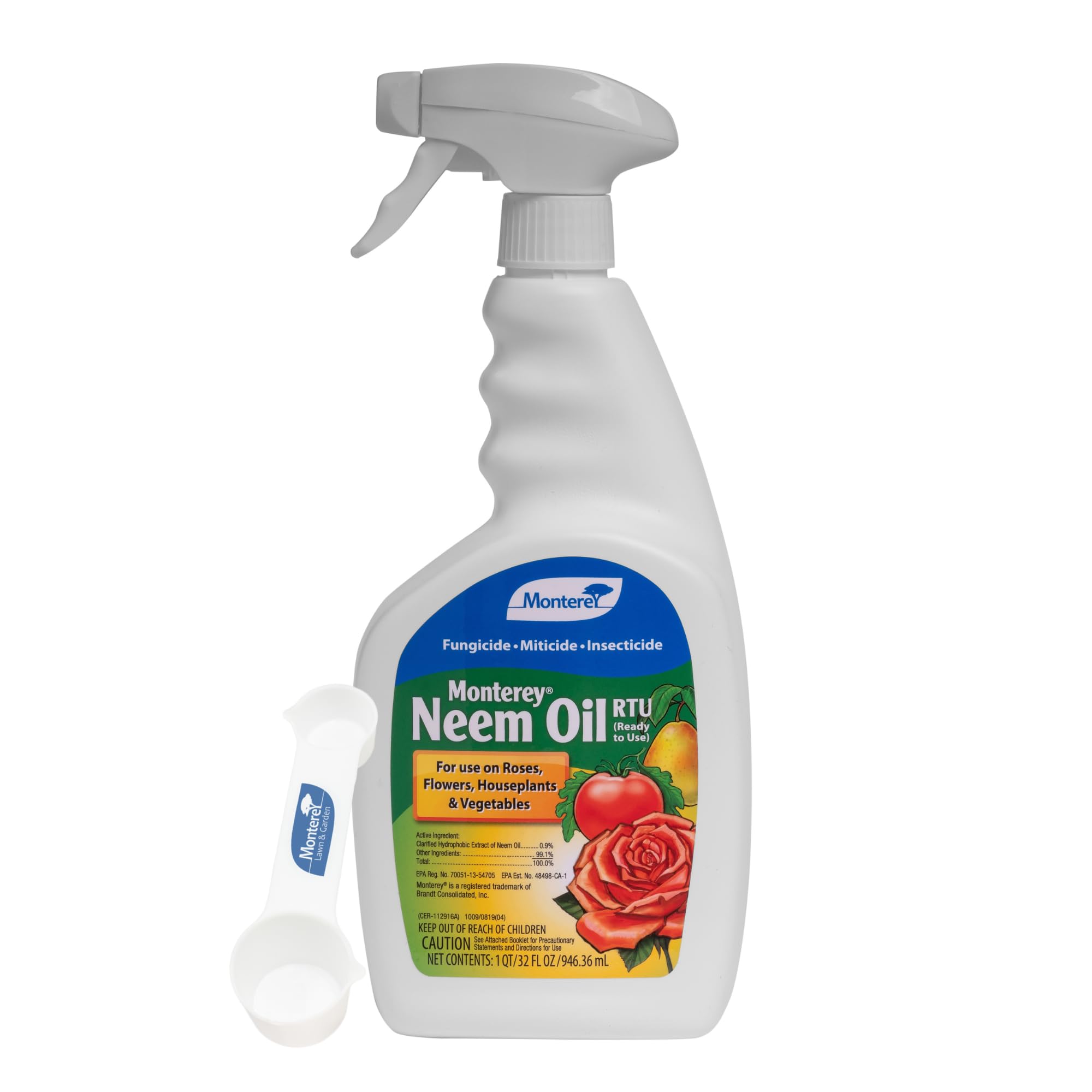
A ready-to-use neem oil that handles black spot and aphids but comes with a powerful odor.
This 32-ounce ready-to-use spray works as a fungicide, insecticide, and miticide all at once. It targets black spot, powdery mildew, rust, aphids, and spider mites, and it is safe to use on edible plants up to the day of harvest. The big plus is convenience — no mixing, no measuring, just shake and spray. The bundled garden measure spoon is a nice bonus for other gardening tasks.
Buyers are honest about the smell: “strong, unpleasant odor like dirty diaper” is a direct quote from one verified reviewer. That smell does dissipate after the spray dries, but the initial application is noticeably pungent compared to mineral oil or pyrethrin sprays. On the performance side, one buyer mentioned it halts the fungus gnat cycle by sterilizing adults and provides good leaf shine, but it is “weak against spider mites” — so if mites are your primary problem, you may need a different product. At 2 pounds with package dimensions of 4 x 3 x 2 inches, it is compact but slightly heavier than the Grower’s Ally (1.7 pounds).
The easy use case
- No mixing: shake and spray straight from the bottle
- Safe for edible plants right up to harvest day
- Controls both insects (aphids) and fungal diseases (black spot, powdery mildew)
The honest trade-offs
- Powerful, unpleasant smell that lingers until the spray dries
- Weak against spider mites, so not a complete broad-spectrum solution
Good for: Budget-minded gardeners who want a no-fuss, ready-to-use neem oil for general aphid and fungus control on vegetables and ornamentals.
Not the best fit if: You are sensitive to strong smells or your primary target is spider mites rather than aphids.
Understanding the Specs
Contact vs Systemic Action
A contact killer works only when the spray directly hits the insect’s body. Oils like neem, mineral, and canola smother the pest or disrupt its outer layer. Systemic insecticides get absorbed into the plant’s tissue, so any aphid that bites into a treated leaf ingests the poison and dies. Contact sprays work immediately but need thorough coverage. Systemics last longer (up to four weeks in some products) but take a few days to move through the plant.
Active Ingredient Types
The three main categories are botanical oils (neem, mineral, canola), pyrethrins (natural flower-derived nerve toxins), and synthetic chemicals. Oils are generally safe for organic gardening and break down quickly. Pyrethrins offer very fast knockdown but degrade in sunlight. Synthetic systemics last longest but may require waiting periods before harvest. Each type trades off speed against persistence and safety for beneficial insects.
FAQ
Can I use an aphid killer on my vegetable garden right before harvest?
Will these sprays harm bees or ladybugs?
How often should I spray for an active aphid infestation?
What is the difference between horticultural oil and neem oil?
Can I mix different aphid killers together for stronger effect?
Why do aphids keep coming back even after I spray?
Is it safe to use aphid killer on indoor houseplants?
What is the best time of day to spray for aphids?
Final Thoughts: The Verdict
For most people, the aphid killer winner is the Grower’s Ally Crop Defender 3 because it delivers a triple-action botanical formula that kills aphids, mites, and powdery mildew without burning seedlings — all while being OMRI Listed for organic gardening. If you want systemic protection that lasts weeks between sprays on your roses, grab the Ortho Rose and Flower Insect Killer. And for the purest neem oil concentrate that stretches into gallons of spray for a large garden, the standout is the Botanical Tradesman Neem Oil.
How We Picked
We do not accept paid placement. Every pick is matched to a real buyer and a real use-case; we do not hands-on test units.
Sources & Methodology
Specifications: manufacturer listings and product documentation. Review insights: verified customer reviews, as of July 2026. Pricing: not shown on this page (it changes often); check the current price via the retailer link.
As an Amazon Associate, Lawn Gear Lab earns from qualifying purchases. This does not affect which products we feature.