
Specs are compiled from manufacturer listings and verified buyer reviews and can change over time — please confirm the key details on the product page before buying.
Chickweed pops up fast, spreads into a thick mat, and chokes out the grass you actually want. The challenge is choosing a herbicide that kills chickweed without harming your lawn, and accepting that the best options often take weeks to work.
I’m Rikta — the founder and writer behind Lawn Gear Lab. This guide is built by comparing the manufacturers’ published specifications and the patterns across verified customer reviews, so you get each pick’s real strengths and trade-offs instead of marketing spin.
Whether you are dealing with a few scattered clumps or a full lawn takeover, the right herbicide for chickweed depends on your grass type, how much area you need to cover, and if you want a ready-to-spray bottle or a concentrate you mix yourself.
Quick Picks
- Bonide Weed Beater Ultra, 32 oz Concentrate — Top Performer
- Ortho Weed B Gon Chickweed, Clover & Oxalis Killer for Lawns, 32 Oz. (Pack of 2) — Best Overall
- Bonide Chickweed, Clover & Oxalis Killer, 128 oz Ready-to-Use Spray — Best Value
- Nufarm Change Up, Premium Selective Herbicide, 32 oz — Premium Concentrate
- Fertilome (10525) Weed Free Zone, 32 oz — Fast Acting
- Hi-Yield (33431) Atrazine Weed Killer RTS, 32 oz — Lawn-Safe Choice
How To Choose The Best Herbicide For Chickweed
Chickweed has shallow roots and spreads quickly, but it is manageable with the right active ingredient. Your main decision is your grass type and how long you can wait for results.
Match the active ingredient to your grass type
Atrazine is safe for St. Augustine and Centipede lawns but can harm other grasses. Dicamba and triclopyr are broader tools that work on most cool-season and warm-season turf. If you have Bermuda, Zoysia, Fescue, or Kentucky Bluegrass, look for a product with dicamba or triclopyr instead of atrazine.
Decide between ready-to-spray and concentrate
Ready-to-spray bottles attach to your hose and mix on their own — no measuring, no mess. Concentrates save money per application and let you control the strength, but you need a sprayer and a bit more time. For a single treatment, a ready-to-spray is simpler. For regular use or large yards, a concentrate is more cost-effective.
Check the coverage number
Herbicide labels list how many square feet each bottle covers. A small 32-ounce ready-to-spray might cover 1,000 to 4,000 square feet, while a larger bottle or a concentrated formula can cover over 10,000 square feet. Match coverage to your lawn size to avoid running out mid-application.
Quick Comparison
| Model | Best For | Active Ingredients | Coverage | Liquid Volume | Amazon |
|---|---|---|---|---|---|
| Bonide Weed Beater Ultra | Kills over 200 broadleaf weeds fast | Dicamba, 2,4-D, others | 1 pint treats 10,000 sq ft | 32 oz (concentrate) | Amazon |
| Ortho Weed B Gon Chickweed, Clover & Oxalis Killer | Best overall coverage (12,800 sq ft) | Triclopyr, Dicamba, others | 12,800 sq ft | 64 oz (2-pack ready-to-spray) | Amazon |
| Bonide Chickweed, Clover & Oxalis Killer | Large ready-to-spray volume | See label | 10,000 sq ft | 128 oz (ready-to-spray) | Amazon |
| Nufarm Change Up | Premium concentrate for over 200 weeds | MCPA, Fluroxypyr, Dicamba | 1,000 sq ft at.46-1.1 oz rate | 32 oz (concentrate) | Amazon |
| Fertilome Weed Free Zone | Starts working within hours | Dicamba, 2,4-D, others | Full (check label) | 32 oz (concentrate) | Amazon |
| Hi-Yield Atrazine Weed Killer | St. Augustine & Centipede lawns | Atrazine | 3,720 sq ft | 32 oz (ready-to-spray) | Amazon |
In‑Depth Reviews
1. Bonide Weed Beater Ultra, 32 oz Concentrate

You see damage to chickweed within hours of spraying, not days — that is faster knockdown than most atrazine or triclopyr options here.
This 32-ounce concentrate is built for speed. The manufacturer claims you can notice injury to weeds within hours of spraying, and plant death happens within 7 to 14 days. That is faster than the Hi-Yield Atrazine, which often needs 3 weeks to show results. It is also rainproof after it dries, so a surprise shower will not wash your work away.
One pint (0.5 pint per 5,000 sq ft) treats roughly 10,000 square feet, giving you a lot of coverage from a single 32-ounce bottle. Unlike the Bonide Chickweed, Clover & Oxalis Killer which comes ready-to-spray, this is a concentrate that mixes with water — you need a backpack, compression, or knapsack sprayer. It is selective (kills only broadleaf weeds like chickweed, dandelion, clover, ground ivy, oxalis, and ragweed, not lawn grasses). No customer reviews are in the data, so real-world feedback is not available here.
Why it stands out
- Visible damage within hours — faster knockdown than almost any chickweed herbicide
- One pint covers 10,000 sq ft, so a 32 oz bottle goes a long way
- Rainproof once dry, no need to re-spray after light rain
Things to know
- Requires a separate sprayer — not a hose-attach ready-to-spray
- No customer reviews in the data, so less real-world feedback than other picks
Best for you if: you want the fastest possible knockdown and are comfortable mixing your own spray with a backpacks.
Consider the Ortho Weed B Gon instead if: you prefer a no-mix, hose-attach bottle and do not want to buy a sprayer.
2. Ortho Weed B Gon Chickweed, Clover & Oxalis Killer for Lawns, 32 Oz. (Pack of 2)
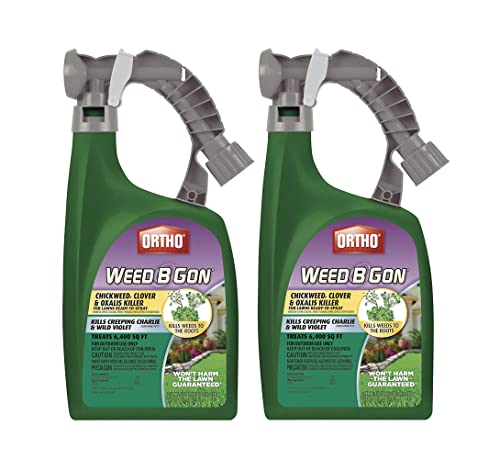
Covers 12,800 square feet, while the Nufarm Change Up is listed at 1,000 sq ft.
This two-pack of ready-to-spray bottles gives you the most coverage of any pick here. Each bottle hooks to your hose, mixes automatically, and kills chickweed, clover, and oxalis down to the roots. It is rainproof in 6 hours, so you have a narrow but manageable dry window. Buyers report that it “got rid of the very stubborn Creeping Charlie in my lawn” — though one reviewer noted it needed four weeks to fully work and another said multiple applications were necessary.
Because it attaches to your hose, there is no measuring or mixing. The total unit count is 64 ounces versus the Hi-Yield Atrazine Weed Killer’s 32-ounce bottle, giving you more product for large lawns. It is designed not to harm your lawn when used as directed, making it a safe pick for most grass types.
Biggest strengths
- 12,800 sq ft coverage covers large lawns with ease
- No mixing required — hose attachment does the work
- Kills down to the roots so weeds do not grow back quickly
Trade-offs
- Some owners mention needing multiple applications for stubborn weeds
- Triclopyr works slowly — be patient for 4 weeks
Best pick for: anyone with a medium to large lawn who wants a simple hose-attach solution that covers a huge area.
skip it if: you need fast results and cannot wait 3-4 weeks for the herbicide to fully work.
3. Bonide Chickweed, Clover & Oxalis Killer, 128 oz Ready-to-Use Spray

A huge ready-to-spray jug that weighs 8 pounds and holds 128 fluid ounces, versus the Hi-Yield Atrazine at 32 fluid ounces.
This is the biggest single bottle in the lineup. The liquid volume is 128 ounces versus the 32-ounce Hi-Yield bottle, and it weighs 8 pounds. It covers up to 10,000 square feet and is labeled to kill chickweed, clover, and oxalis without harming your lawn. Customers note it is “effective on chickweed, clover, dandelions; not on crabgrass” and that adding a surfactant (a spreader-sticker that helps the herbicide stick to weed leaves) helps. One buyer mentioned dandelions died in one spray and clover turned brown in 3 days.
It is a ready-to-use spray, meaning you do not dilute it — just attach the hose or use a sprayer. The trade-off is that some customers found the hand sprayer weak for large lawns and wished it were a concentrate. Unlike the Ortho Weed B Gon, which covers 12,800 sq ft in a two-pack, this covers 10,000 sq ft in one jug but weighs significantly more. It is not a pre-emergent (a product that prevents weed seeds from sprouting), so it only kills existing weeds.
What works well
- Massive 128 oz volume covers large areas without needing to buy multiple bottles
- Kills dandelions in one spray and clover in 3 days per reviewers
- Clear formula with nearly no smell compared to some other herbicides
Limitations
- Hand sprayer is not great for very large lawns — a pump sprayer works better
- Does not work on crabgrass; one reviewer saw no effect on clover patches
Choose this if: you want a giant ready-to-spray jug for a medium lawn and prefer not to mix concentrates.
Look elsewhere if: you need a pre-emergent or want the absolute fastest weed kill — this takes a few days to show results.
4. Nufarm Change Up, Premium Selective Herbicide, 32 oz

A premium three-active-ingredient formula that controls over 200 broadleaf weeds including chickweed — but it treats only 1,000 sq ft, so it suits spot patches better than the 12,800-sq-ft Ortho Weed B Gon.
Nufarm Change Up uses MCPA (51.05%), fluroxypyr (6.0%), and dicamba (4.17%) — a combination that gives it excellent control on hard-to-kill species like thistles and oxalis. At 2.1 pounds, it is listed alongside the Hi-Yield Atrazine at 2 pounds, but the coverage is different: 0.46 to 1.1 oz per 1,000 square feet. That makes it a more targeted concentrate for spot treatments rather than broadcasting across an entire lawn.
It is labeled for a huge range of turfgrasses: cool-season types like Kentucky bluegrass, ryegrass, and fescue, plus warm-season types like Bermuda, Zoysia, St. Augustine, Centipede, and Bahia. Unlike the Ortho Weed B Gon which covers 12,800 sq ft in a ready-to-spray format, this covers 1,000 square feet when used at the lower rate — so it is best for small lawns or targeted patches. There are no customer reviews in the data, so real-world feedback is limited.
Why it stands out
- Three active ingredients tackle over 200 broadleaf weeds including stubborn thistles
- Labeled for both cool-season and warm-season turfgrasses — very versatile
- Premium concentrate for precise spot treatment
Considerations
- Only covers 1,000 sq ft at the use rate — not for large lawns
- No customer reviews, so less real-world data on performance
Best suited for: small lawns or targeted chickweed patches where you want a professional-grade concentrate.
Not ideal for: big lawns needing full coverage — the Ortho Weed B Gon covers 12,800 sq ft, while this one is listed at 1,000 sq ft.
5. Fertilome (10525) Weed Free Zone, 32 oz
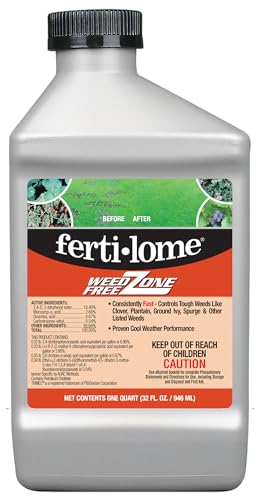
Provides evidence of injury within hours of spraying — one of the fastest starts of any chickweed herbicide, alongside the Bonide Weed Beater Ultra.
Fertilome Weed Free Zone is a dicamba-based concentrate that controls over 80 broadleaf weeds including chickweed, clover, spurge, and thistle. The maker claims you can see signs of injury within hours, which puts it in the same fast-acting category as the Bonide Weed Beater Ultra. It is safe on a wide range of grasses: Kentucky Bluegrass, Bermudagrass, Bahiagrass, Zoysiagrass, and more.
This is a concentrate that mixes with water — simply follow the label rate and spray your lawn thoroughly. The label recommends spraying when broadleaf weeds are young and actively growing, whether in spring, summer, or fall. Unlike the Ortho Weed B Gon which is a ready-to-spray hose attachment, you need a sprayer for this one. There are no customer reviews in the data, so buyer experiences are not documented here.
What it does well
- Visible damage within hours — fast action for a concentrate
- Safe on a broad range of cool-season and warm-season grasses
- Controls over 80 different broadleaf weed species
What to note
- Requires a separate sprayer — not a ready-to-spray bottle
- No customer reviews available for real-world verification
Best for: homeowners who want fast visible results and already own a pump or backpack sprayer.
Skip if: you prefer a no-mix, hose-attach application and do not want to buy a sprayer.
6. Hi-Yield (33431) Atrazine Weed Killer RTS, 32 oz
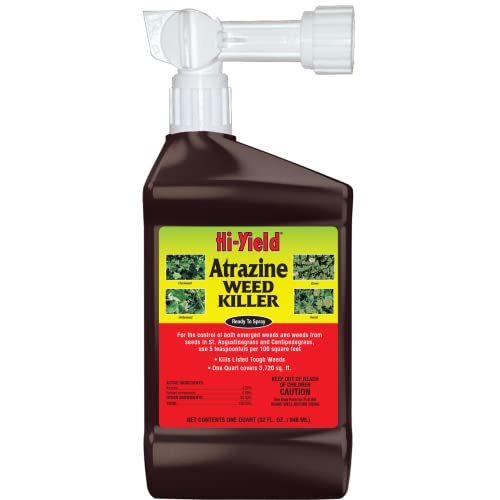
Designed specifically for St. Augustine and Centipede lawns — atrazine kills chickweed without harming those grass types, but it is not safe on Bermuda, Fescue, or Zoysia.
This ready-to-spray atrazine weed killer treats up to 3,720 square feet of lawn and targets chickweed, henbit, clover, and more. Reviewers point out that “applied to St. Augustine for annual bluegrass; no effect after 10 days; after 3 weeks, bluegrass died, St. Augustine unharmed.” That three-week timeline is common for atrazine — it works slowly by restricting nutrients to the weeds rather than burning them on contact. One reviewer warned that the bottle lacks a pour measurement, so you need a separate measuring cup for accuracy.
At 2 pounds and 32 fluid ounces, it is the same bottle size as the Bonide Weed Beater Ultra, but the coverage numbers differ: the Bonide covers 10,000 sq ft per pint of concentrate, while this covers 3,720 sq ft total. Unlike the Nufarm Change Up which is labeled for many grass types, this is specifically for St. Augustine and Centipedegrass only — using it on other lawns can kill your grass. Avoid overdose by spraying evenly, not spot-spraying, and fertilize 4 days after application.
Strengths
- Specifically safe for St. Augustine and Centipede lawns when used correctly
- Ready-to-spray bottle makes application quick and easy
- Buyer-verified: killed annual bluegrass in St. Augustine after 3 weeks
Drawbacks
- Works very slowly — visible results take 3 weeks or more
- Bottle lacks a pour measurement; you need a measuring cup
- Only safe on St. Augustine and Centipede — not for Bermuda, Fescue, or Zoysia
Reach for this if: you have a St. Augustine or Centipede lawn and want a simple, ready-to-spray solution that will not harm your grass.
Look elsewhere if: you have Bermuda, Fescue, Zoysia, or any other grass type — atrazine can kill them.
Understanding the Specs
Active Ingredients
The chemical compounds that actually kill the chickweed. Atrazine is your go-to for St. Augustine and Centipede lawns but is dangerous on other grasses. Dicamba and triclopyr are common broader-spectrum options safe on most cool-season and warm-season turf. MCPA and fluroxypyr add extra punch against hard-to-kill species like thistles. The active ingredient is the most critical spec — it determines grass safety and weed control range.
Coverage Area
Measured in square feet, this tells you how much lawn one bottle can treat. Ready-to-spray bottles like the 32 oz Ortho cover up to 12,800 sq ft in a two-pack, while concentrates like the Nufarm Change Up treat about 1,000 sq ft per application at the labeled rate. Bigger coverage numbers mean fewer refills and less money per square foot, but you also pay more upfront.
Ready-to-Spray vs. Concentrate
Ready-to-spray bottles attach to your garden hose and mix automatically — no measuring, no sprayer needed. Concentrates cost less per application and let you control the strength, but you need a backpack, compression, or pump sprayer to apply them. For a one-time chickweed treatment on a small lawn, a ready-to-spray is simpler. For regular maintenance or large yards, a concentrate stretches your dollar further.
Selective vs. Non-Selective
A selective herbicide kills only broadleaf weeds (like chickweed, clover, dandelions) and leaves your lawn grass unharmed. All six picks here are selective. Non-selective herbicides kill everything — grass and weeds alike — and are only used for spot treatments on patios, driveways, or garden beds. Always check the label for which grass types are safe before spraying.
FAQ
What is the best herbicide for chickweed in St. Augustine grass?
Will these herbicides harm my Bermuda grass lawn?
How long does it take for chickweed to die after spraying?
Can I use these herbicides on vegetable gardens or flower beds?
Do I need to mow before applying chickweed herbicide?
Is rain a problem after I spray?
What is the difference between atrazine and dicamba for chickweed?
Can I spot-treat chickweed patches or do I need to spray the whole lawn?
How often should I reapply chickweed herbicide?
What is a surfactant and do I need one?
Final Thoughts: The Verdict
If you want one dependable pick, the herbicide for chickweed winner is the Ortho Weed B Gon Chickweed, Clover & Oxalis Killer because it covers 12,800 square feet, attaches to your hose with no mixing, and buyers confirm it kills stubborn Creeping Charlie and clover. If you want the fastest knockdown, grab the Bonide Weed Beater Ultra — visible damage within hours and rainproof once dry. And for St. Augustine or Centipede lawns, the standout is the Hi-Yield Atrazine Weed Killer, though you need to wait 3 weeks for results.
How We Picked
We do not accept paid placement. Every pick is matched to a real buyer and a real use-case; we do not hands-on test units.
Sources & Methodology
Specifications: manufacturer listings and product documentation. Review insights: verified customer reviews, as of July 2026. Pricing: not shown on this page (it changes often); check the current price via the retailer link.
As an Amazon Associate, Lawn Gear Lab earns from qualifying purchases. This does not affect which products we feature.