
Specs are compiled from manufacturer listings and verified buyer reviews and can change over time — please confirm the key details on the product page before buying.
You can save money and eat fresher greens by growing sprouts at home — but one bad batch of mold can kill the whole idea fast. The secret is the mesh screen in the lid, which controls airflow and drainage while keeping tiny seeds inside. Get that right, and your first batch tastes crisp and clean, not slimy. These kits focus on that detail so you get a reliable starting point.
I’m Rikta, the founder behind Lawn Gear Lab. This guide compares published specs from manufacturers and patterns from verified customer reviews. You get real strengths and trade-offs for each pick, not marketing claims.
A good sprouting kit turns the daily rinse-and-drain into a simple habit. It puts fresh, crunchy greens on your plate every week, with minimal effort.
Quick Picks
- Haswe Seed Sprouting Jar Kit (White) — Best Overall
- Haswe Seed Sprouting Jar Kit with Blackout Sleeves — Smart Value
- Malastar Complete Sprouting Jar Kit — Top Performer
- Boombamo Premium Sprouting Jar Kit — Premium Build
- ALCEDIA Premium Sprouting Jar Kit — Best Design
- Elementi Sprouting Jar Kit — Budget Pick
How To Choose The Best Sprouting Kit
Three decisions get you the right kit: the mesh material, the stand and tray design, and if you need extras like blackout sleeves. Get these right, and you will be eating homegrown sprouts within a week.
Mesh Screen Material: 304 vs. 316 Stainless Steel
The screen in the lid keeps seeds inside while letting air and water flow through. Look for stainless steel — it resists rust and is food-grade. The two common grades are 304 and 316 stainless steel. Both are excellent, but 316 is more resistant to corrosion, especially if you rinse with hard water or leave the lid damp. For most home sprouters, 304 is perfectly fine. If you want maximum longevity, 316 is the top choice.
Ventilation and Drainage Design
Successful sprouting needs air circulation and free water drainage. If the jar sits flat, water pools and causes mold. The best kits include a stand that holds the jar at an angle, so excess water drips into a tray below. Look for a drip tray high enough to catch all runoff — your counter stays clean. Some kits use a melamine or unbreakable plastic tray, which is lightweight and dishwasher-safe.
Blackout Sleeves for Light Control
Different seeds have different light needs. Green leafy sprouts like broccoli and alfalfa prefer indirect sunlight to develop their chlorophyll (the green pigment in plants). Bean and grain sprouts grow longer and sweeter in darker conditions. If you plan to sprout a variety of seeds, a kit that includes blackout sleeves is a big advantage. These fabric covers slip over the jar and block light, letting you control the growing environment for each batch.
Quick Comparison
| Model | Best For | Mesh Material | Jars | Stand & Tray | Amazon |
|---|---|---|---|---|---|
| Haswe Seed Sprouting Jar Kit (White) | Best Overall Value | 8/18 Stainless Steel | 2 x 32 oz | Yes | Amazon |
| Haswe Kit with Blackout Sleeves | Light Control for Seeds | Stainless Steel | 2 x 32 oz | Yes | Amazon |
| Malastar Complete Sprouting Kit | Premium 316 Mesh | 316 Stainless Steel | 2 x 32 oz | Yes | Amazon |
| Boombamo Premium Sprouting Kit | Durable 304 Steel Build | 304 Stainless Steel | 2 x 32 oz | Yes | Amazon |
| ALCEDIA Premium Sprouting Jar | Decorative Borosilicate Jar | 316 Stainless Steel | 1 x 30 oz | Yes | Amazon |
| Elementi Sprouting Jar Kit | Simple Two-Jar Set | Stainless Steel Mesh | 2 x 32 oz | No | Amazon |
In‑Depth Reviews
1. Haswe Seed Sprouting Jar Kit (White)

This complete set bundles two 32 oz jars, stainless lids, a stand, a drip tray, and a brush — all in one box.
You get two 32 oz wide-mouth mason jars, two stainless steel sprouting lids (made from 8/18 stainless steel), a break-resistant melamine drip tray, a stainless steel stand, and a canning brush. The stand tilts each jar at a sloped angle so water drains into the tray — your counter stays dry. The melamine tray is high enough to collect runoff, and buyers report it is “break-resistant” and “BPA-free” (meaning it contains no bisphenol A, a chemical some people avoid in food-contact plastics).
Compared to the Malastar kit, this Haswe set uses 8/18 stainless steel mesh rather than the premium 316 grade. For typical home sprouting, 8/18 is more than adequate and resists rust well. The lids screw onto standard wide-mouth jars, making replacement easy. One reviewer noted the “wide mouth jars” make removing grown sprouts simple, and another said the set is “compact enough to sit in the corner of my kitchen counter.”
If you sprout a lot of different seed types — especially beans and grains that prefer darkness — you might miss the blackout sleeves. But if you want a get-started-today kit, this one delivers everything reliably.
Why it wins: Two full jars, a sturdy stand and tray, and food-grade stainless steel lids — all at a price that undercuts many partial kits. The included brush makes cleaning quick, and dishwasher-safe parts mean you spend minutes on maintenance.
The trade-off: No blackout sleeves for light-sensitive seeds. The mesh is 8/18 stainless steel, not the more rust-resistant 316 grade found on premium picks.
Reach for this if: You want a complete starter kit that does not force you into a budget-tier single-jar setup. It is the right balance of quantity, material quality, and price for most households.
Look elsewhere if: You need blackout sleeves for bean/grains or plan to sprout more than two jars at a time — you will want the sleeve-equipped model below.
2. Haswe Seed Sprouting Jar Kit with Blackout Sleeves

Adds two blackout sleeves so you can sprout beans and grains that need darkness, plus leafy greens that prefer light.
This version of the Haswe kit builds on the same core components — two wide-mouth mason jars, stainless steel lids and mesh, a drip tray, and a stand — and adds two blackout sleeves. Those sleeves are fabric covers that slide over the jars and block light. That is crucial for mung beans, lentils, or grains, which grow longer and sweeter in dark conditions. Leafy sprouts like broccoli or alfalfa prefer indirect sunlight. Having both options in one kit means you can handle any seed type without buying extra accessories.
Owners mention the kit is “easy to use” and “works perfectly,” with one noting you can get sprouts “in as little as 3-5 days.” The mesh screens provide good airflow and drainage, and the food-grade ABS plastic (acrylonitrile butadiene styrene, a durable, rust-proof plastic) used in the lids is durable and rust-proof. At 1 lb total weight, the set is light enough to move from counter to windowsill easily.
At 8.27 x 2.76 x 5.12 inches, the overall footprint is compact. The 32 oz jars are standard wide-mouth, so replacements are easy to find.
The sleeve advantage: If you regularly sprout both leafy greens (e.g. alfalfa, broccoli) and beans/grains (mung bean, lentils), this single kit covers both. No second purchase needed.
The sleeve caveat: The sleeves are fabric and need occasional washing. The kit uses ABS plastic lids rather than all-metal — though customers note they hold up well with routine rinsing.
Grab this for: Families or individuals who want to sprout a wide variety of seeds — from broccoli to mung beans — and need light control without buying extra accessories. It is the most versatile two-jar kit in its price tier.
skip it if: You only sprout one type of seed that prefers indirect sunlight — you can save a little by buying the base Haswe kit without sleeves.
3. Malastar Complete Sprouting Jar Kit

Uses 316 stainless steel — the most corrosion-resistant mesh in this guide — for sprouters who rinse hard tap water daily.
This kit uses 316 stainless steel for its sprouting lids. That material grade is more corrosion-resistant than the 8/18 or 304 stainless found in most budget kits. For sprouters who use hard tap water or rinse multiple times daily, 316 stainless steel is less likely to develop pitting or rust spots over months of use. The kit includes two 32 oz wide-mouth mason jars, two blackout sleeves, a stainless steel stand, and a drip tray. The stand holds the jars at an ideal sloped angle, and the drip tray is high enough to catch runoff — reviewers point out it keeps the counter “tidy.”
One reviewer who uses the kit daily for their parrots described the design as “both practical and tidy.” Another noted the “lids with built-in strainers enable mess-free rinsing.” The included blackout sleeves let you control light for different seeds — leafy greens get indirect light while beans and grains stay dark. At 5.91 x 7.09 x 8.86 inches versus 8.27 x 2.76 x 5.12 inches for the Haswe kit with sleeves, the overall package is larger.
Shoppers say one caveat: the plastic drip tray warped slightly in the dishwasher on one unit. Hand-washing the tray is a safer bet. The jar covers (blackout sleeves) also take a moment to put on, but once on, they stay secure.
What stands out
- 316 stainless steel mesh — top-tier corrosion resistance for frequent rinsing.
- Comes with two blackout sleeves for light-sensitive seeds.
- Sturdy stand with stable drip tray that catches all runoff.
- Buyers report sprouts ready in as little as 3-5 days, using just 2 tbsp seeds.
A couple of notes
- Drip tray may warp if put in the dishwasher — hand-wash to keep it flat.
- Blackout sleeves are fabric and need occasional washing.
Best for: Dedicated sprouters who rinse multiple times a day and want the most rust-resistant mesh. The 316 stainless steel is the long-game choice if you plan to sprout for years.
Not for you if: You only sprout occasionally — the premium mesh is overkill for light use, and the lower-cost Haswe kits work just fine.
4. Boombamo Premium Sprouting Jar Kit
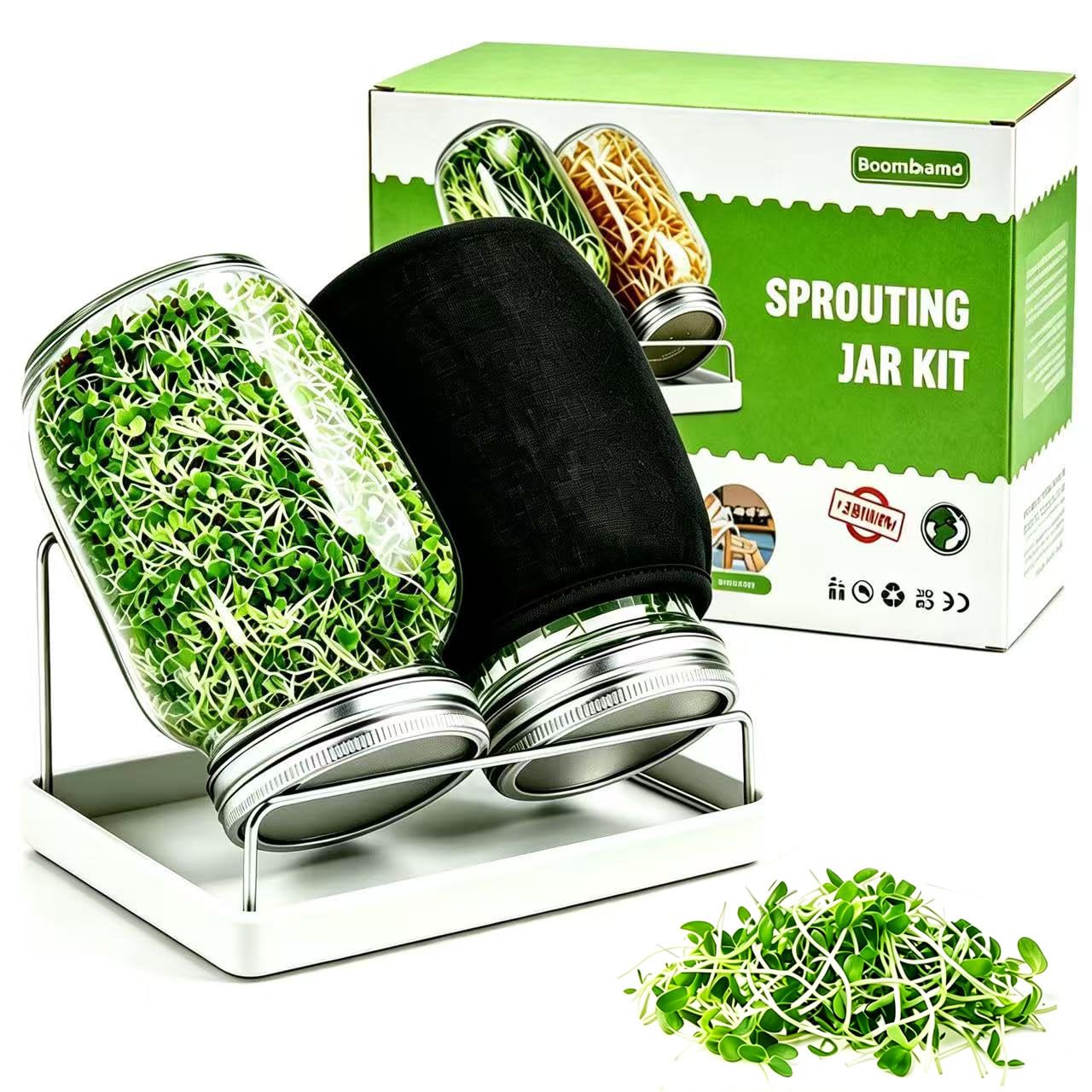
A polished kit with a 304 stainless steel stand and washable blackout sleeves — a step up from basic plastic stands.
The Boombamo kit pairs two 32 oz wide-mouth mason jars with 304 stainless steel sprouting lids and a matching 304 stainless steel stand. The stand holds the jar at a sloped angle for efficient draining, and the drip tray is designed with enough height to collect all the wastewater — no puddles on your counter. The blackout sleeves are fully washable and reusable, handy if you switch between light-preferring and dark-preferring seeds regularly.
Buyers are emphatic about this kit’s ease of use: “I love these! It has been so much fun learning to grow my own sprouts,” one buyer mentioned. Another noted it works “excellent for micros,” specifically broccoli sprouts, and that the daily rinse-and-drain routine is simple. The 304 stainless steel is a step up from basic 8/18 mesh and offers good corrosion resistance without the premium cost of 316.
The kit also comes with a clear four-step usage guide printed in the box, which beginners appreciate. The only potential shortcoming is that the blackout sleeves are not as light-blocking as some thicker fabric sleeves — but for typical home use they do the job well.
Build quality note: The 304 stainless steel stand and lids feel substantial and are designed to last through many cycles. The drip tray is made of sturdy plastic that resists cracking.
The one downside: The blackout sleeves are lightweight fabric that may let a little light through for seeds needing total darkness — but for most users, they work fine.
Reach for this if: You want a complete kit with a metal stand (not plastic), washable sleeves, and 304 stainless mesh — a step up in build quality without jumping to the top-tier price of 316 kits.
pass on it if: You need the maximum corrosion resistance of 316 stainless steel — in that case, get the Malastar kit which uses that exact material.
5. ALCEDIA Premium Sprouting Jar Kit
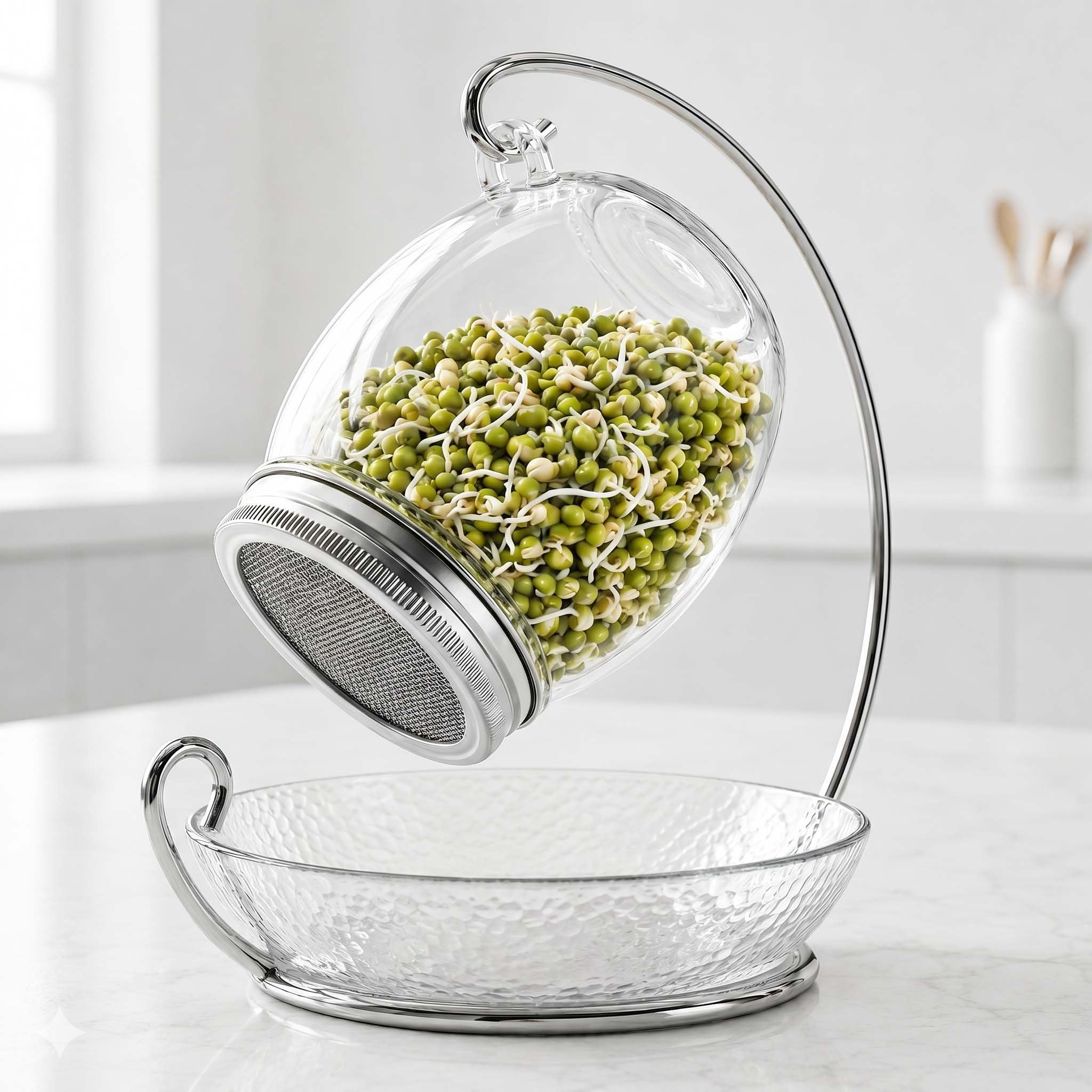
A single borosilicate glass jar — stronger and more temperature-resistant than standard mason jar glass — that looks good enough to leave on your table.
This kit from ALCEDIA takes a different approach: instead of two standard mason jars, you get one specially designed 30 oz (850 mL) jar made from borosilicate glass — the same material used in laboratory glassware, known for being stronger, more durable, and more temperature-resistant than regular soda-lime glass. The rounded, wide-mouthed, flat-bottomed shape is noticeably more attractive than a typical mason jar. Owners mention placing it on their dining table or windowsill as a decorative object. The kit includes a hanging stand, a drip tray, and a 316 stainless steel screen lid.
The 316 stainless steel mesh is the same premium, rust-resistant grade found in the Malastar kit. Because the jar is borosilicate, it can handle hot water rinses without thermal stress — the manufacturer says it is even microwaveable, though you likely will not need that for sprouting. One owner reported that “alfalfa sprouts ready in days, fresh and crisp,” and another mentioned the “gentle curved shape of the jar doesn’t seem to pool any excess moisture.”
At 1 quart capacity, it yields less per batch than a 2-jar kit, but the quality of the glass and the aesthetic design make it a compelling choice if you value both function and form.
Why it stands out
- Borosilicate glass jar — stronger and more temperature-resistant than standard mason jar glass.
- 316 stainless steel screen — top-tier rust resistance.
- Elegant design that looks good on any counter or table.
- Customers note sprouts growing by day 2.
The trade-offs
- Only one jar — you cannot run two batches simultaneously.
- Slightly smaller volume than standard wide-mouth mason jars (30 oz vs 32 oz).
Best for: Anyone who wants a single, high-quality jar that looks as good as it works. If the kitchen aesthetic matters to you, this is the clear winner — it is pretty enough to keep out permanently.
Not ideal for: High-volume sprouters who need to grow multiple batches at once — the single 30 oz jar limits total yield per cycle.
6. Elementi Sprouting Jar Kit
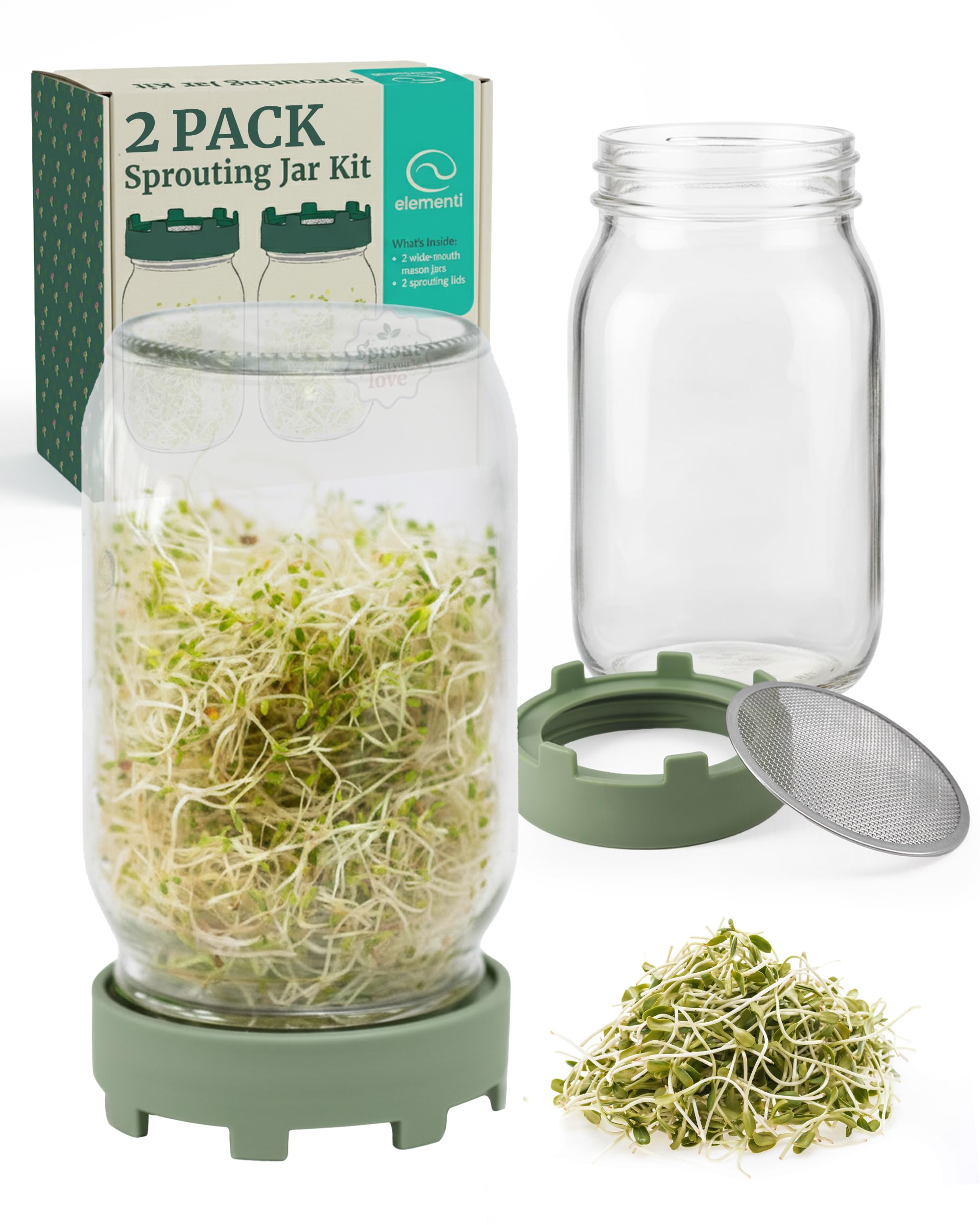
A basic two-jar set with plastic lids and stainless mesh — no stand, no tray, and the lowest price.
The Elementi kit focuses on the essentials: two wide-mouth 32 oz mason jars and two sprouting lids made of plastic with a stainless steel mesh screen. There is no stand, no drip tray, and no blackout sleeve included. You will need to provide your own bowl or surface to prop the jars at an angle for draining, as one customer observed: “worked well but still need to use a bowl to lay on side for sprouting.” The lids have a plastic outer ring and a mesh screen that detaches for easy cleaning.
The mesh is “strong,” according to buyers, and allows you to tap the jar after rinsing so sprouts do not grow through the screen. The plastic lids are top-rack dishwasher safe, but the manufacturer warns not to expose the jar to water over 140°F — thermal expansion can crack the soda-lime glass. Compared to the Haswe kit with sleeves, the Elementi set lacks the stand, tray, and blackout covers. But if you already have a way to drain your jars, this is the lowest-cost way to get two sprouting-ready jars.
One user highlighted the screen is “a bit loose within the lid” and recommended using wide-mouth jar silicone gaskets for a tighter fit. That is a minor fix, but worth knowing if you plan to shake the jar vigorously during rinsing.
The core appeal: Two complete sprouting jars for a low entry price. If you have a bowl or a dish rack to hold the jars upside down, this is perfectly functional.
The missing pieces: No stand, no drip tray, no blackout sleeves — you supply those yourself. The plastic lids work fine but may not feel as premium as all-metal lids.
Reach for this if: You already have a method for draining jars (a bowl or a dish drying rack) and just need the jars and lids themselves. It is the cheapest way to get two sprouting jars.
it’s not for you if: You prefer a complete, all-in-one kit with a stand, tray, and sleeves — the Haswe kit with sleeves costs a little more but gives you everything you need to start sprouting immediately.
Understanding the Specs
Stainless Steel Grades: 304 vs. 316
The mesh screen in the lid is the workhorse of any sprouting kit. Both 304 and 316 stainless steel are rust-resistant and food-grade, but 316 has a small amount of molybdenum added to make it more resistant to corrosion from chlorides (like those found in hard tap water). If you sprout daily or use hard water, 316 is the longer-lasting choice. If you sprout occasionally, 304 is perfectly adequate and costs less. The “8/18” stainless steel found in some budget kits is a slightly simpler alloy — it still resists rust well for typical home use.
Blackout Sleeves: When and Why
Blackout sleeves are fabric covers that block light from reaching the jar. Leafy sprouts like broccoli, alfalfa, and kale need indirect sunlight to develop chlorophyll and turn green. Bean and grain sprouts — think mung beans, lentils, and wheatgrass — grow longer and sweeter in dark environments. A kit that includes blackout sleeves gives you the flexibility to sprout any seed type without needing a dark cabinet. If you only sprout leafy greens, you can leave the sleeves off.
Jar Material: Borosilicate vs. Soda-Lime Glass
Standard mason jars are made from soda-lime glass, which is perfectly fine for sprouting — it is strong, affordable, and widely available. Borosilicate glass, used in the ALCEDIA kit, is more resistant to thermal shock, meaning it can handle hot water without cracking. For sprouting, you rarely pour boiling water into the jar, so borosilicate is a nice-to-have rather than a must. If you plan to microwave the jar (for sterilization, for instance), borosilicate is the safer choice.
Stand and Drip Tray Design
A good stand holds the jar at an angle so water drains out completely — standing water is the fastest way to ruin a batch of sprouts. Look for a stand that is sturdy enough that the jar does not tip over when you bump the counter. The drip tray should be high enough to catch all the runoff without overflowing. Some kits use melamine (a break-resistant, BPA-free material), others use unbreakable plastic. Both clean easily in the dishwasher on the top rack, though some plastic trays may warp over time with high heat.
FAQ
How long does it take to grow sprouts from seed?
Can I sprout any seed in these kits?
How often do I need to rinse the sprouts?
Do I need blackout sleeves for all seeds?
Is borosilicate glass better than regular mason jar glass?
Can I put the lids and jars in the dishwasher?
What is the difference between 304 and 316 stainless steel mesh?
Why does the jar need to be at an angle during sprouting?
How do I clean the mesh screen if sprouts get stuck?
Can I grow microgreens in a sprouting jar?
Final Thoughts: The Verdict
For most people, the sprouting kit winner is the Haswe Seed Sprouting Jar Kit (White) — it gives you two full jars, stainless steel lids, a stand and drip tray, and a cleaning brush, all at a price that undercuts most competitors. If you need light control for a variety of seeds (green leafy plus beans and grains), grab the Haswe Kit with Blackout Sleeves. And for the most rust-resistant mesh available, the standout is the Malastar Complete Sprouting Jar Kit with its 316 stainless steel screens.
How We Picked
We do not accept paid placement. Every pick is matched to a real buyer and a real use-case; we do not hands-on test units.
Sources & Methodology
Specifications: manufacturer listings and product documentation. Review insights: verified customer reviews, as of July 2026. Pricing: not shown on this page (it changes often); check the current price via the retailer link.
As an Amazon Associate, Lawn Gear Lab earns from qualifying purchases. This does not affect which products we feature.