
Specs are compiled from manufacturer listings and verified buyer reviews and can change over time — please confirm the key details on the product page before buying.
Winter is tough on your lawn: freezing soil, short days, and drying wind all stress grass roots when they are trying to store energy for spring. The right winterizer is not about pushing green top-growth — it is about shuttling potassium and slow-release nitrogen into the root zone so your turf survives cold snaps without thinning or browning out. The bag you grab in October or November directly decides whether your lawn emerges patchy or thick in March.
I’m Rikta — the founder and writer behind Lawn Gear Lab. This guide is built by comparing the manufacturers’ published specifications and the patterns across verified customer reviews, so you get each pick’s real strengths and trade-offs instead of marketing spin.
Winterizer formulas differ by the ratio of nutrients, coverage area per bag, and the type of nitrogen they use, which together determine how deeply your grass stores energy. This is your straightforward guide to picking the best fertilizer for winter — one that matches your lawn size and your expectations for early green-up.
Quick Picks
- Greenview Fairway Formula Fall Fertilizer 22.5 lbs — Best Overall
- Jonathan Green Winter Survival 10-0-20 (45 lbs) — Top Performer
- Scotts Turf Builder WinterGuard Fall Lawn Food (10 lbs) — Best Value
- Fertilome Winterizer 10-0-14 (40 lbs) — Large-Lot Pick
How To Choose The Best Fertilizer For Winter
Winterizer is not a one-size-fits-all purchase. The wrong N-P-K ratio can push tender growth that frost kills, and a bag sized too small will leave you buying a second one mid-season. Here are the three specs that separate a smart winter feed from a wasted one.
N-P-K Ratio — Low Nitrogen, High Potassium
Winterizer formulas keep the first number (nitrogen) low to avoid forcing leaf growth when the plant should slow down. The last number (potassium) is the key: it strengthens cell walls, improves cold hardiness, and helps roots store carbohydrates. A ratio like 10-0-20 or 10-0-14 tells you the product is built for fall and winter use. High nitrogen formulas intended for summer will push weak growth that frost easily kills.
Slow-Release vs. Quick-Release Nitrogen
Slow-release nitrogen feeds roots steadily over several weeks without a sudden growth surge, which is ideal for late-season application. A product that uses slow-release nitrogen means you get a consistent nutrient supply through changing soil temperatures. Quick-release forms can wash out faster and are less effective for the long dormancy period.
Coverage Area and Bag Weight
Bag weights vary from 10 lbs to 45 lbs, and coverage ranges from 4,000 sq. ft. up to 15,000 sq. ft. Measure your lawn’s square footage before buying to know if one bag handles everything. A smaller bag on a large lawn forces you to under-apply, which reduces the root-building effect you paid for.
Quick Comparison
| Model | Best For | N-P-K Ratio | Coverage | Bag Weight | Amazon |
|---|---|---|---|---|---|
| Scotts WinterGuard Fall Lawn Food | Small lawns on a budget | Not listed | 4,000 sq. ft. | 10 lbs | Amazon |
| Greenview Fairway Formula Fall Fertilizer | Balanced value and coverage | 59:0:0 (slow-release N) | 7,500 sq. ft. | 22.5 lbs | Amazon |
| Fertilome Winterizer 10-0-14 | Large lawns needing high potassium | 10-0-14 | 10,000 sq. ft. | 40 lbs | Amazon |
| Jonathan Green Winter Survival 10-0-20 | Maximum winter protection | 10-0-20 | 15,000 sq. ft. | 45 lbs | Amazon |
In‑Depth Reviews
1. Greenview Fairway Formula Fall Fertilizer 22.5 lbs

59% slow-release nitrogen that feeds roots for up to 12 weeks straight.
This is the pick that balances premium performance with a coverage footprint that fits most medium-sized yards: the 22.5 lb bag handles 7,500 sq. ft., versus the Scotts WinterGuard at 4,000 sq. ft. from its 10 lb bag. Unlike the Scotts option that leaves its N-P-K numbers unspecified, Greenview publishes a proprietary 59:0:0 ratio — meaning zero phosphate to protect waterways — and the nitrogen is 59% slow-release, so roots get a steady supply without a quick flush-out.
Buyers report a vivid, specific result: one owner in Northern VA switched from Scott’s and saw the lawn turn “deep kelly green within 2 weeks,” staying green through winter into late spring. Another reviewer who used the product for three consecutive falls described clear year-over-year improvement in lawn health. The moisture-proof packaging was also called out for eliminating the clumping you encounter with some name-brand granules, which means a smoother pass through the spreader.
The one trade-off is the per-bag price, but spread over 7,500 sq. ft. the cost per square foot is competitive. If your lawn is larger than 7,500 sq. ft., you will need two bags to get full coverage.
What stands out
- 59% slow-release nitrogen for up to 12 weeks of steady feeding.
- Covers 7,500 sq. ft., versus the Scotts bag at 4,000 sq. ft.
- Zero-phosphate formula that is gentler on nearby waterways.
What to watch
- It is pricier per bag than the Scotts WinterGuard.
- One bag covers only 7,500 sq. ft., so larger lawns need two.
Reach for this if: you have a medium lawn and want a steady, root-deep feed that lasts through winter without a sudden flush of top growth.
Look elsewhere if: your lawn is under 4,000 sq. ft. and budget is your first concern — the Scotts WinterGuard will cost less.
2. Jonathan Green Winter Survival 10-0-20 (45 lbs)

The highest potassium count in this lineup — 10-0-20 — built for deep rooting and early spring recovery.
If you want the maximum cold-hardiness boost in a single application, the Jonathan Green Winter Survival delivers the highest last number (potassium) at 20. The 10-0-20 formula is specifically tuned for late fall: the low nitrogen prevents soft winter growth while the high potassium strengthens cell walls, stores energy in roots, and wards off winter stress. The 45 lb bag covers up to 15,000 sq. ft., versus the Scotts WinterGuard at 4,000 sq. ft., for a moderate increase in price per bag.
Buyers confirm the result: one reviewer in the northeast US applied it in early November and by mid-December the treated front lawn was visibly healthier than the untreated back. Another user described their lawn as “never has looked this beautiful,” calling out the contrast vs. a previous service. The bag also includes slow-release nitrogen that keeps grass greener later into the year without surging uncontrolled growth.
The catch is that some customers found the large granules tricky to spread evenly, and one reviewer noted that newer grass died off anyway — so established lawns benefit more than freshly seeded patches. The 45 lb bag is also heavy to carry, so plan for a wheeled spreader.
Why it wins
- Highest potassium (20) of any pick here, directly boosting root strength.
- 45 lb bag covers 15,000 sq. ft. — ideal for large properties.
- Slow-release nitrogen keeps grass greener through late fall.
Considerations
- Large granules may require a careful spreader setting or a second pass.
- Heavy 45 lb bag is cumbersome to lift and move.
Best for: owners of large lawns (an acre or more) who want the highest winter-hardiness potassium boost in one shot.
skip it if: you have a small lawn under 5,000 sq. ft. — the bag will last years and the granules may not spread evenly over small spaces.
3. Scotts Turf Builder WinterGuard Fall Lawn Food (10 lbs)

The budget-friendly bag that still gives visible wintergreen results when spread right.
Scotts WinterGuard is the most affordable option here, and for a smaller lawn (4,000 sq. ft. from a 10 lb bag) it does exactly what a winterizer should: builds roots for spring recovery without pushing wasteful leaf growth. The N-P-K ratio is not published on the bag, which is a transparency gap compared to the Greenview or Jonathan Green options, but owners mention real results. One reviewer in cold weather noted, “it is 25 degrees outside, the grass is still bright green and not growing wild” — exactly the controlled winter color a good winterizer provides.
Keep in mind that 4,000 sq. ft. is a tight coverage: if your lawn is larger, you will need multiple bags, which erodes the per-bag savings. A single Greenview Fairway Formula bag covers 7,500 sq. ft., while the Scotts bag covers 4,000 sq. ft., making the cost per square foot similar. For a small front or back lawn of a typical subdivision house, though, one WinterGuard bag handles the entire job.
Buyers also note that the granules are standard size and run through most spreaders without clumping. The product works on any grass type, and applying it to a wet or dry lawn takes no extra steps.
The good
- Lowest up-front price — great for a quick fall feed.
- Works on all grass types without special prep.
- Customers note bright green color even in freezing weather.
The limits
- N-P-K ratio is not listed, so you cannot verify the nutrient balance.
- 4,000 sq. ft. coverage is the smallest here — larger lawns need 2-3 bags.
Reach for this if: your lawn is under 4,000 sq. ft. and you want a simple, low-cost winterizer that works.
Look elsewhere if: you need transparent N-P-K numbers for precise feeding or have a medium-to-large lawn.
4. Fertilome Winterizer 10-0-14 (40 lbs)
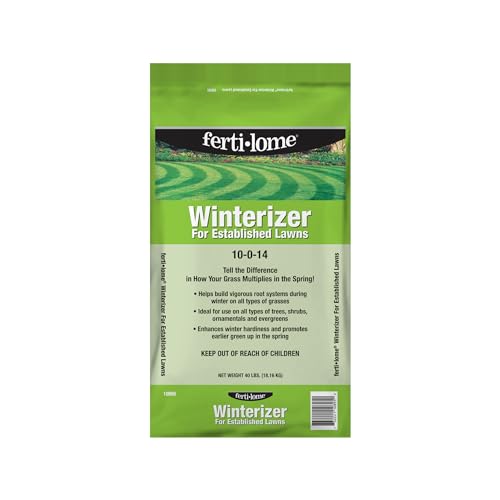
A straightforward 10-0-14 winterizer in a 40 lb bag for medium-large lawns.
Fertilome’s Winterizer hits the classic winterizer ratio of 10-0-14 — low nitrogen to hold back top growth, moderate potassium to protect roots through cold months. The 40 lb bag covers up to 10,000 sq. ft., which splits the difference between the Greenview (7,500 sq. ft.) and the Jonathan Green (15,000 sq. ft.). Reviewers point out a very practical detail: “even in January I can see the spots I missed,” which tells you the granules hold visible long enough to gauge even coverage.
The mix of nutrients is designed not just for lawns but also for trees, shrubs, ornamentals, and evergreens, making this a flexible pick if you have a varied landscape. One reviewer who uses it on centipede grass reported consistent good results. The downside flagged in reviews is the low iron content, which may matter if your lawn needs deep greening in addition to winter protection.
The bag is heavy at 40 lbs, so prepare your spreader and a wheeled dolly. The price per square foot is competitive, landing between the budget Scotts and the premium Greenview.
Strengths
- Covers up to 10,000 sq. ft. — a good middle-ground for medium-large properties.
- Works on lawns plus trees, shrubs, ornamentals, and evergreens.
- Buyers can see missed spots easily in January, helping even coverage next year.
Weaknesses
- Low iron content means less of a deep-green cosmetic effect.
- 40 lb bag is heavy to handle without a spreader.
Ideal for: a lawn of roughly 8,000-10,000 sq. ft. where you need a balanced winterizer that also feeds trees and shrubs.
Not for: anyone wanting high-iron greening or a smaller bag that is easy to carry.
Understanding the Specs
N-P-K Ratio
The three numbers on a fertilizer bag (e.g., 10-0-20) stand for Nitrogen–Phosphorus–Potassium. For winterizers, the first number (nitrogen) should be low to avoid pushing tender growth that frost kills. The last number (potassium) is the critical one: it strengthens cell walls and helps roots store energy through dormancy. A winter formula typically shows 10-0-14 or 10-0-20.
Slow-Release Nitrogen
When a label says “slow-release nitrogen,” the nitrogen is coated to dissolve gradually over weeks instead of all at once. This gives roots a steady supply of food without a sudden growth surge. For a winter feed, slow-release is better because it keeps working as soil temperatures drop, whereas quick-release nitrogen can wash out or push soft growth right before a freeze.
FAQ
When should I apply winter fertilizer in the fall?
Can I use a regular lawn fertilizer in winter instead of a winterizer?
Do I need a winterizer if I live in a warm climate with no hard freeze?
Is 10-0-20 better than 10-0-14 for winter?
How much does a 40 lb bag of winterizer typically cover?
Can winter fertilizer burn my lawn?
Should I water in winter fertilizer after application?
What does the middle number (0) mean in a 10-0-20 winterizer?
Can I use winter fertilizer on newly seeded grass?
How often should I apply winter fertilizer?
Final Thoughts: The Verdict
Across the board, the best fertilizer for winter winner is the Greenview Fairway Formula Fall Fertilizer because its 59% slow-release nitrogen and 7,500 sq. ft. coverage deliver the best mix of performance and value for the typical medium lawn. If you want the highest potassium count and maximum cold-hardiness, grab the Jonathan Green Winter Survival 10-0-20 — it covers up to 15,000 sq. ft. and sets you up for early spring green-up. And for a small lawn on a budget, the standout is the Scotts WinterGuard which gives visible results at the lowest up-front cost.
How We Picked
We do not accept paid placement. Every pick is matched to a real buyer and a real use-case; we do not hands-on test units.
Sources & Methodology
Specifications: manufacturer listings and product documentation. Review insights: verified customer reviews, as of July 2026. Pricing: not shown on this page (it changes often); check the current price via the retailer link.
As an Amazon Associate, Lawn Gear Lab earns from qualifying purchases. This does not affect which products we feature.