
Specs are compiled from manufacturer listings and verified buyer reviews and can change over time — please confirm the key details on the product page before buying.
The real frustration with garden bed soil is not finding a bag — it is buying one that turns into concrete or washes away in the first rain. You want soil that drains, holds air, and gives roots room to spread without drowning. What you actually need is a mix built for the specific plants and conditions you have, not a generic promise on the bag.
I’m Rikta — the founder and writer behind Lawn Gear Lab. This guide is built by comparing the manufacturers’ published specifications and the patterns across verified customer reviews, so you get each pick’s real strengths and trade-offs instead of marketing spin.
Whether you are filling a raised bed, topping off containers, or starting a vegetable garden, you need a mix that holds moisture without turning into mud and stays airy enough for roots to breathe. Read on to find your match with this guide to the soil for a garden bed that takes the guesswork out of the purchase.
Quick Picks
- Espoma Organic Vegetable & Flower Garden Soil — Best Overall
- Coast of Maine Bar Harbor Blend Potting Soil — Premium Pick
- Coast of Maine Organic Soil for Vegetables & Tomatoes — Top Performer
- Brut Organic Potting Soil — Best Value
- Michigan Peat General All Purpose Premium Potting Soil — Budget Champion
- Premium Potting Soil Mix with Peat Moss, Vermiculite, Perlite (8 Dry Quarts) — Compact Pick
How To Choose The Best Soil For A Garden Bed
Picking the right bag depends on a few short questions: what are you growing, where are you planting, and how much time do you want to spend watering? The wrong mix either dries out in a day or holds so much water the roots rot. Here is what to look for before you buy.
Texture and Drainage
You want a mix you can squeeze in your hand that crumbles when you let go — that means it has enough perlite (a volcanic glass that creates tiny air pockets), vermiculite (a mineral that soaks up water and releases it slowly), or sand to let water run through and keep air pockets open for the roots. A mix that stays in a tight ball is too heavy and will drown your plants. Buyers of the Premium Potting Soil Mix describe the ideal texture as “light, fluffy texture, holds moisture without sogginess, drains well.”
Ingredients and Organic Content
Check the ingredients. Rich soil usually contains sphagnum peat moss (a moisture-holding material from bogs), compost, perlite, and sometimes worm castings (worm manure, rich in nutrients) or kelp meal (dried seaweed). These provide slow-release nutrients so you do not have to fertilize every week. A mix listed as “filler-free” is a good sign you are paying for soil, not wood chips. For example, one reviewer noted the Brut Organic Potting Soil had “no wood pieces” and that their “plants love the soil growing well.”
Bag Size and Use Case
Pay attention to the volume — an 8-quart bag (about 2 gallons) works for a few pots, while a 1-cubic-foot bag (about 7.5 gallons) is better for a small raised bed or a whole container garden. If you are filling a 4’x8′ raised bed, you will need several bags of the larger size. The Coast of Maine Bar Harbor Blend in a 16-quart bag was reportedly enough for “8 potato plants” with some left over for a couple more planters.
Quick Comparison
| Model | Best For | Volume | Key Ingredient | Unit Count | Amazon |
|---|---|---|---|---|---|
| Espoma Organic Vegetable & Flower Garden Soil | In-ground vegetable beds | 1 Cubic Feet | Earthworm castings, mycorrhizae | 1536.0 Ounce | Amazon |
| Coast of Maine Bar Harbor Blend Potting Soil | Container and raised beds | 16 Quarts | Lobster and crab shell meal | 2.0 Count | Amazon |
| Coast of Maine Soil for Vegetables & Tomatoes | Heirloom tomatoes and veggies | 20 Quarts | Composted manure, sphagnum peat moss | 2.00 Count | Amazon |
| Brut Organic Potting Soil | Premium indoor/outdoor plants | 21 Quarts | Worm castings, Azomite, kelp | 480.0 Ounce | Amazon |
| Michigan Peat General All Purpose Potting Soil | Budget-friendly general pots | — | Reed sedge peat, perlite, sand | 1.0 Count | Amazon |
| Premium Potting Soil Mix by Midwest Hearth | Seed starting and indoor pots | 8 Quarts | Peat moss, vermiculite, perlite | — | Amazon |
In‑Depth Reviews
1. Espoma Organic Vegetable & Flower Garden Soil

The garden bed anchor that feeds roots with worm castings and mycorrhizae from the first pour.
If you are planting a vegetable garden directly in the ground, this is the bag that does the heavy lifting. It blends into your native soil to improve it — you mix it in when planting or transplanting. The formula includes earthworm castings (worm manure packed with nutrients) and a proprietary mix of endo and ecto mycorrhizae (a type of beneficial fungus that attaches to roots and helps them absorb more water and nutrients). No synthetic chemicals are used, so it is safe for organic gardening.
Buyers report that “plants in Espoma outperformed those in a store-bought organic mix,” with noticeably better growth. At 1536.0 Ounce (per the unit count), it is a true 1-cubic-foot bag — more than double the volume of smaller premium bags, which keeps the cost per quart lower than the Coast of Maine Bar Harbor Blend.
One buyer mentioned they used it outdoors without issues, though two indoor plants developed soil gnats (they were not convinced the gnats came from the bag). If you are using it indoors, keep an eye on drainage.
Why it wins your garden bed
- Mycorrhizae helps roots absorb nutrients more efficiently
- Large 1-cubic-foot bag covers more ground than premium 16-quart options
- Bug-free bags reported by multiple outdoor users
The one thing to watch
- Two indoor-garden users noticed gnats after potting — use a sand top layer if going inside
Ideal for vegetable growers: This is your go-to if you are planting a large in-ground bed or filling a raised bed with a heavy feeder like tomatoes or squash.
Not ideal if: You only need a small bag for a few houseplants — the 1-cubic-foot size is more than you will use.
2. Coast of Maine Bar Harbor Blend Potting Soil
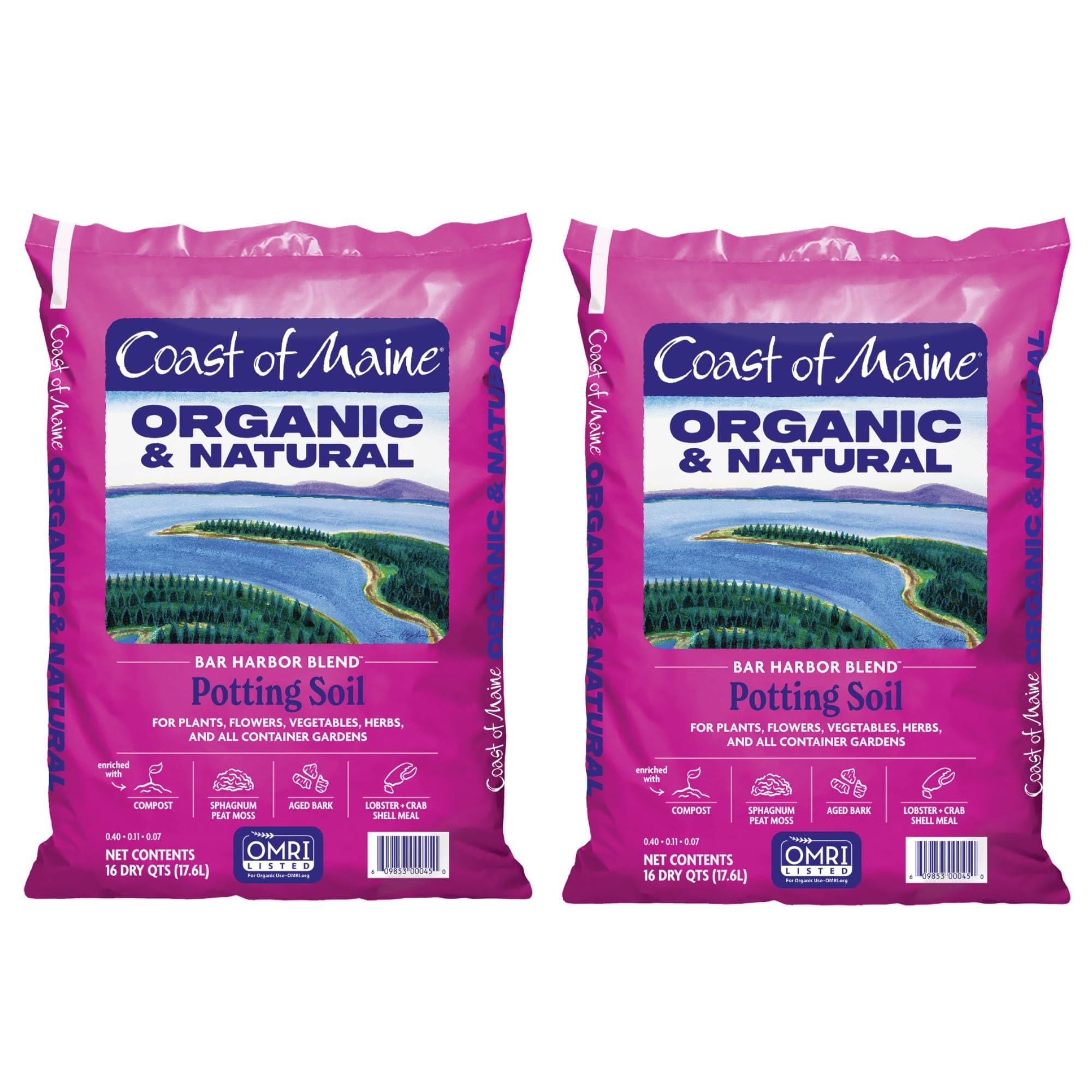
A dark, compost-rich mix that feeds containers over weeks without any funky smell.
This bag is formulated with sphagnum peat moss, compost, perlite, lobster and crab shell meal (crushed shellfish that provides calcium and chitin), and kelp meal — essentially a multi-nutrient meal for your plants. The shellfish meal provides a slow-release source of nitrogen and calcium, which helps vegetables and flowers grow steadily. Buyer feedback calls it “nutrient-rich soil for vegetables; darker due to compost, low peat moss; good mix of perlite, coco coir/peat moss, compost; no funky smell.”
It excels in pots, hanging baskets, and raised beds. One gardener filled “8 potato plants” with two bags and had extra for two more planters. At 16 Quarts per bag in a 2-pack, you get a 32-quart total to work with.
Unlike the Espoma mix which is meant to blend into native soil, this one is a complete standalone potting soil — you can use it straight from the bag for containers. The trade-off: it does cost more per quart than the Espoma bag, so if you have a very large garden, you might want the Espoma for the bulk fill.
What makes it worth the premium
- Lobster and crab shell meal adds natural calcium and chitin for strong cell walls
- Consistent, fine texture with no sticks or weed seeds reported by users
- Two-pack provides a 32-quart total — enough for a dozen 5-gallon pots
The trade-off compared to the Espoma
- Higher per-quart cost than the Espoma 1-cubic-foot bag — less efficient for large beds
Best for containers and hanging baskets: The rich, crumbly texture and slow-release nutrients make this a strong choice for pots that you want to look vibrant all season.
Consider the Espoma anchor instead if: You are filling a large ground bed and want more volume for the same money.
3. Coast of Maine Organic Soil for Vegetables & Tomatoes
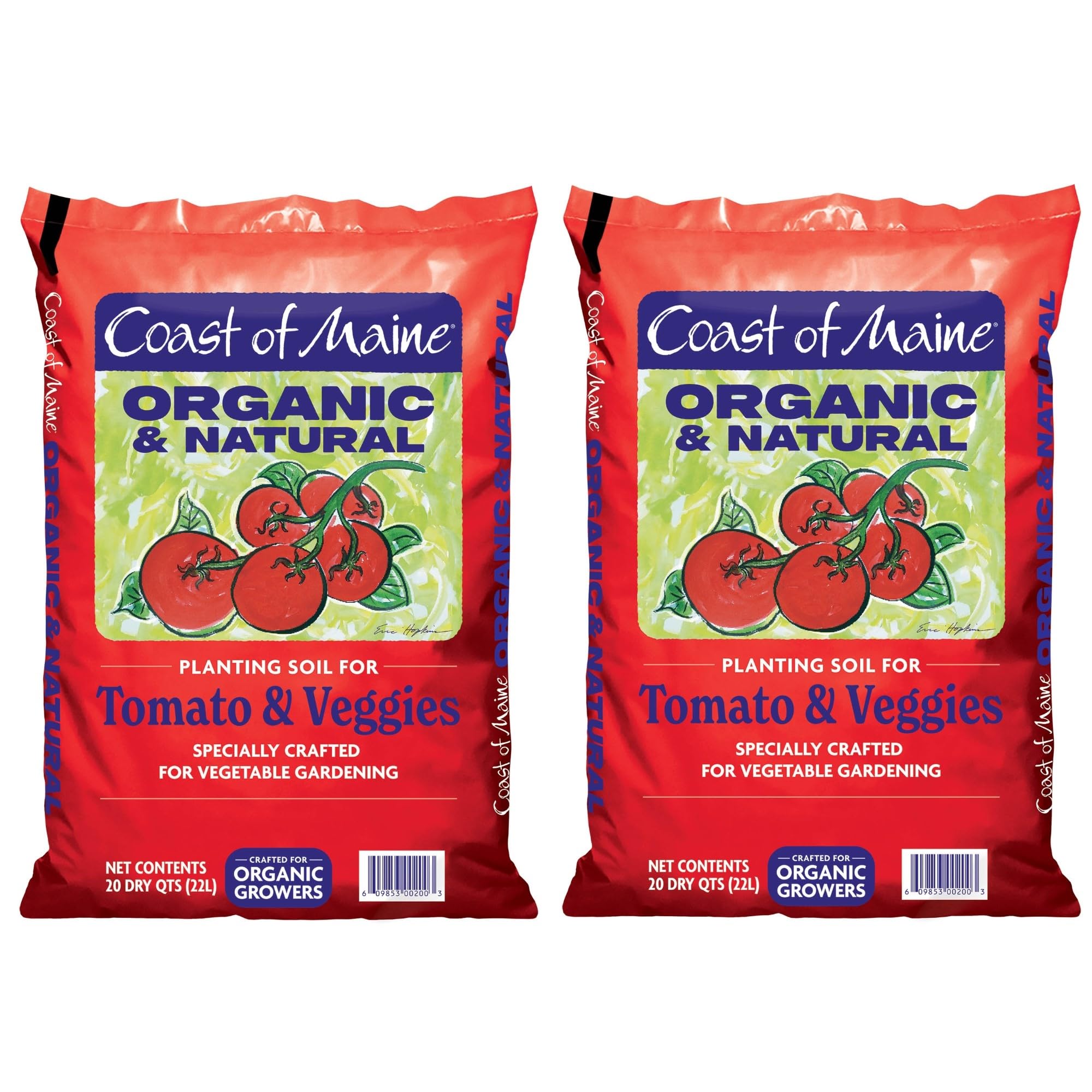
A lightweight 20-quart bag with manure so rich your tomato leaves may green up in days.
If you are growing tomatoes, zucchini, or other heavy feeders (plants that need lots of nutrients), this mix is built for them. It contains composted manure and sphagnum peat moss to balance moisture retention and drainage. One grower running a test reported “excellent moisture retention and drainage; high nutrients cause visible growth within days.” They specifically called it “lightweight” and “best for heirloom tomatoes needing good drainage.”
This mix is OMRI (Organic Materials Review Institute) listed for organic use, so it meets the same standard as the Bar Harbor Blend but uses different ingredients. The composting manure provides a different nutrient profile (more nitrogen) than the shellfish-based Bar Harbor blend. A buyer’s wife said “this is the best soil she’s tried thus far.” The bag is notably heavy at 21 pounds, so be ready for that when you lift it.
The catch? Some reviewers mentioned finding “twigs/undecomposed matter” that needed picking out — so if you need a very fine mix for seeding carrots, you may want to sift it first.
Why tomato growers grab this
- Manure-based nitrogen boost for fast vegetative growth
- Lightweight texture that does not compact around roots
- 20 Quarts per unit — a solid mid-size volume for several 5-gallon pots
The honest head-scratcher
- May contain small twigs that require picking out for fine seed beds
Pick this for a tomato-centric bed: The composted manure formula gives fruit-heavy plants the nutrient kick they need to thrive in containers or raised beds.
skip it if: You need a fine-textured soil for direct-seeding small vegetables like carrots without extra sifting.
4. Brut Organic Potting Soil
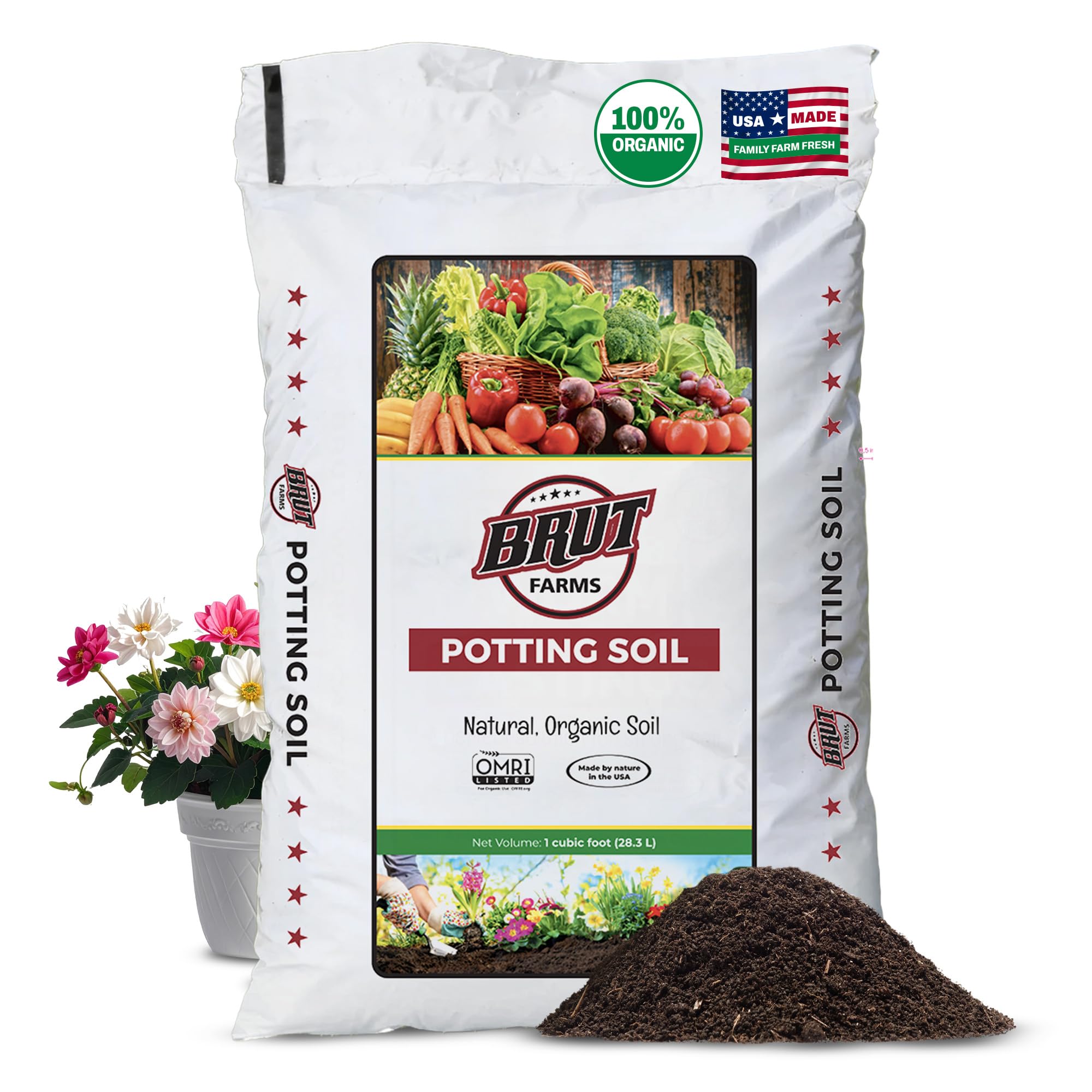
Filler-free soil packed with worm castings that reportedly greened up a citrus tree in two days.
This 21-quart bag is the largest of the premium-size options and comes packed with microbe-rich worm castings and trace minerals like Azomite (a powdered volcanic mineral) and kelp. It is OMRI listed for organic use and pH balanced between 6.3 and 6.5 right out of the bag. The manufacturer promises no sticks, wood chips, or artificial additives — and buyers confirm this. One gardener reported that their “Cara Cara orange and Lapins cherry trees showed deep green leaves and new growth in 2 days” after planting in Brut soil.
At 480.0 Ounce (per the unit count), the volume is 21 Quarts — which is a 2.6x gap over the 8-quart Premium Potting Soil Mix below. So you get substantially more soil here per bag. However, be aware that the rich fish and bone meal content can attract flies if you move the pots outdoors. One buyer recommended adding a sand or gravel top layer to prevent a fly or maggot issue.
Three reasons it stands out
- Filler-free with no wood chips — just soil and organic nutrients
- pH balanced between 6.3 and 6.5 for a wide range of plants
- Large 21-quart bag provides solid value per quart
The reality check from buyers
- Fish/bone meal smell can attract flies if pots are outdoors — a sand top layer helps
Best for indoor and outdoor plant enthusiasts: The filler-free composition and trace minerals make this an excellent all-around soil for anyone who wants a clean, nutrient-dense mix.
Hold off if: You are sensitive to potential pest attraction from the strong organic ingredients in outdoor containers.
5. Michigan Peat General All Purpose Premium Potting Soil

A heavy 50-pound bag that keeps the cost low but may bring a few passengers along.
If you have a lot of pots to fill and your budget is tight, this is the classic workhorse bag. It is a pre-blended mix of rich dark reed sedge peat, perlite, and sand, and already includes starter and slow-release fertilizers — so you do not need to add anything for the first few weeks. It weighs 50 pounds, so it is a heavy lift, but the cost per pound is lower than any premium bag here.
The trade-off, and it is an honest one: owners mention “good soil but lots of gnats come out of it.” This is a known issue with sedge peat-based soils, which can harbor fungus gnat eggs (tiny flies that thrive in moist organic matter). If you plan to use it indoors, you might want to let it dry out or bake it before potting. Outdoors, the gnats tend to disperse quickly and rarely cause long-term problems.
It comes as a single 1.0 Count bag. Unlike the 21-quart Brut or the 1-cubic-foot Espoma, there is no advertised volume here — just the 50-pound weight — so you are buying by mass, not volume. That makes it harder to compare directly, but for bulk filling of large containers or mixing into native soil, it is a cost-effective option.
The budget-friendly upsides
- 50 pounds means a lot of soil for the money — great for large pot fills
- Fertilizers already blended in, so no mixing needed
- Ready-to-use straight from the bag
The honest warnings
- Multiple customers note fungus gnats emerging from the bag
- Heavy 50-pound bag is tough to carry and store
Reach for this if: You have a large outdoor project and need bulk soil at the lowest cost, or you are mixing it into a native ground bed where gnats are not a real concern.
pass on it if: You are planting indoor pots or houseplants anywhere you want to avoid an insect problem.
6. Premium Potting Soil Mix with Peat Moss, Vermiculite, Perlite (8 Dry Quarts)

A fluffy, clean 8-quart bag that seed starters love because it holds moisture without sogginess.
This mix from Midwest Hearth is the smallest bag here at 8 Quarts, making it ideal for seed starting, repotting a few houseplants, or filling small containers. It uses the same formulation professional growers use, according to the manufacturer, with peat moss, perlite, and vermiculite (a mineral that absorbs water like a sponge and releases it slowly) for aeration and moisture control. It also has balanced pH levels to suit a broad spectrum of plants.
Buyers are impressed: “Light, fluffy texture, holds moisture without sogginess, drains well. Promotes strong roots and faster growth in herbs and flowers.” One reviewer used it for germinating petunias and called it “great for my germinating petunias.” Another indoor plant user noted it had “no bad smell.” The bag is resealable, which helps keep the remaining mix fresh for the next use.
The big difference: at 8 Quarts, it is a 2.6x smaller volume than the 21-quart Brut Organic Potting Soil bag. So if you are filling a raised bed, you would need multiple bags. This one is best as a precision tool for smaller, high-value pots.
What makes it a seed-starter favorite
- Vermiculite and perlite provide excellent aeration for delicate seedlings
- Resealable bag keeps leftover soil fresh for weeks
- No weed seeds or bugs reported in multiple verified reviews
The scale limitation
- At 8 Quarts, you will need many bags for any project larger than a few pots
Pick this for small-scale precision work: Seed starting and indoor repotting are where the fluffy, pH-controlled texture of this 8-quart bag shines brightest.
Look at the Brut or Espoma if: You are filling a raised bed or a dozen large containers — the small volume here will not go far enough.
Understanding the Specs
Volume and Bag Size
Volume is the most practical spec because it tells you how much ground you can cover. A bag measured in quarts (like 8 Quarts) is good for a few pots, while a bag measured in cubic feet (like 1 Cubic Foot, which is about 28 dry quarts) can fill a small raised bed. Always check the volume, not just the bag’s weight, because moisture content varies. A 50-pound bag of wet soil has far less actual dirt than a 50-pound bag of dry soil.
Key Ingredients and Nutrients
The ingredients list tells you whether the soil feeds your plants or just sits there. Look for worm castings (worm manure, packed with nutrients), compost (decayed organic matter), kelp meal (dried seaweed), or shellfish meal (crushed shells providing calcium and chitin) — they provide slow-release nutrients. Perlite and vermiculite are lightweight minerals that create air pockets for roots. Avoid mixes that list “forest products” or “composted bark” as the first ingredient; those are often just wood chips that break down and rob nitrogen from your plants.
Organic Certification and pH Balance
OMRI (Organic Materials Review Institute, a third-party certifier) listing means the soil meets organic gardening standards for no synthetic chemicals. pH balance (the acidity or alkalinity of the soil) matters because most vegetables prefer a slightly acidic to neutral range (6.0 to 7.0). A mix that is pH controlled out of the bag saves you the step of testing and amending. The Brut Organic Potting Soil is an example that is pH balanced between 6.3 and 6.5 right out of the bag.
Texture and Drainage
The feel of the soil in your hand tells you as much as any label. A good garden bed mix should feel crumbly and light. If you squeeze a handful and it forms a tight mud ball that does not break apart, the soil is too heavy and may become waterlogged. The presence of perlite (those small white pebbles that create air pockets) and coarse sand helps create the structure needed for plant roots to breathe.
FAQ
Can I use potting soil from a bag directly in my garden bed?
How many quarts of soil do I need for a 4×8 raised bed?
What is the difference between peat moss, vermiculite, and perlite in garden soil?
Why do some bags of soil have fungus gnats?
Is organic soil always better for a vegetable garden?
Can I reuse soil from last year’s garden bed?
What does OMRI listed mean for garden soil?
How do I keep soil from compacting in a raised bed?
Should I add fertilizer to bagged garden soil?
What is the shelf life of a bag of garden soil?
Final Thoughts: The Verdict
For most buyers, the soil for a garden bed winner is the Espoma Organic Vegetable & Flower Garden Soil because it delivers the largest volume with mycorrhizae-infused nutrients, making it the most practical and effective option for in-ground vegetable beds. If you want a premium container mix with slow-release nitrogen and shellfish meal, grab the Coast of Maine Bar Harbor Blend Potting Soil. And for a budget-friendly bulk fill for outdoor pots where gnats are not a concern, the Michigan Peat General All Purpose Premium Potting Soil provides the most soil for your money.
How We Picked
We do not accept paid placement. Every pick is matched to a real buyer and a real use-case; we do not hands-on test units.
Sources & Methodology
Specifications: manufacturer listings and product documentation. Review insights: verified customer reviews, as of July 2026. Pricing: not shown on this page (it changes often); check the current price via the retailer link.
As an Amazon Associate, Lawn Gear Lab earns from qualifying purchases. This does not affect which products we feature.