
Specs are compiled from manufacturer listings and verified buyer reviews and can change over time — please confirm the key details on the product page before buying.
You have a shed or barn with no power. A solar shed light solves that without an electrician, wires, or a monthly energy bill. But some lights dim after an hour, and others light up a full 10×12 space all evening. The one to pick is the ropelux 3000LM — it is the brightest at 3000 lumens, with a 4400mAh battery and dual motion sensors, so you get real workshop light without a plug.
I am Rikta, the founder of Lawn Gear Lab. This guide compares published specs from manufacturers against patterns in verified customer reviews. No marketing spin, just what each pick does well and where it falls short.
if you need a light for a workshop, chicken coop, or gazebo, the right solar shed light matches brightness, battery, and features like a motion sensor (a small detector that turns the light on when something moves) or a remote control so you never fumble in the dark.
Quick Picks
- ropelux Solar Indoor Outdoor Shed Light (3000LM) — Top Performer
- ropelux Solar Shed Light Outdoor Indoor (2000LM) — Best Value
- APILAB Solar Shed Light Indoor Outdoor (2000LM) — Best for Large Sheds
- AEQ Solar Shed Light Indoor Outdoor (1000LM) — Compact Power
- INXPHY Solar Shed Light (1200LM, 174 LEDs) — Versatile Array
- Deogos Solar Shed Light (1000LM) — Motion Specialist
- papasbox Solar Pendant Light (920LM) — Compact Classic
How To Choose The Best Solar Shed Light
Picking the right solar shed light means matching it to your space, your typical weather, and how you plan to use it. Here are the three factors that matter most.
Brightness & Battery: Lumen Output vs. Runtime
Brightness is measured in lumens (lm) — the higher the number, the more light. A 2000-lumen light will flood a 10×12 shed, so you can see tools and shelves clearly. A 900-lumen light works for a chicken coop or small gazebo, where you just need to see nearby objects. But brightness means nothing if the battery dies early. Look for a battery capacity (measured in mAh) that matches your needs: a 4400mAh battery provides 10-20 hours of light, depending on your brightness setting, so you get through a long evening.
Smart Modes: Motion Sensor, Remote, and Daytime Use
Controls vary a lot. Motion sensors (PIR sensors) are great for security — the light stays off until something moves, saving battery for when you need it. A remote control lets you switch between modes (dusk-to-dawn, timer, constant-on) from across the room, so you do not have to walk to the switch. If you work in your shed during the day, look for a “daytime available” mode so the light works even when the solar panel is in the sun — no need to cover the panel.
Solar Panel Placement & Cable Length
A separate solar panel (connected by a cable) is far more flexible than an all-in-one unit. You mount the panel on the roof in full sun while the light hangs inside a dark shed. Most cables are around 16 feet, enough for a typical single-car garage or medium shed. If your roof is far from the light, a longer cable or a larger panel (like the 7×10 inch one) ensures you get a full charge even on shorter winter days.
Quick Comparison
| Model | Best For | Brightness | Battery | Motion Sensor | Amazon |
|---|---|---|---|---|---|
| ropelux 3000LM | Maximum Brightness | 3000 Lumens | 4400mAh | Yes | Amazon |
| ropelux 2000LM | Versatile Features | 2000 Lumens | 4400mAh | Yes (Dual) | Amazon |
| APILAB 2000LM | Pull-String Simplicity | 2000 Lumens | 6000mAh | No | Amazon |
| AEQ 1000LM | Indoor Daytime Use | 1000 Lumens | — | Yes | Amazon |
| INXPHY 1200LM | Adjustable Panel Array | 1200 Lumens | — | Yes | Amazon |
| Deogos 1000LM | Motion-Activated Security | 1000 Lumens | — | Yes | Amazon |
| papasbox 920LM | Compact Dusk-to-Dawn | 920 Lumens | — | No | Amazon |
In‑Depth Reviews
1. ropelux Solar Indoor Outdoor Shed Light (3000LM)

The baseline for “bright enough” just got raised to 3000 lumens.
If your shed or workshop needs light that makes you squint, pick this solar light. Its 3000-lumen output is the brightest in this lineup — more than enough to turn a dark 10×12 storage space into a functional work area, so you can see tools and projects clearly. It uses a premium 4400mAh battery (storing enough charge for 12 to 20 hours) so you do not get left in the dark halfway through a late-night project.
You get five light modes, including two that work all day (Mode 4 triggers motion-activated bright light, and Mode 5 runs continuous lighting and switches to motion-only when the battery hits 50%). The dual PIR motion sensors (two small detectors that sense movement up to 26 feet away across a 180-degree range) give you a wider detection zone than single-sensor lights. Buyers report it catches even slight movement reliably. The adjustable sensing time (25, 35, or 45 seconds) lets you set how long the light stays on. It also offers three color temperatures — warm white (a yellow glow), cool white (a bright blue-white), or a blend of both — so you can shift from a cozy ambience to a crisp task light with a press of the remote.
The separate solar panel connects via a 16.4-foot cable, so you mount the panel on a sunny roof while the light hangs inside. Some early reviewers noted a water-leaking issue with the glass shades, though replacement batches seem to have fixed it. A few owners mention a faint high-pitched sound at full power, but the sheer brightness and flexible modes make this the premium pick for most buyers.
Why it shines
- Highest lumen output in the roundup (3000LM) clears a large shed easily.
- 4400mAh battery delivers 12-20 hours of runtime on a full charge.
- Dual PIR sensors detect motion up to 26 ft over 180° for better coverage.
- Adjustable color temperature (warm, cool, or both).
A few cautions
- Some early units had water ingress issues around the glass shades — check your unit early.
- A few users report a faint high-pitched electronic noise at full brightness.
Who needs this: Anyone with a large workshop, garage, or shed that needs genuinely bright, adjustable light for hours on end. The 3000LM ropelux beats the 2000LM model on sheer output — a good step up if your space is bigger than 10×12.
Trade-off to know: The glass shades may need careful sealing inspection; check your unit early for defects.
2. ropelux Solar Shed Light Outdoor Indoor (2000LM)

2000 lumens, a 4400mAh battery, and dual sensors without the premium price.
This is the balance in the ropelux range — you get the same 4400mAh battery as the 3000LM model but at a lower cost, with a still-respectable 2000-lumen output that easily lights a standard shed or barn. The dual PIR motion sensors detect movement up to 26 feet across a 180-degree range, making it a strong choice for security around a garden workbench or gazebo.
It offers five smart modes, including two all-day lighting options (Mode 4 gives motion-activated light 24/7, and Mode 5 provides continuous light all day). Owners mention it is lightweight and easy to install, with the long 15.6-foot solar panel cord allowing flexible placement. Three adjustable color temperatures (warm white at 3000K, cool white at 6500K, or natural white at 4500K) and four brightness levels mean you can dial in the perfect mood. The 4/6-hour timer settings in Modes 1-3 help conserve battery if you only need light for part of the night.
The separate solar panel lets you chase the sun while hanging the light in full shade — ideal for sheds with limited roof exposure. Owners note it works well for garden arbors and patios, keeping areas visible at night without drawing power. Its IP65 waterproof rating (meaning it resists rain and snow) matches the 3000LM model, so you mount it outdoors without worry.
Standout features
- 2000-lumen output is bright enough for most sheds and barns.
- 4400mAh battery provides 10-20 hours of runtime.
- Dual PIR sensors for wider motion detection (26 ft, 180°).
- Three color temperatures and four brightness levels for total control.
What to watch
- At 2000LM, it is less bright than the 3000LM sibling for very large spaces.
- Motion sensor sensitivity may need adjusting if installed near busy roads or trees.
Reach for this if: You want most of the premium features (big battery, dual sensors, adjustable color) without paying top dollar for the highest lumen count. It is a better value than the 3000LM model for a standard 10×12 shed.
Look elsewhere if: You need the absolute maximum brightness for a large workshop — the 3000LM model fills that role.
3. APILAB Solar Shed Light Indoor Outdoor (2000LM)
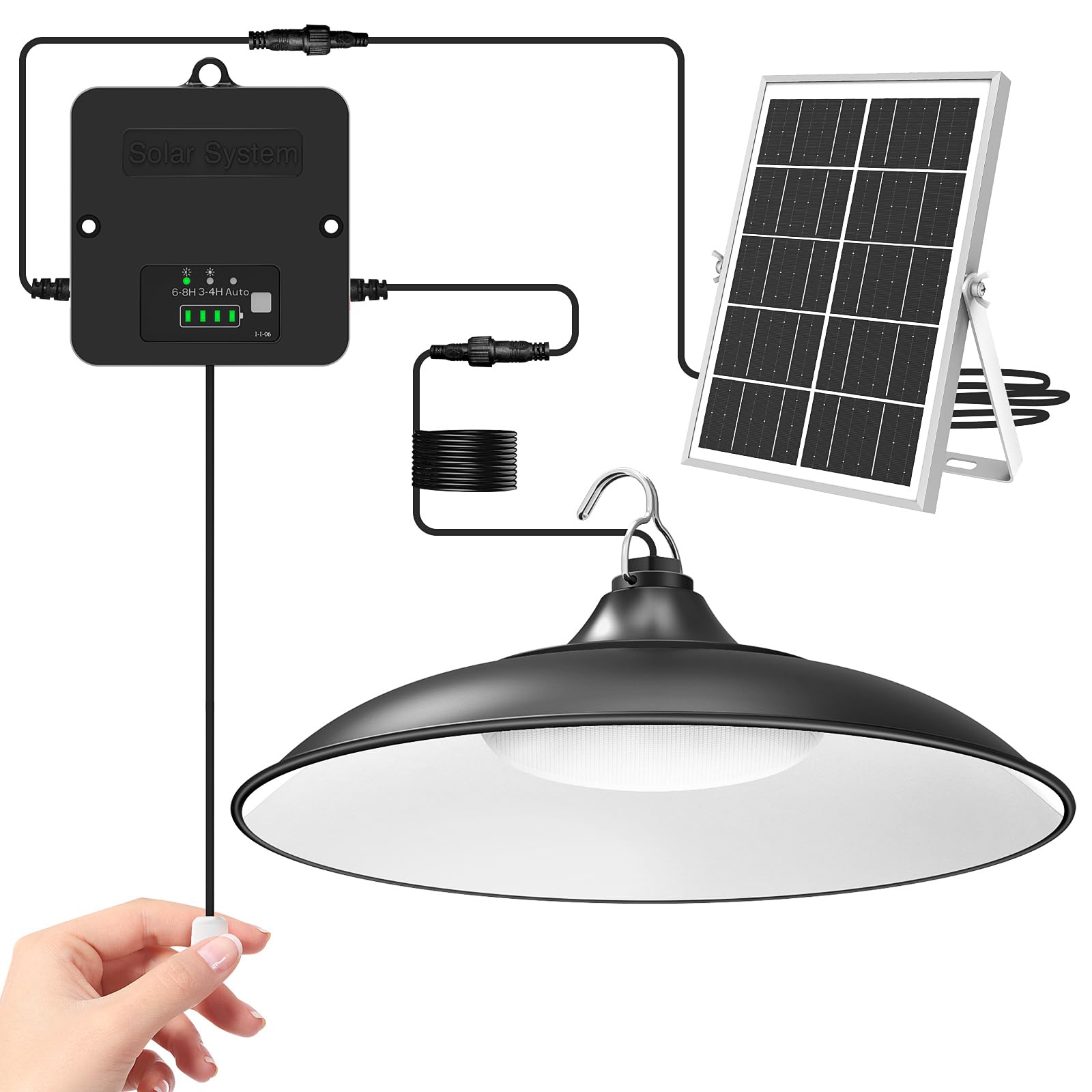
The biggest battery in the roundup means more light for more hours.
If your shed is larger than average — say 10×12 or 10×18 feet — this light’s 2000-lumen output and massive 6000mAh battery (the largest capacity in this guide) ensure the whole space stays illuminated. One buyer with a 10×18 shed confirmed it “lights up the whole shed at night.” The 6000mAh battery powers three modes: medium light for 6-8 hours on one pull, high brightness for 3-4 hours on two pulls, or medium auto-mode for 12-14 hours on three pulls — so you adjust based on how much light you need.
Unlike most competitors, this light has no remote — operation is via a pull string, which some people prefer because you never lose it or need batteries. It also includes a Power Box with battery level indicators so you know exactly how much charge remains. The large solar panel (7×10 inches) has a 30% solar conversion rate (meaning it turns 30% of the sunlight it receives into electricity, which is efficient) and can fully charge in 6-8 hours of direct sun — faster than many smaller panels.
The 2000LM output puts it on par with the ropelux 2000LM, but the APILAB leads on battery capacity — 6000mAh vs 4400mAh — giving you extra runtime for long winter nights. Note that the Power Box itself is not waterproof, so you must mount it in a dry spot inside the shed. The included cables (16.4 ft plus an extra 9.8 ft) give you plenty of reach to position the panel in full sun while keeping the light in the dark.
Why choose it
- Largest battery in the guide (6000mAh) for the longest possible runtime.
- Pull-string control means no remote to lose or break.
- High solar conversion rate (30%) for faster charging.
- 2000-lumen output fills a 10×18 shed, per buyer reports.
Keep in mind
- No remote control — you must walk to the light to switch modes.
- Power Box is not waterproof; needs a dry mounting spot inside.
Ideal for: Owners of larger sheds or barns who want the longest possible battery life and prefer simple pull-string operation over a remote. The 6000mAh battery gives it a clear edge over the ropelux 2000LM for overnight use.
skip it if: You need a remote to control the light from across the room or want a motion sensor — this model has neither.
4. AEQ Solar Shed Light Indoor Outdoor (1000LM)

This compact light brings 360-degree illumination and daytime-ready modes to small, dark spaces.
If you need light in a tight spot — like a chicken coop, walkway, or small shed — the AEQ’s 1000-lumen output is more than enough, and its 360-degree design means no dark corners. The real standout is its two daytime modes: Mode 4 stays off but blasts bright for 20 seconds on motion detection, and Mode 5 stays on constantly all day. That means you can work in a dark shed during the afternoon without covering the solar panel — a feature the ropelux 2000LM does not offer.
It has three night modes (dim-to-bright on motion, off-to-bright on motion, or constant-on from dusk to dawn) plus three timer settings (2H/4H/6H) that work during the day or night. A remote control lets you switch between all six modes from 3-20 feet away, and the “+/-” buttons adjust four levels of brightness. The separate solar panel charges in 6-8 hours and provides 10-20 hours of lighting, depending on the mode. Customers note it works well for chicken runs and animal feeding stations, surviving harsh winters with no issues. The IP65 rating (meaning it resists rain, snow, and frost) ensures it holds up outdoors.
At 1.76 pounds and measuring just 8.2 x 7.2 x 4.9 inches, it is compact enough to hang almost anywhere. One caveat from reviews: if you mount it near a hot grill cover, the heat from the grill can interfere with the motion sensor, causing the light to blink. Keep it away from direct heat sources. Unlike the larger ropelux 2000LM (which has dual sensors and more brightness), the AEQ is aimed at smaller spaces where daytime mode versatility matters more than raw power.
What works well
- 360-degree lighting eliminates shadows in small areas.
- Two daytime-use modes for working in dark sheds during the afternoon.
- Remote control with 4 brightness levels and 3 timer settings.
- Compact and lightweight (1.76 lbs) for versatile mounting.
Watch out for
- Motion sensor can be tripped by nearby heat sources like a grill.
- At 1000LM, it is not bright enough for large workshops or barns.
Perfect for chicken coops, small sheds, and walkways where you need daytime operation and even 360-degree coverage — something the 1000LM Deogos cannot match. Keep it away from heat sources.
Not the choice for large garage spaces — step up to a 2000LM model for more coverage.
5. INXPHY Solar Shed Light (1200LM, 174 LEDs)

Four adjustable panels let you point light exactly where it is needed most.
The INXPHY takes a unique approach with four 120°-adjustable LED panels (the “4+1” design means four leaves plus one central panel). Instead of a single light source, you can aim each leaf at a different workbench, shelf, or corner, giving you targeted illumination that a fixed light like the ropelux 2000LM cannot match. It puts out 1200 lumens from 174 high-efficiency 2835 LED beads, running at 6500K daylight white (a cool, crisp light that mimics natural daylight and helps you see details clearly).
The separate solar panel connects with a 16.5-foot cable, so you put the panel in full sun while the light hangs inside. The remote control handles on/off, brightness, mode selection, and timer settings, while the built-in motion sensor supports five smart modes for day and night operation. Buyers consistently call it “bright” and note the “responsive motion sensor.” The IP65 waterproof build (meaning it resists rain and snow) and high-density ABS material (a tough plastic that withstands bumps and weather) make it suitable for outdoor use.
One small trade-off is that its 12 x 12 x 2.4-inch form factor is larger than most other lights here — it takes up more headroom space. But that size gives you the four adjustable panels, which none of the other picks offer. At 1200 lumens, it sits between the compact AEQ (1000LM) and the heavy hitters (2000LM+), making it a strong middle-ground option for garages and patios. Note the INXPHY measures 12″L x 12″W x 2.4″H compared to the smaller papasbox at 5″L x 5″W x 4″H — a significant size difference that reflects the multi-panel design.
Smart design
- Four independently adjustable panels let you direct light to multiple areas.
- 1200-lumen output at 6500K daylight white is crisp and clear for detail work.
- Remote control with motion sensor and timer adds convenience.
- IP65 waterproof rating handles rain and snow.
Small compromises
- Larger footprint (12×12 inches) than most other solar shed lights.
- Battery capacity not listed, so runtime is harder to estimate.
Best for garages and multi-workbench sheds where you want to aim light at different spots without moving fixtures — a capability the fixed ropelux lights lack entirely.
Consider an alternative if ceiling space is tight — the 12×12 panel array needs more headroom than a compact round light.
6. Deogos Solar Shed Light (1000LM)

A motion-sensing powerhouse for security-minded sheds and gazebos.
With 180 LED beads pumping out 1000 lumens, the Deogos is a solid mid-range choice that focuses on motion-activated security. Its motion sensor is sensitive enough that one reviewer noted it triggers even when their loft cover is closed, making it reliable for catching unexpected activity. The lithium battery provides up to 12 hours of light on a full charge (about 6 hours of sun to recharge), so it works through the night for security.
It offers five lighting modes, including the crucial Mode 4 (off-to-full-bright on motion all day long) and Mode 5 (constant-on all day). The separate solar panel connects via a 16.5-foot wire, and the light can be ceiling-mounted. The included remote lets you switch modes and adjust brightness from a distance. At 2 pounds, it is heavier than the AEQ (1.76 lbs) but still easy to hang. Some owners have had intermittent reliability issues — one unit stopped working for a week then randomly resumed — but the majority of reviews are positive, with one user saying it still works great after “2 summers.”
Compared to the INXPHY (which offers brighter 1200LM and adjustable panels), the Deogos is more about motion detection and simplicity. It is also a good alternative to the AEQ if you prefer ceiling mounting to pendant hanging. Its all-plastic construction feels a bit less premium, but as reviewers point out, the performance in a 12×14 shed is “beyond expectations.”
Strong points
- Sensitive motion sensor with 5 modes including all-day activation.
- Remote control for easy mode switching.
- Up to 12 hours of light on a full charge.
- IP65 waterproof rating and durable ABS material.
Points to note
- Some units have had intermittent reliability issues — check your unit immediately after arrival.
- All-plastic build feels less sturdy than premium alternatives.
Go for this one if motion-activated lighting is your priority for a garage, canopy, or gazebo — the sensor is sensitive and responsive. It outclasses the AEQ on sensitivity for security setups.
Hesitate if you need a rock-solid light with zero reported defects — the intermittent issues are a real risk.
7. papasbox Solar Pendant Light (920LM)
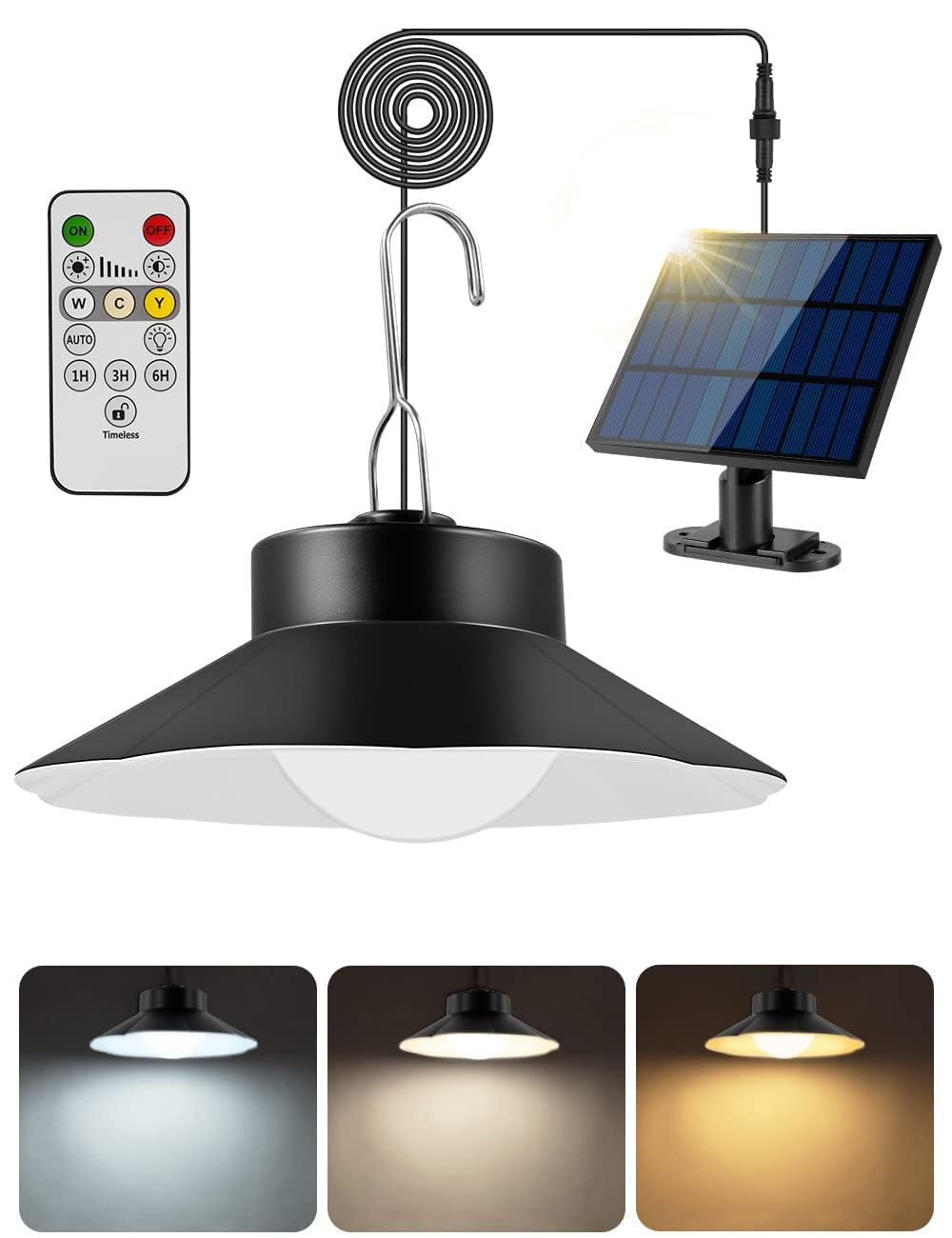
A tiny light that fits in tight corners, with three color temperatures on a budget.
The papasbox is a compact light in this lineup — small enough to hang in a chicken coop, a gazebo corner, or a narrow hallway without overwhelming the space. It offers three color temperatures (3000K warm white, 4500K natural white, 6500K cool white) controlled by the remote. The split design means the light body and solar panel are separate, connected by a 16.4-foot cable.
It offers five brightness modes ranging from 100% (6 hours of light) down to 20% (15 hours of light), plus a dusk-to-dawn auto function. The monocrystalline silicon solar panel is designed for efficient charging. However, one buyer mentioned that after a two-day charge, the auto mode was “dim and died within 2 hours,” so real-world battery performance can be hit-or-miss. Other users have had success, finding it “bright, reliable, and perfect for my shed.”
At 920 lumens, it is the dimmest option here — noticeably less powerful than the 2000LM APILAB or the 1200LM INXPHY. But for a small space like a 5×5 chicken coop or a balcony laundry area where you just need a little light, it gets the job done. Its main strength is its tiny footprint and competitive price, making it a budget entry point for solar shed lighting.
Where it fits
- Ultra-compact (5x5x4 inches) fits in tight spaces other lights cannot.
- Three color temperatures and five brightness modes via remote.
- Split design with 16.4ft cable for flexible panel placement.
- Budget-friendly entry point for solar shed lighting.
What the data shows
- At 920 lumens, it is the least bright option in this guide.
- One owner reported the light lasted less than 2 hours on a full charge — check your unit early.
Best for small, enclosed spaces like chicken coops, small gazebos, or where space is at a premium — at 5x5x4 inches, it fits where the 12×12 INXPHY will not.
Not bright enough for a full-sized garage or workshop — step up to 1200LM or more for real workspace lighting.
Understanding the Specs
Lumens & Color Temperature
Brightness is measured in lumens (LM). A 900-lumen light is good for a small coop or reading area, so you can see nearby objects. A 2000-lumen light fills a 10×12 shed, so tools and shelves are visible. Color temperature, measured in Kelvin (K), tells you the light’s tone: 3000K is a warm yellowish glow for relaxation, 4500K is neutral white for general use, and 6500K is cool daylight white that helps you see fine details for detailed work. Most solar shed lights let you switch between these with a remote.
Battery Capacity & Solar Panel
The battery, measured in milliamp-hours (mAh), stores the sun’s energy for nighttime use. A 4400mAh battery runs 10-20 hours depending on the brightness setting — enough for a typical evening. A 6000mAh battery gives you even more headroom for long winter nights. The solar panel’s size and conversion rate (such as 30%) determine how fast it charges — a larger panel (like 7×10 inches) fills the battery faster on cloudy days. A separate panel with a long cable (15-16 feet) lets you place it in direct sunlight while the light hangs in shade.
Motion Sensor vs. Dusk-to-Dawn
A motion sensor (PIR sensor — Passive Infrared) turns the light on only when it detects movement within a certain range (e.g., 26 feet at 180 degrees). This saves battery and adds a security element — the light stays dim or off until someone or something passes by. Dusk-to-dawn mode uses a light sensor (a photocell that measures ambient brightness) to turn the light on automatically when it gets dark and off at sunrise, keeping the space lit all night without any interaction.
IP Rating & Weather Resistance
IP (Ingress Protection) ratings tell you how well a device resists dust and water. An IP65 rating means the light is fully protected against dust and can handle low-pressure water jets from any direction — basically rain, snow, and hose splashes. This is the standard you want for an outdoor or damp-indoor location like a shed or barn. Items without an IP rating should stay in completely dry indoor areas.
FAQ
Yes, if the light has a separate solar panel connected by a cable that you mount outside.
A 4400mAh battery runs 10–20 hours at low-medium brightness; a 6000mAh battery lasts 12–14 hours on medium.
It overrides the light sensor so the light stays on even when the solar panel is in full sun.
2000 lumens is enough for a 10×12 shed; 1000–1200 lumens works for an 8×10 space.
Can a solar shed light work in a completely enclosed shed with no windows?
How long does a solar shed light last on a full charge?
What does “daytime available” mean for a solar light?
How many lumens do I need for a single-car garage or a 10×12 shed?
Is a solar shed light safe for chicken coops or barns with animals?
Can I use a solar shed light during the winter in freezing temperatures?
How long does it take to fully charge a solar shed light?
What is the difference between a motion sensor and a dusk-to-dawn sensor?
Can I leave the solar panel in the rain or snow?
What does the “memory function” mean on a solar shed light?
Final Thoughts: The Verdict
For most people, the solar shed light winner is the ropelux 3000LM because it offers the highest lumen output (3000LM) and a large 4400mAh battery with dual motion sensors and adjustable color temperatures. If you want a balance of features and price, grab the ropelux 2000LM. And for simple pull-string operation with the largest battery capacity (6000mAh), the standout is the APILAB 2000LM.
How We Picked
We do not accept paid placement. Every pick is matched to a real buyer and a real use-case; we do not hands-on test units.
Sources & Methodology
Specifications: manufacturer listings and product documentation. Review insights: verified customer reviews, as of July 2026. Pricing: not shown on this page (it changes often); check the current price via the retailer link.
As an Amazon Associate, Lawn Gear Lab earns from qualifying purchases. This does not affect which products we feature.