
Specs are compiled from manufacturer listings and verified buyer reviews and can change over time — please confirm the key details on the product page before buying.
You can water, fertilize, and prune all season long, but if your soil’s pH is off, your plants will never reach their potential. A dirt pH tester is the one tool that takes the guesswork out of what is happening underground — telling you in plain numbers whether your soil is too acidic or too alkaline so you can fix it before your vegetables, flowers, or lawn start showing signs of stress.
I’m Rikta — the founder and writer behind Lawn Gear Lab. This guide is built by comparing the manufacturers’ published specifications and the patterns across verified customer reviews, so you get each pick’s real strengths and trade-offs instead of marketing spin.
Whether you choose a pack of 100 lab-grade test strips or a single reusable probe, the right dirt ph tester is the cheapest insurance your garden will ever get — and this guide walks you through every option that actually delivers reliable readings.
Quick Picks
- HSLGOVE 7-in-1 Soil Test Kit — Best Overall
- Luster Leaf 1818 Rapitest 4-in-1 — Best Value
- Leaping Lynx Soil pH Test Kit (100 Strips) — Top Strips
- Pexio PretiHom 3-in-1 Soil Tester — Budget Dual-Needle
- Vitamicor 4-in-1 Soil Tester (90° Rotation) — Compact 4-in-1
- Gain Express ZD-06 Soil pH Meter (295mm Electrode) — Deep Professional
How To Choose The Best Dirt pH Tester
Not every tester works the same way. Before you pick one, you need to decide if you want a disposable strip you read against a color chart or a metal probe that gives you a needle reading on a dial. Each has trade-offs in speed, cost per test, and durability.
Test Strips vs Probe Meters
Test strips are the simplest method — you mix a small soil sample with water, dip a strip, and compare its color to the included chart. They are cheap per test and leave no probe to break, but reading subtle color differences in the 3–9 pH range can be tricky under low light. Probe meters are reusable and give you a direct dial reading, but their metal needles are fragile — buyers report they can snap if you force them into dry or rocky soil. A probe meter is best if you test often in the same garden beds; strips are better if you need to test many spots at once or want to avoid any risk of probe damage.
Extra Functions Worth Considering
Many dirt pH testers also measure moisture, light intensity, and even fertility (nitrogen, phosphorus, potassium levels). A 3-in-1 or 4-in-1 meter combines these into one tool, saving you from buying separate devices. But the extra modes can come with quirks — owners mention that the light meter function on some models is nearly useless, and fertility readings are often calibrated for general NPK levels, not specific to your plant type. If you only need pH, stick with a dedicated pH tester. If you also battle overwatering, a combo with a moisture mode is valuable.
Probe Build and Depth
A probe that is too short might not reach the root zone where pH matters most. Look for a probe around 6–8 inches for standard garden beds, or the longer 295mm electrode found on the Gain Express model for deeper root penetration. Also check the material — corrosion-resistant metal probes last longer, especially if you leave them in the soil for several minutes during testing. Single-probe designs are less disruptive to roots than fork-style dual probes, according to gardeners who test near delicate perennials.
Quick Comparison
| Model | Best For | pH Range | Probe Type | Extra Functions | Amazon |
|---|---|---|---|---|---|
| HSLGOVE 7-in-1 | All-around precision | Dual-screen read | Single metal, 6.8″ | Moisture, fertility, temp, air humidity, light | Amazon |
| Luster Leaf 4-in-1 | Reliable beginner meter | Analog dial | Three stainless steel | Moisture, fertility, light | Amazon |
| Leaping Lynx Strips | Multi-spot batch testing | 3–9 (color chart) | 100 disposable strips | None | Amazon |
| Pexio PretiHom 3-in-1 | Budget-friendly dual-needle | Analog dial | Dual-needle | Moisture, light | Amazon |
| Vitamicor 4-in-1 | Indoor potted plants | Analog dial | Single metal, 90° rotation | Moisture, light, fertility | Amazon |
| Gain Express ZD-06 | Deep-root and commercial use | Analog dial | Single long 295mm electrode | None | Amazon |
In‑Depth Reviews
1. HSLGOVE 7-in-1 Soil Test Kit
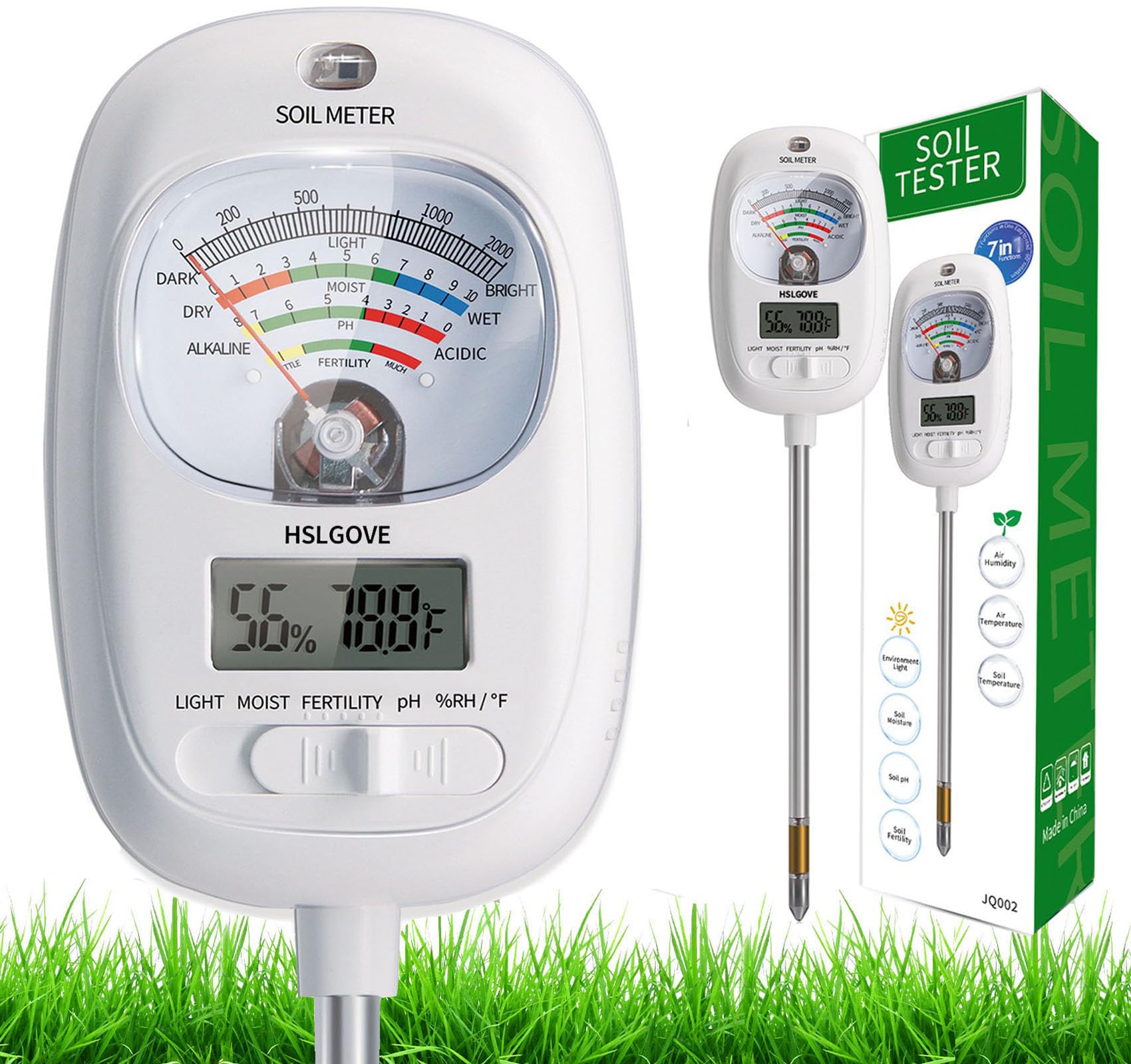
The one tool that replaces five separate meters without cluttering your shed.
This is the most complete soil dashboard you will find in a single device. The HSLGOVE 7-in-1 combines an analog dial for moisture, pH, fertility, and light with a dedicated LCD screen that displays soil temperature, air temperature, and air humidity — so you are not just fixing pH but also tracking whether your grow room or greenhouse environment is in range. It uses a single 6.8-inch metal probe, which customers note is less disruptive to plant roots than the fork-style dual probes found on cheaper meters.
Buyers consistently report it delivers quick, stable readings. One reviewer called it “convenient all-in-one for moisture, pH, fertility, temp, humidity” and praised the “clear dual display.” The catch is durability — one professional agronomist noted the light sensor failed and called the fertility meter useless, though the same reviewer confirmed the moisture and temperature modes work fine. You also need to replace all batteries each time you swap them, which is a small hassle. Compared to the Luster Leaf 4-in-1 below, the HSLGOVE adds digital temp and humidity data that the analog-only Luster Leaf cannot show — making it the better pick if you want environmental tracking alongside pH.
Real-world verdict: This is for the gardener who wants every data point in one place — pH, moisture, fertility, and air conditions — without juggling multiple tools. skip it if you only need pH and prefer a simpler, no-battery analog meter.
Reach for this if: You monitor indoor humidity or soil temperature alongside pH and want a single device that covers everything.
Look elsewhere if: You are a budget shopper who just needs a basic pH reading — the extra cost and battery management are not worth it for casual users.
2. Luster Leaf 1818 Rapitest 4-in-1

The analog meter that gardeners have trusted for years because it just works.
This Luster Leaf is the classic three-probe 4-in-1 that has been a staple in hobby gardens for a reason. It measures soil pH, moisture, fertility, and sunlight — all without any batteries. You simply push the three stainless steel probes into moist soil, wait about 30 seconds, and read the dial. Reviewers point out it gives “accurate, instant pH/fertility/moisture/light readings” as long as you follow the prep: remove the top 2 inches of dry soil, add distilled water, and polish the pH probe with steel wool to activate the static charge.
The trade-off is that the probes are fragile. Multiple reviews warn against forcing the prongs into hard or rocky soil, and one buyer called the light meter “useless.” The fertility reading is also calibrated for general NPK levels, not specific to a plant type. Compared to the Leaping Lynx strips below, the Luster Leaf gives you instant pH without mixing a soil-water slurry — but at a much higher upfront cost. Over time, though, it pays off because you never buy strips again.
What makes it reliable
- No batteries needed, so it works every time you pick it up
- Three stainless steel probes measure pH, moisture, and fertility in one push
- Compact and sturdy enough to toss in a garden bucket — weighs just 3.2 ounces
Where it stumbles
- Probes can snap if you jam them into dry or rocky soil — loosen the dirt first
- Light meter provides “barely adequate” results compared to a dedicated photometer, per one reviewer
- Fertility function is not plant-specific, so you get a general NPK indication rather than tailored advice
The takeaway: Perfect for the weekend gardener who wants fast, battery-free pH and moisture readings without messing with test strips. Not for precision farming or anyone who hates reading analog dials close to the ground.
3. Leaping Lynx Soil pH Test Kit (100 Strips)
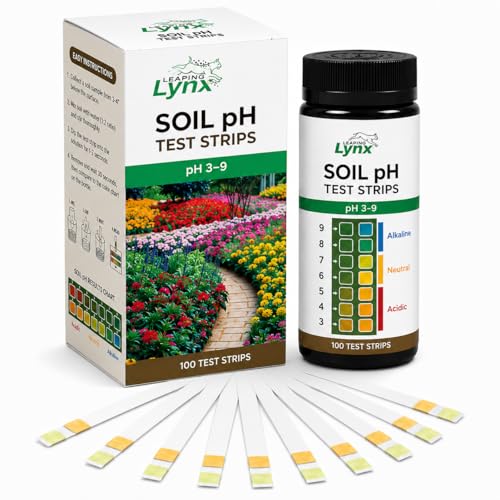
A 100-count strip pack that tests every corner of your garden in one afternoon.
If you need to pH-test a dozen different spots — front lawn, back vegetable patch, each potted plant — a strip kit like this is the most practical route. Each strip covers a pH range of 3 to 9, and you simply mix a small soil sample with water, dip the strip, and match the color to the included chart. One buyer even ran a control test: “I did control checks with baking soda, vinegar and borax (separate tests on each, I did not mix them). And the strips were on point!” That kind of real-world verification is hard to argue with for a product that costs roughly the same as a reusable meter.
The obvious catch is accuracy under real conditions. Another reviewer gave it 1 star, saying the colors are so similar you cannot read specific pH levels accurately. If you have poor eyesight or often test in dim light, the subtle color shifts between, say, a pH of 6.5 and 7.0 can be genuinely hard to distinguish. Compared to the Luster Leaf meter, the strips are less durable (you use them once) but give you 100 shots at diagnosing your soil — making them ideal for mapping a large property. At just 1 ounce for the whole kit, the strips are lighter than the 4.6-ounce Vitamicor 4-in-1 meter, so they slip into any pocket.
Hands-down for batch work: If you need to know the pH of 20 different soil spots this weekend, this is the fastest and cheapest way to do it. pass on it if you want a single meter you can use for years without buying refills.
Best for: Gardeners who test soil in many locations and want a low-cost per-test option.
Not ideal for: Anyone who struggles with color matching or needs a more precise decimal-level pH reading.
4. Pexio PretiHom 3-in-1 Soil Tester
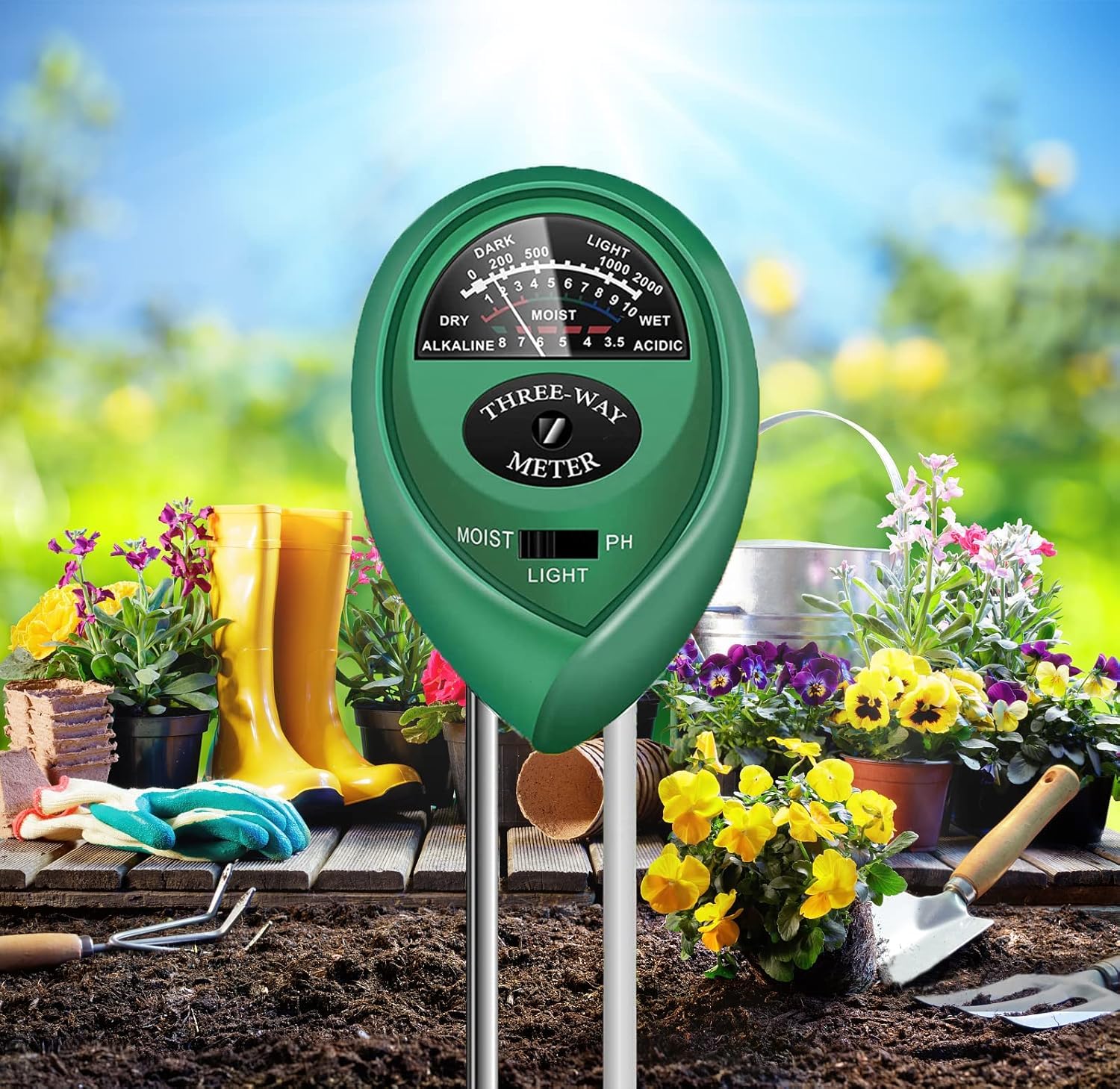
A no-frills battery-free meter that reads moisture, light, and pH from one dual-needle probe.
The Pexio PretiHom is about as simple as a soil tester gets — just push the dual needles about 4 to 5 inches into the soil, flip the switch to the mode you want (moisture/light/pH), and wait a few minutes for the needle to stabilize. It requires no batteries, making it a truly grab-and-go tool for daily plant checks. Buyers describe it as a “durable, battery-free soil pH tester” and note that you can get instant readings by gently cleaning the probes with steel wool to remove the protective coating applied at the factory.
Here is the honest trade-off: the instructions do not mention you need to leave the meter in the soil for up to 10 minutes for a stable reading. One buyer gave it 2 stars specifically because the packaging said nothing about the 10-minute wait, and the meter showed no reading initially. So, expect a learning curve — after the first use, you will know to park it in the soil and walk away. Compared to the Luster Leaf, the Pexio PretiHom uses a dual-needle design that covers more soil area but at a slightly lower build quality feel. The 100.0-count strip pack from Leaping Lynx covers far more ground, but this single meter is a one-time purchase that never runs out of strips.
What works
- Battery-free and simple to operate after the first learning curve
- Dual-needle design gives you moisture, light, and pH from one probe
- Lightweight and portable — fits easily in a plant caddy or pocket
What trips users up
- Requires up to 10 minutes in the soil for stable readings — not instant as some expect
- Initial protective coating on probes can block readings until cleaned
- Not for hard, rocky, or compacted soil — the dual needles are delicate
Smart pick for: Casual indoor plant owners who want a low-cost, battery-free meter for quick moisture checks and occasional pH testing. it’s not for you if you need precise pH data fast or test in multiple spots daily.
5. Vitamicor 4-in-1 Soil Tester (90° Rotation)
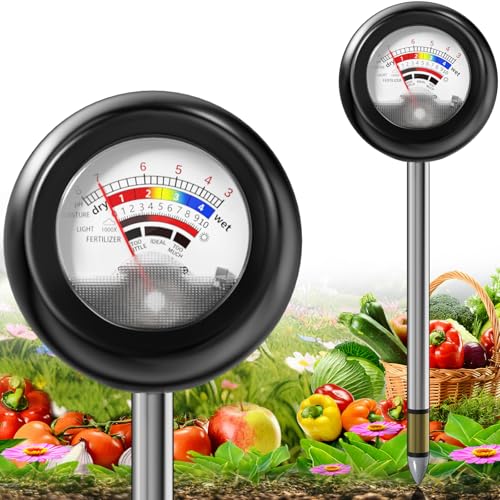
A compact rotating dial tester that works best in medium to large potted plants.
The Vitamicor 4-in-1 measures moisture, pH, light, and soil fertility with a single metal probe that rotates 90 degrees for easy reading. It is designed for soil only — the manufacturer is clear you should not use it in water, clay, sandy, or hard soil. The probe is corrosion-resistant and battery-free, so you just insert it about two-thirds of the way into the soil and get real-time results. One buyer called it a “must-have tool for every plant lover” and praised how quickly it checks all four parameters in one go.
The downside is the size of the needle. Shoppers say the probe is very bulky, making it unsuitable for small pots where the probe’s diameter alone can displace too much soil. Another common complaint is that the switch between modes feels cheap and the mode labels are hard to read. Most critically, a verified buyer reported “inaccurate and irregular readings” — the needle moves inconsistently even in the same hole and fails to read zero when dry. Compared to the HSLGOVE’s dual-screen precision, the Vitamicor’s single dial can be harder to interpret, and the probe length is shorter than the 295mm Gain Express model, so it won’t reach deep-root zones. At 4.6 ounces, it is noticeably heavier than the 1-ounce Leaping Lynx strip kit but still portable for greenhouse use.
A cautious buy: This is fine if you only need a basic 4-in-1 for medium-to-large pots and do not expect lab-grade accuracy. The inconsistent needle behavior reported by multiple buyers makes it a riskier choice for anyone who needs trustworthy pH data.
Grab it if: You want a single tool for checking moisture and pH in your larger houseplants without buying batteries. Look elsewhere if you test in small pots or need reliable, repeatable pH readings across multiple sessions.
6. Gain Express ZD-06 Soil pH Meter (295mm Electrode)

The long-probe specialist for vineyards, orchards, and deep-rooted soil analysis.
While most home meters top out around 7 inches, the Gain Express ZD-06 brings a 295mm (about 11.6-inch) slender electrode that penetrates deep into the soil, giving you pH and moisture readings at the root zone where it actually matters. It is self-powered (no batteries required) and built with a waterproof metal probe, making it suitable for commercial settings like vineyards, orchards, and field production. One buyer confirmed the “heavy duty probe is very durable,” and the meter performs across an operating temperature range of 5°C to 50°C (41°F to 122°F).
The honest trade-off? The pH reading is slow — buyers report it takes minutes to stabilize, not seconds. One buyer called it “trust but verify” and observed that the moisture readout is responsive while the pH needle crawls. The manufacturer also recommends periodic calibration to maintain accuracy, which adds a step that casual users may skip. Compared to the 100-test-strip Leaping Lynx kit which gives you immediate color-based results across many spots, the Gain Express is a one-spot-at-a-time tool. But for a vineyard manager or serious orchard grower who needs to measure deep soil layers without digging a hole, this 295mm electrode is class-leading by any other meter in this list. Unlike the Vitamicor’s bulky probe, the Gain Express’s slender electrode slides into tighter soils with less resistance.
Where it excels
- 295mm electrode reaches deep root zones that shorter probes cannot access
- Self-powered — no batteries to replace or fail
- Waterproof and durable metal construction for outdoor commercial use
Where it lags
- pH reading takes several minutes to stabilize — not instant like a digital meter
- Requires periodic calibration to maintain accuracy, per the manufacturer
- One buyer received a defective unit that locked up, though the seller was responsive
Built for pros: Reach for this if you manage a vineyard, orchard, or large lawn where deep pH data is non-negotiable. look elsewhere if you are a casual houseplant owner — the slow pH read and calibration requirement are overkill for indoor pots.
Understanding the Specs
pH Range (3–9 vs Broader)
Most dirt pH testers cover a range of 3 (very acidic) to 9 (very alkaline), which is enough for nearly all garden and lawn needs. If you are growing acid-loving plants like blueberries or azaleas, you will be reading the lower end of that scale. A strip or meter that only covers 4–8 might miss the extremes, so check the range before you buy. The Leaping Lynx kit specifies a 3–9 range, which matches what most home gardeners encounter.
Single Probe vs Dual-Needle vs Strips
A single metal probe is less disruptive to plant roots and is common on professional meters like the Gain Express. Dual-needle designs (like the Pexio PretiHom) sample more soil area in one push but can be harder to insert. Test strips involve no soil disturbance at all — you just collect a sample in a cup. Choose based on how often you test and how delicate your plants are. If you test near shallow-rooted perennials, a single probe or strip is safer than a fork-style dual needle.
FAQ
Do I need to buy batteries for a dirt pH tester?
How deep should I insert the probe for an accurate pH reading?
Can I use a dirt pH tester in water or hydroponic solutions?
How long does a pH test strip take to develop a color?
Will my pH tester work in dry or rocky soil?
What does the fertility function on a 4-in-1 meter actually measure?
How many times can I reuse a single test strip?
Is a dual-needle meter more accurate than a single-probe meter?
What temperature range can a soil pH meter handle?
How do I clean and maintain my pH tester after each use?
Final Thoughts: The Verdict
If you want one dependable pick, the best dirt pH tester is the HSLGOVE 7-in-1 because it combines a traditional analog dial for pH and moisture with a digital LCD screen for soil temperature and air humidity — giving you a complete picture of your growing environment in one device. If you want a no-battery, tried-and-true analog meter that just works, grab the Luster Leaf 4-in-1. And for deep-root commercial testing in vineyards or orchards, the standout is the Gain Express ZD-06 with its 295mm electrode that reaches the root zone other meters cannot touch.
How We Picked
We do not accept paid placement. Every pick is matched to a real buyer and a real use-case; we do not hands-on test units.
Sources & Methodology
Specifications: manufacturer listings and product documentation. Review insights: verified customer reviews, as of July 2026. Pricing: not shown on this page (it changes often); check the current price via the retailer link.
As an Amazon Associate, Lawn Gear Lab earns from qualifying purchases. This does not affect which products we feature.