Reader support helps keep the reviews honest and the site humming. As an Amazon Associate, I earn from qualifying purchases.5 Best Moisture Meter | Feels the Dirt So Your Thumb Stays Green

Specs are compiled from manufacturer listings and verified buyer reviews and can change over time — please confirm the key details on the product page before buying.

You do not need a green thumb to kill a houseplant—overwatering or underwatering does it fast. Your finger only tells you what is happening at the surface. A good moisture meter tells you exactly when the soil deep in the pot is dry enough to need a drink, so your plants get just what they need. Whether you are new to plants or a seasoned gardener with a fussy Monstera, the right meter spares your roots from rot and you from guessing.

I’m Rikta — the founder and writer behind Lawn Gear Lab. This guide is built by comparing the manufacturers’ published specifications and the patterns across verified customer reviews, so you get each pick’s real strengths and trade-offs instead of marketing spin.

We are about to break down five very different ways to measure soil moisture. You will find instant-read probes and leave-in sticks that change color, so you can pick the best moisture meter for the specific plants on your windowsill.

Quick Picks

How To Choose The Best Moisture Meter

Your choice depends on how you want to use it. Do you want to walk around and test a dozen plants in a minute? Or do you want a visual indicator that sits in each pot and tells you when to water at a glance? Those are the two main categories—analog probe meters and continuous leave-in sensors—and each has different specs to consider.

Analog vs. Leave-In vs. Digital

An analog probe meter (like the XLUX or Dr.meter) works instantly. You push the metal rod into the soil, and a needle on a dial tells you dry, moist, or wet. Good for spot-checking many pots fast, but you must remove it after each reading or the probe corrodes. A leave-in sensor (like the Sustee Aquameter) stays buried in the pot and uses a color-changing indicator—white means water, blue means good—so you never have to remember to test. A digital option (the Luster Leaf Rapitest) gives you a numeric readout and adds extra functions like pH and temperature, but it costs more and needs a battery.

Probe Length and Root Safety

For deep pots, a longer probe reaches the root zone where moisture counts most. The Dr.meter has a notably long thin probe, which buyers report is excellent for checking deep watering. A longer probe also pushes aside more soil, so a single-probe design (like the XLUX and Dr.meter both use) is gentler on roots than a double- or triple-probe head because it disturbs less dirt when you insert and remove it.

Extra Measurements (pH, Light, Temperature)

If you manage a delicate plant that needs specific soil acidity—like a Kaffir Lime or a blueberry bush—a meter that measures pH as well as moisture saves you from buying a separate kit. The Luster Leaf Rapitest also reads light and temperature, making it a four-in-one tool for the serious gardener. Multi-function digital meters need battery power and can drift in accuracy, so some buyers prefer a dedicated analog moisture meter for its simplicity.

Quick Comparison

Model Best For Type Weight Range Amazon
XLUX (2-Pack) Quick spot-checks on many pots Analog probe 3.5 Ounces Up to 150°F Amazon
Dr.meter S10Plus Deep pots and long-reach readings Analog probe 0.13 Kilograms Amazon
IPPINKA Sustee (4-Pack) Continuous monitoring of a collection Leave-in sensor 0.02 Kilograms Up to 104°F Amazon
Luster Leaf Rapitest 1885 pH, light, and temp in one tool Digital multi-tester 7 ounces Up to 99°F Amazon
IPPINKA Sustee (2-Pack) Single-plant leave-in monitoring Leave-in sensor 0.01 Kilograms Up to 104°F Amazon

In‑Depth Reviews

Best Overall

1. XLUX Soil Moisture Sensor Meter (2-Pack)

2-packNo batteries

The quickest dial readout that saves your roots from guesswork and corrosion.

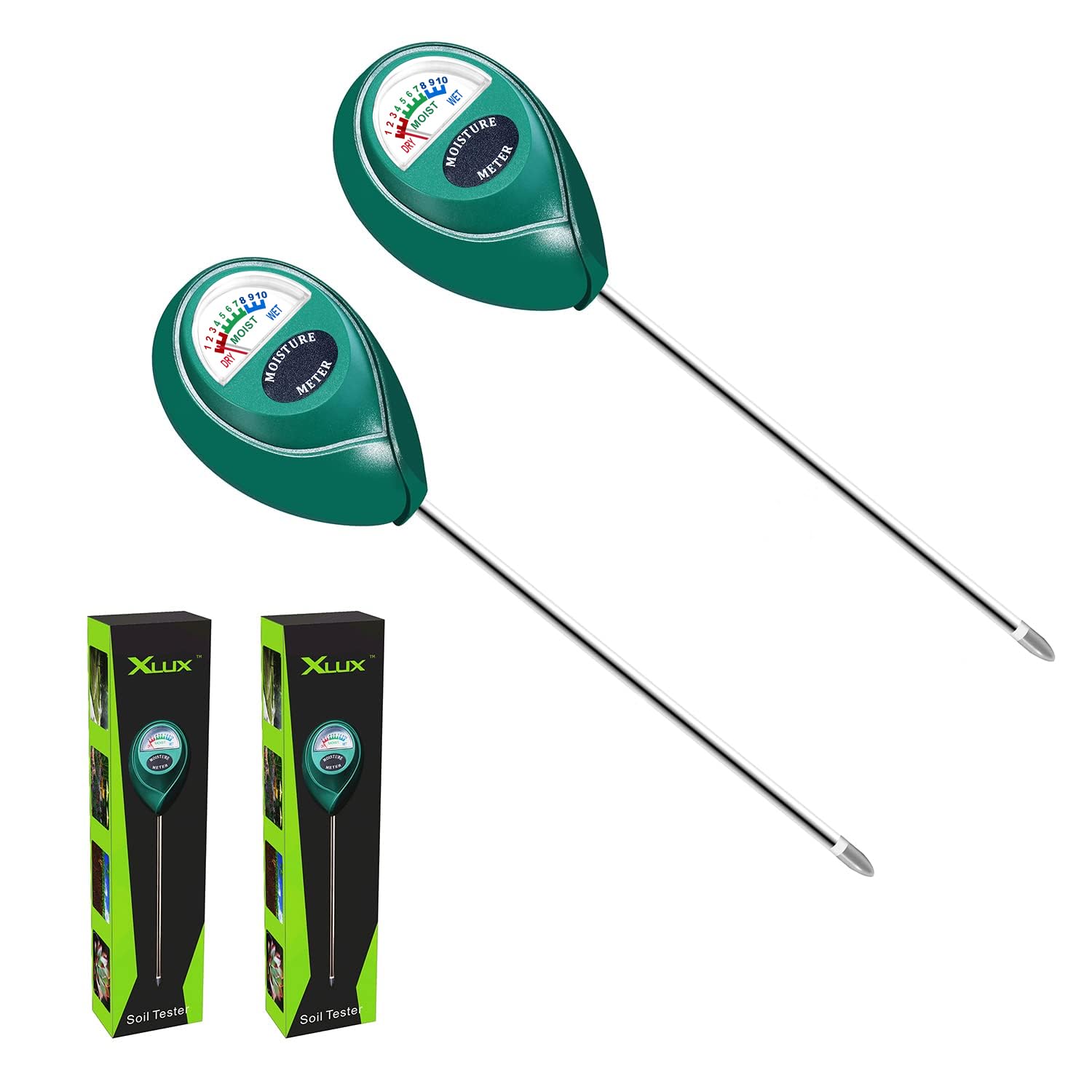
You get a clear reading in about one second with this analog meter. Push the single probe into the soil, and the large dial shows three color zones with ten scales—red for dry, green for moist, blue for wet. One reviewer noted it “literally takes 1 second to read the moisture in the soil!” At 3.5 ounces, it is about half the weight of the Luster Leaf Rapitest (7 ounces), so it feels light in your hand. The manufacturer says not to leave it in the soil for more than 5 minutes, because the metal tip will corrode. It handles outdoor sun better than the Sustee Aquameter, with a maximum temperature tolerance of 150°F versus 104°F.

The single-probe design disturbs less dirt than double- or triple-probe models, so delicate root systems stay intact. You get two meters in the box—one for houseplants, one for the raised bed. The probe is shorter than the Dr.meter’s, so reaching the bottom of a very deep pot requires you to angle the meter or test at the pot’s edge.

If you have a collection of pots and want a no-fuss tool that works without batteries, this set is the first one to grab. The XLUX is faster for spot-checking a whole collection than a Sustee leave-in stick.

Key Specs: Weight: 3.5 oz, Type: Analog probe, Max Temp: 150°F, Dimensions: 2″W x 1.6″H, Batteries: None.

Why it earns the top spot

  • Immediate reading—no waiting for a needle to settle
  • Two meters in one box for a low price
  • Light and easy to handle at 3.5 ounces

One real limitation

  • Cannot leave it in the soil or the metal probe will corrode
  • Shorter probe than the Dr.meter for deep planters

Reach for this if: You want the fastest possible moisture check for a houseplant collection or vegetable garden, with no batteries and no learning curve.

Look elsewhere if: You need a leave-in sensor that stays buried so you never have to remember to test.

Deep Probe Specialist

2. Dr.meter Soil Moisture Meter S10Plus

Long probeSingle probe

The extra-long single probe that reaches deep into the root zone without mangling soil.

You need this meter if you water in deep cycles—giving a big soak and wanting to know the moisture all the way down. Its notably thin and long single probe slides deep into the dirt. One buyer mentioned it works “perfectly for my Urban Worm Bag” to monitor moisture in a worm composting bin. Unlike the XLUX (3.5 ounces), the Dr.meter comes in at 0.13 kilograms, so it has a slightly more solid feel, though it is still a compact handheld tool. The color-coded ten-scale dial runs red to green to blue, just like the XLUX, and no batteries are required. The single-probe design is gentler on roots than the double-probe heads on some other meters.

The honest catch is durability. Several owners mention that the unit “arrived slightly bent,” and one said it “worked initially then failed” after being pushed into wet soil. The probe is thin by design to disturb fewer roots, but that same thinness makes it vulnerable to bending in hard or rocky soil—you have to be careful where you push. Unlike the Sustee Aquameter (0.01 kilograms) that stays in the pot, the Dr.meter is a spot-check tool that you insert, read, clean, and remove.

For worm composters and gardeners checking deep soil moisture in large planters, the reach is the real advantage here—just handle it with care. The XLUX is more forgiving for everyday use, but the Dr.meter goes deeper.

Key Specs: Weight: 0.13 kg, Type: Analog probe, Probe: Long/single, Batteries: None, Model: S10Plus.

Why reach matters here

  • Excellent for deep pots and worm bins where standard probes stop short
  • Single probe is gentle on sensitive root systems
  • No batteries or electronics to fail

The trade-off to know

  • Thin probe can bend in hard or rocky soil
  • Some units arrived with damage—inspect on arrival
  • Must be removed and cleaned after each reading

Grab this for: Deep containers, worm farms, and any situation where you need a probe that reaches past the first few inches of topsoil.

Pass if: You want a simple, sturdy meter that can handle rough soil without careful insertion.

Continuous Monitor

3. IPPINKA Sustee Aquameter (4-Pack, Medium)

4-packLeave-in

A leave-in stick that turns white when your plant is thirsty so you never bend to test again.

You never have to fish out a probe with this system. The Sustee Aquameter stays in the soil of each pot—sized for 3.5- to 6-inch planters—and uses a clever color indicator: white means water now, blue means you are good. It works completely differently from the XLUX and Dr.meter because you do not pull it out; it lives with the plant. Customers note that “each stick will last for approximately 6-9 months” before you need to replace the refillable core. At just 0.02 kilograms per stick, it is nearly weightless in the pot. The Sustee was developed in collaboration with Tokyo University of Agriculture, which gives it a serious design pedigree for a small gadget.

One owner reported these sticks helped save a Kaffir Lime and avocado seedlings that were dropping leaves from overwatering, saying the indicator “eliminates guesswork.” The upper temperature range is only 104°F, compared to the XLUX’s 150°F, so this is strictly a houseplant tool—it does not belong in a hot greenhouse or direct summer sun. The medium size works only for pots up to 6 inches; larger planters need a different size Sustee.

If you have a shelf of potted plants and want a visual reminder that even a forgetful housemate can read, this four-pack covers an entire windowsill at once. Compare this to the XLUX, which requires you to manually test each pot, and the advantage of continuous monitoring becomes clear.

Key Specs: Weight: 0.02 kg, Type: Leave-in color indicator, Pot size: 3.5-6 inch, Core life: 6-9 months, Made in Japan.

The continuous advantage

  • Stays in the pot—never forget to test
  • Visual color change is instantly readable for kids and guests
  • Refillable core reduces waste

What to watch for

  • Core must be replaced every 6-9 months
  • Limited to 104°F—not for hot outdoor sun
  • Medium size only fits pots up to 6 inches

Pick this if: You want a low-maintenance solution for a collection of houseplants and hate pulling a probe in and out every time.

skip it if: You need a meter for outdoor garden soil or very large planters that exceed 6-inch pot size.

Four-in-One Tool

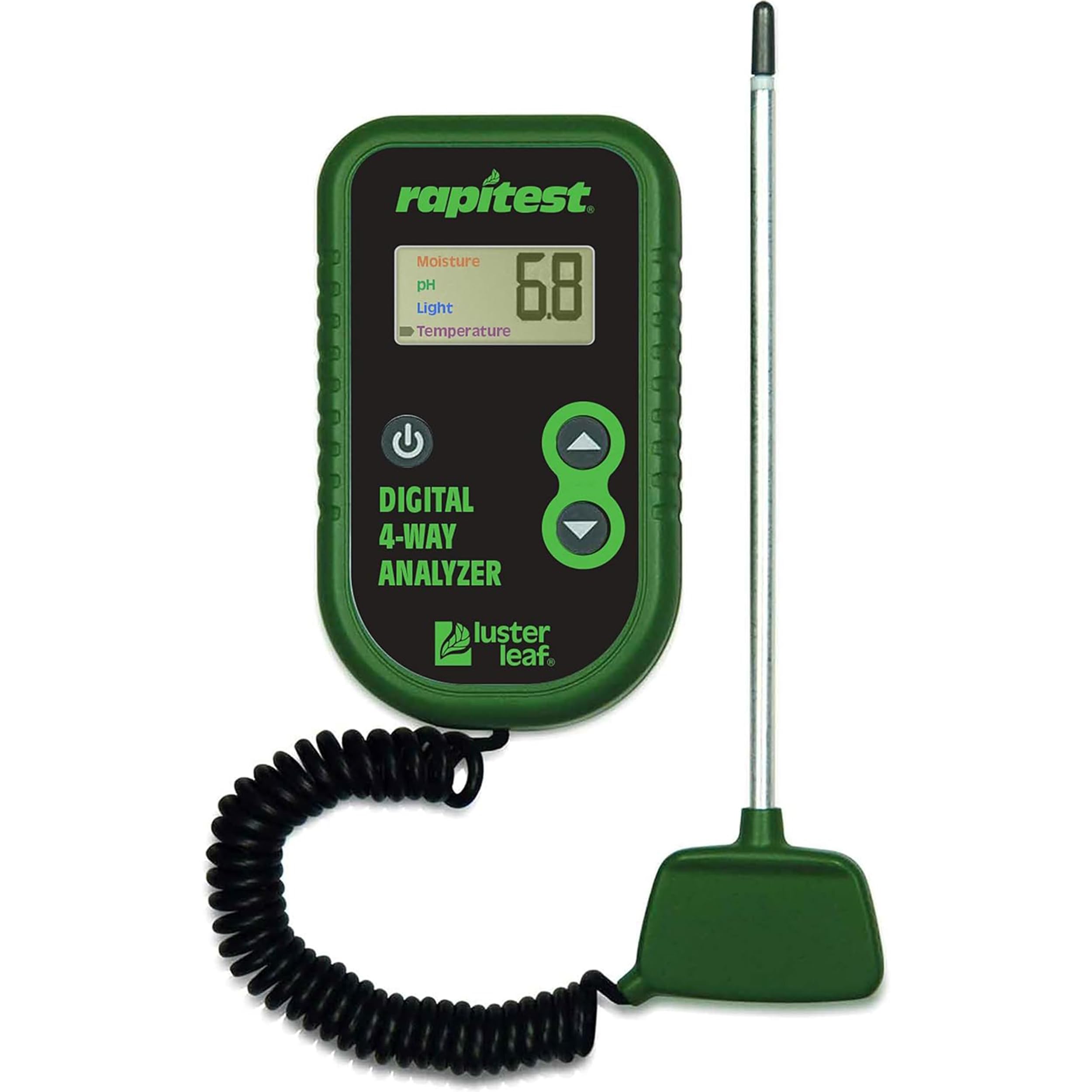
4. Luster Leaf Rapitest 4-Way Digital Soil Analyzer 1885

Measures pHDigital output

The one gadget that reads moisture, pH, light, and temperature in a single digital sweep.

Serious gardeners who manage soil chemistry as carefully as their watering schedule will appreciate this digital four-way meter. It measures soil pH, moisture, temperature, and light level—all on a modern digital display that is easier to read than an analog dial. At 7 ounces versus the XLUX at 3.5 ounces, it feels more substantial in the hand. The corded probe design lets you hold the display unit above the pot while the probe is in the soil, so you do not have to bend over to squint at a dial. The manufacturer includes a full plant list for 450+ plants from Rapitest, helpful when you need to know whether a specific species prefers acidic or alkaline soil.

The trade-offs are real. Several reviewers noted that the pH readings were inconsistent; one owner reported an erroneous pH of 6.2 when the buffer solution was 4.01, ruining a 40-gallon batch of soil. The temperature function also stops at 99°F (double digits only), which disappointed a reviewer who wanted to check a hot compost pile. Unlike the Sustee or XLUX, this meter requires batteries and relies on electronics that can drift over time. For pure moisture reading, the XLUX is faster and simpler—but the Rapitest is the only pick that gives you pH alongside moisture in one tool.

If you are trying to dial in specific soil conditions for a garden bed or finicky plants, the extra data is worth the cost, just be aware you may want a backup analog meter for a quick sanity check. This is the tool for the chemist-gardener, not for someone who just wants a drink/not-drink answer.

Key Specs: Weight: 7 oz, Type: Digital multi-tester, Functions: pH, moisture, light, temp, Max temp: 99°F.

Why you might want it

  • Four measurements in one device (moisture, pH, light, temperature)
  • Digital display is clear and easy to read
  • Includes full pH plant list for 450+ species

Where it falls short

  • pH accuracy can be inconsistent—some units give bad readings
  • Temperature only goes up to 99°F, not useful for hot compost
  • Requires batteries and electronics can fail

Best suited for: The detailed gardener who wants pH data alongside moisture and is comfortable double-checking digital readings against a known baseline.

Not for you if: You only need moisture level and want an instant, no-battery tool—the XLUX does that better for less.

Compact Two-Pack

5. Sustee Aquameter (2-Pack, Medium)

2-packLeave-in

Two featherlight sticks that sit in the dirt and turn white when your favorite plants need a drink.

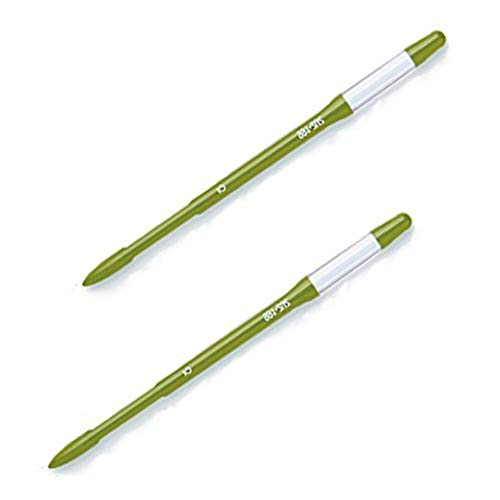
If you have one or two special potted plants—maybe a prized Monstera or a picky fiddle-leaf fig—this two-pack of Sustee Aquameters gives you continuous leave-in monitoring without buying a full four-pack. At just 0.01 kilograms per stick (compared to the Dr.meter’s 0.13 kilograms), each one weighs about as much as a few paperclips and disappears into the soil visually. The medium size fits pots 3.5 to 6 inches, and the color indicator shifts from blue (moist) to white (needs water) as the soil dries. Reviewers point out that “each stick will last for approximately 6-9 months,” and the refillable core means you can replace the sensing element instead of tossing the entire stick. Like the four-pack, this was developed with Tokyo University of Agriculture and carries a made-in-Japan badge.

The big difference from the four-pack is simple: you get two instead of four. That is perfect for a small collection or for gifting. The same 104°F temperature limit applies, so keep these indoors away from direct summer heat. One reviewer appreciated that these work “better than those meters with the needle,” praising the simplicity of a color-change system over an analog dial that requires you to bend and read a scale. The price for two is slightly higher per stick than the four-pack, so if you have more than two pots, the four-pack is better value.

For plant lovers with a small windowsill setup, this two-pack is the cleanest, most elegant way to stop guessing when to water. Think of it as the XLUX alternative for people who never want to pick up a probe.

Key Specs: Weight: 0.01 kg per stick, Type: Leave-in color indicator, Pot size: 3.5-6 inch, Core life: 6-9 months.

What makes it worth buying

  • Nearly weightless—0.01 kilograms each
  • Leave-in design means you never have to fish out a probe
  • Refillable core keeps waste low

One honest caveat

  • Limited to 104°F, so keep out of direct hot sun
  • Two-pack is less cost-effective than the four-pack if you own many plants

Reach for this if: You want a fuss-free leave-in solution for a small group of houseplants and like the visual simplicity of a color change.

Look elsewhere if: You need to test many pots at once—the XLUX 2-pack is faster for spot-checking a whole collection.

Understanding the Specs

Analog vs. Leave-in vs. Digital

An analog meter uses a metal probe and a mechanical needle on a dial—no battery, instant reading, but you must remove it after each use or the metal corrodes. A leave-in sensor (like the Sustee) has no electronics; it uses a moisture-sensitive material that changes color from blue to white, and it stays in the pot permanently until the core wears out after several months. A digital meter gives you a numeric readout and often adds extra functions like pH and temperature, but it depends on a battery and electronics that can drift off calibration over time.

Probe Length vs. Pot Depth

The probe’s length determines how deep into the pot you can read. A short probe (2-3 inches) reads moisture in the top layer of soil, which is fine for shallow pots. A long probe (like the Dr.meter) reaches deeper into the root zone where moisture lingers after a thorough watering. For tall planters or deep garden beds, a longer probe helps you know if the water has soaked all the way down or if the bottom is still bone dry while the top feels damp.

pH, Light, and Temperature Functions

Some multi-function meters (the Luster Leaf Rapitest) add a soil pH reading, a light sensor, and a thermometer. These extras matter if you are growing plants with specific soil acidity needs (blueberries, azaleas, citrus) or if you want to track light levels across your windowsill. Digital pH sensors need regular calibration checks, and the temperature function is often limited—be sure the range covers your actual use case (a maximum of 99°F, for example, will not read a hot compost pile).

Durability and Materials

A moisture meter with a thin metal probe reads deeper and causes less root disturbance but is more likely to bend in hard or rocky soil. A thicker probe is sturdier but can displace more soil and disturb roots. The analog dial itself is quite simple and rarely breaks, but the probe’s metal tip will corrode if left in damp soil for more than a few minutes. Leave-in sensors (Sustee) have no metal in the soil—they use a fabric-like wick and a ceramic sensor that swaps color—so they do not corrode, but the sensing core needs to be replaced after 6 to 9 months of continuous use.

FAQ

Can I leave an analog moisture meter in the soil all the time?
No. Analog meters with a metal probe (like the XLUX or Dr.meter) should be removed immediately after reading. The manufacturer of the XLUX specifically advises not to leave it in the soil for more than 5 minutes, because the metal tip will gradually corrode in the damp environment and stop giving accurate readings.
Which moisture meter works best for very deep pots?
For deep pots, the Dr.meter S10Plus with its long thin probe is the best option among analog meters. It reaches deeper into the root zone than shorter probes, allowing you to check if water has penetrated all the way to the bottom of a tall planter.
How long does a Sustee Aquameter last before you need to replace it?
Shoppers say that each Sustee stick lasts for approximately 6-9 months. The sensing core is refillable, so you can replace just the core rather than the entire plastic stick, which creates less waste than throwing the whole unit away.
Can a moisture meter measure pH at the same time?
Some digital meters, like the Luster Leaf Rapitest 4-Way Analyzer, measure both moisture and pH in one device. However, buyers report that the pH accuracy can be inconsistent, and the tool requires a battery and careful calibration to be trustworthy for precise soil adjustments.
Does a longer probe damage plant roots more?
A longer probe can reach deeper, but a single-probe design (used by both the XLUX and Dr.meter) is gentler than a double- or triple-probe head because it pushes less soil aside when you insert and remove it. The key is to insert the probe gently and avoid twisting or forcing it through compacted dirt.
What is the difference between a Sustee and a standard probe meter?
A Sustee Aquameter is a leave-in sensor that stays in the pot and changes color (white for dry, blue for moist), while a standard probe meter (like the XLUX) is an analog tool you insert, read, and remove each time. The Sustee gives you continuous visual feedback without any action, while the probe meter gives you an instant numeric dial reading but requires you to test each plant manually.
Can I use a moisture meter in outdoor garden soil?
Yes, analog probe meters like the XLUX and Dr.meter work well in outdoor garden soil, as long as the soil is not extremely hard or rocky. The XLUX has a maximum temperature rating of 150°F, which handles direct summer sun. Leave-in sensors like the Sustee are limited to 104°F and are better kept indoors or in shaded pots.
Does the XLUX moisture meter need batteries?
No, the XLUX uses analog technology with a probe and a mechanical dial. It requires no batteries at all—just insert the probe into the soil and read the dial immediately.

Final Thoughts: The Verdict

If you want one dependable pick, the moisture meter winner is the XLUX 2-Pack because it gives you two fast, reliable, battery-free meters at a low cost, with a large dial that anyone can read in one second. If you want a leave-in system for a small collection of houseplants, grab the IPPINKA Sustee 4-Pack and let the white-to-blue color change tell you when to water without lifting a finger. And for the serious gardener who also needs pH and light data alongside moisture, the Luster Leaf Rapitest 4-Way gives you four readings in one tool, though you may want to double-check its pH accuracy with a known reference.

How We Picked

We do not accept paid placement. Every pick is matched to a real buyer and a real use-case; we do not hands-on test units.

Sources & Methodology

Specifications: manufacturer listings and product documentation. Review insights: verified customer reviews, as of July 2026. Pricing: not shown on this page (it changes often); check the current price via the retailer link.

As an Amazon Associate, Lawn Gear Lab earns from qualifying purchases. This does not affect which products we feature.

Please use a real email you check. If it's fake or mistyped, your message won't reach us and we can't reply — wrong addresses are rejected automatically.