
Specs are compiled from manufacturer listings and verified buyer reviews and can change over time — please confirm the key details on the product page before buying.
If your rhododendron has gone from show-stopping to just… stopping — producing few leaves and zero flowers — the soil pH (a measure of how acidic or alkaline the dirt is, here needing to be acidic) is almost certainly the culprit. Rhododendrons are acid-loving plants, and without the right acidic soil environment, they simply cannot access the nutrients they need to grow and bloom. This guide compares manufacturer specs and verified customer reviews to identify the acid fertilizer that actually fixes the problem.
I’m Rikta — the founder and writer behind Lawn Gear Lab. This guide is built by comparing the manufacturers’ published specifications and the patterns across verified customer reviews, so you get each pick’s real strengths and trade-offs instead of marketing spin.
Whether you are nursing a mature shrub back to health or setting up new plantings for success, the right acid fertilizer for rhododendrons is the single most important tool you can buy to unlock your garden’s potential.
Quick Picks
- Espoma Organic Holly-Tone 4-3-4 — Best Overall
- Miracle-Gro Water Soluble Azalea, Camellia, Rhododendron Plant Food — Top Performer
- Dr. Earth Acid Lovers Azalea, Camellia, Rhododendron & Maple Fertilizer — Best Value
- Fertilome (10685) Azalea, Camellia, Rhododendron Food 9-15-13 — Blooming Specialist
- True Organic Azalea, Camellia & Rhododendron Food — Nature’s pH Fixer
How To Choose The Best Acid Fertilizer For Rhododendrons
Choosing the right fertilizer for your rhododendrons depends on a few non-negotiable points. You are not just feeding the plant — you are adjusting the soil chemistry so the plant can feed itself. Here is what matters most.
N-P-K Ratio: The Blooming Formula
The three numbers on the bag (Nitrogen-Phosphorus-Potassium) tell you the primary nutrient balance. For rhododendrons, a higher middle number — phosphorus — is the key to encouraging flower production. An N-P-K like 9-15-13 or 5-4-3 gives the plant the phosphorus push it needs to set buds, while keeping nitrogen moderate to avoid pushing out too many leaves at the expense of blooms. A balanced 4-3-4 is better for overall plant health and root development.
Form Matters: Granules vs. Water-Soluble
Granular fertilizers are slow-release and feed the soil over weeks or months, making them ideal for a single spring and fall application. Water-soluble powders, like Miracle-Gro’s offering, are fast-acting and give a quick green-up and bloom boost, but require reapplication every 7-14 days. For busy gardeners, granules are often the more convenient and consistent choice. For a targeted rescue, a water-soluble option can be faster.
Organic vs. Synthetic: Soil Health Matters
Organic fertilizers, like those from Dr. Earth and True Organic, build soil structure and feed the microbial life that naturally helps plants absorb nutrients. They are slower to act but create long-term soil health. Synthetic fertilizers, like Fertilome, are fast-acting and deliver precise nutrient ratios, but do little for the soil itself. For rhododendrons planted in poor or clay-heavy soil, organic options can be a smarter long-term investment.
Quick Comparison
| Model | Best For | N-P-K Ratio | Item Weight | Item Form | Amazon |
|---|---|---|---|---|---|
| Espoma Organic Holly-Tone | Large Gardens & Long-Term Health | 4-3-4 | 36 lbs | Granules | Amazon |
| Miracle-Gro Water Soluble | Fast Rescue & Quick Blooms | — | 5 lbs | Powder | Amazon |
| Dr. Earth Acid Lovers | Organic Purity & Pet Safety | — | 1 lbs | Granules | Amazon |
| Fertilome Azalea, Camellia, Rhododendron Food | High-Phosphorus Bloom Booster | 9-15-13 | 4 lbs | Granules | Amazon |
| True Organic Azalea, Camellia & Rhododendron Food | Natural pH Reduction | 5-4-3 | 12 lbs | Granules | Amazon |
In‑Depth Reviews
1. Espoma Organic Holly-Tone 4-3-4
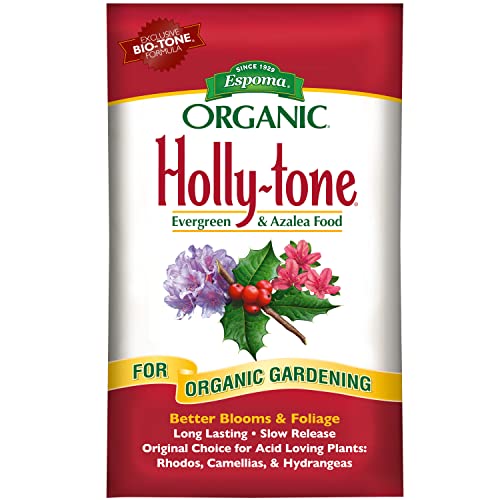
The garden workhorse that turns acid lovers into bloom factories season after season.
For anyone with multiple rhododendrons, azaleas, or a whole acid-loving garden bed, this is the most cost-effective and complete solution you can buy. The 36-pound bag delivers a massive amount of product at 36 pounds versus Dr. Earth at 1 pound, making it the clear choice for serious gardeners who want to feed in spring and fall without buying a new bag every time. The granular form is ready to use with no mixing — you just scatter it around the drip line (the circle of soil under the branches’ outer edge) of the plant and water it in.
The N-P-K ratio (3-number nutrient code: Nitrogen-Phosphorus-Potassium) is 4-3-4, which is a balanced formula for general plant health, root development, and steady growth rather than a high-phosphorus bloom blast. It works over the long term because the organic ingredients break down slowly, feeding the soil microbes along with the plant. It also contains 5% sulfur to help naturally lower soil pH. Buyers are unequivocal: one reviewer noted, “You will never have so many blooms on your azaleas, hydrangeas, or any of your blooming plants.” Another noted they “appreciate the good price on a 36 lb bag. Enough for my spring and fall feedings.” It is produced by the Espoma Company, a leader in natural organics since 1929.
There is a trade-off: unlike a 9-15-13 formula (like the Fertilome pick), this balanced 4-3-4 blend is not specifically designed to force a sudden explosion of flowers. It builds plant health first, and the blooms follow. If your rhododendron has not bloomed in years and you need a targeted phosphorus push, you might pair it with a higher-phosphorus option initially.
What Makes It a Powerhouse
- 36-pound bag offers strong value for large gardens at 36 pounds versus small 1-pound options.
- Organic, environmentally safe formula with no sludges or toxic ingredients; approved for organic gardening.
- Contains Bio-tone and 5% sulfur to feed soil biology and lower pH naturally.
- Granular slow-release means just two applications per year — spring and fall.
Trade-Offs to Note
- Balanced 4-3-4 is not a high-phosphorus bloom booster; you may need a separate product for a quick flowering rescue.
- 36-pound bag is heavy and takes up storage space; may be overkill for a single small rhododendron.
The verdict for most gardens: Buy this if you have multiple acid-loving plants or want a long-term, low-effort feeding regimen that builds soil health and produces reliable blooms year after year.
Consider something else if: You only have one small rhododendron in a pot and need a targeted, high-phosphorus quick fix — a smaller bag or a water-soluble formula will be cheaper and less wasteful.
2. Miracle-Gro Water Soluble Azalea, Camellia, Rhododendron Plant Food

The fast-acting lifeline that pulls a struggling rhododendron back from the brink within a week.
When your rhododendron looks sad, yellow, and refuses to grow, this water-soluble powder is your best bet for a rapid turnaround. Unlike the slow-release granules that take weeks to show results, the Miracle-Gro formula dissolves instantly in water and feeds through both leaves and roots. One buyer mentioned, “This truly helped our rhododendron to recover and look stunning this summer.” The feeding schedule is every 7 to 14 days, using the 1:144 mixing ratio (1 part powder to 144 parts water) for indoor plants or the 1:18 ratio for outdoor plants, either with a watering can or a Miracle-Gro Garden Feeder.
The 5-pound bag goes a long way — it contains enough powder to make dozens of gallons of liquid feed. It is designed for a wide range of acid-loving plants including azaleas, camellias, rhododendrons, gardenias, hibiscus, hollies, hydrangeas, and orchids. The formula is engineered to not burn foliage when used as directed, which is a common concern when applying a synthetic fertilizer. The resealable bag also keeps the powder dry between uses; as a reviewer noted, “the resealable bag… seals great as long as there is no fertilizer left on the Velcro.”
The catch is that this is not a long-term soil builder. It is a synthetic quick-feed that gives a green-up and bloom boost but does not improve the soil biology or structure for the following seasons. You will need to reapply every 7-14 days through the growing season to maintain the effect, unlike the granular options like Espoma that only need a spring and fall application.
Instant rescue, not a permanent fix: Reach for this if your rhododendron needs an immediate intervention — yellow leaves, no blooms, or stress from transplant. It is the quickest path to recovery.
Look elsewhere for hands-off care: If you prefer a “low-maintenance” once-a-season granular feed, the Espoma or Fertilome granular options will save you time over the long run.
Best for the urgent rescue mission: Perfect for a quick green-up and bloom push when you need visible results fast. The fast-acting liquid feed reaches roots immediately.
Not for the set-and-forget gardener: The need for reapplication every 7-14 days through the growing season can be a chore. If you are looking for a single spring application, stick with granules.
3. Dr. Earth Acid Lovers Azalea, Camellia, Rhododendron & Maple Fertilizer

The single-plant specialist that brings a two-year dormant rhododendron back to life in one season.
For the gardener who wants the absolute cleanest organic ingredients and has one or two special rhododendrons to pamper, this is the pick. It is the only Non-GMO Project Verified fertilizer in the USA, and it is certified by OMRI (Organic Materials Review Institute, an independent group that checks if products are allowed in organic farming), OIM (Organic Input Materials), and CCOF (California Certified Organic Farmers). The formula is handcrafted from human and feed grade ingredients with no synthetic chemicals, GMO-infested chicken manure, or toxic ingredients, making it safe for people and pets. A 1-pound bag is tiny compared to the 36-pound Espoma bag, so it is meant for targeted use around individual shrubs.
The granular form is easy to apply — just toss it around the base and water in. One owner reported, “I applied it to my rhododendron (which hadn’t bloomed for two years) and bam! It sprang to life and was covered with huge pink flowers in no time.” Another noted it revived “sad camellias” and that the “agapanthus flowered a month early.” It is enriched with multi-minerals, proteins, carbohydrates, humic acids (naturally occurring compounds that help roots absorb nutrients), and trace elements that go beyond the basic N-P-K to promote the healthiest soil possible.
The honest trade-off is the bag size. At 1 pound, you will need to buy multiple bags to cover a large garden bed or multiple shrubs, which drives up the cost per application compared to the Espoma 36-pound bag. It is best thought of as a precision tool for a few key plants, not a bulk solution for a whole landscape.
Why It Shines
- Highest purity standards: Non-GMO Project Verified, OMRI, CCOF, and NOP certified for organic production.
- People and pet safe — no synthetic chemicals or toxic ingredients, so you can use it on shrubs near play areas.
- Enriched with humic acids and trace minerals to improve soil biology beyond just feeding the plant.
Where It Falls Short
- The 1-pound bag is very small; you would need to buy 36 bags to equal a single 36-pound Espoma bag, making it expensive for large areas.
- The N-P-K ratio is not listed, so you do not know the exact nutrient balance for bloom boosting.
Best for the organic-purist hobbyist: Ideal if you have one or two cherished rhododendrons and care deeply about ingredient purity and soil health over raw volume.
Not for the large-garden feeder: If you have a hedge of azaleas or multiple rhododendrons, the cost and quantity of this 1-pound bag makes it impractical — grab the Espoma Holly-Tone instead.
4. Fertilome (10685) Azalea, Camellia, Rhododendron Food 9-15-13

The high-phosphorus punch that wakes up a rhododendron that has not bloomed in three years.
This is the granular fertilizer specifically engineered for the bloom-deprived rhododendron. The N-P-K ratio of 9-15-13 puts a heavy emphasis on phosphorus (the middle number), which is the nutrient directly responsible for flower formation. If your plant is lush and green but refuses to flower, this is the formula you need. One customer observed: “mine hadn’t bloomed in almost 3 years until i used this!” The granular form makes application straightforward — use 1/4 to 1/2 cup for plants 1 to 5 feet tall, and 3/4 to 1 1/4 cups for plants 6 to 12 feet tall. You feed in very early spring, again after blooming, and once more in the fall.
The 4-pound bag is a practical size for a few medium-sized shrubs. It is not a huge bag, but at 4 pounds versus the 1-pound Dr. Earth bag, it gives you more coverage for about the same category of spending. The product is specifically formulated for Azaleas, Camellias, and Rhododendrons, and it both supplies major plant nutrients and helps control soil acidity. It contains micronutrients (the “key benefit” noted by one buyer) that are often missing from generic fertilizers.
Keep in mind that this is a synthetic, fast-acting granular. It does not build organic matter in the soil like the Dr. Earth or Espoma products. It is a targeted tool for a specific problem — getting blooms — rather than a holistic soil amendment. Also, at 4 pounds, you will need to reorder more frequently than you would with a 36-pound bag if you have a large garden.
Bloom-targeted and effective: If your rhododendron is stubbornly refusing to flower, the 9-15-13 ratio is precisely what you need. The instructions for feeding by plant height make dosing simple.
Not a soil builder: Unlike organic options, this synthetic granular does not improve long-term soil structure or microbial life. Pair it with organic compost for best results.
Best for the bloom-challenged shrub: Use this if you have a healthy, green rhododendron that has not produced flowers in 1-3 years. The high phosphorus content is the most direct fix.
Skip it for general feeding: If your plant is already blooming well and you just need a maintenance feed, the balanced Espoma (4-3-4) or organic options will serve you better over the long term.
5. True Organic Azalea, Camellia & Rhododendron Food
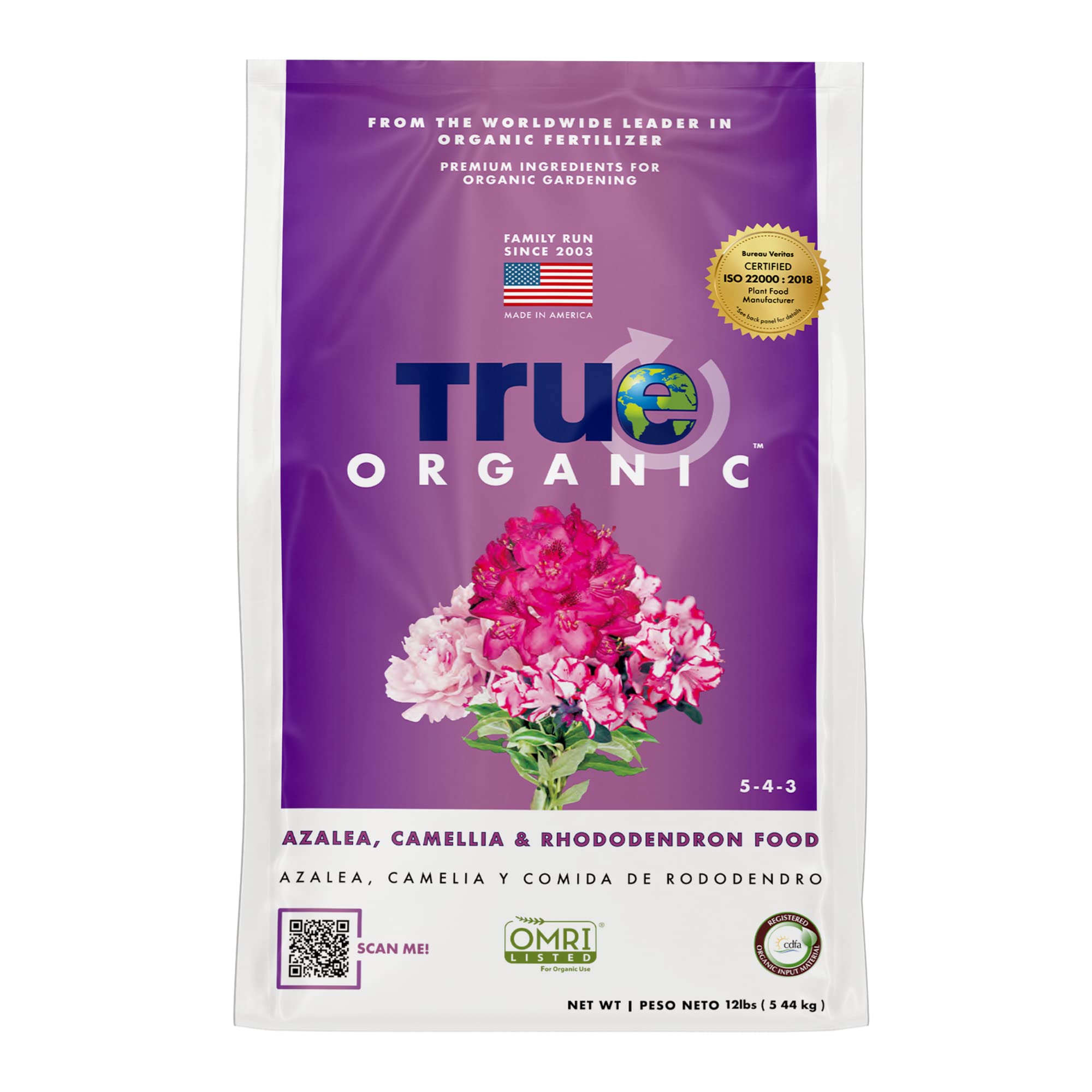
The organic soil acidifier that also pushed one rose bush from 2 feet to 7 feet.
If your soil is stubbornly alkaline and you need a heavy-duty organic solution, this is the bag to reach for. The True Organic formula is unique among the picks because it explicitly contains 5% soil sulfur (elemental sulfur, which soil bacteria convert to sulfuric acid, naturally lowering the pH) to lower soil pH, making nutrients more available to the plant. The N-P-K ratio is 5-4-3, which provides a moderate dose of nitrogen for growth, plus a solid amount of phosphorus for blooms. The 12-pound bag offers a middle-ground size between the 1-pound Dr. Earth and the 36-pound Espoma — enough to cover up to 261 square feet per the manufacturer’s guidance (12lb bag).
The ingredients are organic and include seabird guano (naturally deposited bird droppings rich in nutrients), shrimp and crab shell meal, which feed the soil while they feed the plant. One user highlighted a stunning result: “One rose bush grew from 2-3 ft to 7 ft.” Another noted it “revived struggling zinnias: grew to 4 ft with huge double blooms in 2 weeks.” The recommendation is to apply twice a year — in spring and fall — making it a low-maintenance option that slowly releases nutrients.
The main downside is that the 5% sulfur means you need to be careful not to over-acidify the soil, especially if you are already using other sulfur-based amendments or mulches. The product also has a natural earthy smell from its ingredients, which some buyers found pleasant but is note if you are sensitive to odors.
what separates it
- Contains 5% sulfur to actively lower soil pH — a built-in acidifier that the other organic picks do not emphasize as strongly.
- 12-pound bag is a practical balance — bigger than hobby-size 1-pounds, smaller than bulk 36-pounds, covering up to 261 sq. ft.
- Organic seabird guano and shellfish meal provide a diverse nutrient profile and improve soil biology.
Honest Caveats
- The 5% sulfur can over-acidify if used too heavily or in combination with other acidic amendments; follow application rates carefully.
- The organic ingredients produce a natural earthy smell that some gardeners may notice during application.
Best for the alkaline soil battler: Choose this if you know your soil pH is too high (above 6.5) and you need an organic granular that will actively drive the pH down while feeding the plant.
Switch off for neutral pH soils: If your soil is already naturally acidic or you use acidic mulches like pine bark, the extra sulfur could push the pH too low. A balanced product like Espoma may be safer.
Understanding the Specs
The N-P-K Ratio: What the Three Numbers Actually Mean
The three numbers on the bag stand for Nitrogen-Phosphorus-Potassium — the primary macronutrients your rhododendron needs. The first number (N) pushes leaf and stem growth. The second number (P) is the bloom booster — it is the one that stimulates flower production. The third number (K) supports root health and overall plant stamina. For a rhododendron that is not blooming, you want a formula with a higher middle number, like 9-15-13. For a general maintenance feed, a balanced 4-3-4 or 5-4-3 is the better choice.
Granules vs. Water-Soluble: Which Form Works Best for You?
Granules are dry pellets you sprinkle around the base of the plant and water in. They release nutrients slowly over weeks or months, meaning you only need to apply them once or twice per growing season. Water-soluble powders dissolve in water and feed the plant immediately, which is great for a fast rescue but requires reapplication every 7-14 days to keep working. Busy gardeners with established plants usually prefer granules for their low maintenance. Gardeners trying to save a dying plant or those with container-grown rhododendrons often get better results from the fast-acting water-soluble form.
FAQ
What is the best N-P-K ratio for rhododendrons?
Will any acid fertilizer work on my rhododendron?
Is organic fertilizer better for rhododendrons than synthetic?
How often should I apply acid fertilizer to my rhododendron?
Can I use too much acid fertilizer on my rhododendron?
What is the difference between Holly-Tone and Azalea fertilizer?
How do I apply granular fertilizer to an established rhododendron?
What besides fertilizer can I do to lower soil pH for my rhododendron?
Final Thoughts: The Verdict
For most buyers, the acid fertilizer for rhododendrons winner is the Espoma Organic Holly-Tone because its 36-pound bag offers the best combination of long-term value, organic ingredients, and balanced nutrition for a whole garden of acid lovers. If you need a fast rescue for a bloom-deprived shrub, the Fertilome 9-15-13 is the most targeted tool. And for the organic purist with one special rhododendron, the Dr. Earth Acid Lovers formula provides the highest purity and safety standards available.
How We Picked
We do not accept paid placement. Every pick is matched to a real buyer and a real use-case; we do not hands-on test units.
Sources & Methodology
Specifications: manufacturer listings and product documentation. Review insights: verified customer reviews, as of July 2026. Pricing: not shown on this page (it changes often); check the current price via the retailer link.
As an Amazon Associate, Lawn Gear Lab earns from qualifying purchases. This does not affect which products we feature.