
Specs are compiled from manufacturer listings and verified buyer reviews and can change over time — please confirm the key details on the product page before buying.
Your cedars stay dark green and thick only when the soil pH is right. They evolved to eat from an acidic forest floor, so a general lawn feed often makes them turn pale or stop growing. The best fertilizer for cedar trees gives a steady, low-pH supply of nitrogen (for dense needles), moderate phosphorus (for roots and branches), and potassium (for hardiness) — all without burning their shallow roots.
I’m Rikta — the founder and writer behind Lawn Gear Lab. This guide is built by comparing the manufacturers’ published specifications and the patterns across verified customer reviews, so you get each pick’s real strengths and trade-offs instead of marketing spin.
Whether your cedar is a young sapling hitting its first growth spurt or a mature hedge that needs a seasonal boost, the picks here cover the full range of what works. Fertilizer for cedar trees starts with understanding the one spec that matters most: the NPK ratio (nitrogen-phosphorus-potassium percentages) and whether the formula is aimed at acid-loving evergreens (plants that thrive in soil below pH 7).
Quick Picks
- Espoma Organic Evergreen-Tone 4-3-4 Natural & Organic Fertilizer (18 lb. Bag) — Best Overall
- Espoma Organic Holly-Tone 4-3-4 Evergreen & Azalea Plant Food (2-Pack of 4 lb. Bags) — Best Value
- FoxFarm Happy Frog Japanese Maple Fertilizer (4 lb.) — Soil-Health Pick
- Miracle-Gro Water Soluble Azalea, Camellia, Rhododendron Plant Food (5 lb.) — Quick-Action Pick
- SimplyGro Fertilizer Spikes for Evergreen Trees & Shrubs (12 Spikes – 3.0 lbs) — Low-Hassle Pick
- TPS Nutrients Arborvitae Tree Fertilizer – Liquid Plant Food (32 oz) — Hedge Specialist
- The Old Farmer’s Almanac Tree & Shrub Fertilizer Spikes (Box of 24 – 6 lbs) — Hedge-Line Champion
How To Choose The Best Fertilizer For Cedar Trees
Cedars, like most evergreens, are acid-loving plants (they need soil pH below 7). That means the first thing to check on any bag or bottle is the NPK ratio and whether the formula is tailored for species like azaleas, rhododendrons, or other low-pH feeders. Pick a fertilizer that forces your cedar to compete with alkaline soil, and you will see yellowing and slow growth.
The NPK Ratio That Works
To keep needles green and dense, cedars need a fertilizer with a higher first number (nitrogen) — but not so high that it forces weak, sappy growth that attracts pests. A balanced ratio like 4-3-4 (4% nitrogen, 3% phosphorus, 3% potassium) or a slightly nitrogen-forward 12-3-3 or 13-3-3 is ideal — enough nitrogen for foliage, moderate phosphorus for root and branch strength, and potassium for overall hardiness through drought or cold.
Granular vs. Liquid vs. Spikes
Granular formulas (like Espoma’s Evergreen-Tone) are slow-release (they break down over weeks) and feed the soil biology, which suits established trees planted in the ground. Liquid feeds (like TPS Nutrients Arborvitae fertilizer) are fast-acting and work well for a quick green-up or for newly planted cedars that need immediate nutrition in their first season. Fertilizer spikes (from SimplyGro or Old Farmer’s Almanac) are the “low-maintenance” option — you hammer them into the root zone (the area under the branch line) and they release steadily for up to 3 months, which is a smart move if you have a long hedge line to feed.
Organic vs. Synthetic
Organic options like Espoma’s Bio-tone formulas feed the soil biology (microbes that live in the dirt) and release nutrients as those microbes break them down — this is gentler on roots and safer for surrounding plants. Synthetic water-soluble feeds (like Miracle-Gro) deliver a quick hit of nutrients and are fine for container cedars or when you spot a deficiency, but they require more frequent application and can leach out of sandy soils faster. For mature landscape cedars, organic granular or spikes tend to deliver more consistent, low-hassle results over the growing season.
Quick Comparison
| Model | Best For | NPK Ratio | Item Form | Unit Count | Amazon |
|---|---|---|---|---|---|
| Espoma Organic Evergreen-Tone | Overall evergreen feeding | 4-3-4 | Granules | 18 lb | Amazon |
| Espoma Organic Holly-Tone | Acid-loving plants | 4-3-4 | Granules | 128.0 Ounce (2-pack) | Amazon |
| FoxFarm Happy Frog Japanese Maple | Low pH feeders | 4-3-4 | Powder | 4 lb | Amazon |
| Miracle-Gro Water Soluble Azalea | Quick green-up | — | Powder | 80.0 Ounce | Amazon |
| SimplyGro Fertilizer Spikes | Set-and-forget feeding | 12-3-3 | Sticks | 12 Spikes – 3 lbs | Amazon |
| TPS Nutrients Arborvitae | Liquid feed for hedges | — | Liquid | 32.0 Ounce | Amazon |
| Old Farmer’s Almanac Spikes | Large hedge lines | 13-3-3 | Sticks | 24 Spikes – 6 lbs | Amazon |
In‑Depth Reviews
1. Espoma Organic Evergreen-Tone 4-3-4 Natural & Organic Fertilizer (18 lb. Bag)

One 18-pound bag covers every evergreen in your yard with no mixing needed.
This is the pick for anyone with a mix of cedars, pines, firs, and broadleaf evergreens who wants one product to rule them all. Espoma’s Evergreen-Tone uses a 4-3-4 NPK ratio (4% nitrogen for green needles, 3% phosphorus for roots, 3% potassium for hardiness) plus 5% sulfur to keep soil acidic so your cedar stays dark green, not yellow. Its Bio-tone microbes (beneficial soil bacteria) feed the soil so nutrients release slowly over weeks — no risk of burning shallow cedar roots, which common lawn foods do. You just sprinkle the granules around the drip line (the circle under the outermost branches) and water in; it’s ready to use straight from the bag.
The 18-pound bag feeds a dozen or more mature trees in spring and again in fall without restocking. The brand says feed twice a year — early spring and late fall — to keep evergreens at their peak. It is approved for organic gardening, so no sludge or synthetic chemicals leach into the surrounding beds.
Compared to the 4-pound Holly-Tone bag below, the Evergreen-Tone bag is 18 pounds versus 4 pounds, so for a whole landscape of cedars and evergreens, this is the better value. The catch is that it is granular and needs to be watered in — if you hate dragging a hose, the spikes below may be simpler. Buyers report that their trees stayed deep green through the season with just two applications.
Why it earns the top spot
- 18-pound bag covers the entire yard — no need to buy multiple products
- 4-3-4 formula with 5% sulfur tailored for acid-loving evergreens
- Organic and no-mixing — just sprinkle and water
One trade-off to know
- Granules require watering in, which is a bit more work than hammer-in spikes
Who it fits: The homeowner with a landscape full of cedars, pines, and other evergreens who wants one organic bag for all of them.
Watch out: If you have only one or two small cedars, the 18-pound bag is more than you need for a season — the FoxFarm or a smaller pack makes more sense.
2. Espoma Organic Holly-Tone 4-3-4 Evergreen & Azalea Plant Food (2-Pack of 4 lb. Bags)
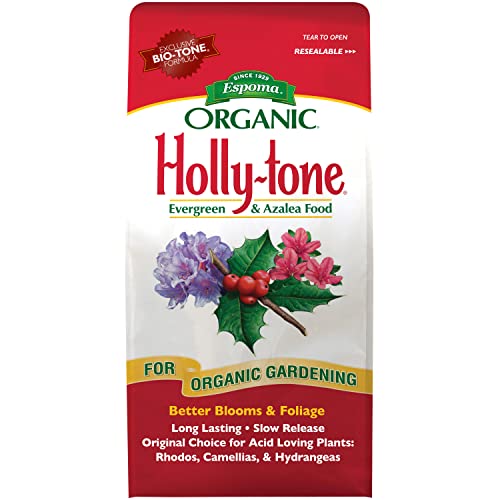
If you grow blueberries and hydrangeas alongside your cedars, this one organic feed covers them all.
This is the pick if you have a mix of cedars, azaleas, blueberries, and rhododendrons and want one organic feed for all of them. Holly-Tone uses the same 4-3-4 NPK ratio with 5% sulfur and the same Bio-tone microbes as the Evergreen-Tone above, and it is approved for organic gardening. The 2-pack gives you two 4-pound bags — you can keep one in the shed and one in the garage for spot treatments.
Owners mention that it “improved blueberries and azaleas” in the garden, though one reviewer noted “no color change on hydrangeas after 2 weeks” — the pH shift takes longer for bloom color. The granules have a strong smell for a few days after application, but that fades after watering. The pack is listed at 128.0 ounces, while the TPS liquid below is 32.0 ounces.
The main difference from the Evergreen-Tone is the bag size — at 4 pounds per bag versus the 18-pound Evergreen-Tone, Holly-Tone is better for smaller gardens or for homeowners who want to try the product before buying a giant bag. If you have a large hedge of mature cedars, skip this and grab the Evergreen-Tone for fewer trips to the shed.
Why we like it
- Works for cedars, azaleas, blueberries, and hydrangeas — one bag for many plants
- Organic and no mixing required
- 128.0 ounces total is a solid amount for the price tier
The honest trade-off
- Granules smell strong right after application, per multiple buyer reports
Best for mixed gardens: If you grow more than just evergreens — blueberries, hydrangeas, and azaleas alongside your cedars — this one feed covers them all.
skip it if: You want a spike or liquid for a quick no-odor application.
3. FoxFarm Happy Frog Japanese Maple Fertilizer (4 lb.)

If your cedar sits in compacted or sandy soil, this powder adds living microbes that help roots pull more nutrients from the ground.
This product delivers more than just NPK numbers. The FoxFarm Happy Frog formula has a 4-3-4 ratio (matching the Espoma picks above) but it is boosted with beneficial microorganisms and mycorrhizal fungi — tiny soil fungi that partner with roots to pull more water and nutrients. This is especially helpful in sandy soil that leaches (washes away) fertilizer fast.
The mixing ratio is 2 tablespoons per 1 gallon of water, and the brand recommends monthly feeding during the growing season. Customers note it “brought one plant back to life” and has been used effectively on smaller ornamentals around the garden. The formula is tailored for low pH feeders like Japanese maples, hydrangeas, dogwoods, and evergreens, so it matches precisely what a cedar’s root system evolved to absorb.
Compared to the Miracle-Gro powder below, the FoxFarm feed is a monthly routine versus every 7-14 days, so it requires a bit less frequency once you have your cedars established. Just mix it into the topsoil or top-dress around the drip line and water in. The powder does have an organic aroma (some buyers describe it as earthy), so keep the bag sealed in your shed.
What makes it different
- Contains mycorrhizal fungi that help roots absorb more nutrients in poor soil
- Monthly feeding schedule is less demanding than weekly liquid feeds
- 4-3-4 ratio is perfect for acid-loving evergreens like cedars
A small catch
- 4-pound bag is light — you will need multiple bags for a large cedar hedge
Best for poor soil: If your cedars sit in sandy or compacted ground that drains nutrients quickly, the added microbes make this the most efficient feed for the job.
If you have a massive hedge: The 4-pound bag runs out fast on a long row — the Espoma 18-pound bag is more economical.
4. Miracle-Gro Water Soluble Azalea, Camellia, Rhododendron Plant Food (5 lb.)

If your cedar looks pale and you need a green-up in a week, this fast-dissolving powder delivers nitrogen immediately.
When your cedar looks pale or you want a quick green boost before a big event (or just after transplanting), this soluble powder is the fastest way to deliver nitrogen to the foliage. The formula is designed for acid-loving plants like azaleas, camellias, rhododendrons, and cedars — and it feeds as soon as you water it in. The mixing ratio is 1:144 for indoor use and 1:18 for outdoor plants, so one 80-ounce bag covers a lot of ground.
Reviewers point out it “truly helped our rhododendron to recover and look stunning this summer” and noted that the “easy mix ability in watering can or with hose” makes application simple. The manufacturer recommends feeding every 7 to 14 days, which is more frequent than the granular or spike options — but you get visible results within a week, per the reviews. The bag is resealable with Velcro (shoppers say it seals well as long as you keep powder off the closure).
The main downside versus the FoxFarm above is that this is a synthetic feed — it delivers nutrients fast but doesn’t build soil biology. For container cedars or seasonal feeding, that is just fine. For a permanent landscape planting where you want to improve the soil year over year, the organic granular options or spikes are a smarter long-term move. At 5 pounds (80 ounces), this bag holds a lot of product, but it is still lighter than the 18-pound Espoma Evergreen-Tone bag.
What stands out
- Visible green-up in a week — great for reviving a sad-looking cedar
- Works with a watering can or hose-end sprayer for easy application
- 80-ounce bag is a generous amount at the entry-level price
What to consider
- Requires mixing and feeding every 7-14 days — more work than spikes or slow-release granules
Best for emergencies: When your cedar needs a fast green-up after winter or transplant shock, this is the pick that delivers visible results in a week.
Long-term care: If you prefer set-and-forget feeding, the SimplyGro spikes or Espoma granules require less frequent trips out to the tree.
5. SimplyGro Fertilizer Spikes for Evergreen Trees & Shrubs (12 Spikes – 3.0 lbs)
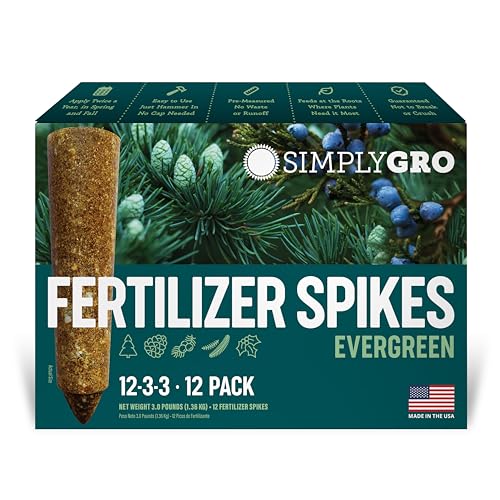
Hammer in a spike in spring, walk away, and your cedar gets 3 months of steady nitrogen without any mixing.
For anyone who wants to feed their cedars without measuring, mixing, or smelling granules, these TruSpikes are the answer. Each 5-inch spike is packed with a 12-3-3 NPK formula (12% nitrogen for lush green needles, 3% phosphorus for root strength, and 3% potassium for overall health) and releases continuously for up to 3 months. You hammer them into the soil at the drip line in spring and again in fall — that is two applications per year.
Buyers report that these spikes dramatically improved trees in sandy, nitrogen-deficient soil where granular feeds leached away. One buyer mentioned their fruit trees “went from sparse foliage/death to lush, green, thriving” after using these spikes, and another noted that pine trees “brought them back to life in a matter of 2 weeks.” At 3 pounds for 12 spikes, the set covers a modest hedge or a few mature trees. The spikes are designed not to break, crush, or smash — you can hammer them straight into the ground without a plastic cap.
At 3 pounds total, these are lighter than the Old Farmer’s Almanac 24-spike box below (6 pounds), so for a longer hedge line, the larger box saves you a repurchase trip. The 12-3-3 ratio is also higher in nitrogen than the 4-3-4 Espoma or FoxFarm picks, which is ideal for encouraging dense needle growth on established cedars that have already set their root systems. For a handful of trees, this is the simplest path to deep green needles.
Why it’s clever
- No measuring, mixing, or smell — just hammer and walk away
- 12-3-3 ratio is optimized for nitrogen-hungry evergreens
- Spikes resist breaking and deliver nutrients directly to the root zone
The trade-off
- Hard to reposition if you hammer one in the wrong spot — the spike is anchored
Set-and-forget home run: If you want the lowest-maintenance feed that delivers steady nitrogen for months, these spikes win for sheer convenience.
Heavy hedges: For more than a dozen trees, buy the Old Farmer’s Almanac 24-pack below — you get double the spikes for one purchase.
6. TPS Nutrients Arborvitae Tree Fertilizer – Liquid Plant Food (32 oz)
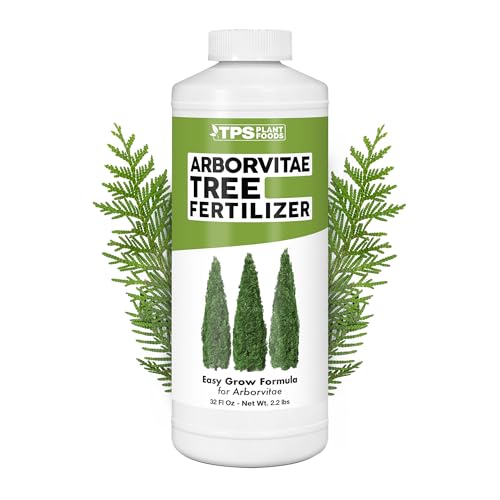
When your cedar hedge looks rough after winter, this liquid feed revives it in a week — something granules can’t match.
If your cedar hedge took a beating over winter or is planted in sandy soil where granules wash away before they can work, this concentrated liquid delivers nutrients directly to the roots in a form they can use immediately. The 32-ounce bottle mixes at 2 tablespoons per gallon of water, and the brand makes it clear this is “made for arborvitae trees” — which are close cousins to cedars — so the nutrient profile is designed for their growth cycle.
Owners mention that this product “kept newly planted arborvitae alive through Chicago winter” while neighboring unfertilized trees died. Another reviewer with sandy soil noted that fertilizing every 2 weeks “reversed branch die-off” and “restored green growth.” The liquid format is ideal for spot-treating individual trees or for use with a hose-end sprayer to cover a long hedge fast. At 32.0 fluid ounces, the bottle is compact but you get a lot of concentrated doses — expect around 16 full watering-can batches per bottle at the 2-tablespoon rate.
Compared to the spikes above, liquid feeds require mixing and more frequent application (every two weeks in the growing season), but they are class-leading for speed of action on a struggling tree. If your cedar looks stressed today, this is the pick to reach for before the slow-release options kick in.
Why we recommend it
- Liquid format is fast-acting — perfect for reviving winter-damaged or newly planted cedars
- Made specifically for arborvitae/evergreen hedges, so the nutrient ratios are on-target
- Works with sprayer or watering can for flexible application
The honest downside
- Requires mixing and regular application every two weeks
Best for stressed trees: When your cedar looks rough after winter or transplant, this liquid feed is the fastest way to get it back to green and healthy.
Skip if you want low-maintenance: A two-week mixing schedule is more work than spikes or granules — use the SimplyGro spikes for a hands-off season.
7. The Old Farmer’s Almanac Tree & Shrub Fertilizer Spikes (Box of 24 – 6 lbs)
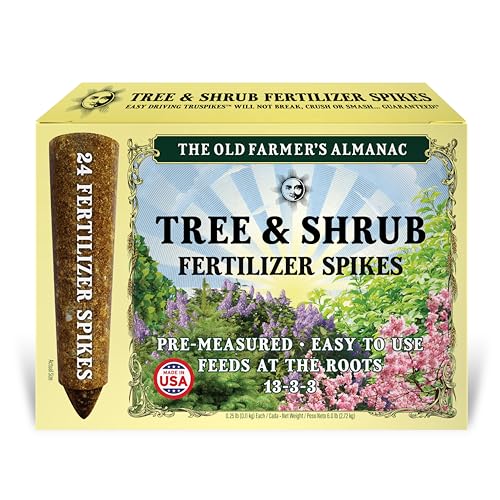
For a long cedar hedge, 24 spikes feed every tree for a full year on just two trips out.
When you need to feed a long row of cedars that runs the length of your property, this is the most efficient way to do it. The box contains 24 TruSpikes (the same patented design as SimplyGro spikes above) each 5 inches long and packed with a 13-3-3 NPK formula — the highest nitrogen ratio in this list, which drives dense, deep green needle growth on conifers. The spikes contain natural ingredients like molasses that help feed soil microbes as they break down.
The manufacturer recommends feeding once per season — early spring and late fall — so a 24-pack covers about 12 trees per application (two spikes per tree). At 6 pounds total, this box is exactly double the weight of the SimplyGro 12-spike pack, so if you have a large hedge, the per-spike cost here is lower. Like the SimplyGro spikes, these are designed not to break, crush, or smash when hammered into the ground — no plastic cap or special equipment needed.
If you have a smaller yard with just two or three cedars, this box is overkill — you would have spikes leftover for two years. The SimplyGro 12-pack or the Espoma Holly-Tone 4-pound bag would be a smarter buy for smaller landscapes. But for a substantial privacy hedge or multiple trees, grabbing this box means you only think about fertilizing twice a year.
The big win
- 24 spikes feed a long hedge line with minimal effort — hammer and forget
- 13-3-3 ratio is the highest nitrogen in this guide, ideal for dense needle growth
- Spikes use natural ingredients like molasses to feed soil biology
Consider this
- Too many spikes for a small yard — you will be storing them for next season
Best for big properties: If you have a long cedar hedge or multiple evergreens spread across the yard, this 24-pack is the most convenient way to feed them all for a full year.
If you have only a few trees: The SimplyGro 12-pack or a granular option like FoxFarm is a better fit without leftover spikes.
Understanding the Specs
NPK Ratio & What the Numbers Mean
The three numbers on every bag or bottle — like 4-3-4 or 13-3-3 — stand for the percentage of nitrogen (N), phosphorus (P), and potassium (K). For cedars, the first number (nitrogen) matters most because it drives the green color in the needles and supports new foliage growth. Phosphorus supports root and branch strength, while potassium helps the tree stay hardy through stress like drought or cold. A ratio around 4-3-4 is a balanced general feed; a higher first number like 12-3-3 or 13-3-3 is more targeted at needle-driven evergreens that need a bigger nitrogen boost.
Granular vs. Spikes vs. Liquid
The form of the fertilizer changes how you apply it and how fast it works. Granules (like Espoma’s Evergreen-Tone and FoxFarm) are sprinkled around the drip line and watered in — they break down slowly over weeks and feed the soil biology. Spikes (SimplyGro and Old Farmer’s Almanac) are hammered into the ground at the root zone and release nutrients steadily for up to 3 months with zero mixing. Liquids (TPS Nutrients) mix with water and deliver nutrients in a form the roots can absorb immediately, which is ideal for reviving a stressed tree but requires more frequent application.
FAQ
When should I fertilize my cedar tree?
Can I use a general all-purpose fertilizer on cedars?
How do I apply fertilizer spikes to my cedar tree?
How much granular fertilizer do I need per cedar tree?
Is liquid fertilizer better than granular for cedar trees?
Can I over-fertilize a cedar tree?
What is the difference between Holly-Tone and Evergreen-Tone?
Do cedar trees need different fertilizer in sandy soil?
How long does it take to see results from fertilizing a cedar?
Can I use cedar tree fertilizer on other evergreens in my yard?
Final Thoughts: The Verdict
For the majority of shoppers, the fertilizer for cedar trees winner is the Espoma Organic Evergreen-Tone 18 lb. Bag because it combines a bucket-load of organic granules with a proven 4-3-4 ratio and zero mixing for the best coverage-to-effort ratio. If you want a slow-release, no-mess option that feeds for months, grab the SimplyGro Fertilizer Spikes (12 pack) for their set-and-forget convenience. And for quickly reviving a stressed or newly planted cedar, the standout is the fast-acting TPS Nutrients Arborvitae Liquid Feed.
How We Picked
We do not accept paid placement. Every pick is matched to a real buyer and a real use-case; we do not hands-on test units.
Sources & Methodology
Specifications: manufacturer listings and product documentation. Review insights: verified customer reviews, as of July 2026. Pricing: not shown on this page (it changes often); check the current price via the retailer link.
As an Amazon Associate, Lawn Gear Lab earns from qualifying purchases. This does not affect which products we feature.