
Specs are compiled from manufacturer listings and verified buyer reviews and can change over time — please confirm the key details on the product page before buying.
Blackberry bushes can turn a manageable yard into a thorny mess within a single growing season. You need a killer that reaches deep enough to stop regrowth, not just singe the leaves you can see. That means picking a brush-killing herbicide with a systemic action that travels down to the roots — otherwise you will be back with clippers next spring.
I’m Rikta — the founder and writer behind Lawn Gear Lab. This guide is built by comparing the manufacturers’ published specifications and the patterns across verified customer reviews, so you get each pick’s real strengths and trade-offs instead of marketing spin.
These reviews narrow the field to the most effective options for tackling invasive brambles, thorny thickets, and woody brush so you can buy the right blackberry bush killer with confidence.
Quick Picks
- Hi-Yield (33701) Super Concentrate Killzall II (2.5 gal) — Best Overall
- Remedy Specialty Herbicide Weed Killer & Brush Control (1 Gal) — Premium Pick
- Crossbow Herbicide Brush Killer 1 Gallon — Fast & Thorough
- Hi-Yield (32171) Killzall 365 (1 gal) — High-Value Concentrate
- BioAdvanced Extended Control Brush Killer Spray (1 gal) — Long-Duration Control
- Southern Ag Crossbow Specialty Herbicide (128oz) — Broad Spectrum
- Brush Killer, Ready to Use (Tordon RTU, 1 qt) — Spot Treatment
How To Choose The Best Blackberry Bush Killer
Blackberry bushes are woody perennials with deep, resilient root systems. A spray that only burns the leaves will leave the roots alive, and you will see new shoots within weeks. The three factors below separate a temporary fix from a true end to the problem.
Systemic vs Contact Action
A contact killer only damages the parts it touches — the leaves and canes you see. A systemic herbicide, by contrast, is absorbed through the leaves and translocates (moves through the plant’s vascular system) down into the roots. For blackberry bushes, systemic action is essential because the root mass stores enough energy to push up new growth after a contact spray dies off.
Concentrate vs Ready-to-Use
Ready-to-use (RTU) sprays are convenient for small patches — you just point the nozzle and apply. Concentrates, which you mix with water, cost less per gallon of spray solution and let you treat larger areas. A concentrate like the Hi-Yield (32171) Killzall 365 (1 gal) covers up to 17,200 square feet, for example, which is far more than a one-gallon RTU bottle can handle.
Active Ingredient Strength
The two most common active ingredients in blackberry bush killers are glyphosate and triclopyr. Glyphosate is a non-selective herbicide that kills almost any plant it contacts, while triclopyr is a selective brush killer that is especially effective on woody species like blackberry. Some products combine both. The percentage of active ingredient in the concentrate determines how strong your final spray mix will be, so check the label to see if the product is labeled for “brush” or specifically for “blackberry.”
Quick Comparison
| Model | Best For | Liquid Volume | Unit Count | Item Weight | Amazon |
|---|---|---|---|---|---|
| Hi-Yield (33701) Super Concentrate Killzall II (2.5 gal) | Large-scale root kill | 2.5 Gallons | 320.0 Fluid Ounces | 25.56 Pounds | Amazon |
| BioAdvanced Extended Control Brush Killer Spray | Long-term regrowth prevention | 1 Gallons | 128.0 Fluid Ounces | 8.5 Pounds | Amazon |
| Crossbow Herbicide Brush Killer 1 Gallon | Fast knockdown on thick brush | 1 Gallons | 128.0 Fluid Ounces | 11 Pounds | Amazon |
| Hi-Yield (32171) Killzall 365 (1 gal) | Large-area ground sterilization | 128 Fluid Ounces | 128.0 Fluid Ounces | — | Amazon |
| Remedy Specialty Herbicide (1 gal) | Pasture and fence-line blackberry | 1 Gallons | 128.0 Fluid Ounces | — | Amazon |
| Southern Ag Crossbow Specialty Herbicide (128oz) | Broad-spectrum brush and weed control | 128 Fluid Ounces | 128.0 Ounce | — | Amazon |
| Brush Killer, Ready to Use (Tordon RTU) | Small spot treatments and stumps | 1 Quarts | 32.0 Fluid Ounces | — | Amazon |
In‑Depth Reviews
1. Hi-Yield (33701) Super Concentrate Killzall II (2.5 gal)

A super-concentrate that reaches the root in two hours and shows visible results in three.
The defining feature here is speed. The manufacturer states that the active ingredients reach the roots in 1 to 2 hours and produce visible results in as little as 3 hours — a timeline that outpaces most brush killers on the shelf. Owners mention it works like a Roundup replacement at a lower cost, especially when used in an ATV sprayer for fence-line work. One reviewer noted, “Reaches the roots in 1 to 2 hours and provides visible results in as little as 3 hours.”
At 25.56 pounds for the 2.5-gallon jug (320.0 Fluid Ounces), this is a heavy-duty buy for serious infestations. You will need a sprayer accessory to apply it, and buyers caution that it will also kill grass, flowers, and any bug it contacts, so treat it as non-selective. The unit count of 320.0 Fluid Ounces vs a 32.0 Fluid Ounce RTU like Tordon represents a 10.0x gap in how much product you get, making this the volume king of the list.
Why it leads the field
- 320 fl oz of concentrate — largest volume on this list by a 10x margin over small RTU bottles
- Reaches roots in 1-2 hours, visible die-off in 3 hours
- Budget-friendly per ounce compared to premium brush-specific brands
Things to be careful about
- Requires a separate sprayer — not ready-to-use
- Non-selective, so it kills any grass or flower it touches
- Heavy at 25.56 lbs; not convenient to carry long distances
Best for the job: Anyone with a large blackberry patch who wants fast root kill and the lowest cost per gallon of solution.
Look elsewhere if: You only need to spot-treat a few small bushes — a ready-to-use quart will be far less hassle.
2. Remedy Specialty Herbicide Weed Killer & Brush Control (1 Gal)
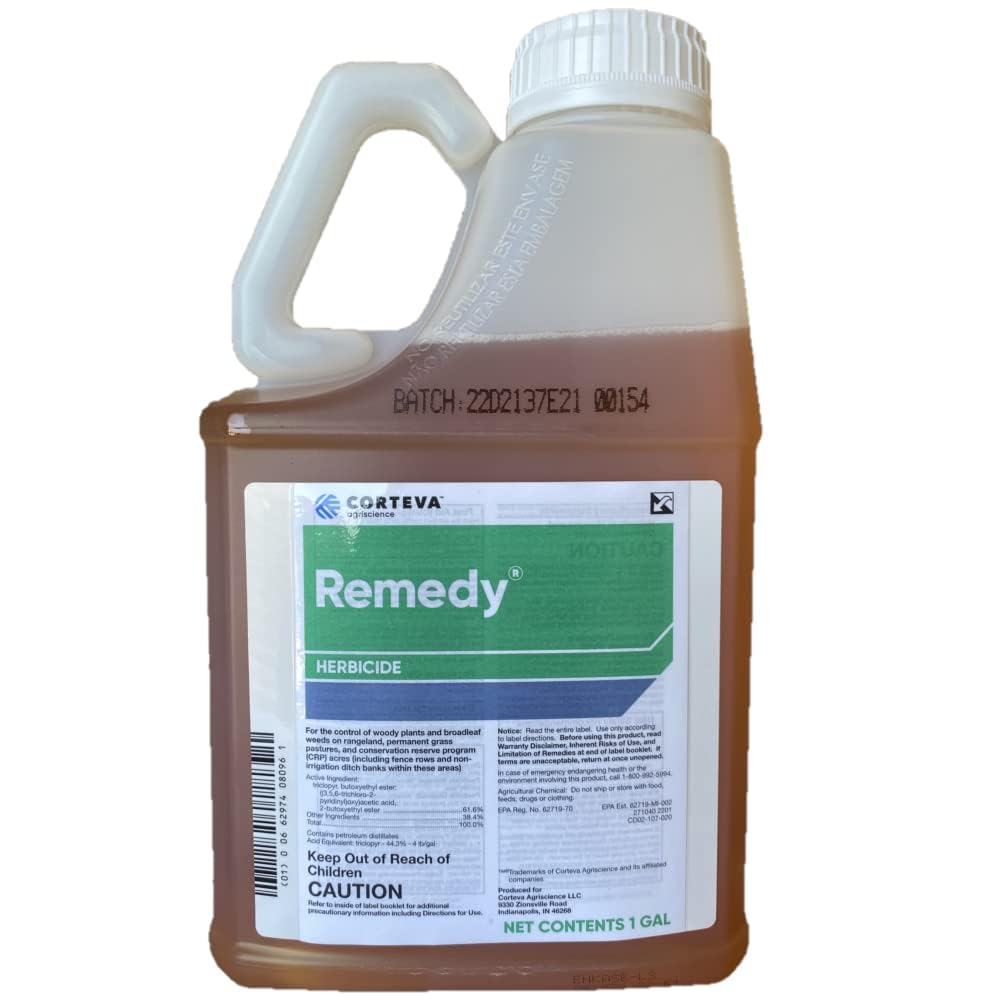
A pasture-grade triclopyr concentrate that targets blackberry roots without harming grass.
Remedy is a top-rated pasture herbicide that uses triclopyr as its active ingredient, a selective brush killer that is especially effective on woody species like blackberry while leaving grass alive. The manufacturer states it is safe to use around children and pets when applied according to the label. Customers note it works best when mixed with diesel for basal bark application — one buyer mentioned, “took a couple of weeks to kill some small trees that kept coming back, but they’re gone now.” Another user who applied it on blackberry bushes and small trees confirmed the same formula mix works well.
At 1 gallon (128.0 Fluid Ounces), this is a mid-volume concentrate that costs more per ounce than the Hi-Yield Killzall II, but reviewers point out the selectivity makes it worth it for pasture and fence lines where you want to keep the grass. It does not work on general weeds or unwanted grass — one buyer admitted they chose the wrong product for their needs — so be sure your target is brush, not weeds. The low-odor formula is a practical bonus when you are working upwind.
Selective advantage: The standout benefit is that it spares your grass while annihilating woody brush, a trait none of the non-selective concentrates share.
Consider this: It takes up to a couple of weeks to finish off established bushes, so it is not the fastest option if you need immediate visual results.
Reach for it: If you are managing blackberry on a pasture or along fence lines and do not want to kill the surrounding grass.
Avoid it: If you need a multi-purpose spray that also kills weeds and grassy invaders — this one is brush-specific only.
3. Crossbow Herbicide Brush Killer 1 Gallon
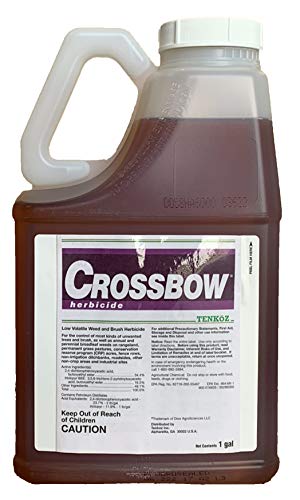
A fast-acting brush killer that shrivels blackberry overnight and keeps working for up to two years.
Crossbow uses a triclopyr-based formula that buyers describe as devastatingly fast. One owner reported: “Kills everything sprayed within 24 hours; shriveled by next day, dead by day two.” That speed is paired with residual soil activity that lasts up to 2 years according to the same buyer, meaning you do not have to reapply after every rain. The gallon size covers approximately 1 acre or less, which suits medium-sized patches well.
This product is heavier than the BioAdvanced RTU at 11 pounds for the same 1-gallon volume (128.0 Fluid Ounces), but one experienced buyer noted that the standard formula contains only 16.5 percent triclopyr — they bought a gallon of pure Garlon triclopyr at 61.6 percent to boost the strength for woody brush and blackberries. So while it works well out of the bottle, heavy infestations may benefit from a secondary booster. The strong chemical smell is noted by buyers as a confirmation it is working, but apply on calm days only.
Speed credentials
- Visible shriveling within 24 hours; complete kill by day two
- Residual effect lasts up to 2 years — no reapplication every season
- Covers roughly 1 acre, good for medium-scale patches
What to watch for
- 16.5% triclopyr may need a booster for very thick blackberry stands
- Strong odor — use a respirator and avoid wind
- Primarily triclopyr-based, so less effective on broadleaf weeds than glyphosate blends
Perfect for: Anyone tired of waiting weeks for results — this one delivers visible die-off the next day.
Not the best for: Those who want a single product that also kills general weeds and grass, or who need a low-odor application.
4. Hi-Yield (32171) Killzall 365 (1 gal)
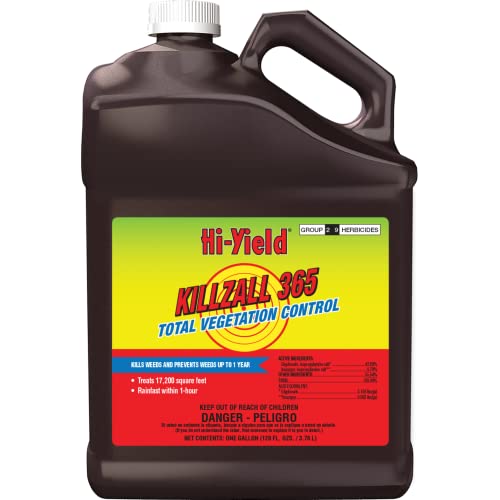
A one-gallon concentrate that stretches to 17,200 square feet — enormous value for spreading across whole fields.
The headline number here is coverage: 17,200 square feet per bottle when mixed at the spot-control rate of 6 oz per gallon of water. That is a massive treating area for a 1-gallon concentrate, giving it the best cost-per-square-foot in this lineup. Buyers confirm its blackberry-fighting reputation. One customer observed, “This stuff is amazing in the battle of blackberry intrusion.” They use it to kill weeds coming from an overgrown abandoned property next door. Another buyer noted it remains effective even after rain the next day, which is a practical advantage for unpredictable weather.
Compared to the Killzall II (2.5 gal), this is a smaller volume but the same brand and similar non-selective action. One user went through two full bottles in a year, spraying three or four times, and still considered it more cost-effective than store brands. It is rain-resistant after drying, which adds flexibility compared to products that need 24-48 hours of dry weather. The catch: the label says “do not use on lawns,” because it kills grass just as effectively as it kills brush.
Coverage champion: At 17,200 sq ft per bottle, this stretches further than any other concentrate on this list, making it the right choice for large, semi-neglected areas.
Honest catch: Shoppers say the “365” claim does not mean one spray lasts a full year without regrowth — multiple applications per season are likely for aggressive blackberry.
Best for: Large plots, abandoned land edges, and fence rows where you need expansive coverage from a single bottle.
skip it if: You need a selective spray that leaves grass intact — this one kills everything green it touches.
5. BioAdvanced Extended Control Brush Killer Spray (1 gal)
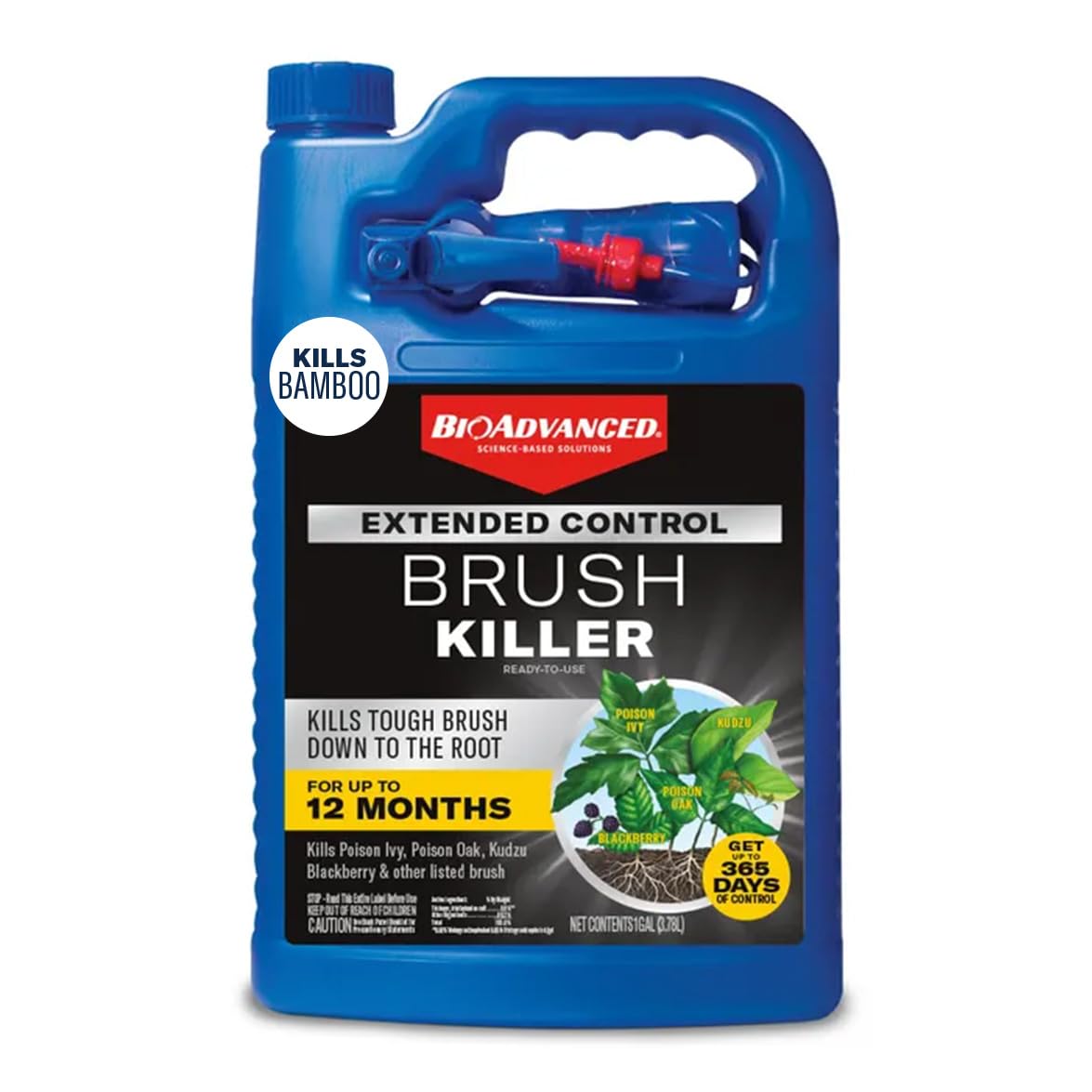
A ready-to-use spray that claims to stop brush regrowth for up to 365 days from a single treatment.
This is the only ready-to-use spray in the premium half of the list, which means you do not need a sprayer — just twist the nozzle and apply until the leaves are wet. The label says it kills tough brush like blackberry, bamboo, and poison ivy down to the root for up to 12 months. One user highlighted it “killed bush regrowth after 2 months with no regrowth,” though not all experiences match the 365-day claim. It treats up to 500 square feet, so know that a 1-gallon bottle covers a relatively small area compared to concentrates.
At 8.5 pounds, this is the lightest full-gallon product on the list — the Killzall II (2.5 gal) weighs 25.56 pounds, a 3.0x weight gap that matters if you are carrying the bottle across a field. But the unit count is 128.0 Fluid Ounces vs the 320.0 Fluid Ounces of the Killzall II, which is a 2.5x volume difference in favor of the concentrate. The slow-kill systemic action (1-28 days for visible results) is a trade-off: one buyer who gave it 1/5 stars found it ineffective after three applications on bamboo and saplings, calling it a “waste of money.” So while many succeed, results may vary by species and condition.
Convenience factors
- True ready-to-use — no mixing, no sprayer needed
- Lightest full-gallon option at 8.5 lbs for easy carrying
- Systemic formula targets roots for true elimination
Compromises to know
- Only 500 sq ft per bottle — too small for large patches
- 1-28 day window is slow; impatient buyers may think it failed
- Mixed reviews on tough species — not everyone gets 365-day control
Who it serves well: Homeowners with a modest blackberry patch (up to 500 sq ft) who value grab-and-go convenience over bulk value.
Who should pass: Buyers tackling acres of thick brush — you will burn through this bottle too fast and pay more per square foot than a concentrate.
6. Southern Ag Crossbow Specialty Herbicide (128oz)

A two-active-ingredient concentrate that covers 2.23 acres per bottle and works fast on broadleaf brush.
Southern Ag Crossbow combines Garlon and 2,4-D as its active ingredients, making it a broader-spectrum brush killer than a straight triclopyr product. The label says it makes up to 96 gallons of spray solution and covers 2.23 acres — by far the largest coverage claim on this list. Buyers who have used it for years call it “super effective.” One noted it killed all overgrowth including ivy, vines, 8-foot weeds, small trees, bushes, and grass within 48 hours, with complete die-off in one week. That is competitive with the Crossbow brand above but at a slightly different active-ingredient mix.
One reviewer, who compared it directly to Roundup, said it is “safer than Roundup with a 3-day soil half-life” and noted it contains no glyphosates or neonicotinoids. They recommend applying it at a 1% solution, which takes roughly one week to show results. A different buyer noted that efficacy varies significantly by soil type: 85% kill in Ohio brown soil, but only 30-35% in rich Illinois soil. This suggests local conditions matter more with this formula than with some others. The strong odor is a recurring comment — gloves and a mask are wise.
Standout specs
- Covers 2.23 acres per 128 oz bottle — more than any single product here
- Dual active ingredients (Garlon + 2,4-D) for broader weed and brush control
- Buyers confirm 48-hour visual results on heavy overgrowth
Limitations noted
- Efficacy varies significantly by soil type — not equally effective in all regions
- Strong odor requires good ventilation and protective gear
- Rain within 2 days of application reduces performance
Take it home if: You need maximum coverage per bottle (2.23 acres) and want a herbicide that handles both woody brush and broadleaf weeds.
Consider alternatives if: Your soil is rich and dark — buy a small bottle first to test efficacy before committing to the full gallon.
7. Brush Killer, Ready to Use (Tordon RTU, 1 qt)

A small, powerful RTU that one reviewer calls “the magic bullet” against invasive weed trees and stumps.
At 32.0 Fluid Ounces, this is the smallest product in the lineup — just 1 quart. But buyers are emphatic about its potency. One reviewer warned, “USE CAREFULLY. Seriously this stuff kills anything. It’s the magic bullet you’ve been waiting for in your fight against weed trees.” Another found it effective against buckthorn and honeysuckle, confirming it kills the root on everything used on it. The size makes sense for stump treatment: one buyer simply painted it on cut stumps to stop them from resprouting, and it worked perfectly.
The liquid volume of 1 Quart (32.0 Fluid Ounces) puts it at a 10.0x deficit compared to the Killzall II (320.0 Fluid Ounces), so this is not the choice for acres of blackberry. But for someone cutting down a few large bushes and treating the stumps to prevent regrowth, a quart can last months. The manufacturer labels it for invasive species and non-selective broad spectrum coverage. There is no mixing — it is true point-and-spray RTU. The downside is that at this small size, you pay a big premium per ounce compared to any concentrate.
Stump specialist: This quart-sized RTU is the ideal choice for treating cut stumps after you have chopped down the main canes — the systemic action stops resprouting dead in its tracks.
Best for small jobs: If your blackberry problem is under a dozen bushes and you want to finish the job in one afternoon, this eliminates the hassle of mixing a concentrate.
Grab it when: You are selectively spot-treating stumps, cut canes, or a small cluster of invasive brush without needing a sprayer.
Leave it on the shelf if: You are facing a large patch or fence line — you will run out fast and spend more per ounce than any concentrate alternative.
Understanding the Specs
Liquid Volume & Unit Count
This tells you how much product you actually get for your money. A 1-quart (32-fluid-ounce) RTU bottle like Tordon is convenient but expensive per ounce. A 2.5-gallon (320-fluid-ounce) concentrate like Hi-Yield Killzall II gives you 10 times the volume, and because you dilute it with water, you get even more spray solution. Check the unit count on the label to make apples-to-apples comparisons — 128.0 Fluid Ounces is 1 gallon, 32.0 is 1 quart, and so on. The bigger the number, the more area you can treat without buying another bottle.
Concentrate vs Ready-to-Use (RTU)
A ready-to-use spray comes pre-mixed so you can apply it straight from the bottle — zero measuring, zero cleanup. A concentrate requires you to mix a specific amount (typically 6-8 oz per gallon of water) in a pump sprayer. Concentrates are almost always cheaper per treated square foot, but they add time and a step. For a small blackberry patch under 500 square feet, an RTU like BioAdvanced is simpler. For an acre of brush, a concentrate is the only practical choice.
FAQ
Will a blackberry bush killer kill the roots or just burn the leaves?
How long does it take to see blackberry bushes die after spraying?
Can I use a blackberry bush killer around my lawn without killing the grass?
How much area can one bottle treat?
Is it safe to use these products around pets and children?
Does rain affect how well a blackberry killer works?
What is the difference between triclopyr and glyphosate for blackberry?
Can I mix a blackberry killer with diesel or other additives?
How often do I need to reapply a blackberry bush killer?
Is a concentrate or a ready-to-use spray better for blackberry?
Final Thoughts: The Verdict
If you want one dependable pick, the blackberry bush killer winner is the Hi-Yield (33701) Super Concentrate Killzall II (2.5 gal) because it delivers the fastest root kill at the lowest cost per gallon of any product here. If you want a selective formula that spares your grass while wiping out blackberry, grab the Remedy Specialty Herbicide (1 gal). And for quick spot treatment on a handful of bushes without hauling out a sprayer, the standout is the Brush Killer, Ready to Use (Tordon RTU).
How We Picked
We do not accept paid placement. Every pick is matched to a real buyer and a real use-case; we do not hands-on test units.
Sources & Methodology
Specifications: manufacturer listings and product documentation. Review insights: verified customer reviews, as of July 2026. Pricing: not shown on this page (it changes often); check the current price via the retailer link.
As an Amazon Associate, Lawn Gear Lab earns from qualifying purchases. This does not affect which products we feature.