
Specs are compiled from manufacturer listings and verified buyer reviews and can change over time — please confirm the key details on the product page before buying.
Feeding your plum tree like a lawn is the biggest mistake you can make. A fast-release, high-nitrogen blast pushes out weak, leafy growth that attracts pests and cuts your fruit harvest. You need a fertilizer that supports root development, flower production, and fruit set without burning the roots. The right choice depends on a balanced nutrient ratio, the form of the fertilizer, and whether you prefer organic or synthetic feeding. This guide compares four proven options for home orchards, breaking down the real-world results from each one.
I’m Rikta — the founder and writer behind Lawn Gear Lab. This guide is built by comparing the manufacturers’ published specifications and the patterns across verified customer reviews, so you get each pick’s real strengths and trade-offs instead of marketing spin.
Whether you are planting a new sapling or nursing a mature tree toward a bigger harvest, finding the right fertilizer for plum trees means matching the nutrient profile to your tree’s current stage and soil condition.
Quick Picks
- Espoma Organic Tree-Tone 6-3-2 (Pack of 2) — Best Overall
- Down To Earth Organic Fruit Tree 6-2-4 — Premium Pick
- TPS Nutrients Fruit Tree Liquid Fertilizer 32 oz — Best Value
- Fertilome Fruit, Citrus and Pecan Tree Food 19-10-5 — Budget Champion
How To Choose The Best Fertilizer For Plum Trees
Picking the right fertilizer means looking past the box art and focusing on what a plum tree actually needs at each stage of its life. A young tree wants root-building phosphorus; a mature tree needs balanced potassium for better fruit. Here are the three most important factors to weigh.
N-P-K Ratio: What Those Numbers Mean
The three numbers on the label (Nitrogen, Phosphorus, and Potassium) control different parts of your tree’s growth. Nitrogen pushes green leaves and overall size. Phosphorus helps roots establish and flowers set. Potassium strengthens the tree and improves fruit size and sweetness. For established plum trees, a balanced or slightly lower-nitrogen formula works best — too much nitrogen sends the tree into leaf mode at the expense of fruit.
Granular vs Liquid Form
Granular fertilizers, like the Espoma Tree-Tone or Fertilome, are slow-release and feed over weeks. You sprinkle them around the drip line once or twice a year. Liquid fertilizers, like the TPS Nutrients option, give a faster, more targeted boost — ideal for container-grown trees or a mid-season pick-me-up when you see weak growth. Granules build long-term soil health; liquids handle emergencies.
Organic Certifications and Soil Safety
Organic fertilizers like the Down To Earth Fruit Tree or Espoma Tree-Tone use naturally derived ingredients like feather meal, bone meal, and kelp. They feed the soil microbes as well as the tree. Synthetic formulas can work faster but risk salt buildup in soil over time, especially in pots. If you grow edibles, an organic option avoids chemical residues around your food.
Quick Comparison
| Model | Best For | N-P-K Ratio | Item Weight | Form | Amazon |
|---|---|---|---|---|---|
| Espoma Tree-Tone 6-3-2 | Best Overall for organic care | 6-3-2 | 4 Pounds (per bag, pack of 2) | Powder (no mixing) | Amazon |
| Down To Earth Fruit Tree 6-2-4 | Premium organic feeding | 6-2-4 | 5 Pounds | Powder | Amazon |
| Fertilome Fruit, Citrus and Pecan 19-10-5 | Budget-friendly synthetic boost | 19-10-5 | 3.25 lbs | Granules | Amazon |
| TPS Nutrients Fruit Tree Liquid | Quick liquid supplement | 2 Tbs per gallon | 32 Oz | Liquid | Amazon |
In‑Depth Reviews
1. Espoma Organic Tree-Tone 6-3-2 (Pack of 2)
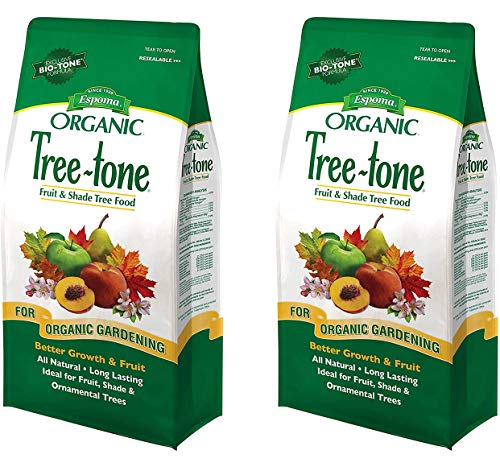
The set-and-forget organic that turned a slow leafer into a full canopy in one week.
Espoma’s Tree-Tone gives you a 6-3-2 N-P-K analysis that is gentle enough for young saplings but effective enough for a mature plum tree that needs consistent annual feeding. It comes as two 4-pound bags (8 pounds total) — a solid year’s supply for one or two standard trees. The formula includes 5% calcium, which helps prevent blossom-end rot and strengthens cell walls for better fruit quality.
Unlike synthetic formulas, you do not mix or dilute anything. You simply sprinkle the powder around the drip line in spring and fall and let the soil microbes do the work. The Bio-tone formula is a proprietary blend of beneficial bacteria and mycorrhizae that helps roots absorb nutrients more efficiently. Buyers report that a tree that had been slow to leaf out was transformed — “1 week after using product entire tree leafed iut and looks good,” one owner wrote. Another reviewer noted their pluot and apple trees seemed to love it.
The main trade-off is that it is lighter at 4 pounds per bag compared to the Down To Earth option which weighs 5 pounds, but the 128.0 ounce total from the 2-pack offsets that for most home growers. Some buyers also mention that dogs find the organic ingredients appetizing, so you will want to bury it a few inches into the soil or water it in well to keep pets away.
What You Are Getting
- Organic formula with no harsh chemicals or sludge — safe around edible fruit.
- Ready-to-use with zero measuring or mixing required.
- 5% calcium for better fruit development and disease resistance.
- Two bags give you enough for multiple trees or season-long coverage.
Keep In Mind
- Heavier than the 3.25 lb Fertilome bag, so shipping adds some cost.
- Odor and taste attract dogs — must be worked into soil.
- Slower visible results compared to a synthetic high-nitrogen feed.
Perfect for: Organic gardeners who want a low-maintenance granular feed that builds soil health over time.
Consider alternatives if: you need a fast-acting correction for a severely nutrient-deficient tree mid-season.
2. Down To Earth Organic Fruit Tree 6-2-4

The heavyweight organic that revived a wind-damaged tree into a producing powerhouse.
The extra weight matters for larger plum trees with a wide root zone. The formula is OMRI-listed, which means it meets organic production standards. It is built from feather meal, fish bone meal, kelp meal, and alfalfa meal — ingredients that break down slowly and feed the soil food web.
The real draw here is the buyer-reported results. One reviewer noted their crabapple tree had been uprooted by wind with no leaves or berries, and “after 2 years of use, tree now has healthy leaves, abundant berries, and stronger roots; stakes can soon be removed.” That kind of comeback story suggests the slow-release organic nutrients also build root structure. The higher potassium (4) relative to the Espoma (2) may also help fruit ripening and cold hardiness in your plums.
The catch is the box is not resealable, so storing it in a moist garage can cause clumping. You will need a scoop or measuring cup since there are no pre-measured packets. Also note that the 6-2-4 ratio is slightly lower in phosphorus than the Espoma 6-3-2, which is worth considering if your soil test shows a phosphorus deficiency.
Standout Features
- 5-pound box gives you more volume per purchase than most organic competitors.
- Seven natural ingredients feed both tree and soil microbes.
- Visible recovery on damaged trees in buyer reports, not just maintenance.
- Contains calcium from calcium carbonate for fruit development.
Potential Drawbacks
- Powder form can clump if exposed to humidity after opening.
- Requires measuring — no pre-portioned application.
- Lower phosphorus than the Espoma option, less ideal for sandy soils low in P.
Who it suits: Organic growers with mature trees that need a sustained, deeper-root feeding program.
Look elsewhere if: you want a simple pour-and-go without measuring or your soil already has high potassium levels.
3. TPS Nutrients Fruit Tree Liquid Fertilizer 32 oz
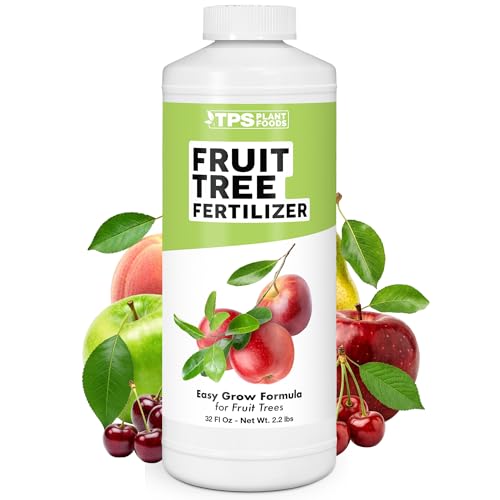
The liquid option that mixes instantly and gets absorbed by leaves and roots.
Not every plum tree is in the ground. Potted trees on a patio or deck cannot take a heavy granular application without risk of burning confined roots. TPS Nutrients solves that with a 32 oz liquid concentrate that you dilute at 2 tablespoons per gallon of water. Owners mention it “mixes easily with water” and that a single bottle lasts from spring through summer, even for trees that need heavy feeding. You can also use it as a foliar spray — meaning you spray it directly onto the leaves — which gives an even faster green-up.
The flexibility makes this a great second product to have on hand alongside a slow-release granular. You can use the liquid as a rescue feed when you see pale leaves or slow growth in July, then rely on the granular for the main spring and fall applications. One buyer mentioned it “works well for apple and plum trees needing heavy feeding,” and another saw it helped their peach, apple, and pecan trees. The liquid is made in the USA and is formulated specifically for fruit-bearing trees.
The downside is the liquid label does not specify an exact N-P-K ratio, which makes it harder to compare against the granular options or dial in a precise nutrient correction for a soil deficiency. You are trusting the proprietary blend rather than adjusting each element yourself.
Reasons To Choose
- Works in a watering can or as a foliar spray for immediate uptake.
- 32 oz bottle covers a whole growing season for one or two trees.
- Safe for container plants where granular build-up is a concern.
Before You Buy
- Missing a published N-P-K number means you cannot correct a known deficiency precisely.
- Requires more frequent applications than a granular once-a-season feed.
- 32 oz unit is small compared to the 128.0 oz total from the Espoma 2-pack.
Best suited for: Container growers and anyone who wants a fast-acting supplement to pair with a main granular feed.
skip it if: you want a single, low-maintenance product and you already have healthy soil.
4. Fertilome Fruit, Citrus and Pecan Tree Food 19-10-5
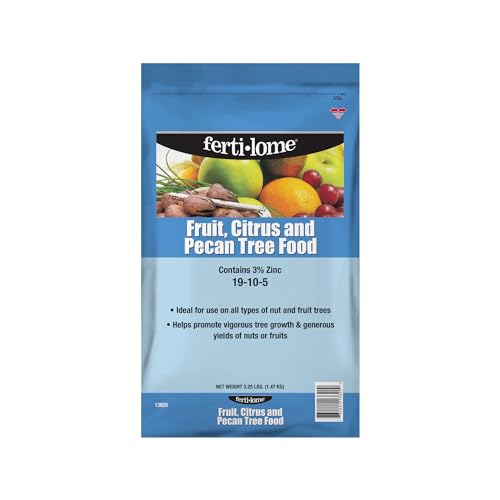
The high-nitrogen synthetic that a 20-year user says “peach and cherry trees seem to love it.”
If you have an established plum tree in native soil that needs a quick green-up and growth push, the Fertilome 19-10-5 delivers the highest nitrogen (19) of any pick here. That is 19 nitrogen versus 6 in the Espoma and Down To Earth organics. The synthetic granules release fast when watered in, so you see a visible response within a week or two. One owner reported: “Have used this product for more than 20 years.” That kind of loyalty comes from consistency.
The 52.0 ounce (3.25 lb) bag is compact, and the price per pound is lower than the organic options. The formula includes zinc, which is mainly added for pecan trees but can also help with general trace mineral nutrition. You apply it twice a year — spring and fall — which matches the standard plum tree feeding schedule. Another long-time reviewer noted, “Easy to use and does not require a lot for my apple and peach trees.”
The caution with any high-nitrogen synthetic is the risk of over-application. Too much can burn roots and push aggressive leafy growth at the expense of fruit buds. The 19-10-5 ratio has 19 nitrogen versus 6 in the organic picks, which means you need to measure carefully. One reviewer even warned: “Do not overdo it.” For potted plum trees or sandy soil that drains fast, a synthetic release may also wash through before the tree can use it.
Advantages
- High nitrogen content gets fast results on yellowing or slow-growing trees.
- Compact 3.25 lb bag is easy to store and apply.
- Cost-effective for covering multiple trees in a larger orchard.
Consider Carefully
- High 19% nitrogen can burn roots if you over-apply or fail to water in.
- Synthetic formula does not feed soil microbes or improve organic matter.
- Only 52.0 ounces total versus the 128.0 oz Espoma 2-pack.
Grab this for: An instant growth boost on a mature tree in heavy native soil where you want visible results fast.
Pass on it if: you are growing organically, have a young tree, or your soil already tests high in nitrogen.
Understanding the Specs
N-P-K Ratio Explained
The three numbers on any fertilizer bag stand for Nitrogen, Phosphorus, and Potassium (N-P-K). Nitrogen pushes leaf and stem growth. Phosphorus helps develop flowers, fruit, and roots. Potassium improves overall tree health, disease resistance, and fruit quality. For a plum tree, a ratio lower in nitrogen (like 6-3-2 or 6-2-4) works better than a lawn-style 19-5-9, because too much nitrogen reduces flowering and fruit production.
Organic vs. Synthetic Fertilizers
Organic fertilizers like the Espoma Tree-Tone and Down To Earth are made from natural materials (bone meal, feather meal, kelp). They release nutrients slowly as soil microbes break them down. They improve the long-term structure of your soil. Synthetic fertilizers like the Fertilome option are refined and water-soluble, giving trees a fast dose of pure nutrients. They work well for a quick correction but can build up salts in the soil over time. For edible fruit, most home gardeners lean organic.
FAQ
When should I fertilize my plum tree in spring and fall?
Can I use a general all-purpose fertilizer like 10-10-10 on my plum tree?
How much fertilizer does a mature plum tree need per application?
Is liquid fertilizer better than granular for a newly planted plum tree?
Will the Espoma Tree-Tone work for a plum tree growing in a pot?
Can I apply the Down To Earth 6-2-4 around the base right after planting?
Why does the Fertilome 19-10-5 have so much more nitrogen than the organic options?
How long does the TPS liquid fertilizer last once mixed with water?
Final Thoughts: The Verdict
For most plum tree owners, the fertilizer for plum trees that strikes the best balance of effectiveness and ease is the Espoma Organic Tree-Tone because it is mess-free, organic-safe, and has a proven track record with stone fruit. If you want an organic pick with a bit more weight per box for bigger trees, go with the Down To Earth 6-2-4. And for a fast-acting liquid that works well on container trees or as a mid-season boost, the TPS Nutrients Liquid Fertilizer is a solid buy.
How We Picked
We do not accept paid placement. Every pick is matched to a real buyer and a real use-case; we do not hands-on test units.
Sources & Methodology
Specifications: manufacturer listings and product documentation. Review insights: verified customer reviews, as of July 2026. Pricing: not shown on this page (it changes often); check the current price via the retailer link.
As an Amazon Associate, Lawn Gear Lab earns from qualifying purchases. This does not affect which products we feature.