
Specs are compiled from manufacturer listings and verified buyer reviews and can change over time — please confirm the key details on the product page before buying.
You have raked the soil, tossed down the seed, and watered twice a day. Now the big question: what fertilizer actually kicks those seeds into gear without burning your new lawn? The answer mostly depends on one number on the bag — the phosphorus level — which feeds the roots while the top is still just a fuzz of green.
I’m Rikta — the founder and writer behind Lawn Gear Lab. This guide is built by comparing the manufacturers’ published specifications and the patterns across verified customer reviews, so you get each pick’s real strengths and trade-offs instead of marketing spin.
Choosing the right starter fertilizer for grass seed is the single fastest way to get a thick, dark-green lawn that chokes out weeds before they get a foothold. This works whether you are starting from bare dirt, overseeding thin patches, or laying fresh sod.
Quick Picks
- The Andersons 18-24-12 Starter Turf Fertilizer, 50lb Bag — Best Overall
- The Andersons Premium New Lawn Starter 20-27-5 Fertilizer (18 lb) — Fast Results
- Greenview Spring or Fall Lawn Starter Fertilizer – 8 lb Bag — Best Value
- Jonathan Green (16006) Veri-Green Starter Fertilizer for Seeding & Sodding – 12-18-8 (4 lb) — Sod & Seed
- Fertilome (10904) New Lawn Starter Fertilizer 9-13-7 (4 lbs.) — Budget Champion
How To Choose The Best Starter Fertilizer For Grass Seed
A starter fertilizer is different from the regular lawn food you use mid-summer. Its job is to deliver a quick burst of phosphorus to developing roots while providing enough nitrogen to push green growth without burning the tender seedlings.
Look for the middle number — Phosphorus
Every fertilizer bag shows three numbers: N (Nitrogen) for leaf growth, P (Phosphorus) for root development, and K (Potassium) for overall plant health. For a starter applied at seeding, you want the middle number to be the highest or at least equal to the first. A ratio like 10-18-10 or 12-18-8 is ideal because it puts root strength first.
Match the coverage to your yard size
Bags list the square footage they cover. A small 4-pound bag may cover only 1,000 square feet, while a 50-pound sack can blanket 12,500 square feet. Measure your lawn before buying — overspending on a huge bag for a patchy yard wastes money, and buying a small bag for a full acre means making multiple trips.
Check the release type
Many starter mixes combine quick-release nitrogen (for an immediate green-up you see within days) with slow-release nitrogen (which keeps feeding for weeks, so you do not have to reapply as often). The best starter fertilizers for grass seed give you both, so the grass gets an instant boost and steady nutrition as the roots settle in.
Quick Comparison
On smaller screens, swipe sideways to see the full table.
| Model | Best For | NPK Ratio | Coverage | Weight | Amazon |
|---|---|---|---|---|---|
| The Andersons 18-24-12 | Large lawns & pros | 18-24-12 | 12,500 sq ft | 50 lb | Amazon |
| The Andersons 20-27-5 | Fast root fill-in | 20-27-5 | 5,000 sq ft | 18 lb | Amazon |
| Greenview 10-18-10 | Budget spring/fall seeding | 10-18-10 | 2,500 sq ft | 8 lb | Amazon |
| Jonathan Green 12-18-8 | Sod & overseeding | 12-18-8 | 1,500 sq ft | 4 lb | Amazon |
| Fertilome 9-13-7 | Small patches & tight budgets | 9-13-7 | 1,000 sq ft | 4 lb | Amazon |
In-Depth Reviews
1. The Andersons 18-24-12 Starter Turf Fertilizer, 50lb Bag
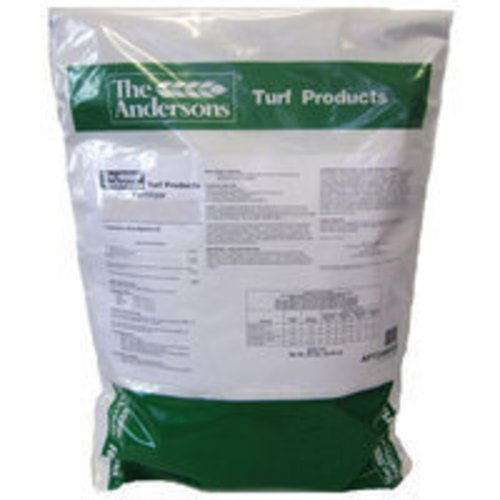
The 50-pound sack delivers thick grass across half a football field (12,500 sq ft).
This is the serious option for anyone with a large lawn. It gives you the best root push of any pick here because the phosphorus level (24) is the highest on this list, feeding roots at 24 parts per 100. The Andersons 18-24-12 is a 50 lb bag that covers 12,500 square feet at a medium rate — that is massive compared to the 4 lb options below. Buyers report deep green color and quick liveliness after one application with a broadcast spreader (a rolling hopper that flings granules in a fan pattern). One thing to keep in mind: this is a premium-tier investment in both price and weight. You need a sturdy spreader and a bit of muscle to haul the bag around the yard. But for the cost per square foot, it is the most economical choice if your lawn is big. Reviewers also note that this formula works well on fruit trees and established turf with phosphorus deficiencies — it is not just a one-trick pony. Unlike the Greenview 8 lb bag, this one keeps you buying fertilizer only once a season for most properties.
What powers it
- Highest phosphorus (24) for best root establishment
- Giant 12,500 sq ft coverage — fewer bags per season
- Pro-grade brand trusted by golf course and farm users
What holds it back
- 50 lb weight is heavy to carry and load into spreaders
- Premium cost upfront, even if the value per sq ft is great
- No included micro-nutrient iron like the smaller Andersons bag
Your go-to for big lawns: If you have more than 5,000 sq ft of bare dirt or sod to cover, this bag saves money and trips to the store.
A smaller yard? Pass on this one. If your yard is under 2,000 sq ft, the 50 lb bag would take years to use and could cake up in storage.
2. The Andersons Premium New Lawn Starter 20-27-5 Fertilizer (18 lb)
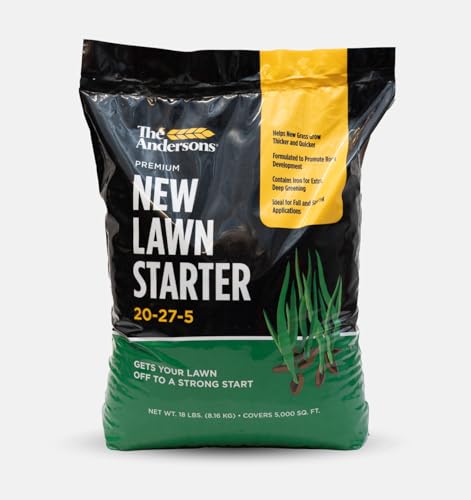
The phosphorus bomb — at 27 parts per 100, it is the strongest root kick on the list, and owners mention it sprouted grass in just over a week.
This middle-weight premium option from The Andersons nails the classic starter formula: a 20-27-5 NPK ratio, where the middle number (phosphorus) is the highest. It also contains 1% iron for that extra deep greening that makes a new lawn look established sooner. The 18 lb bag covers 5,000 sq ft, making it a natural fit for a typical suburban front yard. Customers note getting visible grass in “just over a week” after applying it alongside seeding. Unlike the Greenview and Jonathan Green products, this one includes both quick-release and slow-release nitrogen, so you see fast green-up while the slow portion keeps feeding for weeks. One reviewer noted that combined with dethatching (raking out dead thatch) and overseeding, the results ran circles around Milorganite alone. The catch? For an 18 lb bag, this hits a higher price tier than the Greenview or Fertilome options. But if you factor in the 1% iron and the phosphorus level at 27 versus 24 on the 50 lb bag, the cost per thousand square feet is competitive — and the results are hard to argue with.
Ideal for medium yards: A stellar pick for a 5,000 sq ft new-seed project where you want the fastest root fill and do not want to wrestle a 50 lb bag. This one has more root-driving phosphorus than the 50 lb Andersons, at 27 versus 24, so it is the better choice for a property under 5,000 sq ft that needs a big push.
Best for: Homeowners starting a new lawn from scratch on a standard-sized lot who want dark green color in weeks, not months.
Over 10,000 sq ft? Look at the 50 lb bag instead. You will run out and need a second bag at a higher cost than the 50 lb option.
3. Greenview Spring or Fall Lawn Starter Fertilizer – 8 lb Bag

Light on the wallet, but heavy on the root-boosting phosphorus (18 parts per 100) for 2,500 sq ft.
Greenview strikes a smart balance between price and performance. The 10-18-10 NPK ratio puts phosphorus front and center, and the 8 lb bag covers 2,500 sq ft — enough for a good-sized side yard or a front lawn that has been patchy. The packaging spring or fall timing is exactly when most people seed anyway. Reviewers point out seeing grass within 7-10 days, which lines up with the product’s mix of immediate and time-released nitrogen that feeds for up to 8 weeks. It is lighter to carry than the 18 lb Andersons bag, and the price lands well below the premium tier. One buyer mentioned this was the only product they used across five different houses, all with consistent results. But let us be honest: some buyers found it less potent than Scott’s brand, and a few noted little impact on the lawn. The 10-18-10 ratio is solid but not extreme — if your soil is very depleted, the higher phosphorus options (20-27-5 or 18-24-12) will give you a bigger kick start. Think of this as the reliable, value-conscious starter that does the job while staying affordable.
A balanced workhorse: Great for a normal first-time seeding where you want results in a week and a half without paying premium prices.
Reach for this if: Your lawn area is 2,500 sq ft or less and you want a trusted formula that is easy to find and easy to spread.
Absolute fastest lawn? The higher-phosphorus Andersons products (20-27-5 and 18-24-12) will beat it on sheer root push.
4. Jonathan Green (16006) Veri-Green Starter Fertilizer for Seeding & Sodding – 12-18-8 (4 lb)

Tailored for sod and seed with humates — organic compounds that unlock soil nutrients — so your grass gets more from the dirt you already have.
Jonathan Green positions this as a starter specifically for seeding and sodding, and the 12-18-8 ratio shows why. The 18% phosphorus is right in the balance for root formation, and the added humates — organic compounds that improve nutrient exchange in the soil — set it apart from simpler formulas. The 4 lb bag covers 1,500 sq ft, which is a typical front lawn patch or a small yard. One owner reported that after just one month their yard “looks 10x better,” and the grass came up in good time without burning or brown spots even after four mows. The inclusion of humates means this fertilizer works harder in poor soil than a basic N-P-K mix would, which is helpful if you are starting with compacted or sandy dirt. On the downside, the 4 lb size means you will need multiple bags for any lawn over 2,000 sq ft, and that pushes the cost per square foot higher than the Greenview or Andersons options. It is also a dry granular that must be stored carefully — moisture will turn it into a solid block. For small seeding jobs or laying sod on a modest lot, this is a premium performer. For a full-acre project, the economics tilt hard toward the larger bags.
Why it stands out
- Humates enhance nutrient availability in tough soil
- Feeds for up to 2 months with a single application
- Strong track record for sod root establishment
The trade-off
- Small bag size means higher per-square-foot cost
- 4 lb bag covers only 1,500 sq ft
- Granules can clump if exposed to moisture
Perfect for: The homeowner laying sod on a small lot or overseeding a patchy lawn who values soil-conditioning humates over raw NPK numbers.
Over 5,000 sq ft? The higher cost per pound makes the 18 lb or 50 lb bags a smarter buy.
5. Fertilome (10904) New Lawn Starter Fertilizer 9-13-7 (4 lbs.)
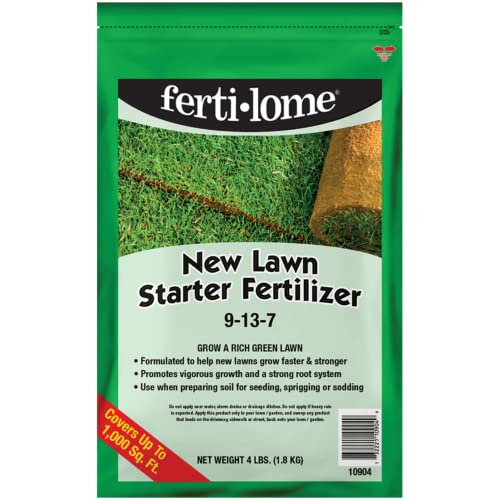
A compact 4 lb bag that delivers a balanced boost for small patches up to 1,000 sq ft.
Fertilome’s 9-13-7 is the smallest and most affordable option in this lineup, covering 1,000 sq ft with a single 4 lb bag. The NPK ratio is modest compared to the 20-27-5 or 18-24-12 products from The Andersons — with phosphorus at 13 versus 27 or 24 — but it is still a legitimate starter formula where phosphorus (13) beats nitrogen (9). Shoppers say quick results in grass density and color within weeks, and several called out the larger granule size compared to Scott’s, which they say releases slower and lowers the burn risk on tender new grass. One customer observed it produced a “dark rich green” that covered weak spots in the lawn. It works for seeding, overseeding, and sod equally well, making it a versatile tool to keep in the shed. The catch is simple: you will need multiple bags for any lawn over 1,000 sq ft. At 4 lbs per 1,000 sq ft, a 5,000 sq ft yard would need five bags, which starts eating into the value advantage. It is best thought of as a targeted tool for a bare patch or a small new garden bed rather than a whole-lawn strategy.
Small project specialist: If you are fixing a single thin spot or planting grass around a new flower bed, this bag is exactly the right size at a no-regret price. It is the pick for a first-time buyer who wants to cover a small area and not overcommit on storage.
Need full-lawn coverage? The 8 lb Greenview bag or the 18 lb Andersons option will save you money and work in the long run.
For a 1,000 sq ft project, this is the most direct choice.
Understanding the Specs
NPK Ratio — the three numbers
Every bag shows N (nitrogen) for leaf and stem growth, P (phosphorus) for root development, and K (potassium) for overall plant health and disease resistance. For a starter fertilizer applied right at seeding, you want the middle number to be the highest — that is the phosphorus that feeds the new root system while the grass is still short and vulnerable. A ratio like 10-18-10 or 18-24-12 tells you the bag is designed for this job.
Coverage area
This is simply how many square feet one bag will treat at the labeled application rate. A 4 lb bag covering 1,000 sq ft is fine for a small patch, but for a 10,000 sq ft yard you would need ten of them. Always measure your lawn before buying. The bigger bags (18 lb or 50 lb) usually offer a much lower cost per square foot, but only if you need that much.
FAQ
Can I use regular lawn fertilizer as a starter for grass seed?
How soon after applying starter fertilizer will I see grass?
How often should I reapply starter fertilizer to a new lawn?
Will starter fertilizer burn my new grass seed?
Should I apply starter fertilizer before or after seeding?
Can I use starter fertilizer on established grass?
What does the 1% iron in some starter fertilizers do?
How should I store an open bag of starter fertilizer?
Final Thoughts: The Verdict
If you want one dependable pick, the starter fertilizer for grass seed winner is the The Andersons 18-24-12 Starter Turf Fertilizer because it pairs the highest phosphorus level with the lowest cost per square foot for large lawns. If you want fast greening and root fill on a medium-sized lot, grab the The Andersons Premium New Lawn Starter 20-27-5. And for a small patch or budget-friendly overseeding project, the Greenview Spring or Fall Lawn Starter Fertilizer gives you reliable results without the premium price tag.
How We Picked
We do not accept paid placement, and we did not hands-on test every unit. Instead, we match each pick to a real buyer and use-case by comparing the manufacturers’ published specifications against the patterns in verified customer reviews — so you get each pick’s real strengths and trade-offs instead of marketing copy.
Sources & Methodology
Specifications: manufacturer listings and product documentation. Review insights: verified customer reviews, as of July 2026. Pricing: not shown on this page (it changes often); check the current price via the retailer link.
As an Amazon Associate, Lawn Gear Lab earns from qualifying purchases. This does not affect which products we feature.