
Specs are compiled from manufacturer listings and verified buyer reviews and can change over time — please confirm the key details on the product page before buying.
Thin, cheap seed trays crack after one season, leak water all over your shelves, and sag under the weight of wet soil — leaving you scrambling for replacements right when your seedlings need you most. The right 1020 tray is thick enough to last multiple growing seasons without twisting, bending, or breaking, saving you money and frustration in the long run. This guide compares the heaviest-duty options so you can buy once and forget about flimsy trays for years.
I’m Rikta — the founder and writer behind Lawn Gear Lab. This guide is built by comparing the manufacturers’ published specifications and the patterns across verified customer reviews, so you get each pick’s real strengths and trade-offs instead of marketing spin.
The best 1020 seed trays are built with thick plastic (1.2mm to 1.8mm) to resist cracking, support heavy soil loads, and survive repeated use across multiple seasons. Here are the exact models that deliver on that promise — no flimsy trays, no guesswork.
Quick Picks
- Hemlock Home Brewing 1020 Seed Starting Trays – 5-Pack (No Holes) — Best Overall
- Bootstrap Farmer Extra Strength 1020 Trays – 5-Pack, Black (With Holes) — Best With Holes
- RooTrimmer 10-Pack 1020 Trays – Extra Thick, No Holes, Black — Best Value in Bulk
- Handy Pantry 10-Pack 1020 Garden Growing Trays – with Drain Holes — Budget Pick with Holes
How To Choose The Best 1020 Seed Trays
Picking a seed tray sounds simple, but the difference between a tray that cracks in month one and one that lasts a decade depends on three things: the thickness of the plastic, the presence of drainage holes, and how well the tray fits your existing setup. Here is what to check before you click “buy.”
Plastic Thickness and Material
The single biggest durability factor is the actual thickness of the plastic walls and floor. Cheap trays often measure around 0.4mm and feel flimsy in your hands — they sag when filled with damp soil and crack under the heat of a propagation mat (a heating pad that warms soil from below to speed up germination). Look for trays that are at least 1.2mm thick (buyers report measuring them with calipers, a tool that measures small gaps precisely) to get a rigid tray that holds its shape season after season. The material matters too: polypropylene (PP) trays tend to be more flexible without cracking, while polystyrene (PS) trays are stiff and can be brittle if dropped.
Drainage Holes
Some trays come with holes in the bottom, others are solid. There is no “better” choice — it depends on what you are growing. Solid trays (no holes) are ideal for microgreens, wheatgrass, bottom-watering setups, and as drip trays under pots, because they hold water without leaking. Trays with drainage holes are better for seed-starting cells and nursery pots where excess water needs to escape so roots do not rot. Many serious growers keep both types: solid trays underneath to catch runoff, holed trays on top for the actual plants.
Dimensions and Compatibility
The “1020” label means the tray is roughly 10 inches by 20 inches, but the exact outer and inner dimensions vary between brands by up to an inch. A tray that is slightly larger on the outside may not fit snugly on your shelf, and one with a different inner lip design may refuse to accept your existing inserts. Check the listed dimensions (especially the inner length and width) and scan recent reviews for mention of compatibility problems — some buyers found their old standard 1020 inserts did not sit flat inside newer tray designs.
Weight and Stackability
A heavy tray (around 3 pounds for a 5-pack) is usually a sign of sturdy, thick plastic that will not warp under a full load of wet soil. Lighter trays (around 1 pound for a 10-pack) are easier to lift and carry, but may feel less solid. Also check whether the trays stack neatly when empty — good stacking saves significant storage space between growing seasons and keeps your greenhouse organized.
Quick Comparison
On smaller screens, swipe sideways to see the full table.
| Model | Best For | Material | Thickness | Drainage | Amazon |
|---|---|---|---|---|---|
| Hemlock Home Brewing 5-Pack (No Holes) | Best Overall Durability | Polypropylene | 1.2mm | No | Amazon |
| Bootstrap Farmer Extra Strength 5-Pack | Best With Holes | Polypropylene | — | Yes | Amazon |
| RooTrimmer 10-Pack (No Holes) | Best Value in Bulk | Polystyrene | 1.8mm | No | Amazon |
| Handy Pantry 10-Pack | Budget Pick with Holes | Polystyrene | — | Yes | Amazon |
In‑Depth Reviews
1. Hemlock Home Brewing 1020 Seed Starting Trays – 5-Pack (No Holes)

The thickest plastic at this price point, measured by real buyers at 1.2mm compared with 0.4mm for cheap trays.
You get five solid-bottom trays built from BPA-free polypropylene (a flexible plastic that resists cracking) that resists cracking and sagging — exactly what you want for microgreens, wheatgrass, or as a leak-proof tray under pots. Owners mention that the measured 1.2mm thickness (confirmed by calipers) compares with the flimsy 0.4mm trays sold at big-box stores, so these hold water for deep watering without flexing or bowing. The outer dimensions are 21 x 10.75 x 2.5 inches, meaning they fit standard 1020 shelving without overhang, and the absence of holes makes them a perfect bottom-watering reservoir.
Reviewers consistently call these “the best ones I have” and praise the cheerful green color that makes them easy to spot among a stack of black trays. At 3.94 pounds per 5-pack (1.79 kilograms), they have a satisfying heft that signals real durability. One buyer who bought them twice says they do not flex and last for years of continuous use — a strong sign if you plan to use them season after season in a home greenhouse or indoor setup. They weigh 3.94 pounds per 5-pack, while the RooTrimmer trays are listed at 1.1 pounds for a 10-pack, for setups where a minor flex or twist would spill water.
The catch is that these trays have no drainage holes, so they are not ideal for setups where you need water to flow through the tray and out. They also come in a 5-pack — if you need a larger quantity, you will have to buy multiple packs, which adds up. But for sheer structural quality at a mid-range price, these are the ones that keep your seedlings safe and your shelves dry.
Why they win: Measured 1.2mm thickness compared with the 0.4mm cheap-tray standard in a BPA-free polypropylene build that resists sagging and cracking for years.
The one limit: No drainage holes means they are not ideal for top-watered seed cells; pair them with a holed tray on top if you need drainage.
Reach for these if: You grow microgreens, wheatgrass, or bottom-water your seedlings and want a solid leak-proof tray that will not warp.
Look elsewhere if: Your primary use is seed-starting cells that need drainage holes, or you need a larger quantity per order.
2. Bootstrap Farmer Extra Strength 1020 Trays – 5-Pack, Black (With Holes)
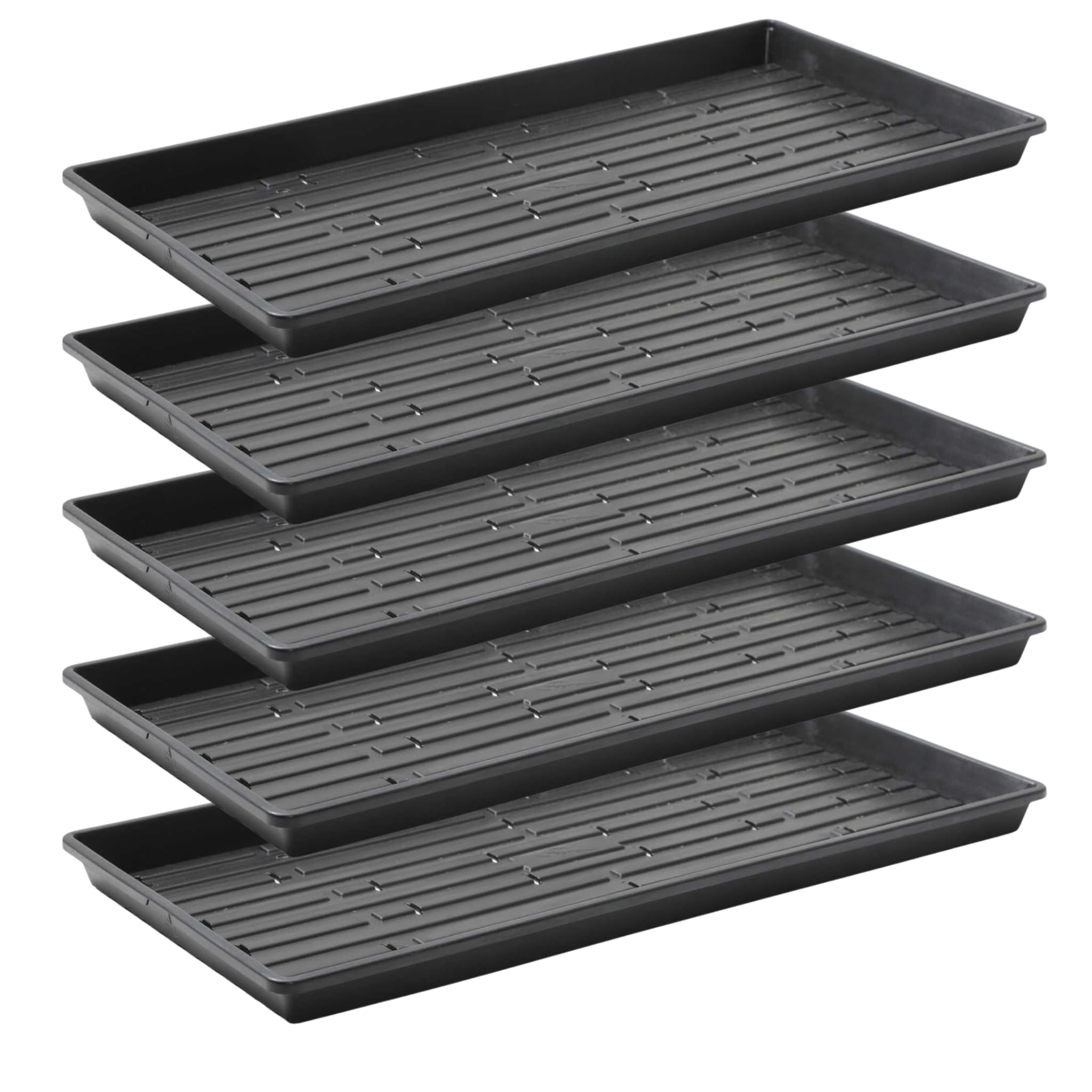
At 3.13 pounds for a 5-pack, these trays have a substantial build compared with lighter bulk packs.
These trays are built from BPA-free, recyclable polypropylene and designed specifically to handle heat mats and humidity domes without warping. The shallow 1.2-inch depth (the shallowest of all four picks) makes them especially convenient for microgreen harvesting — you do not have to dig down through excess soil to reach the roots. The drainage holes and cross-channel patterns on the bottom improve water flow, so roots get air and excess moisture escapes instead of pooling. And unlike some trays, these are dishwasher-safe for quick cleaning between cycles.
One reviewer noted they are the sturdiest trays they have used — thick PP plastic prevents twisting and folding even when loaded with wet soil. The same reviewer received theirs with cracked bottom trays, attributing it to the shipper and poor seller packaging, so inspect yours on arrival. At roughly 3.13 pounds per 5-pack, these are a heavier build than the RooTrimmer at 1.1 pounds for a 10-pack, meaning they will not flex or sag under a heavy load of seedlings.
The catch is that shallow 1.2-inch depth means they hold less soil than a standard 2.5-inch deep tray — fine for microgreens, but limiting if you want to grow taller plants or use deeper inserts. They also cost more per tray than the Hemlock Home Brewing pick, but the two-year warranty and proven robustness make them a justifiable premium choice for commercial-level use.
Built for tough conditions
- 3.13 lbs per 5-pack with a rigid, warp-resistant build
- Dishwasher-safe for easy cleanup between growing cycles
- Two-year warranty covers normal use conditions
- Drainage holes for seed-starting and nursery-pot setups
Things to check
- Shallow 1.2-inch depth limits soil volume for taller plants
- Some customers note cracked trays on arrival due to poor packaging
- Higher per-tray cost than comparable mid-range options
Best for: Serious microgreen growers or greenhouse operators who need trays that survive years of heavy use with heat mats and humidity domes.
Not ideal if: You want deep soil for larger plants, or you are on a tight budget and do not need the extra ruggedness.
3. RooTrimmer 10-Pack 1020 Trays – Extra Thick, No Holes, Black

A 10-pack of 1.8mm-thick trays that weigh only 1.1 pounds total — incredibly light while still feeling very sturdy.
The RooTrimmer trays are made from high-quality polystyrene with a reinforced 1.8mm wall thickness that resists twisting and bending even when loaded with wet soil. The solid bottom (no holes) holds water for bottom-watering setups and microgreen propagation, and the deeper 2.56-inch side walls mean you can fill them with more soil than the Bootstrap Farmer shallow trays. Compared with the Handy Pantry tray depth of 2.38 inches, the RooTrimmer is 2.56 inches deep, so you get a taller growing space in a still-manageable tray.
Buyers consistently praise the “nice, thick construction” and say these trays are heavy duty enough to last for years in a greenhouse. One reviewer found, however, that their older 1020 inserts did not fit inside the new RooTrimmer trays — the interior dimensions are slightly different from older standard trays, so check compatibility before buying if you are stacking existing inserts. At 1.1 pounds for the full 10-pack, these are much lighter than the Bootstrap Farmer 5-pack at 3.13 pounds while still feeling rigid, thanks to the thick polystyrene walls.
The catch is polystyrene is stiffer than polypropylene — it will hold its shape well but can be more brittle if dropped. These trays also lack drainage holes, so they are best suited for bottom-watering, microgreens, or as drip trays under other containers. For the price, getting ten thick, 1.8mm trays is a serious value proposition, especially if you need a large quantity for a single growing season.
Standout spec: 1.8mm measured thickness in a 10-pack — the best thickness-to-quantity ratio of any pick here.
Compatibility note: Reviewers point out that some older standard 1020 inserts may not fit inside these trays, so test with one before filling the whole batch.
Pick these for: Microgreen growers or home gardeners who need a large batch of thick, solid-bottom trays without spending a premium per tray.
Skip them if: You need drainage holes in the tray bottom, or you rely on older 1020 inserts that might not fit the interior dimensions.
4. Handy Pantry 10-Pack 1020 Garden Growing Trays – with Drain Holes

Ten trays with built-in drainage holes, made in the USA from food-safe polystyrene that is flexible without breaking.
These Handy Pantry trays are designed for seed starting, microgreens, and hydroponic use where drainage is essential. The built-in holes allow excess water to flow out freely, preventing overwatering and root rot — and they work well for bottom-watering when you nestle them inside a solid-bottom tray. At 10 trays in a single pack, and a depth of 2.375 inches (the specs list 20 x 10 x 5 inches, likely shipping dimensions; the growing depth is 2.375 inches), they offer a good middle ground of depth for seedling roots. Reviewers report being “happy with these” after years of yearly use, noting the trays are “durable enough for multiple uses” and never broke despite being somewhat flexible.
One buyer found that with the drain holes, the trays are not effective for holding 4-inch pots because water drains straight through. That is a design feature for seed flats and cell trays, not a flaw — but it means you need separate solid trays underneath if you want to bottom-water or catch runoff. Compared to the RooTrimmer no-hole trays (10-pack at 1.1 pounds), the Handy Pantry trays are slightly less rigid but still “fine for the home gardener,” according to buyers. At 2 inches depth in the dimensions spec versus the RooTrimmer’s 2.56 inches, the RooTrimmer is deeper by height.
The catch is these are not the thickest trays available — buyers describe them as “flexible but never had one break.” They are a solid choice for the budget-conscious home gardener who wants drainage holes and a large quantity but does not demand the extreme rigidity of the Bootstrap Farmer or Hemlock Home Brewing picks. If you are growing microgreens and need to save money up front, these get the job done.
Value highlights
- 10 trays in one order for a low per-tray cost
- Drainage holes allow proper water flow for seed cells and flats
- Made in the USA from food-safe polystyrene
- Shoppers say trays last for years of yearly use without breaking
Keep in mind
- Not as rigid as polypropylene trays — they flex under heavy loads
- Drain holes mean water leaks through, so you need solid trays underneath for catch
- Not ideal for holding individual 4-inch nursery pots due to drainage pattern
Best for: Home gardeners starting seeds in flats or cell trays on a budget who need a large quantity of holed trays.
Not right if: You want solid-bottom trays, need extreme rigidity for commercial use, or plan to bottom-water without a separate solid tray.
Understanding the Specs
Plastic Thickness (mm)
This is the single most important number for judging durability. Cheap seed trays often measure 0.4mm — they feel like thin takeout lids and sag under wet soil. Serious trays start at 1.2mm (like the Hemlock Home Brewing pick, measured by buyers with calipers) and go up to 1.8mm (like the RooTrimmer). A thicker tray means it resists cracking, bending, and twisting even when filled with damp soil and placed on a heat mat. If the manufacturer does not list a thickness, check customer reviews — real buyers often measure and report it.
Drainage Holes
Trays with holes let water drain out freely, which is ideal for seed-starting cells, nursery pots, and any setup where excess water needs to escape so roots do not rot. Trays without holes (solid-bottom) are better for microgreens, wheatgrass, bottom-watering, and as drip trays under other containers. Many experienced growers keep both types — solid trays underneath to catch runoff, holed trays on top for the plants. There is no universal “best” option; buy according to what you are actually growing.
Material: Polypropylene vs. Polystyrene
Polypropylene (PP) trays are slightly flexible and resistant to cracking from impact — they will bend rather than snap, which makes them a good choice if you drop things or stack trays high. Polystyrene (PS) trays are stiffer and hold their shape better but can be brittle if dropped on a hard floor. Both materials are food-safe and recyclable. PP is typically more expensive but more forgiving; PS offers stiffness at a lower cost. Check the product specs for “Material Type” to see which one you are getting.
Weight and Rigidity
A heavier tray (around 3 pounds per 5-pack, like the Bootstrap Farmer) is almost always a sign of thicker, denser plastic that will not warp under heavy loads. Lighter trays (like the RooTrimmer at 1.1 pounds for a 10-pack) can still be rigid if the plastic is thick enough in key stress points — but the total weight gives you a quick gut-check of how much material you are actually getting. Compare weight per tray across packs of the same quantity to get a fair apples-to-apples sense of build quality.
FAQ
What does 1020 mean in seed trays?
How thick should a good 1020 seed tray be?
Should I buy trays with or without drainage holes?
Will all 1020 inserts fit inside any 1020 tray?
Are these trays safe for growing food?
Can I put these trays on a heat mat?
How do I clean and store seed trays between seasons?
What is the difference between polypropylene and polystyrene trays?
Will these trays work for hydroponic growing?
Final Thoughts: The Verdict
For most home growers and greenhouse operators, the 1020 seed trays winner is the Hemlock Home Brewing 5-Pack because they deliver a measured 1.2mm plastic thickness compared with the 0.4mm flimsy-tray standard in a BPA-free polypropylene build that resists sagging and cracking for years of reliable use. If you need drainage holes and extreme rigidity for heat mats and humidity domes, grab the Bootstrap Farmer Extra Strength Trays. And for the best value in bulk — ten thick 1.8mm trays at a low per-tray cost — the RooTrimmer 10-Pack is the smart pick for microgreen growers who need quantity without sacrificing strength.
How We Picked
We do not accept paid placement, and we did not hands-on test every unit. Instead, we match each pick to a real buyer and use-case by comparing the manufacturers’ published specifications against the patterns in verified customer reviews — so you get each pick’s real strengths and trade-offs instead of marketing copy.
Sources & Methodology
Specifications: manufacturer listings and product documentation. Review insights: verified customer reviews, as of July 2026. Pricing: not shown on this page (it changes often); check the current price via the retailer link.
As an Amazon Associate, Lawn Gear Lab earns from qualifying purchases. This does not affect which products we feature.