
Specs are compiled from manufacturer listings and verified buyer reviews and can change over time — please confirm the key details on the product page before buying.
You need a clear panel that actually stays clear. The biggest headache in this category is that many panels let UV rays through, then turn yellow and get brittle within one season. The real test isn’t just how much light they pass (which is almost always a high number) — it’s whether that performance lasts after a full summer of sun and a winter of snow. The best picks here balance a safety margin in thickness, solid UV blocking (so you avoid that yellowing), and a twin-wall design (honeycomb air channels) that traps air to buffer your greenhouse against outdoor temperature swings.
I’m Rikta — the founder and writer behind Lawn Gear Lab. This guide is built by comparing the manufacturers’ published specifications and the patterns across verified customer reviews, so you get each pick’s real strengths and trade-offs instead of marketing spin.
Whether you are patching a storm-damaged roof, winterizing a chicken coop, or starting a greenhouse from scratch, the best clear greenhouse panels share one trait: they pair solid impact resistance with UV protection (a coating that blocks ultraviolet rays) on the outward-facing side to keep from clouding up after the first season.
Quick Picks
- XISOCO 3-Pack (4’x2’x0.24in) — Best Overall
- VEVOR 5-Pack (2’x4’x0.32in) — Roof Grade
- DGSL 6-Pack (4’x2’x0.16in) — Best Value
- Tatuo 6-Pack (4’x2’x0.16in) — Versatile Pack
- UMIG 12-Pack (4’x2’x0.16in) — Maximum Coverage
How To Choose The Best Clear Greenhouse Panels
The decision depends on three connected specs: thickness, UV protection, and the internal structure of the panel. A thicker panel resists hail and snow loads better, but you pay more per square foot. A twin-wall design (the honeycomb air channels you see on the cut edge) adds insulation that a solid sheet cannot match, which is the whole point of a greenhouse in winter. And the UV coating on one side is not a marketing gimmick — without it the polycarbonate goes cloudy and then brittle within a year or two.
Thickness (0.16in vs 0.24in vs 0.32in)
The thickness number you see (0.16in, 0.24in, 0.32in) is the panel’s overall depth including the internal ribs. A 0.16in panel is fine for vertical walls or a chicken coop that does not get heavy snow loading, and it is easy to cut with a razor knife. A 0.24in or 0.32in panel handles roof duty much better — it resists hail and heavy falling objects without cracking. Thicker panels also have wider internal air channels, which improves the insulating R-value (a measure of heat flow resistance) so you lose less heat on cold nights.
UV Protection
Look for a formulation that has a UV-resistant co-extruded layer (a bonded surface layer) on one side. The data on these panels shows numbers like 99.5% UV protection (the XISOCO) or blocking 98% of UV rays (the VEVOR). That coating keeps the polycarbonate from turning yellow after a few months of sun. A critical installation detail is that the protective film on the side that faces outward is the UV coated side. If you install it backwards, the panel will receive no UV protection and will degrade rapidly. Every manufacturer marks this — the outward-facing film is usually a different color or clearly labeled.
Twin-Wall Construction for Insulation
Twin-wall panels (also called multiwall or honeycomb) have a series of vertical air channels between two outer skins. That trapped air is what gives a greenhouse its temperature buffer. One reviewer on the VEVOR panels reported the coop temperature rose 10-15°F, and in -7°F sun the coop reached 28-32°F. A solid single-layer panel like acrylic or corrugated fiberglass cannot do that. For a greenhouse that needs to hold warmth after sunset, twin-wall is effectively the only choice among these clear panels.
Quick Comparison
On smaller screens, swipe sideways to see the full table.
| Model | Best For | Thickness | Panel Count | Weight (Total) | Amazon |
|---|---|---|---|---|---|
| XISOCO 3-Pack | Best Overall (Mid Range) | 0.24 in | 3 | — | Amazon |
| VEVOR 5-Pack | Heavy Roof Duty | 0.32 in | 5 | 9.68 lbs | Amazon |
| DGSL 6-Pack | Best Value Pack | 0.16 in | 6 | 6.15 lbs | Amazon |
| Tatuo 6-Pack | Versatile Mid-Pack | 0.16 in | 6 | 7.7 lbs | Amazon |
| UMIG 12-Pack | Biggest Coverage | 0.16 in | 12 | — | Amazon |
In‑Depth Reviews
1. XISOCO 3-Pack (4’x2’x0.24in)

The 0.24in balance blocks UV without breaking your budget — and it’s more roof-ready than thinner 0.16in packs like the DGSL.
This three-panel set from XISOCO gives you the right thickness for general greenhouse use without paying for a full 5-pack. The panels are 48 inches long by 24 inches wide and 0.24in thick — a step above the 0.16in standard, so they stiffen up noticeably under wind and light snow loads. The manufacturer claims 99.5% UV protection on the outward-facing side, which is a strong number for the price. Twin-wall construction (cellular multi-layer structure) reduces heat loss in winter while blocking overheating in summer, and the bottom side has a special anti-condensation coating so drips do not form and fall on your plants.
Buyers report these are “easy to cut but stand up to desert sun, blunt impacts, and high winds” and that after “over 6 months full sun and no discoloration.” That review directly confirms the UV coating is doing its job. Reviewers also say the panels are “lightweight and fairly sturdy” for building a grow shed, though one buyer explicitly said “would not use them for a roof panel,” which tracks for a 0.24in sheet — it is better suited for walls or a sloped roof with good support spacing. The three-panel count is a smaller investment than a 6-pack, so it works well as a starter kit or for replacing individual broken panels. Compared to the 0.16in DGSL 6-pack, the XISOCO gives you noticeably stiffer walls and better insulation for about the same price per panel.
Smart thickness for the money: At 0.24in, these land between the budget 0.16in options and the heavier 0.32in VEVOR. They offer better insulation than the thinner panels and are easier to cut than the thickest ones, making them the balanced choice for a mid-sized greenhouse project. The aluminum frame material listed is a plus for the overall structure, though the panels themselves are polycarbonate.
Don’t use it as a roof: The 0.24in thickness is tough enough for vertical glazing, but a buyer’s own warning against roof use is worth heeding if you live where hail or heavy snow is common. A 0.32in panel (like the VEVOR below) is the safer roof choice.
Best for: The buyer who needs a mid-thickness panel for greenhouse walls or a grow shed and wants verified UV protection that lasts through a full summer.
Consider another option if: You are roofing a greenhouse in a region with regular hail or snow loads — you want the 0.32in VEVOR for that job.
2. VEVOR 5-Pack (2’x4’x0.32in)
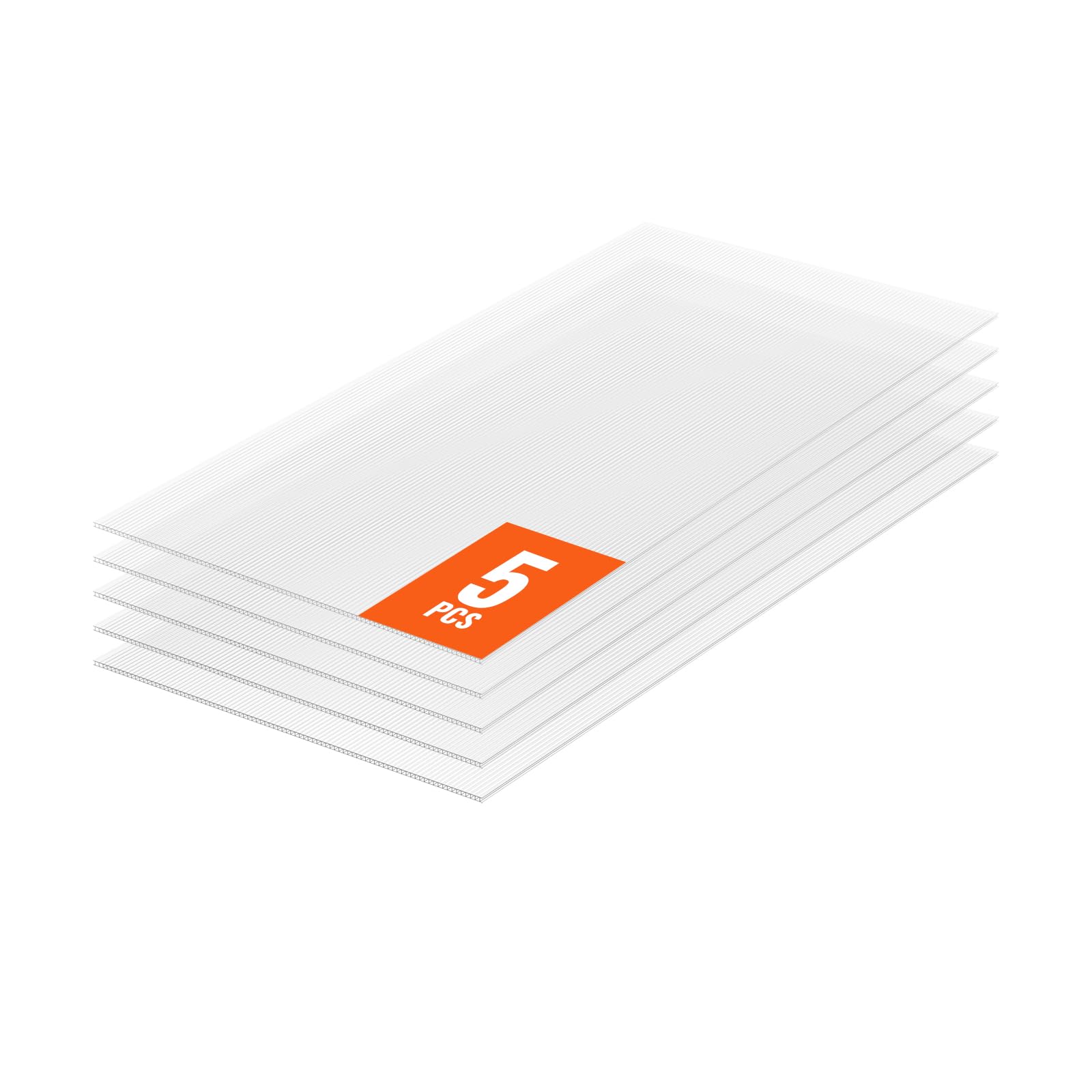
The thickest panel here — 0.32in — with a buyer report that it warmed a coop by 10-15°F in winter.
At 0.32in thick and weighing 9.68 pounds for the 5-panel set, the VEVOR is the clear heavyweight option here — literally, because the 80% light transmission and 98% UV blocking rate are the best readings in the group. The “heavy-duty double-layer honeycomb design” is rated for abuse from hail and “heavy falling objects,” which is the language you want to hear for a roof that has to survive a storm. The operating temperature range of -40°C to 120°C means these panels handle deep freezes and summer heat without cracking.
Owners mention these panels “raised chicken coop temp 10-15°F” and that on a day with -7°F sun, the coop reached 28-32°F. That is a direct temperature lift that matters for anyone winterizing a coop or cold frame. One reviewer noted they were “easy to cut with a jigsaw and fine blade” and are “sturdy, true to size.” Another reviewer appreciated the flexibility, saying you can cold-form the panel into a gentle arch, which is useful for curved greenhouse roofs. The 5-panel set covers up to 39.4 sq. ft., so you can wrap a decent-sized lean-to or small greenhouse roof in one purchase.
Impressive real-world insulation proof: The 10-15°F temperature boost is not a marketing claim — it came from a verified buyer. This panel’s combination of 0.32in thickness and honeycomb air channels should support strong thermal performance. It is also strong enough to replace an awning roof, which a buyer successfully did.
Packaging can be an issue: A buyer mentioned that two panels arrived damaged in shipment. The panels themselves are sturdy, but the long, thin shape is vulnerable during transit. Ordering directly from Amazon’s fulfillment centers tends to be safer than third-party dropshipping.
Best for: Anyone who needs a real roof, a chicken coop winterization, or a greenhouse in a cold climate where every degree of insulation counts.
Not ideal if: You are on a tight budget for a large project — the 5-pack price per panel is higher than the 6-pack DGSL, so for a full greenhouse wall you might get more square footage for less money with a thinner panel.
3. DGSL 6-Pack (4’x2’x0.16in)
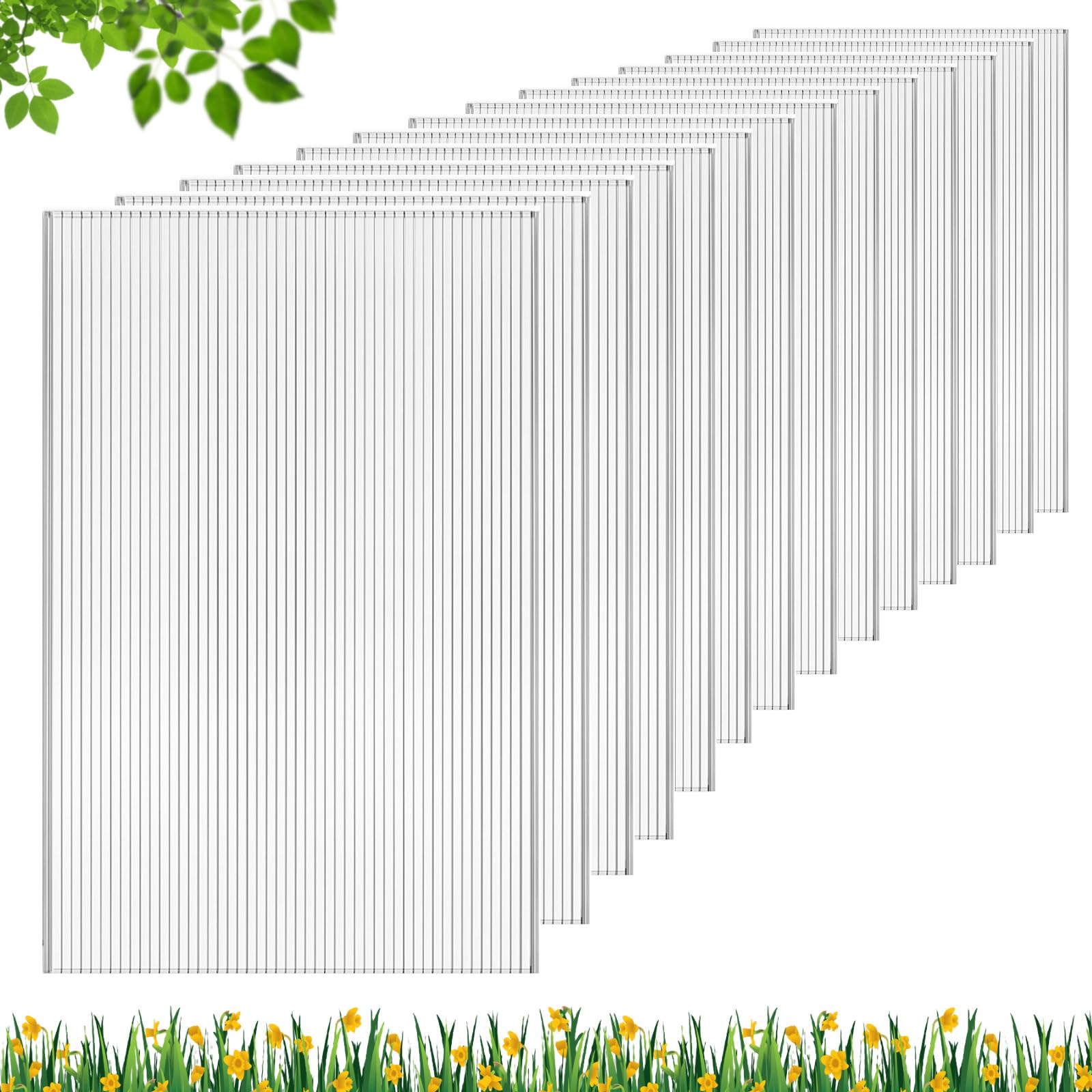
Six panels for the price of three — the DGSL gives you the most square footage per dollar of any pick here, at 0.16in thick.
DGSL gives you six panels at 4 feet x 2 feet x 0.16in thickness, which puts more material in your hands per dollar than any other pack on this list. The 80% light transmission is consistent with the other twin-wall panels, and the temperature tolerance spans from -44°C to 120°C, so it handles both deep winter and blazing summer. The twin-wall polycarbonate construction provides the same honeycomb insulation advantage as the more expensive brands, just in a thinner profile that is noticeably easier to cut with a razor knife or scissors. One buyer described cutting them with a Sawzall fine tooth blade, saying they “cut like butter.”
Customers note these panels work well for replacing stock greenhouse panels, with one saying they “replaces 10mm panels; 8mm works for mounting.” The fit is slightly thinner than the original (0.16in vs the 0.24in or thicker originals some greenhouses use), but the flexibility means you can often squeeze them into existing channels. Another buyer used them to wrap a chicken run for winter and said they “work well and can be taken down and stored in the summer.” That reusability matters if you want seasonal coverage rather than a permanent install. The 2.79 kilogram (about 6.15 pounds) total weight makes the set light enough that a single person can handle all six panels without help — roughly 1.5 pounds lighter than the Tatuo set.
Best cost-per-panel in this group: For sheer square footage, the DGSL six-pack is the most economical way to cover a greenhouse. You get the same light transmission and UV resistance as panels that cost more per unit, in a thickness that is fine for vertical walls.
0.16in means less insulation: The thinner panels have smaller internal air channels, so they do not hold heat as well as the 0.24in or 0.32in options. If you live where winters regularly go below -10°F, you will notice the difference in greenhouse temperature overnight.
Best for: Replacing a full greenhouse side wall or wrapping a chicken run on a budget — the six-pack covers a lot of area for the outlay.
skip it if: You need the panels to survive hail or heavy snow on a roof. The 0.16in thickness is too flexible and will sag or crack under that kind of load.
4. Tatuo 6-Pack (4’x2’x0.16in)

The only panel claiming UV protection on both sides — so you can’t install it backwards and ruin it.
The Tatuo 6-pack uses a “honeycomb multi layer design” that it describes as UV resistant on both sides — a feature the other panels only offer on a single side. If true, this means you cannot install the panel backwards and lose protection, which is a small peace-of-mind win for anyone who does not want to read the film labels carefully. The 0.16in thickness is identical to the DGSL and UMIG panels, but the total set weight of 7.7 pounds versus the DGSL set’s 6.15 pounds suggests slightly denser plastic or more sturdy internal ribs. The stated item dimensions of 48.82 x 25.2 x 1.97 inches mean each panel is fractionally wider than the advertised 48 by 24 inches, so you get a little extra coverage per sheet.
Buyers love these for swapping out a Harbor Freight greenhouse roof, with one review saying they “replaced HF 10×12 greenhouse roof” and noting the panels were “thicker than 4mm HF panels.” That extra rigidity compared to the original thin HF panels is a real upgrade. Another buyer used them as a room divider in a basement studio and said they “let in ambient light” while offering privacy. The most common application is winterizing chicken runs — one buyer confirmed “immediate warmth improvement” after attaching them with screws to a silkie chicken run. The 6-pack covers 48 square feet (according to the unit count spec), which is the same coverage area you get from the DGSL 6-pack but in a slightly heavier and potentially denser material.
Double-sided UV resistance is a standout: All the other panels here only have UV protection on the outward side. The Tatuo is the only set claiming UV protection on both sides, which is a meaningful difference if you are repurposing leftover panels for a different project years later.
Cost per panel is slightly higher than DGSL: The Tatuo carries a small premium over the DGSL 6-pack. You pay for the slightly denser build and double-sided UV coating, but the material performance on a vertical wall will feel similar.
Best for: A buyer who expects to cut panels into irregular shapes (the honeycomb is flexible without cracking) and wants the extra safety margin of double-sided UV protection.
Look elsewhere if: You are optimizing purely for square footage per dollar — the DGSL 6-pack gives you the same panel count for less.
5. UMIG 12-Pack (4’x2’x0.16in)
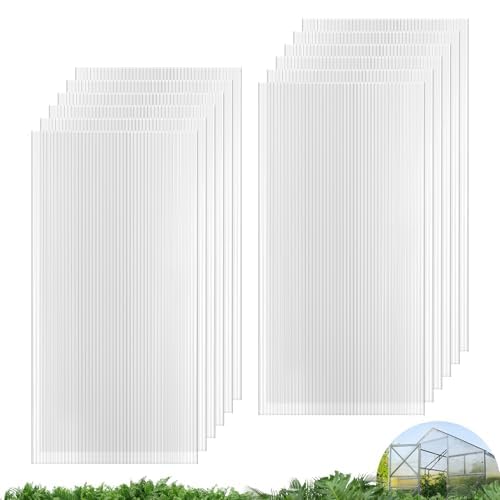
Twelve panels in one box — the single-order solution for a large greenhouse build.
When you need to cover an entire greenhouse in one order, the UMIG 12-pack skips the math of buying multiple smaller sets. All twelve panels are the standard 4 feet x 2 feet x 0.16in profile, so you get the same coverage area as two of the 6-packs above. The twin-wall construction has a stated specific gravity of 1.2 kg/㎡ (a measure of material density), and the “upgraded double-layer design” is meant to improve thermal insulation compared to single-layer sheets. The panels are coated on both sides for UV protection (like the Tatuo), though the data does not specify a percentage of UV blocking. The 80% light transmission is standard for this twin-wall category.
Reviewers point out the panels work extremely well for DIY aquarium lids — “great for DIY aquarium lids; cuts easily with utility blade, saved hundreds” — which highlights how easy these are to trim to custom sizes. One buyer used them around a chicken coop for winter and said they “reduced wind, raised temperature several degrees, warms up faster on sunny days.” On the durability side, one longer-term buyer had a cautionary note: “I purchased these in the 2’x4′ also, but a year earlier… I noticed the older panels are yellowing.” That report is a reminder that no budget twin-wall panel is immune to UV degradation — the coating slows it down but does not eliminate it forever. Buyers also praise the packaging, noting the “plastic corner protectors” kept the dozen panels safe during shipping and that they “arrived undamaged and strong.” This pack gives you twelve panels in one order.
One-box solution for a whole greenhouse: Twelve panels in one order can cover a large project without needing a second purchase. The packaging with corner protectors is a clear advantage over brands that ship panels loose and risk edge damage.
Reports of yellowing after a year: One buyer mentioned the older panels turning yellow. This is not unique to UMIG — all polycarbonate eventually yellows — but it is worth knowing that the UV coating is not a permanent fix. Expect to replace panels every 3-5 years depending on sun exposure.
Best for: Anyone building or recladding a full greenhouse in one purchase who wants a good-value panel that cuts easily and arrives well-protected.
Consider carefully if: You want the longest possible lifespan from the panels — the yellowing report suggests you might get better longevity from the XISOCO’s 0.24in panels or the thicker VEVOR, which tend to have heavier UV-coating layers.
Understanding the Specs
Twin-Wall Polycarbonate
Twin-wall means the panel has two solid outer layers connected by a grid of vertical ribs, creating air channels that trap heat. This is why a polycarbonate greenhouse holds temperature better than a glass or single-sheet structure. The numbers you see (0.16in, 0.24in, 0.32in) refer to the overall thickness including those ribs — not just the skin. Thicker panels have wider channels and better insulation, but they are also heavier and cost more. For a vertical wall that just replaces broken glass, 0.16in works fine. For a roof that has to keep snow off, 0.32in is safer.
UV Protection Coating
The panels have a UV-resistant co-extruded layer (a bonded covering) on one side only (except the Tatuo, which claims both sides). This coating prevents the polycarbonate molecules from breaking down under sunlight — without it, the plastic turns yellow and gets brittle within one or two seasons. The coating side is almost always marked by a different colored protective film. You must install that side facing outward. If you put the uncoated side toward the sun, the panel will have no protection and will degrade as fast as plain plastic. This is the single most common installation mistake in the category.
Light Transmission
The numbers you see (80% is typical for twin-wall, higher for solid glass or acrylic) measure what percentage of visible light passes through the panel. 80% is plenty for plant photosynthesis and observation. The real concern is not the initial transmission percentage — all the panels here deliver similar light — but whether that transmission stays high after a few years. Yellowing caused by insufficient UV protection can cut transmission by 20-30% even if the panel is structurally sound, which defeats the purpose of a clear greenhouse.
Overlap with Installation
The panels arrive with protective plastic film on both sides. You must remove the film before installation. The outward-facing film is usually white or marked, and that side must be the side that receives direct sun. The manufacturer’s spec states “the protective film indicates that the pattern faces outward and is protected from UV rays.” If you install the panel with the uncoated film side facing the sun, the panel will not have UV protection and will yellow rapidly. Also, the manufacturer notes a cutting tolerance of +/- 0.19 inch, so measure twice and cut once, and never cut through the protective film without scoring first.
FAQ
What is the difference between 0.16in and 0.32in panels?
Which side of a polycarbonate panel faces the sun?
Will these panels fit my existing greenhouse frame?
How do I cut greenhouse panels to size?
Are these panels suitable for a roof?
How long do clear polycarbonate panels last?
Can I use these panels for a chicken coop?
Do these panels block UV rays from burning my plants?
What is the difference between twin-wall and corrugated panels?
Final Thoughts: The Verdict
If you want one dependable pick, the best clear greenhouse panels winner is the XISOCO 3-Pack because the 0.24in thickness strikes the best balance between insulation, impact resistance, and cost per panel, and it has verified UV protection that lasts through a full season without yellowing. If you need a proper roof or are winterizing a chicken coop where every degree matters, grab the VEVOR 5-Pack for its 0.32in thickness and proven 10-15°F temperature lift. For covering a full greenhouse on a budget, the standout is the DGSL 6-Pack for sheer square footage per dollar.
How We Picked
We do not accept paid placement, and we did not hands-on test every unit. Instead, we match each pick to a real buyer and use-case by comparing the manufacturers’ published specifications against the patterns in verified customer reviews — so you get each pick’s real strengths and trade-offs instead of marketing copy.
Sources & Methodology
Specifications: manufacturer listings and product documentation. Review insights: verified customer reviews, as of July 2026. Pricing: not shown on this page (it changes often); check the current price via the retailer link.
As an Amazon Associate, Lawn Gear Lab earns from qualifying purchases. This does not affect which products we feature.