
Specs are compiled from manufacturer listings and verified buyer reviews and can change over time — please confirm the key details on the product page before buying.
Tulips are hungry little things. Plant them in the fall, and what you feed them before winter decides whether you get a few sad stalks or a full row of fat, colorful bells come spring. The trick is knowing which numbers on the bag (NPK — the balance of nitrogen, phosphorus, and potassium) actually matter for bulbs, because a general-purpose lawn food pushes leaves, not flowers. This guide covers seven proven options for every style of gardener — organic spike fans, water-soluble boosters, and slow-release granules alike.
I’m Rikta — the founder and writer behind Lawn Gear Lab. This guide is built by comparing the manufacturers’ published specifications and the patterns across verified customer reviews, so you get each pick’s real strengths and trade-offs instead of marketing spin.
Whether you are planting a new bed of Darwin hybrids or feeding established perennial clumps, the best fertilizer for tulips offers the phosphorus boost that bulbs crave without burning tender roots or attracting every dog in the neighborhood.
Quick Picks
- Espoma Organic Bulb-Tone 3-5-3 — Best Overall
- Grow More Super Bloomer 15-30-15 — Best Bloom Booster
- Lilly Miller Bulb & Bloom Food 4-10-10 — Best Slow-Release
- Earth Science Natural Bone Meal — Best Value
- Cz Garden 4-10-10 Bulb and Bloom Fertilizer — Premium Pick
- Jobe’s Organics Bone Meal Fertilizer Spikes — Easiest Application
- Espoma Organic Bone Meal 4-12-0 (Pack of 2) — Best Value
How To Choose The Best Fertilizer For Tulips
Tulips are heavy feeders that store energy in their bulbs for the next year’s show. If you give them the wrong N-P-K balance — especially too much nitrogen — you get tall leafy plants with tiny or no flowers. Here are the three things to check before you buy.
NPK Ratio — Why the Middle Number Matters Most
The three numbers on a fertilizer bag represent Nitrogen (N), Phosphorus (P), and Potassium (K). Nitrogen drives green leaf growth; phosphorus fuels root development and flower bud formation; potassium supports overall plant health and disease resistance. For tulips and other flowering bulbs, you want the middle number (phosphorus) to be the highest. A ratio like 2-14-0 or 4-10-10 signals a bloom-focused formula. Avoid balanced or high-nitrogen lawn fertilizers, which will give you impressive foliage but disappointing flowers.
Form: Spikes, Granules, or Water-Soluble
Spikes are the most convenient: you push them into the soil near the bulb and they release nutrients slowly over weeks. Granules (like bone meal or Bulb-tone) are worked into the soil at planting time and break down naturally. Water-soluble powders (like Grow More Super Bloomer) are mixed with water and absorbed fast — ideal for a mid-spring boost when the buds are forming. Your choice depends on if you want “low-maintenance” slow-release or quick-acting liquid feeding.
Organic vs. Synthetic
Organic fertilizers (bone meal, feather meal, composted manure) feed the soil microbiome as they break down, releasing nutrients slowly and reducing the risk of burning bulbs. Synthetic fertilizers (like the 15-30-15 bloom booster) are salt-based, work faster, and deliver precise ratios, but require careful measuring. For tulips, organics are a safer bet because bulbs sit in the ground all winter — slow-release prevents a nutrient surge before the bulb is ready.
Quick Comparison
On smaller screens, swipe sideways to see the full table.
| Model | Best For | NPK Ratio | Form | Weight | Amazon |
|---|---|---|---|---|---|
| Espoma Organic Bulb-Tone | Overall bulb health & organic gardens | 3-5-3 | Granules | 4 lb | Amazon |
| Grow More Super Bloomer | Maximum bloom size & speed | 15-30-15 | Water-soluble powder | 1.5 lb | Amazon |
| Lilly Miller Bulb & Bloom | Slow-release feeding for established beds | 4-10-10 | Granules | 4 lb | Amazon |
| Earth Science Bone Meal | High-phosphorus organic root booster | — | Granules | 4 lb | Amazon |
| Cz Garden 4-10-10 | Premium iron-rich formula for flowers | 4-10-10 | Granules | 4 lb | Amazon |
| Jobe’s Organics Bone Meal Spikes | Easy no-mess spike application | 2-14-0 | Spikes | 50 count | Amazon |
| Espoma Organic Bone Meal (2-pack) | Budget-friendly organic bulk value | 4-12-0 | Granules | 4 lb (x2) | Amazon |
In‑Depth Reviews
1. Espoma Organic Bulb-Tone 3-5-3

The organic all-in-one that tulip growers return to season after season.
Espoma’s Bulb-Tone is the closest thing to a universal bulb food because it is formulated specifically for both fall bulbs (tulips, daffodils, crocus) and spring bulbs (gladioli, lilies) with a 3-5-3 NPK ratio that puts phosphorus first — exactly what tulips need for root anchorage and flower formation. It also contains 6% Calcium, which helps prevent bulb rot in heavy clay soils. The granules are ready to use straight from the bag: drop a handful into the planting hole for new bulbs, or sprinkle on the surface around established plants and water in. No mixing required.
The brand’s Bio-tone formula is a proprietary blend of beneficial microbes that help roots access nutrients more efficiently, which buyers report seeing results quickly. One reviewer noted: “This has absolutely made my tulips and daffodils thrive!” — a testimonial that mirrors dozens of other five-star ratings. At 4 pounds, the bag covers a medium-sized bed with enough left over for spring top-dressing.
Compared to the water-soluble Grow More Super Bloomer below, Bulb-Tone is slower-acting but much safer for beginners — it is OMRI listed for organic gardening and contains no synthetic chemicals, so there is much less risk of burning bulbs even if you get heavy-handed. The catch is that it works slower than a synthetic bloom booster; if you want immediate greening and bud set, you may want to supplement with a liquid feed in early spring.
Garden-tested formula: The mildly sweet earthy smell and fine granule texture mix easily into soil without dust clouds. One buyer mentioned they use it yearly on daffodils and “they look great,” which speaks to consistent results.
The one trade-off: Because it is organic, the 3-5-3 ratio provides less phosphorus punch per pound than a 15-30-15 synthetic; you need to apply it at planting time and again after blooming for best performance.
Reach for this if: You want a single trusted, organic bag you can use on every bulb bed without second-guessing ratios or mixing instructions — it is the most simple to use pick for new and experienced gardeners alike.
Look elsewhere if: You prefer water-soluble feeding for a rapid spring bloom boost; the slower organic release may not satisfy growers chasing maximum flower size in a short season.
2. Grow More Super Bloomer 15-30-15
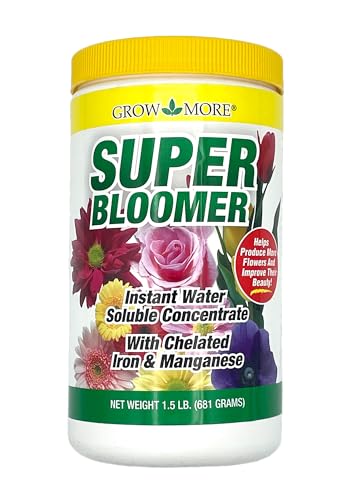
The high-octane phosphorus mix that turns a modest tulip bed into a spectacle.
This water-soluble powder from Grow More brings the highest phosphorus concentration in this lineup — a 15-30-15 NPK ratio that is tailor-made for growers who want maximum flower size, color intensity, and stem strength. The chelated iron and manganese in the formula prevent the interveinal chlorosis (yellowing between leaf veins) that can occur when heavy phosphorus feeding locks up other micronutrients in alkaline soil. You mix a small scoop with water and apply it as a soil drench or foliar spray every two weeks during the growing season.
The results, according to buyers, are dramatic. One verified reviewer reported: “Plants are about twice the size and have two to three times the blooms.” The 15-30-15 ratio provides 30 phosphorus versus 14 in the Jobe’s spikes (2-14-0), so a little goes a long way — the 1.5-pound bag lasts many seasons for a typical home garden. It is manufactured in the USA and works on any flowering plant, from tulips and roses to fruiting shrubs.
You pay for that speed with a 1.5-pound bag that is noticeably smaller than the 4-pound organic options; it is more concentrated but also more expensive per pound. Unlike the slow-release Espoma Bulb-Tone, this synthetic salt-based fertilizer requires precise measuring — overdo it and you risk burning tender tulip roots. Buyers recommend applying it at half-strength for first-time use, especially in containers.
Fast-acting flower fuel: The water-soluble form is absorbed within hours, making it the best choice for a mid-spring morale boost when you see buds forming but want them bigger. One reviewer called it simply “the best fertilizer.”
The fine print: Not OMRI listed. The powder can clump if the bag is not stored completely dry, so keep the zip seal tightly closed.
Grab this for: A controlled, high-phosphorus bloom boost that delivers visible results in days — perfect for growers who want to maximize flower size and are comfortable measuring and mixing.
skip it if: You need an organic label, want a set-and-forget slow-release option, or have poor drainage (salt buildup can stress bulb roots in waterlogged soil).
3. Lilly Miller Bulb & Bloom Food 4-10-10

A potassium-rich slow feeder that gives bulbs steady nutrition all season.
Lilly Miller’s 4-10-10 ratio stands apart from the other bulb-focused options because it is nearly equal parts phosphorus and potassium (the third number). Potassium strengthens cell walls, improves disease resistance, and helps tulips store more energy back into the bulb for next year — a critical advantage if you are naturalizing tulips (leaving them in the ground to return annually). The slow-release feeding mechanism means you apply it once at planting or early spring and the granules break down gradually over weeks, matching the bulb’s natural growth curve.
Buyers confirm it works across a range of spring bulbs. One reviewer wrote, “My purple iris loved this product!” — a solid endorsement from a related bulb family. The 4-pound bag provides good value for established beds, and because the NPK is less extreme than the Grow More 15-30-15, there is almost no risk of root burn even if you apply slightly too much. It is made in the United States and the powder-like granule texture spreads easily by hand or with a lawn spreader.
The trade-off is that with a 4-10-10 ratio, the phosphorus content is lower than the bone-meal options (which are in the 12-14% P range). If your soil is already phosphorus-rich from years of bone meal applications, this is actually a benefit — excess phosphorus can lock up iron and zinc. But if you are starting a bed in poor, sandy soil, a higher-P option like the Earth Science bone meal may give you a stronger first-season bloom.
Why seasoned gardeners choose it
- Slow-release granules feed bulbs steadily without a sudden growth spurt that can cause floppy stems.
- High potassium (10) helps bulbs store energy for next year — ideal for naturalized tulip beds.
- Hard to find locally in some areas, but buyers appreciate finding it online for consistent supply.
What it is not
- Not an organic product; does not carry OMRI or organic certification.
- Lower phosphorus than bone-meal-based options; best for maintenance feeding, not correcting severe phosphorus deficiency.
Choose this for: Established perennial beds where you want consistent, gentle feeding that supports both this year’s flowers and next year’s bulb health — the 4-10-10 balance is tough to top for long-term naturalizing.
Consider something else if: You need a fast-acting rescue feed for weak, spindly tulips; the slow release takes weeks to show results.
4. Earth Science Natural Bone Meal

Straight bone meal, no additives — pure phosphorus for root and bloom development.
Bone meal is the classic organic phosphorus source for bulbs, and Earth Science delivers it in a clean 4-pound bag of finely ground granules with an earthy smell that buyers describe as “fine texture” with “no strong odor.” Its primary job is to supply phosphorus for early root establishment and flower bud formation — exactly what tulips need during their critical fall root-growth period before the ground freezes. The recommended rate is 10 lbs per 100 sq. ft. for garden beds or 1 tsp per individual bulb worked into the planting hole.
One owner reported that the “high phosphorus boosts blooms (roses, dahlias) and veggie growth (tomatoes, peppers)”, confirming its versatility beyond just tulips. Because it is a single-ingredient organic amendment, it breaks down slowly and feeds the soil microbiome, improving long-term soil structure — something a synthetic 15-30-15 does not do. The 4-pound bag offers more bulk than the Grow More Super Bloomer at 1.5 pounds, offering more bulk for the same general price tier.
The catch with straight bone meal is that it provides almost no nitrogen (N) or potassium (K). Tulips need some nitrogen for leaf growth, so if you rely solely on bone meal, you may end up with good roots and flowers but smaller, yellower leaves. Most serious tulip growers use bone meal as a phosphorus supplement alongside a balanced organic fertilizer like Espoma Bulb-Tone, not as a standalone feed. Also, as with any bone meal, it can attract digging animals if not buried deep enough.
No-fuss ingredient: The fine texture mixes easily into soil and releases phosphorus gradually over several months, matching the bulb’s winter dormancy and spring awakening. Owners mention their gardens “love it.”
Remember: Bone meal is a supplement, not a complete fertilizer. Pair it with a balanced feed or compost for best results with tulips.
Best for: Gardeners who want a pure, organic phosphorus source to mix into planting holes or add to compost — especially if your soil test already shows adequate N and K but low phosphorus.
Not for: Anyone looking for a single-bag complete fertilizer. Tulips need nitrogen and potassium too, so bone meal alone is not a full feeding program.
5. Cz Garden 4-10-10 Bulb and Bloom Fertilizer

Premium-grade granules with added iron for vibrant, deep green leaves alongside blooms.
The Cz Garden Supply 4-10-10 stands out because it includes 2% iron plus micronutrients, addressing a common issue in alkaline or heavy soils where iron becomes unavailable to tulips, causing the leaves to yellow between the veins while the flower buds survive. The 4-pound heavy duty resealable pouch makes storage simple — no clumping, no spilled granules in the shed. The 4-10-10 NPK mirrors the Lilly Miller formula above, providing moderate phosphorus and high potassium for overall bulb health and winter hardiness.
Buyers are impressed with the results across a range of flowers. One customer observed: “This stuff has my bougainvillea blooming and growing amazing”, while another noted their Gerber Daisy produced “blooms after blooms after blooms.” For tulips, the added iron ensures that even if your soil pH is off, the leaves stay green and photosynthesize efficiently, sending maximum energy to the bulb. It is manufactured in the USA from “the highest quality ingredients,” as the brand states.
At this price point, you are paying a small premium over the Lilly Miller for the iron inclusion and the resealable packaging. The 4-pound bag is roughly the same weight as the Earth Science bone meal but offers a more complete nutrient profile. For tulip growers dealing with iron chlorosis (yellowing leaves), this is the best targeted solution in the list — though for gardeners with neutral or acidic soil, the Lilly Miller is functionally identical for less.
What makes it different
- 2% iron prevents leaf yellowing — a common problem with tulips in high-pH or compacted soil.
- Resealable heavy duty pouch keeps granules dry and fresh between seasons.
- Premium-grade purity with micronutrients for more complete nutrition.
Know before you buy
- Higher price per pound compared to the Lilly Miller — you pay for the iron and premium processing.
- Not labeled as organic; do not use if you need certified organic inputs.
Grab this if: Your tulips have yellowing leaves despite adequate feeding — the 2% iron is the targeted fix. It is also a smart choice if you prefer premium-grade, dust-free granules in a resealable pouch.
Pass if: Your soil is naturally rich in iron (acidic, loamy) or you are on a strict budget; the Lilly Miller covers the same NPK base at a lower cost.
6. Jobe’s Organics Bone Meal Fertilizer Spikes

Pre-measured spikes that eliminate measuring, mixing, and mess.
Jobe’s solves the biggest hassle of granular fertilizers — figuring out how much to apply. Each of the 50 spikes is pre-measured to deliver a consistent 2-14-0 NPK dose directly to the root zone of bulbs, tomatoes, roses, and other flowering plants. You simply push a spike into the soil near each bulb cluster at planting time, and the bone meal nutrients release gradually over 8 weeks. The OMRI-listed organic formula contains no synthetic chemicals, and because the nutrients are concentrated in the spike, there is minimal runoff — no dusty granules washing away in rain.
Buyers consistently praise the convenience, but multiple reviews mention a strong dog-attracting smell. One user highlighted: “They smell like dog food which enticed my neighbors dog to dig them up and eat a lot of them.” Another echoed: “My girl decided to dig up and eat a few.” If you have dogs, bury the spikes at least 3-4 inches deep and water the area well to push the scent down. The spikes are best inserted before the bulb breaks soil and again after blooming has finished.
Compared to the loose bone meal options (Earth Science, Espoma Bone Meal), these spikes offer a phosphorus concentration of 2-14-0, which is higher than the Bulb-Tone’s 3-5-3 but still 14 phosphorus versus 30 in the Grow More 15-30-15. They are ideal for containers or small beds where measuring grams of powder is impractical. The trade-off: you get 50 fixed doses per box, so for large tulip beds (50+ bulbs), you will run through a box quickly, whereas a 4-pound bag of granular bone meal covers far more ground.
Convenience champion: “Substantial quantity in package,” one shopper added — “insert easily in soil.” For gardeners with mobility issues or anyone who hates mixing, spikes are a genuine time-saver.
Dog warning: Bury these deeper than you think necessary if pets roam your garden. The smell is real, and dogs will locate every spike.
Reach for these if: You have a small to medium tulip bed, hate measuring fertilizer, and want an organic, ready-to-use solution that feeds roots directly — just push and forget.
Choose something else if: You have dogs that dig in garden beds, or you need to cover a large planting area (50+ bulbs) where spikes become expensive and time-consuming to insert.
7. Espoma Organic Bone Meal 4-12-0 (Pack of 2)

Two 4-pound bags of Espoma’s trusted organic bone meal for serious bulb feeders.
This pack gives you two 4-pound bags (8 pounds total) of Espoma’s all-natural bone meal with a 4-12-0 NPK ratio, making it a high-phosphorus, low-nitrogen organic amendment that is perfect for fall bulb planting. The 4-12-0 ratio means 12% phosphorus, which fuels root growth and flower development without pushing excessive leafy growth. It is OMRI-listed for organic gardening and, like all Espoma products, contains no sludges, synthetic chemicals, or toxic fillers. The granules are fine enough to mix easily into the soil but coarse enough to break down slowly over the winter.
Buyers have used it successfully beyond bulbs. One reviewer noted: “Great for growing garlic”, while another said “Has helped strengthen my shrubs”. The two-bag format means you get 64 ounces total — enough to handle a substantial tulip bed (around 80-100 bulbs at 1 tsp per bulb) with bags left over for side-dressing perennials in spring. Because it is pure bone meal, it works best when paired with a balanced organic fertilizer that provides nitrogen and potassium.
The value proposition here is straightforward: two bags of Espoma quality for roughly the same price you would pay for a single 4-pound bag of other premium brands. However, the mixing ratio listed as 10:100 in the specs is likely a data artifact rather than the actual NPK (which is clearly 4-12-0 from the label). The same dog-attraction warning applies as with any bone meal — bury it deep. Unlike the Jobe’s spikes, this loose granule form can be spread evenly across a bed with a hand spreader, making it faster for large areas.
Why the 2-pack wins
- 8 pounds total organic bone meal at a price that undercuts buying two single bags separately.
- Espoma’s trusted 4-12-0 formula provides strong phosphorus without nitrogen burn.
- Versatile — used by reviewers for bulbs, garlic, shrubs, and tomatoes with consistent results.
Heads-up
- Bone meal alone does not provide complete nutrition; supplement with a balanced organic feed for optimal tulip health.
- Can attract digging animals if not worked thoroughly into the top 2-3 inches of soil.
Buy this if: You go through bone meal quickly (large garden, many bulbs, or regular side-dressing) and want the best cost-per-pound from a brand with decades of organic gardening credibility.
Skip if: You only need a small bag for a few pots or a tiny tulip bed — buy the single 4-pound bag of Earth Science or a single Espoma bag instead.
Understanding the Specs
NPK Ratio (Nitrogen-Phosphorus-Potassium)
These three numbers tell you the percentage by weight of each major nutrient in the bag. For tulips, the middle number (phosphorus, or P) is the star — it drives root growth, flower bud formation, and energy storage in the bulb. A ratio like 2-14-0 (Jobe’s spikes) or 15-30-15 (Grow More) puts phosphorus first. The first number (nitrogen, N) promotes leaf growth; too much makes tulips tall and floppy with fewer flowers. The third number (potassium, K) strengthens stems and helps bulbs overwinter. For tulips, look for a ratio where P is at least equal to or higher than N and K.
Water-Soluble vs. Granular vs. Spikes
Water-soluble fertilizers (like the Grow More Super Bloomer) dissolve in water and are absorbed within hours — great for a fast spring boost when buds are forming but risky if over-applied. Granular fertilizers (Espoma Bulb-Tone, Lilly Miller, bone meals) break down slowly as soil microbes and moisture work on them, releasing nutrients over weeks or months — safer for bulbs that sit in cold soil all winter. Spikes (Jobe’s) are a convenience invention: pre-measured, slow-release stakes you push into the ground near the root zone. They eliminate measuring but can be harder to distribute evenly across a dense planting bed.
FAQ
When should I fertilize tulips?
Can I use regular plant food or lawn fertilizer on tulips?
Is bone meal good for tulips?
How much fertilizer do I need per tulip bulb?
Can I use fertilizer spikes for tulips in containers?
What is the difference between 3-5-3 and 15-30-15 for tulips?
Do I need to fertilize tulips every year?
My tulips have tall leaves but no flowers — what went wrong?
Are granular or liquid fertilizers better for tulips?
Can I use bloom booster on other flowers in my garden?
Final Thoughts: The Verdict
For the majority of shoppers, the fertilizer for tulips winner is the Espoma Organic Bulb-Tone because its balanced 3-5-3 organic formula with added calcium works for both fall planting and spring top-dressing without any mixing or low risk of root burn. If you want maximum flower size and are comfortable measuring, grab the Grow More Super Bloomer for its concentrated 15-30-15 phosphorus punch that customers praise for strong bloom performance. And for the easiest no-mess feeding — especially in containers or small beds — the Jobe’s Organics Bone Meal Spikes take the work out of fertilizing as long as your dogs stay away from them.
How We Picked
We do not accept paid placement, and we did not hands-on test every unit. Instead, we match each pick to a real buyer and use-case by comparing the manufacturers’ published specifications against the patterns in verified customer reviews — so you get each pick’s real strengths and trade-offs instead of marketing copy.
Sources & Methodology
Specifications: manufacturer listings and product documentation. Review insights: verified customer reviews, as of July 2026. Pricing: not shown on this page (it changes often); check the current price via the retailer link.
As an Amazon Associate, Lawn Gear Lab earns from qualifying purchases. This does not affect which products we feature.