
Specs are compiled from manufacturer listings and verified buyer reviews and can change over time — please confirm the key details on the product page before buying.
If you have ever spent a Saturday bent over a flower bed yanking at crabgrass or hacking at rock-hard clay with a shovel, you already know the real problem: your lower back and your patience give out long before the weeds do. A handheld tiller flips that script—it grinds through compacted soil and pries up roots while you stay upright, so a chore that used to eat a whole morning can be done in a short stretch of time. But not every cordless or corded mini cultivator is worth buying: some lack the torque to break fresh ground, others die mid-row because the battery is tiny, and a few vibrate so aggressively that they are almost worse than a shovel.
I’m Rikta — the founder and writer behind Lawn Gear Lab. This guide is built by comparing the manufacturers’ published specifications and the patterns across verified customer reviews, so you get each pick’s real strengths and trade-offs instead of marketing spin.
Below you will find the showdown of the best handheld tiller models of the season, ranked by how much genuine work they do per charge and per dollar.
Quick Picks
- TaskStar TH4000 Cordless Tiller Cultivator — Top Performer
- Saker SK-TC18B Cordless Electric Garden Tiller — Best Battery Value
- Westinghouse W6TCAC Corded Electric Mini Tiller — Corded Powerhouse
- MZK 20V Cordless Tiller Cultivator — Speed Specialist
- Earthwise TC70020IT Cordless Electric Garden Tiller — Budget Champion
- FORDWALT TLDCB20 Cordless Tiller Cultivator — DeWalt Compatible
- Muylux CT-20LS Cordless Tiller Cultivator — Budget Starter
How To Choose The Best Handheld Tiller
Picking the garden tiller that will actually make your life easier depends on three specs that tell you whether the tool can handle the dirt you have rather than the dirt you wish you had.
Tilling Depth and the Soil You Actually Dig
The depth figure (usually 4 to 7 inches) tells you how far down the tines can penetrate in a single pass. For a vegetable bed or a long-neglected border, a tiller that hits at least 6 inches deep will save you from having to go over the same spot twice. Light top-soil weeding, though, works fine with a 4-inch max depth, so match this number to your real ground.
Battery Voltage, Capacity, and Real Runtime
A 20-volt battery is the standard, but the amp-hour (Ah) rating matters more for how long you can keep working. A 2.0Ah battery will typically run a cultivator for 20 to 30 minutes of constant digging. Two batteries double your session. If you have a big plot, look for a model that includes two packs or works with a battery system you already own.
Tine Design and Tilling Width
The number of tines and the total width they cover decide how many passes you need to work a row. A 7.5-inch width is nimble in raised beds; a 9-inch width covers more ground faster but can be harder to fit between established plants. Heavier steel tines also resist bending when you hit a hidden rock or a root.
Quick Comparison
On smaller screens, swipe sideways to see the full table.
| Model | Best For | Tilling Width | Tilling Depth | RPM | Amazon |
|---|---|---|---|---|---|
| TaskStar TH4000 | Full coverage in larger beds | 9 inches | 7 inches | 360 RPM | Amazon |
| Saker SK-TC18B | Long runtime with dual batteries | 9 inches | 6.3 inches | 360 RPM | Amazon |
| Westinghouse W6TCAC | Plug-in power without battery anxiety | 6.3 inches | 6 inches | 300 RPM | Amazon |
| MZK ET1401-2 | Cordless speed in tight rows | — | — | 360 RPM | Amazon |
| Earthwise TC70020IT | Entry-level lightweight weeding | 7.5 inches | 6 inches | — | Amazon |
| FORDWALT TLDCB20 | Dewalt battery owners | 8.7 inches | 6.3 inches | 270 RPM | Amazon |
| Muylux CT-20LS | Budget-friendly raised beds | — | 4 inches | 240 RPM | Amazon |
In‑Depth Reviews
1. TaskStar TH4000 Cordless Tiller Cultivator
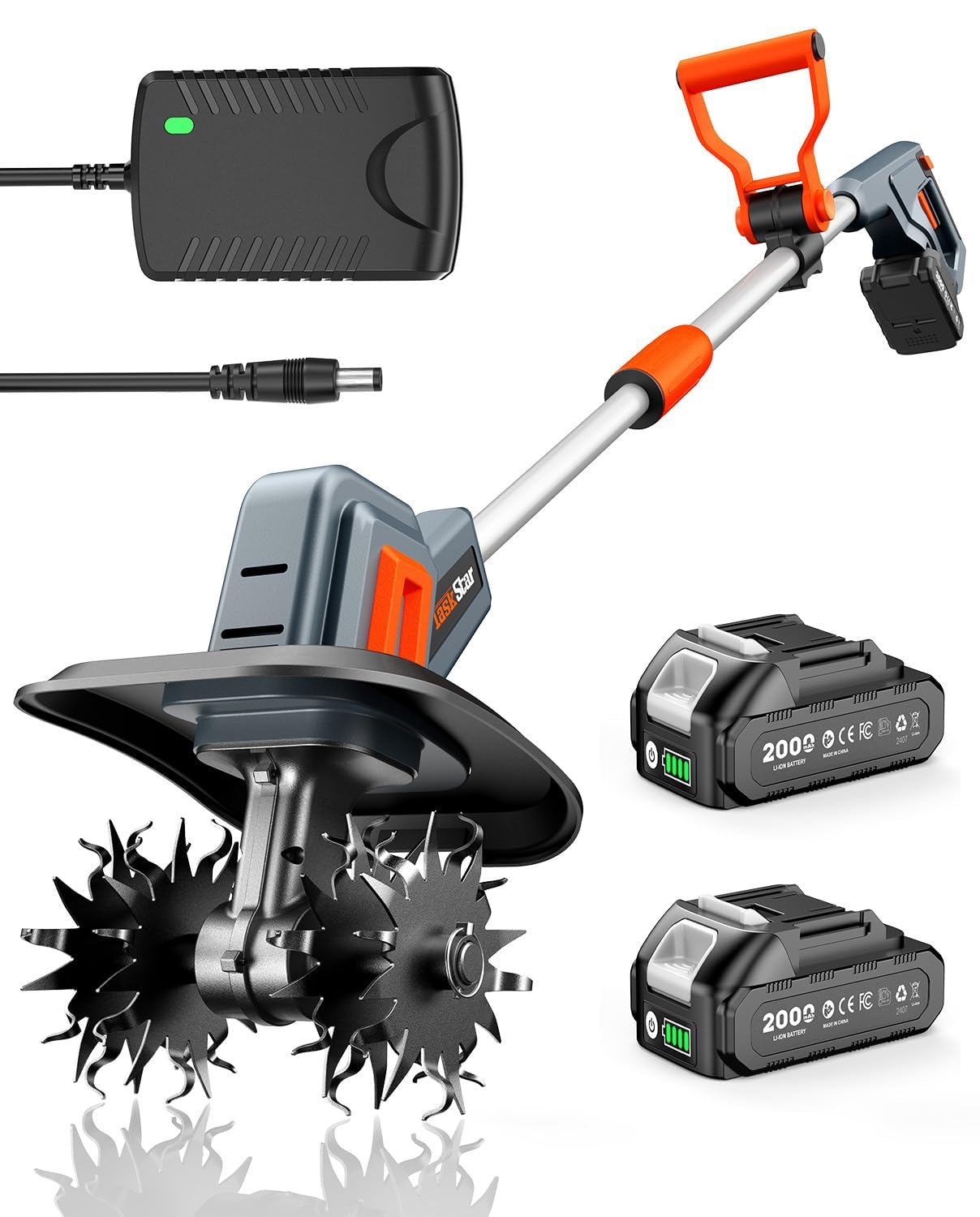
The deepest digger here, slicing 7 inches down at a fast 360 RPM.
The TaskStar TH4000 goes 7 inches deep versus the Muylux CT-20LS at 4 inches, which means you pull roots out of the subsoil in one pass instead of two. It clears a 9-inch-wide path versus the Westinghouse’s 6.3-inch head, so you cover more row per pass. The motor spins at 360 RPM (the speed of the tines, or rotations per minute), and its 48 steel tines (curved metal spikes) churn through compacted earth and mix in compost without bogging down.
It runs on two 2.0Ah lithium-ion batteries (amp-hours, a measure of energy storage) that give a combined 4000mAh (milliamp-hours, the same metric) of capacity. Buyers report each battery lasts about 20 to 30 minutes and charges quickly, which let one owner weed a 30-by-40-foot garden in an hour. The trade-off is that weeds and tall grass can wrap around the tines mid-job—a problem you will need to clear by hand every so often. The unit weighs 12.79 pounds, a bit heavier than the competition, but that heft helps it bite into unbroken ground rather than bouncing on top of it.
Why it leads
- Tills 7 inches deep versus the Muylux at 4 inches
- 360 RPM motor powers through hard, unbroken soil
- Two batteries (4000mAh total) give solid runtime for medium to large beds
One real annoyance
- Grass and weeds tangle in the tines and require manual clearing
- Instructions are poorly written, though assembly is simple
Grab it if: You have medium-to-large raised beds or a vegetable plot and want the deepest single-pass tillage from a cordless machine.
Look elsewhere if: You need something ultra-light for a tiny container garden; the 12.79-pound weight feels substantial.
2. Saker SK-TC18B Cordless Electric Garden Tiller
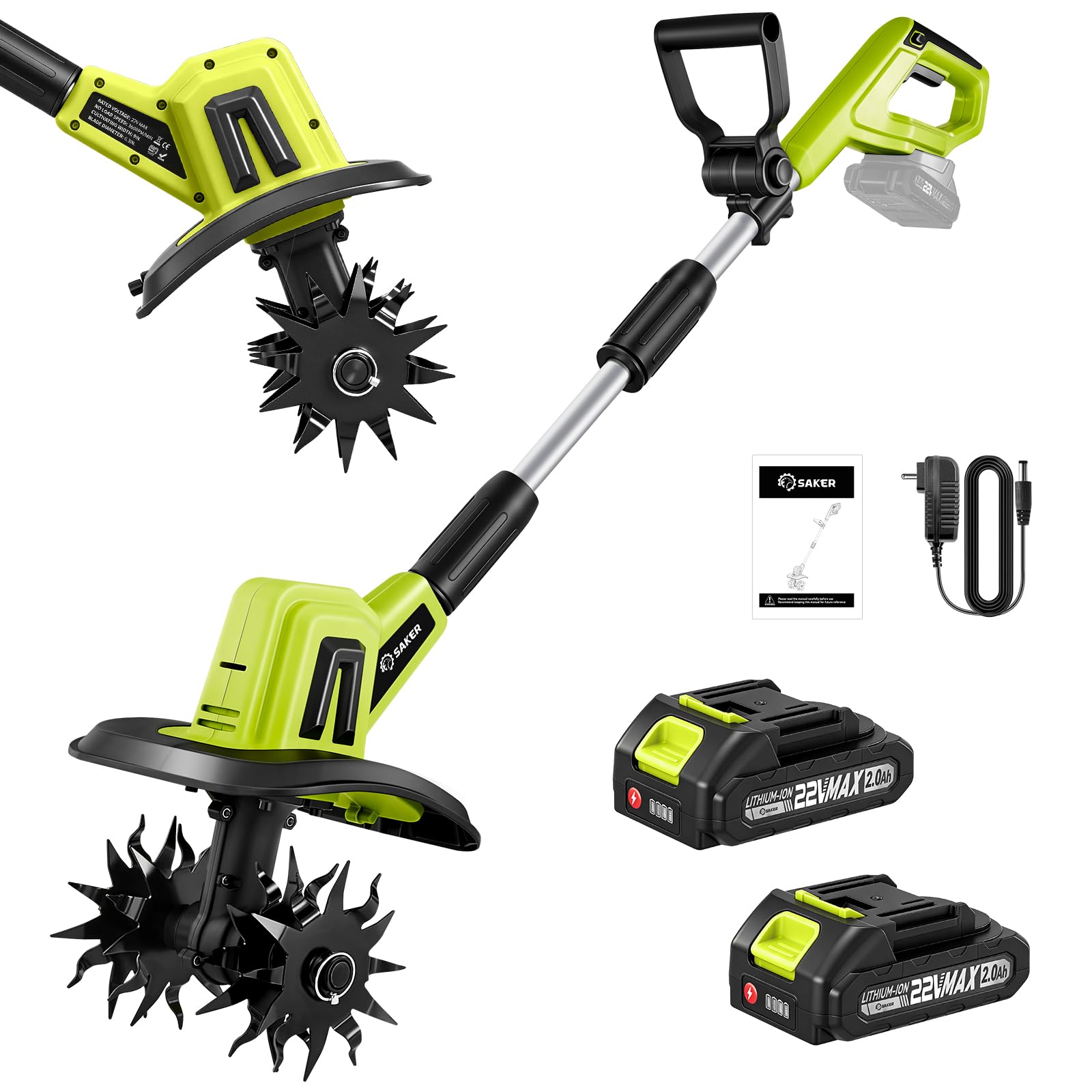
Two 22V batteries and a 360 RPM motor for hour-plus sessions.
The Saker SK-TC18B matches the TaskStar’s 360 RPM and 9-inch tilling width but adds a higher-voltage battery system (22V per pack instead of the usual 20V, meaning more electrical pressure for sustained power). Each of the two included 2.0Ah batteries offers up to 30 minutes of runtime, so you can swap packs and keep going without a recharge break. The tilling depth hits 6.3 inches, enough to churn up dry, packed soil in a vegetable bed.
Owners mention that it loosens dry packed soil the full 6 inches in a single pass, though the four steel tines lack a rear guard (a protective shield behind the tines)—you need to be aware of your foot placement while you work. The Saker is heavier than the Muylux (6.85 kg, about 15.1 lbs), but the weight sits forward, giving the tines extra bite. Reviewers also point out that a shoulder strap would add stability on longer jobs, but nobody reports that the tool is hard to control.
Standout strengths
- Two 22V 2.0Ah batteries provide extended runtime compared to the 20V packs on the Muylux
- 9-inch width covers ground with a wider path than the Westinghouse at 6.3 inches
- Dual-safety trigger prevents accidental startups
Watch for
- No rear guard — feet are exposed to the spinning tines
- Heavy at 15.1 lbs; can fatigue your arms on long jobs
Reach for this if: You need all-day battery swapping and a wide tilling path for garden rows or raised beds.
skip it if: You work in tiny, tight spaces where a lighter, narrower tiller like the Earthwise would be easier to maneuver.
3. Westinghouse W6TCAC Corded Electric Mini Tiller
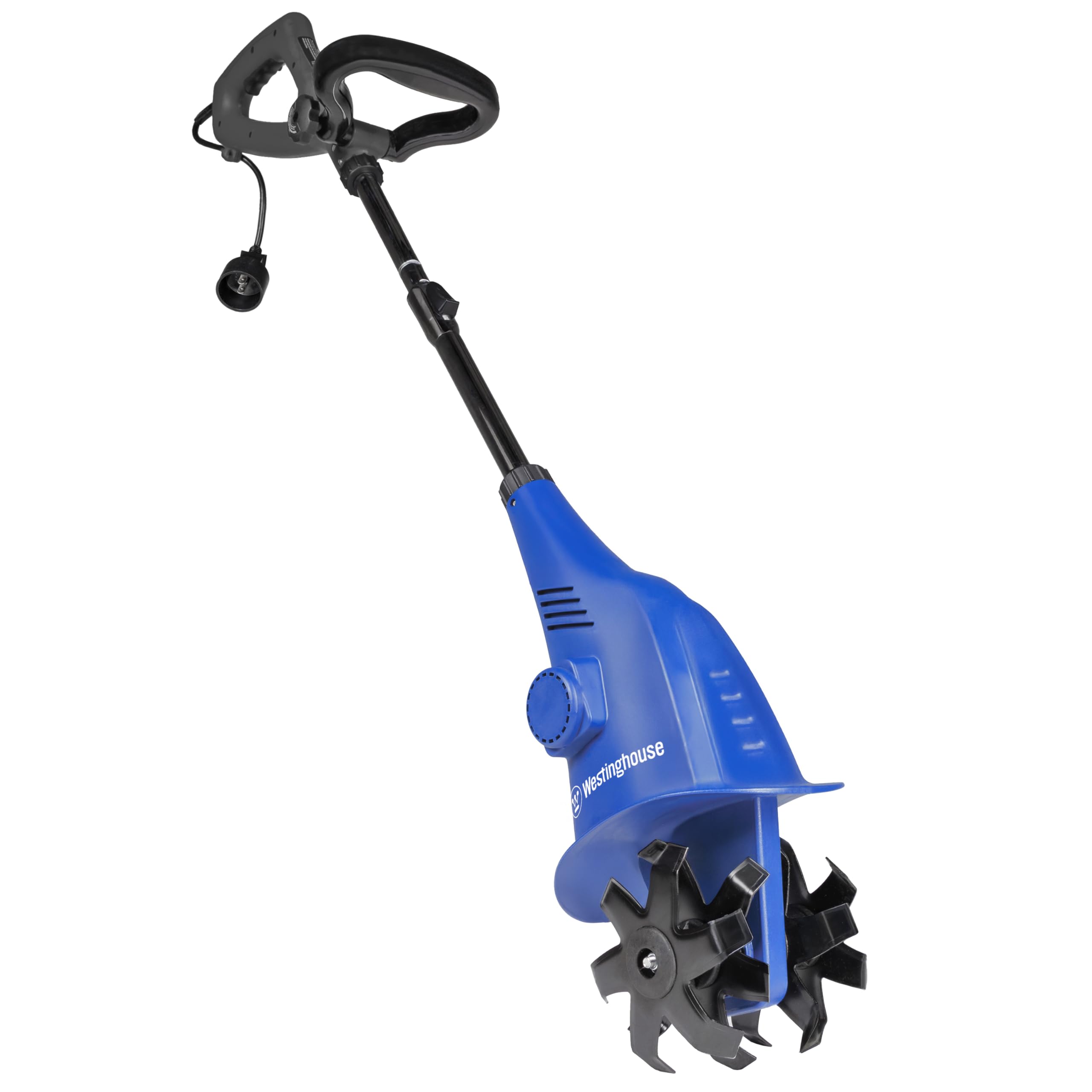
The plug-in choice that never runs out of juice mid-row.
If you do not want to worry about charging batteries, the Westinghouse W6TCAC plugs into a standard 120V outlet (the household voltage in the US) and delivers a constant 2.5 Amps (a measure of electrical current, powering the motor) at 300 RPM. This is the only corded model in the lineup, which means no waiting for a recharge and no swapping packs. The four steel blades (flat metal cutters, not curved tines) churn 6 inches deep and 6.3 inches wide. Customers note that it tills hard, neglected soil and requires less work than a pick and shovel.
The 9.9-pound weight makes it only marginally heavier than the Muylux, but it vibrates heavily during use — a few owners mention the vibration makes longer jobs tiring. The extension pole also feels flimsy to some, and the tool is not designed for left-handed people because the safety and trigger are on one side only. Still, if you have a small garden bed with tough clay or a weedy patch that needs serious work, the Westinghouse delivers consistent power that no cordless tiller in this list can guarantee hour after hour.
Why it works
- Constant 300 RPM with no battery fade; runs as long as the cord reaches
- Light at 9.9 lbs, matching the Muylux at 9.9 lbs
- 2-year limited warranty and lifetime technical support
Trade-offs
- Vibrates heavily; your hands may get tired sooner
- Safety control is right-handed only; lefties cannot reach both the trigger and safety button
Ideal for: Gardeners with a small patch of tough, compacted soil and an outdoor outlet nearby who never want to stop mid-job to swap a battery.
Not ideal for: Left-handed users, or anyone who needs to till far from an extension cord.
4. MZK 20V Cordless Tiller Cultivator

Ties the fastest RPM here but stirs a reliability question mark.
The MZK ET1401-2 spins its steel tines at 360 RPM, matching the TaskStar and the Saker for top rotational speed in this group. That spin helps it tear through weeds and loosen soil quickly. The 20V cordless system includes a dual-battery setup, and while the exact Ah rating is not published, reviewers point out the battery life is solid for small to medium jobs and that swapping keeps you moving.
The catch is a reliability risk that multiple owners have flagged. One reviewer noted that the unit stopped working after a year of storage despite fully charged batteries—no power, no sound. Another confirmed the same issue. Given that the sale price was deeply discounted (47% off), some users suspect a quality-control problem. On the positive side, the tiller is lightweight, easy to handle, and shoppers say it is “surprisingly powerful for tough soil.” If you are willing to bet on a budget-friendly 360 RPM tool, this one performs well until it does not.
What is good
- 360 RPM is tied for fastest spin in this comparison
- Lightweight and easy to handle, according to buyers
- Two included batteries for extended runtime
What is risky
- Multiple buyers report the tool stops working after a year of storage
- Short battery life on a single charge, some owners mention
Choose this for: A fast-spinning cordless option for hobby gardeners who use it frequently and keep batteries cycled.
Think twice if: You plan to store it for long off-seasons; there is a pattern of failure after months of disuse.
5. Earthwise TC70020IT Cordless Electric Garden Tiller

A light, nimble starter tiller that shines in small raised beds.
The Earthwise TC70020IT is a straightforward entry-level tool: 20-volt, 2.0Ah battery, four steel tines, a tilling width of 7.5 inches, and a depth of 6 inches. It is not the fastest or the widest, but it weighs very little and can be operated with one hand on the safety trigger. Buyers rave that it is “lightweight but powerful,” breaks up compacted soil, and pulls weeds from the roots in small gardens.
The big limitation is battery run time. At 7.5 inches versus the TaskStar at 9 inches, it needs more passes to cover the same ground. Still, for a gardener with a small area and a limited budget, the Earthwise delivers clean, quiet tilling without the smell and pull-start hassle of a gas machine.
What works
- Lightweight, quiet, and easy for smaller or elderly gardeners
- 6-inch depth for good root removal in a single pass
- Fast charger and battery included right in the box
What holds it back
- Single 2.0Ah battery dies before tilling a full medium garden
- Narrower tilling width (7.5 inches) requires more passes than a 9-inch tiller
Best suited for: First-time tiller buyers with small flower beds or a single vegetable plot.
pass on it if: Your garden is large enough to need an hour of continuous tilling — you will outrun the battery.
6. FORDWALT TLDCB20 Cordless Tiller Cultivator
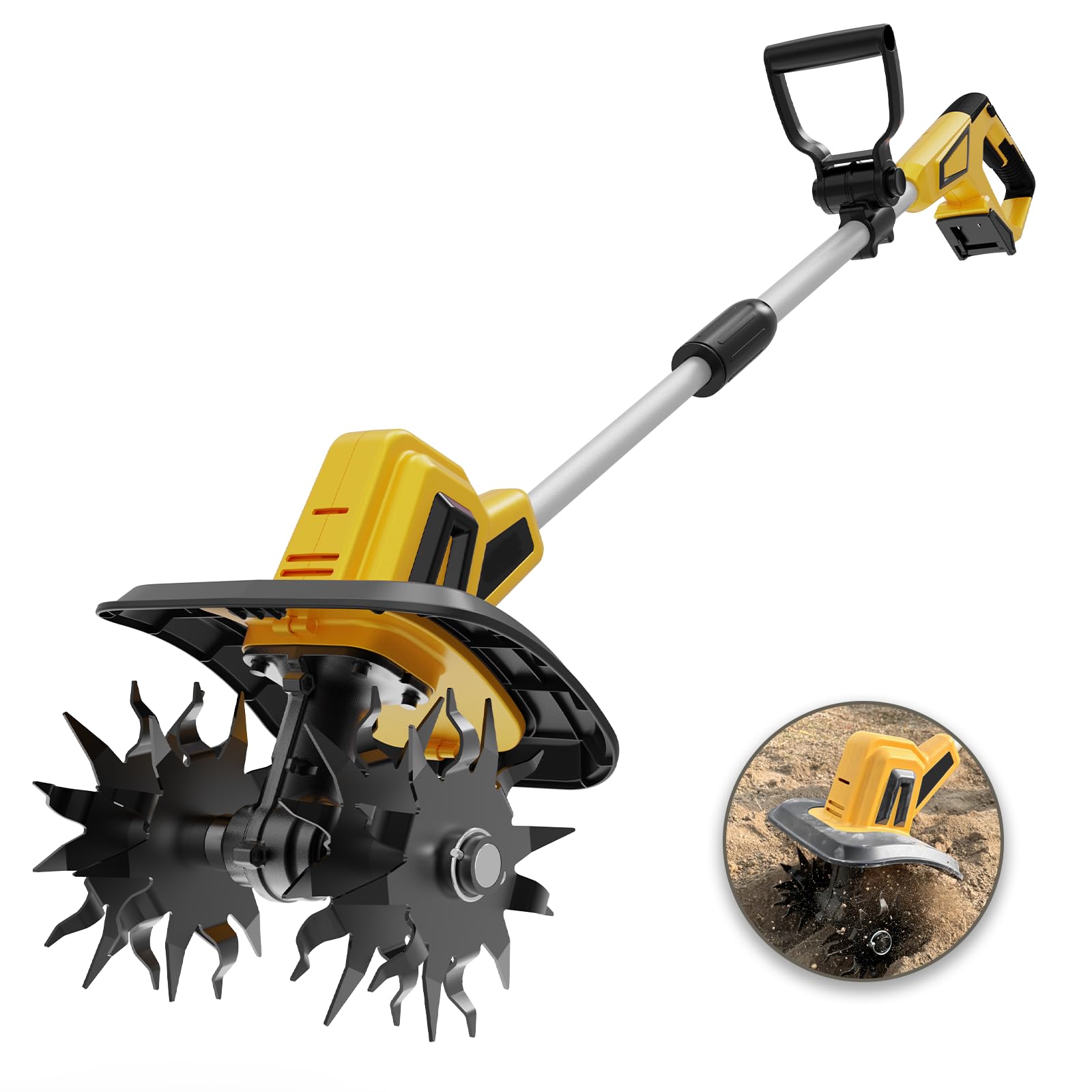
The leanest path for Dewalt 20V owners who already have battery stock.
This FORDWALT tiller is a tool-only unit that runs on any Dewalt 20V battery (not included). If you already own Dewalt power tools, this is the most economical way to add a tiller to your shed because you share batteries and chargers.
Buyers describe it as “lightweight, compact cordless tiller for light garden work,” but the same fast-spinning tines that mix compost in a bucket also wrap vines and weeds around the spikes—you need to remove a pin to clear debris. The FORDWALT is fine for sandy soil and flower beds, but it is not for hard, rocky ground where a heavier corded machine like the Westinghouse would churn through. It also comes with a 5-year warranty, the longest in this list.
Why Dewalt fans love it
- Runs on any Dewalt 20V battery — no new charger or batteries to buy
- Tilling width of 8.7 inches versus the Westinghouse at 6.3 inches
- 5-year warranty provides long-term confidence
Limits
- 270 RPM versus the Westinghouse’s 300 RPM
- Tines catch vines and weeds easily; requires debris removal
House it if: You own Dewalt 20V tools and want one battery ecosystem for all your yard gear.
Pass on it if: Your soil is heavy clay or full of rocks—the lighter 270 RPM motor struggles there.
7. Muylux CT-20LS Cordless Tiller Cultivator
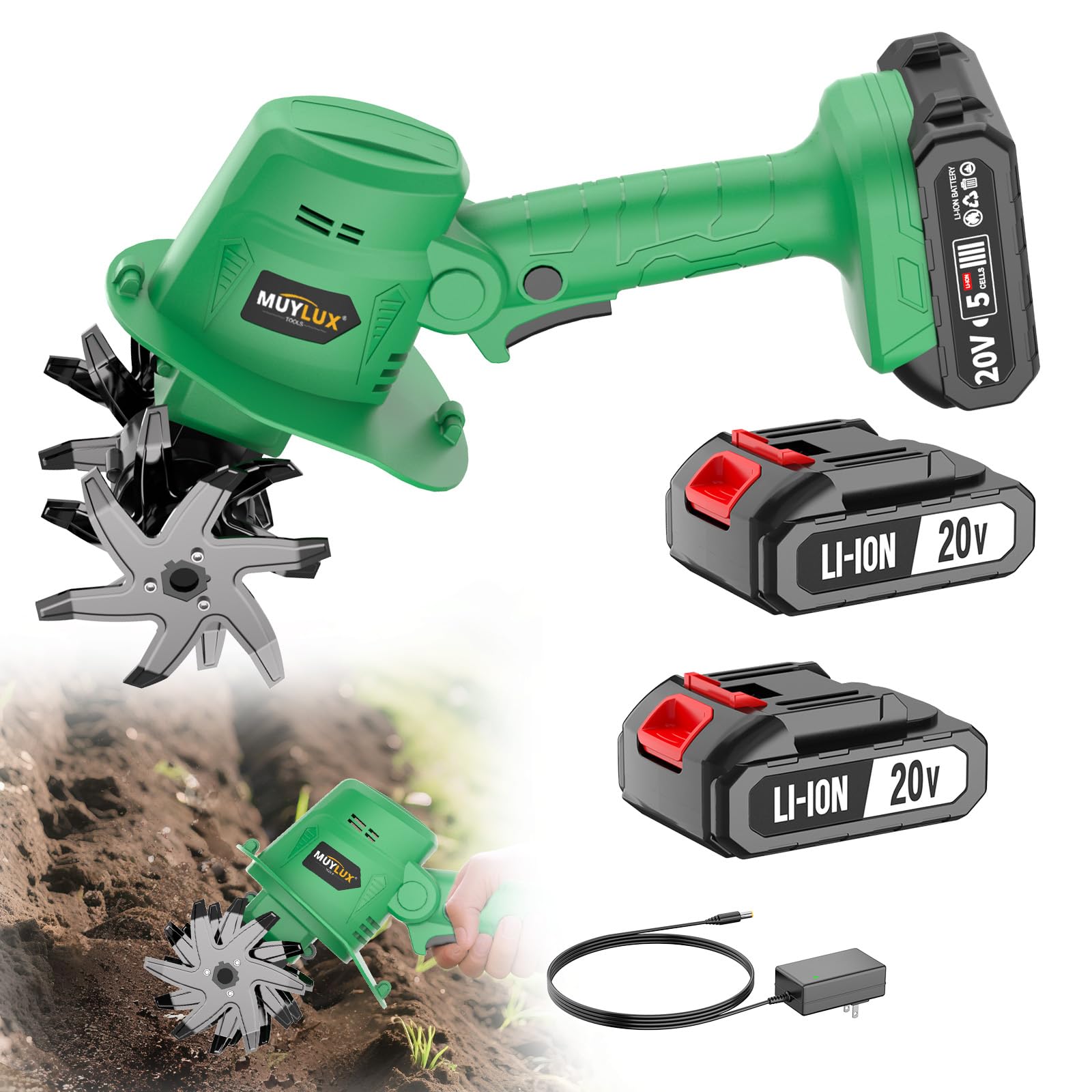
A 240 RPM that cuts gardening time down to 15 minutes for an 80-year-old user.
The Muylux CT-20LS sits at the entry price tier but includes two 20V 2.0Ah batteries, a charger, and a comfortable ergonomic grip. Yet for light weeding, container gardening, and surface-level soil prep, it gets the job done without breaking your back or your budget.
Customers note that it “struggles with roots thicker than yarn but works dirt well to expose them.” The battery lasts about 45 minutes of intermittent use, according to one owner, and the tines are removable for easy cleaning. Several older gardeners note that the tiller is easy to handle, cuts their gardening time from a whole morning to 15 minutes, and is easy on arthritic hands. The downside is obvious: this tiller cannot chew through hard clay or deeply compacted ground in a single pass, and the 4-inch depth means you may need extra passes to get a full bed ready.
Where it wins
- Two 2.0Ah batteries included — more runtime than the single-pack Earthwise
- Extremely easy to use for elderly or physically limited gardeners
- Removable steel tines for simple cleaning and storage
Where it falls short
- 4-inch tilling depth versus the TaskStar at 7 inches
- Struggles with dense roots and hard pack; best for soft, maintained soil
Grab it for: Container gardening, raised beds with loose soil, or anyone who needs a lightweight tiller for quick weeding.
it’s not for you if: You have hard clay, rocky ground, or need to break fresh sod where the extra depth of the TaskStar or Saker is required.
Understanding the Specs
Tilling Depth
Tilling depth is the maximum vertical distance the tines can dig into the soil in one pass. A depth of 6 inches or more is enough for most vegetable beds and flower borders, letting you turn over soil and bury weeds fully. A 4-inch depth works for surface weeding and mixing in light compost but will leave deeper roots untouched, so you may need a second pass or follow-up hand weeding.
Tilling Width
Tilling width is the horizontal span the tines cover. A wider head (8 to 9 inches) finishes a row in fewer passes but is less maneuverable in tight raised beds and between established plants. A narrower head (6 to 7.5 inches) takes more passes for a full bed but pivots easily in tight corners and narrow borders. Match the width to the scale of your planting area.
FAQ
Can a handheld tiller break new ground in hard clay?
How long does a 20V 2.0Ah battery last in a tiller?
Is a corded tiller better than a cordless tiller for a small garden?
Will a handheld tiller chop up existing weeds and grass?
What is the difference between steel tines and steel blades on a tiller?
Can I use a tiller to mix compost into my garden beds?
Why does my cordless tiller stop running mid-job even though the battery shows a charge?
How heavy is a typical handheld tiller, and can an older gardener use one?
Can I use a Dewalt 20V battery in a tiller from another brand?
Does a higher RPM always mean better tilling performance?
Final Thoughts: The Verdict
For most people, the handheld tiller winner is the TaskStar TH4000 because its 7-inch depth and 48 steel tines handle everything from weed removal to compost mixing without running out of steam in the middle of a bed. If you want extended runtime and wide coverage in one charge cycle, grab the Saker SK-TC18B. And for the lowest entry price with two batteries included, the Muylux CT-20LS is a capable starter that does not sacrifice ease of use for its cost.
How We Picked
We do not accept paid placement, and we did not hands-on test every unit. Instead, we match each pick to a real buyer and use-case by comparing the manufacturers’ published specifications against the patterns in verified customer reviews — so you get each pick’s real strengths and trade-offs instead of marketing copy.
Sources & Methodology
Specifications: manufacturer listings and product documentation. Review insights: verified customer reviews, as of July 2026. Pricing: not shown on this page (it changes often); check the current price via the retailer link.
As an Amazon Associate, Lawn Gear Lab earns from qualifying purchases. This does not affect which products we feature.