
Specs are compiled from manufacturer listings and verified buyer reviews and can change over time — please confirm the key details on the product page before buying.
Waking up to that telltale white powder on your zucchini leaves or the gray fuzz spreading across your rose bush feels like watching a slow-motion disaster. Powdery mildew is the most common and frustrating fungal problem for home gardeners, and choosing the right treatment means the difference between saving your harvest and watching your plants slowly suffocate under that dusty coat.
I’m Rikta — the founder and writer behind Lawn Gear Lab. This guide is built by comparing the manufacturers’ published specifications and the patterns across verified customer reviews, so you get each pick’s real strengths and trade-offs instead of marketing spin.
Below, you will find six of the most effective treatments available right now, from ready-to-use sprays to powerful concentrates, with honest details on how they work, what real gardeners say about them, and which one fits your garden’s specific needs. This is your plain-English breakdown of the best powdery mildew treatment for your plants this season.
Quick Picks
- Earth’s Ally Disease Control Concentrate — Best Value Concentrate
- Bonide Revitalize Biofungicide — Biofungicide
- Athena IPM Plant Pest Control Ready-to-Use Spray — Best Overall
- Grower’s Ally Crop Defender 3 — Triple-Action
- Bonide Captain Jack’s Citrus, Fruit & Nut Orchard Spray — Orchard Pick
- Monterey Neem Oil RTU — Budget Champion
How To Choose The Best Powdery Mildew Treatment
Not all fungicides work the same way, and the wrong choice can leave you spraying every week with no results. Here are the three things to check before you buy.
Ready-to-Use vs. Concentrate
A ready-to-use spray (RTU) comes in a bottle with a trigger, and you just point and spray. No measuring, no mixing, no mess. A concentrate requires you to mix a small amount — usually tablespoons — into a gallon of water. The trade-off is simple: RTU is faster and easier, but a concentrate makes many more gallons of spray for a lower per-application cost. If you have a large garden or many plants, a concentrate saves money. If you have one potted rose or a single houseplant, an RTU makes more sense.
Active Ingredient: Botanical Oils vs. Biofungicides
The active ingredient determines how the treatment works. Botanical oils (neem oil, rosemary oil, clove oil) smother the powdery mildew spores on contact, stopping the fungus in its tracks. They are fast and effective but can burn leaves if applied in full sun. Biofungicides, like the one in the Bonide Revitalize product, contain a beneficial bacterium that triggers your plant’s own immune response. They work more slowly but provide longer-lasting protection and are less likely to damage tender new growth. Citric acid — the active in Earth’s Ally — works by changing the pH on the leaf surface, making it inhospitable to fungus.
OMRI Listing and Harvest Intervals
If you are growing vegetables, herbs, or fruit, look for the OMRI label (Organic Materials Review Institute). It means the product meets organic gardening standards and contains no synthetic pesticides. Equally important is the harvest interval — how many days must pass between the last spray and when you can pick and eat your produce. Some products, like Bonide Revitalize and Earth’s Ally, allow use right up to the day of harvest. Others may have a 1-day or 7-day wait. Check the label if you plan to eat what you grow.
Quick Comparison
On smaller screens, swipe sideways to see the full table.
| Model | Best For | Type | Active Ingredient | Volume | Amazon |
|---|---|---|---|---|---|
| Earth’s Ally Disease Control | Citric acid concentrate for root fungus & leaf spots | Concentrate | Citric Acid | 32 oz | Amazon |
| Bonide Revitalize Biofungicide | Immune-boosting concentrate for organic gardens | Concentrate | Bacillus amyloliquefaciens | 16 oz | Amazon |
| Athena IPM | Ready-to-use spray for houseplants & seedlings | RTU Spray | Botanical Oils | 32 oz | Amazon |
| Grower’s Ally Crop Defender 3 | Triple-action organic spray for pests & mildew | RTU Spray | Botanical Oils | 24 oz | Amazon |
| Bonide Captain Jack’s Orchard Spray | Multi-purpose orchard concentrate for fruit trees | Concentrate | Lemon & Sulfur | 32 oz | Amazon |
| Monterey Neem Oil RTU | Budget-friendly neem oil for veggie gardens | RTU Spray | Neem Oil | 32 oz | Amazon |
In‑Depth Reviews
1. Earth’s Ally Disease Control Concentrate
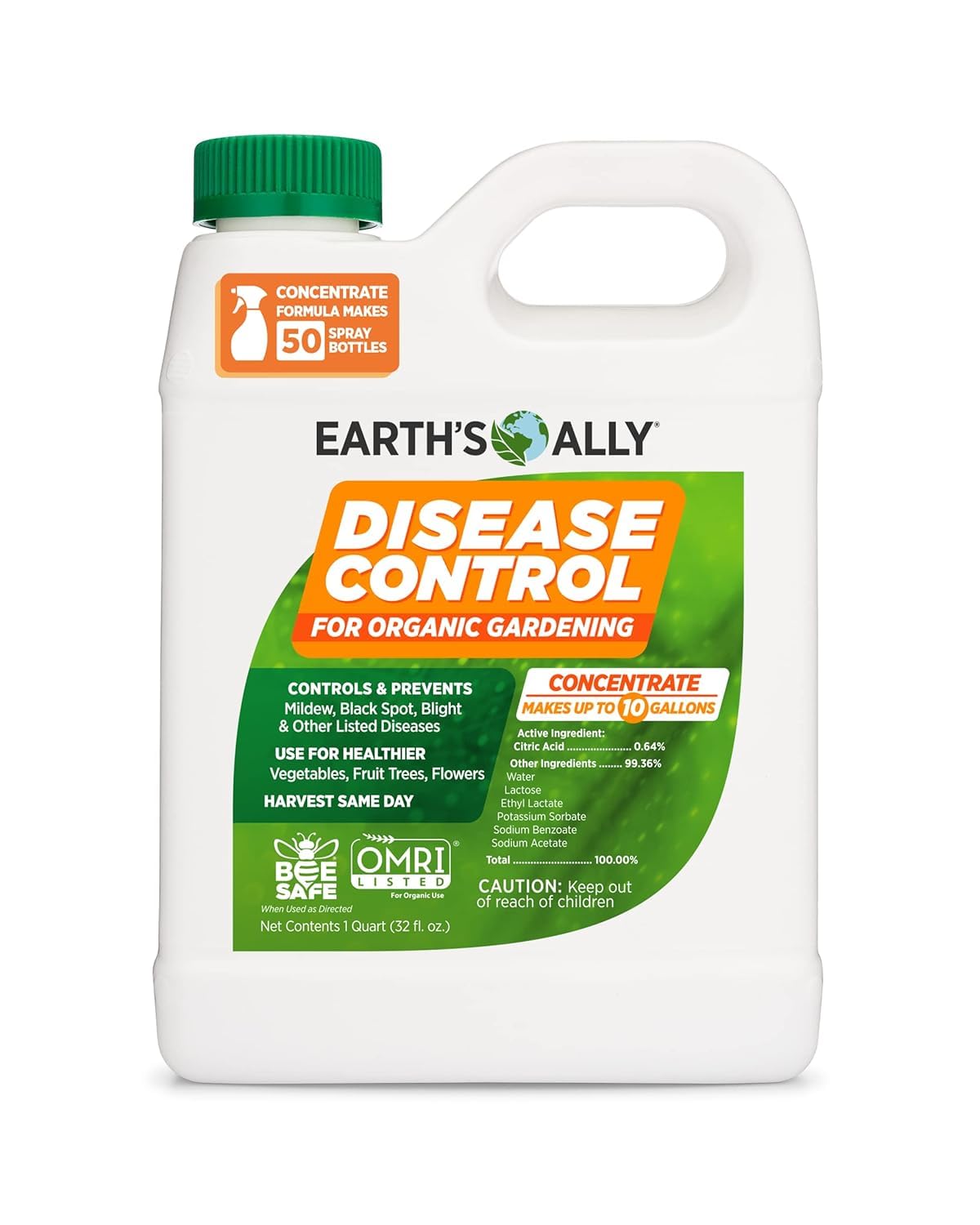
The citric-acid concentrate that a gardener says “stopped root fungus in 2 applications.”
This is not just a surface spray — Earth’s Ally uses citric acid to change the leaf-surface pH so fungus cannot take hold. It tackles powdery mildew, downy mildew, blight, black spot, and leaf spot. Because it is a concentrate, a single 32-ounce bottle (which weighs 2.26 pounds) makes 10 full gallons of spray. That is a lot of coverage for your money, especially compared to ready-to-use sprays that are mostly water.
Unlike the Grower’s Ally (which is a ready-to-use spray with a 24-ounce bottle), this concentrate gives you much more flexibility in how much you mix. You use 6 tablespoons per gallon of water. Buyers report it works fast — one reviewer noted it “stopped root fungus in 2 applications” on a troubled Palo Verde tree that an arborist had recommended removing. Another said their rose leaves “look MUCH healthier” after using it.
It is OMRI Listed for organic gardening and safe to use on fruits, vegetables, flowers, and ornamentals right up to the day of harvest. No harsh chemical residues to worry about. The only catch is that citric acid can be slightly less effective on severe, established powdery mildew compared to stronger fungicides. If your plants are already heavily coated, you may need to spray every few days and be patient.
What growers love
- Concentrate makes 10 gallons — very economical for large gardens
- OMRI Listed and safe to use until harvest day
- Effective on both leaf fungus and soil/root fungus
The trade-offs
- Requires measuring and mixing — not grab-and-go
- May need multiple applications for stubborn mildew
Reach for this if: you have a large vegetable garden or many roses and want the best value per gallon — the concentrate format and 2.26-pound bottle stretch further than any RTU.
Look elsewhere if: you only have one potted plant and do not want to measure tablespoons — a ready-to-use spray is simpler.
2. Bonide Revitalize Biofungicide

The biofungicide that wakes up your plant’s own defenses instead of just poisoning the fungus.
Bonide Revitalize works differently than every other product on this list. Instead of smothering spores with oil or changing pH with acid, it contains a live bacterium (Bacillus amyloliquefaciens) that triggers an immune response inside your plant. Your plant basically starts fighting the powdery mildew on its own. This makes it ideal for long-term prevention and for gardeners who want to avoid spraying any kind of oil onto delicate foliage.
It comes as a 16-ounce concentrate — 16 fluid ounces versus 32 fluid ounces for the Earth’s Ally concentrate. But because it is a biological product, a little goes a long way. You apply it as a foliar spray or a soil drench. One buyer mentioned dramatic results on pear trees with fire blight: “After using this for about a month & applying every 3-4 days as a soil drench, the trees are starting to show signs of rebounding – new leaves, no more black leaves, etc.” Another reviewer called it the “best option to treat fungal problems on houseplants.”
It is approved for organic gardening and can be used up until the day of harvest. It works on vegetables, fruits, nuts, trees, shrubs, and houseplants. The main caveat is that biofungicides work more slowly than oil-based sprays — you need patience and consistent application (every 7-14 days for prevention). If you need to knock down a severe outbreak immediately, this may not be your first choice.
The big advantage
- Boosts plant immunity for longer-lasting protection
- Can be used as a soil drench to fight root-level fungus
- Safe for edible plants right up to harvest
What to know
- Works slower than oil-based sprays — not for emergencies
- 16-ounce bottle makes fewer gallons than larger concentrates
Best for prevention-minded gardeners: if you want to build your plant’s long-term resistance rather than relying on contact-kill sprays.
Not the pick for: a sudden, heavy powdery mildew outbreak that needs immediate knockdown — reach for an oil-based spray instead.
3. Athena IPM Plant Pest Control Ready-to-Use Spray
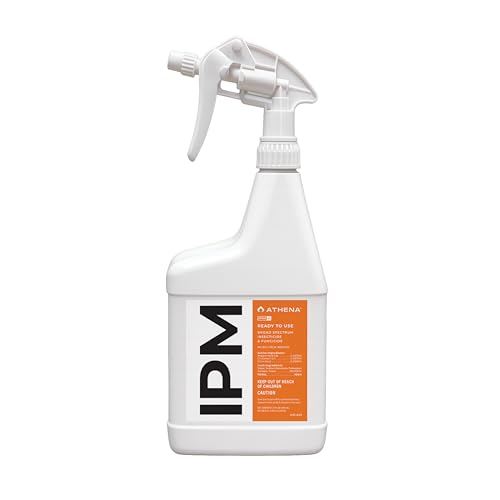
The zero-mix instant spray that kills powdery mildew and spider mites on contact with a pleasant smell.
Athena IPM is the closest thing to a “just spray it and forget it” solution. It comes ready to use in a 32-fluid-ounce bottle — 32 fluid ounces versus 16 fluid ounces for the Bonide Revitalize concentrate. No mixing, no measuring, no special equipment. You shake it, point the nozzle, and spray. The botanical oil formula kills spider mites, aphids, thrips, and powdery mildew on contact. One verified buyer confirms: “Spray kills bugs instantly, easy to apply, no mixing needed, pleasant smell.” Another called it “the best of the best to battle pests.”
Athena is made with EPA 25(b) minimum risk ingredients, which means it uses substances that the EPA considers safe enough to exempt from standard pesticide registration. It is safe around pets and children when used as directed. It works on houseplants, vegetable gardens, flower beds, fruit trees, and hydroponic setups — throughout the entire plant lifecycle, from clones to flowering plants. One reviewer who grows cannabis said, “Literally the best product I’ve used so far. And don’t need to try anything else from here on.”
Because it is an RTU, you pay a premium for the convenience — each bottle is mostly water plus the active oils. If you have a large garden, the per-application cost adds up faster than using a concentrate like Earth’s Ally or Bonide Revitalize. But for a home grower with a moderate number of pots, the simplicity is worth it.
Ease of use
- No mixing, no measuring — spray straight from the bottle
- Pleasant botanical scent (reviewers mention it smells good)
- Kills both fungal disease and insects in one spray
Cost consideration
- RTU format costs more per application than concentrates
- 32-ounce bottle is heavy for some users
Best for the grab-and-go gardener: if you want a single bottle that handles both powdery mildew and pest insects without any preparation, this is the one.
skip it if: you have a large outdoor garden and want to stretch your dollar — a concentrate will give you more coverage for less money.
4. Grower’s Ally Crop Defender 3
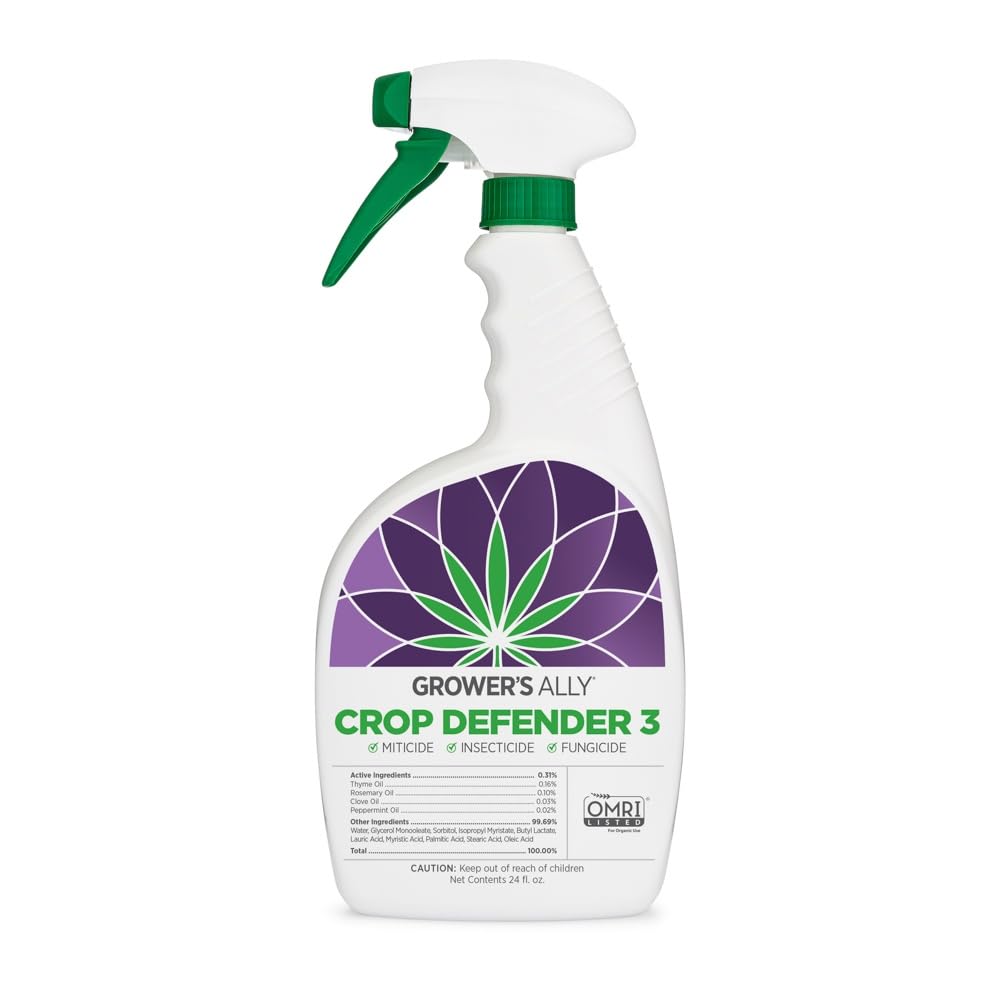
The triple-threat spray that kills mites, fungus, and insects without burning a single leaf.
Grower’s Ally Crop Defender 3 is a ready-to-use spray that does three jobs at once: it is a miticide (kills spider mites and russet mites), an insecticide (kills aphids, thrips, and other soft-bodied bugs), and a fungicide (kills powdery mildew). It uses a blend of botanical oils with a built-in surfactant (a soap-like agent that helps the spray spread evenly across the leaf surface instead of beading up). It comes in a 24-fluid-ounce bottle, versus 32 fluid ounces for the Athena IPM.
One of the biggest worries with oil-based sprays is leaf burn — especially on tender seedlings. Owners mention this is not an issue here. One verified reviewer wrote: “Does not burn plants! Works really well. Best spray for aphids and mites. I’m so pleased with this spray.” Another said it worked on spider mites in an indoor garden where “multiple organic & DIY solutions” had failed. The spray is OMRI Listed for organic gardening and is FIFRA 25(b) exempt, which means it contains no synthetic pesticides and no heavy metals.
Unlike the Earth’s Ally and Bonide Revitalize concentrates, this is a pure RTU — you pay for convenience. But the formula is gentle enough that you can spray it on flowering plants and even harvest the same day. It is also bee-safe and suitable around kids and pets. The only real downsides are the smaller bottle size (24 oz vs 32 oz for several competitors) and the fact that it is not sold in a concentrate format for larger gardens.
Gentle effectiveness
- Does not burn leaves — safe on seedlings
- Triple action covers mildew, mites, and insects
- OMRI Listed with zero heavy metals
Size trade-off
- 24-ounce bottle is smaller than most competitors
- No concentrate option for large-scale users
Perfect for indoor growers and seedling nurseries: the no-burn formula means you can spray young, delicate plants without fear.
Not ideal for: large outdoor gardens or orchards where you would need many bottles — the 24 oz size goes fast.
5. Bonide Captain Jack’s Citrus, Fruit & Nut Orchard Spray

The multi-purpose orchard concentrate that one apple tree owner says turned a yellow tree noticeably greener.
If you have fruit trees — apples, citrus, pecans, avocados — this is the spray designed specifically for you. Bonide Captain Jack’s Orchard Spray is a 32-ounce concentrate that works as a fungicide, insecticide, and miticide in one bottle. The active ingredients include lemon oil and sulfur. One pint (16 oz) makes up to 6.4 gallons of finished spray, depending on how you dilute it — anywhere from 2.5 fluid ounces per gallon to a stronger mix depending on the target pest or disease.
Customers note visible results fast. One verified reviewer said: “The leaf spots on my apple tree are disappearing and it is noticeably greener. Before using this product the tree was fairly yellow looking overall.” Another called it “effective fungus control for all of my fruit trees.” It controls powdery mildew, rust, blight, brown rot, and leaf spots while also killing beetles, fruit flies, caterpillars, mealybugs, spider mites, thrips, and scale. The 2.3-pound bottle is similar in weight to the Earth’s Ally (2.26 pounds).
The sulfur component leaves a slight powdery white residue on leaves, which is normal and washes off. The product is not persistent — you need to reapply after rain. It can be used up to the day before harvest, which is a day shorter than the day-of-harvest allowance on Earth’s Ally and Bonide Revitalize. For most home orchardists, that one-day buffer is not a problem.
Orchard power
- Covers insects, mites, and fungal diseases in one concentrate
- Visible improvement on leaves within days
- 32 oz concentrate goes a long way
A few downsides
- Leaves a sulfur powder residue on foliage
- Short persistence — reapply after heavy rain
Tailor-made for orchard owners: if you have apple, citrus, or nut trees and want one product that handles everything from powdery mildew to Japanese beetles, this is your pick.
Not the choice for: indoor houseplants or small container gardens — the sulfur smell and residue are overkill for a single potted plant.
6. Monterey Neem Oil RTU
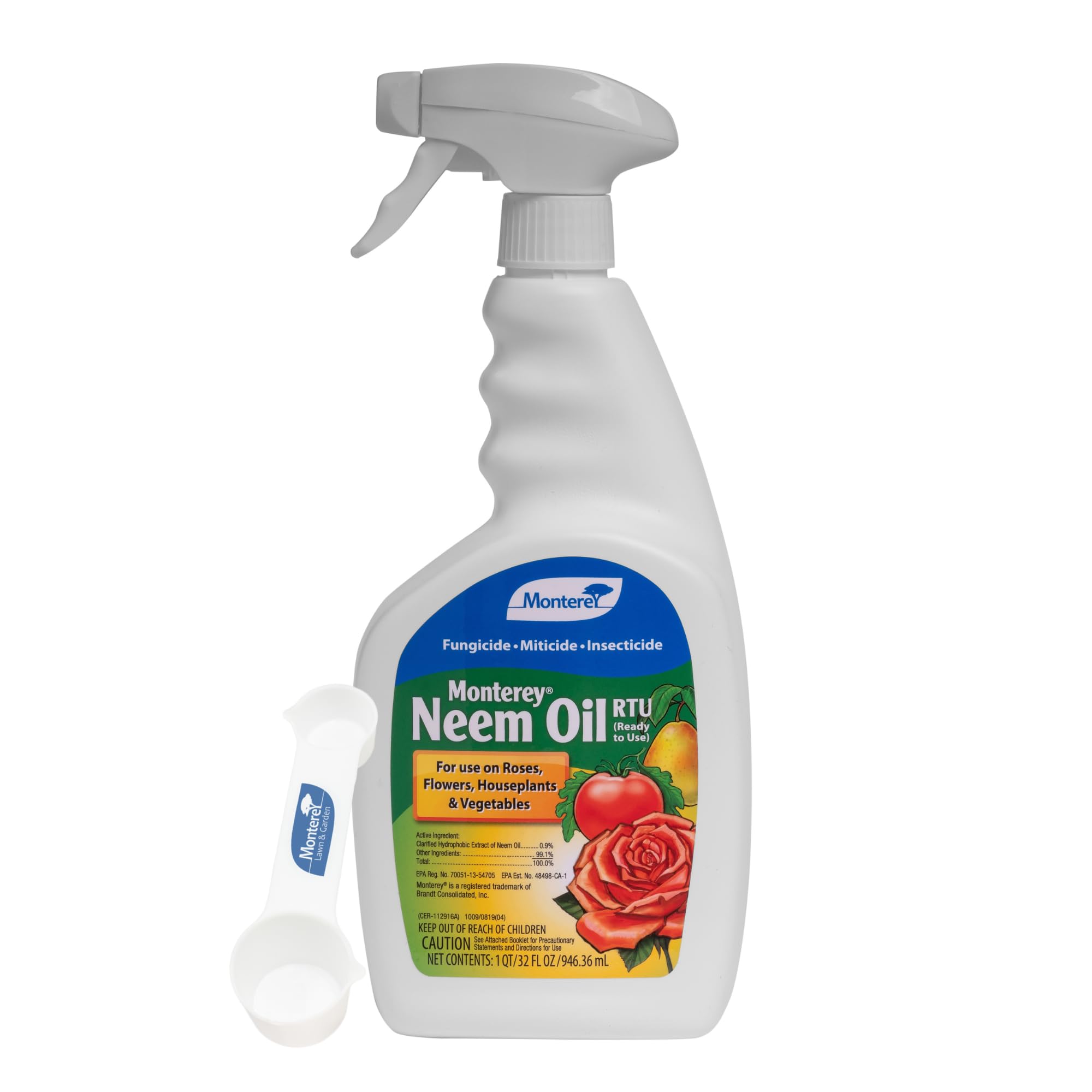
The classic neem oil spray that works but reviewers warn smells like a dirty diaper until it dries.
Neem oil has been a go-to organic treatment for decades, and Monterey Neem Oil RTU delivers it in a ready-to-use 32-ounce spray bottle. It works as a fungicide (covers powdery mildew, black spot, rust), an insecticide (aphids, spider mites, whiteflies), and a miticide. No mixing required — just shake and spray. It is safe for edible plants up to the day of harvest and works on roses, ornamentals, houseplants, shrubs, and vegetables.
One buyer with a small container garden reported it “controlled caterpillars and powdery mildew on tomatoes” and noted “the smell dissipates after drying.” Another reviewer was more blunt: “Strong, unpleasant odor like dirty diaper. Effective fungicide/insecticide for black spot, powdery mildew, aphids, whiteflies; good leaf shine.” The odor is the trade-off for neem oil — it lingers while wet but fades once dry. The same reviewer also noted it is “weak against spider mites” compared to stronger miticides, so if spider mites are your primary problem, consider the Grower’s Ally or Athena IPM instead.
The 2-pound bottle arrived with packaging issues according to one buyer — half the bottle leaked inside the box. That is a shipping problem rather than a product problem, but it is worth noting. For the price, this is the most affordable neem oil RTU on the list, and neem oil is a tried-and-true solution. Just be prepared for the smell.
Classic organic
- Neem oil is a proven, centuries-old treatment
- RTU format — no mixing required
- Very affordable for a 32 oz bottle
Smell factor
- Strong, unpleasant odor until it dries
- Some buyers reported shipping leaks
- Weaker on spider mites than specialized miticides
Grab this for the budget-friendly organic option: if you want a classic neem oil solution for your vegetable garden and can tolerate the temporary smell, this is the most economical RTU choice.
Pass on this if: you are sensitive to strong odors or need a product that specifically targets spider mites — a botanical oil blend will work better.
Understanding the Specs
Ready-to-Use (RTU) vs. Concentrate
The label will say “Ready-to-Use” or “Concentrate.” An RTU is filled with water and active ingredients — you open the bottle, spray, and you are done. A concentrate is a small bottle of potent liquid that you dilute yourself, usually at a rate like “6 tablespoons per gallon of water.” Concentrates are cheaper per application because you are not paying to ship water. RTUs are simpler and faster but cost more per spray session. If you have a small garden (under 10 plants), an RTU makes sense. If you have a large garden, a concentrate will save you money over a full season.
Active Ingredient: What Is Doing The Killing?
Botanical oils (neem, rosemary, clove, lemon) work by smothering fungal spores and soft-bodied insects. They act fast but can burn leaves in direct sunlight — apply in the evening or on cloudy days. Citric acid (as in Earth’s Ally) changes the pH on the leaf surface, making it impossible for powdery mildew to grow. Biofungicides (like Bonide Revitalize) use live bacteria that activate your plant’s immune system. They work slower but provide longer-lasting protection and are gentler on new growth. Sulfur (in Captain Jack’s) is a classic contact fungicide that leaves a visible white residue and is very effective but needs reapplication after rain.
FAQ
Can I use these treatments on vegetables and herbs I plan to eat?
Which product works fastest on powdery mildew?
Will these sprays burn my plants in hot weather?
How often should I spray for powdery mildew?
What is the difference between a fungicide and a biofungicide?
Can I mix two different treatments together?
Will these products kill honeybees or other beneficial insects?
How long do concentrated bottles last once opened?
What is OMRI Listed and why does it matter?
Should I treat the soil or just the leaves?
Final Thoughts: The Verdict
Across the board, the powdery mildew treatment winner is the Athena IPM Ready-to-Use Spray because it kills both mildew and pests on contact with zero mixing, a pleasant smell, and proven results from home growers and commercial cultivators alike. If you want a concentrate that makes gallons of spray for less money per application, grab the Earth’s Ally Disease Control Concentrate. And for a long-term prevention approach that builds your plant’s own immunity, the standout is the Bonide Revitalize Biofungicide.
How We Picked
We do not accept paid placement, and we did not hands-on test every unit. Instead, we match each pick to a real buyer and use-case by comparing the manufacturers’ published specifications against the patterns in verified customer reviews — so you get each pick’s real strengths and trade-offs instead of marketing copy.
Sources & Methodology
Specifications: manufacturer listings and product documentation. Review insights: verified customer reviews, as of July 2026. Pricing: not shown on this page (it changes often); check the current price via the retailer link.
As an Amazon Associate, Lawn Gear Lab earns from qualifying purchases. This does not affect which products we feature.