
Specs are compiled from manufacturer listings and verified buyer reviews and can change over time — please confirm the key details on the product page before buying.
Walking into the nutrient aisle can feel like you need a chemistry degree. You are staring at rows of bottles with cryptic N-P-K ratios, wondering which one actually makes your lettuce crisp and your tomatoes plump instead of just burning a hole in your wallet. The real trick is matching the nutrient formula to your specific growth stage and setup—and the five picks here cover every path from seed to harvest.
I’m Rikta — the founder and writer behind Lawn Gear Lab. This guide is built by comparing the manufacturers’ published specifications and the patterns across verified customer reviews, so you get each pick’s real strengths and trade-offs instead of marketing spin.
Whether you are growing leafy greens in a basement or tending fruiting plants under LEDs, these are the best hydroponic nutrients that actually deliver on their claims without complicating your routine.
Quick Picks
- Botanicare Pure Blend Pro Grow — Best Overall
- General Hydroponics FloraSeries Trial Pack — Full Control
- Growth Technology GT Foliage Focus — Foliage Focused
- VIVOSUN Liquid Nutrients Base A & B Bundle — Two-Bottle System
- NEW Hydroponics MaxiGro & MaxiBloom Set — Powder Power
- OceanSolution 2-0-3 All Natural Liquid Fertilizer — Organic Microgreens
How To Choose The Best Hydroponic Nutrients
The right nutrient turns a struggling seedling into a plant that practically explodes with leaves. The wrong one leaves you with yellowing leaves, mysterious deficiencies, and a lot of head-scratching. Here is what actually matters when you browse.
N-P-K Ratio and Growth Stage
Every nutrient label shows three numbers, like 3-2-4, standing for Nitrogen, Phosphorus, and Potassium. In the vegetative phase, you want higher nitrogen to fuel leaf and stem growth. When the plant shifts to flowering or fruiting, it needs more phosphorus and potassium. A product like General Hydroponics FloraSeries gives you three separate bottles so you can tailor the mix week by week, while a one-part formula like Botanicare Pure Blend Pro Grow is pre-balanced for a single stage.
Liquid vs. Powder
You can pour liquid concentrates straight into your reservoir and they mix instantly, so beginners avoid measuring errors. Powders, like the NEW Hydroponics MaxiGro/MaxiBloom set, need more stirring but deliver more concentrated feed per ounce and create less plastic waste. Your choice depends on whether you prefer quick mixing or saving storage space.
Complete System vs. One-Part
The main decision is between a single bottle that covers everything (one-part) or a multi-bottle system you mix yourself. A complete system like VIVOSUN’s Base A & B bundle lets you fine-tune the ratio for specific plants, but it adds a step to every watering. One-part liquids are simpler but less adjustable if your crop needs a different balance mid-season.
Quick Comparison
On smaller screens, swipe sideways to see the full table.
| Model | Best For | N-P-K | Liquid Volume | Form | Amazon |
|---|---|---|---|---|---|
| Botanicare Pure Blend Pro Grow | Premium all-in-one vegetative phase | 3-2-4 | 128 fl. oz | Liquid | Amazon |
| General Hydroponics FloraSeries | Full control over every growth stage | 3-part system | 32 fl. oz total | Liquid | Amazon |
| Growth Technology Foliage Focus | Houseplants and tropical foliage | Balanced mineral | 946 ml | Liquid | Amazon |
| VIVOSUN Base A & B | Versatile vegetative to flowering | 2-part formula | 64 fl. oz | Liquid | Amazon |
| NEW Hydroponics Maxi Gro/Bloom | Budget powder for lettuces and herbs | Powder formula | 70.4 oz | Powder | Amazon |
| OceanSolution 2-0-3 | Organic microgreens and gardens | 2-0-3 | 32 fl. oz | Liquid | Amazon |
In-Depth Reviews
1. Botanicare Pure Blend Pro Grow

One gallon of premium liquid feed that covers everything from cacti to fruiting crops.
This is the pitcher you grab when you want one bottle to do the entire vegetative phase without any lab-coat measuring. With a balanced 3-2-4 N-P-K ratio, it is designed for fruits, flowers, vegetables, houseplants, shrubs, and cacti—and works in soil, coco coir, or soilless hydroponics. The liquid volume of 128 Fluid Ounces is a 4.0x gap over the 32 Fluid Ounces in an OceanSolution bottle, meaning you refill far less often. Buyers report it is their absolute “go to” nutrient, though more than one reviewer notes you will want a Cal-Mag supplement if you run it in a pure hydroponic system.
At 10.4 Pounds, this jug is the heaviest pick on the list—2.3x heavier than the 4.56-pound powder set from General Hydroponics. That weight comes from the sheer volume of concentrated liquid, so make sure your shelf can handle the load. The one-part formula is dead simple: mix at a 1:1 ratio with water and apply with every watering during vegetative growth.
For a grower who wants an easy, proven liquid that works across multiple plant types and media, this is the strongest anchor for the list. Just budget for the optional calcium-magnesium booster if you are running a bare-bones hydro setup.
Why it wins: One 128-ounce bottle replaces smaller bottles from OceanSolution and others, delivering a 4.0x volume advantage in a single pour-and-grow liquid that buyers call a go-to staple.
One catch: At 10.4 Pounds it is the heaviest product here, and pure hydroponic systems may need a separate Cal-Mag additive.
Grab this if: You want a single, large-format liquid nutrient that handles the full vegetative stage for a wide variety of plants without mixing multiple bottles.
Look elsewhere if: Shelf space is tight or you grow in a pure hydro system that relies on RO water and may need extra calcium.
2. General Hydroponics FloraSeries Trial Pack

Three separate bottles let you dial in the perfect ratio for every week of growth.
The FloraSeries gives you FloraMicro, FloraGro, and FloraBloom as three separate quarts (32 fluid ounces total), so you can adjust the N-P-K mix as your plant moves from seedling to harvest. At 3 different items per pack, this is 50% more bottles than the 2 in the VIVOSUN Base A & B bundle, giving you finer control over the feeding schedule. One reviewer described how a leca (expanded clay pellet) conversion caused a plant decline, and this nutrient revived a pothos in just 2 days, with new leaves and roots appearing on a pink princess and rubber tree.
The mixing ratio is a simple 1:1:1 for general use, but you can tweak the proportions week to week. At 8.06 Pounds the kit is noticeably lighter than the 10.4-pound Botanicare jug, yet still holds enough to feed a decent-sized grow. FloraMicro provides nitrogen, calcium, and chelated micronutrients (tiny nutrients chemically wrapped so plants can absorb them easily) for fast-growing crops, FloraGro supports structural and foliar growth, and FloraBloom packs phosphorus, potassium, magnesium, and sulfur for flowering. Owners mention seeing results as fast as the same week.
Three-bottle strength
- Customizable N-P-K ratio at each growth stage
- Proven to revive stressed plants within days
- Light enough at 8.06 lbs to store on any shelf
The trade-off
- Three bottles mean more measuring steps per watering
- Premium price for the trial pack volume
Perfect for: A grower who likes to fine-tune the nutrient mix week by week and wants proven recovery power for struggling plants.
skip it if: You prefer a single bottle you can just pour and forget.
3. Growth Technology GT Foliage Focus
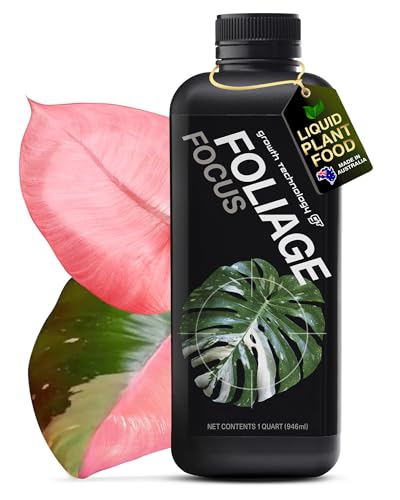
A precision liquid for tropical leaves that makes aroids and alocasias visibly glow.
If your collection leans toward monstera, philodendron, alocasia, ferns, and palms, this is the nutrient that speaks their language. The balanced mineral content includes nitrate-nitrogen, potassium, calcium, magnesium, and trace elements (tiny amounts of nutrients like iron and zinc that plants need in very small quantities) to keep chlorophyll production humming. The mixing ratio is straightforward: 3–5 ml per liter for soil, 5–7 ml per liter for hydroponics, or dilute it further for a foliar spray you mist directly onto the leaves.
Customers note the new growth and leaf size become “significantly larger,” and one reviewer noted their hydro plants “grow like weeds” with it. The 2.2-pound bottle is the lightest liquid option here, making it an easy grab from under the sink. One downside noted by reviewers: the original bottle can leak, so store it upright in a secondary container. Compared to the 3-bottle General Hydroponics set, this is a single-bottle solution for people who specialize in leafy tropicals rather than mixed vegetable gardens.
Why it stands out: The formula is precision-targeted for aroids and tropical foliage, delivering visibly larger leaves and richer color in a light 2.2-pound bottle.
Watch for: The bottle may leak if tipped over, and the one-size approach does not cover fruiting or flowering plants.
Reach for this if: You are dedicated to houseplants—especially aroids, ferns, and palms—and want a simple one-bottle feed that produces noticeably bigger, more vibrant leaves.
Pass if: You grow vegetables or flowering crops that need a different N-P-K ratio.
4. VIVOSUN Liquid Nutrients Base A & B Bundle

Two quarts of concentrated goodness that carry your plants from vegging leaf to full flower.
This bundle gives you Base A and Base B in separate bottles totaling 64.0 Fluid Ounces, which is a 2.0x unit-count jump over the 32.0-ounce OceanSolution bottle. The two-part system is a middle path—more adjustable than a one-part like the Botanicare, but simpler than General Hydroponics’ three-bottle kit. The bundle supports everything from the vegetative stage through the end of flowering, and the makers claim it is 100% water soluble and helps stabilize pH in the nutrient solution (the liquid mix that feeds your plants). It works with soil, hydroponics, aquaponics, and coco coir.
Reviewers point out that at 5 ml per gallon of tap water, these containers hold a lot of quantity and quality, and the plants stay lush and green. One buyer mentioned that the water gets cloudy if you use too much, so stick to the recommended amounts. The two bottles are compact compared to the 10.4-pound Botanicare gallon, making them easier to store in a small grow tent or under a cabinet. Just remember: never mix A and B concentrate together directly—always dilute each separately in water before combining.
Why it works
- Two-bottle system gives more control than a one-part formula
- 64 fl. oz total is double the volume of single-bottle options like OceanSolution
- Works across all growing media from soil to coco
The catch
- Must mix A and B separately into water before combining
- Overdosing can make the solution cloudy
Best for: A grower who wants more fine-tuning than a one-bottle liquid but does not want to juggle three separate nutrients.
Not ideal if: You want a single-bottle, pour-and-go feed with no measuring chore.
5. NEW Hydroponics MaxiGro & MaxiBloom Set

A lightweight powder duo that packs a punch for lettuces, tomatoes, and flowering plants.
This is the entry point for growers who want concentrated feed without paying for heavy water. The set includes MaxiGro for the vegetative stage and MaxiBloom for flowering, both in powder form. At 4.56 Pounds the package is 2.3x lighter than the 10.4-pound Botanicare jug, and the 70.4 Ounce unit count means a single bag can equal several bottles of liquid fertilizer. Shoppers say made HUGE differences in the Lettuce and green onions, and one owner reported the tomatoes kept “growing amazing and strong green.” The mixing ratio is 15 ml per gallon of water.
The powder format means less plastic waste and more feed per dollar, but it requires thorough stirring to dissolve completely. One reviewer did mention accidentally creating salt buildup on the roots after misjudging the amount, so accuracy with a measuring spoon or syringe (a small measuring tool like a plastic syringe without the needle) is important. Compared to the VIVOSUN liquid bundle, this set is better for a budget-conscious grower who does not mind a bit of stirring for a better cost-per-feed ratio.
Why it is a solid choice: The powder format is light at 4.56 Pounds and produces strong visible results on lettuces, herbs, and tomatoes at a price that leaves room in the budget.
Be careful with: Measuring errors can cause salt buildup on roots, so precision is a must.
Pick this for: A budget-friendly powder that makes a big difference in leafy greens and tomatoes without the shipping weight of liquid gallons.
Skip this if: You prefer a ready-to-pour liquid or worry about measuring powder accurately.
6. OceanSolution 2-0-3 All Natural Liquid Fertilizer
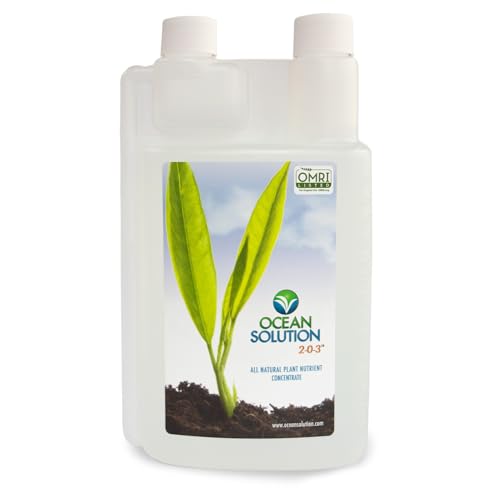
An OMRI-listed ocean-mineral concentrate that gives microgreens their deepest green.
This is the pick for growers who need certified organic input for their microgreens business or home garden. The 2-0-3 ratio is low in nitrogen and has no phosphorus, making it a gentle supplement that will not burn tender seedlings. The 32 Fluid Ounce bottle is concentrated at a 1:128 mixing ratio (just 1 ounce of concentrate per gallon of water), which means a single bottle stretches a long way. Buyers report that it delivered the “greenest and tallest” wheatgrass they have grown, and one business owner specifically bought it because it is organic certified.
At 32.0 Fluid Ounces, the bottle is half the unit count of the VIVOSUN 64.0-ounce bundle, but the super-concentrated nature means you actually get more gallons of feed from each bottle. The liquid is odorless and mess-free, though one customer observed the bottle could use a redesign for easier pouring. Because it has no phosphorus, some buyers wish it had a little extra P for more balanced general feeding. It is best treated as a targeted organic booster for greens rather than an all-purpose nutrient like the Botanicare or General Hydroponics options.
Organic edge
- OMRI Listed and certified organic for commercial growers
- Super-concentrated 1:128 mixing ratio stretches the bottle
- No fishy smell and no staining of systems
Limitations
- No phosphorus limits its use to early-stage greens
- Bottle design makes pouring a bit messy
Who it fits: A microgreens grower or organic gardener who needs a certified odorless liquid that produces the greenest growth.
Who should skip it: Anyone growing flowering or fruiting plants that require a phosphorus-rich nutrient.
Understanding the Specs
N-P-K Ratio (The Three Numbers)
Every nutrient label shows three numbers like 3-2-4. They stand for the percentage of Nitrogen, Phosphorus, and Potassium by weight. Nitrogen fuels leaf and stem growth during the vegetative stage. Phosphorus supports root development and flower/fruit production. Potassium boosts overall plant health and disease resistance. A higher first number means stronger leaf growth; a higher middle number pushes flowers and fruit.
Mixing Ratio (Dilution)
This tells you how much concentrate to add to water. A 1:128 ratio means 1 ounce of concentrate per 128 ounces (1 gallon) of water. A high dilution ratio like that means the product is very concentrated and will make many gallons of feed. A lower ratio like 1:1 or 15 ml per gallon means it is less concentrated and you will use more product per watering session.
Liquid Volume vs. Unit Count
Liquid Volume tells you the total fluid volume of the product—like 32 fl. oz. Unit Count tells you the total amount of product by fluid volume as listed. A product with a 64.0 Fluid Ounce unit count versus a 32.0 Fluid Ounce bottle holds twice as much feed. A higher liquid volume does not always mean more feeding gallons if the mixing ratio is different, so always check both numbers.
Powder vs. Liquid Form
Powder nutrients like the MaxiGro/MaxiBloom set are dry and must be mixed with water before use. They are usually lighter to ship and produce less plastic waste. Liquid concentrates are ready to pour and mix instantly. Powders often have a higher nutrient density per ounce, meaning a 4.56-pound bag can equal several bottles of liquid, but they require precise measuring to avoid salt buildup.
FAQ
What is the difference between a one-part and a multi-part nutrient system?
Do I need Cal-Mag with these nutrients?
Can I mix nutrient A and B concentrate directly together?
Which nutrient is best for microgreens?
How often should I feed my plants with hydroponic nutrients?
What is the mixing ratio and why does it matter?
Can I use hydroponic nutrients in soil or coco coir?
How long does a bottle of liquid nutrient typically last?
Is there a risk of nutrient burn or salt buildup?
Can I use these nutrients for flowering and fruiting plants?
Final Thoughts: The Verdict
For most growers, the best hydroponic nutrients winner is the Botanicare Pure Blend Pro Grow because its 128-ounce liquid volume and simple 3-2-4 ratio (three parts nitrogen, two parts phosphorus, four parts potassium) deliver consistent vegetative growth across many plants without complicated mixing. If you want to fine-tune every week of growth, choose the General Hydroponics FloraSeries. And for a budget-friendly powder option that works well on leafy greens, pick the NEW Hydroponics MaxiGro & MaxiBloom Set.
How We Picked
We do not accept paid placement, and we did not hands-on test every unit. Instead, we match each pick to a real buyer and use-case by comparing the manufacturers’ published specifications against the patterns in verified customer reviews — so you get each pick’s real strengths and trade-offs instead of marketing copy.
Sources & Methodology
Specifications: manufacturer listings and product documentation. Review insights: verified customer reviews, as of July 2026. Pricing: not shown on this page (it changes often); check the current price via the retailer link.
As an Amazon Associate, Lawn Gear Lab earns from qualifying purchases. This does not affect which products we feature.