
A power washing hose that bursts, kinks into a knot, or refuses to lay flat turns a quick driveway cleaning into a frustrating tug-of-war. You need a hose that delivers full pressure without fighting you — one built with the right materials, fittings, and pressure rating for the job you actually have, not the one on the box. This guide digs into the real specs and real-world feedback on six 50-foot power washing hoses, ranging from budget-friendly replacements to premium commercial-grade lines, so you can pick the one that stays reliable season after season.
I’m Rikta — the co-founder and writer behind Lawn Gear Lab. This guide is built by comparing the manufacturers’ published specifications and the patterns across verified customer reviews, so you get each pick’s real strengths and trade-offs instead of marketing spin.
Your pressure washer is only as good as the hose connecting it. Choosing the wrong one means leaks, bursts, or constant untangling. This guide sorts through working pressure ratings from 3200 PSI (pounds per square inch, the standard force for residential work) up to 4800 PSI (for heavy-duty commercial jobs). It covers material differences like PVC (a lightweight, flexible plastic) versus steel-wire-braided rubber (a tougher, heat-resistant construction). It also explains fitting types including 3/8-inch quick-connects (a snap-on coupling for fast changes) and M22-14mm threads (a common screw-in fitting on major brands) to bring you the clearest comparison of the current power washing hose market.
How To Choose The Best Power Washing Hose
Picking a replacement hose comes down to three decisions: the pressure your machine produces, the fittings on your gun and washer outlet, and the physical toughness you need for the surfaces you clean. Get these three right, and you avoid bursts, leaks, and the hassle of constant re-coiling.
Match the PSI Rating (Your Safety Floor)
Every hose has a maximum working pressure — the constant PSI it can handle during normal use. Your hose must be rated *at or above* the output of your pressure washer. If your washer delivers 3200 PSI and you buy a hose rated for 3000 PSI, you risk a burst. Most residential gas washers run between 2800 and 4000 PSI, so a hose rated for 3200 PSI or higher is the bare minimum. The burst pressure (a temporary spike rating, often 2x to 3x higher than working pressure) is an extra safety margin for accidental trigger releases.
Know Your Fitting Types: M22 vs. 3/8-Inch Quick Connect
Pressure washer fittings are not universal. Two standards dominate the market: the M22-14mm threaded screw fitting (common on Ryobi, Greenworks, Craftsman, and Honda models) and the 3/8-inch quick-connect snap coupling (common on Simpson, Generac, DeWalt, and many gas-powered machines). Some machines use proprietary connectors that require an adapter. Before you buy, identify the gender and size of the fitting on your spray gun and washer outlet — a mismatch means you cannot attach the hose without an adapter.
Choose the Right Material for Your Use
Hose construction directly affects how it feels in your hands. PVC (polyvinyl chloride) is the most common in budget to mid-range hoses — it is lightweight and flexible at room temperature, but it stiffens in cold weather and is less abrasion resistant. Rubber-jacket hoses (often reinforced with steel wire braiding) are heavier and more expensive, but they resist kinks, tolerate hot water up to 212°F, and survive dragging over concrete and gravel without wearing through. For occasional patio and car washing, a good PVC hose works fine. For daily commercial use or cleaning driveways and equipment with hot water, step up to a steel-braided rubber hose.
Inner Diameter: 1/4-Inch vs. 3/8-Inch
The inner diameter (ID) controls how much water flows through the hose. A 1/4-inch ID is standard on most 50-foot budget and mid-range hoses — it is sufficient for residential gas and electric washers up to about 3400 PSI. A 3/8-inch ID delivers a significantly higher flow rate (gallons per minute, or GPM), which is critical for commercial-grade washers and longer hose runs where pressure drop becomes noticeable. The catch is weight: a 3/8-inch rubber hose is substantially heavier (often 5.5 to 6+ pounds) compared to a 1/4-inch PVC hose (2.5 to 3.5 pounds).
Quick Comparison
On smaller screens, swipe sideways to see the full table.
| Model | Category | Best For | Key Spec | Amazon |
|---|---|---|---|---|
| TOOLCY Super Flexible | Mid-Range | Best value for flexible PVC performance | 3400 PSI, 1/4-inch ID, 50 ft | Amazon |
| AURORA CAR 3/8-Inch | Premium | Industrial-grade toughness with steel braiding | 4200 PSI, 3/8-inch ID, 50 ft | Amazon |
| YAMATIC 3/8″ 4000 PSI | Premium | Heavy-duty hot-water jobs with swivel fitting | 4000 PSI, 3/8-inch ID, 50 ft | Amazon |
| POHIR 3/8-Inch | Premium | Highest pressure durability for commercial use | 4800 PSI, 3/8-inch ID, 50 ft | Amazon |
| Hourleey 3600 PSI | Budget-Friendly | Affordable all-rounder with adapter kit | 3600 PSI, 1/4-inch ID, 50 ft | Amazon |
| YAMATIC 3200 PSI | Budget-Friendly | Entry-level replacement for M22 machines | 3200 PSI, 1/4-inch ID, 50 ft | Amazon |
In‑Depth Reviews
1. TOOLCY Super Flexible Pressure Washer Hose 50ft, 3400 PSI

3400 PSI working pressure and the best balance of flexibility, toughness, and price make the TOOLCY Super Flexible Pressure Washer Hose the top pick for anyone with a standard residential gas washer (up to about 7 horsepower or 220cc engine size) who wants to upgrade from a stiff, memory-prone factory hose.
The TOOLCY’s biggest strength is its PVC material. Buyers report it feels “as flexible as Uberflex/Flexzilla, with less curling” — a rare compliment. Professional detailers note it does not tangle. The hose comes with five brass quick-connect adapters (2 x M22 female to plug, 2 x M22 male to socket, 1 x M22 male-to-male coupler) that let it fit Ryobi, Dewalt, Greenworks, Karcher, Craftsman, Honda, and Simpson machines out of the box. Its outside diameter is just 0.25 inches, so it is lighter than every 3/8-inch rubber hose on this list, saving your arm on long cleaning sessions.
Be ready to unwind it completely before using it. If you pressurize it while still coiled, it keeps those pigtails, as verified owners warn. It also tops out at 3400 PSI, so skip it if your gas washer pushes 4000 PSI or higher. For the vast majority of mid-range residential users, this one delivers premium flexibility at a mid-range price.
Why it’s great
- Flexibility rivals premium Uberflex/Flexzilla at roughly half the cost
- Comes with five brass adapters for broad compatibility with major brands
- Lightweight PVC construction reduces arm fatigue during extended use
Good to know
- Must be fully uncoiled before pressurizing to avoid kinks
- Max working pressure of 3400 PSI not ideal for high-output commercial washers
2. AURORA CAR Pressure Washer Hose 50FT with 3/8 Inch Quick Connect, 4200 PSI

If the TOOLCY is the flexible all-rounder, the AURORA CAR is the industrial-weight workhorse. It beats the TOOLCY on maximum pressure by a wide margin — its burst pressure is 16,000 PSI versus the TOOLCY’s roughly 9,000 PSI ceiling. Its 3/8-inch inner diameter delivers a significantly higher flow rate (2.5 to 5 GPM) compared to the 1/4-inch TOOLCY, so you get more cleaning power on long runs. This is the hose you grab when you are cleaning concrete, stripping old paint, or running a commercial-grade gas washer all day.
The key to its toughness is a high-tensile steel wire braided core wrapped in synthetic rubber. This construction makes it substantially heavier (3.55 kilograms or about 7.8 pounds) than the TOOLCY, but owners mention it “held up at 4000 PSI dragged over rocks” with no damage. The 3/8-inch quick-connect fittings on both ends click into place securely and resist rust. The package includes an M22 14mm female-to-3/8-inch male plug and an M22-to-3/8-inch female coupler for setups that need adapters.
The downside is weight and maneuverability. At 3.55 kilograms it is about 52% heavier than the Hourleey 3600 PSI hose, which weighs just 2.33 kilograms. That heft makes it less pleasant to coil and carry, but if your priority is a hose that survives being dragged across sharp aggregate without wearing through, the AURORA CAR is the one to choose over the lighter PVC options.
Where it shines
- Steel wire braided with 16,000 PSI burst pressure for extreme safety margin
- 3/8-inch ID delivers high flow (2.5-5 GPM) for heavy-duty cleaning
- Buyers confirm it performs at 4000 PSI even when dragged over rocks
Worth noting
- Weighs 7.8 pounds — noticeably heavier than flexible PVC hoses
- Bulkier to coil and store than 1/4-inch ID alternatives
3. YAMATIC 3/8″ ID Pressure Washer Hose 50 FT, 4000 PSI

Consider the YAMATIC 3/8-inch 4000 PSI hose if your cleaning work involves hot water — degreasing restaurant equipment, washing service vehicles, or cleaning commercial kitchens. While the AURORA CAR tops out at 140°F, this YAMATIC handles an extreme temperature range from 15°F all the way up to 212°F (the boiling point of water), making it one of the most thermally versatile hoses in this lineup.
Its standout feature is the 360° axial swivel built into the quick-connect fitting — a small rotating collar that lets the hose twist freely as you move around a vehicle or patio. This reduces tangles and arm strain. The hose itself has a steel wire braided core under a non-marking rubber jacket (gray, so it does not leave black streaks on light-colored concrete). It has a true 3/8-inch inner diameter for high-flow performance. Customers note it “feels heavy and heavy-duty” at 5.59 kilograms (about 12.3 pounds), and one review mentions the male fitting is glued on, so you will need a torch to remove it if you want to swap fittings.
The trade-off is weight. At more than 12 pounds, this is the heaviest hose in the group. You must follow the instructions to lay it in the sun before first use to soften the rubber. If you need hot-water capability and a swivel connector to manage the bulk, this YAMATIC is the clear leader. But if you wash only in cold water and prefer a lighter coil, the AURORA CAR or TOOLCY are better fits. With a 212°F ceiling and a 360° swivel, no other hose here handles both heat and twist like this one.
What stands out
- Handles hot water up to 212°F (boiling) for commercial degreasing
- 360° swivel quick-connect reduces tangles during large-area cleaning
- Non-marking gray rubber jacket keeps concrete and siding streak-free
The trade-offs
- Heaviest hose at 12.3 pounds; requires sun-softening before use
- Male fitting is thread-locked on — difficult to remove without heat
4. POHIR 3/8″ Pressure Washer Hose 50 FT, 4800 PSI

The single number that matters most in this category is working pressure, and the POHIR scores a 4800 PSI — the highest in the lineup. That is an 800 PSI buffer above the premium YAMATIC 4000 PSI model, plus a 16,000 PSI burst pressure matching the AURORA CAR. If you run a commercial-grade pressure washer that pushes 4500 PSI or higher, this is the hose that guarantees safe operation.
Like the AURORA CAR, the POHIR uses a steel wire braided core with a synthetic rubber jacket. It boasts a slightly higher temperature ceiling (140°F / 60°C for continuous use) and an identical flow rate range (2.5 to 5 GPM). Buyers describe it as “a beast, the pictures do not do it justice,” praising its strength and lack of kinks. The 3/8-inch quick-connect fittings and two included M22-14mm adapters make it compatible with most gas washer brands. The 3/8-inch inner diameter ensures full water volume on long runs.
The real downside is reported in the reviews. One buyer notes it “marks on concrete driveway” and finds it hard to roll up, which is typical of heavy 3/8-inch rubber hoses. If you absolutely need a 4800 PSI ceiling and can tolerate a stiff, heavy coil, the POHIR gives you that headroom. If your washer stays under 4000 PSI, you save money and weight with the AURORA CAR, making the POHIR a price-to-value play only for those who need the extreme pressure ceiling.
The upsides
- 4800 PSI working pressure — highest in this comparison for extreme-duty safety
- 3/8-inch ID with 2.5-5 GPM flow for minimal pressure drop on long runs
- Steel wire braided rubber jacket is built for repeated tough use
Keep in mind
- Can mark light-colored concrete; use caution on finished driveways
- Heavy and stiff to coil — similar bulk to the YAMATIC 3/8-inch
5. Hourleey Pressure Washer Hose 50 FT, 3600 PSI
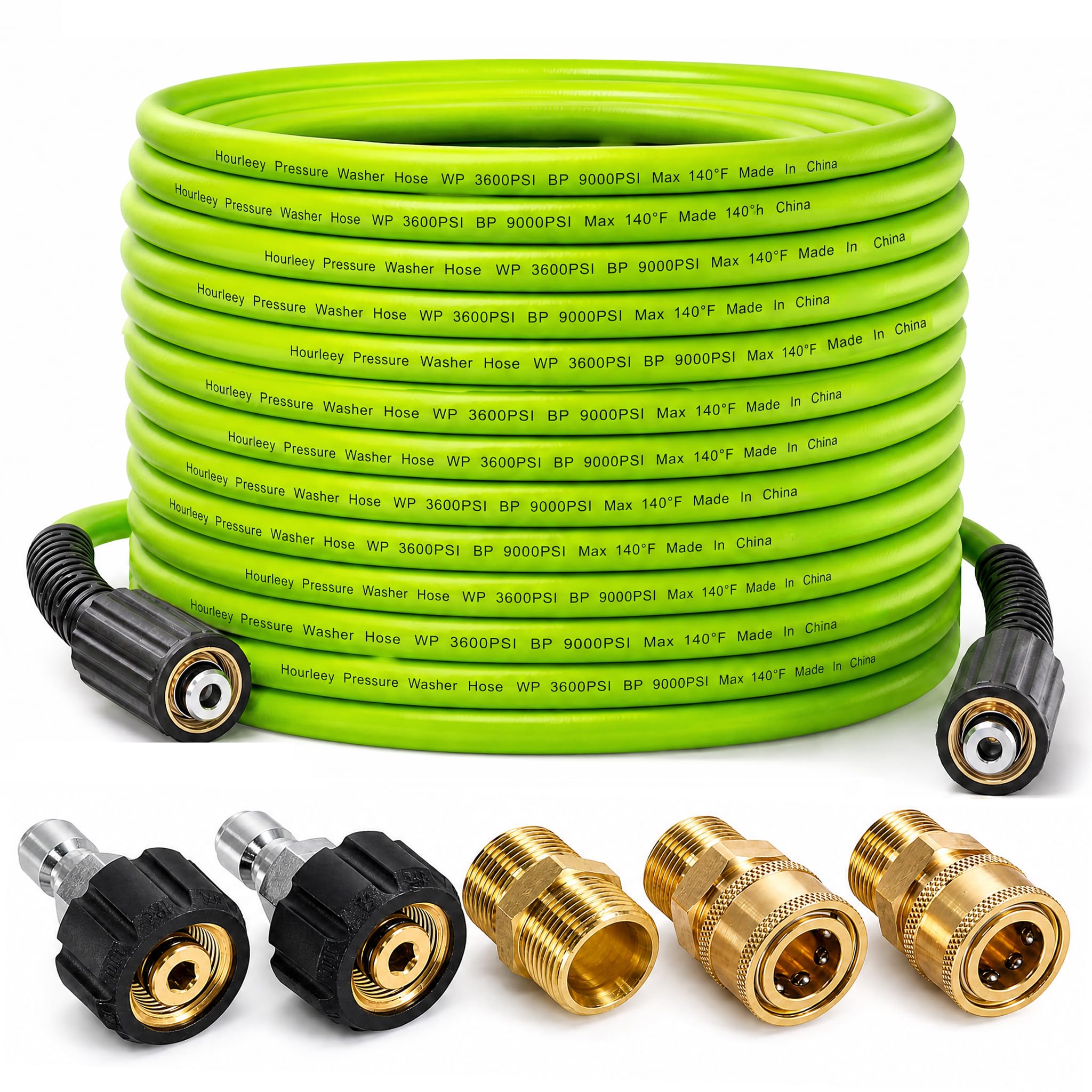
At an entry-level price, the Hourleey delivers a 3600 PSI working pressure hose with a burst pressure of 9000 PSI — a solid safety margin for most residential electric and mid-size gas washers. It comes with five adapters (including M22-14mm to 3/8-inch quick-connect plugs), which makes it a drop-in replacement for a wide range of machines without buying extra parts.
What you give up at this price shows up in real-world construction. Reviewers point out that the hose is “kink resistant but can still kink.” The 1/4-inch outside diameter is listed at 0.25 inches in the specs, but one reviewer noted inconsistent measurements on the product page (0.375-inch wall thickness mentioned elsewhere). One user experienced a leak at the M22 coupler due to a bad o-ring, though the seller replaced parts quickly. The hose is lightweight (2.33 kilograms) and flexible at room temperature, but some buyers found it “a little stiff” when coiling back up.
This is the hose for the budget-conscious occasional user — someone who washes a car or patio a few times a year and does not want to overspend. If you can check for a proper o-ring seal on first use and tolerate a bit of PVC stiffness in cooler weather, the Hourleey offers decent functionality for the money. Just do not expect the supple feel of the TOOLCY or the ruggedness of the steel-braided hoses.
Why we’d pick it
- Affordable price with 3600 PSI rating suitable for most residential washers
- Includes five adapters for broad brand compatibility out of the box
- Lightweight PVC body (2.33 kg) reduces arm fatigue
A few caveats
- Some units reported leaking at the M22 coupler due to o-ring quality
- PVC material feels stiffer to coil than premium flexible hose
6. YAMATIC Pressure Washer Hose 50FT x 1/4″, 3200 PSI

This is the most budget-conscious entry in the list, perfect for the light-duty homeowner who simply needs a 50-foot replacement for a worn-out OEM hose and wants to keep the cost low. At 3200 PSI working pressure and 8700 PSI burst pressure, it is rated for standard residential machines (most gas washers in the 2800-3200 PSI range). Its 1/4-inch inner diameter and PVC construction place it in the light-duty tier compared to the premium 3/8-inch options.
What that money buys you is a straightforward hose with M22-14mm female brass fittings on both ends that fit Ryobi, Troy-Bilt, Greenworks, Craftsman, Honda, and Simpson models. No adapters are included, and it will not work with Karcher, Sun Joe, or AR Blue Clean machines without a separate adapter kit. The outside diameter is 0.5 inches, which is 2x thicker than the Hourleey’s 0.25-inch OD, but it still weighs just 3.6 pounds (1.63 kilograms), making it easy to carry and coil.
The honest trade-off: one buyer mentioned the hose “burst after 2 months” of regular use, though YAMATIC customer service sent a free replacement. Other long-term users say it is “durable and high-quality” and have bought it multiple times over several years. You pay less upfront, but you accept a higher chance of premature failure compared to the TOOLCY or a steel-braided rubber hose.
Strong points
- Lowest upfront cost for a 50-foot pressure washer replacement hose
- Lightweight at 3.6 pounds — easy to carry, coil, and store
- M22-14mm fittings fit most major residential washer brands
Before you buy
- Some units have burst after ~10 uses; warranty replacement required
- No adapters included — not compatible with Karcher, Sun Joe, AR Blue Clean
Understanding the Specs
Working Pressure vs. Burst Pressure
Working pressure is the constant PSI (pounds per square inch) a hose can handle during normal cleaning. Burst pressure is a temporary spike limit — always 3x to 5x higher — and represents the pressure at which the hose would physically rupture. Never use a hose whose working pressure is lower than your washer’s output. A 3200 PSI hose is safe for a 3200 PSI washer, but you lose the safety buffer you would get from a 4000 PSI hose. For peace of mind, pick a hose with a working pressure at least 200-300 PSI above your machine’s rating.
Fitting Compatibility: M22 vs. 3/8-Inch Quick Connect
M22-14mm is a threaded brass fitting (14mm diameter with 1.5mm thread pitch) used on Ryobi, Greenworks, Craftsman, and Honda. The 3/8-inch quick-connect is a push-and-click coupling used on Simpson, Generac, DeWalt, and most gas commercial washers. Some machines use proprietary fittings (Karcher’s “K-series” coupler, Sun Joe’s quick-connect), which always require an adapter. Always check your spray gun and washer outlet before buying — a hose with the wrong fitting type will not attach without extra parts.
Inner Diameter (ID): Flow Rate and Pressure Drop
The inner diameter controls how much water flows through the hose per minute (GPM). A 1/4-inch ID hose is standard for most residential washers up to about 3400 PSI. A 3/8-inch ID hose delivers roughly 40-60% more flow, which prevents pressure drop on longer runs (50+ feet) and is essential for commercial-grade machines that push 4+ GPM. One limitation is weight: 3/8-inch rubber hoses can weigh 12+ pounds versus 3-4 pounds for a 1/4-inch PVC hose, so consider your storage and arm strength before upsizing.
Material: PVC vs. Steel Wire Braided Rubber
PVC (polyvinyl chloride) hoses are lightweight, flexible in warm weather, and affordable — but they stiffen in cold temperatures, are less resistant to abrasion from concrete and gravel, and typically last 1-3 seasons with frequent use. Steel wire braided rubber hoses use a synthetic rubber jacket wrapped around a high-tensile steel braid core. They resist kinks, tolerate hot water (140°F to 212°F), survive being dragged over rough surfaces, and typically last 3-5+ seasons. For occasional car and patio washing, PVC is fine. For daily commercial use, hot-water cleaning, or concrete work, the extra weight of a steel-braided rubber hose is worth the longevity.
FAQ
Can I use a standard garden hose on a pressure washer?
How do I know if my pressure washer uses M22 or 3/8-inch quick-connect fittings?
Why does my new pressure washer hose keep kinking when I uncoil it?
Is a 3/8-inch hose always better than a 1/4-inch hose?
Final Thoughts: The Verdict
Across the board, the power washing hose winner is the TOOLCY Super Flexible 3400 PSI because it delivers the best balance of flexibility, pressure rating, and included adapters at a mid-range price. If you need hot-water capability up to 212°F and a 360° swivel to manage the bulk, grab the YAMATIC 3/8-inch 4000 PSI. And for commercial-grade cleaning where 4800 PSI and steel-braided durability are non-negotiable, the POHIR 3/8-inch 4800 PSI delivers the headroom that no other hose in this lineup matches.