
Your grass needs a last meal before winter shuts it down. Most people think the lawn stops feeding when it gets cold, but in reality the final weeks of fall are when roots build the reserves they need to survive frost and bounce back green in spring. A good winterizer delivers a specific balance of nutrients (nitrogen, phosphorus, and potassium — the N-P-K ratio on the bag) that pushes energy into the roots, not into blades you are about to stop mowing.
I’m Rikta — the co-founder and writer behind Lawn Gear Lab. This guide is built by comparing the manufacturers’ published specifications and the patterns across verified customer reviews, so you get each pick’s real strengths and trade-offs instead of marketing spin.
We sorted through the top formulas by their N-P-K ratios, coverage area, and what experienced lawn buyers report after a full winter cycle, so you can find the best lawn winterizer for your yard size and grass type without guessing.
How To Choose The Best Lawn Winterizer
A lawn winterizer is not the same as the high-nitrogen fertilizer you use in spring. Your goal in fall is to prepare the root system for freezing temperatures and to store carbohydrates for a strong green-up when the ground thaws.
The N-P-K ratio is your first filter
The three numbers on the bag (for example 32-0-10) tell you the percentage of nitrogen (N), phosphorus (P), and potassium (K). For winterizing, you want a low first number (moderate nitrogen so you do not push top growth that will freeze) and a relatively high last number (potassium, which strengthens cell walls in the roots against cold stress). A ratio like 10-0-20 or 32-0-10 is common; a high-phosphorus fertilizer is rarely needed for established lawns in fall.
Slow-release nitrogen matters for feeding duration
Slow-release nitrogen (also labeled as controlled-release or water-insoluble nitrogen) breaks down gradually over weeks or months, feeding the lawn consistently rather than all at once. A winterizer with a high percentage of slow-release nitrogen, such as 50% or 59%, keeps nutrients available as the soil cools, so the grass takes them up steadily without a wasteful flush of growth right before frost.
Coverage area tells you the bag size you need
Winterizer bags list a coverage area in square feet (for example, 5,000 sq. ft. or 15,000 sq. ft.). Measure your lawn’s square footage roughly (length times width of the main lawn area) and pick a bag that covers at least that much, ideally a bit more so you have enough for edges and overlaps. A 45-pound bag covering 15,000 sq. ft. is a lot of material per square foot, which translates to a higher nutrient density per area.
Quick Comparison
On smaller screens, swipe sideways to see the full table.
| Model | Category | Best For | Key Spec | Amazon |
|---|---|---|---|---|
| Jonathan Green (12414) | Premium | Largest coverage per bag | 15,000 sq. ft. coverage | Amazon |
| Fertilome (10895) | Premium | Large established lawns | 10,000 sq. ft. coverage | Amazon |
| Scotts Turf Builder WinterGuard | Popular | Recovery from summer stress | 32:0:10 N-P-K ratio | Amazon |
| Greenview Fairway Formula | Value | Phosphate-free lawns | 59% slow-release nitrogen | Amazon |
| The Andersons Premium | Mid-Range | All turf types with iron green-up | 24-0-14 N-P-K ratio | Amazon |
| Green Thumb GT58105 | Budget-Friendly | Smaller yards on a budget | 32-0-10 with 50% slow-release | Amazon |
In‑Depth Reviews
1. Jonathan Green (12414) Winter Survival Fall Lawn Food

The 15,000-square-foot coverage per 45-pound bag is the largest of any winterizer we evaluated, and the 10-0-20 N-P-K ratio puts potassium front and center for root strength — exactly what your lawn needs before a hard freeze. It is the best fit for owners of large or medium-sized lawns who want a single-bag solution that delivers high potassium to store nutrients for a vigorous spring start without having to layer multiple products.
The slow-release nitrogen feeds the grass gradually so the lawn stays greener later into the fall season without a sudden growth spike. One reviewer noted applying it in early November in the Northeast and seeing “lawn significantly healthier by mid-Dec vs untreated area”, which lines up with the 10-0-20 chemistry designed for sustained release.
The catch is the bag size and granule texture: some reviewers noted the large granules can be tricky to spread evenly with a basic broadcast spreader, so you may need to calibrate your spreader setting carefully. If you want the widest coverage in one trip and a formula built around winter root protection, this is the confident pick.
Why it’s great
- High potassium (20) for root cold-hardiness
- 45 lbs covers 15,000 sq. ft., the largest in this lineup
- Slow-release nitrogen for long winter feeding
Good to know
- Large granules may require spreader calibration
- Heavy 45 lb bag to carry and lift
2. Fertilome (10895) Winterizer for Established Lawns 10-0-14 (40 LBS)
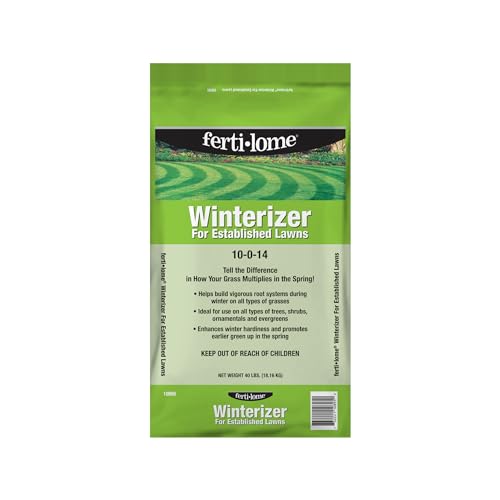
The Fertilome Winterizer falls short of the Jonathan Green on coverage (10,000 square feet versus 15,000) but it leads on application precision for established lawns: its 10-0-14 ratio delivers only 0.4 lbs of nitrogen per 1,000 square feet, which is exactly the low-and-slow dose you want for a final fall application that does not push unnecessary leaf growth. It is the best option if your lawn is already mature and you want a gentle, measured nutrient boost without risking a late-season flush of green blades that will just die back in frost.
At 40 pounds, the bag is lighter and easier to handle than the 45-pound Jonathan Green, and the 10,000 square foot coverage suits mid-size lawns well. One reviewer captured the precision perfectly: “Even in January I can see the spots I missed” — which tells you the granules stay visible on the lawn long enough to avoid overlap gaps.
Choose the Fertilome over the Jonathan Green if your lawn is established (not newly seeded) and you want a lower-nitrogen winterizer that delivers a potassium boost (14) for root resistance, without the higher nitrogen content that could push tender new growth before winter.
Where it shines
- Low nitrogen per 1k sq. ft. (0.4 lbs) — safe for final fall feed
- Visible granules help prevent overlaps and missed spots
- 40 lbs bag is manageable to carry and pour
Worth noting
- Covers 5,000 fewer sq. ft. than the top pick (10k vs 15k)
- Low iron content means less instant greening
3. Scotts Turf Builder WinterGuard Fall Lawn Fertilizer for All Grass Types

If your lawn took a beating from summer heat, drought, or heavy foot traffic, the Scotts WinterGuard is designed to reverse that damage before dormancy. Its 32:0:10 N-P-K ratio delivers more than three times the nitrogen of the Jonathan Green (32 versus 10), which is ideal for turf that needs to rebuild leaf tissue and recover from brown patches before winter sets in — not just store food for spring.
One buyer mentioned the grass staying “bright green and not growing wild” even at 25 degrees Fahrenheit, thanks to the high nitrogen content paired with 10% potassium for root support. The 32.3-pound bag covers 12,000 square feet, putting it mid-pack on coverage but ahead on recovery power. Reviewers consistently mention the visible green-up within days of application after rain soaks the granules in.
The 32% nitrogen is aggressive, so this is not the right choice if your lawn is already lush late in the fall — you could push growth that frost will kill. If your turf is thin, patchy, or stressed from summer, the Scotts is the strongest recovery tool in this list.
What stands out
- High nitrogen (32) for rapid recovery of summer-damaged turf
- 12,000 sq. ft. coverage from a relatively light 32.3 lb bag
- Strong greening even into cold weather
The trade-offs
- High nitrogen can burn lawn if applied too heavily in warm fall
- Not ideal for already-healthy lawns that need only maintenance
4. Greenview Fairway Formula Fall Fertilizer – 22.5 Lb – Covers 7,500 Sq. Ft.

The single number that matters most in this category is 59% — that is the slow-release nitrogen content in the Greenview Fairway Formula Fall Fertilizer, which is 84% more than the Scotts WinterGuard (which has zero slow-release stated). This means the 59:0:0 ratio feeds your lawn steadily for up to 12 weeks without a sudden burst, matching how grass absorbs nutrients as soil cools in late fall.
The downside you accept is the smaller coverage area: 7,500 square feet from a 22.5-pound bag, which is half the reach of the Jonathan Green. It also contains zero phosphate (the 0 in the 59:0:0 ratio), which is great if you want to protect local waterways from phosphorus runoff, but it means the formula focuses purely on nitrogen delivery and root conditioning through potassium.
One long-time buyer summed up the value: the brand says one customer switched to this formula and saw their lawn become a deep kelly green within 2 weeks, staying green through winter into late spring. If you have a smaller yard and want the highest percentage of slow-release nitrogen for extended winter feeding, this is the best price-to-spec ratio in the lineup.
The upsides
- 59% slow-release nitrogen — highest in this list for extended feeding
- Phosphate-free formula protects waterways
- Moisture-proof packaging prevents clumps
Keep in mind
- Covers only 7,500 sq. ft., half the reach of premium picks
- No phosphorus may not suit all soil types
5. The Andersons Premium Fall Lawn Food 24-0-14 Fertilizer 5,000 sq ft Bag
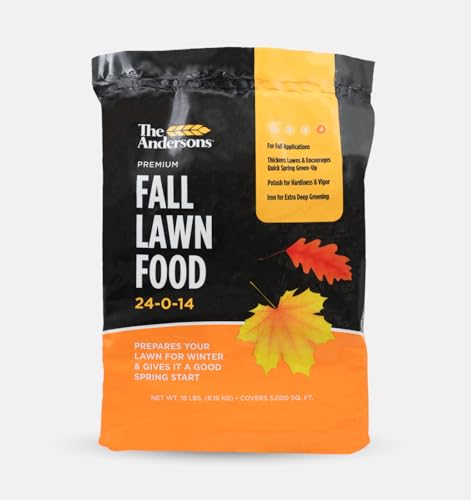
What you actually get at this lower price is a 24-0-14 formula with added iron for deep greening and a triple-release nitrogen system (quick-, intermediate-, and slow-release) that delivers visible color in about a week while still feeding for weeks afterward.
What you give up is coverage: the 18-pound bag covers only 5,000 square feet, making it the smallest-coverage winterizer in this list — a 3x gap compared to the Jonathan Green’s 15,000 sq. ft. That matters if your lawn is larger than a quarter-acre, because you will need two bags. One reviewer wrote that pictures taken 7 weeks after applying it showed new grass sprouting and a deep dark green color.
The Andersons is perfect for the budget buyer with a small-to-medium lawn who wants the most advanced nitrogen release system (three speeds of feeding) and does not mind buying two bags for a bigger yard.
Why we’d pick it
- Triple-release nitrogen for fast greening and long feeding
- Added iron for deep, rich color before winter
- Safe for all turf types
A few caveats
- 5,000 sq. ft. coverage is smallest in this comparison
- 18 lb bag is relatively small for large yards
6. Green Thumb GT58105 Winterizer Lawn Fertilizer, 32-0-10 Formula, 5,000 Sq. Ft.
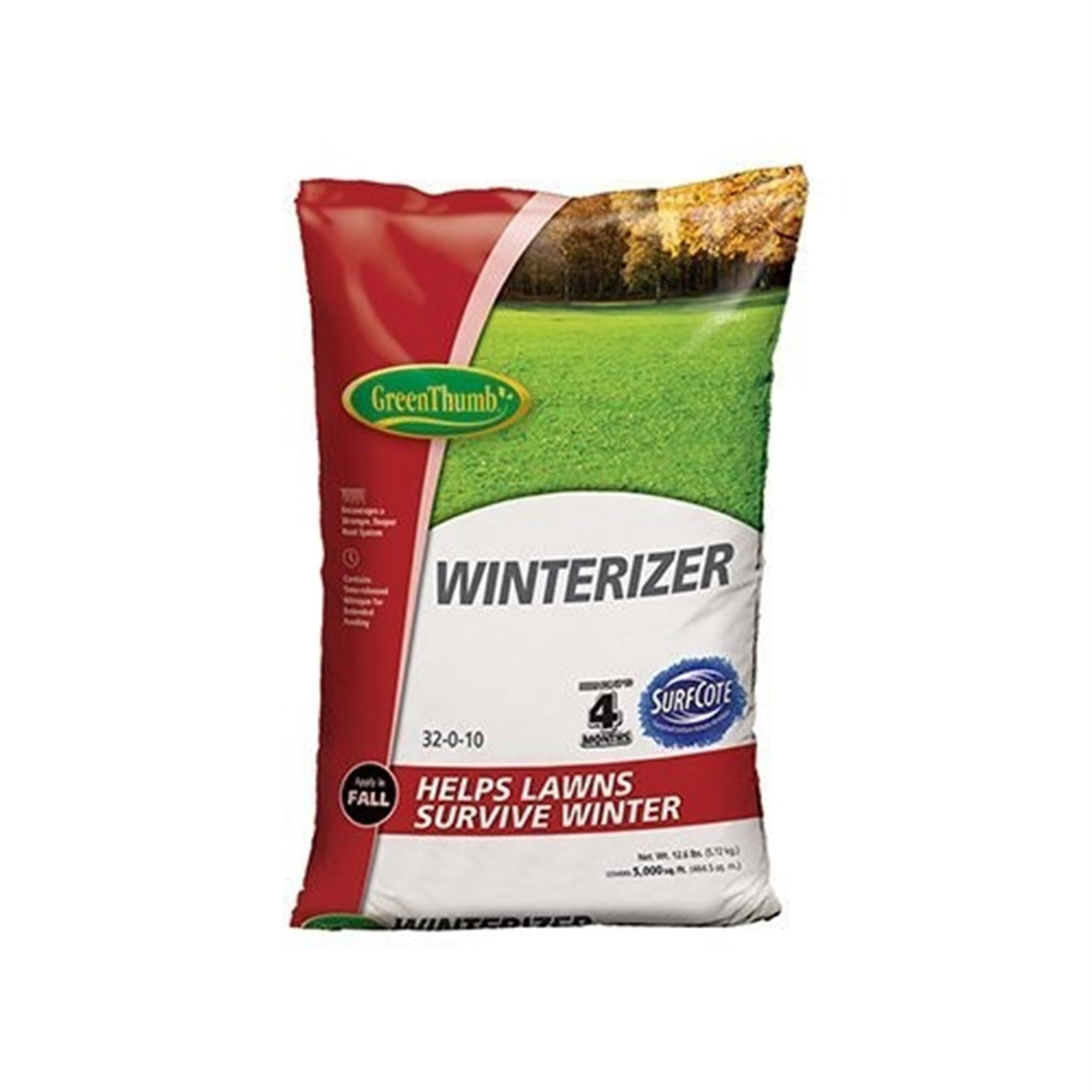
The Green Thumb GT58105 is perfect for the budget-conscious owner with a lawn of 5,000 square feet or less who still wants a solid 32-0-10 winterizer with iron. It gives you a 32-0-10 N-P-K ratio and 50% controlled-release nitrogen at the most accessible price point in this list. That is the same ratio as the popular Scotts WinterGuard, but with half the nitrogen content locked into slow-release form, which means you get the same high-nitrogen recovery boost for stressed lawns without as much risk of a sudden growth surge that could get zapped by frost.
The 2% iron content provides visible greening, and one buyer laid out a precise routine: “Apply Oct 1st, water 5 min daily for 4 weeks, then blow out system,” suggesting the formula responds well to consistent light watering. At 12.6 pounds for 5,000 square feet, the coverage density is lower than premium options — you get less concentrated nutrition per square foot, which is why the bag is lighter and easier to carry.
If your yard is bigger, you will need multiple bags, at which point the larger-coverage options become more economical.
Strong points
- 50% slow-release nitrogen for steady winter feeding
- 2% iron gives quick visible greening
- Light 12.6 lb bag is easy to handle and store
Before you buy
- 5,000 sq. ft. coverage requires multiple bags for larger yards
- Lower nutrient density per sq. ft. than premium winterizers
Understanding the Specs
N-P-K Ratio
These three numbers on the bag stand for Nitrogen (N), Phosphorus (P), and Potassium (K). For winterizers, a high last number (potassium) is essential — it strengthens cell walls in grass roots against frost heave and cold stress. A moderate first number (nitrogen) feeds the lawn without pushing tender new growth that will die when the temperature drops.
Slow-Release Nitrogen
This is the percentage of nitrogen that breaks down gradually over weeks instead of all at once. A higher percentage, like 50% or 59%, means the grass gets a steady supply of food as the soil cools, which prevents wasteful runoff and supports the lawn through the entire winter dormancy period.
Coverage Area
The bag will list a coverage area in square feet (for example, 5,000 or 15,000). This tells you how much ground one bag covers at the recommended application rate. Measure your lawn’s length times width to get your square footage, then choose a bag that covers at least that much.
Iron Content
Some winterizers list iron as a percentage of the formula. Iron does not help with root growth, but it produces a deep green color in the grass blades within days of application. If you want your lawn to look good going into winter (not just survive it), look for a formula that explicitly mentions iron.
FAQ
When should I apply a lawn winterizer?
Can I use a regular lawn fertilizer instead of a winterizer?
Do I need to water in a winterizer after application?
Final Thoughts: The Verdict
For the majority of shoppers, the best lawn winterizer winner is the Jonathan Green (12414) Winter Survival Fall Lawn Food because it covers the most ground at 15,000 square feet with a high-potassium 10-0-20 formula built for deep root protection. If you want a measured, low-nitrogen feed for an established lawn, grab the Fertilome (10895) Winterizer. And for the highest percentage of slow-release nitrogen (59%) in a phosphate-free blend, the Greenview Fairway Formula Fall Fertilizer gives you the most feeding duration per bag.