
You want a lush, green lawn without dandelions, clover, and crabgrass taking over. The right weed-and-feed product handles both jobs in one pass — killing the broadleaf weeds you see while feeding the grass so it thickens and chokes out future invaders. The trick is picking the formula that matches your grass type, your yard size, and your patience for reapplication.
I’m Rikta — the co-founder and writer behind Lawn Gear Lab. This guide is built by comparing the manufacturers’ published specifications and the patterns across verified customer reviews, so you get each pick’s real strengths and trade-offs instead of marketing spin.
Here are five options that deliver visible results for a lawn fertilizer and weed killer while staying affordable.
How To Choose The Best Lawn Fertilizer And Weed Killer
Picking the wrong product means wasted money and a yard full of weeds that just won’t die. Focus on these three things: the form (liquid spray or dry granules), the N-P-K numbers (nitrogen-phosphorus-potassium percentages), and the coverage area.
Liquid vs. Granular: Which applies easier?
Liquid formulas like the Spectracide line use a hose-end sprayer that you simply connect and walk across your yard — no measuring, no spreader. Granular options like The Andersons require a rotary (spinning) or drop (gravity-fed) spreader. Liquids deliver faster weed-killing action because the herbicide (weed-killing chemical) soaks into the leaf immediately, while granules need moisture (rain or watering) to activate. If you have a small to medium yard and want speed, a liquid spray is your best bet.
N-P-K Numbers: What those three digits actually mean
The three numbers on the bag (for example, 20-0-0 or 21-0-3) stand for the percentage of nitrogen (N), phosphorus (P), and potassium (K). Nitrogen drives green leaf growth — the higher the first number, the faster the grass greens up. A zero in the middle means no phosphorus, which is fine for established lawns; phosphorus is mostly for new seedings. The third number, potassium, helps root strength and disease resistance. A weed-and-feed with a 20-0-0 ratio gives you pure nitrogen-driven green-up and weed control without extra minerals you may not need.
Coverage Area: Don’t under-buy or over-pay
A 5,000 sq. ft. bag covers a typical quarter-acre lot. If your yard is larger, you will need multiple units — and some products like The Andersons cover 16,000 sq. ft. from a single bag, which saves money per treatment. Always check the square footage stated on the label, not the weight. A 15-pound bag may cover only 5,000 sq. ft. while a 40-pound bag can cover triple the area. Buying the wrong coverage leads either to spotty results or wasted product.
Quick Comparison
On smaller screens, swipe sideways to see the full table.
| Model | Category | Best For | Key Spec | Amazon |
|---|---|---|---|---|
| Scotts Turf Builder Weed and Feed 3 | Liquid Spray | Medium yards wanting deep green results fast | Covers 5,000 sq. ft. per bottle | Amazon |
| The Andersons Professional Surge | Granules | Large lawns needing professional-grade coverage | Covers 16,000 sq. ft. | Amazon |
| Spectracide Weed & Feed (3-Pack) | Liquid Spray | Repeat applications on large yards | 96 oz total, 7,500 sq. ft. per bottle | Amazon |
| Jonathan Green Green-Up Weed & Feed | Granules | Slow-release feeding for up to 3 months | 21-0-3 N-P-K ratio | Amazon |
| Spectracide Weed & Feed Ready-to-Spray | Liquid Spray | Budget-friendly spot treatment for small yards | 32 oz bottle covers 7,500 sq. ft. | Amazon |
In‑Depth Reviews
1. Scotts Turf Builder Weed and Feed 3, 5,000 sq. ft.
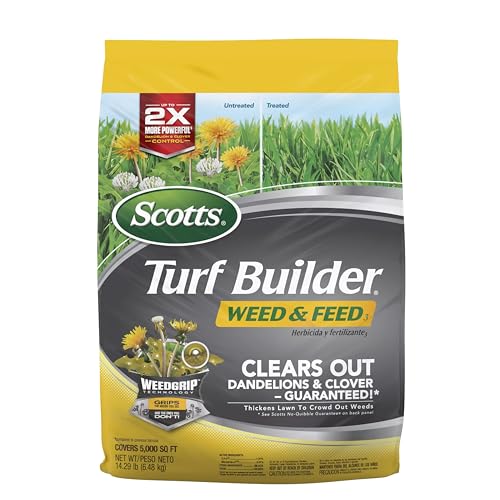
5,000 sq. ft. coverage per bottle and the fastest visible green-up make the Scotts Turf Builder Weed and Feed 3 the top pick for homeowners whose main problem is dandelions and who want fast results. It uses WeedGrip Technology to latch onto weeds you see and the ones still hiding, delivering up to 2X more powerful dandelion and clover control than the older Scotts formula, according to the brand. The liquid spray connects to your hose, so you simply walk the yard aiming where needed.
Buyers report that after two treatments their lawn was “thicker, more even, weeds thinned,” and that the hose attachment with its on/off lever made application simple. It covers a 5,000 sq. ft. lot in one bottle, which is typical for this category. The formula feeds with a nitrogen-heavy mix that greens grass visibly within days — one reviewer noted their Bermuda grass turned “beautiful dark green” right after spraying.
The honest trade-off is that while it demolishes dandelions, it struggles with crabgrass and clover — one buyer mentioned it “didn’t kill my crab grass or clover but no dandelions.” For the best results on a medium yard full of broadleaf weeds, this is the one to beat. skip it if crabgrass or clover are your primary weeds, because you will need a granular option like The Andersons instead.
Why it’s great
- 2X more powerful dandelion/clover control versus older formula
- WeedGrip Technology grabs hidden weeds
- Easy hose-end sprayer, no spreader needed
- Leaves grass dark green and thick
Good to know
- Not effective on crabgrass or clover
- Strong chemical smell during application
- Avoid walking on treated areas for 2-3 days
2. The Andersons Professional Surge Weed and Feed 16-0-9 (40 lb)
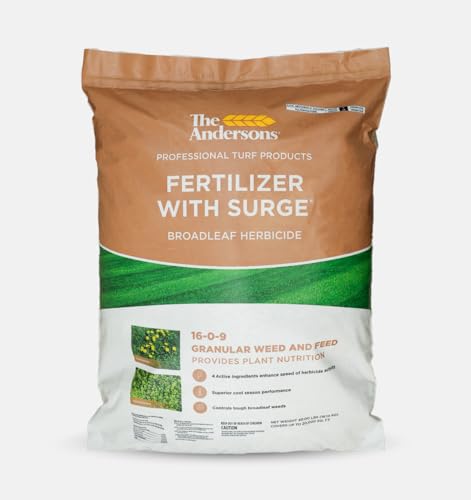
Large lawns get 3.2X the coverage of the Scotts Turf Builder here — The Andersons Surge covers 16,000 sq. ft. from a single 40-pound bag versus 5,000 sq. ft. from the Scotts. But it is a granular format, so you will need a rotary (spinning) or drop (gravity-fed) spreader and you must water it in after application to activate the herbicide (weed-killing chemical).
Where it truly shines is on stubborn weeds like creeping charlie (a fast-spreading ground ivy) and crabgrass that liquid sprays often miss. One owner reported, “I tried a lot of pre emergents and could not prevent crabgrass or kill creeping charlie. I used this product this year and so far I see no creeping charlie.” The 16-0-9 N-P-K ratio (16% nitrogen, 0% phosphorus, 9% potassium) gives you a balanced nitrogen dose for green growth plus potassium for root strength — something most weed-and-feed products skip entirely.
Choose The Andersons if your yard is a half-acre or larger, or if creeping charlie and crabgrass have taken hold. The catch is that a few reviewers felt it was no better than cheaper brands for basic broadleaf weeds, so it is best reserved for the tough stuff. If your yard is under 5,000 sq. ft., you are better off with a smaller bag like the Jonathan Green to avoid waste.
Where it shines
- Covers 16,000 sq. ft. per bag — largest in this guide
- Eliminates over 250 weed types including creeping charlie
- Professional-grade performance year-round
- Includes potassium for root health
Worth noting
- Requires a spreader and watering-in
- Not for Floratam St. Augustine or dichondra
- Some reviewers found similar results with cheaper brands
3. Spectracide Weed & Feed 20-0-0, 3 Count (96 oz total)
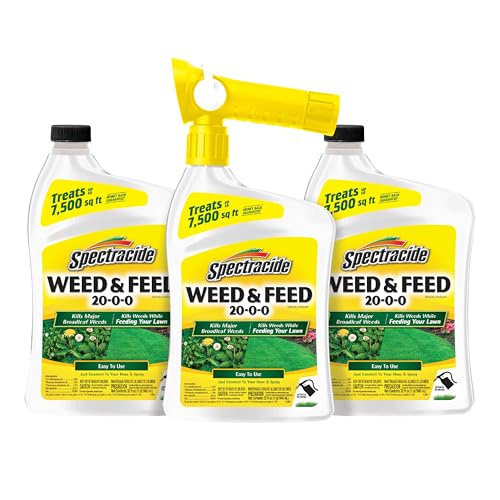
If you have a yard larger than 7,500 sq. ft. and plan to apply weed-and-feed multiple times through the growing season, this three-pack saves you from buying separate bottles each time. Each 32-ounce bottle treats up to 7,500 sq. ft., for a combined coverage of 22,500 sq. ft. — so you can hit your whole yard three times from one purchase. That is a 3.0X liquid volume advantage over the single-bottle Spectracide ready-to-spray version.
Owners mention that the formula “kills weeds and feeds grass; one bottle covers 2400 sq ft house yard” and that the QuickFlip sprayer (a lever that starts and stops flow) makes hose attachment simple. The 20-0-0 nitrogen ratio provides a rapid green-up — one customer observed weeds turned white within a few days and the grass fed noticeably after two weeks with rain. The three-pack comes with one nozzle that you reuse, so you only need to swap bottles.
The standout spec here is the 96-ounce total liquid volume — enough for three full treatments on a typical suburban lot at a cost that works out to less than many single-bottle competitors. This is the value-winning middle path for mid-sized yards: more coverage than the single-bottle Spectracide but less commitment than the giant Andersons bag.
What stands out
- Three bottles for multiple applications in one purchase
- Covers 22,500 sq. ft. combined
- QuickFlip sprayer is easy to use
- Safe for St. Augustine grass
The trade-offs
- Does not kill all weed types (lawn violets may need repeat treatment)
- Salty smell lingers for days after application
- Avoid use above 85°F
4. Jonathan Green (12344) Green-Up Weed & Feed – 21-0-3

21-0-3 is the single number that matters most in this category, and this product scores the highest first number in this guide — 21% nitrogen for the strongest green-up punch. That powers your grass for up to 3 months because the granules release nutrients gradually (a slow-release mechanism built into the particle) rather than all at once. It controls over 250 broadleaf weeds, including dandelion, chickweed, clover, and even tough ones like poison ivy.
The downside is that, as customers note, some weeds may not die. One user highlighted, “Applied as directed and noticed the lawn to get nice and green..but so did the weeds! Didn’t kill any weeds…which is what I needed!” The fine particle size is designed to feed grass while weeds disappear over time, but results depend heavily on timing — it works best when weeds are actively growing in late spring or early fall.
If your main priority is thick, dark green grass and you can accept slower weed die-off, the Jonathan Green delivers long-term feeding that most liquid sprays cannot match for a single application. Pick this one over the Scotts if you hate reapplying and want a single treatment to last months rather than weeks — a strong price-to-value read for those prioritizing feeding over fast weed kill.
The upsides
- 21-0-3 ratio provides powerful, long-lasting green-up
- Feeds gradually for up to 3 months
- Controls over 250 broadleaf weed types
- Fine particles for even coverage
Keep in mind
- Weed killing may be inconsistent for some users
- Small 15-lb bag covers only 5,000 sq. ft.
- Cannot be used at the same time as seeding a new lawn
5. Spectracide Weed & Feed 20-0-0 (Ready-to-Spray) 32 oz
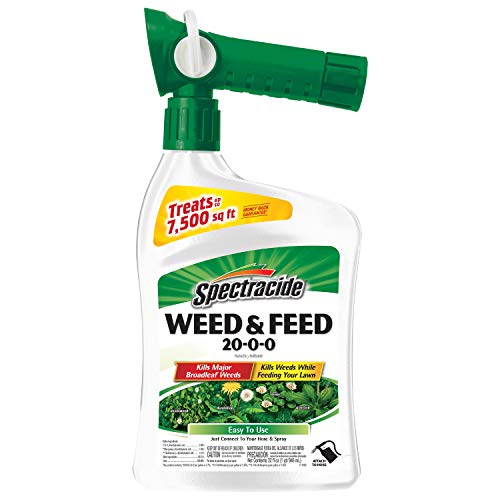
What you actually get at this lower price is a single 32-ounce bottle that covers 7,500 sq. ft., making it the most entry-level option in the lineup — perfect for a small suburban yard or a first-time user who just wants a simple, one-bottle solution. The Ready-to-Spray design means you screw it onto your hose, flip the lever, and walk the yard. No measuring, no spreader, no mixing.
What you give up compared to the three-pack is quantity — this is one bottle versus three, so you will need to buy again if your yard needs a second application. But the formula is identical: 20-0-0 nitrogen to feed grass and a broadleaf weed killer that targets dandelion, chickweed, clover, and plantain. One shopper added it “covers entire yard (2400 sq. ft. house) with one bottle; kills weeds (turning white) and feeds grass.”
This is the right pick if your lawn is under 7,500 sq. ft., you want the lowest upfront cost, and you are okay reapplying later if some weeds survive — exactly the budget buyer who wants a proven spray without overcommitting. For one-and-done simplicity on a small lot, nothing in this guide costs less or applies faster.
Why we’d pick it
- Lowest upfront cost for a single treatment
- Covers a full 7,500 sq. ft. from one bottle
- Easy hose-end sprayer, no spreader
- Safe for St. Augustine grass
A few caveats
- Single bottle only — need to buy again for repeat treatment
- Not effective on all weed types (e.g., lawn violets)
- Salty odor lingers after use
Understanding the Specs
N-P-K Ratio: What each number does for your grass
The three hyphenated numbers tell you the percentage of nitrogen (N), phosphorus (P), and potassium (K) in the bag. A 20-0-0 formula has 20% nitrogen — that drives fast green leaf growth. The zero in the middle means no phosphorus, which is fine for established lawns that do not need new root growth from seed. The third number (0 or 3 or 9) is potassium, which strengthens cell walls and helps grass survive heat and disease. For weed-and-feed products, the first number is the one that matters most because you want visible greening fast.
Coverage Area: How to match product to yard size
Every product lists the square footage it treats per bag or bottle — from 5,000 sq. ft. for the Jonathan Green and Scotts up to 16,000 sq. ft. for The Andersons. To choose correctly, measure your lawn’s square footage (length x width of each section, add them up). If your yard is 10,000 sq. ft., a 5,000 sq. ft. bag means you need two bags. If you buy the Andersons, one bag does the whole job. Overshooting coverage is better than undershooting because spotty application leaves weed patches.
FAQ
Should I apply weed and feed before or after rain?
Can I use weed and feed on St. Augustine grass?
Why did my weeds not die after using weed and feed?
Final Thoughts: The Verdict
Across the board, the lawn fertilizer and weed killer winner is the Scotts Turf Builder Weed and Feed 3 because it delivers the fastest visible results with the easiest hose-end application and 2X more powerful weed control than its predecessor, per the brand. If you have a large lawn or tough creeping charlie, grab the The Andersons Professional Surge. And for the best value per treatment on a mid-sized yard, the Spectracide Weed & Feed 3-Pack gives you the most liquid coverage per dollar.