
Getting big, juicy tomatoes starts with what you put in the soil. But with so many bags and bottles on the shelf, it is easy to grab the wrong thing and end up with lots of leaves and hardly any fruit. This guide walks you through the six most important numbers (called N-P-K ratios) you need to read on a label and the seven top-rated fertilizers that match what your tomato plants actually need at different stages of growth.
I’m Rikta — the co-founder and writer behind Lawn Gear Lab. This guide is built by comparing the manufacturers’ published specifications and the patterns across verified customer reviews, so you get each pick’s real strengths and trade-offs instead of marketing spin.
Finding a reliable fertilizer for tomatoes means picking a formula that balances root strength, leaf growth, and fruit production without burning your plants. Whether you are planting in a raised bed, a container on a balcony, or a full garden row, the right N-P-K ratio (the three numbers that stand for Nitrogen, Phosphorus, and Potassium) makes the difference between a leafy bush and a plant loaded with fruit.
How To Choose The Best Fertilizer For Tomatoes
Tomatoes are heavy feeders, meaning they pull a lot of nutrients from the soil over a single growing season. Picking the right fertilizer is about matching the N-P-K ratio (the three numbers on every bag that stand for Nitrogen, Phosphorus, and Potassium) to what your plant is doing at that moment — growing leaves early on or setting fruit later.
The N-P-K Ratio and What It Does for Your Tomatoes
The first number (Nitrogen) drives leafy green growth. The second number (Phosphorus) supports root development and flower formation. The third number (Potassium) boosts overall plant health and fruit quality. For tomatoes, you usually want a middle or lower first number and a higher second and third number once flowers appear so the plant focuses energy on fruit instead of just leaves.
Calcium — The Blossom End Rot Preventer
A dark, sunken spot on the bottom of your first ripe tomato is blossom end rot, and it is almost always caused by a calcium deficiency. Look for a fertilizer that lists calcium on the label or contains ingredients like bone meal or gypsum so your fruit stays smooth from top to bottom.
Slow-Release Spikes vs. Liquids vs. Granular Mixes
Spikes (like the Jobe’s pick below) are the easiest — you push them into the soil and they feed for weeks without any mixing. Liquids (like the Bloom City pick) work fast and are great for container plants but require you to mix and apply every week or two. Granular mixes (like the Down To Earth and FoxFarm picks) need to be worked into the soil and watered in, but they offer the most control over exactly what your plants get.
Quick Comparison
On smaller screens, swipe sideways to see the full table.
| Model | Category | Best For | Key Spec | Amazon |
|---|---|---|---|---|
| Jobe’s Tomato Fertilizer Spikes | Spikes | No-measure feeding | N-P-K 6-18-6 | Amazon |
| Cz Garden 5-10-10 | Granules | Strong fruiting late-season | N-P-K 5-10-10 | Amazon |
| Bloom City Liquid Fertilizer | Liquid | Fast-acting container feeding | Liquid form | Amazon |
| Down To Earth 4-6-2 | Organic Granules | Gentle soil building | OMRI-listed organic | Amazon |
| FoxFarm Happy Frog 5-7-3 | Granules | Vigorous fruit production | N-P-K 5-7-3 | Amazon |
| Espoma Garden-tone 3-4-4 | Organic Granules | Monthly all-season feeding | Bio-tone formula | Amazon |
| Espoma Tomato-tone 3-4-6 | Organic Powder | Maximum fruit on every plant | 8% calcium | Amazon |
In‑Depth Reviews
1. Jobe’s Tomato Fertilizer Spikes 6-18-6

6-18-6 N-P-K ratio, pre-measured and time-released for two months of feeding — Jobe’s Tomato Fertilizer Spikes are for the hands-off gardener who wants consistent results without measuring or mixing.
You simply push the 18 spikes (two packs included) into the soil around each plant. The time-release formula works below the surface where the active roots are growing — there is no wasteful runoff, no messy smell, and no hazard of over-mixing. One reviewer noted that “these tomato spikes are the best! They saved my tomato plants,” which lines up with the steady 8-week feeding cycle the manufacturer specifies. At a very light 8.8 ounces total, the whole two-pack is easy to store and handle, and each spike is pre-measured so you cannot accidentally dump too much.
The catch is that you cannot adjust the ratio mid-season — once they are in the ground, the 6-18-6 formula is locked in. That makes these spikes best for the hands-off gardener who wants consistent results. If you need to tweak nutrients week by week (like heavy phosphorus pushes), skip these and look at the granular Cz Garden 5-10-10 instead, which lets you control dosage per feeding. For effortless, set-and-forget feeding, Jobe’s spikes are the top pick.
Why it’s great
- Pre-measured spikes mean zero mixing or measuring
- Feeds continuously for 8 weeks straight
- No runoff, no smell, and no mess to clean up
Good to know
- Cannot change the ratio once spikes are in the soil
- Not ideal for container plants with limited root space
2. Cz Garden 5-10-10 Tomato & Vegetable Fertilizer

Compared to the Jobe’s 6-18-6 spikes, the Cz Garden 5-10-10 delivers a lower Nitrogen number but doubles the Phosphorus and Potassium in its ratio — 10-10 versus 6-18-6’s 18 Phosphorus — making it a stronger late-season fruiting choice when plants already have plenty of green growth and need to set fruit.
Each 4-pound bag comes in a resealable, heavy-duty pouch so you can spoon out exactly what you need (about 1 to 2 tablespoons per plant every two weeks during fruiting) without worrying about moisture ruining the rest. One buyer called it “effective late-season veggie fertilizer for fruiting” and noted that the colored beads make it easy to see where you have already applied it around the drip line. The downside is that this is a synthetic granule, not an OMRI (Organic Materials Review Institute)-listed organic, so it works fast but does not build long-term soil microbiology the way organic blends do.
If you want organic soil health, pick the Down To Earth 4-6-2 instead; choose this Cz Garden over the top pick if you are a gardener focused on maximizing late-summer yield in an existing garden bed.
Where it shines
- High 5-10-10 ratio pushes heavy fruiting late in the season
- Resealable pouch keeps granules dry and easy to store
- Very clear instructions help avoid plant burn
Worth noting
- Synthetic formula does not build soil microbiology
- Requires mixing into soil and watering in each time
3. Bloom City Tomato & Veggie Plant Food – Liquid Fertilizer

A liquid fertilizer delivers nutrients fast to container roots because the soil volume is small — this 32-fluid-ounce concentrate from Bloom City mixes at 2 ounces per gallon of water and feeds a single plant all season. For patio or balcony growers, this is often the most practical choice because the roots have a much smaller volume of soil to draw from and need nutrients they can drink immediately.
One buyer mentioned “this made a huge difference in my tomato plant” and mentioned that the bottle fed a single plant through the entire season with plenty left over for next year — a testament to how far a 32-fluid-ounce bottle stretches when you are only feeding one or two containers. The liquid form absorbs into the root zone within minutes, so you see results on leaf color and new growth in just a few days rather than waiting weeks. The trade-off is that you need to mix and apply it weekly or bi-weekly, which is more hands-on than the Jobe’s spikes (32 fluid ounces of liquid vs. 8.8 ounces of solid spikes). This is the go-to for container growers who value fast action and precise control, but skip it if you have a large in-ground garden — the weekly mixing becomes a chore compared to granular options like the Cz Garden 5-10-10.
What stands out
- Absorbs into roots within minutes for fast results
- 32-ounce bottle feeds multiple plants for an entire season
- Easy to mix with a watering can or hose sprayer
The trade-offs
- Requires weekly or bi-weekly mixing and application
- Less suitable for large in-ground gardens due to frequency
4. Down To Earth All Natural Fertilizers Organic All Purpose Tomato & Vegetable Mix 4-6-2

The OMRI (Organic Materials Review Institute) listing on the bag tells you this product is certified for organic production — that is the single most important number for organic growers, not the N-P-K itself. This Down To Earth mix carries that listing and uses eight natural ingredients including fish bone meal, blood meal, feather meal, rock phosphate, langbeinite (a potassium-magnesium mineral), greensand (a marine-deposit mineral), humates (organic matter compounds), and kelp meal to deliver a gentle 4-6-2 blend that feeds the soil microbes as much as it feeds the plant.
One limitation for this all-natural approach is a lower phosphorus number (6) compared to the Cz Garden 5-10-10 (10) — a 40% gap — meaning this mix is better suited for early-season soil building and transplanting than the heavy fruiting push you might want in late July. One owner reported that it “revived pale, flimsy tomato plants within two weeks after application,” which shows that the gentle organic ingredients still pack enough punch to turn around struggling plants. The compromise mentioned in reviews is a noticeable smell (from the fish and blood meals) that dissipates after a few days in the soil.
This is the pick for the certified-organic grower who wants to build soil health long-term; if you just want the strongest fruit push, the FoxFarm Happy Frog 5-7-3 has a higher phosphorus count. For the price, you get a multi-ingredient organic mix with OMRI certification that delivers long-term soil value rather than a short-term bloom spike.
The upsides
- OMRI-listed for certified organic gardening
- Eight natural ingredients build soil health long-term
- Gentle, non-burning formula safe for transplants
Keep in mind
- Noticeable fishy smell for a few days after application
- Lower phosphorus than synthetic fruiting blends
5. FoxFarm Happy Frog Tomato & Vegetable Fertilizer 5-7-3

What you actually get at this lower price is a 4-pound bag of 5-7-3 N-P-K granules that includes calcium to prevent blossom end rot and mycorrhizal fungi to improve nutrient uptake, plus no strong chemical or fishy odor. The FoxFarm Happy Frog line has a passionate following among growers willing to invest in a proven brand name for noticeably bigger plants and earlier fruit.
The real-world results come through in the reviews, where one buyer wrote that “tomatoes produced baby fruit days after feeding” and specifically credited the calcium for preventing the blossom end rot that ruined their previous harvests. The 4-pound bag is heavy enough to feed a medium-sized garden for a full season, and users report that the granules are easy to apply, have no strong chemical or fishy odor, and do not burn roots even when applied a bit generously. The one honest limit is the price point relative to the bag size — at 4 pounds it is the same weight as the Espoma Garden-tone bag but costs more per pound, so budget-conscious growers feeding a very large garden may find better value in the Espoma Tomato-tone 3-4-6.
This premium pick makes sense if you want the calcium and mycorrhizae benefits without smelling fish meal, but pass on it if your priority is saving money per pound. It is perfect for the budget buyer who wants a small, odorless bag with blossom-end-rot prevention for a medium-sized garden and is willing to pay a bit more per pound for those extras.
Why we’d pick it
- Calcium included to prevent blossom end rot
- Mycorrhizal fungi improve root nutrient uptake
- No strong chemical or fishy smell during application
A few caveats
- Higher cost per pound than some bulk organic blends
- Not OMRI-listed for certified organic production
6. Espoma Organic Garden-tone 3-4-4

This all-season formula is perfect for the mixed-vegetable gardener who wants one bag that can safely feed tomatoes, lettuce, and melons without risking burn. The 3-4-4 N-P-K ratio is lower across the board than the FoxFarm 5-7-3, but Espoma compensates with its exclusive Bio-tone formula, which contains beneficial microbes and 5% calcium to support root health and prevent fruit disorders.
The biggest selling point here is the value — you get two 4-pound bags per order, giving you 8 pounds total, which is double the weight of the FoxFarm Happy Frog bag for a comparable price. One enthusiastic reviewer in zone 10b reported harvesting 400 pounds of tomatoes from a garden fed with Espoma products, attributing the sustained performance to the monthly feeding schedule that the brand recommends. Garden-tone is approved for organic gardening and is made in the USA by a company that has been in the natural organics business since 1929.
If you have a mixed vegetable garden and want one bag for everything, this is your winner; go to the Tomato-tone if you are growing mostly tomatoes and want maximum fruit. The only real drawback is the lower phosphorus number (4) compared to dedicated tomato blends like the Espoma Tomato-tone (6), so heavy-fruiting gardeners may want to top-dress with something stronger during peak production.
Strong points
- Two 4-pound bags give you 8 pounds total at a great value
- Bio-tone formula includes beneficial soil microbes
- Safe enough to use on all vegetables without burning
Before you buy
- Lower phosphorus than dedicated tomato-specific blends
- Has a mild smell that some users note in reviews
7. Espoma Organic Tomato-tone 3-4-6 with 8% Calcium
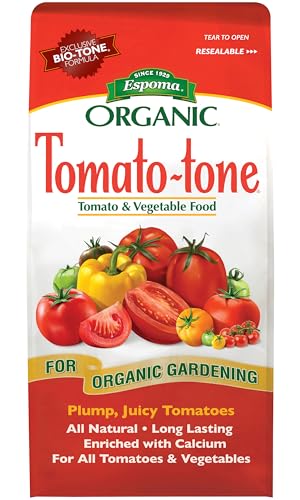
For the money, Espoma Organic Tomato-tone 3-4-6 with 8% Calcium sits at a premium price tier but offers the best raw volume among premium picks on this list, delivering three 4-pound bags (12 pounds total) in a single order. Compared to the all-purpose Garden-tone (3-4-4) from the same brand, Tomato-tone bumps the potassium up to 6 and adds a notable 8% calcium, giving you a formula specifically focused on fruit size and flower production over leaf growth.
The 8% calcium directly targets blossom end rot prevention, and the 3-4-6 N-P-K ratio provides just enough nitrogen to stay green (3), enough phosphorus to keep blooming (4), and a generous dose of potassium (6) to swell each fruit. One long-time user reported using Tomato-tone for six consecutive years and consistently getting “beautiful, bountiful, best-ever tomatoes” by applying it at planting time and side-dressing every three weeks. The 12-pound total beats the Garden-tone two-pack on overall weight and is a better fit for serious gardeners with multiple raised beds or a large row garden.
The only reason to choose the Garden-tone instead is if you are growing a very mixed vegetable garden and want one bag for everything — because Tomato-tone is specifically formulated for tomatoes and similar fruiting crops. Its powder form can be dusty during application compared to granules. The one clear reason to choose it is if you want a tomato-specific formula with extra calcium to prevent blossom end rot and maximum potassium for fruit swelling, all in the largest total weight among premium-tier picks.
What we like
- 8% calcium directly prevents blossom end rot
- Three bags give you 12 pounds total, great for large gardens
- Approved for organic production with a proven track record
The downsides
- Specifically for tomatoes and fruiting veggies, not all-purpose
- Powder form can be dusty during application compared to granules
Understanding the Specs
N-P-K Ratio
These three numbers are the backbone of every fertilizer label. Nitrogen (N) fuels leaf and stem growth. Phosphorus (P) drives root development and flower formation. Potassium (K) strengthens the plant and improves fruit quality. For tomatoes, look for a ratio where the middle and last numbers are equal to or higher than the first once flowers appear, so the plant puts energy into fruit rather than endless leaves.
Time Release vs. Fast Release
A time-release formula (like the Jobe’s spikes) meters out nutrients slowly over weeks so you only apply once. A fast-release liquid (like the Bloom City) delivers nutrients instantly but requires more frequent application. Granular products fall in between — they break down over days or weeks depending on soil moisture and temperature.
FAQ
What does an N-P-K ratio of 6-18-6 mean for my tomato plants?
Can I use a general vegetable fertilizer on tomatoes, or do I need a tomato-specific one?
How often should I fertilize my tomato plants during the growing season?
Final Thoughts: The Verdict
For the majority of shoppers, the fertilizer for tomatoes winner is the Jobe’s Tomato Fertilizer Spikes because the pre-measured 6-18-6 spikes eliminate all guesswork and feed steadily for 8 weeks without any mixing or measuring. If you want the most fruit-focused organic formula with 8% calcium to stop blossom end rot, grab the Espoma Tomato-tone 3-4-6. And for container gardeners who need fast-acting liquid nutrition, the Bloom City Liquid Fertilizer 32-ounce bottle keeps one or two plants happy all season long.