
Your plant looks perfectly healthy, but it stops growing. You check the water, the light, the fertilizer. The real problem is likely hiding in the soil’s pH (a scale from 0 to 14 that tells you how acidic or alkaline your soil is). When the pH is off, your plant cannot soak up the nutrients it needs. These meters solve that problem — they give you a direct reading of your soil’s chemistry so you can fix it fast. For most gardeners, the YINMIK Digital Soil pH Meter wins because it offers 3-point auto calibration (the gold standard for accuracy) and Bluetooth data logging, all for a price that undercuts lab-grade tools.
I’m Rikta — the co-founder and writer behind Lawn Gear Lab. This guide is built by comparing the manufacturers’ published specifications and the patterns across verified customer reviews, so you get each pick’s real strengths and trade-offs instead of marketing spin.
Choosing the right ph tester for soil is the single most impactful tool you can add to your gardening routine for healthier, more productive plants.
How To Choose The Best pH Tester For Soil
Not every soil pH tester works the same way. Some measure only pH, while others bundle in moisture, light, and fertility readings. The key is matching the tool’s capabilities to your actual gardening habits and the types of soil you work with.
Digital vs. Analog: What Each Actually Tells You
A digital meter shows an exact number on an LCD screen, which removes the guesswork of interpreting a needle on a dial. An analog meter (the kind with a moving pointer) is simpler and often cheaper, but it demands careful reading and a steady hand. For precision work — like adjusting soil for blueberries or tomatoes — a digital unit saves you from second-guessing the needle position.
Probe Length and Build Quality
For deep-rooted plants or outdoor garden beds, a longer probe (around 7 to 12 inches) reaches the root zone where the pH actually matters. Shorter probes (around 3 to 5 inches) work fine for small potted plants. The probe material also matters: stainless steel resists rust and corrosion, while cheaper metals can degrade and throw off readings over seasons of use.
Calibration: The Difference Between Trustable and Guesswork
A pH meter that you can recalibrate with buffer solutions (pre-mixed liquids with a known pH value) is far more reliable over time than a sealed, calibration-free unit. If you are serious about accuracy — especially for finicky plants or large soil batches — look for a meter that allows at least a 2-point or 3-point auto calibration. Meters without calibration tend to drift, meaning their readings slowly become less accurate as the sensor ages.
Quick Comparison
On smaller screens, swipe sideways to see the full table.
| Model | Category | Best For | Key Spec | Amazon |
|---|---|---|---|---|
| YINMIK Digital Soil pH Meter | Premium | Serious gardeners needing app logging & calibration | Bluetooth / 3-point auto calibration | Amazon |
| LUVCOSY Digital Soil pH Meter | Mid-Range | Gardeners wanting fuss-free, calibration-free precision | Industrial-grade / 5-year battery life | Amazon |
| Luster Leaf Rapitest 4-Way | Mid-Range | Gardeners who want pH, moisture, light & temp in one tool | 4-way digital / corded probe | Amazon |
| HSLGOVE 7-in-1 Soil Test Kit | Budget | Beginners who want a wide range of readings on a budget | 7 functions / dual-screen design | Amazon |
| Gain Express Soil pH Meter | Budget | Gardeners needing a long probe for deep soil testing | 295mm electrode / no batteries needed | Amazon |
In‑Depth Reviews
1. YINMIK Digital Soil pH Meter

The YINMIK Digital Soil pH Meter earns its top spot because it lets you perform a 3-point auto calibration (adjusting the meter to match known pH values of 4, 7, and 10) using included buffer powders, so you verify accuracy yourself instead of trusting a factory setting — a big step up from the calibration-free LUVCOSY. It pairs with the YINMIK app via Bluetooth to log pH readings over time, which means you track how your soil changes week by week without writing anything down.
At 13.7 ounces, it is noticeably heavier than the HSLGOVE at 4.8 ounces, but that weight comes from a replaceable glass-tipped electrode and a stainless steel dibber (a pointed tool) that protects the probe when you push into hard or dry ground. Buyers report that dry soil gave false alkaline readings (8.4-8.6) but that proper dampness yielded accurate 6.4-6.8 readings — a clear signal that soil moisture matters for any pH meter. The kit also includes an extra electrode, six calibration buffer packets, a cleaning brush, and a dropper, making this one of the most complete packages available.
Some users noted the glass probe is fragile if you jab it into rocky soil, and the accuracy depends heavily on your soil being moist enough for a true reading. This meter suits the gardener who wants the deepest insight into soil chemistry and is willing to follow calibration steps for reliable data — skip it if you want instant readings with zero setup.
Why it’s great
- Automatic temperature compensation (ATC) keeps readings accurate across seasons
- Bluetooth data logging eliminates manual record-keeping
- Includes spare electrode, stainless steel dibber, and full calibration kit
Good to know
- Glass probe is delicate and requires careful handling in rocky soil
- Requires moist soil for repeatable, accurate readings
2. LUVCOSY Digital Soil pH Meter
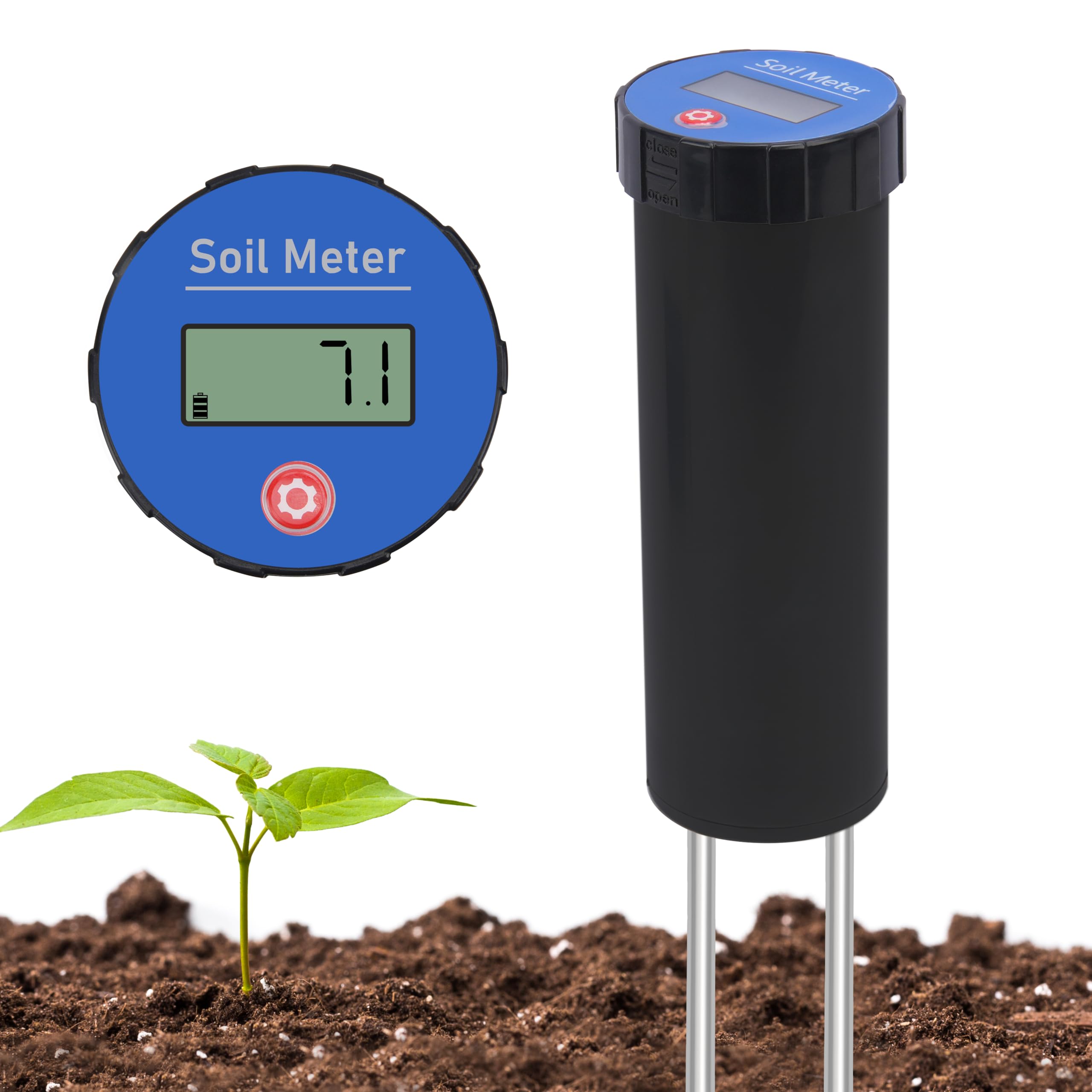
The LUVCOSY Digital Soil pH Meter arrives pre-calibrated and ready to use straight out of the box, unlike the YINMIK which demands you mix buffer solutions — saving you zero extra steps before the first reading. It uses double-needled stainless steel probes and a sophisticated internal algorithm to deliver readings without any setup fuss. Owners mention that the 3 AA batteries already included in the product could support for 5 years — so you will not worry about power for a very long time.
At 9.6 ounces and measuring 10 x 2 x 2.7 inches, it is a lighter, more compact package than the YINMIK, making it easier to carry around a garden bed or between pots. The calibration-free design means you never need to mix buffer solutions or follow complicated instructions, which is ideal if you just want a quick pH check and trust the factory calibration to hold up over years. Reviewers consistently call it easy to use and accurate for typical garden soil conditions.
Choose the LUVCOSY if you value convenience over absolute lab precision and don’t want to manage calibration buffers — it is for the home gardener who wants a quick, reliable pH check over the top pick.
Where it shines
- Calibration-free design means ready to use immediately
- Batteries included last an estimated 5 years
- Double-needled probes resist corrosion and stay sensitive
Worth noting
- Cannot be recalibrated if readings begin to drift over years
- Measures soil pH only — no moisture, light, or temperature
3. Luster Leaf Rapitest 4-Way Digital Soil Analyzer
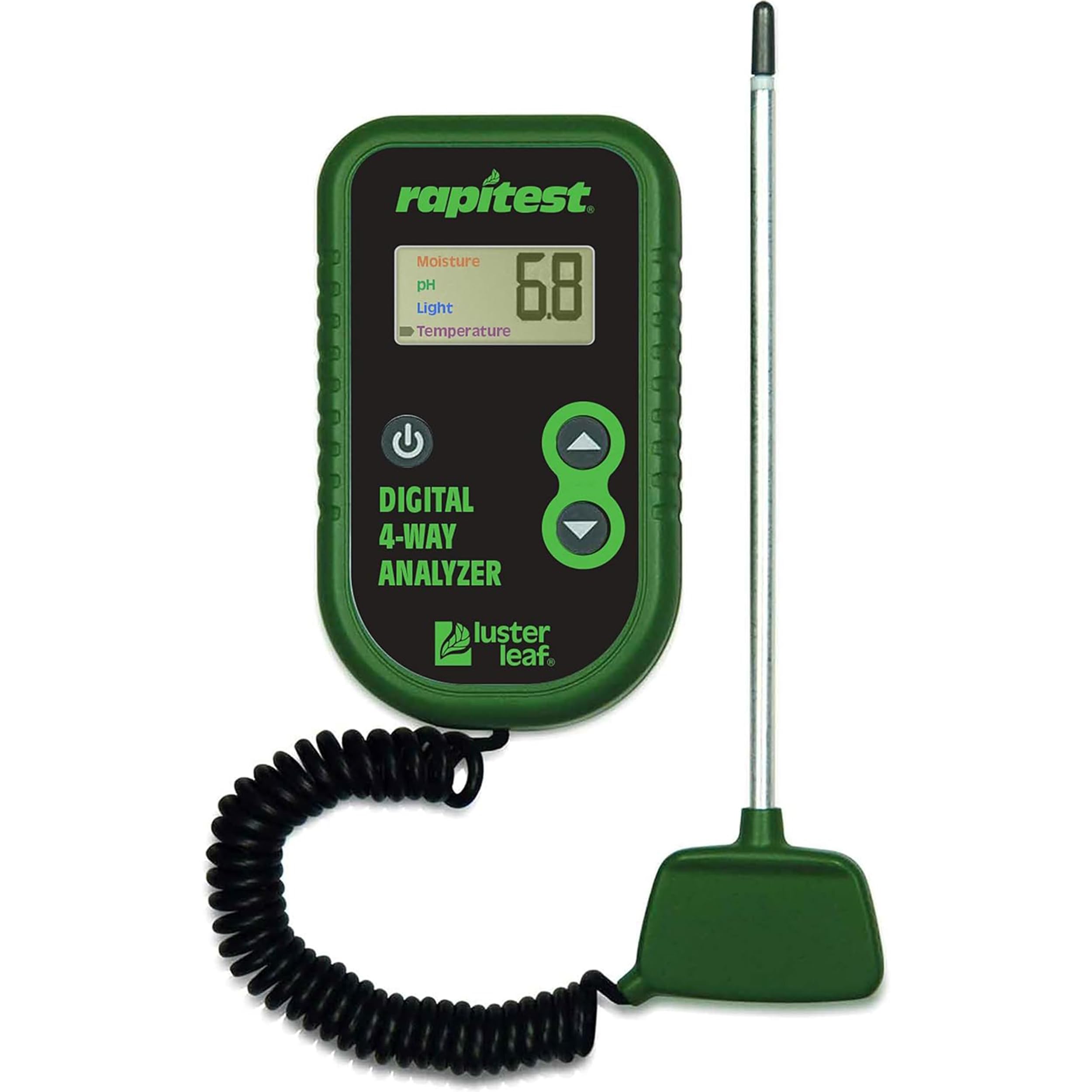
The Luster Leaf Rapitest 4-Way Digital Soil Analyzer is a solid option if you want one tool that checks pH, moisture, temperature, and light levels without juggling multiple meters — all in a single corded probe design. The attached cord lets you read the digital display while the probe is in the soil, which is handy for deep pots or garden beds where bending over to see a meter on the unit itself is annoying. It measures 12 x 7 x 2 inches, making it 20% larger than the LUVCOSY, but that size comes from a clear, readable screen and a full plant pH guide for over 450 plants included in the manual.
A key real-world catch surfaced in buyer reports: one reviewer found pH readings were inaccurate and inconsistent, causing costly mistakes in a 40-gallon soil batch. Another user reported that on day three the display dimmed significantly, and the temperature readout tops out at 99°F. While it handles simple moisture checks and light readings well, the pH accuracy appears less predictable than dedicated pH-only meters like the YINMIK or LUVCOSY.
This meter gives you a quick, multi-function snapshot of your soil’s environment — but verify its pH readings with a secondary check once in a while. It covers over 450 plants in the manual, but its temperature sensor stops at 99°F.
What stands out
- Tests pH, moisture, light, and temperature with one probe
- Corded design makes reading easy while probe is in the ground
- Includes comprehensive plant care guide for 450+ plants
The trade-offs
- pH readings have been reported as inconsistent by multiple users
- Display may dim after a few days of use; temperature limited to 99°F
4. HSLGOVE 7-in-1 Soil Test Kit
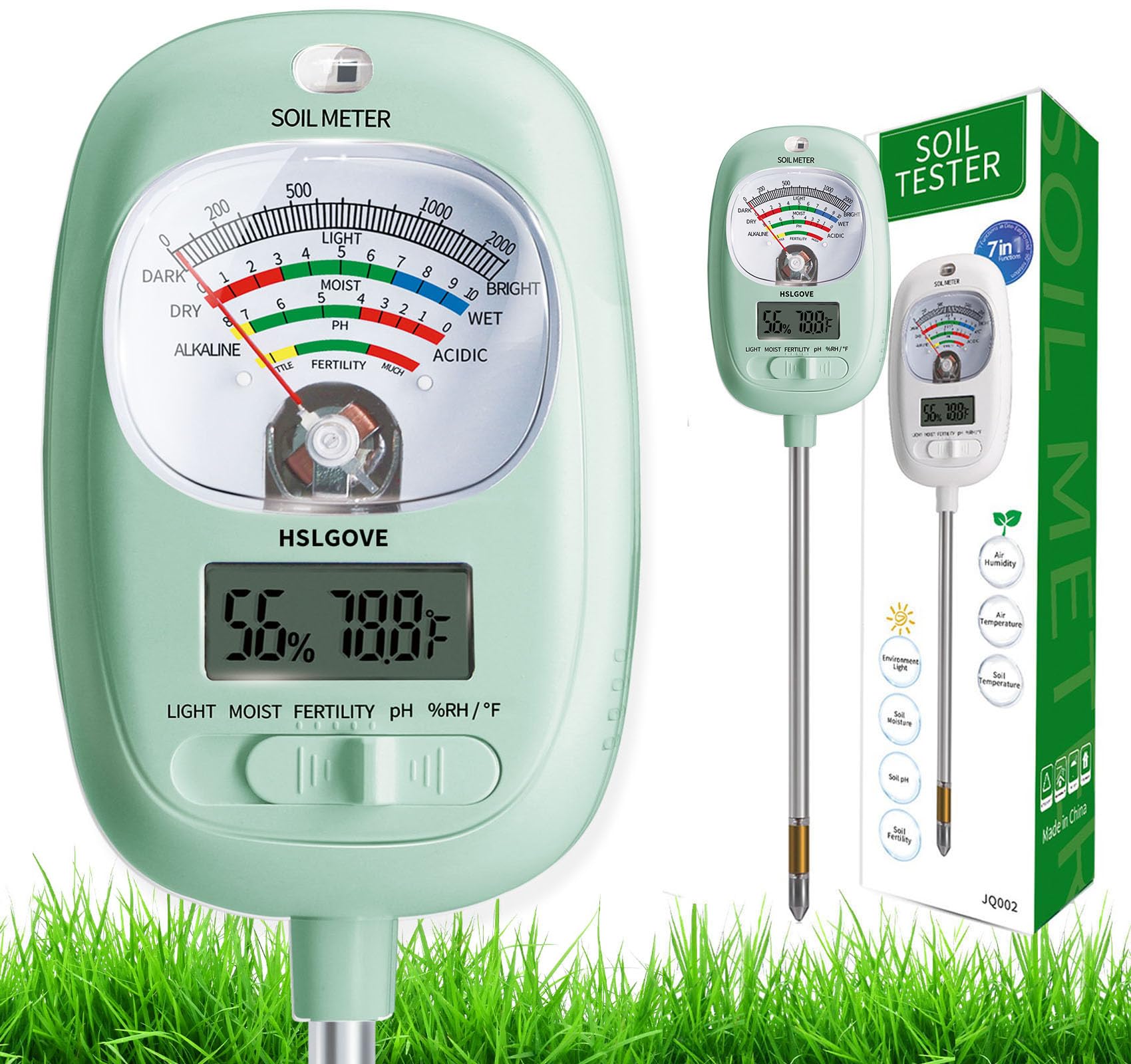
4.8 ounces — the HSLGOVE 7-in-1 Soil Test Kit is the lightest tester in the lineup, nearly three times lighter than the YINMIK (13.7 ounces), which makes it an easy grab-and-go tool for a gardener working across multiple pots and beds. It promises seven functions: soil moisture, pH, fertility, light, soil temperature, air temperature, and air humidity, all displayed on a combination of an analog dial and an LCD screen. For someone new to soil testing, this breadth of data is appealing because it covers nearly every variable plants care about.
The catch, however, is that not all of those functions perform reliably. Customers note that the light sensor is non-functional, the fertility measurement is impossible, and pH readings are inaccurate — coming out too acidic compared to known soil conditions. Moisture and temperature seem to work reasonably well, but the pH function appears to be the weakest link. The probe itself is 6.8 inches long, which is adequate for medium pots but not deep enough for raised beds or outdoor rows.
This meter offers more data streams than any other unit here, but you get what you pay for in terms of pH reliability. If you want to track moisture and temperature at a glance and are okay using a separate method to verify pH, it gives you a lot of readings for very little money — but skip it for any pH-sensitive crop.
The upsides
- Broadest range of measurements: 7 functions in one unit
- Very lightweight at 4.8 ounces — easy to carry and store
- Dual analog and LCD display gives quick visual feedback
Keep in mind
- pH readings reported as inaccurate by multiple verified buyers
- Light sensor and fertility measurement functions essentially unusable
5. Gain Express Soil pH Meter (295mm Probe)

The Gain Express Soil pH Meter is the budget-friendly choice that focuses on doing two things (pH and moisture) with a long, durable probe — the 295mm (roughly 11.6-inch) electrode reaches past surface soil to where roots actually live, giving you a reading that the shallow 6.8-inch probe on the HSLGOVE simply cannot. It is self-powered — no batteries required — which means it cannot die on you mid-season and you never have to remember to replace a cell.
The downside is that this is an analog meter, so you are reading a needle on a dial rather than a crisp number on a screen. Reviewers point out that pH readings are slow, taking minutes to stabilize, while moisture readings are much more responsive. Some users found that accurate contact is best achieved in clay or loamy soil, and that very dry or sandy soils may give less consistent results. The meter only measures pH and moisture — no temperature, light, or fertility data.
If your garden has deep soil and you value a tool that will never need a battery swap, this is the pick that reaches where others can’t. It is perfect for the budget buyer who needs a simple, no-fuss probe for vegetable gardens and field use where reach matters most.
Why we’d pick it
- 295mm electrode reaches deep into soil for root-zone readings
- No batteries required — self-powered and always ready
- Heavy-duty, waterproof metal probe is built for outdoor durability
A few caveats
- Analog needle takes several minutes to stabilize for pH
- Only measures pH and moisture — no other soil metrics
Understanding the Specs
Calibration (Buffer Solutions)
A calibration buffer is a pre-mixed liquid with a known, precise pH value — typically pH 4, 7, and 10. When you dip your meter into a buffer, you can adjust the meter to match that known value, which corrects any sensor drift. Meters that allow 2-point or 3-point calibration (matching two or three different buffer values) give you far more reliable readings over years than sealed, calibration-free units. If you grow pH-sensitive plants like blueberries, tomatoes, or hydrangeas, calibration is non-negotiable for trustworthy results.
Probe Length and Material
Probe length (measured in inches or millimeters) determines how deep you can reach into your soil. For small potted plants, a 3-to-5-inch probe works fine. For outdoor garden beds, raised rows, or deep containers, look for probes around 7 to 12 inches to reach the active root zone. The probe material matters for durability: stainless steel resists corrosion from soil moisture and fertilizer salts, while cheaper metal coatings can rust and create a poor electrical contact that skews readings. A well-built stainless steel probe should last multiple growing seasons.
FAQ
Why does my pH meter give different readings in dry vs. wet soil?
Can I use a soil pH meter to test water or liquid fertilizer?
How often should I calibrate my pH meter for reliable results?
Final Thoughts: The Verdict
Across the board, the ph tester for soil winner is the YINMIK Digital Soil pH Meter because it offers the most reliable blend of calibration control, Bluetooth data logging, and complete kit contents — ideal if you take soil pH seriously. If you want a simpler, calibration-free tool that works straight out of the box, grab the LUVCOSY Digital Soil pH Meter. And for deep-rooted beds where probe reach matters most, the standout is the long 295mm electrode on the Gain Express Soil pH Meter.