
Keeping your trees and shrubs lush without a complicated routine comes down to one thing: a fertilizer that fits how you work. Spikes let you hammer in a single dose for a whole season, while granules let you measure and scatter. The right pick saves you time, prevents over-fertilizing, and delivers deep roots and full foliage.
I’m Rikta — the co-founder and writer behind Lawn Gear Lab. This guide is built by comparing the manufacturers’ published specifications and the patterns across verified customer reviews, so you get each pick’s real strengths and trade-offs instead of marketing spin.
Here are the top six products with honest pros and cons laid out plainly.
How To Choose The Best Fertilizer For Trees And Shrubs
Picking the right fertilizer for your woody plants is simpler once you understand the nutrient numbers on the package and the physical form. Spikes are the easiest for a one-and-done approach, while granules require more hands-on work but can be more versatile.
It is all about the NPK ratio
Every fertilizer label shows three numbers, like 15-5-10. N stands for Nitrogen (which fuels leaf and stem growth), P stands for Phosphorus (which supports roots and flowers), and K stands for Potassium (which strengthens overall health and disease resistance). For trees and shrubs, a higher first number (Nitrogen) often encourages lush foliage, but a balanced mix like 5-3-3 works well for general use.
Quick Comparison
On smaller screens, swipe sideways to see the full table.
| Model | Category | Best For | Key Spec | Amazon |
|---|---|---|---|---|
| Jobe’s Tree Fertilizer Spikes, 30 Count | Best Overall | High-nitrogen, one-time feeding for trees | 16:4:4 NPK | Amazon |
| Miracle-Gro Fertilizer Spikes, 12 Pack | Premium Pick | Convenient, single-season use | 15-5-10 NPK | Amazon |
| Espoma 10-10-10 Garden Food (Pack of 2) | Best Value | Balanced feeding for a variety of plants | 1:1:1 NPK | Amazon |
| Espoma Organic Plant-Tone 5-3-3 (Pack of 2) | Top Performer | Organic gardening for all plants | 5-3-3 NPK | Amazon |
| The Old Farmer’s Almanac Tree & Shrub Spikes (24 Count) | Compact Pick | Fast-acting results for deep roots | 13-3-3 NPK | Amazon |
| Jobe’s Organics Granular All Purpose Fertilizer, 16 lbs | Budget Champion | Organic granular for vegetable gardens and shrubs | 4-4-4 NPK | Amazon |
In‑Depth Reviews
1. Jobe’s Tree Fertilizer Spikes, 30 Count

The Jobe’s Tree Fertilizer Spikes earn the top spot because they pack the highest nitrogen content on this list — a 16:4:4 NPK ratio (16 parts Nitrogen for leaf growth, 4 parts Phosphorus for roots, 4 parts Potassium for health). That high Nitrogen directly fuels lush, green foliage on your trees and shrubs. If you want fast, visible top growth without a complex schedule, this is it. You simply hammer the spikes into the ground around your tree’s drip line (the outer edge of the branches) once, and that is it for the whole season.
With 30 spikes in a single package, you get 2.5 times the quantity of the Miracle-Gro 12-pack, so you can easily handle a larger yard or multiple trees. The time-release formula continuously feeds the roots below the surface, preventing the runoff you get with granular products. Buyers report that even drought-stressed trees recover well after using these spikes, and shrubs like hydrangea, lilac, and rose of Sharon thrive and bloom on schedule year after year.
The only real effort is installation — one reviewer notes that the spikes require pounding into the ground, and pre-drilling holes with a metal rod is recommended for hard or dry soil. If you have a large yard with several trees, this is the pick for you. skip it if you have very compacted clay soil and don’t want to pre-drill.
Why it’s great
- Highest nitrogen (16:4:4) supports strong foliage growth.
- 30 spikes per box provides excellent coverage.
- Time-release format means no mixing or measuring.
Good to know
- Need to hammer or pre-drill holes for installation in dense soil.
2. Miracle-Gro Fertilizer Spikes for Trees and Shrubs, 12 Pack

The Miracle-Gro spikes are the strongest direct competitor to the Jobe’s spikes, but they take a slightly different approach. Where the Jobe’s hits hard with a 16:4:4 ratio, these sticks come in at a 15-5-10 NPK (15 Nitrogen for leaves, 5 Phosphorus for roots, 10 Potassium for disease resistance). That means more Potassium than the Jobe’s to support overall plant health. The catch is you get fewer spikes — 12 compared to 30 — so this is a better fit for smaller yards or targeted feeding.
These are perhaps the easiest-to-use product on the list; once you hammer them into the soil, the nutrients are released directly into the root zone and you do not have to think about it again for the whole season. Owners mention that these spikes “fixed yellowing leaves within weeks” and maintained color all summer in extreme Texas heat. The simplicity is the key appeal — no measuring, no mixing, no mess.
Choose the Miracle-Gro spikes if you want a trusted brand and only need to treat a small number of plants. The 12-count package is perfectly sized for a handful of shrubs or a couple of young trees — it’s the pick for small yards or specimen plants.
Where it shines
- Extremely simple to install and use once per season.
- 15-5-10 ratio provides a good blend of Nitrogen and Potassium.
- Buyers saw results fast, even in hot climates.
Worth noting
- Only 12 spikes in the box, so less coverage than some competitors.
3. Espoma 10-10-10 Garden Food, 6.75-Pound Bag (Pack of Two)
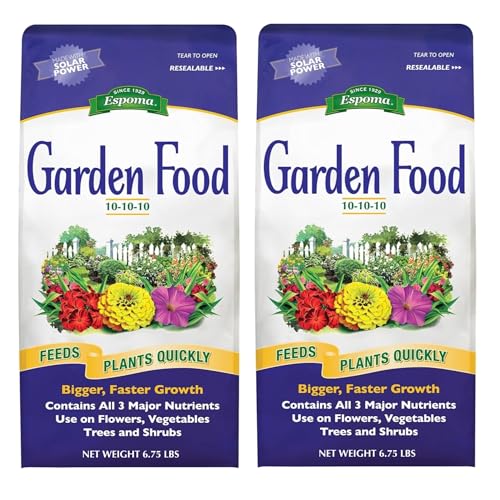
A perfectly balanced 1:1:1 NPK ratio like the Espoma 10-10-10 is your safest bet for feeding a mixed landscape because it delivers equal parts Nitrogen, Phosphorus, and Potassium — so no single nutrient dominates. This makes it ideal if your yard has flowers, vegetables, trees, and shrubs all in one space.
You do need a bit more hands-on work with a granular product than with spikes. You apply it to the soil around the drip line of your plants and then water it in thoroughly. The payoff is versatility — customers note dramatic improvements, with one reviewer noting that a 57-year-old, lightning-damaged Magnolia tree began thriving again after using this food. At 13.5 pounds total (two 6.75-pound bags), you get 69% more product by weight than the Espoma Organic Plant-Tone 5-3-3 pack, giving you excellent value.
This is tough to beat on cost-per-pound for the price-conscious gardener who wants a balanced, all-around fertilizer.
What stands out
- Perfectly balanced 1:1:1 NPK for a variety of plants.
- Very high value with 13.5 pounds total.
- Revived old and storm-damaged trees, per buyer reports.
The trade-offs
- Requires manual application and watering-in; not as hands-off as spikes.
4. Espoma Organic Plant-Tone 5-3-3 Natural & Organic All Purpose Plant Food (Pack of 2)

The single number that matters most in this category is 5-3-3, the lowest NPK ratio among these picks, which makes this the only organic-certified option here and gentle enough to avoid burning plants even with a heavy hand.
The key feature is the Bio-tone formula, a proprietary blend of soil microbes that helps break down organic materials so the plant can use them. Reviewers point out it “works quickly” and produces rapid Spring growth. The downside for that organic peace of mind is the smell — reviewers honestly note it has that distinct chicken manure odor, so stay upwind when applying. At 128 ounces (4 pounds per bag, two bags), it is a solid amount for a season’s worth of feeding.
Choose this over the Espoma 10-10-10 if organic certification is non-negotiable for you, and for the price, you get two bags of a certified organic formula that feeds gently all season.
The upsides
- Certified organic and approved for organic gardening.
- Gentle 5-3-3 formula will not burn plants.
- Contains Bio-tone microbes for better soil health.
Keep in mind
- Has a strong, manure-like smell during application.
5. The Old Farmer’s Almanac Tree & Shrub Fertilizer Spikes, 24 Count
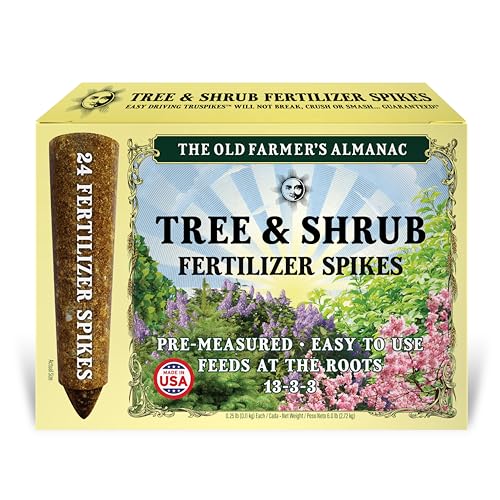
At this lower price, you get 24 spikes with a 13-3-3 NPK ratio (13 Nitrogen, 3 Phosphorus, 3 Potassium) that includes molasses as a natural additive to feed beneficial soil bacteria in the root zone. The spikes are high in Nitrogen for strong leaf and color development, making them specifically powerful for foliage-focused shrubs and trees.
These 5-inch spikes are built tough — the manufacturer says they won’t break, crush, or shatter, which is good because you hammer them into the ground without a cap. Shoppers say that in just three weeks after installing them, they saw a clear difference in the grass around their trees, and one reviewer noted a Japanese Stewartia tree produced more flowers than ever before. The spikes contain natural ingredients that release nutrition directly, feeding once per season in spring and fall.
The premium price is worth it for gardeners who want visible results faster than other spikes — but pass on it if you want the lowest cost per spike, as the Jobe’s 30-count gives better value. This is the perfect pick for the budget buyer who prioritizes fast, visible foliage results over the lowest cost per spike.
Why we’d pick it
- Contains molasses for feeding soil microbes.
- Durable spikes that don’t break when hammered in.
- Buyers saw visible results in as little as 3 weeks.
A few caveats
- Premium price point compared to other spike options.
6. Jobe’s Organics Granular All Purpose Fertilizer, 16 lbs

This Jobe’s Organics 16-pound bag is perfect for the budget-conscious organic gardener who has lots of ground to cover and wants a mild, safe formula that is virtually impossible to overdo. At just a 4-4-4 NPK, it is the mildest formula on this list, using no synthetic chemicals and carrying the OMRI (Organic Materials Review Institute) listing for organic gardening.
What you trade off for that bulk supply is lower potency — you need to apply it more often (every 2-3 weeks) compared to the high-nitrogen spikes. One creative buyer turned this into a liquid fertilizer, noting that “liquid feed (1 cup liquid to 1 gallon water) weekly/biweekly gave quick boost: squash buds opened within 48 hours.” This shows you can get fast results, but it takes a bit of extra effort. The granules are also easily measured with a spreader, making it a great option for large areas.
Just keep in mind that its one weakness is the need for frequent reapplication — you will be feeding every 2-3 weeks rather than setting and forgetting.
Strong points
- Excellent value with 16 pounds of organic formula.
- Mild 4-4-4 NPK is safe and gentle on all plants.
- OMRI listed for organic gardening.
Before you buy
- Requires reapplication every 2-3 weeks for best results.
- Lower NPK means slower visible effect than high-nitrogen spikes.
Understanding the Specs
The Three Numbers (NPK)
The most important thing to check on any fertilizer bag is the NPK ratio. N stands for Nitrogen, which fuels leaf and stem growth and gives plants that deep green color. P is Phosphorus, which supports healthy root systems and helps flowers and fruit develop. K is Potassium, which strengthens the plant’s overall immune system, helping it resist disease and stress. A higher first number (like 16-4-4) means more leaf growth, while a balanced mix (like 10-10-10) is a general-purpose option for everything.
Spikes vs Granules
You are choosing between two main types: spikes and granules. Spikes are solid sticks you hammer into the soil around the plant’s drip line (the outer edge of its branches). They release nutrients slowly over a full season, so you apply them only once or twice a year. Granules are loose pellets you scatter on the soil and then water in. They work faster and are easier to adjust for different plants, but you usually need to apply them more often, sometimes every few weeks.
FAQ
How often should I fertilize my trees and shrubs?
Will a high-nitrogen fertilizer burn my tree roots?
Final Thoughts: The Verdict
For most buyers, the fertilizer for trees and shrubs winner is the Jobe’s Tree Fertilizer Spikes, 30 Count because it combines the highest nitrogen ratio (16:4:4) with the convenience of a slow-release spike, giving you powerful results without any mixing or measuring. If you want organic peace of mind and a versatile granular option, grab the Espoma Organic Plant-Tone 5-3-3. And for the best balance of cost and simple effectiveness on a mixed landscape, the standout is the Espoma 10-10-10 Garden Food (Pack of Two).